

The World Bank gets thousands of applicants for fewer than 50 Young Professionals Program spots in a typical cohort, according to the World Bank Young Professionals Program page. That number changes how you should think about world bank jobs for fresh graduates.
This is not a lottery. It’s a sorting exercise.
Recruiters and hiring managers aren’t asking whether you’re smart. Plenty of applicants are smart. They’re asking whether your profile fits a specific institutional need, whether you can work across countries and teams, and whether your experience already points to development work rather than vague ambition. Fresh graduates who understand that early usually make better choices. They target the right entry door, build the right evidence, and stop wasting time on applications they were never going to win.
Most advice online flattens the World Bank into one employer with one hiring logic. That’s wrong. Treasury hires differently from operations. A structured flagship program evaluates differently from a direct technical role. A consultant manager looks for something different again. If you treat all of them the same, you’ll sound generic everywhere.
The strongest candidates don’t try to look impressive in general. They look obviously useful for one path.
That’s the critical element. You do not need a perfect background. You need a credible one. You need to show the Bank where you fit, why now, and what problem you can help solve sooner than other applicants with similar degrees.
Your Guide to a World Bank Career
A World Bank career attracts people for obvious reasons. The work sits close to policy, finance, infrastructure, health, climate, and state capacity. You get exposure to country problems that matter and colleagues who work at a high level. That combination pulls in graduates from top universities, strong regional schools, government fellowships, think tanks, and private sector programs.
Prestige helps. It also confuses people.
A lot of applicants assume institutional prestige means the Bank wants polished generalists with broad international interests. That profile is usually too weak. The Bank hires around function, sector, and delivery needs. Even the most developmental language in a vacancy still leads to a practical hiring question: can this person do the job with limited hand-holding?
What committees actually care about
Fresh graduates often overrate credentials and underrate relevance. A famous university helps. A strong GPA helps. Neither rescues an application that doesn’t show judgment, technical grounding, and a believable link between your background and the work.
Hiring committees usually pay attention to a few things:
Mission fit that looks real. Country research, fieldwork, public finance analysis, health systems work, climate project exposure, or financial markets experience all beat a generic statement about wanting impact.
Evidence of execution. A dissertation, internship, capstone, RA role, consulting project, or government assignment matters when it produced something concrete.
International and cross-cultural maturity. The Bank is collaborative and political. Teams notice whether you can work across institutions, not just whether you have traveled.
Writing and analytical discipline. Weak writing kills a lot of otherwise solid candidates.
The mindset that works
Treat this like a campaign, not a single application. Pick your path early. Build proof around it. Learn the language of that path. Then apply repeatedly and with precision.
Practical rule: If your CV could be sent unchanged to a consulting firm, a ministry, a think tank, and the World Bank, it’s still too generic for the World Bank.
That sounds harsh, but it’s useful. The Bank rewards clarity. Your job is to make the match easy to see.
Understanding the Four Main Entry Doors
The Bank has four main ways fresh graduates usually get in front of hiring teams: YPP, internships, direct hire roles, and short-term consultant work. They sound similar from the outside. They are not.
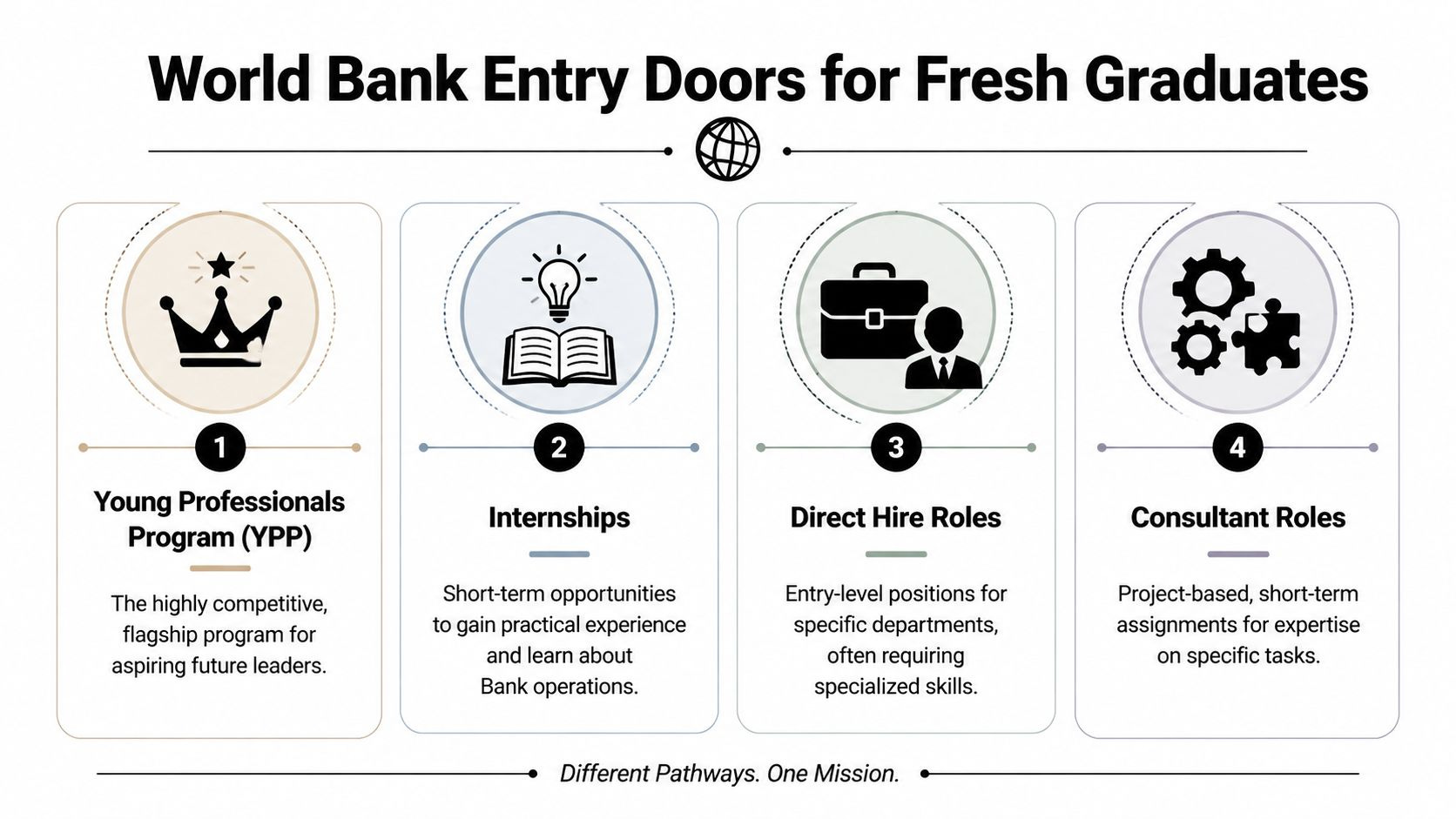
The four doors are built for different profiles
The first mistake I see is graduates chasing the most prestigious label instead of the best fit. That usually means they aim at YPP when they would have a better shot through Treasury, a specialist hire, or a consultant track that lets them build internal credibility first.
Here’s the clean comparison.
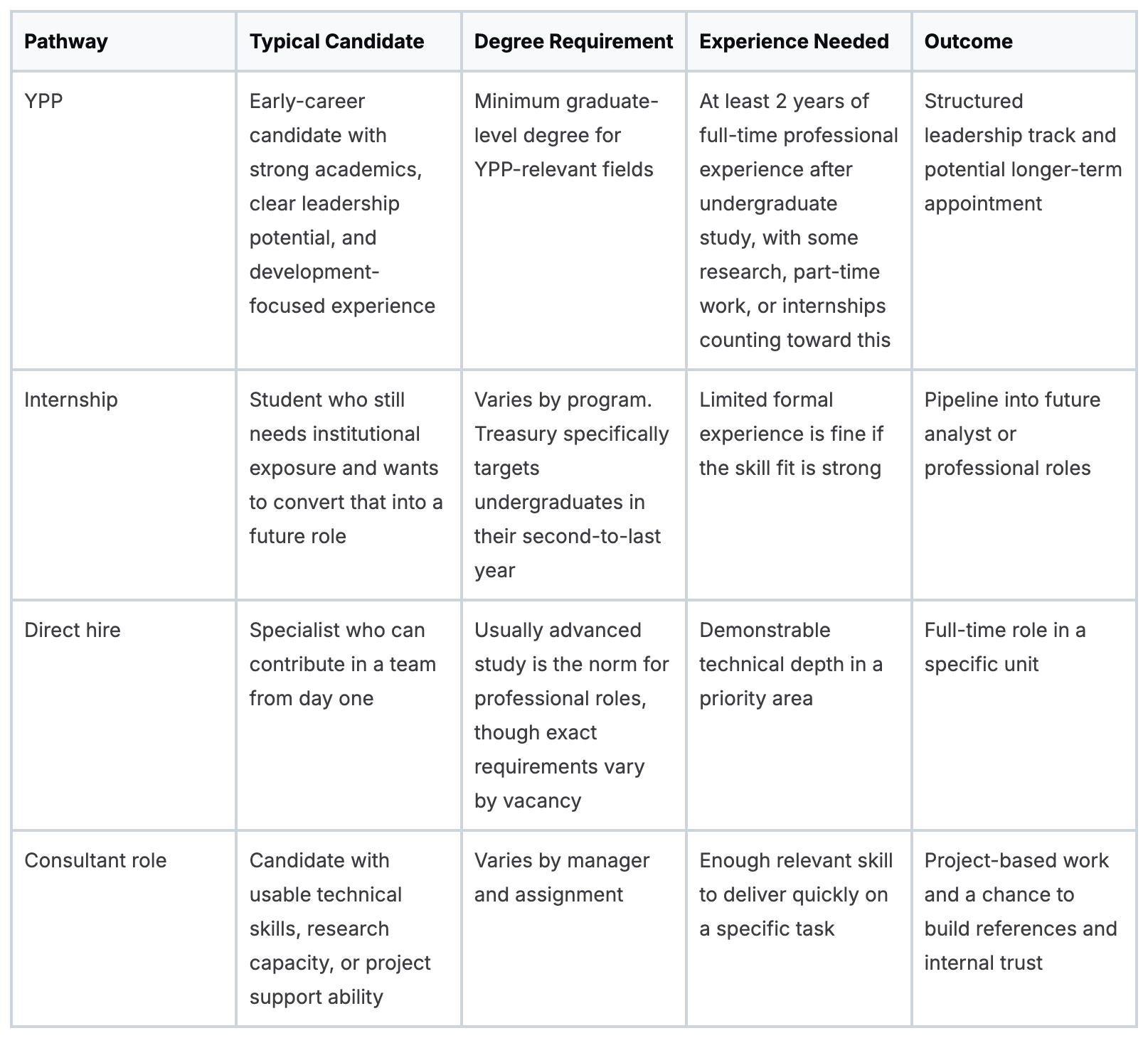
The trade-offs most graduates miss
YPP gives you structure and status. It also has the toughest filter and expects a much more mature profile than “smart recent graduate.”
Internships are the most honest route for people who still need institutional proof. The Bank can watch how you work, not just what you say about yourself.
Direct hire roles are better for specialists than for polished generalists. If you’ve built depth in climate finance, digital regulation, health financing, or a similarly relevant niche, this route can be stronger than forcing yourself into a broad leadership narrative.
Consultant work is messy but underrated. Managers use consultants to solve immediate delivery problems. If you’re good, visible, and reliable, that opens doors.
One under-discussed point matters a lot: pathways for graduates without a Master’s degree are thinner, but they do exist, especially in Treasury and some non-YPP routes, as noted in this guide to World Bank career opportunities for bachelor’s and master’s candidates. If you’re exploring adjacent structured paths, it also helps to understand the World Bank Junior Professional Associate route, because many candidates confuse these entry categories.
Which door fits you
You already have a graduate degree and development exposure. Focus on YPP or specialist direct hire roles.
You’re still an undergraduate and finance-oriented. Treasury is the sharpest target.
You have a niche skill and a portfolio of serious work. Direct hire or consultant routes can move faster.
You need credibility more than prestige right now. Any role that gets you closer to delivery beats waiting around for a perfect flagship opening.
The Premier Path The Young Professionals Program
Fewer than 50 people usually get into YPP in a cycle. That number matters because it shapes the actual selection logic. The committee is not searching for promising graduates in the abstract. It is looking for candidates who already show Bank-ready judgment, technical depth, and evidence that they can work across institutions without hand-holding.
YPP has prestige, but prestige is not the main reason to apply. The primary advantage is placement. If you get in, you enter the Bank through a structured route that gives you exposure, internal sponsors, and early operational credibility that can take years to build through ad hoc hiring.
What the formal bar screens for
The published requirements are already demanding. Applicants need a graduate degree in a field tied to the Bank’s work, citizenship from a member country, and strong English. Recent cycles have also used age-related eligibility language. For the 2026 cycle, applications opened on January 19 and closed on February 17, 2026.
Those requirements screen for baseline fit. They do not explain who gets serious consideration.
In practice, YPP is much closer to a selective mid-entry pipeline than a standard graduate scheme. If your profile reads like a bright student with excellent intentions, you will struggle. If it reads like an early professional who has already handled real policy, financing, research, or implementation problems, you have a case.
What recruiting committees actually look for
The strongest candidates usually show three things at the same time.
First, a clear technical anchor. That can be public finance, transport, health systems, education, digital development, climate adaptation, agriculture, governance, or another area the Bank hires into. Broad interest in development is not enough. Committees want to know what problem set you can work on from day one.
Second, proof that your work mattered outside the classroom. Research assistant work can help. Government advisory work can help more. An NGO role can be strong if you can show decisions, budgets, delivery constraints, or stakeholder management. The unwritten rule is simple. The Bank rates applied judgment more highly than elegant theory on its own.
Third, signs that other professionals already trust you. That trust can show up through recommendation letters, stretch assignments, field responsibility, publication ownership, or being given client-facing work earlier than expected. Titles matter less than entrusted responsibility.
One candidate with a narrow but credible profile in municipal finance often beats a candidate with top grades, model UN leadership, and a generic commitment to global development.
Why the rotation structure matters
YPP includes three 8-month rotations. On paper, that sounds like training design. In practice, it is a test of whether you can stay useful while switching contexts.
One rotation usually builds on your core function. Another forces you to work outside your comfort zone. At least one puts you closer to country operations. That setup rewards candidates who can do more than write well and interview well. It favors people who can absorb a new portfolio quickly, work with different managers, and keep their analytical quality when the politics and delivery constraints change.
Many smart applicants commonly misread the program. They pitch themselves as future thought leaders. The Bank is hiring future operators.
Common reasons strong applicants still lose
A lot of rejections are not about intelligence. They come from weak positioning.
The story is too broad. If your CV covers five sectors and three geographies with no clear thread, reviewers cannot place you.
The experience is real but not translated. “Supported policy reform” means very little unless you specify the instrument, counterpart, and result.
The recommendations are polite rather than persuasive. YPP works better when senior people can speak to your judgment under pressure, not just your work ethic.
The essays sound morally committed but operationally thin. The committee has heard every version of “I want to reduce poverty.” It pays attention when a candidate can explain why a lending instrument failed, why implementation lagged, or how incentives shaped outcomes.
For candidates still building the kind of profile YPP rewards, a more tactical route is often smarter. This guide to the World Bank internship path explains one of the better ways to get Bank-relevant experience before aiming at a flagship program.
The practical takeaway
Apply to YPP if you already have a coherent professional identity, not just strong credentials. The best applications make the reviewer’s job easy. They answer four questions fast: what you know, where you have used it, who trusted you, and why the Bank can place you across teams with confidence.
That is the standard.
Getting Your Foot in the Door Internships and Treasury Roles
The Treasury side of the World Bank runs one of the few entry routes where the signal is unusually clear. The Bank’s own student and graduate careers page for Treasury describes a summer internship that can feed into a two-year Junior Analyst track. For fresh graduates with finance or quantitative training, that is one of the cleaner paths into the institution.
Treasury is also one of the least misunderstood parts of World Bank recruiting. Hiring managers are not screening for broad development rhetoric. They are screening for whether you can handle market-facing work accurately, explain it plainly, and keep your judgment when timelines tighten.
That difference changes how you should position yourself.
Why Treasury stands out
Treasury supports the Bank’s funding and financial operations. The work sits closer to capital markets, liquidity management, banking operations, and analytics than to country policy dialogue. Candidates who treat it like a generic “international development” application usually miss the mark.
Recruiting committees in Treasury tend to reward three things.
Technical range with limits. They want someone who can work in Excel, interpret financial information, and understand instruments or market mechanics. They do not need a student who claims expertise in everything from sovereign debt to impact evaluation.
Accuracy under pressure. A memo with one clean chart and no factual errors beats a flashy deck with sloppy assumptions.
Professional maturity. Treasury teams notice whether you meet deadlines, write clearly, and ask questions that show you prepared before the meeting.
This is the unwritten rule. Treasury will forgive limited experience faster than it will forgive weak discipline.
The candidate profile that fits
The summer program is usually aimed at students who are still in school, often in the second-to-last year of a four-year degree, in finance, business, economics, or related fields. Based on past published cycles, eligibility has typically focused on students graduating within a defined window in the following academic year, so always check the current posting rather than relying on last year’s dates.
That detail matters because many applicants waste time applying late, or apply with the wrong profile entirely.
A strong candidate usually shows a clear fit with one or two Treasury functions. Capital markets. Investments. Banking operations. Asset and liability management. Quantitative analytics. If your background spans all five on paper, the application often reads as unfocused. If your coursework, internship, thesis, or student fund experience points cleanly to one lane, reviewers can place you faster.
If you want a realistic view of how internship applications are screened, read this World Bank internship guide for MDB candidates.
How interns actually convert into hires
Internships help because managers get direct evidence. They see your drafts, your response time, your error rate, and how you handle ambiguous instructions. That is much more persuasive than a polished statement about mission alignment.
Conversion usually depends less on brilliance than on trust.
Managers remember interns who reduce supervision costs. The intern who cleans data carefully, flags an inconsistency early, and sends a summary that can be forwarded with minor edits has a real advantage. The intern who needs constant prompting, or who speaks confidently without checking the numbers, creates risk. In Treasury, risk travels fast through a reputation.
What works during the internship
A strong intern tends to do four practical things well:
Learn the desk quickly. Understand the team’s products, workflow, approval points, and recurring pain points in the first two weeks.
Write for busy reviewers. Use short summaries, clear subject lines, and charts that answer one question well.
Ask narrow, informed questions. “I checked last quarter’s note and saw a different assumption on duration. Should I follow that approach here?” is much stronger than “Can you explain this whole process?”
Become reliable early. If you say you will send something by 3 p.m., send it by 2:45.
For bachelor’s candidates in particular, this route deserves serious attention. It offers something rare at the World Bank: a path where limited experience can be offset by technical precision, strong habits, and a profile that matches an actual business need.
Direct Hire and Consultant Roles for New Grads
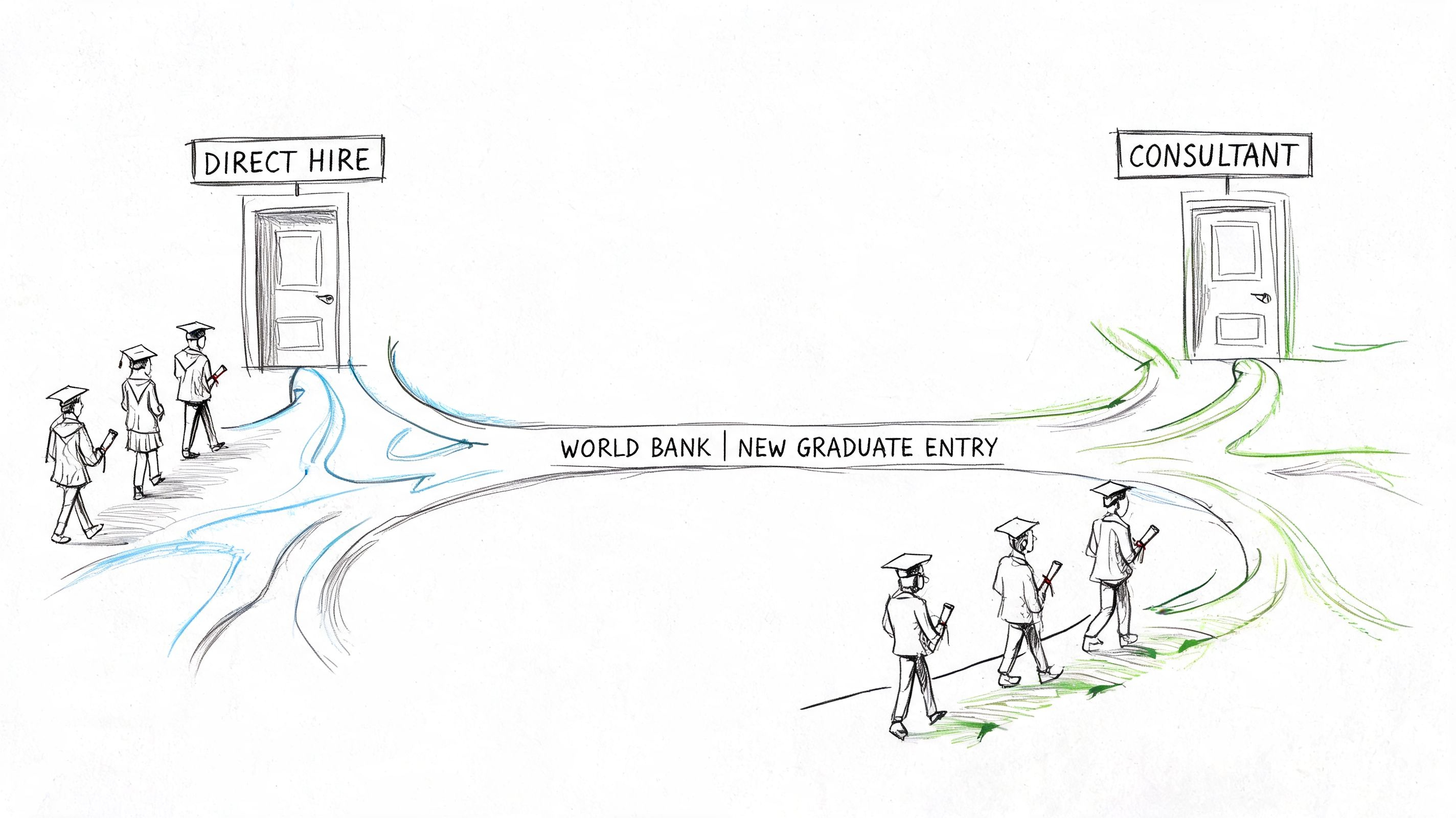
Most graduates overlook direct hire and consultant roles because they assume the World Bank only recruits entry-level talent through branded programs. That’s a mistake.
Some teams hire fresh or early-career candidates because they need a specialist, not a trainee. The standard is tougher in one sense and simpler in another. You won’t get much grace for being “promising.” You will get attention if you can solve a live problem.
Where fresh graduates can still compete
According to this guide to World Bank career paths and hiring expectations, direct professional hires at the entry level often center on Climate Finance, Digital Development, and Public Health Systems, and candidates are expected to “walk in and start solving a specific problem.”
That phrase is the key. It means your CV needs proof of technical depth, not broad interest.
A good direct hire profile might include a graduate thesis on climate risk modeling, a serious project on digital public infrastructure, or research on health financing and service delivery. A good consultant profile might include strong data cleaning, analytical writing, survey support, policy note drafting, or project coordination in exactly one relevant area.
How to position yourself
Use a three-part test before you apply.
Can you name the problem
If you can’t describe the team’s likely problem in plain English, don’t apply yet. “I’m interested in digital development” is weak. “I’ve worked on data governance and digital identity design issues in public systems” is much stronger.
Can you prove technical depth
The proof can come from coursework, research, internships, fellowships, or previous jobs. It still needs to be visible. Hiring managers should be able to spot your specialty in seconds.
Can you survive the interview
Technical interviews matter here. You may be asked to critique a reform idea, think through implementation constraints, or discuss trade-offs inside a sector. If your knowledge only lives in buzzwords, you won’t get through.
Consultant managers often hire for speed and trust. If your materials suggest they’ll need to train you from scratch, they’ll move on.
Where candidates go wrong
They apply too broadly. Ten weak specialist applications are worse than two sharp ones.
They bury the evidence. Put your most relevant sector work high on the CV.
They sound ideological instead of practical. The Bank hires people to operate in real institutions with trade-offs, delays, and imperfect data.
This route rewards focus. If you have a niche, lean into it.
Crafting Your Application CV Cover Letter and Portals
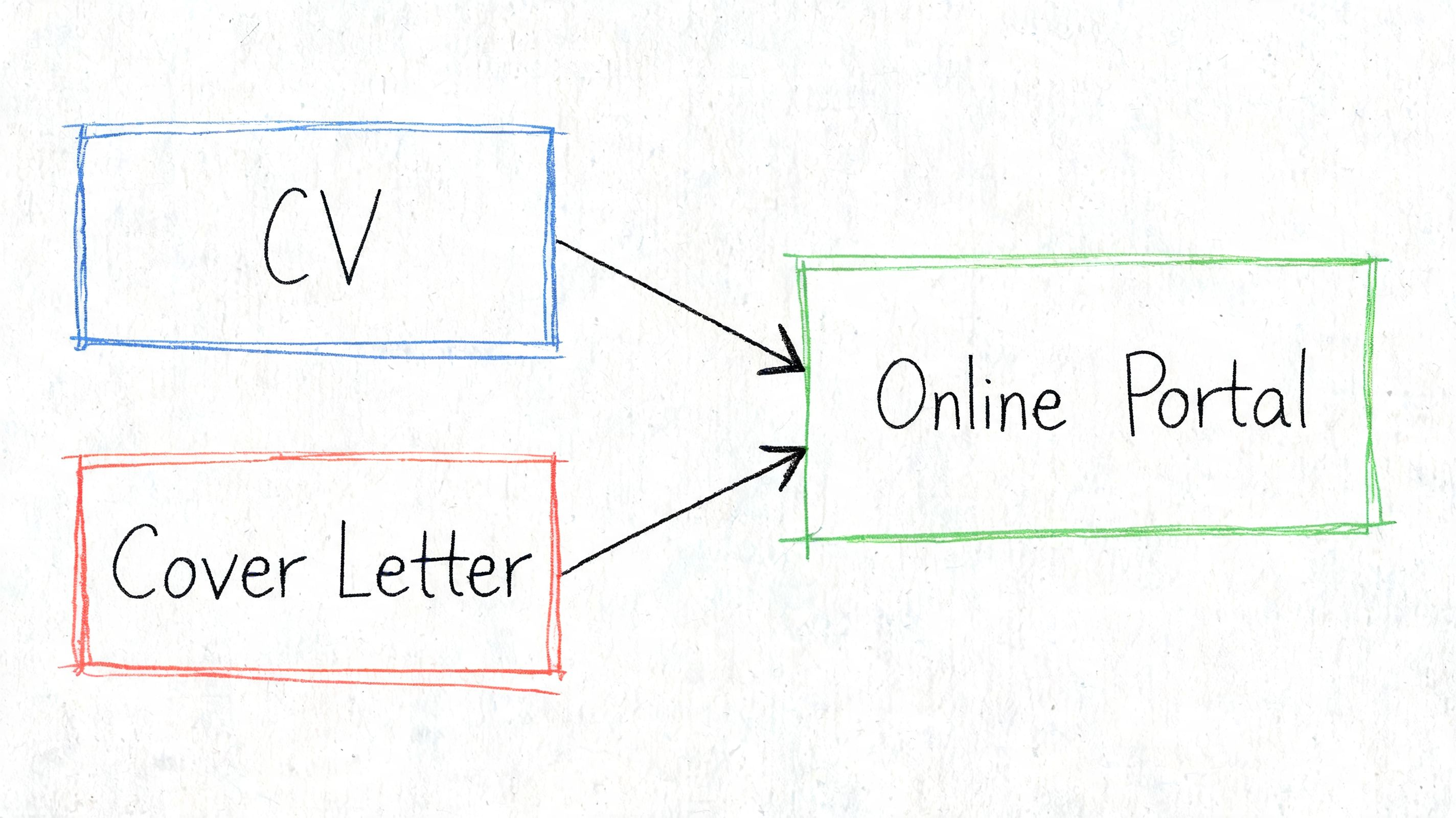
A World Bank application usually fails long before the interview. It fails because the CV is vague, the cover letter is recycled, or the portal answers don’t make the fit obvious.
That part is fixable.
Build a CV for screeners first
Most graduates write CVs for themselves. You need to write one for a busy recruiter and a hiring manager scanning for evidence.
Use the top third of the CV well. Put your education, core specialization, languages, and most relevant experience where they are immediately visible. For fresh graduates, a thesis, capstone, RA role, policy memo, or technical internship can matter more than a brand-name extracurricular buried in the middle.
A strong bullet usually does three things:
names the issue,
shows the task,
signals the output.
“Researched development topics” says almost nothing. “Built a literature review and policy brief on municipal finance constraints for a faculty-led public sector project” says much more.
Write a cover letter that narrows the match
The cover letter’s job is not to repeat your CV. Its job is to explain fit. Why this team, this function, this sector, and this point in your career.
Three paragraphs are usually enough.
Paragraph one
Name the role and state the fit directly. Skip the dramatic opening. Get to your value.
Paragraph two
Connect two or three pieces of evidence from your background to the work. Many candidates, at this point, become generic. Be concrete about the problem area.
Paragraph three
Show institutional maturity. Demonstrate that you understand the work environment, not just the mission language.
A good cover letter reduces uncertainty. The reader should finish it knowing where you would contribute and why your background makes sense for that team.
Handle the portal like part of the assessment
Application portals punish sloppiness. Match dates carefully. Keep titles consistent. Don’t leave text boxes thin if they invite substantive answers. Recruiters notice when your uploaded CV says one thing and your portal profile says another.
Before you submit, check:
Keywords match the vacancy. Not by stuffing terms, but by using the same functional language.
Experience order helps your case. Lead with relevance, not chronology alone.
Writing is clean. Typos in a multilateral application are a credibility problem.
If you get to interview stage, prepare differently than you would for a corporate screen. This guide on how to pass a competency-based interview is worth reviewing because World Bank and broader MDB interviews often test evidence, structure, and judgment more than charisma.
Your Strategic Timeline and Looking Beyond the Bank
The strongest candidates for world bank jobs for fresh graduates usually think in windows, not moments. They build toward an application cycle. They don’t wake up in January, see a role, and try to invent a profile by February.
A practical timeline starts much earlier.
A realistic sequence
Stage one is capability building. Choose the lane first. That might be public finance, health systems, climate, digital development, or Treasury-style financial work. Then build one or two serious pieces of proof around it.
Stage two is credibility building. Credibility building involves internships, RA work, field exposure, ministry projects, or specialist consulting support. You want people and experiences that can validate your work.
Stage three is application season. At this point you should not be discovering the Bank’s hiring language for the first time. Your CV, references, and writing samples should already reflect the function you’re targeting.
Why Plan B makes you stronger
A lot of talented graduates hurt themselves by treating the World Bank as the only acceptable outcome. That mindset creates bad decisions. You delay useful roles. You ignore other multilaterals. You pass on adjacent institutions that could make you much more competitive a year later.
That’s unnecessary.
The multilateral development bank ecosystem is broad. Regional development banks, the IMF, and related institutions all build skills that transfer. In many cases, they may be the smarter first move. Strong experience in one multilateral or a closely linked public institution often makes a later World Bank application more credible.
The long game
Think in terms of compounding relevance. One good role can lead to the next one. One weak year of random applications does almost nothing.
If you’re serious, pick a path, build evidence, and stay close to the problems the institution works on. That’s how candidates stop looking like hopeful graduates and start looking like future staff.
If you want a steady pipeline of openings, consultant roles, and practical MDB hiring guidance beyond this article, subscribe to Multilateral Development Bank Jobs. It’s one of the few resources focused specifically on helping candidates track and land roles across the World Bank and other major development finance institutions.