

World Bank careers are high-impact roles at the center of global development. These positions range from economists and project managers in Washington D.C. to specialists in health, education, and climate change working in over 140 country offices.
This guide breaks down what these careers look like and how you can position yourself to land one.
What a World Bank Career Really Looks Like
Before you think about applying, you need to understand what you’re signing up for.
The World Bank isn’t a monolithic financial institution. It’s a massive, global consulting firm with a single client: the developing world. Its mission is to finance and advise on projects that reduce poverty and build shared prosperity.
Your job is to contribute a piece to that puzzle. An energy specialist helps design a national power grid in sub-Saharan Africa. An education expert works on a project to improve literacy rates in South Asia. A finance professional structures the loans that make it all possible.
A Mission-Driven Global Workforce
The scale is immense. The World Bank has over 18,000 staff members from more than 180 countries. This diversity is fundamental to how the Bank operates, bringing different perspectives to complex problems.
This global footprint means your work has real-world consequences. It’s a demanding environment that requires top-tier technical expertise and a deep commitment to the mission. The problems are complex, the stakes are high, and the pace is relentless.
The core of a World Bank career is applying elite technical skill to solve the world’s most intractable development challenges. Your analytical abilities directly connect to improving lives.
Understanding the Career Structure
A common mistake is thinking everyone at the World Bank is a PhD economist. While economists are central, the institution hires a vast range of professionals. The work demands specialists in everything from public health and agriculture to procurement and IT.
The roles fall into two main buckets:
Headquarters (HQ) Based: Many roles are in Washington D.C., focusing on global policy, research, strategy, and project oversight. This is the central nervous system.
Country Office Based: These roles are on the front lines. You’re managing projects, engaging with governments, and implementing programs in the field.
This structure creates a dynamic where technical knowledge from HQ meets the on-the-ground reality of country offices. Success requires navigating both worlds effectively. Our insider’s guide to World Bank careers provides solid context on what that’s like.
To give you a clearer picture, let’s break down the main ways you can work for the World Bank. Each path is for different experience levels and career goals, from recent graduates to seasoned experts.
World Bank Career Paths at a Glance
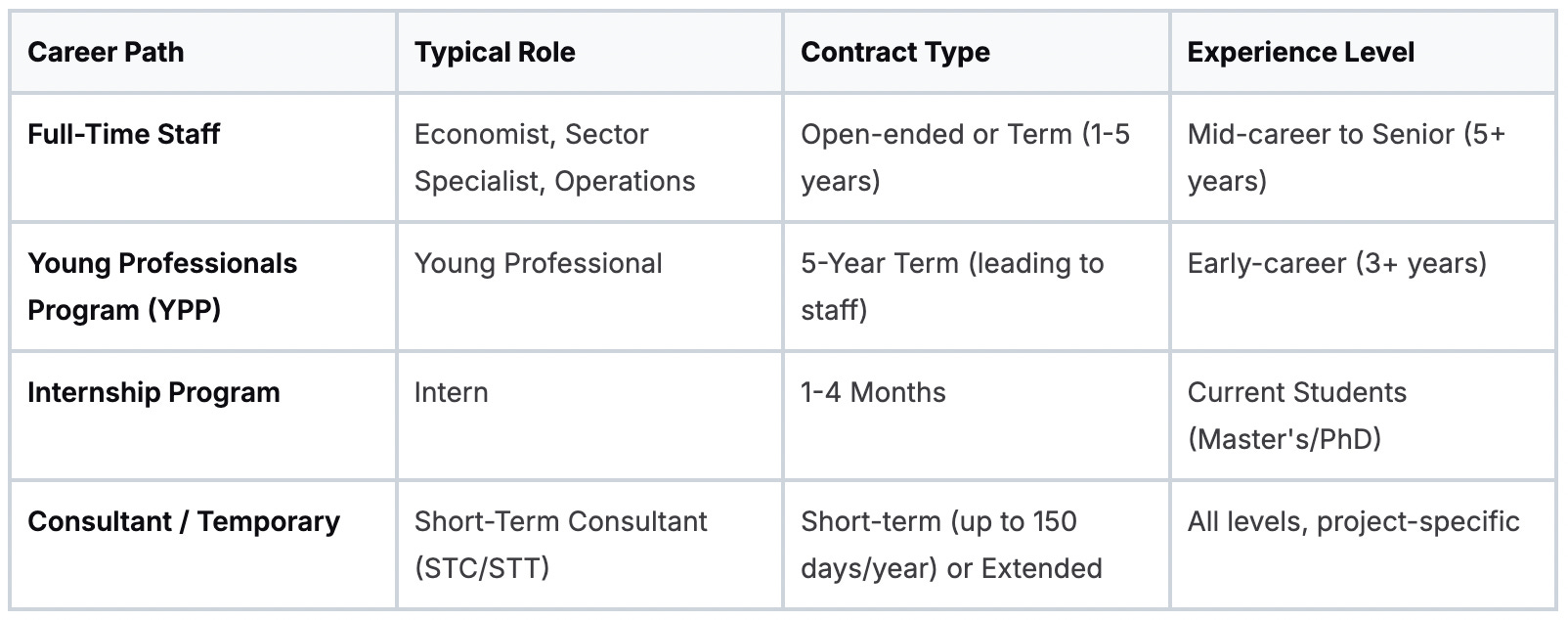
These are the main entry points, each with its own rhythm and requirements. Understanding these distinctions is the first step in crafting a successful application.
Trying to get a job at the World Bank feels like finding the right door in a massive building. It’s not one single organization but a collection of different paths for people at different career stages.
Figuring out which door is yours is the most important first step. This visual breaks down the two main career tracks: Staff and Consultant roles.
Think of it this way: Staff roles are like becoming a permanent part of the building’s architecture, a long-term commitment. Consultant positions are like bringing in a specialist architect for a specific renovation, project-based and highly specialized.
Let’s break down each of the four main pathways so you can see where you fit.
Staff Appointments: The Traditional Career Path
When people imagine a lifelong career at the World Bank, they’re talking about Staff Appointments. These are the core roles that make the institution run, from Operations Analysts on the ground to Lead Economists shaping policy.
These jobs are typically open-ended or on fixed-term contracts that last between one and five years.
To be competitive for a staff role, you generally need a Master’s degree or higher, plus at least five to eight years of relevant professional experience. Recruiters want to see a clear track record of getting things done in your field, whether that’s public health, infrastructure finance, or climate policy.
The application process is tough and incredibly competitive. Your CV and cover letter must be laser-focused, matching the job description perfectly and showing real, quantifiable results from your past work.
The Young Professionals Program: The Future Leader Pipeline
The Young Professionals Program (YPP) is the World Bank’s premier recruitment pathway. It’s an elite program designed to find and develop the Bank’s future leaders.
The name is misleading; this isn’t an entry-level job. The YPP has strict, non-negotiable criteria:
Age: You must be 32 years old or younger when you apply.
Education: A Master’s degree is the minimum, but a PhD is common.
Experience: You need at least three years of relevant, policy-level professional experience.
If you make it, you’re hired on a five-year contract and put through an intense two-year development program. This involves rotations across different departments, giving you a comprehensive view of the Bank’s work. After you successfully finish the program, you transition into a regular staff position.
The YPP is about spotting potential. The selection process heavily favors candidates with PhDs and experience that lines up directly with the Bank’s biggest strategic goals.
Internships: A Gateway for Students
For current Master’s and PhD students, the World Bank Internship Program is an excellent way to get your foot in the door and see how the institution works from the inside.
These are paid positions, usually lasting between one and four months, and they run during the summer and winter. Interns contribute to real projects and work alongside seasoned development professionals. It’s the perfect opportunity to build your network and get practical experience that will make a future application for a staff or YPP role much stronger.
The requirements are simple: you must be enrolled in a full-time graduate program (Master’s or PhD) and hold an undergraduate degree. An internship doesn’t guarantee a job offer, but many successful staff members started their careers this way. It’s a proven testing ground for talent.
Consultant Roles: Project-Based Expertise
Consultant and temporary contracts are the most flexible way to work with the World Bank. These roles are for specialists hired for specific, time-bound assignments. A contract could be for a few weeks or several months, but most short-term gigs have a contractual limit of 150 days per fiscal year.
These opportunities, often called Short-Term Consultant (STC) or Short-Term Temporary (STT) positions, are ideal for seasoned experts. If you want to lend your skills to a project without the commitment of a full-time staff role, this is the way to go. The Bank relies heavily on consultants for their deep, niche expertise in everything from digital development to environmental impact assessments.
Landing these roles requires a proactive strategy. They’re often filled through professional networks or when a specific department seeks a particular skill set. If you have deep expertise in a high-demand area, your best bet is to start connecting with Bank staff in your field and get on their radar for when the next project comes up.
Understanding Eligibility and Nationality Rules
Getting a job at the World Bank is about more than just having the right skills. The Bank has a unique set of rules, especially around nationality, that can be confusing from the outside. The Bank has a mandate to build a workforce that reflects its global membership.
At its heart, the World Bank is an institution owned and run by its member countries. This means it actively works to ensure its staff comes from the nations it serves. This is a core part of its identity and directly shapes who gets hired, particularly for certain roles.
For most regular staff positions, your nationality isn’t an explicit barrier. For specific programs and consultant gigs, it can be a deciding factor. The system is designed to prevent any single country from dominating the workforce and to ensure a rich mix of global perspectives.
The Key Nationality Rule for Consultants
If you’re aiming for a consultant role, there’s one rule you must know: the G-5 nationality restriction.
This rule is straightforward: a consultant generally cannot hold citizenship from one of the G-5 countries (France, Germany, Japan, the United Kingdom, and the United States) if the hiring manager for that specific job is also a citizen of that same country.
For instance, if the manager overseeing a project is a British national, they’re barred from hiring another British national as a consultant for that assignment. It’s a hard policy designed to promote diversity and sidestep any hint of favoritism, and it directly impacts hiring decisions every day.
Education and Experience Are Non-Negotiable
Beyond nationality rules, the baseline requirements for education and experience are rock-solid. The World Bank is built on a foundation of deep technical expertise and they don’t compromise on it.
A Master’s degree is the standard minimum for almost any professional role. For technical jobs, especially in economics or research, a PhD is often expected or will give you a major leg up. This academic rigor is essential for tackling the complex, data-driven work the Bank does.
Professional experience is just as critical. Even for early-career pipelines like the Young Professionals Program, you’ll need at least three years of solid, relevant work. For most staff jobs, you won’t be considered a competitive candidate without at least five to eight years of substantive experience in your field.
The World Bank doesn’t hire for potential alone. It hires for proven expertise. Your application has to showcase real-world achievements and deep subject matter knowledge.
How Diversity and Inclusion Shape Recruitment
The Bank’s focus on diversity goes beyond nationality quotas. Women now hold 45-50% of professional positions, a huge jump from just 35% in 2010, thanks to deliberate recruitment efforts. The Bank’s 18,000+ staff is also geographically diverse, with 39% coming from developing countries, ensuring member quotas are respected. For anyone applying from overseas, knowing French or Spanish can seriously boost your chances for postings in Africa or Latin America. You can dive deeper into these trends in recent reports on the future of jobs.
This commitment means the Bank constantly tries to balance its workforce by nationality, gender, and regional background. If you’re from an under-represented member country or have experience in fragile and conflict-affected states, you bring a perspective that is highly sought after.
To get a better handle on where you stand, check out our guide on which MDBs you are eligible to apply for. Understanding these nuances helps you figure out where you might have a strategic edge in the application process.
How the World Bank Recruitment Process Works
Navigating the World Bank’s hiring process is a marathon. It’s long, methodical, and can feel like a black box from the outside. Knowing the stages and what’s happening behind the scenes gives you a massive advantage and helps you manage your expectations.
The whole thing is designed to be incredibly rigorous. The Bank isn’t just looking for smart people; they’re looking for deep technical expertise and a specific set of behavioral competencies. Every step is a filter designed to test for those qualities. It’s a multi-stage vetting process.
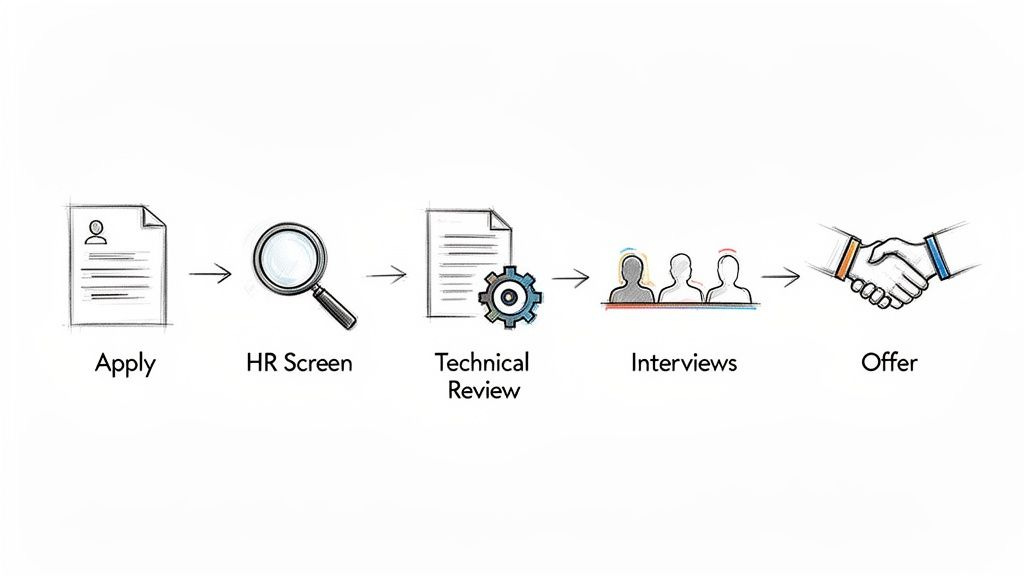
From the moment you hit “submit” to a potential offer, you could be looking at anywhere from three to six months. For senior or highly specialized roles, it can take even longer. Patience is a non-negotiable requirement.
Stage 1: The Online Application and Initial Screening
Your journey starts at the World Bank’s online job portal. This is where you’ll upload your CV, craft your cover letter, and fill out the formal application. This first hurdle is critical because it’s where automated systems and HR screeners make the first and largest cut.
Your application materials must be tailored to the job description. Use the exact keywords from the posting and make it obvious that you meet the minimum qualifications for education and experience. If you don’t, the system has an easy reason to screen you out before a human sees your file.
After the automated systems, an HR screener gives your application a quick review. They are checking for a few basic things:
Basic Eligibility: Do you meet the non-negotiables? Education, years of experience, and any required language skills.
Relevance: Does your background clearly and immediately match the role?
Completeness: Is everything filled out correctly and professionally?
This stage is about getting past the gatekeepers. Your goal is to make it easy for them to say “yes” and push your application to the next round.
Stage 2: The Hiring Manager’s Technical Review
Once you’ve cleared the initial HR screen, your application lands on the desk of the hiring manager and their team. This is the review that matters. Here, subject matter experts, your potential future boss and colleagues, dig into the substance of your experience.
They’re no longer just checking boxes. They’re assessing the quality, depth, and relevance of your technical skills.
This is where your track record of tangible achievements becomes your biggest asset. The hiring team is asking one simple question: “Has this person actually done the work we need them to do, and have they done it well?”
To get through this stage, your CV needs to be packed with quantifiable results. Don’t just list your responsibilities; show your impact. Instead of “managed infrastructure projects,” you need something like “managed a $50 million portfolio of renewable energy projects, resulting in a 15% increase in rural electricity access.”
Stage 3: The Interview Gauntlet
If the technical review goes well, you’ll be invited to the interview stage. This is almost never a single conversation. It’s usually a series of discussions designed to test you from every angle. While the format can vary, you can expect a few common types of interviews.
The Phone or Video Screen This is often a preliminary chat with someone from HR or the hiring team. It’s their chance to verify the information in your application, get a sense of your motivation, and see how you communicate. It’s a screening interview, so keep your answers sharp, concise, and professional.
The Technical Interview This is where they put your expertise under a microscope. You’ll speak with peers and senior specialists in your field who will ask detailed, probing questions about your past projects, the methodologies you’ve used, and how you would tackle specific technical challenges relevant to the role. Be prepared to go deep.
The Panel Interview This is the final and most formal stage. You’ll meet with a panel of interviewers that usually includes the hiring manager, senior staff from the department, and an HR representative. This interview is a blend of technical and behavioral questions. They’re assessing not just what you know, but how you work.
They use a structured, competency-based approach, asking questions that start with “Tell me about a time when...” to see how you’ve handled real-world situations. Your ability to provide clear, structured answers using the STAR method (Situation, Task, Action, Result) is essential. For more detailed guidance, check out our complete breakdown on how to apply for World Bank jobs.
After this final interview, the panel makes its recommendation. If you are the top candidate, the process moves on to reference checks and a formal offer.
Creating Application Materials That Get Noticed
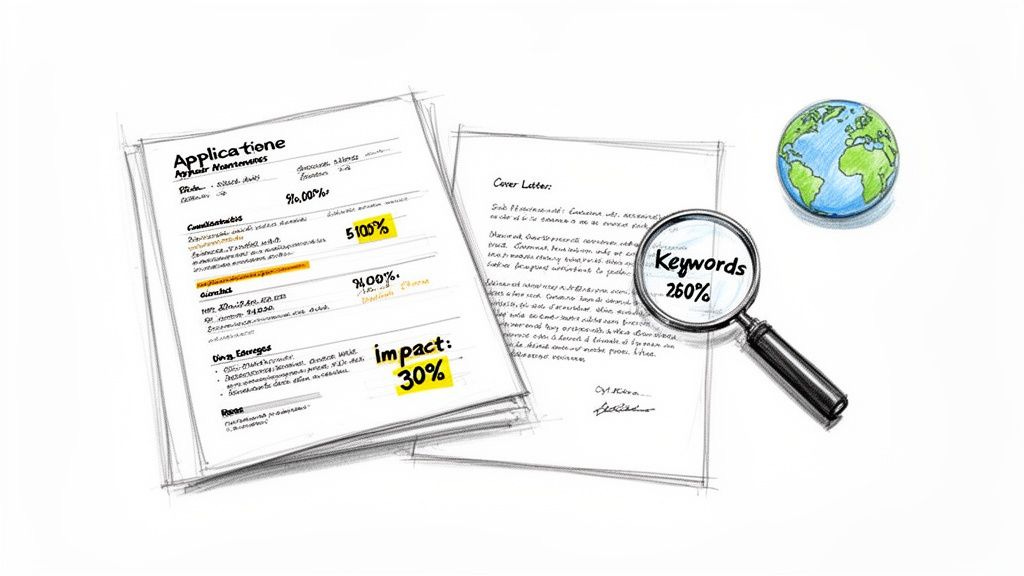
Your CV and cover letter are the only things standing between you and the hiring manager’s shortlist. At the World Bank, where thousands of highly qualified people are gunning for a single role, “good enough” is the same as rejected.
You have to be strategic. You need to frame your experience in a way that resonates with the Bank’s specific culture and its core mission. Generic advice won’t cut it; your documents need to scream “development professional.” That means moving past listing job duties and starting to showcase quantifiable impact. The Bank wants to know what changed because of your work.
Crafting a World Bank CV
Your CV is not a historical archive of every job you’ve ever had. It’s a marketing document with one goal: to prove you can solve the problems laid out in the job description. Forget flashy designs or creative layouts. At the Bank, substance and clarity are everything.
Think of your CV as a series of evidence points. Every bullet point should be a concise, powerful statement of achievement, not a passive description of a responsibility.
Here’s a practical checklist to get your CV ready:
Quantify Everything: Don’t say you “managed a budget.” Say you “managed a $2.5 million project budget, delivering it 10% under forecast.” Numbers provide concrete, undeniable proof of what you can do.
Use Development Language: Frame your accomplishments using terms the Bank values. Talk about “stakeholder engagement,” “capacity building,” “policy analysis,” and “project implementation.” Show you speak their language.
Front-Load Your Achievements: Start each bullet point with a strong action verb: “Led,” “Analyzed,” “Designed,” “Implemented.” Put your most impressive results right at the beginning of the sentence.
Align with Core Competencies: The Bank is big on competencies like client orientation and teamwork. Weave examples that prove you have these skills directly into your work experience descriptions.
Your CV must be a direct answer to the hiring manager’s unstated question: “Can this person deliver results in a complex, multicultural, and politically sensitive environment?” Every line should work to answer “yes.”
Writing a Cover Letter That Connects
While your CV presents the hard evidence, your cover letter tells the story. This is your chance to connect the dots and make a compelling case for why you want this specific job at the World Bank. A generic, copy-pasted letter is the fastest way to get your application tossed.
Your cover letter needs to accomplish three things very quickly: show you understand the role, prove you have the skills to excel in it, and demonstrate a genuine commitment to the Bank’s mission.
That mission-driven focus is more important than ever. World Bank career opportunities are deeply tied to its goal of tackling global job crises, especially with 1.2 billion young people in developing countries hitting the workforce over the next decade. The Bank has made employment a core objective in all its projects, which drives demand for professionals who can support private sector development and skills training. You can learn more about the World Bank’s focus on jobs and growth to align your story.
A Three-Paragraph Structure That Works
Don’t overcomplicate it. A powerful cover letter can be built around three focused paragraphs:
The Hook: Start by stating the exact position you’re applying for. Then, immediately link your single most significant achievement to a core requirement of the role. Show them you’re a perfect match from the very first sentence.
The Proof: Dedicate the next paragraph to sharing two or three specific examples from your career that directly map to the main duties in the job description. This is where you bring your CV’s bullet points to life with more context.
The “Why”: End by explaining your motivation. Why the World Bank? Why this specific department? Connect your personal and professional goals to the institution’s mission to end poverty. This shows you’re not just looking for another job—you’re looking for a purpose.
Your Questions Answered: The Nitty-Gritty of a World Bank Career
Even with a clear map of the application process, a few practical questions always pop up. Let’s get straight into the ones I hear most often from people seriously considering a move to the Bank.
What’s the Deal with Salaries and Benefits?
Let’s not beat around the bush: the compensation is excellent. The World Bank offers competitive, tax-free salaries for most non-US citizens, plus a benefits package that’s hard to beat. We’re talking generous health, life, and disability insurance, a solid pension plan, and allowances for things like education and relocation.
If you’re working outside your home country, you can often expect home leave travel expenses to be covered. While specific salaries depend on your grade level and experience, they’re benchmarked against top-tier employers to attract the best talent. Just as a reference point, entry-level professionals in the highly competitive YPP can expect to start at over $100,000 a year.
Do I Absolutely Need a PhD to Get In?
A PhD is a huge advantage for technical and research-heavy roles, but it’s not a hard-and-fast rule for every job. For economists and certain deep-dive specialists, it’s practically essential. In the ultra-competitive Young Professionals Program, having a PhD can be the very thing that sets you apart from a crowd of brilliant candidates.
However, for a huge number of operational roles—think project management, finance, or communications—a Master’s degree combined with serious, relevant work experience is the standard. The real trick is to stop worrying about a single credential and instead match your entire profile to what the job description is asking for.
The World Bank hires for proven expertise. While a PhD signals deep subject matter knowledge, a strong track record of delivering complex projects can be just as powerful for operational roles.
How Important Is a Second Language?
English is the working language of the Bank, so fluency is non-negotiable. That said, proficiency in another language is a massive asset and can be a deal-breaker for certain country-specific or regional roles.
Given the Bank’s global footprint, languages like French, Spanish, Arabic, and Portuguese are particularly valuable. If you’re aiming for a position in a regional office, being fluent in the local language is often crucial for actually getting things done and engaging with stakeholders. Ticking that language box on your application makes you a stronger contender for a much wider range of jobs.
Can I Just Work Remotely?
In short, probably not. The World Bank’s culture is overwhelmingly office-based, especially at its Washington D.C. headquarters and major country offices. The whole operational model is built on in-person collaboration and engagement.
While the Bank has become more flexible with hybrid models, fully remote positions are still very rare. You’ll typically only see them for certain short-term consultant gigs with very specific, self-contained tasks. For almost all staff appointments, you’ll be expected to relocate. Being on the ground in the country or at HQ is considered fundamental to the work.
Navigating the complex world of MDB hiring requires strategy and insider knowledge. At Multilateral Development Bank Jobs, we send three emails a week packed with full-time staff listings, consultant opportunities, and deep-dive guides to help you land your dream role. Subscribe and get the next curated list of opportunities sent directly to you.