

If you want to break into international development, you’ve probably heard of the World Bank’s big-name programs. But there’s another crucial entry point that often flies under the radar: the Junior Professional Associate (JPA) program.
Think of it as a strategic apprenticeship. It’s a two-year, paid consulting role designed to give recent graduates a real, hands-on job inside the Bank. This isn’t a guaranteed path to a permanent job, but it’s one of the best ways to get your foot in the door and build the experience for a long-term career in global development.
Your Entry Point Into Global Development
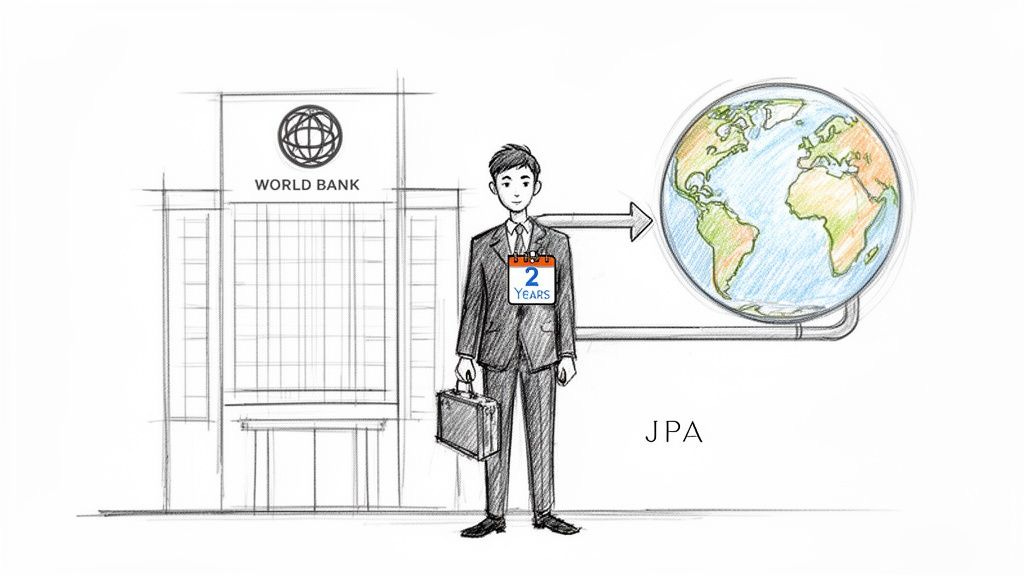
The JPA program is the World Bank’s talent pipeline for up-and-coming professionals. It’s a highly sought-after opportunity that gives you a front-row seat to the massive, complex work of ending global poverty.
Let’s be clear: this isn’t an internship where you’ll be stuck making copies. As a JPA, you’re a contributing member of a specific team, embedded in real projects from day one. One day you might be analyzing data for a new infrastructure project in Southeast Asia; the next you could be helping draft policy briefs on climate finance in Africa.
Here are the core details of the program.
JPA Program At A Glance
Here’s a high-level summary of what the JPA program entails:
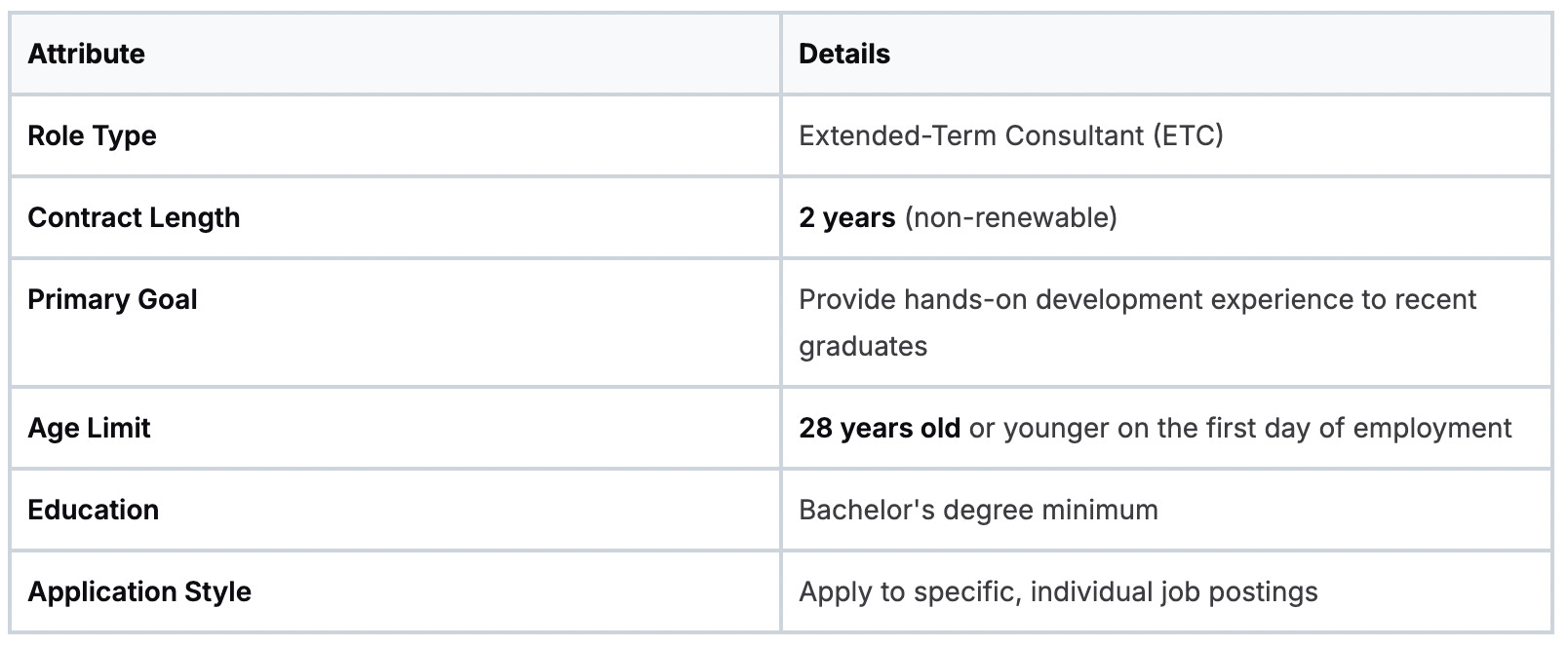
This structure gives you a solid foundation and a powerful credential on your CV, setting you up for your next move in the development sector.
The Strategic Purpose of the JPA Program
So, why does the Bank run this program? It’s simple: it’s how the organization brings in fresh talent and new perspectives. By hiring recent graduates with up-to-date technical skills, the Bank stays agile and effective.
The role is structured as a two-year extended-term consultant (ETC) contract. This fixed-term setup gives you deep, meaningful experience without the long-term commitment of a staff role. It allows both you and the Bank to make the most of those two years.
The JPA experience is your chance to test-drive a career in global development. It immerses you in the Bank’s operations, builds your professional network, and gives you the credentials for a successful career, whether at the Bank or elsewhere.
Who the Program Is Built For
This role is for recent graduates looking for their first major role in the development world. To be eligible, you must be 28 years old or younger and hold at least a bachelor’s degree, with full fluency in English. The Bank is also explicit about its commitment to diversity, welcoming applicants regardless of gender, race, religion, or disability. You can read the program’s official guidelines to learn more.
Here’s what the Bank looks for in a JPA candidate:
A strong academic record: A good GPA from a well-regarded university is the baseline.
Relevant, in-demand skills: Expertise in fields like economics, public health, data science, finance, or climate policy will make you stand out.
A genuine passion for development: You have to show you’re committed to the Bank’s mission, not just looking for a prestigious job.
A key feature of the JPA program is that you’re not applying to a generic talent pool. Roles are posted by individual teams for specific jobs. This means you can hunt for an opening that perfectly matches your skills and career ambitions right from the start.
The Ideal JPA Candidate Profile
Let’s break down who gets into the Junior Professional Associate (JPA) program. Before you spend hours on your application, make sure you clear the non-negotiable hurdles.
First, age. You must be 28 years old or younger when you start the job. This is a hard rule, no exceptions. You’ll also need at least a bachelor’s degree and full fluency in English. If you check those three boxes, you’ve made it past the first filter.
That’s just the starting line. From there, it’s all about the specific skills you bring to the table.
The Skills That Get You Noticed
Many people assume you need an economics or finance background to get into the World Bank. That’s not the case here. The Bank is a massive, specialized consulting firm that needs a whole host of technical experts to solve global problems.
Your job is to prove you have a specific, in-demand skill that a hiring manager needs on their team right now.
These are the backgrounds that consistently get a second look:
Data Science and Analytics: You know your way around large datasets, can build models, and create compelling visualizations that guide policy.
Climate and Environmental Science: Your expertise is in climate finance, renewable energy, sustainability, or biodiversity.
Public Health: You’ve got skills in health systems, epidemiology, or health economics, especially within a development context.
Infrastructure and Engineering: You understand the nuts and bolts of transport, energy, digital development, or urban planning.
Finance and Private Sector Development: You have a solid background in financial analysis, investment, or creating business-friendly environments.
The Bank doesn’t hire “development professionals” for the JPA program. It hires data scientists, transport analysts, and public health specialists who can apply their craft to development challenges.
Your application is a direct pitch to a specific team. They are looking for a skilled practitioner who can contribute from day one, not a generalist with a passion for helping people.
The official JPA flyer below drives this home, showing just how broad the Bank casts its net for talent.
This visual makes it clear: expertise in areas like Agriculture, Education, and Social Protection is just as valuable as a traditional economics degree. Your unique technical niche could be exactly what a team is desperate to find for its next project.
How Your Nationality Can Play A Role
Finally, let’s talk about nationality. The World Bank is a true international organization and hires qualified candidates from all its member countries.
However, some JPA roles are different. These positions are funded by specific donor countries through special trust funds and are often restricted to nationals of that particular country.
For instance, if a government funds a JPA spot focused on digital innovation, that role might only be open to its own citizens. These restrictions are always clearly marked in the job posting, so you’ll know upfront. The vast majority of JPA roles are open to citizens of all World Bank member countries.
Navigating The JPA Application Process
Let’s talk about how you actually land a Junior Professional Associate role. The first thing to get straight is that this isn’t like applying for a graduate scheme where you throw your hat into a massive talent pool.
You’re targeting specific, individual job postings that pop up randomly throughout the year. This means you need to be proactive and constantly on the lookout.
Each JPA opening is posted by a specific team with a very specific problem to solve. Your job is to prove you’re the solution to that problem.
Finding And Targeting The Right Opening
Because JPA jobs are posted on an ad-hoc basis, there’s no “application season.” A team in the climate finance unit might post a role in May, and another team working on public health might post one in September. You can’t predict it.
The key is to be ready to pounce when an opening that fits your profile appears.
Your best bet is to set up saved searches and email alerts on the World Bank’s careers portal. Filter for “Junior Professional Associate” and any keywords related to your field. This is the only way to make sure you don’t miss an opportunity.
Preparing Your Application Materials
Once you’ve found the perfect role, you must tailor your CV and cover letter with surgical precision. I’m not kidding. Generic, one-size-fits-all applications go straight into the virtual trash can.
Your application needs to do three things well:
Prove you have the exact technical skills listed in the job description.
Show you’ve done your homework and understand what that specific team (or “Global Practice”) does.
Make a compelling case for why you are a better choice than the dozens of other qualified people applying.
The most powerful way to do this is to quantify everything. “Assisted with data analysis” means nothing. Instead, say you “analyzed a dataset of 10,000+ survey responses to identify key trends in rural education.” Numbers cut through the noise and show real impact.
Think of your application as a sales pitch. The product is your unique skill set, and the customer is a busy hiring manager with a specific headache. Make it incredibly easy for them to see you’re the solution they need.
This whole thing boils down to a straightforward, three-stage process.
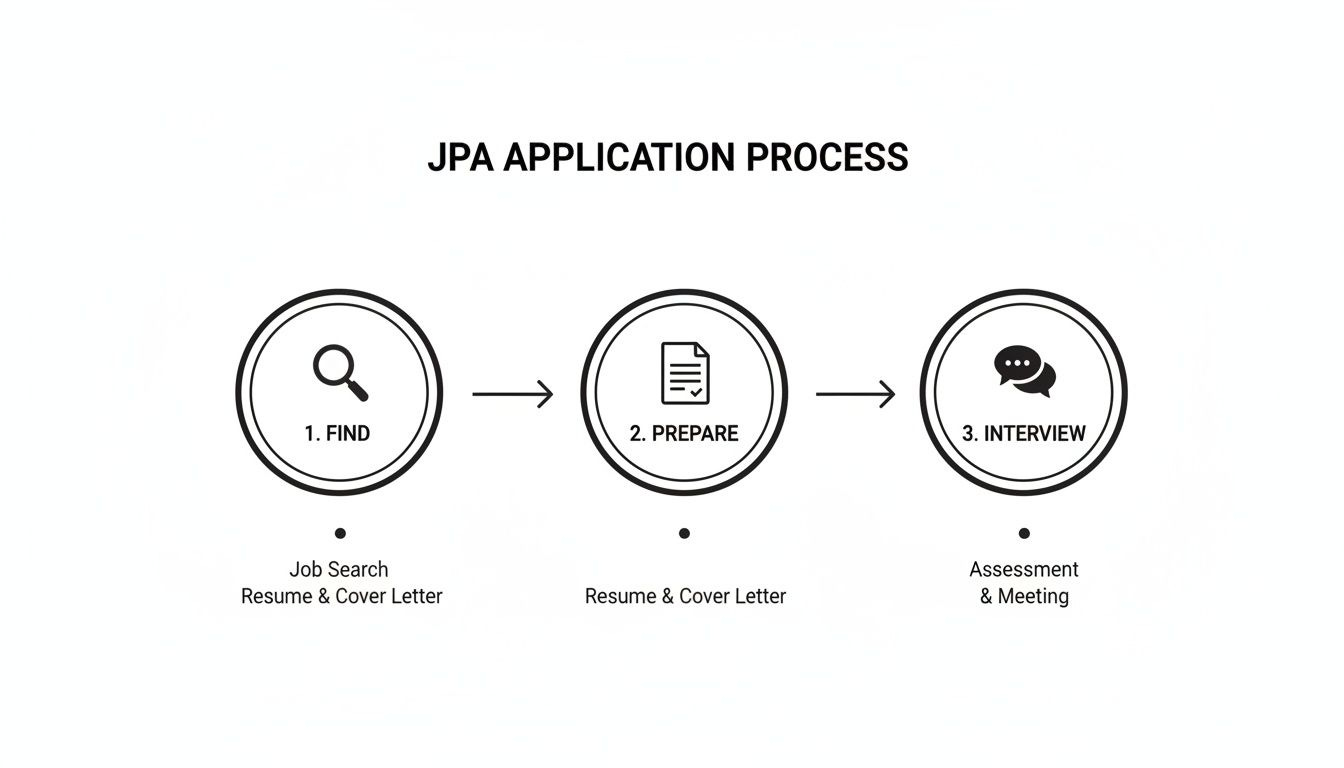
As the visual shows, it’s a focused journey from finding the right opening to proving you’re the right person in the interview. Preparation holds it all together.
Understanding The Screening And Interview Stages
After you hit submit, your application enters the machine. An automated system (ATS) will likely do the first pass, scanning for keywords and checking if you meet the basic eligibility boxes. Only after that does a human, a recruiter or the hiring manager, look at the shortlisted applications.
If you make the cut, you’ll probably go through a multi-stage interview process. The entire journey, from application to offer, can take several months. Patience is a virtue here.
Here’s a rough sequence of what to expect:
Initial Screening Call: This is usually a quick chat with HR. They’re just verifying your interest, checking basic qualifications, and making sure you’re a real person.
Technical Interview: This is the big one. You’ll speak with people from the actual team, and they will grill you with deep, technical questions about the work. They might give you a case study or a small data task to see how you think on your feet.
Panel Interview: If you get this far, you’ll likely meet with the hiring manager and other senior staff. This final round assesses your fit with the team culture, your high-level understanding of the Bank’s mission, and your problem-solving approach.
For a more detailed look at the nuts and bolts of applying to the Bank in general, check out our guide on how to apply for World Bank jobs.
To get through these interviews, you need to know your CV cold and have a sharp, compelling story about why you want this specific World Bank Junior Professional Associate role.
Crafting A Standout JPA Application
Your application is your one chance to make a first impression. For the World Bank Junior Professional Associate role, you’re competing with some of the most driven, intelligent young professionals from every corner of the globe.
A generic CV and cover letter will be deleted in seconds. To have any chance, you need to think like the hiring manager. They have a problem to solve, and your job is to make it blindingly obvious that you are the solution.
Turning Your CV Into A Results Document
Let’s get one thing straight: your CV is not a boring list of job responsibilities. It’s a sales document that screams competence and proves you get things done. A recruiter spends just a few seconds glancing at each CV, so yours has to make an impact immediately.
The biggest mistake people make is listing their duties. “Assisted with research” or “contributed to a report” is weak and vague. Reframe every bullet point to showcase a quantifiable achievement.
Here’s how to transform your experience from a list of tasks into a catalog of results:
Quantify Everything: Don’t just say what you did. Tell them how much, how many, or what the result was. Instead of “Analyzed survey data,” write something like, “Analyzed a dataset of 5,000+ responses to identify a 15% increase in community engagement.“ See the difference?
Frame Academic Work as Professional Experience: Don’t have a ton of formal work experience? No problem. Use your academic projects. That capstone project on renewable energy policy in Ghana is real, relevant experience for a climate team. Describe it using the same professional, results-oriented language.
Mirror the Job Description: This is critical. Go through the JPA job posting line by line. Pull out every keyword, skill, and technical term. Make sure those exact words appear in your CV. This is how you beat the automated screening software and show the hiring manager that you speak their language.
Your CV is the evidence. Your cover letter is the argument you build with that evidence. And the evidence needs to be rock-solid.
Writing A Cover Letter That Tells A Story
This is where you bring your application to life. The CV is the “what,” and the cover letter is the “why.” It’s your chance to connect the dots and explain why your skills matter specifically to the World Bank.
A great cover letter must convince the reader of three things: why the World Bank, why this specific team, and why you are the absolute best person for this job. It’s a story about the intersection of your passion, your skills, and the Bank’s mission.
Let’s break down how you build that story.
A Strong Opening Hook: Start with a powerful opening that immediately links your unique background to the role. Do not waste precious space with, “I am writing to apply for...” They know that. Jump straight into what makes you a compelling candidate.
Demonstrate Your Alignment: Show them you’ve done your homework. Mention a specific project the team has worked on or a recent report they published. Then, connect your own skills and experience directly to that work. This proves your interest is genuine.
Connect Skills to the Mission: The World Bank is a mission-driven organization. Show that you get it. End your letter by linking your technical abilities to the Bank’s overarching goals of ending extreme poverty and boosting shared prosperity. Show them you understand the big picture.
Crafting a powerful cover letter or statement of interest is a skill in itself. To really nail this, you should check out our deep-dive guide on how to write a compelling statement of interest for these kinds of roles.
Ultimately, your application materials have to work together. Your CV provides the hard data, and your cover letter tells the persuasive story that makes a hiring manager decide you’re the one they need to talk to.
JPA Versus YPP: Understanding The Key Differences
Let’s clear up one of the most common points of confusion: the difference between the World Bank Junior Professional Associate (JPA) program and the Young Professionals Program (YPP). They are completely different animals, built for professionals at different points in their careers.
Applying to the wrong program is a classic rookie mistake and a guaranteed way to waste your time. Getting this distinction right is the first step before you even think about tailoring your CV.
The simplest way to think about it: the JPA is a two-year, entry-level apprenticeship. The YPP is a highly competitive, five-year leadership development program for mid-career professionals gunning for a permanent staff role.
The Big Divide: Career Stage and Experience
The most glaring difference is the level of professional experience you need. The JPA is specifically for recent graduates. It’s an entry point for people with a strong academic record but not a ton of full-time work. For the JPA, your internships, volunteer work, and tough academic projects are your currency.
The YPP is a whole different ballgame. It’s for people who are already established in their fields. The World Bank Group’s Young Professionals Program (YPP) demands candidates have several years of relevant, full-time experience, putting it firmly in the mid-career category.
This difference in experience requirements changes everything, from how you apply to the work you’ll be doing.
Contract Type and Career Path
What your contract looks like and what happens after are also worlds apart.
As a JPA, you’re hired on a two-year Extended Term Consultant (ETC) contract. This is a fixed-term gig. There is no automatic renewal or conversion to a permanent job. The program is a career launchpad, a powerful accelerator for whatever you do next, whether that’s another role inside the Bank, a jump to the private sector, or heading off to grad school.
The YPP is structured as a direct pipeline to a leadership career within the World Bank Group. YPPs get a five-year, full-time staff contract designed to lead straight into a permanent position once you successfully complete the program.
The JPA program is your “foot in the door” opportunity. The YPP is the “fast track to leadership” for those who already have a foot planted firmly in their professional careers.
To make this absolutely crystal clear, let’s put the two programs side-by-side.
JPA vs YPP Key Program Differences
This table breaks down the core distinctions you must understand before starting an application.
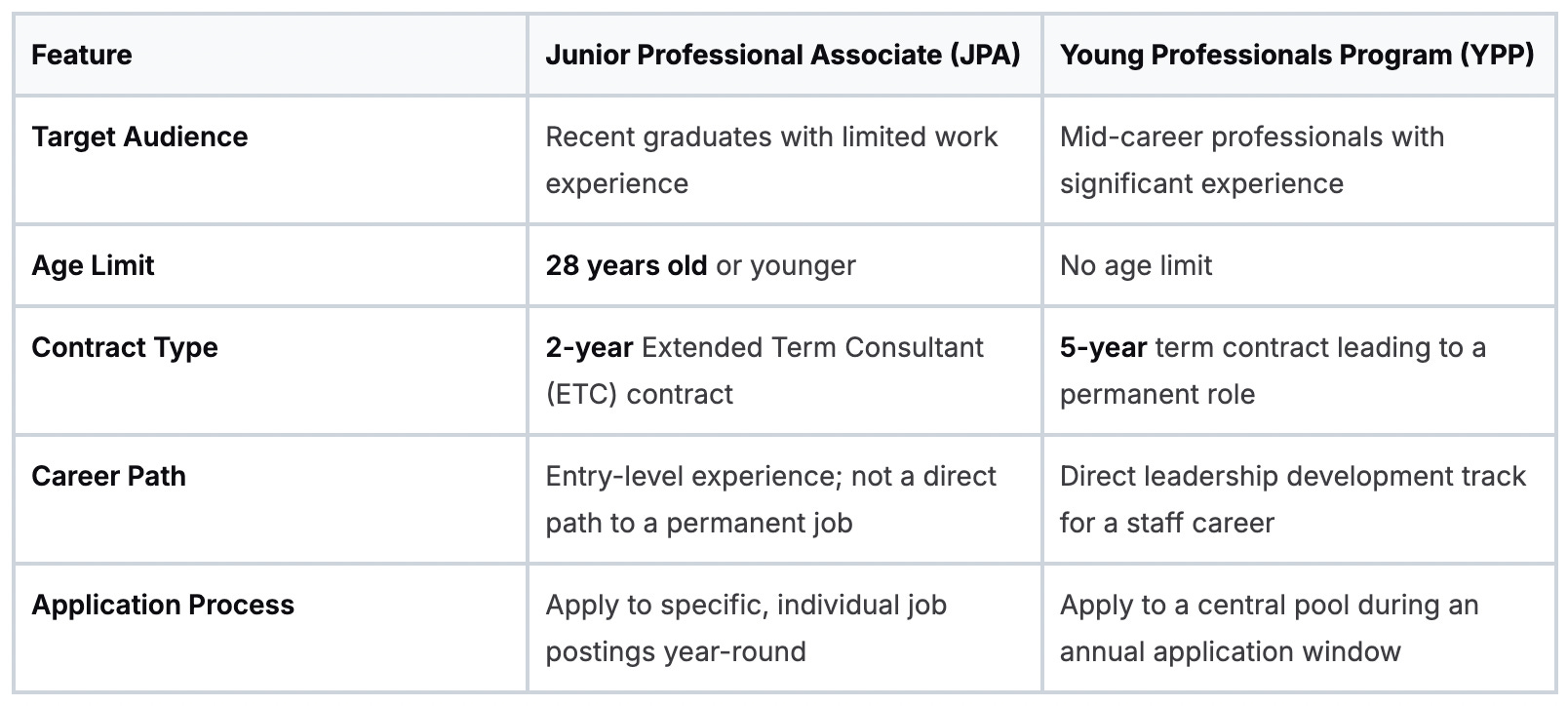
Choosing the right program isn’t about which one is “better.” It’s about which one is built for you at this exact moment in your career. If you’re a recent grad looking to break in, the World Bank Junior Professional Associate program is your target. If you’ve got several years of solid, relevant work behind you, then the YPP is the path to explore.
Life As A JPA And Your Next Career Move
So, you’ve landed the JPA role. What does day-to-day life actually look like inside the World Bank? Go in with a clear picture. This isn’t an internship; your two-year contract is an intense, hands-on experience where you’re expected to be a meaningful contributor from day one.
You are an analyst, a researcher, and a core member of an operational team. The work is substantive, and you’ll often handle tasks that are critical to your team’s projects.
What You Will Actually Do
The specific work you do depends entirely on which team hires you. A JPA in the Transport Global Practice will have a completely different daily routine than someone in the Education unit.
That said, some core responsibilities are common across the board.
Data Analysis and Research: Get ready to spend a lot of time with data. This could mean running statistical analysis on household surveys, building financial models for infrastructure projects, or conducting deep-dive literature reviews on a policy question.
Operational Support: Many JPAs get thrown right into project management. This can mean helping draft project appraisal documents, tracking a project’s implementation progress, or preparing mission briefs for senior staff.
Drafting and Writing: At the Bank, clear communication is everything. You’ll be expected to draft concept notes, write sections of larger reports, and whip up talking points or presentations for your managers.
To give you a real-world feel, Salvatore Consolo, a Transport Analyst JPA, works on safe and sustainable transport programs in the Western Balkans. Meanwhile, another JPA, Mahlubi Ntsetselelo Dlamini, worked on an early literacy initiative in Eswatini, helping analyze the impact of getting books into the hands of young children. This shows the incredible range of work you could be part of.
The JPA experience is your shot at doing real, impactful work. You will be challenged, learn at an incredible pace, and see firsthand how development projects move from an idea to a reality on the ground.
The role itself is a two-year Extended Term Consultant (ETC) contract. It comes with a competitive salary and benefits. Based on Glassdoor data, the average salary for a JPA is between CA$60,000 and CA$80,000 per year. These positions are based either at the World Bank’s headquarters in Washington, D.C., or in one of its many Country Offices around the globe.
As the official program documentation notes, it’s a valuable stepping stone for a variety of future careers. You can read more in the World Bank’s JPA overview.
The Two-Year Launchpad
The JPA contract is intentionally non-renewable. This is by design. The program isn’t a direct, automatic pipeline to a permanent job at the World Bank.
Think of it as a powerful career accelerator. Your two years are about building the ultimate foundation for whatever comes next.
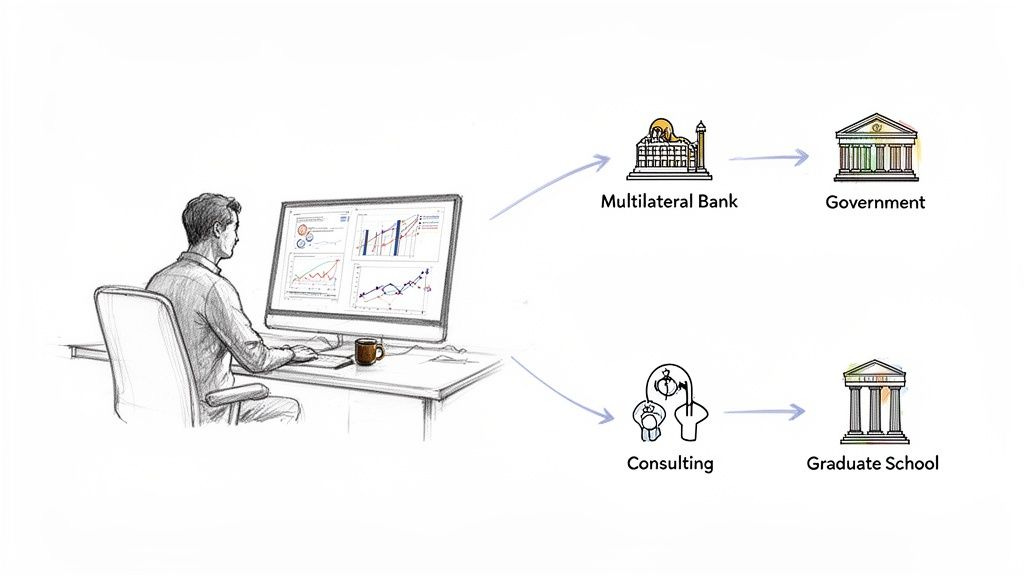
After completing the program, former JPAs fan out into impressive roles across the globe. Your experience and the network you build will open doors that would otherwise be firmly shut for a recent graduate.
The most common career paths include:
Other Roles at the World Bank: While there’s no automatic conversion, many JPAs successfully compete for other consultant or staff positions within the Bank after their contract ends.
Other Multilateral Development Banks: The skills you gain are directly transferable to organizations like the IMF, the Asian Development Bank, or the African Development Bank.
Government and Public Sector: Many former JPAs take their expertise back to their home countries to work in finance ministries, foreign affairs, or other key public service roles.
Private Sector Consulting: Top-tier consulting firms highly value the analytical rigor and international experience that former JPAs bring to the table.
Top-Tier Graduate Programs: A successful JPA stint is a massive boost for applications to leading Master’s or PhD programs in public policy, economics, or international relations.
Your two-year investment as a World Bank Junior Professional Associate pays dividends for the rest of your career. To explore the landscape of MDB roles further, check out our comprehensive World Bank Career Guide for 2025.
Frequently Asked Questions About The JPA Program
I get a lot of questions about the World Bank Junior Professional Associate program. Let’s cut through the noise and get straight to the practical, real-world concerns you need to understand before you sink time into an application.
Can I Apply If I Am Over 28 Years Old?
No. This is a hard rule with zero exceptions. You must be 28 years old or younger on the day your employment officially begins.
The Bank is strict about this because the JPA program is specifically an entry point for recent graduates. If you’re over 28, your time is better spent focusing on other roles that fit your experience level. Look at standard professional vacancies or, if you qualify, the more senior Young Professionals Program (YPP).
Does The JPA Program Lead To A Permanent Job?
It does not guarantee a permanent position, and you shouldn’t expect one. The JPA role is a two-year extended-term consultancy contract, and it’s explicitly non-renewable.
However, the experience and network you’ll build are incredibly valuable. Many former JPAs successfully compete for other consultant or staff roles within the Bank after their contract ends. Think of the JPA program as a career accelerator, not a direct pipeline to a permanent staff job.
What Kind Of Salary And Benefits Can I Expect?
As a JPA, you’ll receive a competitive salary and a standard benefits package for entry-level consultants at the World Bank. The exact salary figure depends on the duty station and its cost of living, but it’s competitive for a recent graduate entering international development.
The contract also comes with health insurance and other benefits typically offered to Extended Term Consultants (ETCs). It’s a professional package that reflects the substantive work you’ll be doing.
Do I Apply To A General Pool Or A Specific Job?
This is a critical point that trips up many applicants: you apply directly to a specific JPA vacancy, never to a general talent pool.
Each opening is posted by an individual team with a clearly defined need, whether in Washington, D.C., or a country office. This means you must tailor every single application to the unique requirements and duties listed in that job description. A one-size-fits-all approach will not work for the World Bank Junior Professional Associate program.
At Multilateral Development Bank Jobs, we track these roles and break down what it takes to land them. Subscribe to our newsletter for weekly job listings and the insider guides you need to build a career in global development. Learn more and sign up at
https://mdbjobs.com.