

The World Bank Internship Program is the main entry point for graduate students aiming for real, hands-on experience inside a top development institution. It’s designed to bring fresh thinking into the Bank while giving the next generation of development professionals a clear view of the work.
Your Entry Point to Global Development

This internship is your first big break. It’s a structured opportunity for Master’s and PhD students to get a real role on projects that directly impact developing countries. You’ll be deep in research, data analysis, and the operational work of development.
This is the main pipeline for aspiring interns. The Bank also runs specialized tracks, like the Treasury Summer Internship, which is a ten-week dive into the Bank’s financial operations.
Understanding the Program’s Structure
Here’s a simple breakdown of the program’s key attributes.
World Bank Internship At a Glance
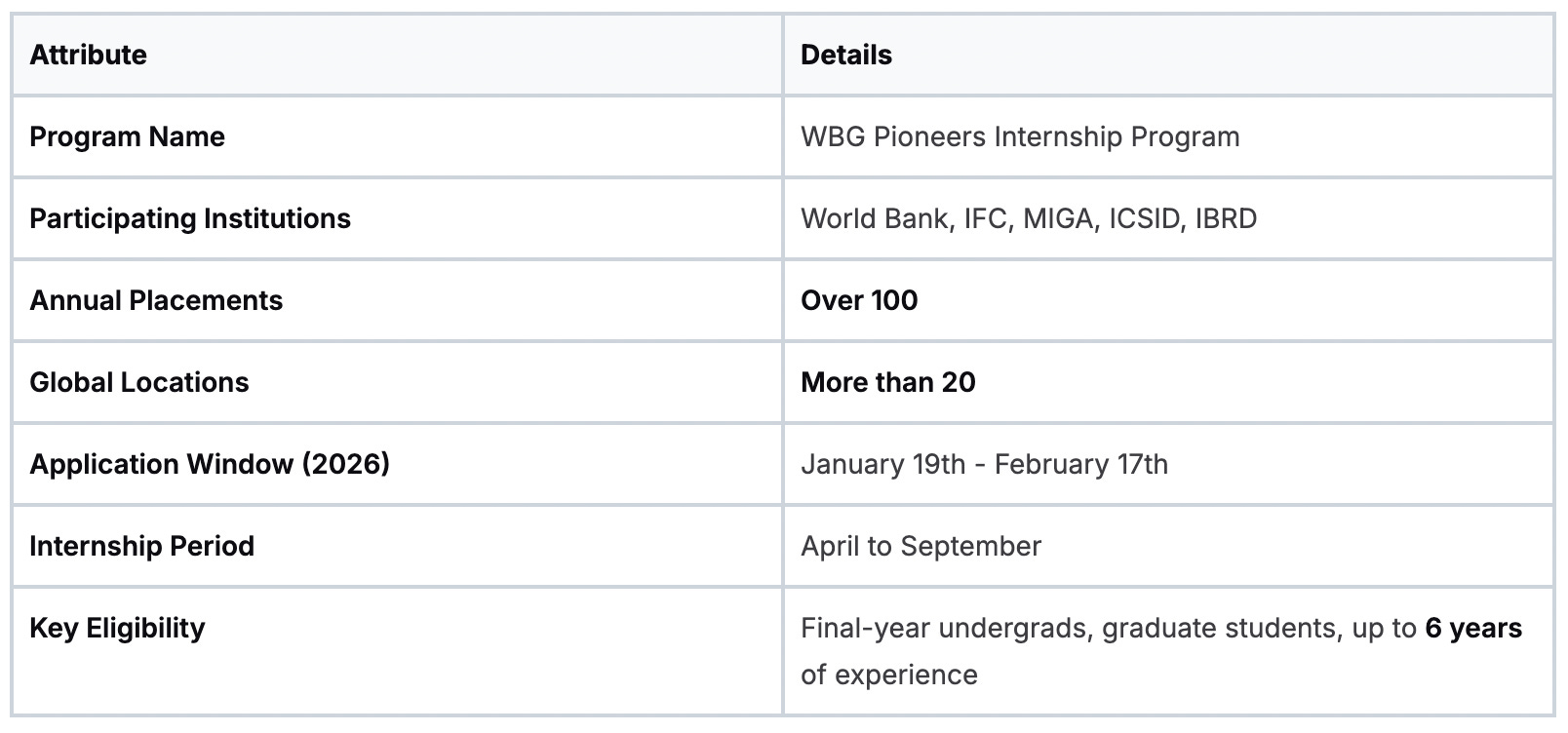
This table gives you a quick snapshot. Now let’s get into the details.
The World Bank recently consolidated its internship streams into a single initiative: the WBG Pioneers Internship Program. This change streamlines the process, offering one clear path to opportunities across all five of the Bank’s core institutions.
For the 2026 cohort, the program offers over 100 placements in more than 20 locations worldwide. The application window is from January 19th to February 17th, with internships running between April and September. Eligibility is now much broader, covering final-year undergrads, graduate students, and even those with up to six years of professional experience.
The core idea is simple: the Bank needs skilled, passionate individuals to help solve the world’s toughest development challenges. The internship is their way of scouting that talent and giving you a chance to prove you have what it takes.
What Makes This Internship Different
The World Bank program puts you at the intersection of policy, finance, and social impact. You’re working inside an institution that moves billions of dollars and shapes global economic policy.
The payoff for securing a spot is clear:
Direct Project Experience: You’ll contribute to meaningful work, like analyzing poverty data or helping structure an infrastructure project.
Unmatched Networking: You get direct access to a network of world-class experts in economics, public policy, and international finance.
A Premier Career Launchpad: Having this on your CV is a powerful signal to any future employer in the development space.
This program is a premier launchpad for careers in multilateral institutions. For a deeper understanding of the organization’s structure, read our complete guide to the World Bank.
The World Bank is notoriously specific about its interns. These are hard rules you must meet to be considered.
Your application first has to pass an automated screening and then a human one before a hiring manager sees it. Get this checklist right, and you can apply with confidence. If you don’t meet these criteria, focus your energy elsewhere for now.
Educational Standing is Non-Negotiable
First, your student status. The World Bank Internship Program is built for people in graduate studies. This is a primary filter with no way around it.
You have to be a full-time student enrolled in a Master’s or PhD program. You must be planning to return to your degree program after the internship. If you’ve already graduated, you’re not eligible.
The Bank views this internship as a two-way street. You bring fresh academic thinking into its operations, and you take practical, real-world experience back to your studies.
This requirement keeps the program rooted as a bridge between academia and professional development practice. You’ll need to provide proof of enrollment, so have that document ready.
Core Fields of Study and Essential Skills
Your field of study has to be relevant to the Bank’s work. They’re looking for expertise that can directly fuel their mission to end extreme poverty and promote shared prosperity.
Your graduate degree should align with the Bank’s operational or corporate needs. The most common disciplines are:
Economics and Finance
Human Development (public health, education, and social protection)
Social Sciences (sociology, anthropology, and political science)
Agriculture and Environmental Science
Urban Planning and Infrastructure
Private Sector Development
The Bank also needs interns for corporate support functions. If you’re studying law, communications, information technology, or human resources, you’re also in the running.
Language and Nationality Requirements
Fluency in English is mandatory. All internal reports, meetings, and communications happen in English. You need professional-level command, both written and spoken.
Speaking another language gives you a serious advantage. The Bank’s operational languages are used constantly in its work with client countries.
Languages That Give You an Edge:
French
Spanish
Arabic
Russian
Portuguese
Chinese
There are no nationality restrictions for the main World Bank Internship Program. The organization is a global partnership of 189 member countries and looks to build a diverse workforce. Your passport won’t be a barrier.
There isn’t an official age cap, but the program is designed for current graduate students. Most successful applicants are in their mid-to-late twenties. The key is your full-time student status. If you tick all these boxes, you’re ready for the next step.
How to Navigate the Application Process
Applying for the World Bank internship is a process you can master if you understand the moving parts. Get your documents ready early and navigate the online portal without making unforced errors.
Timing is everything. The application windows are non-negotiable. If you miss them, you’re waiting another year. For the main World Bank Summer Internship Program, which runs from May to September, the application window is typically from January 15 to February 28.
Specialized tracks have their own rigid deadlines. The DECDI track, for instance, had a deadline of January 16, 2026. Pay close attention to the specific dates for your desired track.
Your entire application goes through the online World Bank Careers portal. You’ll need to pull together three key documents: your Curriculum Vitae (CV), a Statement of Interest, and proof of enrollment in your graduate program.
Crafting a World Bank-Ready CV
Your CV is the first hurdle. Treat it like a strategic document that maps your experience directly to the Bank’s core priorities like climate change, poverty reduction, or private sector development.
Don’t just say you “Conducted data analysis.” Reframe it to show impact. Try: “Analyzed household survey data using Stata to identify poverty drivers in rural communities, contributing to a project brief on social protection.”
Quantify everything: Use numbers to show scale. Did you manage a $50,000 project budget? Analyze a dataset with 100,000+ entries? Include it.
Use their language: Weave in keywords from World Bank project documents and strategy papers relevant to your field. This shows you’ve done your homework.
Keep it tight: Two pages maximum. Recruiters sift through thousands of applications; they don’t have time for a novel.
This flowchart breaks down the eligibility checks your application has to pass.
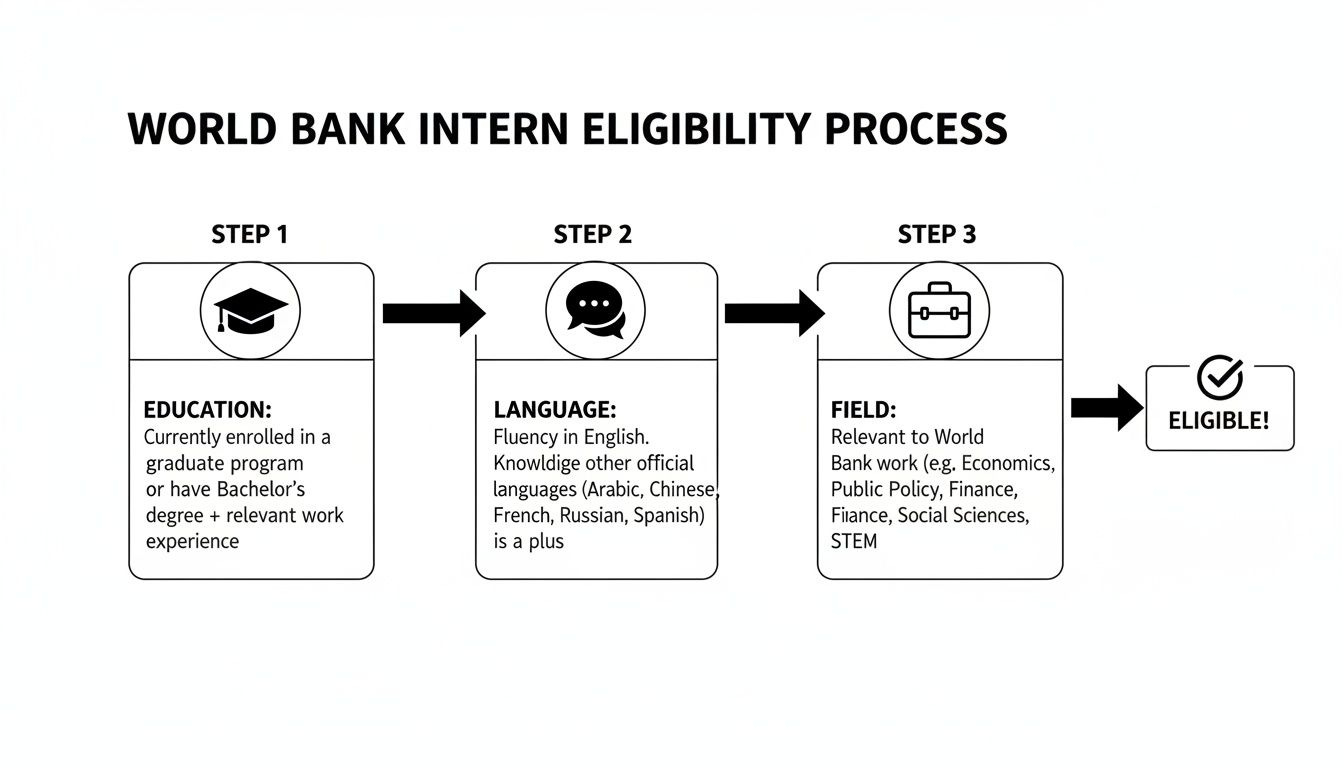
The core pillars are your education, language skills, and field of study. Your application documents need to make it crystal clear you meet every criterion.
Writing a Compelling Statement of Interest
This is where you tell your story. The Statement of Interest connects your academic work, professional experience, and your desire to work at the World Bank. A generic statement is a fast track to the rejection pile.
Your goal is to answer one fundamental question: Why you, and why the World Bank? The statement must show you understand the Bank’s mission and have a clear idea of how you’d fit in.
To pull this off, you have to do research. Find a specific department, region, or Global Practice that genuinely interests you. Mention a recent World Bank report or project that you found compelling. This proves you have a targeted interest.
A winning statement will:
Start with a hook that grabs the reader and states your core motivation.
Draw a clear line from your past experience to a specific area of the Bank’s work.
Show your unique value by highlighting specific skills or perspectives you bring.
Finish with a confident statement about your career goals and how this internship is a critical step.
This document is your primary sales tool. For a deeper dive, read our guide on how to write a statement of interest for these kinds of roles. It’s a skill that will pay off.
Let’s break down what happens after you submit your application. It enters a filtering process designed to find the best talent. You need to understand how it works to survive each stage.
First, your application has to get past the gatekeepers. This initial screening is a mix of automated systems and HR staff. It’s a simple pass/fail check on the non-negotiables: Are you enrolled in a graduate program? Did you upload everything they asked for? A silly mistake here can get you knocked out.
If you pass that first hurdle, you land in the long-listing pile. Here, human screeners look at your CV and Statement of Interest. Their job is to build a pool of qualified candidates for hiring managers, matching your profile to the general needs of different departments.
Who Reads Your Application (and How to Impress Them)
You’re writing for two different audiences. Your application has to work for both.
First are the HR screeners or junior staff who build that initial long-list. They’re generalists, not technical experts. They scan for signs of a strong candidate: a clear connection to development, relevant coursework, and quantifiable achievements.
The second audience is the hiring managers: team leads, senior economists, and technical experts. They’re specialists. When they pull from the long-list, they’re hunting for subject-matter expertise. They will scrutinize your CV for the exact skills they need, whether it’s proficiency in Stata or Python for a research role or financial modeling experience for a private sector development team.
This means your application must do two jobs at once:
Broad Appeal: A generalist needs to understand within 30 seconds that you’re a high-caliber candidate who is passionate about the Bank’s mission.
Technical Depth: It must also have enough specific, technical detail to convince an expert you have the skills to hit the ground running.
Preparing for the World Bank Interview
Making the shortlist and getting an interview invite is a huge win. This is where you prove you’re as sharp in person as on paper. Bank interviews are a mix of behavioral questions, technical deep-dives, and case-study problems.
Be ready to defend every word on your CV. If you listed an econometric model you used, be prepared to explain the methodology, its limitations, and your findings. They will dig in.
The interview isn’t just a test of what you know; it’s an assessment of how you think. They want to see your approach to complex problems, listen to your reasoning, and figure out if you’ll fit into the Bank’s collaborative, evidence-driven culture.
Expect a couple of main question types. Behavioral questions will probe your soft skills like teamwork, leadership, and problem-solving. They almost always start with, “Tell me about a time when...”
Technical questions will be specific to the team you’re interviewing with. An economics-focused role might involve discussing your views on a development policy or interpreting a dataset on the spot. A finance-focused internship might require you to walk through a project finance structure.
To get ready, you must do your homework on the specific department. Read their latest reports, get familiar with their flagship projects, and know the names of their senior staff. Show up with smart questions that prove you’ve done more than a quick Google search. This is how you signal that you don’t just want an internship, you want to be on their team.
Compensation, Logistics, and Life as an Intern
So you’ve landed the offer. Congratulations. Now, let’s talk about the practical stuff: what you’ll earn, where you’ll live, and what your day-to-day work will be.
This is a paid internship. The Bank provides a competitive hourly wage to all its interns to help cover the cost of living, which is important if you’re based in an expensive city like Washington, D.C.
While the exact rate varies, some specialized programs offer a clear benchmark. The World Bank Treasury Summer Internship, for instance, provides a contract for 400 hours over ten weeks. The pay is set between $21.80 (net for non-US citizens) and $26.20 (gross for US citizens) per hour. These numbers can change with HR policies, but they give you a solid idea of what to expect.
Relocation and Visa Support
The Bank is a global institution and recruits globally. They know many interns will be moving, often to Washington, D.C. for the first time.
The World Bank provides a travel allowance to eligible candidates to help cover airfare and related costs. The amount you get depends on factors like your home country and how far you’re traveling.
Visas are another big piece of the puzzle, and the Bank provides serious support. If you’re not a U.S. citizen or permanent resident, the World Bank Group will sponsor your G-4 visa. This is a massive plus, as it simplifies a process that can be a real headache. You’ll still do the paperwork, but the institutional backing makes all the difference.
The Bank wants you focused on delivering high-quality work from day one, not getting tangled up in administrative red tape. The logistical support for travel and visas is designed to make that possible.
What Life as an Intern Is Really Like
At the World Bank, you are an integrated member of the team, given real responsibility, and expected to contribute from the start.
Your daily tasks depend entirely on which unit you land in. One day you might be conducting econometric analysis for a report on education in sub-Saharan Africa. The next, you could be:
Helping prepare project appraisal documents for a new renewable energy investment in Southeast Asia.
Drafting talking points and briefs for senior staff ahead of meetings with government officials.
Building financial models to assess the viability of a public-private partnership.
You’ll work shoulder-to-shoulder with seasoned development professionals. The culture is collaborative but demanding. Deadlines are firm and the expected quality of work is exceptionally high. You’ll also find endless opportunities to network, from formal sessions with senior leaders to grabbing coffee with colleagues.
To see how intern pay fits into the bigger picture, see our comprehensive World Bank salary guide. It gives you a full breakdown of compensation across different roles at the institution.
Ultimately, the experience is what you make of it. Be proactive, ask smart questions, and build connections with everyone you can.
Turning Your Internship into a Career
A World Bank internship is your foot in the door of an incredibly competitive field. Turning that internship into a full-time job requires a game plan from day one.
Think of your internship as a months-long job interview. Your performance, attitude, and how you navigate the Bank’s culture will decide if this is a summer gig or the launchpad for your career.
Positioning Yourself for a Full-Time Offer
Interns who get invited back treat their internship with the seriousness of a permanent staff member. They’re proactive, they’re hungry, and they constantly look for ways to add value.
Your manager is your most important ally. Your job is to make their job easier. Figure out their priorities and the team’s bigger goals. When you see a chance to help a colleague or take initiative on a project, just do it. This shows you see the bigger picture.
Your internship is your chance to build a reputation inside the institution. A strong recommendation from a respected manager is one of the most powerful assets you can walk away with, often more valuable than the paycheck itself.
Don’t be shy about your ambitions. Your manager isn’t a mind reader. Schedule a conversation to talk about your long-term goals and ask for honest feedback. This signals you’re serious about a future at the Bank and gives them a reason to advocate for you.
Pathways from Intern to Employee
The World Bank has a few paths for keeping top intern talent. One of the most direct is through the Treasury Summer Internship. High-performing interns from this program often get a serious look for a coveted Junior Analyst position.
This isn’t an automatic promotion. You still have to apply and compete. But having a successful internship makes you a known quantity, which gives you a massive advantage over external candidates.
The Treasury Junior Analyst role is a one-year term contract, often renewable for a second year. It’s an incredible career booster that can place you in high-impact teams like:
Capital Markets & Investments: Working on investment management and structured finance.
Treasury Operations: Handling the details of asset and liability operations.
Quantitative Solutions and Analytics: Putting advanced data skills to work on real financial problems.
Even if a direct offer doesn’t materialize, a standout internship sets you up for other roles. Your experience makes you a credible candidate for staff positions, consultancies, or the prestigious Young Professionals Program (YPP) a few years later.
Framing Your Experience for Future Roles
How you talk about your World Bank internship on your CV is everything. You have to frame your work in terms of impact and scale.
Instead of “Assisted with research,” be specific and quantitative. Try this:
“Conducted econometric analysis on a $235 billion asset portfolio to identify risk factors, directly informing the team’s hedging strategy.”
“Co-authored a project brief for a $50 billion bond issuance that was circulated to senior management.”
“Analyzed household survey data from 15 countries to support the drafting of a flagship report on social safety nets.”
This approach translates what you did into the language of impact. It’s exactly what hiring managers at the Bank and other MDBs are looking for. Your internship is proof that you can operate and deliver in this demanding environment. Don’t waste it.
Frequently Asked Questions
Let’s tackle the most common questions that trip up candidates. Getting these details straight can be the difference between a standout application and one that gets lost.
Can I Apply if I Have Already Graduated?
No. This is a hard rule for the main World Bank Internship Program. You must be enrolled full-time in a Master’s or PhD program and planning to go back to your studies right after the internship.
The program is a bridge between academic work and real-world practice. If you’ve already graduated, you’re not eligible. Instead, look at junior professional roles or consultancies at the Bank.
How Competitive Is the Program?
It’s brutally competitive. The World Bank is a prestigious institution, and its internship program is a magnet for top talent. Every cycle, thousands of qualified people apply for a handful of spots.
The Bank doesn’t publish acceptance rates, but they are exceptionally low. Your application can’t just be good; it needs to be flawless. That means a razor-sharp CV, a compelling Statement of Interest, and undeniable proof you have the skills hiring managers want.
What Are the Most In-Demand Skills?
Beyond your field of study, a few practical skills will make your application jump off the page. Hiring managers want people who can contribute from day one.
Here’s what they really value:
Quantitative Analysis: A strong command of statistical software like Stata, R, or Python is non-negotiable for roles in economics or research.
Financial Modeling: If you’re targeting finance, private sector development, or infrastructure teams, you need to be able to build and dissect financial models.
Data Management and Visualization: Being able to wrangle large datasets and use tools like Tableau to tell a clear story can give you a massive edge.
Language Proficiency: English is the baseline. But fluency in other official UN languages like French, Spanish, or Arabic is a huge asset for operational roles.
Your job is to prove you can do the work, not just that you know the theory. Listing “Python” on your CV is useless. Showing how you’ve used it is everything. For example: “Used Python to scrape and analyze public procurement data for a governance report.” That demonstrates practical application, which is exactly what they’re looking for.
Hopefully, this clears up any lingering doubts. Use these insights to polish your application and put your absolute best foot forward.
Finding the right role in a multilateral development bank is a job in itself. At Multilateral Development Bank Jobs, we do the hard work for you, delivering curated job lists and insider guides directly to your inbox. Stay ahead of the competition and discover your next opportunity at
https://mdbjobs.com.