

Applying for a UN job feels opaque until you see the machinery behind it. The United Nations employs 116,388 people in staff positions, and applications are handled largely through Inspira, with thousands of submissions competing for a single role across human rights, administration, peacekeeping, and more. That scale changes everything. Your application is not being read first as a story. It’s being processed as a record.
That’s why generic job-search advice fails here. The UN runs on competency frameworks, structured forms, and screening discipline. Incomplete profiles can be rejected automatically, and customized applications carry more weight because recruiters are looking for direct evidence of fit, not potential in the abstract. If you treat a UN application like a private-sector application with a nicer logo, you’ll waste months.
The good news is that the process is learnable. There are written rules, and then there are the unwritten rules: how to phrase experience so it survives automated screening, how to handle the P.11 and profile fields without getting screened out, how nationality status affects your odds, and how to write motivation statements that sound like a practitioner rather than an admirer.
These un job application tips come from how the system operates. They focus on what moves an application forward, what subtly undermines it, and where experienced candidates still trip up. If you want to compete seriously, you need precision, patience, and a willingness to tailor every submission like it matters. Because in this system, it does.
1. Tailor Your CV to UN Core Values and Competencies
A strong UN application starts with translation. You may already have the right experience, but if you describe it in your own language instead of the UN’s language, the system won’t reward you for it.
UN applications through Inspira use a competency-based approach tied to core values such as professionalism and respect for diversity, and customized forms with keyword alignment matter in automated screening, according to UN application guidance summarized by United Career Coalition. That means your CV should show evidence of competencies, not a list of tasks.
Write for competencies, not duties
“Managed projects” is weak in a UN application because it says almost nothing. “Applied results-based management to deliver donor-funded projects across multiple stakeholders” is much stronger if that language matches the vacancy notice and your actual work.
The same goes for leadership. “Supervised team members” is generic. A better version shows context, complexity, and judgment: you coordinated a multicultural team, handled competing interests, and delivered under pressure. That’s what hiring panels are trying to verify.
Practical rule: If a hiring panel can’t identify the competency from your wording, rewrite the line.
Use the STAR method in short form. Situation, task, action, result. You don’t need to spell out the labels in the CV, but the structure should be visible in every serious achievement statement.
Mirror the vacancy language carefully
If the posting emphasizes stakeholder engagement, capacity building, coordination, drafting, monitoring, or results-based management, those exact terms should appear where they truthfully fit your background. Close synonym swapping is risky in UN applications because the screening process rewards alignment.
A few practical fixes help:
Replace vague verbs: Swap “supported” or “assisted” for language that shows ownership when ownership was what you had.
Show multicultural context: If you worked across countries, ministries, agencies, or local partners, say so explicitly.
Name the operating environment: Humanitarian, development, political, field-based, donor-funded, interagency. Context matters.
Tie actions to outcomes: A competency claim lands harder when you show what changed because of your work.
A realistic example: if you worked in a ministry reform program, don’t write that you “worked on governance issues.” Write that you coordinated counterparts, drafted policy inputs, facilitated consultations, and tracked implementation milestones. That reads like evidence, not autobiography.
2. Master the UN Personal History Form P.11 and OHRM Profile
The P.11 and your online profile are not admin paperwork. They are screening documents. Treat them casually and you’ll lose before anyone evaluates your substance.
In practice, many qualified candidates get filtered out because their profiles are incomplete, inconsistent, or too loose on dates and duties. UN recruiters work inside a structured system. If your profile creates doubt, they move on.
Precision beats style
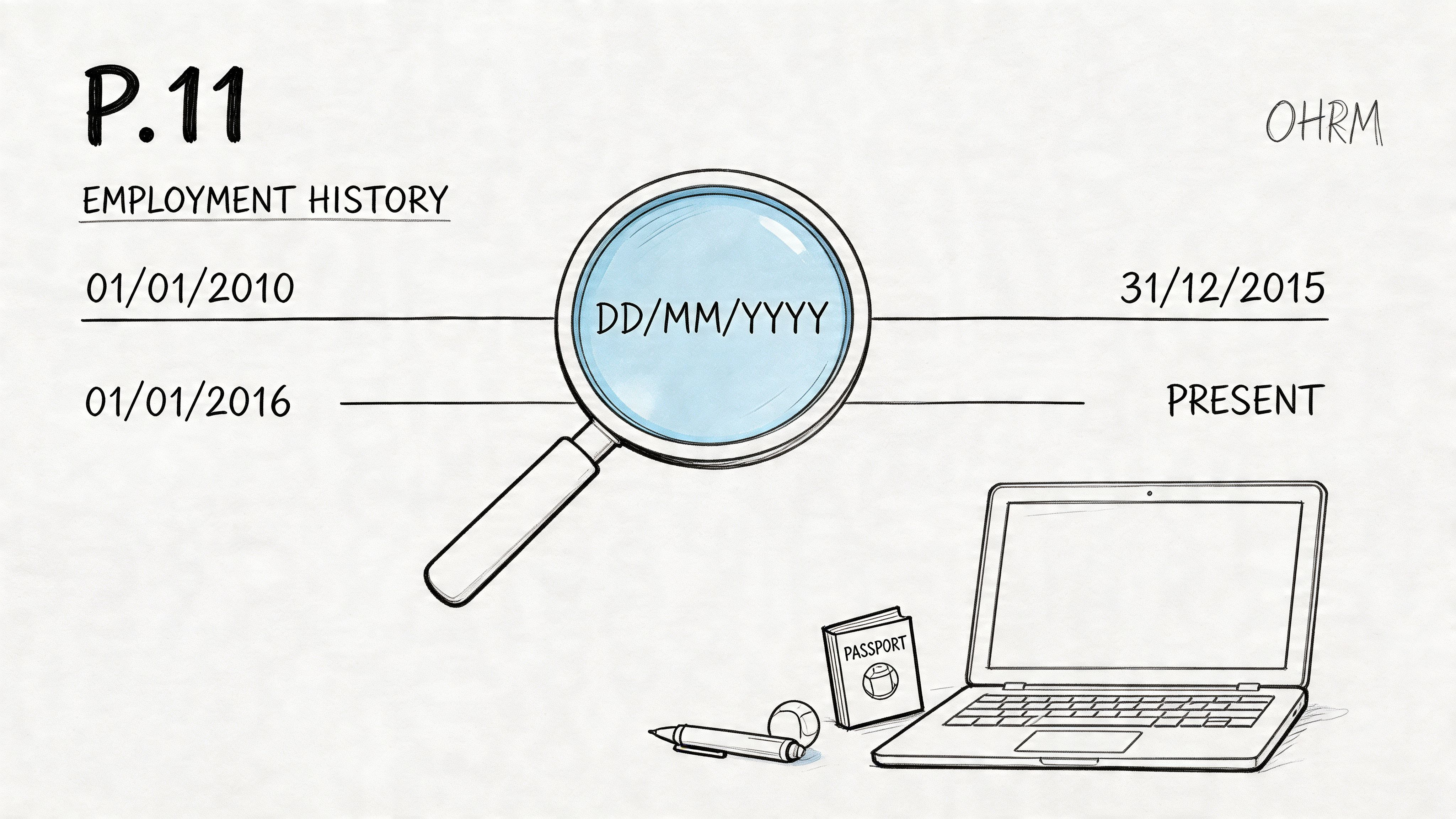
A polished CV cannot rescue a sloppy profile. The profile fields need to match your record exactly, including dates, titles, contract types, and employment sequence. Recruiter guidance shared by UN insiders notes that the Personal History Form requires precise formatting, non-overlapping periods, and detailed task descriptions, with strict attention to minimum experience thresholds in larger agencies, as described in this UN application strategy video.
That last point matters more than applicants think. If a role asks for a set amount of relevant experience, your profile has to make that experience legible. Don’t assume the screener will infer it.
Common profile mistakes that cost people interviews
The pattern is predictable. Smart people rush the form because they think the important work is the CV or cover letter. It isn’t.
Incomplete employment entries: Every relevant role needs enough detail to show duties, subject matter, and level of responsibility.
Messy date logic: Overlaps, unexplained gaps, and inconsistent formats trigger doubt fast.
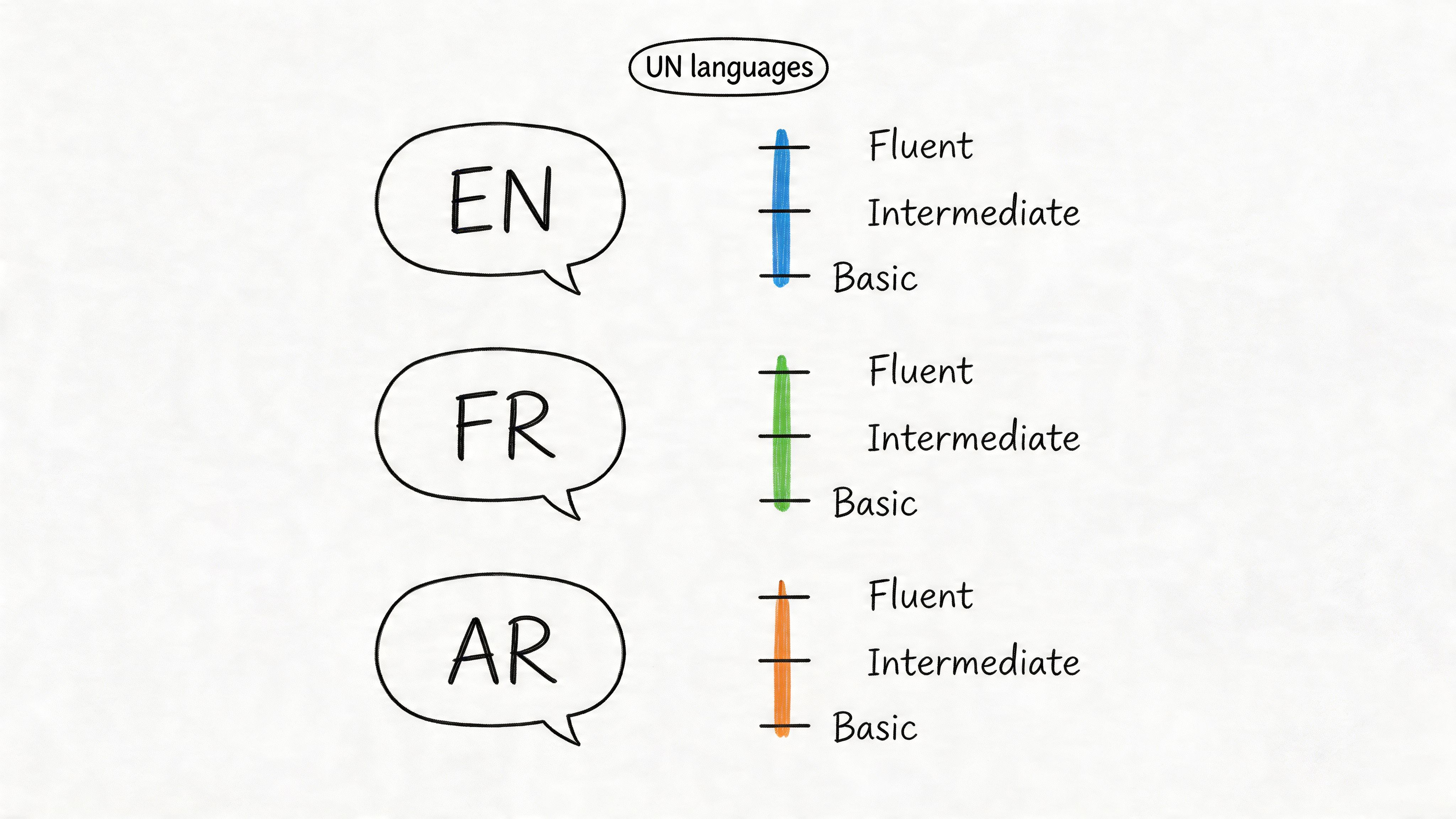
Thin language section: If you have working proficiency, state it clearly and consistently across documents.
One-size-fits-all entries: Your master profile can be broad, but each application still needs role-specific tailoring where the system allows it.
Fill the profile as if the reviewer will only read that document. Sometimes, effectively, that’s true.
A realistic scenario: someone with strong humanitarian logistics experience lists “operations officer” and leaves the duties generic. Another candidate describes supply chain coordination, vendor management, field deployment support, and interagency liaison in terms that match the vacancy. The second candidate looks qualified on paper even if both did similar work.
If you’re applying across the system, remember that Inspira is central, but agencies such as UNICEF and WHO use separate portals. Keep your core material updated, then adapt it to each platform’s format and language.
3. Strategic Nationality and Geographical Balance Awareness
This is one of the least discussed parts of UN hiring, and it changes the competitive environment.
The UN pays attention to geographical representation. That doesn’t override merit requirements, but it absolutely shapes context. If you ignore it, you’re missing one of the key variables in the process.
According to analysis of UN nationality and geographic representation dynamics, only 37% of Professional posts were filled by nationals from unrepresented or underrepresented Member States as of 2023, and applicants from overrepresented countries can face materially tougher competition. That’s not a side issue. It affects how you should target roles and frame your profile.
Know what your passport means in the process
If your nationality is underrepresented, verify that status and use it intelligently. You don’t need to overplay it, but you should understand where it may matter.
If your nationality is overrepresented, the answer isn’t discouragement. The answer is positioning. You need to bring sharper differentiation through field hardship experience, scarce technical skills, hard-to-find language combinations, or regional credibility.
Here’s the practical distinction:
Underrepresented nationality: Confirm the status and apply broadly where your background fits.
Overrepresented nationality: Focus harder on niche fit, technical depth, and postings where your profile solves a difficult staffing problem.
Dual-national candidates: Check which nationality status is relevant and how the institution handles it.
Field-oriented candidates: Geographic balance concerns can play out differently outside headline headquarters posts.
Target roles where your profile makes institutional sense
A candidate from an overrepresented country who applies only to New York policy roles is choosing the most crowded lane. A candidate with the same background who targets field coordination, regional technical support, or hardship stations may be entering a more workable market.
Geographic balance won’t carry a weak application. It can strengthen a strong one.
This also matters beyond the UN Secretariat. Multilateral development banks have their own nationality policies and representation practices, even if they don’t all use the same language. If you’re applying across UN and MDB systems, study nationality rules role by role instead of assuming one model fits all.
The unwritten rule is simple: understand the institutional incentives behind the vacancy. Hiring managers work inside them.
4. Leverage Language Proficiency as a Competitive Differentiator
Language ability changes how useful you are on day one. In UN hiring, that matters more than many applicants realize.
Panels do not treat languages as a nice extra. They read them as a staffing risk or a staffing advantage. If a team needs someone who can draft in French, brief counterparts in Arabic, or run meetings in Spanish, weak or vague claims create doubt fast. Strong, specific claims make your application easier to defend during screening and competency-based interviews.
The unwritten rule is simple. A second UN language helps only if the panel can see where you used it under real working conditions.
Make language visible in the parts of the application that get screened first
Do not hide language skills in a final profile field and assume recruiters will connect the dots. Put them where they support your candidacy: your summary, your work history, and your achievement bullets.
A good language claim sounds like this: drafted donor updates in French, facilitated bilingual workshops with ministry counterparts, or conducted field interviews in Arabic and produced English reporting for headquarters. That kind of detail tells a hiring manager you will not need hand-holding.
A weak claim sounds like a self-rating with no context.
Match the language to the post, not your ego
Applicants often overstate proficiency because they assume more languages always look better. In practice, inflated claims create interview problems. If the panel switches to that language for five minutes and your answers collapse, the rest of your application becomes harder to trust.
Use a stricter standard:
List professional proficiency accurately: Include only languages you can use in meetings, drafting, and stakeholder communication.
Tie the language to actual tasks: Show where you negotiated, trained, interviewed, wrote, or coordinated in that language.
Reflect regional demand: French matters differently in Dakar than in Geneva. Arabic matters differently in Amman than in New York.
Prepare for verification: Written tests, interview questions, and reference checks can all expose a weak claim.
One sentence can do a lot of work here. “Managed francophone partner communication and drafted monthly program updates in French” is stronger than “French, intermediate.”
Use language as evidence of field readiness and institutional fit
Applicants often miss the strategic point. Language is not only about communication. It signals deployability, credibility with counterparts, and lower onboarding friction.
For field posts and regional roles, that can shift how your profile is read. A candidate with solid technical experience plus working French or Arabic may solve a practical staffing problem that a technically similar monolingual candidate does not. That is especially true in offices where teams are stretched and managers cannot afford a long adjustment period.
This also connects to how UN teams assess delivery. A candidate who can collect information directly, brief multiple audiences, and write without translation support is easier to place in a results-driven role. Framing your experience in the language of results-based management can help you show that your language skills improved implementation, coordination, or reporting quality.
A realistic comparison makes the difference clear. Two applicants have similar governance experience. One writes, “French, intermediate.” The other writes that they drafted briefing notes in French, facilitated workshops with local authorities, and coordinated with francophone civil society partners during a reform process. The second applicant gives the panel evidence they can use.
Language skills help your case when they appear as proof of performance.
If you speak more than one UN language, use that advantage carefully. Put the strongest and most relevant language where it will be seen early, then support it with concrete examples from your record. That is how language stops being a checkbox and starts working in your favor.
5. Build a Track Record of Results-Oriented Impact with Quantifiable Metrics
UN hiring teams read a lot of applications from people who sound busy. They’re looking for people who can show results.
That doesn’t mean every line needs a big number. It means your record should show change, scale, delivery, or problem-solving in concrete terms. If all your experience reads like responsibility without consequence, your application feels weak even when the work was substantial.
Show outputs and outcomes
Strong applicants explain what they did and what happened because they did it. The difference is huge.
If you coordinated a training program, what changed after it? If you managed grants, what did that management enable? If you supported policy reform, what moved forward because of your drafting, consultations, or technical support?
A results-based management approach helps. It forces you to think in a way UN hiring panels already understand: inputs, activities, outputs, outcomes, and evidence.
Use numbers you can defend
Some candidates avoid metrics because they think only large-scale program managers can use them. That’s wrong. Metrics can reflect scope, volume, timeliness, coverage, team size, budget responsibility, or process improvement. What matters is credibility.
A realistic example works better than a polished slogan. Instead of “supported donor coordination,” write that you prepared briefing materials, tracked action points, consolidated partner inputs, and kept a complex process moving on deadline. If you can quantify any part of that truthfully, do it.
Use this filter when revising your experience:
Scope: How large was the portfolio, geography, partner group, or thematic area?
Responsibility: What did you personally own?
Change: What improved, moved, launched, resolved, or got delivered?
Evidence: What can you defend in an interview?
Hiring panels remember applicants who can explain impact clearly in two minutes.
This also improves competency interviews. If your written application already captures concrete outcomes, your oral answers become easier. You’re not inventing examples under pressure. You’re reusing a well-documented track record.
The trade-off is time. Tailoring achievement statements properly takes longer than copying old bullets. It’s still the better use of time because weak framing is one of the fastest ways to disappear in a crowded pool.
6. Craft Compelling Motivation and Cover Letters Aligned with UN Sustainable Development Goals
Most UN cover letters fail for one reason. They sound like the candidate wants to work at the UN more than they want to do the job.
That’s a problem because hiring managers aren’t selecting for admiration. They’re selecting for mandate fit. Your motivation statement has to connect your experience to the agency’s work, the vacancy’s priorities, and the problem the unit is trying to solve.
Write to the mandate, not the brand
A good motivation statement makes it obvious that you understand the entity you’re applying to. UNHCR, UNICEF, UNDP, WHO, and OCHA do very different work. Broad enthusiasm for multilateralism won’t carry a generic letter.
Tie your motivation to the role’s substantive agenda and the relevant SDG context where appropriate. If the vacancy is about social protection, forced displacement, public health systems, or climate adaptation, show that you’ve worked on that terrain and understand the institutional challenge.
If you need a useful contrast, compare your draft against the discipline used in a well-structured consulting proposal. The same principle applies: define the problem, show fit, and make your value easy to assess.
Keep it specific and credible
A realistic example works better than lofty language. If you’ve spent years supporting maternal health programming, say why that work connects directly to the role and what perspective it gave you. If your experience exposed implementation gaps between national policy and local delivery, that’s a real motivation point because it emerges from practice.
What doesn’t work:
Generic purpose language: “I am passionate about making a difference.”
UN flattery: Long praise for the organization with little evidence of fit.
Career tourism: Framing the job as a dream rather than a responsibility.
What works:
Mandate alignment: You understand the unit’s work and can contribute quickly.
Issue-specific commitment: Your motivation comes from actual professional exposure.
Role-specific evidence: Your background maps onto the vacancy notice.
The strongest cover letters sound like a future colleague, not a fan.
Keep the letter tight. Reviewers don’t need your life story. They need a persuasive explanation of why this role, this agency, and this moment make sense for your profile.
7. Understand Young Professional Programs and Entry-Level Pathways
The UN does not reward ambition alone. It rewards fit, timing, and entry through the right mechanism.
Many applicants waste a year applying to P-level jobs that were never realistic for their profile. The problem is rarely effort. It is category error. They are competing in channels built for candidates with stronger internal exposure, more years of experience, or a profile that matches a very specific roster need.
Early-career candidates need to study the entry routes with the same care they give vacancy notices. Young Professional Program tracks, consultancies, internships, and junior posts serve different purposes. Each one is screened differently. Each one builds a different kind of credibility inside the system.
Choose the route that fits your actual profile
A strong application cannot compensate for missing experience. The better move is to target a pathway that matches your current stage and gives you evidence the UN hiring system recognizes.
If you are eligible for YPP, treat it seriously. It is one of the few formal routes designed to bring in early-career professionals, but the gate is narrow. Nationality, age, education, and exam-cycle eligibility all matter. A focused resource like this guide to the UN Young Professionals pathway is useful if you want to track those requirements without missing a cycle.
A practical breakdown:
YPP route: Best for candidates who meet the nationality and eligibility rules in the current round.
Consultant route: Best for candidates who already have a defined technical skill and can deliver quickly.
Internship route: Best for candidates who need institutional exposure and can afford the trade-offs.
Agency-specific junior roles: Best for candidates who understand that UNICEF, UNDP, WFP, WHO, and Secretariat entities do not hire in the same way.
Entry roles are how many careers start
Treating these roles as beneath you is a mistake.
A consultancy or junior assignment often gives you the exact signals later shortlists look for. Supervisors who can vouch for your work. Experience with UN reporting language. Proof that you can work inside slow clearance processes, political constraints, and multi-stakeholder environments without falling apart.
That is the unwritten rule. Hiring teams trust candidates who have already shown they can function inside the machinery.
A common pattern looks like this. A public health candidate keeps applying to broad P posts and gets screened out. The same candidate shifts to technical consultancies tied to immunization systems or health financing, builds agency-specific evidence, and becomes far easier to shortlist later. It is not glamorous, but it is often the faster route.
Entry-level strategy in the UN is rarely about finding your ideal post first. It is about getting into the right stream, building credible internal proof, and moving from there.
8. Network Strategically and Use Informational Interviews with UN Professionals
UN networking does not get jobs handed to you. It gives you something more useful. A clearer read on how a team hires, what a vacancy is really trying to solve, and which parts of your background will carry weight in review.
That matters because UN recruitment is formal on paper and highly interpretive in practice. The post goes through the portal, the screening questions still matter, and the competency framework still governs the process. Yet behind all of that, hiring managers and panel members are still asking practical questions: Can this person handle the politics of this office? Do they understand donor pressure, government relations, field constraints, or interagency coordination? A good informational interview helps you answer those questions before you submit anything.
Ask for pattern recognition, not personal intervention
The strongest outreach is specific, brief, and easy to answer.
Ask what a unit values in practice. Ask how the team splits work across policy, operations, coordination, and reporting. Ask what tends to separate shortlisted candidates from technically qualified applicants who never make it past screening. Those are professional questions. They show judgment.
A weak message asks for a referral in the first contact. A smart message asks for fifteen minutes to understand the role, office, or recruitment pattern.
This is one of the unwritten rules.
UN professionals are often willing to explain the reality of a function, especially if you have done your homework and your questions are serious. They are far less interested in vague requests from candidates who clearly want a shortcut.
What these conversations can actually tell you
Official vacancy text rarely tells you enough. Informational interviews often reveal the operational logic behind the post.
Use them to clarify:
What the team is solving right now: surge delivery, donor reporting, country office support, political coordination, technical guidance, or internal process management
Which competencies carry the most weight: relationship management, drafting, negotiation, project oversight, stakeholder coordination, or subject-matter depth
How the duty station changes the profile: headquarters roles often reward drafting and system knowledge, while field or regional posts may value implementation credibility and government-facing experience
What language signals fit: the exact terms teams use for results, partnerships, crisis response, or programme support
How recruitment tends to move: recurring consultancies, roster use, temporary appointments, or frequent turnover in hard-duty locations
That kind of intelligence improves your application more than generic networking ever will.
A common example. An applicant targeting a regional programme role assumes the panel will care most about research and policy writing. A conversation with someone in that office reveals that the true pressure point is managing government counterparts, clearing comments across agencies, and keeping delivery on track despite slow approvals. The application changes. The candidate leads with coordination, negotiation, and implementation evidence instead of publications and analytical output. That is a stronger match because it reflects the job as it is performed.
Treat informational interviews like fieldwork
Go in prepared. Read the vacancy if there is one. Review the office mandate, recent reports, leadership structure, and country or regional context. Then ask questions that a practitioner would respect.
Useful questions include:
What does this team expect from someone in the first six months?
Which part of the role consumes the most time?
Where do external candidates usually misread the post?
What kind of examples work well in competency-based interviews for this function?
Does this office tend to value prior UN exposure, government experience, NGO operations, or technical specialization more heavily?
Notice the pattern. These questions get you closer to selection logic, not just surface description.
Stay professional after the call
Send a short thank-you note. Mention one point that changed your thinking. If you apply later, you can send a brief update. Do not turn a useful contact into a running obligation.
The trade-off is simple. Networking done well sharpens your judgment. Networking done poorly makes you look needy, careless, or transactional.
In the UN system, reputation circulates. So does competence. Use these conversations to get clearer, write better applications, and target the offices where your profile makes sense.
UN Job Application: 8-Point Comparison
A strong UN application is rarely won on qualifications alone. It is won by candidates who understand how the system screens, compares, and subtly filters people out before an interview panel ever sees the full picture.
Use this comparison to judge effort against likely return.
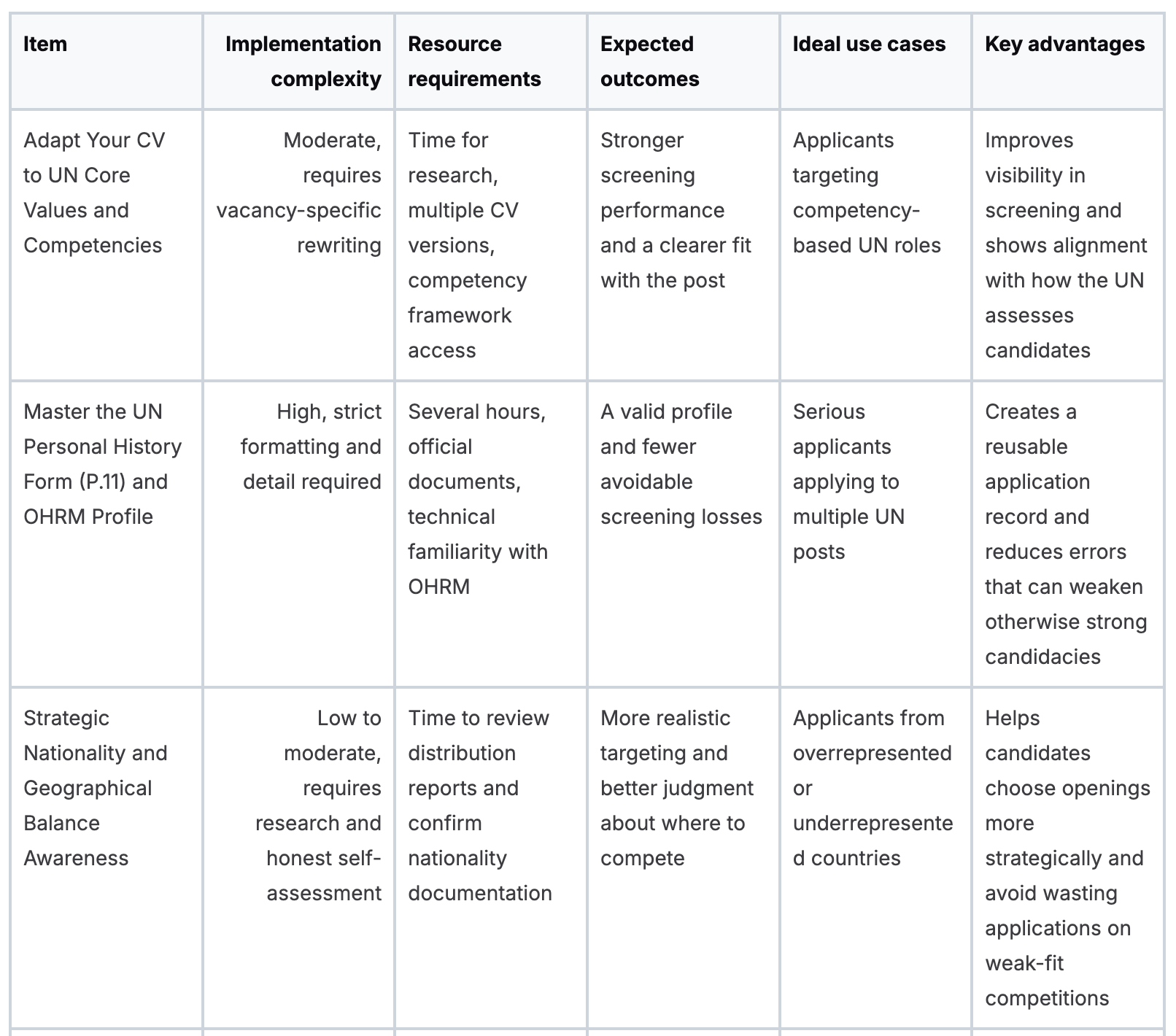
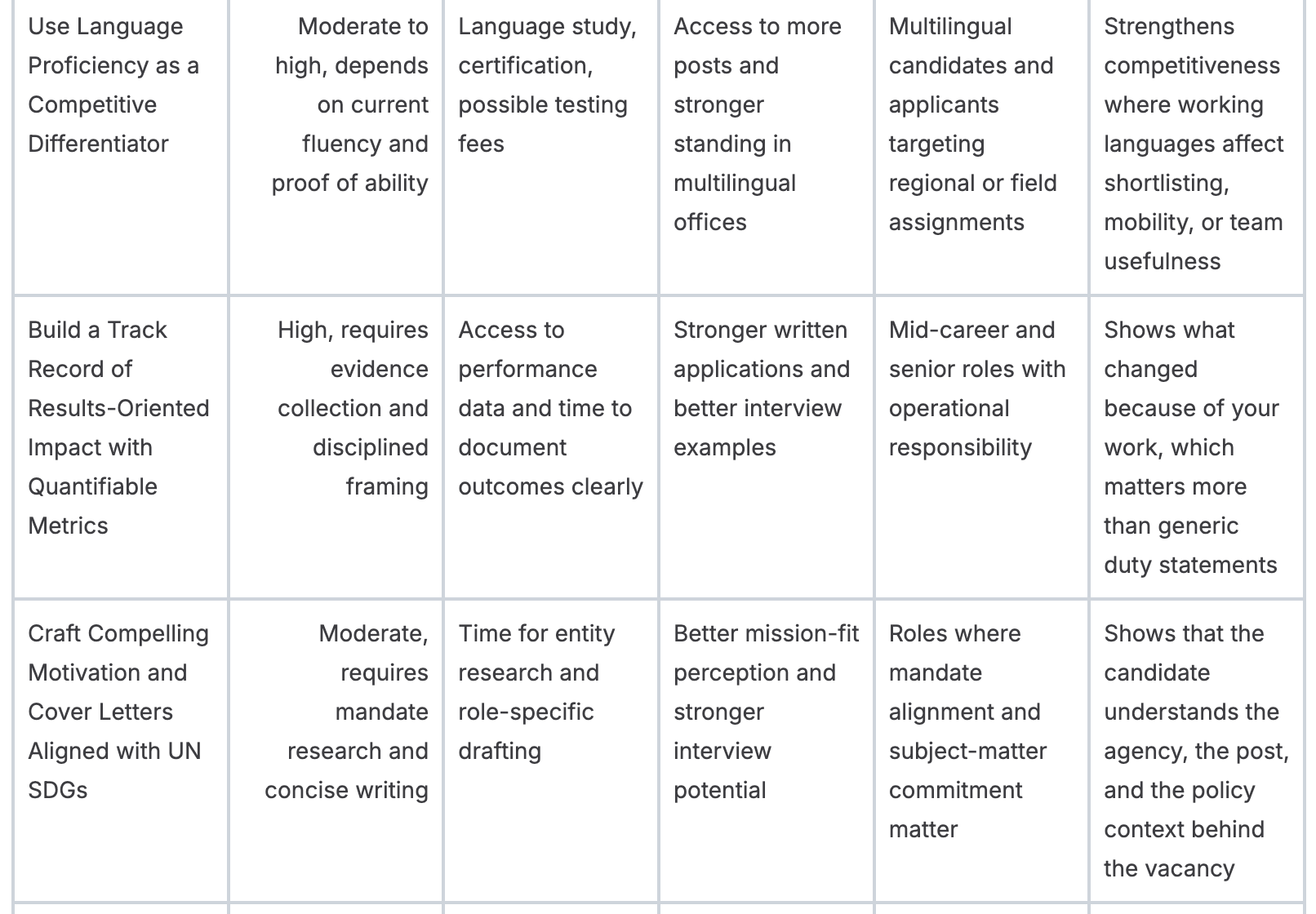
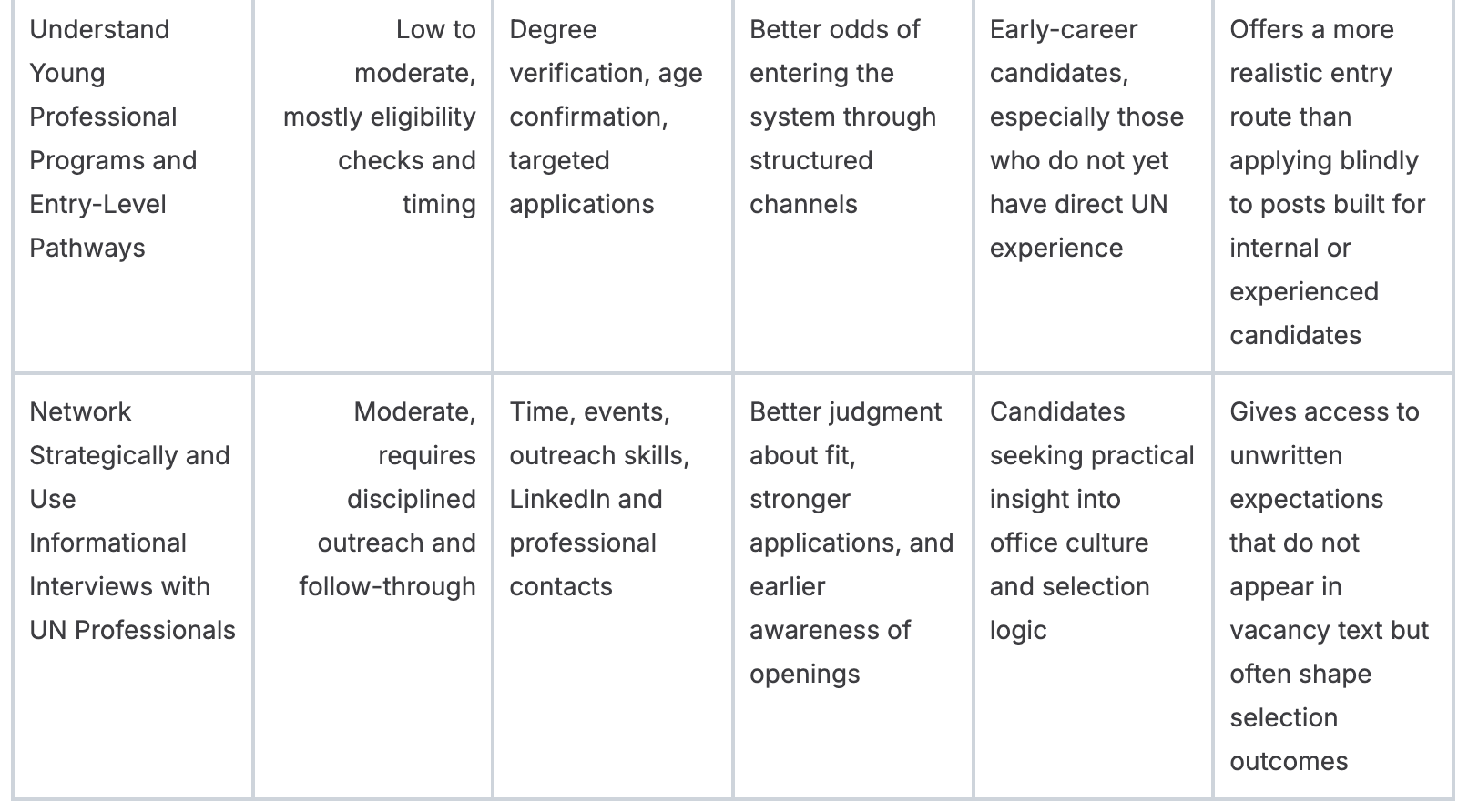
The trade-off is straightforward. Some tactics improve a single application. Others improve every application you submit after that. Candidates who treat the P.11, competency framing, language profile, and nationality context as system issues usually make faster progress than candidates who focus only on motivational messaging.
Your Strategy for a Successful UN Application
UN hiring is not opaque once you understand what the system is screening for. The most important shift is to stop treating each vacancy as a fresh gamble and start treating your candidacy as a file that must survive a bureaucratic review, then compete against stronger and often better-positioned applicants.
That changes how you apply.
A successful approach starts with control over the parts you can influence. Your profile has to be internally consistent. Dates need to line up. Titles, duties, and achievements need to reflect the language used in the vacancy. Your examples need to show clear evidence of the competencies being assessed, not vague claims about being committed, adaptable, or passionate. In UN recruitment, weak formatting and unclear evidence are often enough to keep a qualified candidate out of the longlist.
After that, strategy matters more than volume. Strong applicants are selective. They go after posts where the grade, duty station, technical focus, and experience threshold fit their record. They also pay attention to the unwritten filters that rarely appear clearly in the vacancy notice. Those include roster preference, institutional familiarity, geography, language mix, and whether the office is likely to favor someone who can operate with little onboarding. Official guidance will not spell that out, but it affects outcomes.
Patience is part of the process, but patience without adjustment wastes time. A rejection can mean the field was crowded, the office wanted a profile with prior UN exposure, or your application did not make the match obvious fast enough. The practical response is to revise the next submission with more precision. Generic applications fail unnoticed in this system.
Treat every application as a selection exercise, not a document upload. Read the vacancy line by line. Identify the functional requirements, the competency language, and the clues about operational context. Then rewrite your experience so a reviewer can spot the fit in seconds. Hiring managers and HR colleagues are often reviewing large volumes under time pressure. If your relevance is buried, it may as well not exist.
There is also a longer-term strategy that experienced applicants understand well. One consultancy can build credible UN-adjacent experience. One hardship duty station can change how your profile is read. One additional working language can widen the number of serious openings you can pursue. Over time, those pieces create a profile that looks less like an outsider trying to break in and more like someone already operating in the multilateral field.
That is usually how candidates get traction. They build toward the system instead of waiting for the perfect vacancy to rescue them.
If you are applying across multilateral institutions, it helps to track opportunities in one place and compare how different organizations recruit. Multilateral Development Bank Jobs is one relevant option for monitoring MDB roles, UN consultant listings, and guidance on YPPs, nationality considerations, and application strategy.
The practical formula is simple. Submit fewer applications. Make each one sharper. Use the vocabulary of the vacancy without copying it mechanically. Show results, not intentions. Build a profile that makes sense on paper before you ask a panel to imagine your potential. That is how serious candidates handle a system that rewards precision, patience, and fit.