

When you’re trying to land a consulting project with big players like the UN or Multilateral Development Banks (M-Banks), your proposal is your first deliverable.
Think of it as the first piece of work your client sees from you. A generic, copy-pasted proposal sends a clear message: you’re going to deliver generic, copy-pasted work. Every section needs to prove you understand their problem inside and out and have a rock-solid plan to solve it.
Your Proposal Is Your First Deliverable
Too many consultants get this wrong. They treat the proposal like a brochure. The real selling should have already happened in your conversations before you start writing. When you’re staring at a Request for Proposal (RFP), your job is to formalize the understanding you’ve already built and prove you are the lowest-risk, highest-value choice.
For organizations like the World Bank or a UN agency, the proposal is everything. These are bureaucratic institutions that live and die by structured scorecards. A messy, disorganized document looks bad and makes it physically difficult for the evaluation committee to tick their boxes and award you points. It signals that your project management will be just as chaotic.
Here’s a mindset shift: The proposal’s job is to formalize what’s been agreed upon and give your internal champion the ammunition they need to defend their choice. The business should already be won before the document is sent.
Reading Between the Lines of an RFP
The best proposals go beyond what’s explicitly asked. You have to dissect an RFP to uncover the client’s unspoken priorities, political sensitivities, and the real, underlying problems they might not state directly. Evaluators are looking for a partner who just gets it.
Here’s my checklist for analyzing any RFP:
Look for Repetitive Language: Pay close attention to words or phrases the client uses over and over. This is a massive tell. It’s a direct line into their biggest pain points and top priorities. Weave that exact language back into your proposal. It shows you’re listening.
Dissect the Evaluation Criteria: This section is your cheat sheet. If “Team Composition” is worth 40% of the total score, you know listing your team’s credentials won’t cut it. You have to explain why each specific person is the perfect fit for this specific challenge.
Spot the Hidden Constraints: Hunt for clues about budget ceilings, impossibly tight deadlines, or internal politics. Addressing these things proactively in your methodology shows foresight and builds immediate trust. If the timeline seems unrealistic, your work plan should show exactly how you’ve structured your approach to meet it.
To help you structure your thinking, here’s a quick-reference table that breaks down the core sections you’ll need to build and what evaluators are looking for in each one.
Core Sections of a Winning M-Bank Proposal
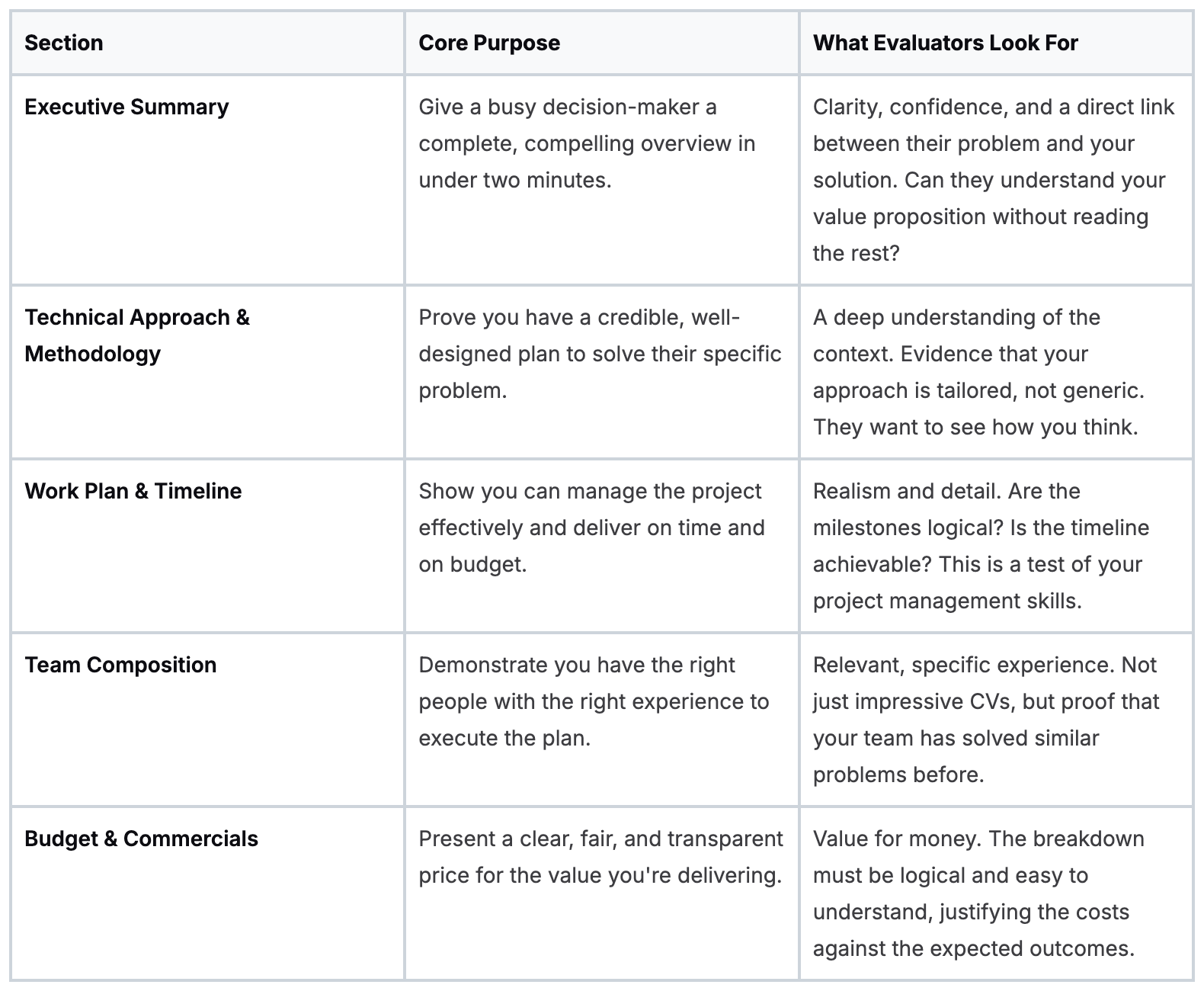
This table is a guide to the strategic purpose behind each component. Get these right, and you’re already ahead of the pack.
Shifting Your Mindset from “Applying” to “Solving”
Your goal is to present a clear, compelling solution to the client’s problem. Frame every section of your proposal through this lens. Explain the outcome and the value it delivers.
For example, instead of this: “We will conduct stakeholder workshops.”
Try this: “Our facilitated workshops will build consensus among key departments, ensuring project buy-in and eliminating the implementation delays that have stalled past initiatives.”
The first is an activity. The second is a solution.
This initial analysis is the foundation for everything that follows. It’s how you stop being another qualified consultant and become the only logical choice. When the evaluation committee reads your document, you want them nodding along, thinking, “Finally, someone who understands our problem better than we do.”
Structuring Your Proposal the M-Bank Way
Multilateral Development Banks and UN agencies run on process. They are bureaucratic by nature, which means your proposal will be judged against a structured scorecard. If your document is a maze of dense text and confusing sections, you’re making it harder for the evaluation committee to give you points.
A winning proposal presents great ideas in a way that lines up perfectly with their evaluation framework. Your goal is to build a document that is both compliant and compelling, making it easy for the evaluator to nod along and tick their boxes.
The structure reflects your professionalism and attention to detail.
The Anatomy of a Compliant Proposal
Think of your proposal’s structure as the skeleton that holds your technical solution together. While the exact section titles might vary based on the Request for Proposal (RFP), nearly all M-Bank and UN proposals require these core components. Get them right, and you’re building on a solid foundation.
Here are the non-negotiable sections you must include:
Executive Summary: This is your one-page pitch. Write it last, but place it first. Assume the busiest decision-maker will only read this section. It needs to crisply define their problem, your unique solution, and the ultimate value you’ll deliver.
Understanding of the Terms of Reference (ToR): This is where you prove you’ve done your homework. Don’t parrot their ToR back to them. Show your deep comprehension by connecting their stated needs to the broader context, identifying potential risks they haven’t mentioned, and proving you grasp the project’s nuances.
Technical Approach & Methodology: This is the heart of your proposal and where you win or lose the contract. Here, you’ll detail the how: the specific steps, frameworks, and tools you’ll use. A generic, copy-paste approach is an instant disqualifier.
Work Plan & Timeline: This section translates your methodology into a concrete schedule. It should include clear phases, key activities, milestones, and deliverables, often presented in a Gantt chart. This is a direct test of your project management skills.
Team Composition & Management: Introduce your team. Don’t just attach CVs. Create a narrative that explains why this specific group of people is perfectly assembled for this specific challenge, detailing roles, responsibilities, and relevant experience.
Budget: Your financial proposal. It needs to be detailed, transparent, and offer clear value for money. We’ll break this down further in a later section.
This entire approach boils down to a simple, three-stage mindset: analyze the client’s needs, strategize your unique solution, and demonstrate your value clearly.
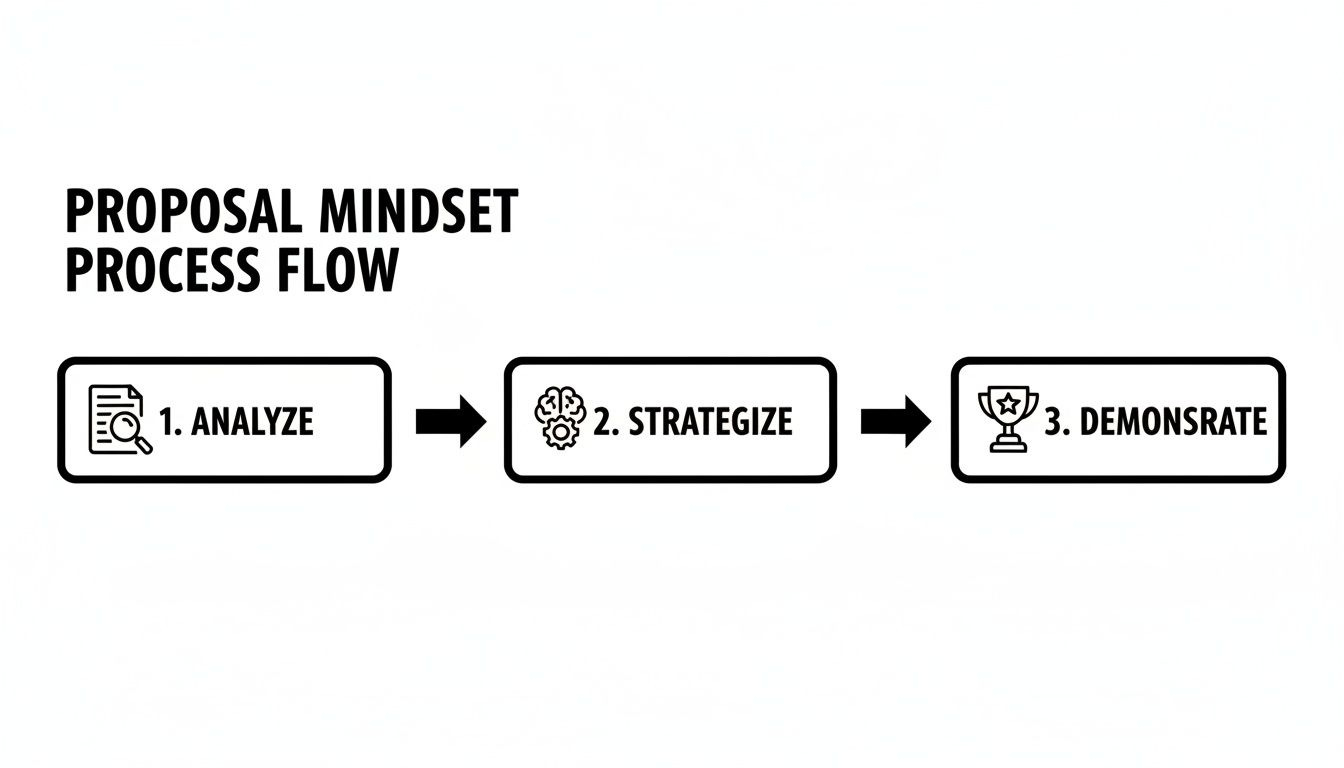
This process ensures your proposal is built on a solid foundation of understanding before you ever write a single word about your solution.
Writing for the Evaluator
Remember, a real person is reading your document, likely under a tight deadline with a stack of other proposals to get through. Make their job easy.
Use clear headers, short paragraphs, and visual aids like tables or charts to break up the text. Each section should stand on its own while contributing to a cohesive, compelling story.
An evaluator’s job is to score your proposal against a predefined matrix. Your job is to hand them the points on a silver platter by making every section clear, compliant, and easy to score.
Precise alignment with procurement rules separates the winners from the rest. For instance, U.S. firms once dominated the World Bank consulting market, capturing 18% of all contracts over a five-year period. This wasn’t an accident. It was largely because their proposals were meticulously aligned with M-Bank procurement guidelines, giving them a significant edge over competitors from the U.K., France, and Germany.
Beyond the Standard Sections
While the core components are mandatory, a winning proposal often includes carefully chosen annexes. These can add depth and credibility without cluttering the main body of your document.
Consider including:
Tailored CVs: Never use a standard CV. Each one should be edited to highlight the most relevant experience for this project. A three-page maximum is a good rule of thumb.
Past Performance Summaries: Include brief, one-paragraph summaries of 3-5 highly relevant past projects. Detail the client, the challenge, your actions, and the quantifiable results. This is your evidence.
Company Profile: A short, one-page overview of your firm’s capabilities can be useful, but keep it brief and laser-focused on what matters for this contract.
By structuring your document this way, you create a proposal that is easy to read and easy to evaluate. This strategic approach is fundamental to success. To better understand which organizations you can work for, you can also check out our guide on the different types of MDBs. This shows you’re a professional who understands their world before the project even begins.
Crafting Your Technical Approach and Methodology
Let’s be direct: this is where the proposal is won or lost. You’ve shown the client you get their problem. Now, you have to convince them you have a smart, credible plan to solve it.
Slapping in a generic methodology is the fastest way to land your proposal in the “no” pile. This section is the narrative that bridges the client’s pain with your unique solution, spelling out the logic behind every step.
Differentiating Your Approach From the Competition
Every other qualified consultant bidding on this project will propose a plausible plan. Your job is to make your plan the only logical choice. That means going beyond the standard industry frameworks and showing you’ve thought about this on a much deeper level.
Start by zeroing in on the critical success factors for the project. These are the 3-5 things that absolutely must go right for this to succeed. Frame your entire methodology around delivering on these factors.
For instance, maybe a critical factor is getting buy-in from a group of skeptical regional managers. A generic proposal would say, “Conduct stakeholder workshops.” A winning proposal says, “Our methodology includes a phased pilot program in the Midwest region, led by their own managers, to build grassroots support and create internal champions before a national rollout.”
You’re not just executing tasks; you’re actively managing the project’s human and political realities.
The best technical approaches are so tailored to the client’s problem that they feel completely bespoke. The evaluator should read it and think, “This was written just for us.”
From Activities to Outcomes
A classic rookie mistake is focusing on what you will do rather than what the client will get. Clients don’t buy your time and effort; they buy results. Every activity in your methodology must be explicitly tied to a tangible outcome.
This requires a simple but powerful shift in language. Stop talking about your inputs. Start describing their outputs and the outcomes they’ll see.
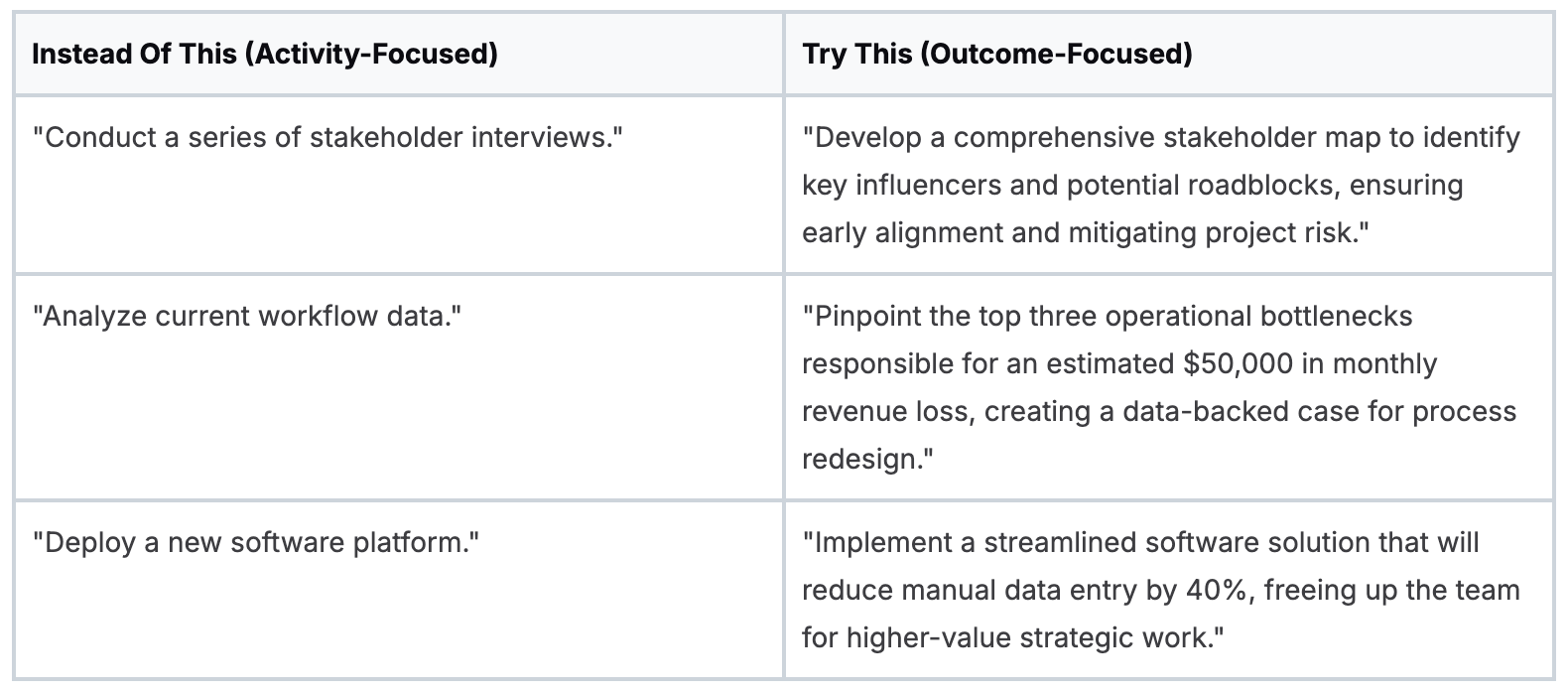
This pivot in perspective shows you’re not a hired gun. You’re a strategic partner invested in moving their business forward.
Embedding Proof in Your Plan
Your methodology is the perfect spot to prove you can deliver. Don’t just claim you’re an expert; show them you’ve done this before. The best way to do this is by weaving mini-case studies or specific examples directly into your technical approach.
For example, when outlining a data analysis phase, you could write:
“Our data validation process is modeled on the framework we successfully implemented for a major financial services client in Southeast Asia. By establishing a cross-functional data integrity team, we cut their reporting errors by 75% in six months, a model we will adapt for this project.”
This tactic is powerful for two reasons:
It validates your plan: It shows your methodology is battle-tested in the real world.
It reduces perceived risk: The client immediately sees you as a safe pair of hands, which is often the tiebreaker in a tight competition.
Making Complexity Clear
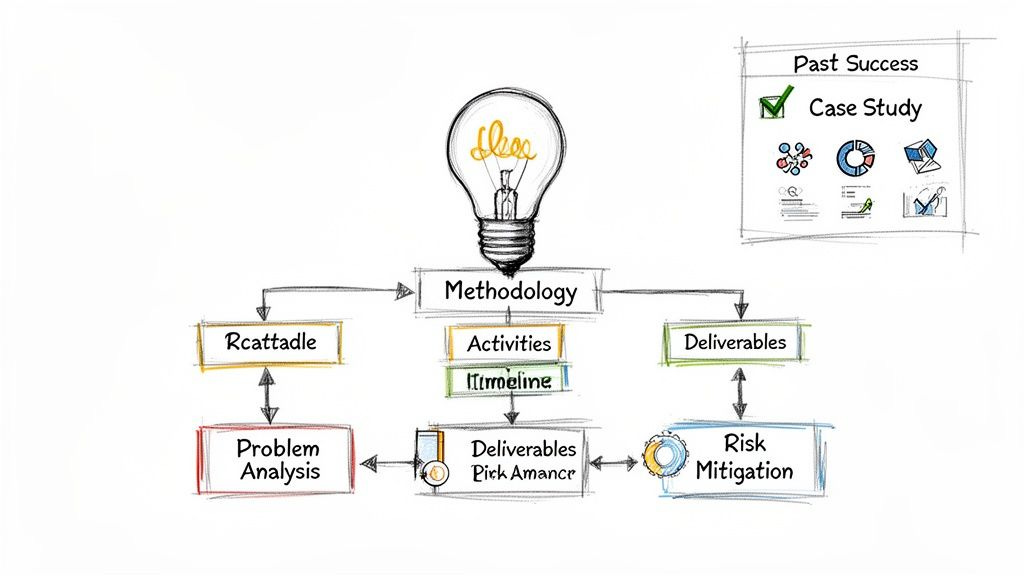
Your solution might be complex, but your explanation must be brutally simple. Use visuals to help the client “get it” in a single glance. Flowcharts, diagrams, and timelines are your best friends here.
A simple logical framework (or “logframe”) can visually connect the dots from your activities to your deliverables and, ultimately, to the project’s high-level goals. This visual map helps evaluators quickly grasp your logic and see that your plan is coherent.
Break your technical section into logical phases with clear, punchy subheadings. A common, effective structure looks like this:
Phase 1: Discovery and Diagnostic
Phase 2: Solution Design and Co-Creation
Phase 3: Pilot Implementation and Refinement
Phase 4: Full-Scale Rollout and Knowledge Transfer
Under each phase, use bullet points to list the key activities and the specific deliverable that comes out of each one. This makes your entire approach scannable and dead simple for the evaluation committee to follow and score. You’re making it easy for them to choose you.
Building a Competitive and Profitable Budget
Pricing your consulting work is a delicate dance. Go too high, and you’ll get screened out before they even read your technical proposal. Go too low, and you leave money on the table and make the client question if you’re experienced enough for the job.
Your budget is a statement about your professionalism and credibility. A sloppy, confusing budget hints at sloppy, confusing work. A clear, well-justified financial proposal builds immediate trust.
Deconstructing the Consulting Budget
Your financial proposal needs to be completely transparent. The goal is to show the client exactly what they’re paying for, linking every dollar back to the value you’re promising to deliver.
This approach demystifies your pricing and proves you’ll be a responsible steward of their funds. For any standard M-Bank or UN proposal, your budget will almost always be broken down into these core line items:
Consultant Fees (Remuneration): This is the heart of your budget. It’s a simple calculation: the number of days each team member will work multiplied by their individual daily rate.
Per Diems: This covers daily living costs like meals and incidentals when your team is working away from home. These are usually flat, pre-approved rates set by the client (like the UN) or based on official government allowances for that specific city or country.
Travel Costs: This bucket includes all project-related travel, from international flights for your experts to the in-country transport needed for fieldwork.
Other Direct Costs (ODCs): This is the catch-all category for any other expense directly tied to the project. Think workshop venue rentals, translation services, report printing, or specialized software licenses.
By itemizing everything, you create a clear financial story that justifies your total price.
Setting Your Consultant Day Rates
Figuring out your day rate is the most critical piece of the puzzle. It has to reflect your experience, the complexity of the work, and the going market rate for that role in that region.
Underpricing is one of the most common mistakes. It undermines your value. Research is your best friend here. Dig into public contract awards from the client, talk to colleagues in the field, and look up industry benchmarks to find a competitive range. You can also check out our guide on the financial differences between being an MDB consultant versus a full time employee.
Don’t pull your day rate out of thin air. Base it on hard data. A rate that’s too low can be just as damaging as one that’s too high, as it makes evaluators question your experience and the quality of your work.
Once you’ve settled on a rate, you have to tie it directly to your work plan. The number of “expert-days” you budget for each person must perfectly match the tasks and timeline you’ve laid out. If your work plan says a task will take 10 days, your budget must show 10 days of that expert’s time. No exceptions.
Presenting Your Budget with Confidence
How you present the numbers is just as important as the numbers themselves. The financial proposal should always be a separate document from the technical one, but the two must be in perfect sync.
Here’s a simple, clear format that works every time:
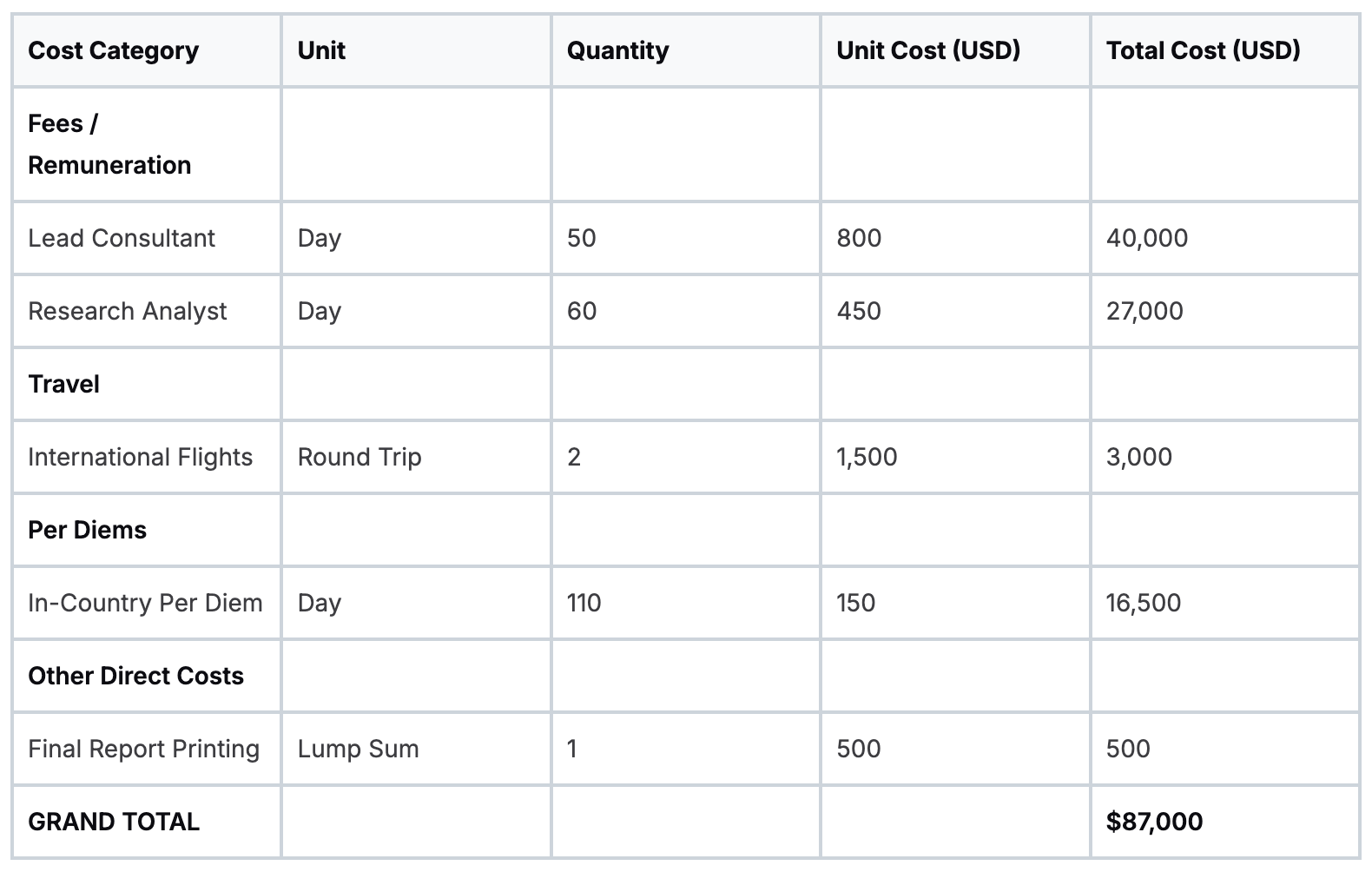
This level of detail leaves no room for doubt. The client can see exactly how you arrived at your final figure, which builds confidence in your ability to manage their project. A well-structured budget signals a well-structured project, making it easier for the client to say yes.
Avoiding Common Proposal Pitfalls
I’ve reviewed more proposals than I can count. After a while, you start to see the same unforced errors that get otherwise qualified consultants kicked out of the running.
Learning how to write a winning proposal is about sidestepping these mistakes as much as it is about nailing the structure. These are the recurring, deal-killing blunders I’ve seen sink countless bids. Get this part right, and you’re ahead of most of the competition.
The Copy-Paste Catastrophe
This is the number one mistake, and it’s painfully obvious to an evaluator. Boilerplate language screams that you haven’t invested real time or thought into the client’s specific problem. It’s a sign of laziness and, worse, shows a fundamental lack of respect for their challenge.
When a proposal is littered with generic fluff like “leveraging best-practice methodologies” or “implementing a synergistic approach,” it’s an immediate red flag. The client wants a plan built just for them.
How to Fix It: Your proposal should feel like a direct continuation of your earlier conversations. Reference specific points from the Terms of Reference (ToR) and use the client’s own language. If they call it a “logistics bottleneck,” you call it a “logistics bottleneck.” This simple act of mirroring proves you were listening.
Vague Objectives and Fuzzy Outcomes
Another classic mistake is a proposal filled with cloudy objectives and no measurable outcomes. Statements like “improve operational efficiency” or “enhance team collaboration” are meaningless without numbers attached. They offer no clear definition of what success looks like.
Clients need to see a straight line from their investment to a tangible result. If you can’t define what you’re going to achieve in specific, quantifiable terms, you’re asking them to take a massive leap of faith. Most won’t.
Winning proposals are built on a foundation of concrete, measurable goals. An evaluator must be able to clearly visualize the end state and understand exactly how you’ll measure success along the way.
A weak objective is “Streamline the reporting process.” A strong, measurable outcome is “Reduce the time spent on manual monthly reporting from 20 hours to 4 hours by automating data collection.” The second version gives the client a clear, quantifiable return on their investment.
Mismatched or Untailored CVs
Many consultants just tack on their standard, all-purpose CV and call it a day. This is a huge missed opportunity. The evaluation committee doesn’t care about your entire career history; they only care about the experience that is directly relevant to solving their problem right now.
A CV that highlights your experience in a completely unrelated sector just creates noise. It forces the evaluator to hunt for the relevant bits and can make them question if you’re the right fit.
How to Fix It: Every single CV you submit must be tailored. It’s non-negotiable.
Edit Ruthlessly: Cut any experience that doesn’t directly apply. A two-page maximum is a solid rule of thumb.
Reframe Your Experience: Rewrite the descriptions of past roles to spotlight the achievements that mirror what the ToR is asking for.
Write a Summary: Start each CV with a short, powerful summary that explicitly connects that person’s specific skills to the project’s needs.
Visually Cluttered and Confusing Documents
A proposal that looks like a solid wall of text is an evaluator’s worst nightmare. The people reviewing your document are often overworked and sifting through dozens of submissions. A document that’s hard to read is a document that’s hard to score well.
Poor formatting, inconsistent fonts, and a lack of white space broadcast a lack of professionalism and attention to detail. If you can’t produce a clean, professional document, it raises serious doubts about your ability to manage a complex project.
The fix is simple: use short paragraphs, clear headings, bullet points, and tables. Break up the text and make your key points easy to scan. Your proposal’s design should make the evaluator’s job as easy as possible. This small act of consideration can have a massive impact on how your entire bid is perceived.
Your Top Consulting Proposal Questions, Answered
Even with the best plan, you’re going to have questions when a high-stakes proposal is on the line. After years in this field, I’ve heard them all. Here are straight-up answers to the questions that pop up most often for consultants chasing M-Bank and UN contracts.
How Long Should My Consulting Proposal Be?
There’s no magic number. A better question to ask is, “How clear and direct is my proposal?”
M-Banks and UN agencies are bureaucratic. Their Requests for Proposal (RFPs) almost always come with strict page or word limits. You must adhere to these limits without exception.
For a standard technical proposal, aim for 15-25 pages, not including annexes like CVs. The goal is to be comprehensive without being long-winded. An evaluator would much rather read a sharp, focused 15-page document that nails every point than a rambling 50-page monster that buries the good stuff.
Use your appendices strategically. If you have detailed data, long project descriptions, or other heavy supporting evidence, move it to an appendix. This keeps the main body of your proposal clean and laser-focused on your solution.
What Is the Single Biggest Mistake to Avoid?
The biggest mistake by a long shot is submitting a generic, one-size-fits-all proposal.
Evaluators can spot boilerplate text from a mile away. It immediately tells them you haven’t bothered to understand their specific problem, and it’s a fast track to the rejection pile.
Your proposal has one job: to prove you have a custom-built solution for their unique challenge. To do that, you have to tailor every single section.
Mirror their language: Use the exact terminology you see in their Terms of Reference (ToR).
Customize the approach: Your technical methodology must directly address the specific constraints and opportunities of this project.
Tailor the team: Don’t just dump in full CVs. Every CV you include needs to be edited to highlight the most relevant experience for this specific assignment.
A generic proposal is disrespectful. A tailored one proves you’re a serious contender who has already started the work.
Should I Include Case Studies or Past Performance?
Yes. This is non-negotiable if you want to build credibility. Your claims are just words until you back them up with proof. Past performance is your proof.
You can weave these in strategically. A mini-case study can fit perfectly within your technical approach to validate a specific step in your methodology. Most RFPs also require a dedicated section on past performance or corporate experience.
For that section, create concise, one-paragraph summaries for 3-5 of your most relevant projects. Each summary should follow a simple but powerful structure:
Client & Context: Who was the client and what was the big-picture situation?
The Challenge: What specific problem were you hired to solve?
Your Actions: What were the key steps you actually took?
Quantifiable Results: What was the measurable impact of your work? Numbers speak louder than words.
This approach gives the client concrete evidence that you can deliver, which massively reduces their perceived risk in hiring you. If you’re just starting out and need to figure out how to frame your experience, you can learn more in our article about navigating short-term consultancy positions.
Your past performance is a curated collection of evidence that proves you are the lowest-risk, highest-value choice for this specific project. Frame it that way.
Ultimately, every part of your proposal should work together to create a document that is clear, compliant, and impossible to ignore.
At Multilateral Development Bank Jobs, we don’t just list opportunities; we provide the insider knowledge you need to win them. Our newsletter offers expert guides, curated job listings, and the strategic advice that helps you build a successful consulting career with the world’s top development organizations. Subscribe to get ahead. https://mdbjobs.com