

Landing a job with the United Nations feels like cracking a secret code. It’s not. It’s about strategy.
Most applicants make the same critical mistake: they park themselves on the main UN Jobs portal and wait. That’s like trying to see all of New York City from Times Square. You’re missing most of the action. The UN is a massive network of agencies, funds, and programs, each with its own hiring process and its own career site.
If you want to find the best UN job opportunities, you have to look beyond the central hub.
The Three Main Roads Into the UN
Your entire job-hunting strategy hinges on which of the three main career tracks you’re targeting. Each one has a different entry point, a different type of contract, and requires a totally different approach. Chasing all of them at once is a recipe for frustration.
Staff, Consultants, and Special Programs
Here’s the breakdown:
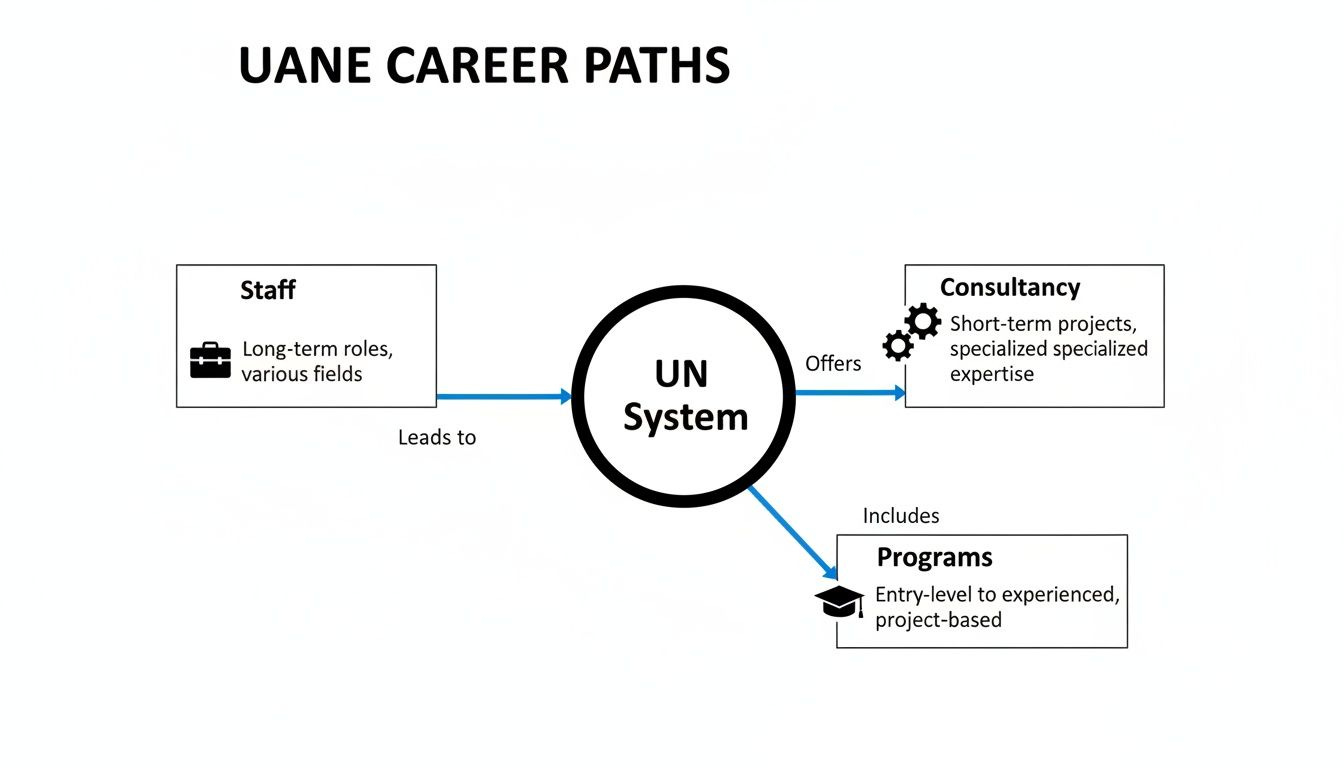
Staff Positions: These are the formal, long-term contract roles (think P-level professionals and G-level support staff) that come with the full package of benefits. They’re the most competitive and have a notoriously long and structured recruitment process.
Consultancies: These are project-based, short-term contracts for experts with a very specific skill set. They are the single best way to get direct UN experience on your CV without committing to a multi-year staff role.
Specialized Programs: These are the coveted entry-level pathways like the Junior Professional Officer (JPO) and the Young Professionals Programme (YPP). They are designed to bring in the next generation of talent.
This map gives you a visual of how these paths branch out. It makes it clear why a one-size-fits-all search just doesn’t work.
To make sense of these pathways, this table breaks down who each category is for and where you should be looking.
UN Job Categories and Entry Points at a Glance
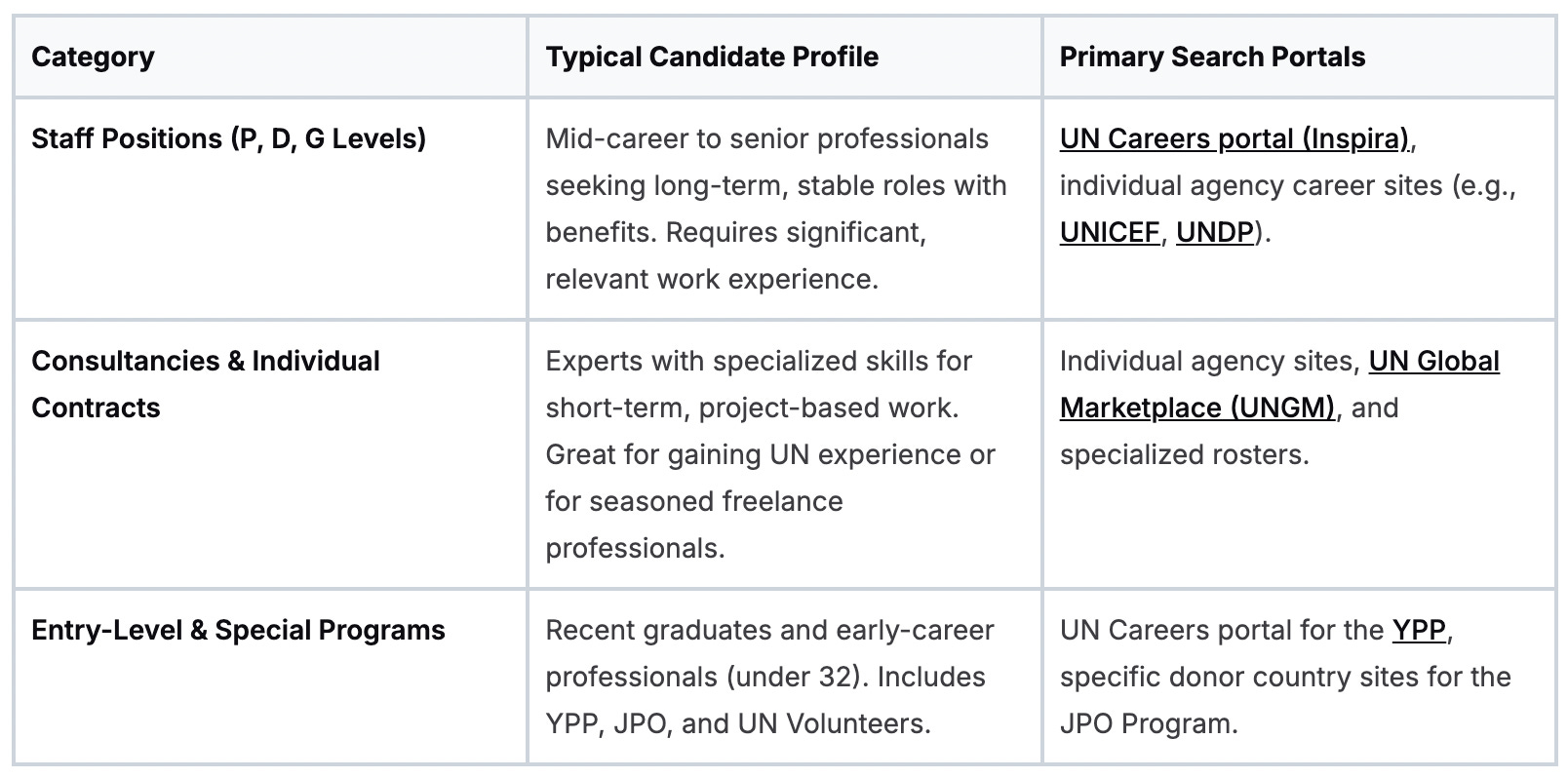
Understanding this table is the first step to a smarter search. It helps you filter out the noise and focus your energy where it counts.
The most successful candidates build a career strategy around the specific entry point that matches their experience and goals. They don’t just fire off applications into the void.
Before you go any further, decide which of these lanes makes sense for you right now. Are you an established professional ready for a P-4 role? Or are you a specialist who could rack up experience and income through a series of consultancies?
Once you have that focus, you can stop wasting time on applications that go nowhere and start targeting the UN job opportunities you can actually win.
Where to Actually Find UN Jobs (It’s Not Just One Place)
To find the best UN job opportunities, you need to think beyond the main portals. Most people camp out on the central UN Careers site, hitting refresh, and wondering why they’re not seeing the right roles.
Here’s the reality: that main portal, and its backend system Inspira, primarily serves the UN Secretariat. It’s a critical piece of the puzzle, but it’s only one piece. Relying on it alone means you’re missing a massive number of openings.
The UN is a sprawling network of specialized agencies, funds, and programs. The heavy hitters like the United Nations Development Programme (UNDP), UNICEF, and the World Food Programme (WFP) all manage their own recruitment. They have their own budgets, their own projects, and their own career pages where they post jobs that never appear on the main UN site.
This means your job search must be strategic and multi-pronged. The central portals are your gateway to the Secretariat, but the real action for specific mandates in development, children’s rights, or food security happens elsewhere.
Go Straight to the Source: The Big Agencies
The official UN Careers portal is the entry point for jobs at the UN Secretariat, certain political missions, and a few system-wide programs like the Young Professionals Programme (YPP). It’s an essential bookmark, but it’s not the whole story.
This is the homepage you’re probably familiar with. It’s structured around broad job networks and locations, which is fine for general browsing.
While this portal gets you into Inspira, its search functionality can feel like shouting into the void. To get a real edge, you have to go directly to the agencies with the most funding, the most projects, and consequently, the most jobs.
Focus your energy here:
United Nations Development Programme (UNDP): A massive agency with a constant demand for experts in governance, poverty reduction, and crisis recovery. Their jobs board is one of the most active in the entire system.
UNICEF: If your passion is children’s rights, this is the place. They hire for roles in health, nutrition, education, and child protection all over the world.
World Food Programme (WFP): As the world’s largest humanitarian organization fighting hunger, they are always looking for logistics, supply chain, and program management specialists.
UNHCR (The UN Refugee Agency): This is the front line of refugee protection. They need protection officers, legal experts, and camp managers.
World Health Organization (WHO): The global authority on public health. They hire everyone from epidemiologists to communications officers and medical doctors.
Don’t just browse. Go to each of these sites and set up tailored job alerts. Use specific keywords for your expertise and filter by your professional level (e.g., P-3, P-4). This way, relevant openings land directly in your inbox. You can learn more about where to find these specific agency listings in our guide on the best places to find UNDP job opportunities.
The “Insider” Route: Rosters and Consultancies
The fastest way to get “UN experience” on your CV is to look for consultancies.
Agencies maintain expert rosters, which are pre-vetted lists of consultants they can call upon for short-term projects. Getting on a roster means you’ve already passed the initial screening. Hiring managers can then contact you directly for an assignment, completely bypassing the long, drawn-out public vacancy process.
Rosters are the UN’s secret weapon for hiring with speed and precision. A full-time staff job can take a year to lock down, but a consultancy pulled from a roster can come together in just a few weeks. It’s a game-changer.
To find these, search for terms like “Call for Experts” or “Expression of Interest” on agency procurement sites or their main career pages. You aren’t applying for a specific job, but for a spot in their pool of qualified candidates. It’s one of the best ways to get your foot in the door.
Don’t Forget the Neighbors: Partner Organizations
Smart job seekers look beyond the UN system itself. Multilateral Development Banks (MDBs) like the World Bank and regional powerhouses like the Asian Development Bank (ADB) or African Development Bank (AfDB) are close partners with UN agencies.
They work on the same massive development projects and often need staff with similar skills. Their job boards frequently list roles requiring direct collaboration with the UN, offering another fantastic and often overlooked entry point. You might be working in the same country, on the same project, just with a different logo on your payslip. It’s a different path to the same goal.
How to Decode UN Job Announcements
Think of a UN job announcement as the first test you have to pass. If you don’t know how to read it, your application is dead on arrival. The UN’s Vacancy Announcements (VAs) are structured in a very specific way, and every detail is there for a reason. Most people get this wrong.
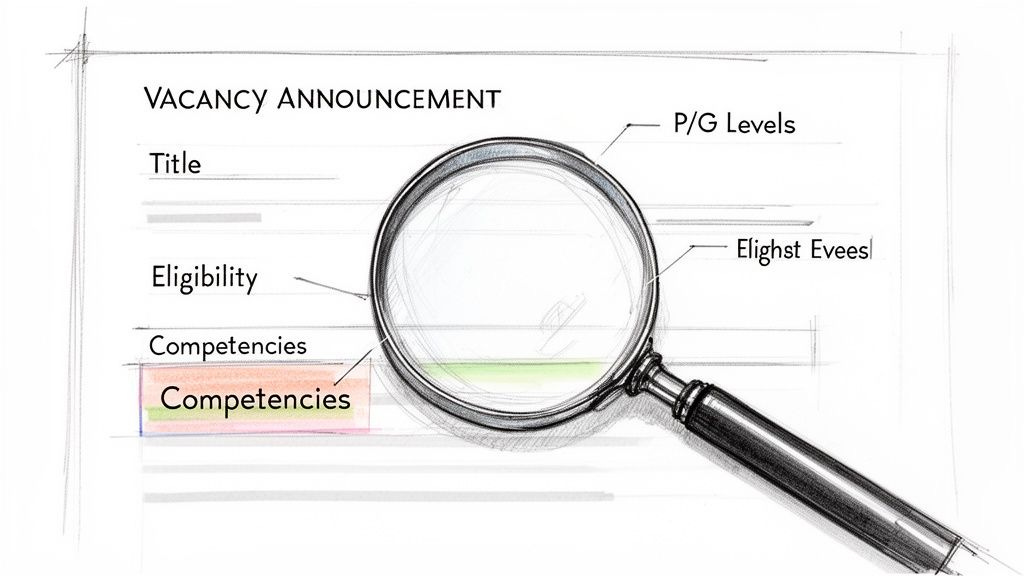
Your job is to ignore the fluff and get straight to the technical details. This is what the automated screening systems and HR officers use to make their first, brutal cuts. You have to prove, without a shadow of a doubt, that you meet every mandatory requirement.
Understanding Job Categories and Levels
First thing’s first: find the job category and grade level. This code tells you everything: the seniority, the salary, the requirements, and whether you’re even eligible to apply. Get this wrong, and you’ve wasted your time.
You’ll generally run into three main categories:
P-Level (Professional and Higher Categories): These are the internationally recruited jobs. They range from entry-level professional roles (P-1/P-2) to senior managers (P-5) and directors (D-1/D-2). These positions always require a university degree and a specific number of years of relevant professional experience.
G-Level (General Service): These are locally recruited support roles that handle administrative, clerical, and technical work. Eligibility for G-level posts is almost always restricted to nationals or legal residents of the country where the job is located.
NPO (National Professional Officer): These are professional roles, but they’re reserved for nationals of the country where the duty station is. The work requires deep local knowledge and context, like managing a country-specific program.
Don’t be the person who applies for an NPO role in Kenya when you’re not Kenyan. It’s an instant rejection. The same goes for applying to a G-level post in Geneva if you don’t have Swiss or EU residency. Check this detail before you read the rest of the announcement.
Interpreting the Core Eligibility Criteria
Once you’ve confirmed the job category, scan for the hard requirements. These are the non-negotiables that the Inspira platform or an HR officer will use to filter out 90% of applicants right away. If you don’t meet these, move on.
Look for a section titled “Qualifications,” “Education,” or “Experience and Skills.” You have to tick every single box.
Education: If the VA asks for an “Advanced university degree (Master’s degree or equivalent),” your Bachelor’s degree is not enough. The only exception is if the announcement explicitly says a “first-level university degree in combination with two additional years of qualifying experience may be accepted.” If it doesn’t say that, it’s a hard no.
Work Experience: The UN is incredibly literal about this. If a P-3 role requires “a minimum of five years of progressively responsible experience,” you must be able to prove you have at least 60 months of relevant work under your belt. If you have 59 months, the system will likely screen you out.
Language: When it says “fluency in English is required,” they mean you can operate at a high professional level. If another language is listed as “desirable,” having it gives you a massive advantage over other otherwise qualified candidates.
This is pure gatekeeping. The first screening round is often automated. If your profile doesn’t match the minimum years of experience and educational degree required to the letter, a human being will never see your application.
The Most Important Section: The Competencies
Okay, you meet all the hard requirements. Congratulations, you’ve made it past the first filter. Now comes the part that really matters: dissecting the “Competencies” section. This is the heart of the job announcement and the key to getting an interview.
The entire UN hiring process is built on a competency-based framework. The organization has a pre-defined set of skills and behaviors it looks for, and hiring managers are required to assess every candidate against them.
You’ll always see a list of core competencies, like:
Professionalism: Showing you’re an expert in your field and take pride in your work.
Teamwork: Demonstrating you can work well with colleagues to hit shared goals.
Planning & Organizing: Proving you can set clear goals and manage priorities effectively.
Communication: Speaking and writing in a clear, effective, and persuasive manner.
Client Orientation: Showing you can build and maintain productive relationships with partners.
These are not buzzwords. They are the exact criteria you will be scored against. Your entire application, your cover letter and your Personal History Profile (PHP), needs to be laser-focused on providing concrete examples of how you have demonstrated these exact competencies in your previous jobs. If you fail to do this, you will not get an interview. It’s that simple.
Crafting an Application That Beats the System
Let’s get one thing straight: your standard corporate resume and cover letter are useless here. The UN system operates on its own unique logic. If you just fire off a generic application, you’ve already lost. Success means meticulously building your profile within their specific framework, which is almost always the Personal History Profile (PHP) found in portals like Inspira.
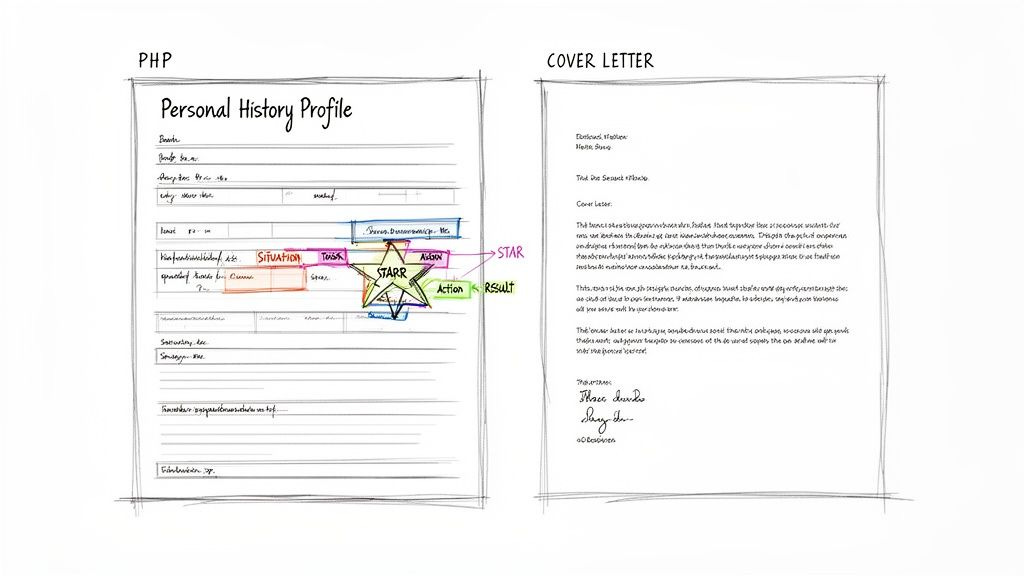
The PHP isn’t a simple resume upload. It’s a detailed, structured database entry. An algorithm will screen this long before a human ever sees it. Your entire focus needs to be on translating your experience into the precise language and format the system is built to recognize.
This means you must reframe your entire career history as a series of competency-based achievements. It’s a completely different way of thinking about your background, but it’s the only way to get noticed.
Frame Everything with the STAR Method
The single most powerful tool in your arsenal for the PHP and your cover letter is the STAR method. It forces you to stop listing what you were responsible for and start showing the impact you made. This is the exact language UN hiring managers are trained to look for.
Every significant achievement in your work history should be a compact STAR story.
Situation: Briefly set the scene. Where were you, and what was the challenge or context?
Task: What was your specific assignment? What goal were you tasked with achieving?
Action: Detail the specific steps you took. Use strong action verbs and own your contribution.
Result: What happened because of your actions? Quantify it. Use numbers, percentages, and hard, concrete outcomes.
This approach transforms your application from a passive laundry list of duties into an active portfolio of accomplishments. It gives the screeners the evidence they need to check the box next to each competency in the job description.
Building Your Personal History Profile
The PHP is exhaustive and tedious. But cutting corners here is a fatal mistake. Every single field you fill out is a data point that gets scored by the system. My advice: fill out everything completely, even sections that seem redundant.
When you get to describing your past roles, don’t just copy and paste from an old job description. For each position, write several bullet points, each one a self-contained STAR example.
Let’s take a project manager role targeting the “Planning & Organizing” competency.
Weak Statement: “Responsible for project planning and budget management.”
Strong STAR-based Statement: “As project lead on a $500,000 public health initiative in a post-conflict region (Situation), I was tasked with delivering the project on time despite severe supply chain disruptions (Task). I developed a new risk-mitigation matrix and renegotiated vendor timelines, holding weekly coordination meetings with three separate field teams (Action). This resulted in the project completing 2 weeks ahead of schedule and 10% under budget, directly supporting 5,000 beneficiaries (Result).”
See the difference? The second version gives them concrete, verifiable proof of the competency. It’s what gets you past the algorithm and onto a human’s desk.
Writing a Cover Letter That Gets Read
Your cover letter, often called a “motivation letter” in UN circles, has one job: to serve as a direct, point-by-point response to the vacancy announcement. This is not the place for your life story or a vague summary of your career dreams.
It needs to be a concise, hard-hitting document that explicitly maps your best qualifications to the job’s most critical requirements.
A structure that consistently works looks like this:
Opening: Right away, state the exact job title and vacancy number. In that first paragraph, give them a powerful one-sentence summary of why your specific profile is a perfect fit for this role.
Body Paragraphs (2-3): This is where you connect the dots. Pick the two or three most important competencies or requirements from the job announcement. Dedicate one paragraph to each, using a solid STAR example to prove you have that skill.
Closing: Reiterate your strong interest and your confidence that your skills will directly benefit their team. Keep it professional and short.
Your goal is to make the hiring manager’s job easy. You’re saying, “You asked for X, here is a specific example of when I did X and achieved Y result.” Anything else is just noise. This approach of crafting a targeted, results-focused document is valuable in many contexts; for instance, you can find similar advice in our guide on how to write a consulting proposal.
Your cover letter is the bridge between your PHP and the job opening. A great letter tells the reviewer which parts of your detailed PHP are most relevant to this specific role, saving them the work of connecting the dots themselves.
This targeted strategy is essential for navigating the complex world of UN job opportunities. It proves you understand the system and respect the recruiter’s time, which immediately puts you far ahead of the pack.
Passing the Tests and Nailing the Interview
Let’s get you past the screening stage. If your application made the cut, take a moment to celebrate. You’ve successfully navigated the UN’s applicant tracking system, and a real person now believes you might be the one for the job.
But don’t get too comfortable. The real test is just beginning. Now, you’ll have to prove you can do the work. This usually means facing one or more assessments designed to separate contenders from pretenders.
This is where the rubber meets the road. The hiring manager’s goal is simple: they want to de-risk their choice by seeing your skills in action before investing time in a formal interview.
What you’ll face depends entirely on the role. A communications officer might be asked to draft a press release against a tight deadline. A data analyst could get a messy dataset to clean and interpret. A project manager might need to whip up a presentation on handling a project crisis. There’s no one-size-fits-all test here.
Cracking the Written and Technical Tests
The secret to these assessments isn’t just delivering a perfect final product. It’s about managing your time and showing your thought process. They want to see how you think under pressure.
Here’s how to handle them:
Dissect the Instructions: Read the prompt two, even three times. If anything is remotely unclear, ask for clarification. Misunderstanding the task is the fastest way to get disqualified.
Show Your Work: Before you start writing, sketch out a quick outline. If it’s a technical test, comment on your code or explain your steps. You need to let the evaluator see how you’re solving the problem, not just the solution itself.
Connect to the Competencies: Remember those core competencies from the job post? They aren’t just for the interview. If “Client Orientation” is a key requirement, frame your response around stakeholder needs. If it’s “Planning & Organizing,” your answer better be structured, logical, and impeccably organized.
These tests are designed to weed out candidates who look great on paper but can’t deliver in practice. Don’t overthink it. Provide solid, professional work that directly answers the question.
The Main Event: The Competency-Based Interview
This is where most otherwise qualified candidates fall apart. They walk in ready for a friendly chat about their career history and their passion for the UN. The panel couldn’t be less interested.
A UN interview panel is not there to get to know you. They have a scorecard listing the job’s core competencies, and their only function is to score your answers against those criteria. It’s a methodical, evidence-gathering exercise.
Your interview is not a conversation; it’s an oral exam. The panel has a checklist, and they are looking for specific, evidence-backed examples that prove you possess each competency. If you don’t give them those examples, you get a low score, and you don’t get the job.
This is why your preparation needs to be surgical. You must walk into that room with a pre-loaded arsenal of STAR method examples, one for each competency listed in the job announcement.
Building Your Arsenal of STAR-Based Answers
Before the interview, you need to map your best career stories directly to the required competencies. For a P-3 role that requires “Teamwork,” “Communication,” and “Professionalism,” you need at least one bulletproof example for each.
Let’s break down a classic question: “Tell us about a time you had a conflict with a colleague.”
Weak Answer: “I once had a disagreement with a team member about a project. We talked it out and eventually found a solution. We have a good working relationship now.” This is vague, generic, and gives the panel nothing to score.
Strong STAR Answer: “In my role at XYZ organization, a key subject matter expert on my team strongly disagreed with our project’s data collection methodology (Situation). My responsibility was to resolve this without delaying our reporting deadline (Task). I scheduled a one-on-one meeting to fully understand their concerns, then facilitated a technical workshop for the whole team. In that meeting, we reviewed the methodology against the project’s core objectives, and I made sure their perspective was heard and incorporated their suggestion for an additional quality check (Action). As a result, the team member endorsed the final methodology, we met our deadline, and the donor later praised the data for its accuracy (Result).”
See the difference? This answer is a home run. It directly demonstrates Teamwork, Communication, and Professionalism. It’s specific, packed with evidence, and gives the panel exactly what they need to tick their boxes with high marks.
Managing the Panel and Asking the Right Questions
UN interviews are almost always conducted by a panel of three to five people. It can be intimidating. You’ll likely have the hiring manager, someone from HR, and a couple of subject matter experts. Address your answer to the person who asked the question, but make sure to pan your eye contact across the entire panel.
At the end, they will always ask if you have questions for them. Your answer should never be, “No, you’ve covered everything.” This is a rookie mistake that makes you seem disengaged. This is your final chance to shine.
Avoid: “What are the benefits?” or “When will I hear back?” (These are for HR, later).
Ask: “What would you see as the biggest challenge for the person in this role in their first six months?” or “How does this team’s work contribute to the agency’s broader strategic goals for the region?”
These kinds of questions prove you’re already thinking like a member of the team. It’s your last opportunity to reinforce your professionalism and lock in your spot as the top contender for that coveted UN job opportunity.
Answering Your Top Questions About UN Jobs
Trying to land a UN job brings up a ton of questions. The official answers are often buried in jargon, and getting it wrong can sink your application before it even gets read. Here are the straight answers to the most common questions I get from candidates.
How Long Does the UN Recruitment Process Actually Take?
You need to be patient. Seriously. The UN recruitment timeline is notoriously slow, and there’s nothing you can do to speed it up. For staff positions, expect to wait anywhere from four months to well over a year between the application deadline and a final offer.
This marathon process involves a series of bureaucratic hurdles: longlisting, shortlisting by the hiring manager, technical tests, competency-based interviews, reference checks, and a final sign-off from a central review body. It’s a slow-moving machine.
Consultancy roles, on the other hand, move much faster. Because they’re tied to urgent project needs, you can get from application to offer in just one to three months. My advice? Apply for every role that fits your profile, and then try to forget about it while you pursue other opportunities.
Is a Master’s Degree Mandatory for P-Level Jobs?
For most Professional (P-level) and Director (D-level) jobs, the answer is yes. An advanced university degree, a Master’s or PhD, is the standard. This is one of the first filters HR and the automated screening systems use, and it’s not flexible.
But there’s a critical exception to watch for. Some job announcements will explicitly state that a first-level university degree (a Bachelor’s) combined with two additional years of qualifying work experience can be substituted for the Master’s. If that specific sentence isn’t in the vacancy, a Bachelor’s degree alone will get your application screened out instantly.
For General Service (G-level) roles, a high school diploma is typically all that’s required.
What Are My Chances Without Previous UN Experience?
It is absolutely possible to get a UN job without ever having worked in the system. I’ve seen it happen countless times, but you have to be smart about it. You can’t just throw your corporate resume over the wall and expect a hiring manager to connect the dots.
The trick is to meticulously translate your experience. Your Personal History Profile (PHP) and cover letter are your tools to show exactly how your past achievements line up with the UN’s competencies. Frame your skills, project management, stakeholder engagement, cross-cultural communication, using the STAR method they expect.
A powerful strategy for breaking in is to target consultancies. They’re less competitive than staff roles and are the single best way to get that crucial “UN experience” on your CV. Once you have it, you become a much more credible candidate for permanent staff positions down the line.
Can I Negotiate My Salary for a UN Position?
For any fixed-term staff position, whether P-level or G-level, the salary is non-negotiable. Full stop. The UN operates on a global salary scale determined by the job’s grade (like P-3 or G-5), the cost of living at the duty station, and your number of dependents.
HR will calculate your “step” within that grade based on a rigid formula tied to your years of relevant experience. There is zero room for bargaining. Our guide to UN staff benefits and entitlements breaks down exactly how this works.
Consultancy contracts are a different story. Here, there is often some flexibility to negotiate your daily or monthly fee. Your leverage comes down to your level of expertise, the urgency of the project, and how badly they need your specific skillset.
At Multilateral Development Bank Jobs, we demystify the hiring processes for the UN and the entire world of MDBs. Sign up for our newsletter to get weekly job listings and insider guides delivered straight to your inbox. Find your next opportunity at
https://mdbjobs.com
.