

If you want to work for an institution like the World Bank, you need to understand one core concept: Results-Based Management (RBM).
Forget traditional project management. RBM is the discipline of managing for outcomes. It forces organizations to answer the one question that truly matters: did our work actually make a difference?
This is the entire philosophical foundation for how modern development work gets done.
Shifting Focus from Activities to Impact
Here’s the difference. A traditional project manager is tasked with building a bridge. Success is declared when the bridge is finished on time and within budget. Job done.
RBM pushes further. It asks the critical follow-up questions:
Did that bridge actually cut commute times?
Did it boost local commerce?
Did it connect a remote village to healthcare services?
Those were the real goals. The bridge was just the tool.
This distinction is everything in the world of Multilateral Development Banks (MDBs). They aren’t in the business of building bridges; they’re in the business of improving lives. Grasping this is the first step to proving you understand how these institutions define success.
To make this clearer, let’s look at how the focus shifts.
Traditional Management vs. Results-Based Management
This table breaks down the fundamental shift in thinking. It’s all about moving from what we do to what we change.
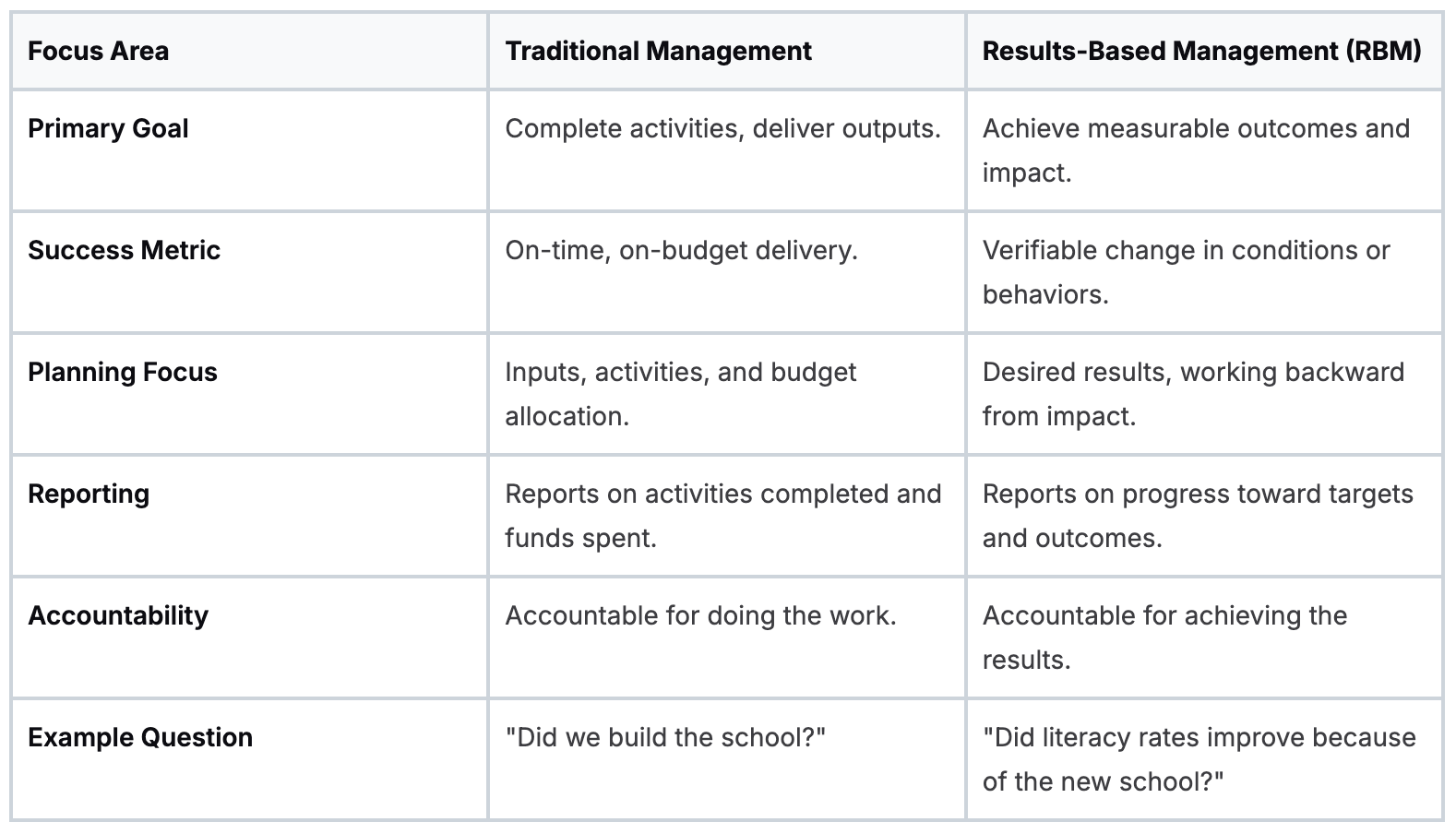
As you can see, RBM is a completely different mindset. It forces project teams to be accountable for their effectiveness, not just their effort.
From Outputs to Outcomes
At its heart, RBM is about moving your attention from outputs to outcomes.
Outputs are the immediate, tangible products of your activities. Think: 500 healthcare workers trained, or 10,000 textbooks distributed. They’re easy to count and important to track, but they are only part of the story.
Outcomes are the short- to medium-term changes that happen because of those outputs. Did the trained healthcare workers actually lower patient mortality rates? Did the new textbooks lead to better literacy scores? That’s the real prize.
The fundamental question in RBM is “What changed because of what we did?” This simple pivot changes how projects are designed, managed, and evaluated from day one.
Understanding this framework is non-negotiable for a career in this sector. For a broader look at the landscape, you can learn more about international development and its core principles.
MDBs structure their entire project lifecycle around proving impact, and RBM is the operating system they use. It provides the backbone for accountability, ensuring that billions of dollars are directed toward efforts that deliver real, verifiable results for the communities they serve.
The Core Components of RBM You Need to Know
To get your head around results-based management, you have to understand the machinery under the hood. RBM is a structured approach built on a few key, interconnected parts. Once you see how they click together, the whole system makes sense.
At its core is the Results Chain, the logical roadmap showing how a project creates change. Think of it as a cause-and-effect pathway, starting with simple actions and leading to long-term impact. It forces you to clarify exactly how you expect your work to translate into meaningful results, instead of just crossing your fingers.
The Results Chain Explained
The Results Chain connects every single stage of a project. Each step is a prerequisite for the next, creating a clear line of sight from your budget all the way to your ultimate goal.
Here’s the standard progression:
Inputs: The resources you start with: funding, staff time, equipment.
Activities: The tasks you perform with those inputs, like conducting training workshops or building infrastructure.
Outputs: The direct, tangible products of your activities. For example, 50 teachers are trained, or 10 new wells are constructed. You can count these easily.
Outcomes: The short- to medium-term changes that happen because of your outputs. This could be improved teaching quality or increased access to clean water for 5,000 people.
Impact: The long-term, high-level change you contributed to, like higher graduation rates or a measurable reduction in waterborne diseases.
This diagram shows how RBM flips the traditional model. It shifts the focus from just planning and doing things to ensuring those activities deliver real, measurable change.
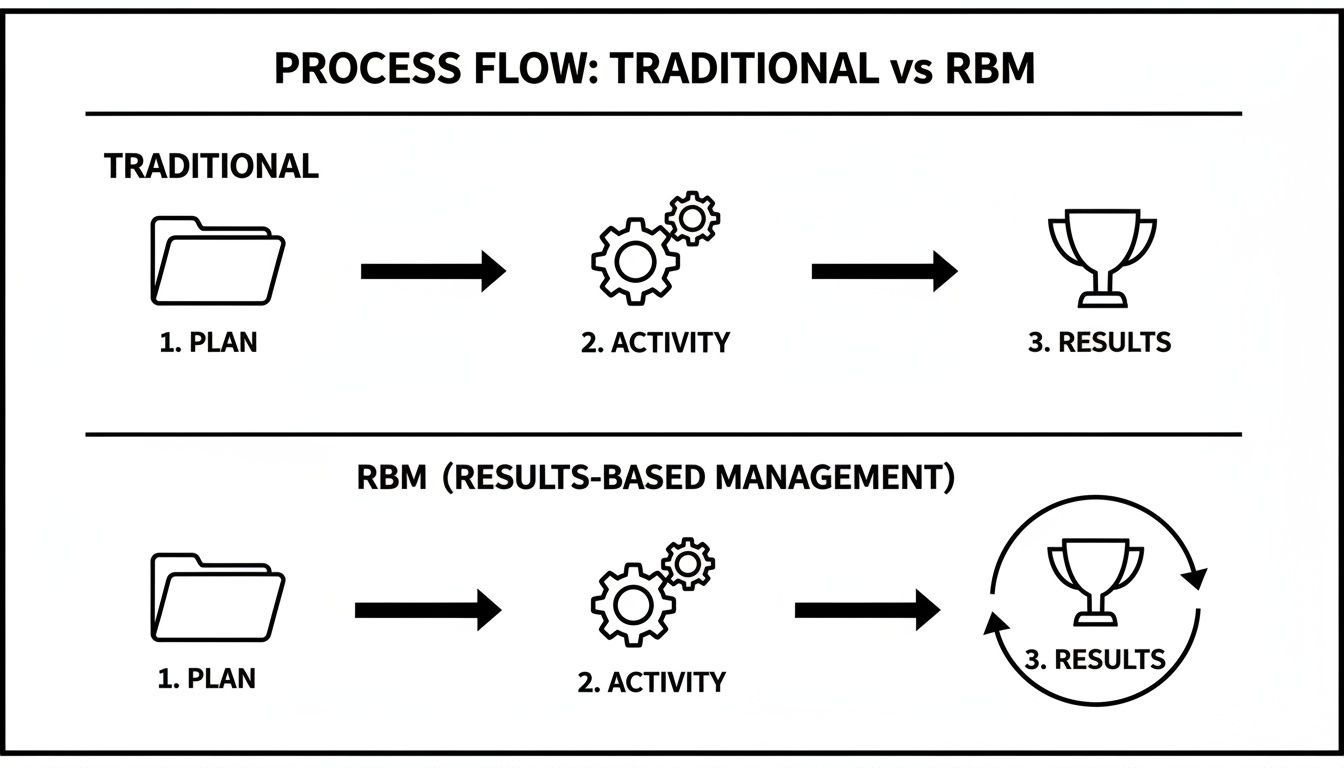
RBM creates a feedback loop. The results you achieve inform your future plans and activities, making it a dynamic cycle of learning and improvement, not a one-and-done linear process.
Defining Your Metrics for Success
The Results Chain gives you the map, but you need signposts to know if you’re on track. That’s where the other core components come in. They provide the hard data needed to prove your project is working.
An indicator is the evidence. It’s how you prove a project is actually working, not just busy.
These next three components are the bread and butter of MDB job descriptions and project documents, so pay close attention.
Performance Indicators: These are the specific, measurable metrics you use to track progress. An indicator for a vocational training program might be the “percentage of graduates employed within six months.” Good indicators are always clear, relevant, and verifiable.
Baselines: This is your starting point. It’s the measurement of an indicator before your project begins. If your goal is to increase farmers’ income, the baseline is their average income today. Without a baseline, you have no way to prove you’ve made a difference.
Targets: This is your finish line. It’s the specific value you want your indicator to reach by a certain time. You might set a target to “Increase average farmer income by 25% within three years.” Targets make your goals concrete and hold the project accountable.
Put them all together, and you have a robust framework. The Results Chain defines the logic, while indicators, baselines, and targets provide the measurable proof. This is exactly how MDBs move from simply funding activities to managing for verifiable, life-changing impact.
How MDBs Apply RBM in Real-World Projects
In Multilateral Development Banks (MDBs), results-based management is the operational language spoken every day.
This is how billions of dollars get planned, spent, and accounted for across the entire project lifecycle. It starts with the initial proposal and continues until the final evaluation report is written. If you want to work in this space, you must understand how RBM works on the ground.
RBM is an active management strategy that shapes decisions in real time.
Imagine an MDB is running a rural electrification project. The RBM framework constantly tracks progress. If data shows one region is falling behind its targets for new household connections, managers don’t just wait. They act.
They use the framework to figure out why. Is it a supply chain issue? A lack of community buy-in? Once they diagnose the problem, they can reallocate resources or tweak the implementation strategy. This adaptive approach is central to how MDBs operate; it allows them to steer massive, complex projects toward their intended outcomes by making necessary course corrections.
RBM as an Accountability Mechanism
For MDBs, RBM is the primary way they prove they’re getting the job done. These institutions spend taxpayer and donor funds, and they are on the hook to deliver tangible improvements. RBM provides the transparent framework to show their work.
RBM provides the evidence that answers the ultimate question for any development project: “Did this investment actually make a difference in people’s lives?” It shifts the focus from good intentions to proven impact.
This evidence-based approach has become the standard across major international organizations. A 2019 review of 12 United Nations organizations found that RBM was being most effectively implemented in strategic planning and programme development.
This signals a huge shift away from simply tracking how much money was spent. The review estimated that the mainstreaming of RBM had improved by 30-40% since 2009. For a deeper dive, you can explore the full findings of this UN system review.
The Operational Language of MDBs
When you crack open a project document from the World Bank or the African Development Bank, you’re seeing RBM in action. The project’s goals are laid out as measurable outcomes. The budget is tied directly to specific results. The monitoring plan is built around tracking performance indicators against baselines and targets.
For anyone looking for a job in this sector, this is need-to-know information.
Being fluent in RBM shows you understand how these organizations think, operate, and define success. It proves you can contribute to a culture that prioritizes evidence over effort and impact over activity. For those serious about working within these systems, a deep dive into an MDB like The World Bank is a great next step. This knowledge is the core competency that signals you’re ready to contribute from day one.
Mastering Key RBM Tools and Frameworks
Results-based management runs on specific tools that turn principles into practice. Think of these as the blueprints project managers use to design, monitor, and report on their work inside MDBs.
Getting fluent in these tools gives you a massive advantage. You’re learning the practical, day-to-day language of the hiring managers and project teams you want to join.
The centerpiece of RBM is the Logical Framework Approach, known almost everywhere as the LogFrame. It’s a simple matrix that lays out the entire results chain, showing exactly how activities and outputs are supposed to lead to outcomes and, eventually, impact.
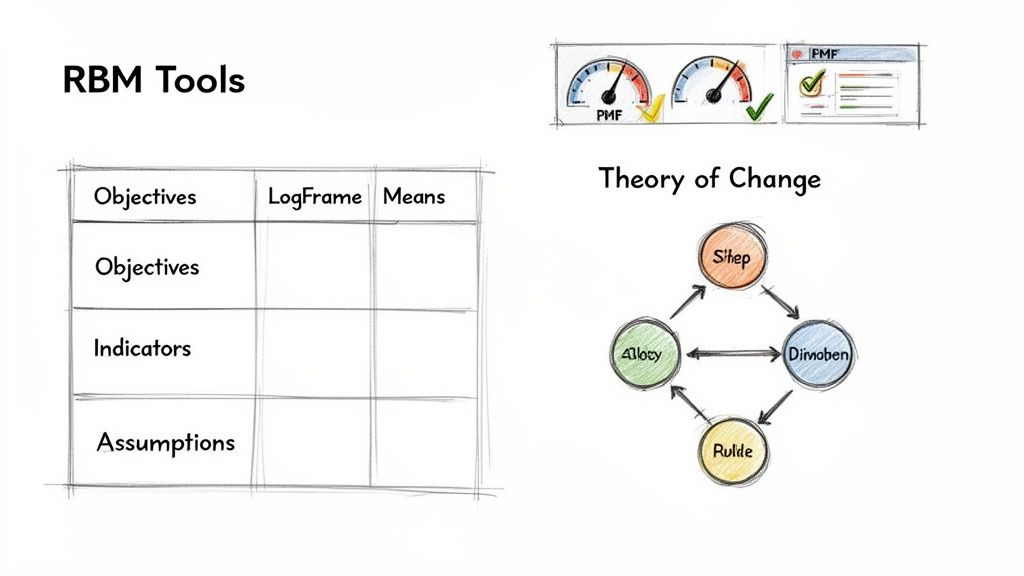
This is where all the pieces click together: the results hierarchy, the indicators you’ll use to track progress, and the assumptions or risks that could throw the whole thing off course. It’s the primary tool for making sure a project’s design is solid from the get-go.
The Theory of Change
The LogFrame gives you the structure, and the Theory of Change (ToC) tells the story. It’s a more narrative map that shows the causal pathway from what you do to the ultimate change you hope to see. A good ToC forces the team to get honest about the “how” and “why” behind their strategy.
For instance, a ToC might map out how providing micro-loans (activity) allows women to launch small businesses (output). This leads to higher household incomes (outcome), which ultimately helps reduce poverty in their community (impact). It makes your logic explicit so it can be tested and proven.
The LogFrame is the project’s skeleton, the essential structure. The Theory of Change is the narrative that brings that skeleton to life, explaining how all the parts work together to create movement.
The Performance Measurement Framework
Finally, there’s the Performance Measurement Framework (PMF). If the LogFrame is the blueprint, the PMF is the dashboard you use once the project is running. It takes the indicators from the LogFrame and makes them operational.
Specifically, the PMF spells out:
The precise definition of each indicator
The baseline data and the final target
Who is responsible for collecting the data
How often that data will be collected
This is the tool that powers RBM’s accountability. Its impact is well-documented. In Canada, for example, 75% of government agencies reported better decision-making after they implemented RBM systems built around clear PMFs. You can dig into the data by reviewing these lessons from public sector reforms.
Key RBM Tools and Their Purpose in MDBs
Here’s a quick cheat sheet on the main RBM tools and how they fit into the MDB project cycle. Understanding the distinct role of each one is crucial.
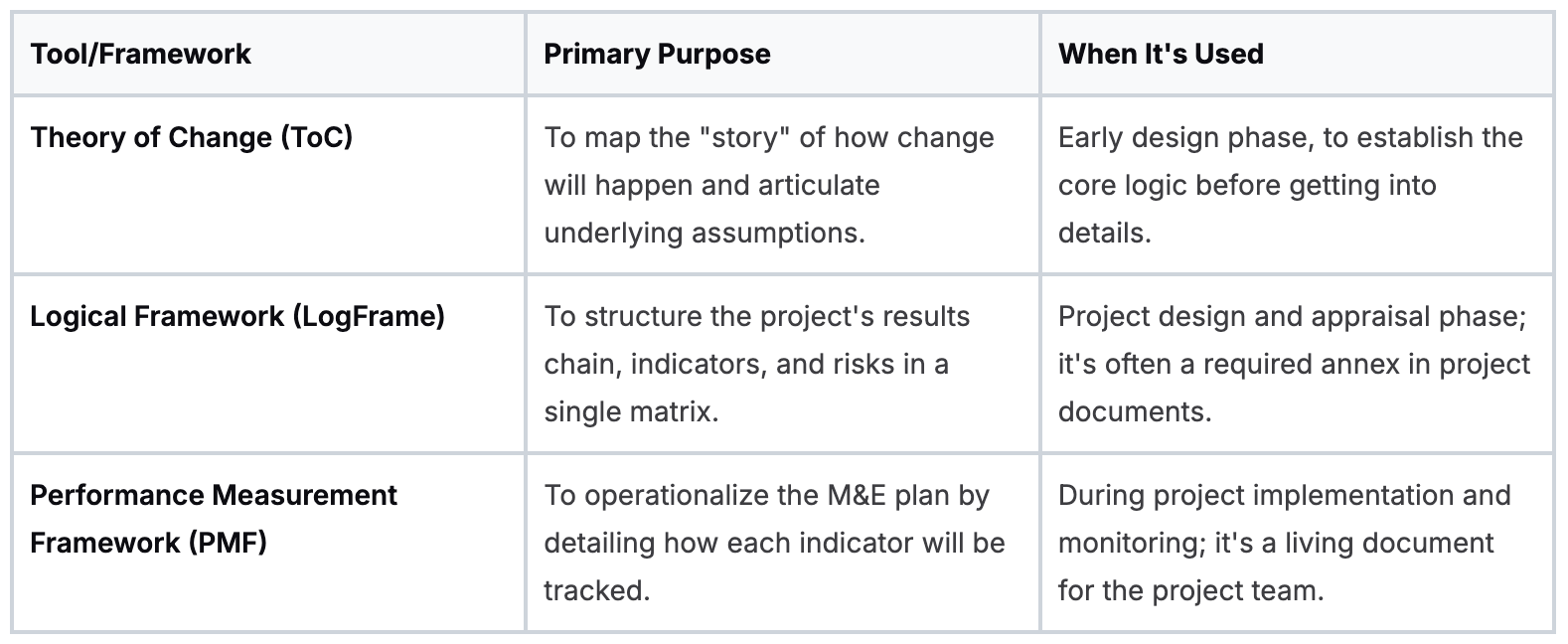
These frameworks are the core instruments used by teams to manage for real, measurable results.
Together, the LogFrame, ToC, and PMF form the practical toolkit for anyone working on MDB-funded projects. They are the instruments used to steer projects toward tangible, meaningful impact. Mastering them means you’re ready to hit the ground running.
How to Show Recruiters You Actually Know RBM
Knowing the definition of results-based management is one thing. Proving you can do it is something else entirely. Recruiters aren’t looking for someone who can recite a textbook. They want to see that you think, act, and speak the language of results.
This is where you translate theory into a compelling reason to hire you. You have to weave RBM principles into your CV and interview answers, showing them you’re ready to contribute.
It’s all about showing, not telling. Use your CV to frame your achievements in a way that screams RBM. It requires a subtle but powerful shift in language from what you did to what you achieved.
Fine-Tuning Your CV for RBM Roles
Your CV is the first signal you send. Replace bland phrases with specific statements that prove you understand the results chain.
Here are a few before-and-after examples:
Instead of: “Managed a project budget.”
Try this: “Aligned project expenditures with key performance indicators to ensure resources directly supported outcome achievement.”
Instead of: “Responsible for project monitoring.”
Try this: “Developed and implemented a performance measurement framework to track progress against established baselines and targets.”
Instead of: “Wrote project reports.”
Try this: “Authored quarterly reports analyzing performance data to inform adaptive management decisions.”
These small changes carry a lot of weight. They show you get it: MDBs manage for impact, not just to tick off a list of activities. For a deeper dive on positioning your experience, check out our guide on how to land jobs in the MDB sector.
Nailing the RBM Questions in Your Interview
In the interview, you need to bring your CV to life with concrete examples. This is where the STAR method (Situation, Task, Action, Result) becomes your best friend. It’s a simple storytelling structure that forces you to focus on the outcome.
When an interviewer asks about a project you managed, frame your story like this:
Situation: Briefly set the scene and describe the problem.
Task: Explain your specific role and the goal you were tasked with achieving.
Action: Detail the steps you took. Highlight how you used RBM principles, like analyzing baseline data to set realistic targets or using indicator feedback to adjust project activities mid-stream.
Result: Quantify the outcome. What changed because of what you did? Use hard numbers and data.
The “R” in STAR is where the magic happens. It’s the proof you delivered a result, not just an output. It’s the difference between saying, “I ran a training program,” and saying, “I ran a training program that increased participant skill retention by 40%.”
This structured approach shows you have a practical, working knowledge of results-based management. It proves you’ve moved beyond the jargon and internalized the mindset.
Organizations are hungry for this. The World Health Organization found that by applying RBM, their country offices aligned 80% of budgets to key priorities, which in turn improved technical support coordination by 50%. You can read more on WHO’s RBM implementation to see how powerful this is in practice.
Common RBM Mistakes You Should Avoid
Knowing the theory is one thing, but real expertise comes from understanding where things go wrong. Recognizing these common pitfalls is what separates a thoughtful practitioner from someone rattling off jargon. It’s also what separates the top candidates in an interview.
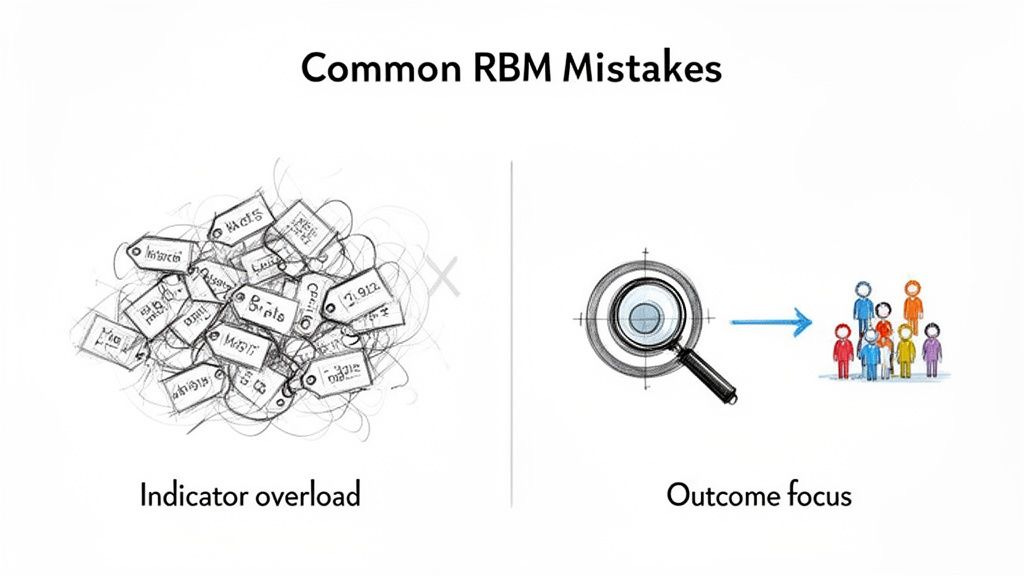
A classic trap is indicator overload. Organizations build massive dashboards tracking dozens of metrics, thinking more data means better management. In reality, it just creates analysis paralysis. The team gets so buried in collecting data that they lose sight of the outcomes that actually matter.
Confusing Busyness with Progress
Another common mistake is getting outputs and outcomes mixed up. It feels good to celebrate things you can count, like holding 20 workshops or training 500 people. These are outputs, plain and simple. They’re activities.
The real test is whether those activities led to meaningful change. Did the skills people learned in those workshops help them get better jobs or increase their income? That’s the outcome, and in a real RBM system, it’s the only thing that proves your project worked.
RBM fails when teams celebrate what they did instead of what they changed. The goal is not to be busy; it’s to be effective.
Sticking to a Broken Plan
Finally, teams treat their RBM frameworks, like the LogFrame, as if they were carved in stone. Once the project kicks off, the plan becomes sacred. This is a huge mistake.
The whole point of collecting performance data is to learn and adapt. A well-run RBM system is a living tool. It’s your early warning system, telling you when your initial assumptions were wrong or when the world has shifted.
A project that rigidly sticks to a failing plan just because it’s “the plan” is destined to deliver poor results. Being willing to pivot based on evidence is the hallmark of a mature and effective RBM culture.
Answering Your Questions on Results-Based Management
When you first dive into MDBs, RBM can feel like more jargon. Let’s cut through the noise and tackle the most common questions.
Is RBM Just for Monitoring & Evaluation Specialists?
No. While M&E specialists are the technical gurus, RBM is a bank-wide philosophy, not a departmental tool. It’s a fundamental shift in how everyone approaches their work.
Project managers, financial analysts, and communications staff are all expected to think in terms of outcomes. The question is no longer “What are we doing?” but “What change are we creating?” Everyone needs to understand how their slice of the pie contributes to the bigger picture.
How Is RBM Different from Project Management Methods Like PMP?
This is a great question because it gets to the heart of what makes RBM unique.
Traditional project management, like the PMP framework, is brilliant at ensuring a project is delivered on time, on budget, and within scope. It masters the delivery of the outputs: the new road, the training manual, the software platform.
RBM, on the other hand, is obsessed with the ‘why’. It zooms out to focus on the desired changes and benefits: the outcomes and impact. Under an RBM framework, a project is only successful if it achieves its intended results, not just if it delivers its planned outputs on schedule. A perfectly built bridge that no one uses is a project management success but an RBM failure.
Where Can I Get Formal RBM Training or Certification?
Several organizations offer well-regarded courses. The UN System Staff College (UNSSC) is a popular choice, and many universities weave RBM into their development studies or public policy programs.
But here’s a crucial piece of advice for MDB job seekers: practical experience is king. A certificate shows you know the theory, but describing how you’ve actually applied RBM principles in past roles is infinitely more powerful. Your goal is to prove you can do the work, not just that you passed a test.
Ready to put this knowledge to work? Multilateral Development Bank Jobs is the definitive resource for finding your next role in the MDB sector. Every week, we deliver curated lists of full-time staff and consultant opportunities directly to your inbox, along with career guides to help you stand out. Subscribe today and find your next opportunity.