

If you’re a recent graduate aiming for a career at the United Nations but feel blocked by experience requirements, the UN Young Professionals Programme (YPP) is your entry point. This is the UN’s signature recruitment exam designed to bring fresh, diverse talent directly into the Secretariat.
You don’t need years of work experience to apply. This makes it a unique gateway for qualified graduates to launch a career as an international civil servant.
What Is the UN Young Professionals Programme?
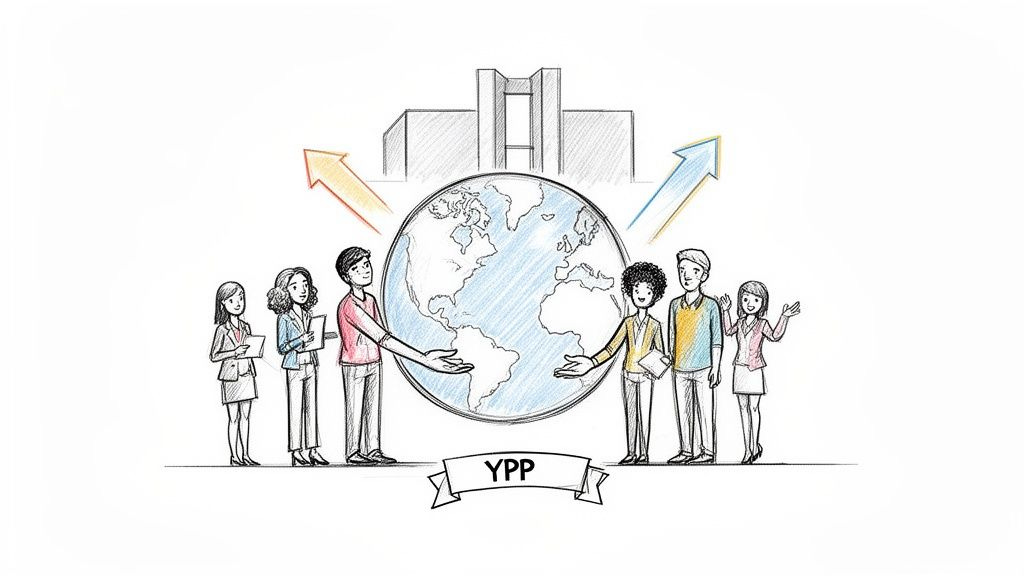
The UN YPP is the organization’s premier talent pipeline. It’s a highly selective program built to find the next generation of international civil servants. The UN has two clear goals with the YPP.
First, it injects new skills and perspectives into the system. For years, the UN has faced an aging workforce. As far back as 2000, UN data revealed that only 21% of new hires were at the entry-level P-1/P-2 grades. The YPP is the UN’s direct answer, ensuring a steady stream of young talent to fill critical roles. You can review the history of this in the original UN report on recruitment trends.
Second, the YPP is a powerful tool for improving geographical diversity. The UN must reflect the world it serves, and that starts with its staff. The program exclusively recruits from member states that are unrepresented or underrepresented within the Secretariat, making it a key mechanism for balancing national representation.
Here’s a quick overview of what the program involves.
UN YPP at a Glance
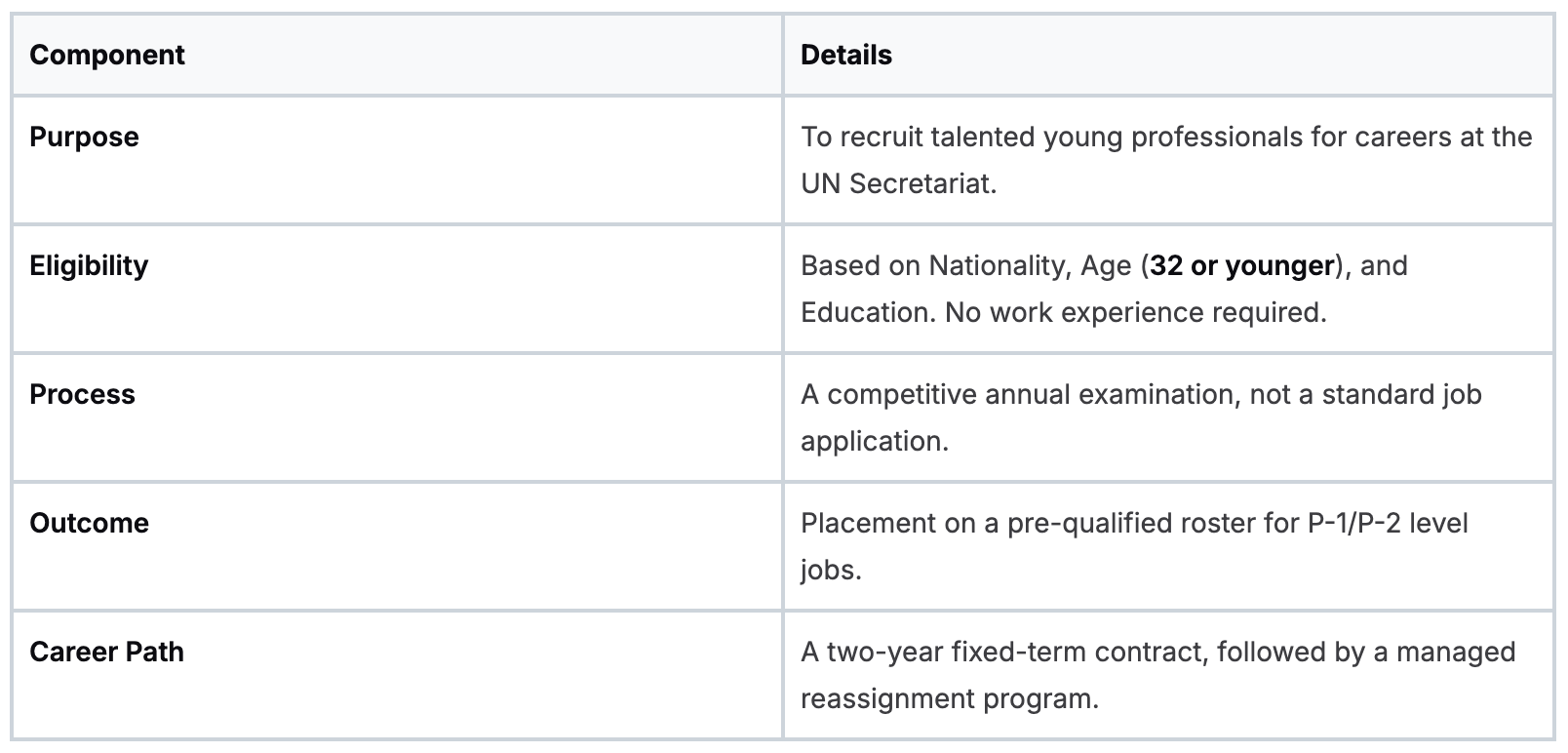
The table gives you the basics. Let’s get into how it actually works for an applicant.
How the Programme Works
The YPP is an annual entrance exam. Each year, the UN assesses its future needs and identifies specific “job families” where it needs to recruit. These are career fields like Political Affairs, Human Rights, or Statistics and Data Science.
To be considered, you have to meet three strict, non-negotiable criteria:
Nationality: You must hold a passport from one of that year’s participating countries.
Education: You need at least a first-level university degree that’s relevant to the exam area you’re applying for.
Age: You must be 32 years old or younger in the year of the exam.
If you meet these requirements, you can apply to sit for the rigorous, multi-stage examination. Passing the exam earns you a spot on the YPP roster.
Passing the exam means you are pre-qualified for P-1 or P-2 level professional roles. Hiring managers across the UN Secretariat use this roster to fill vacancies for the next three years. It’s a direct path to a career, bypassing the traditional scrum for individual job posts.
Your Career Path with the YPP
Once you’re selected from the roster for a position, you’re offered a two-year, fixed-term contract. This is your official start as an international civil servant.
The program is designed for serious career growth. After your first two years, you’ll join the Managed Reassignment Programme (MRP). This system gives you broad exposure by rotating you to a different role, often in a new country or department.
The point is to build well-rounded, versatile leaders who understand the UN system from multiple angles. This structured progression makes the UN Young Professionals Programme a powerful launchpad for a long-term career in international affairs, peace, and development.
First Things First: Are You Even Eligible?
Before you invest any energy into a UN Young Professionals Programme application, you need to pass the first, most brutal test: eligibility.
The UN is completely rigid and transparent about its requirements. There are no exceptions and no workarounds. If you don’t meet every single criterion, your application is dead on arrival. It’s critical to confirm your eligibility before you start.
The Three Unbreakable Rules of YPP Eligibility
Think of these as the gatekeepers to the entire program. Fail to meet one, and your application will be automatically screened out before a human sees it. It’s about meeting the foundational criteria the program was built on.
Let’s break them down.
1. Nationality: The Make-or-Break Factor
This is the most important and most misunderstood rule. You must be a national of a participating Member State for the specific year you apply.
The list of countries changes every single year. The list is determined by which countries are unrepresented or underrepresented within the UN Secretariat staff. A country on the list this year might be gone next year, and vice versa.
Actionable Step: Before you do anything else, find the official list of participating countries for the current YPP cycle. This is published on the UN Careers website. If your country isn’t on that list, you are not eligible to apply this year.
2. Age: The Firm Cutoff
The age requirement is simple. You must be 32 years old or younger in the year of the examination. This means your birthdate must fall on or after a specific date set by the UN for that year’s cycle.
For example, for an exam in 2025, the rule might state you were born on or after January 1, 1993. The exact date is always spelled out clearly in the official announcement. There is zero flexibility.
3. Education: The Right Foundation
Finally, you need the right academic credentials. You must hold at least a first-level university degree, which is usually a bachelor’s degree or a three-year equivalent.
Your degree must be relevant to the specific exam area, or “job family,” you’re applying for. If you’re aiming for the “Economic Affairs” exam, a degree in 18th-century poetry isn’t going to work.
Your university degree must directly align with the job family you select. The UN gives clear guidance on which fields of study are relevant for each exam area, so check this carefully.
Always Check Your Status for the Current Year
The UN YPP exists to address specific organizational needs, especially geographical diversity. This targeted push for representation is why the list of participating countries changes annually based on who is underrepresented in the nearly 40,000-person UN system.
The subject areas also shift to match the UN’s priorities. Past exams have covered everything from Statistics and Data Science to Political Affairs and Human Rights. You can find more details on how exam subjects are chosen at UN Talent.
Your only reliable source of truth is the official UN YPP page. Check it every year for the current list of participating countries and available exam subjects. If you meet all three criteria for this cycle, then you are ready to move forward.
Mapping the YPP Application and Selection Timeline
The UN YPP process is a marathon. From the moment you submit your application to a potential offer, you could be looking at a journey of well over a year.
Knowing the typical timeline is key to managing your expectations and avoiding frustration during the long periods of silence. The exact dates can shift each year, but the overall sequence is consistent.
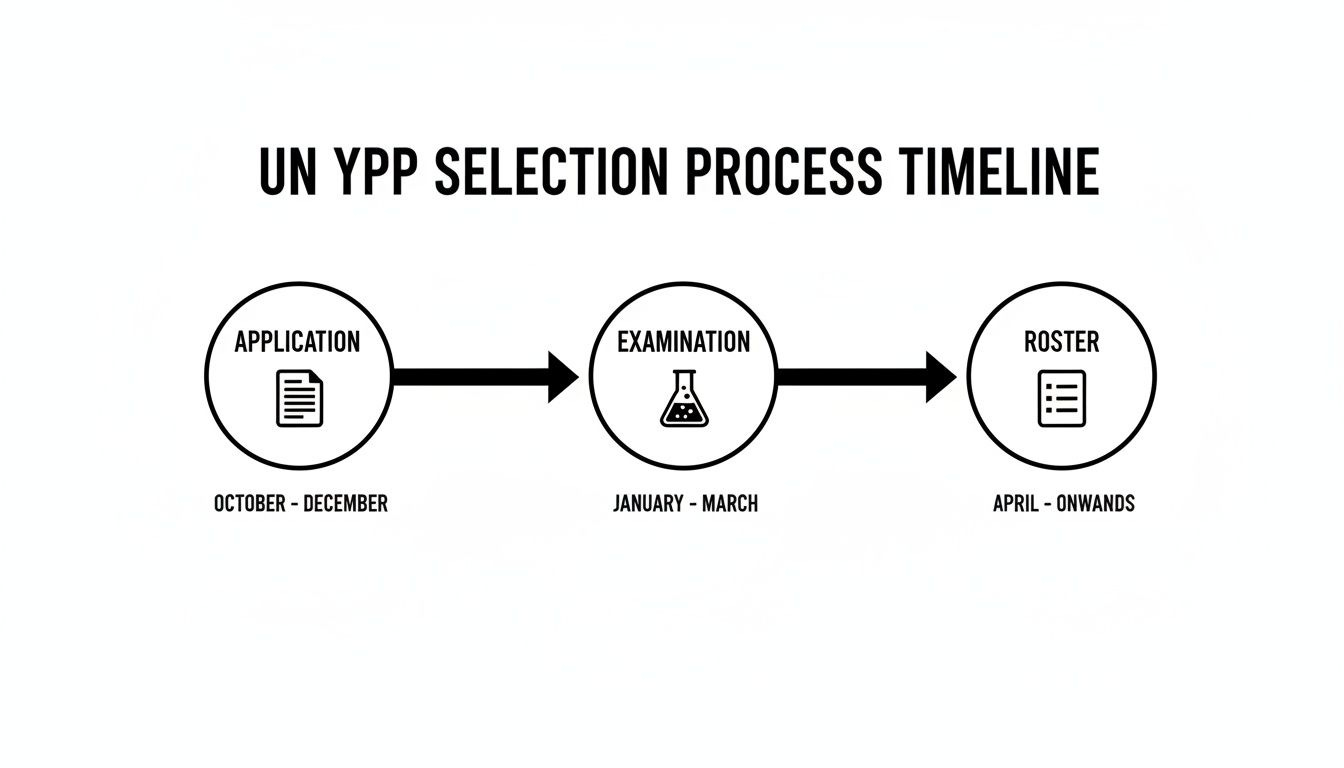
Here’s a breakdown of the typical YPP cycle.
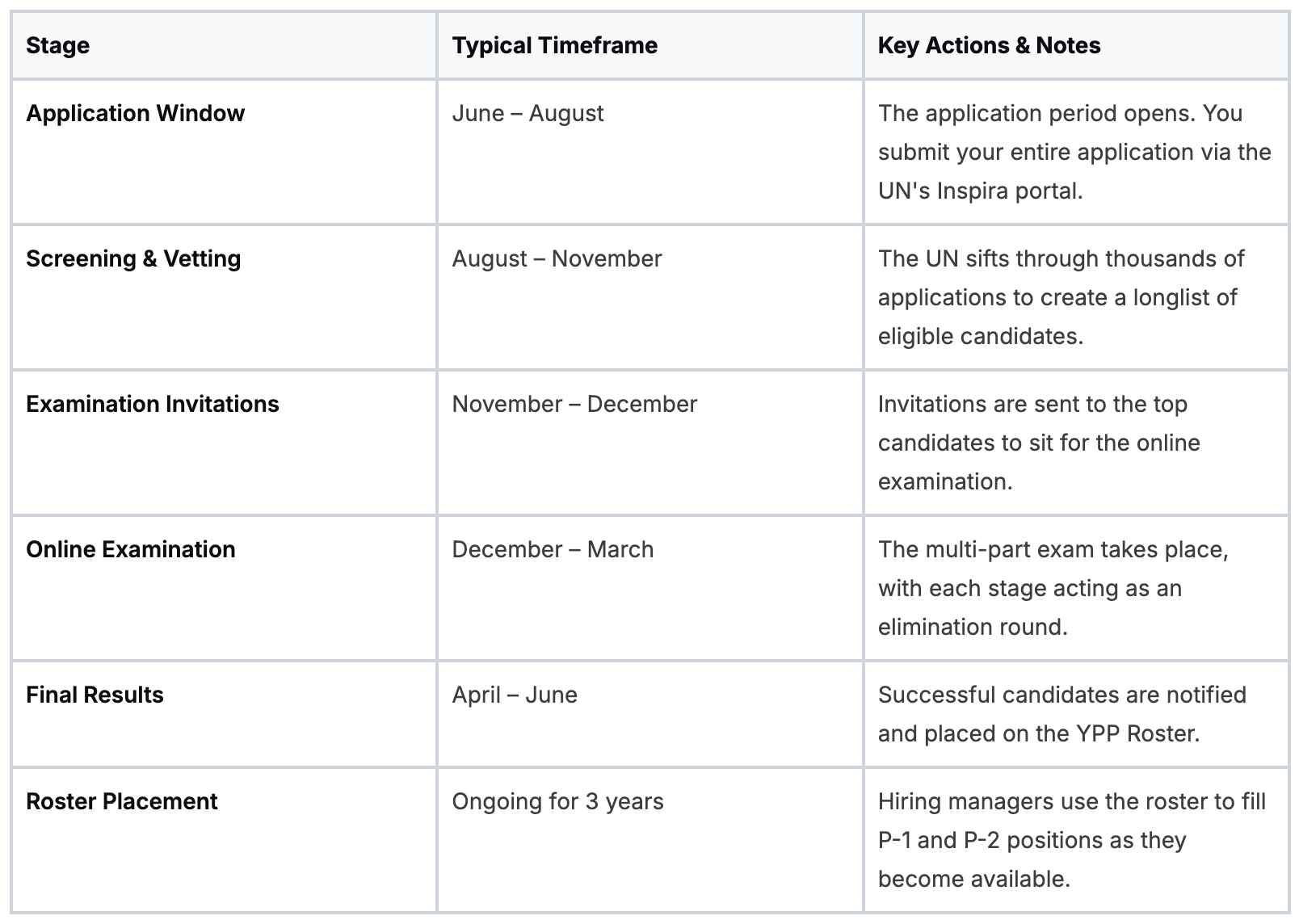
Now, let’s dig into what each stage means for you.
Stage 1: The Application Window
The race begins when the application window opens, usually around June or July each year. You’ll have about two months to get everything in order.
You’ll use the UN’s online portal, Inspira, to submit your Personal History Profile and your cover letter or statement of interest.
Do not rush your cover letter. This is your first real chance to sell yourself. It needs to show a clear, compelling link between your background, your ambitions, and the specific job family you’re targeting. For a deep dive, check out our guide on how to write a compelling statement of interest.
Stage 2: The Screening Process
Once the application window closes, the long wait begins. The UN’s HR teams start the massive task of screening every application to find who makes the first cut.
This part of the process is a black box for applicants. You won’t hear anything for months as they work through the pile. Expect radio silence until sometime in the fall, typically between September and November.
The UN’s objective is to invite a maximum of 60 candidates from each participating country for each exam area. If more than 60 eligible people from one country apply, their applications are ranked based on education, work experience, and language skills to select the top 60.
The numbers here are brutal. Thousands apply, but only a small fraction will get the email inviting them to the exam.
Stage 3: The Examination
If you make it through the screening gauntlet, you’re now invited to the main event: the YPP examination. The whole thing is done online and usually happens between December and March of the following year.
It’s a multi-stage affair, and each part is an elimination round.
Online Assessment: This is often the first hurdle. It involves situational judgment tests and general knowledge questions. It’s a filter to see if you have the basic competencies and mindset of an international civil servant.
Written Examination: This is the core of the test. You’ll face a General Paper, which tests your drafting and reasoning skills on international affairs, and a Specialized Paper, which gets deep into the technical details of your chosen exam area.
Competency-Based Interview: If you pass the written portion, you’ll move to the final oral exam. This is a formal, competency-based interview with a panel that will probe your skills, motivations, and overall fit for a UN career.
Only candidates who pass one stage are invited to the next. It’s a progressive knockout tournament.
Stage 4: Roster Placement and Beyond
The final results are usually announced in the spring, often between April and June. If you’ve passed every stage, you are officially placed on the YPP roster.
The roster is a pool of pre-qualified, pre-vetted talent. UN hiring managers across the globe use this list to fill vacant P-1 or P-2 jobs as they open up.
Roster Validity: You stay on the roster for three years.
Placement: A hiring manager might contact you for a specific job at any point during those three years.
The Wait: A spot on the roster is not a job guarantee. Placement depends entirely on the needs of UN departments matching your specific profile.
The whole UN Young Professionals Programme timeline is a test of patience. Understanding each phase helps you prepare for the long road ahead.
Strategies for Mastering the UN YPP Examination
Passing the UN YPP examination is your single biggest hurdle. This is where strategic preparation separates the thousands of applicants from the handful who make it onto the roster.
The exam is designed to test a specific blend of knowledge, reasoning, and communication skills. Success is about proving you can think, write, and reason like a UN professional.
The exam process includes a General Paper, a Specialized Paper, and for those who pass the written stages, a final Competency-Based Interview. Let’s break down how to conquer each one.
Dominating the General Paper
The General Paper tests you as a communicator and analyst. It assesses your ability to draft a clear, concise, and logical text on a topic related to international affairs. You’ll be given source materials, like a background document or a short article, and asked to produce a summary or a brief essay based on them.
The evaluators are focused on core skills:
Information Synthesis: Can you quickly pull the most critical points from a dense block of text?
Logical Structure: Can you organize your thoughts into a coherent argument with a clear introduction, body, and conclusion?
Clarity and Precision: Can you write in a direct, professional style, free of jargon and fluff?
Imagine you’re preparing a briefing note for a senior diplomat. They need the key information, presented logically, without wasting their time.
To get good at this, read and summarize official UN reports, Security Council resolutions, and major speeches by the Secretary-General. This is the best way to train your brain to adopt the UN’s distinct, formal-yet-direct communication style.
Excelling in the Specialized Paper
This is where your technical expertise is tested. The Specialized Paper dives deep into the specific job family you applied for. The questions will be a mix of multiple-choice and constructed-response (essay-style) questions.
Your preparation here is twofold. First, you need a strong academic foundation in your field. This is the baseline. Dust off your university coursework and core textbooks.
Second, you must connect that academic knowledge to the UN’s specific work. It’s not enough to know economic theory; you must understand how the UN applies it in the context of the Sustainable Development Goals (SDGs). For instance, if you’re interested in project management in the UN context, you need to understand what results-based management is and how it is applied.
The key is to frame your technical expertise through a UN lens. Ask yourself: How does my field contribute to peace and security, development, or human rights? Who are the main UN agencies working in this area, and what are their flagship reports?
Preparing for the Competency-Based Interview
The final gate is the Competency-Based Interview (CBI). This is an oral examination conducted by a panel of UN staff. They are assessing your behavioral competencies, your inherent skills and traits.
The UN looks for specific competencies like:
Professionalism: Showing integrity, a strong work ethic, and respect for diversity.
Teamwork: The ability to collaborate effectively with colleagues from different cultural backgrounds.
Planning & Organizing: The capacity to manage priorities and deliver work on time.
Prepare for this by mastering the STAR method. It’s a structured way to answer behavioral questions by providing a real-life example that proves you have the skill.
The STAR Method Explained
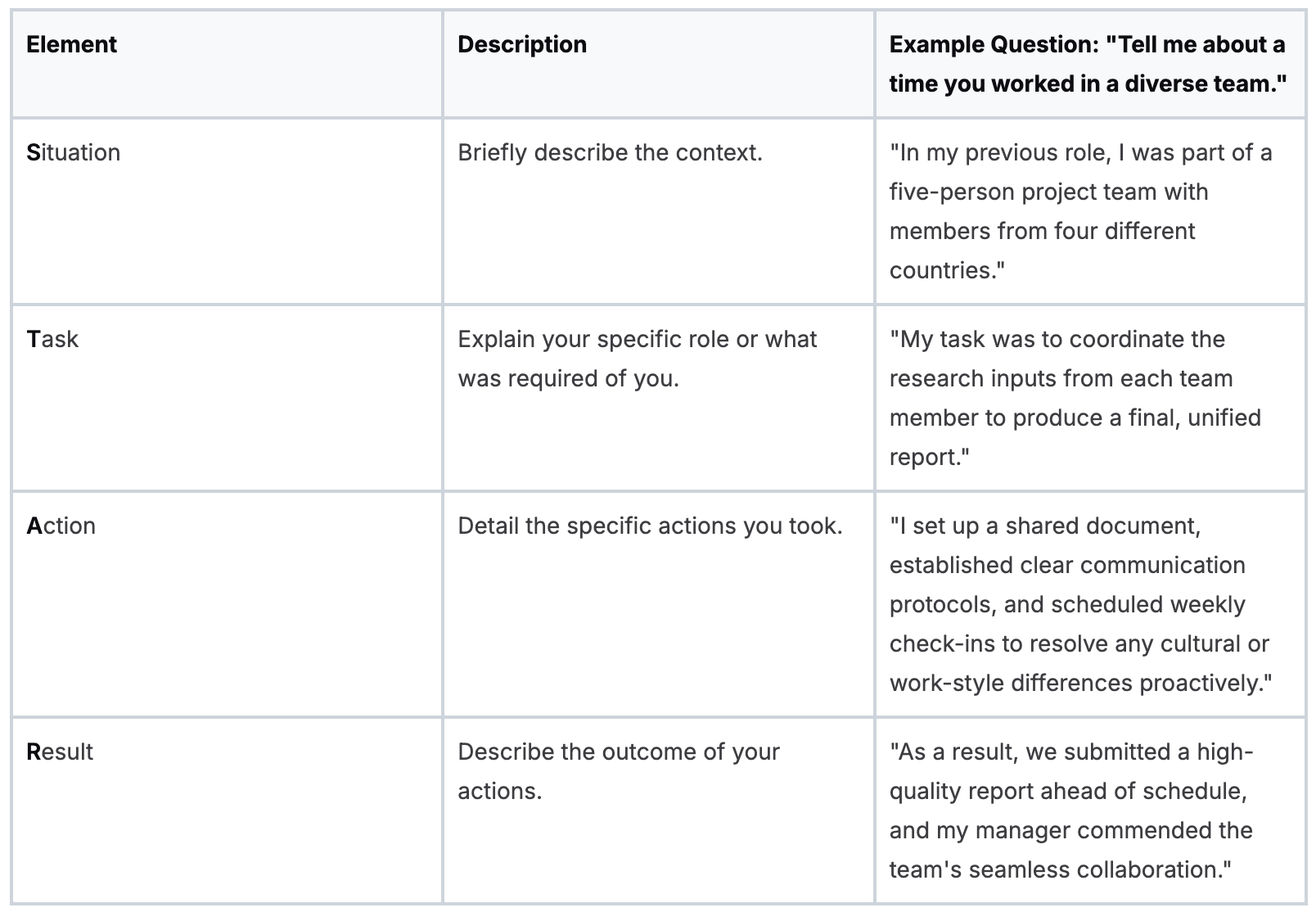
Your job is to prepare five to seven solid STAR examples from your academic, professional, or volunteer experience. Map these stories directly to the core UN competencies. This preparation will give you the confidence to handle any behavioral question the panel throws at you and prove you have the mindset to thrive in the UN Young Professionals Programme.
Understanding the YPP Roster and Your UN Career
So you passed the final interview. Congratulations. That’s a huge hurdle cleared, but your journey with the UN Young Professionals Programme isn’t over. You don’t get an immediate job offer.
You’ve earned a coveted spot on the YPP roster. Think of this as the UN’s official pool of pre-vetted, top-tier talent. This part of the process can be a confusing waiting game, but knowing how it works is key to managing your expectations.
The Roster: A Waiting Game
Being on the roster is like having a VIP pass to the UN’s internal job market. For the next three years, your profile is visible to hiring managers across the UN Secretariat who are looking to fill P-1 and P-2 level positions.
Placement isn’t guaranteed. It’s a matching game. A department in Geneva might need a human rights officer with your exact language skills, or a team in New York might be looking for a data analyst with your specific academic background.
You are in a highly curated pool, but you are still competing for opportunities as they arise. Success at this stage depends on departmental needs aligning with your unique profile. This is why it’s critical to have a well-defined and accurate profile in the system.
There’s nothing you can do to speed things up during this period. It’s all about patience as you wait for the right role to open up.
Securing Your First UN Post
When a hiring manager flags you as a strong match for an open position, they’ll reach out to you directly. This could be for an informal chat or a more formal discussion about the role. The good news is you’ve already passed the tough YPP exam, so you get to skip another competitive recruitment process.
Once you’re selected, you’ll be offered an initial two-year, fixed-term contract at either the P-1 or P-2 level. This is your official entry into a career as an international civil servant. Your salary, benefits, and responsibilities will be based on this grade. You can learn more about UN staff benefits and entitlements in our detailed guide.
Building a Career Through the Managed Reassignment Programme
The YPP is built to forge versatile, experienced leaders. A central part of that strategy is the Managed Reassignment Programme (MRP). After your first two-year assignment, you’ll enter the MRP.
This system gives you broad exposure to the UN system through a mandatory rotation. You’ll move to a different role, often in a new department and sometimes in a different country.
This is a strategic move to help you:
Develop New Skills: Gaining experience in different functional areas makes you a more adaptable and valuable staff member.
Build a Wider Network: Working across different offices exposes you to a broader range of colleagues and policy issues.
Understand the UN System: Seeing how different parts of the organization fit together gives you a holistic, big-picture perspective.
This focus on mobility and development is a direct answer to a historical problem of retaining young talent. The modern YPP, with its structured MRP, is designed to build skills and foster loyalty, creating a clear path toward a long-term continuing contract. You can read about the UN’s approach to career development for young professionals.
The combination of roster placement, an initial assignment, and the MRP makes the UN Young Professionals Programme a true career accelerator. It’s a demanding path, but it’s purpose-built to transform talented graduates into the future leaders of the United Nations.
Your UN YPP Questions Answered
The UN Young Professionals Programme is complex, and navigating the official website can feel like a maze. We see the same questions pop up year after year from hopeful candidates.
Here are some straight answers to the questions we get asked most often.
Can I Apply with a Master’s Degree If My Country Is Not on the List?
Let’s get this one out of the way first. The answer is a hard no.
The nationality requirement is the single most important rule in the entire process. It is absolute and non-negotiable. Your eligibility is tied directly to your citizenship in a participating Member State for that specific year, which is about ensuring diverse representation within the UN.
No PhD, incredible work history, or fluency in six languages can get you around this. You must be a citizen of a country on that year’s list. If your nation isn’t on it, you cannot apply.
Is Work Experience Required for the UN YPP?
Officially, no. The UN YPP is designed specifically for talented graduates, so professional work experience is not a formal requirement.
However, in a sea of thousands of qualified applicants, relevant experience can give you an edge. Think of it as a tie-breaker. If the screening team has to choose between two otherwise identical profiles, the one with some practical experience will likely get the nod.
The bottom line: a lack of experience won’t get you disqualified. But having some, even internships or substantive volunteer work, gives you a library of real-world examples for your application and interview, which can make all the difference.
What Happens If I Pass the Exam but Am Not Offered a Job?
Passing the exam is a massive achievement that gets you placed on the YPP roster. This roster is valid for three years.
During this time, hiring managers from across the UN Secretariat can view your profile and select you for a suitable P-1 or P-2 position. It’s a pre-qualified pool of talent.
Placement, however, is not guaranteed. It all comes down to supply and demand. You’ll only get an offer when a specific department’s needs align perfectly with your exam area, skills, and background. While many rostered candidates are successfully placed, it’s possible for the three-year period to expire without a job offer.
How Are YPP Exam Areas Chosen Each Year?
The exam subjects, known as “job families,” are a direct reflection of the UN Secretariat’s strategic workforce planning. They change every year based on anticipated staffing shortages.
The process is an exercise in filling critical talent gaps.
If the UN foresees a need for more conflict analysts, you might see “Political Affairs, Peace and Security” on the list.
If they’re focused on global development goals, “Economic Affairs” could be an exam area.
If data-driven decision-making is a priority, you’ll probably see “Statistics and Data Science” offered.
The goal is to bring in fresh expertise precisely where the organization knows it will need it most in the coming years.
At Multilateral Development Bank Jobs, we help you navigate complex application processes just like this one. Our newsletter delivers curated job lists, deep-dive guides on Young Professional Programs, and insider tips to help you land a role at a top international organization. Subscribe to get exclusive career content delivered straight to your inbox. Learn more and subscribe at https://mdbjobs.com.