

Working for the International Monetary Fund is a direct line to the center of the global financial system. Your work contributes to policies that affect billions of people. These roles are intensely competitive, demanding serious analytical chops, an advanced education, and a deep grasp of macroeconomics.
What An IMF Career Actually Looks Like
Let’s get straight to it. A career at the IMF means committing to its core mission: keeping the global monetary system stable, smoothing out international trade, and helping countries achieve sustainable growth and reduce poverty.
Your analysis directly informs the advice given to finance ministers and central bank governors. The stakes are massive, and the intellectual challenge is just as big.
The Core Mission and Your Role
The IMF acts as a financial watchdog and an economic advisor to its 190 member countries. The staff are the engine that makes this happen. They’re the ones analyzing economic data, spotting risks, and crafting policy recommendations.
This is practical work. It involves deep dives into a country’s fiscal policy, its monetary system, and the vulnerabilities in its financial sector. You could easily find yourself on a “mission” to a member country, sitting across the table from senior officials to discuss their economic performance.
The real work is connecting complex data to real-world policy. You’re not just running models; you’re helping countries navigate recessions, manage debt, and build resilient economies.
A Hub of Global Economic Talent
The IMF is a magnet for top-tier economic minds. This creates a culture of intense debate and intellectual rigor where your ideas are constantly stress-tested. It’s a unique melting pot of expertise and cultural perspectives, which is central to its effectiveness.
Historically, the Fund’s staffing needs have expanded in response to global events. After the 2008 financial crisis, the IMF ramped up hiring by 15% between 2007 and 2012 to handle its bigger lending and surveillance workload. Today, the Fund employs around 2,700 staff from over 170 countries, with a huge portion holding advanced degrees in economics. You can get a better sense of the IMF’s operational approach and history here.
The career paths are as diverse as its workforce. The table below breaks down the main job categories so you can see where you might fit.
Key IMF Job Categories at a Glance
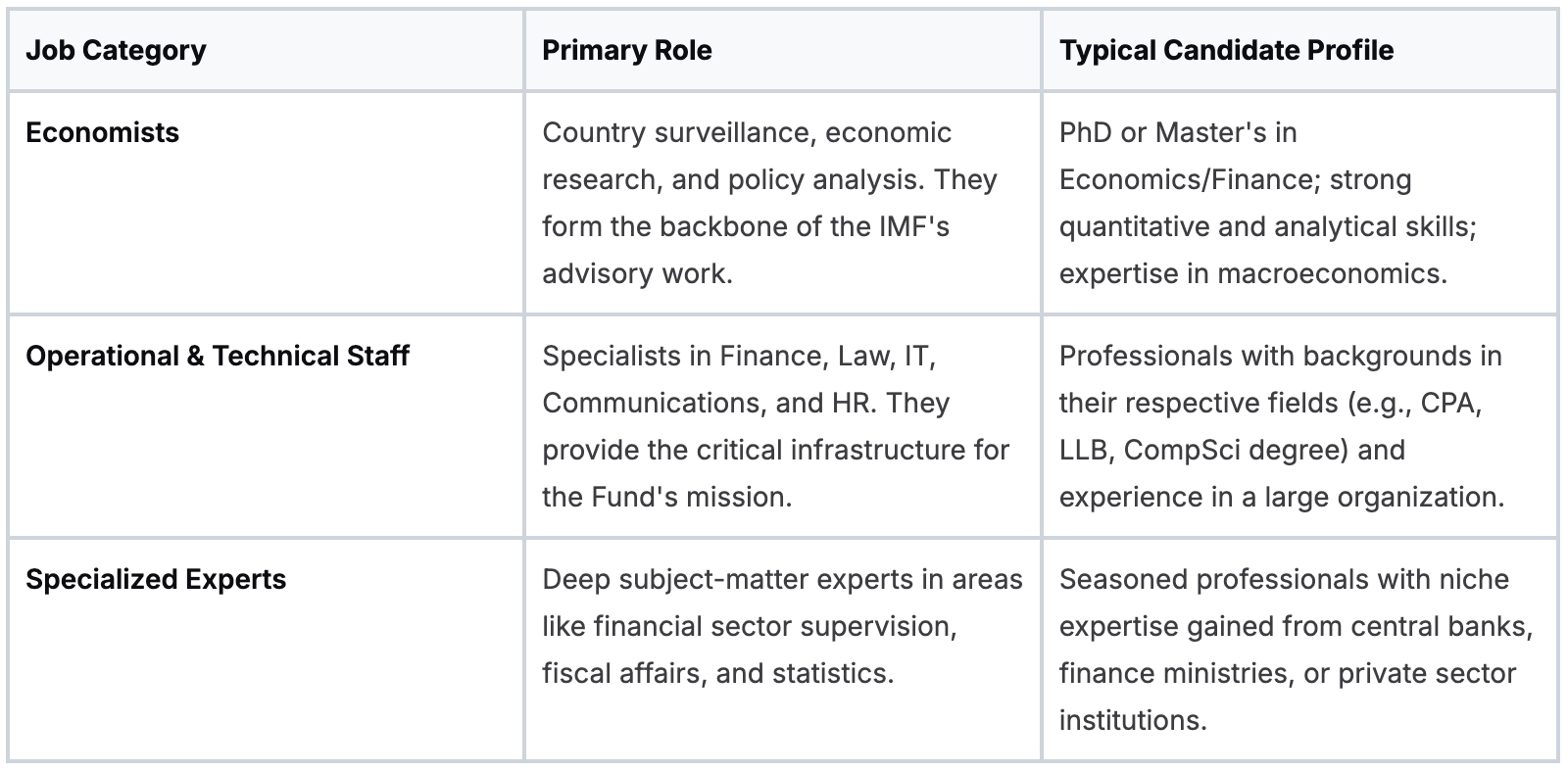
While economists are the largest group, the operational and specialized roles are essential for the Fund to function. Without top-tier lawyers, IT specialists, and communications experts, the economic analysis would never translate into real-world impact.
Understanding these foundational streams is the first step. It clarifies what International Monetary Fund jobs are really about before you dive into different roles and the application process.
Breaking Down The Different Types Of IMF Roles
When you hear “International Monetary Fund jobs,” your mind probably jumps to PhD economists sketching out complex macroeconomic models. That’s a huge part of what the Fund does, but it’s not the whole story. Not even close.
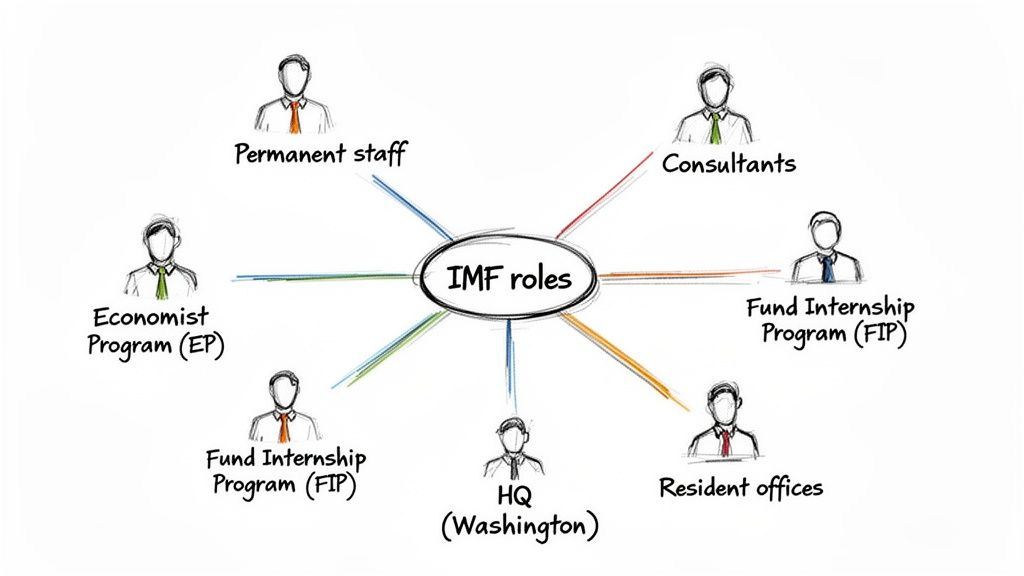
The IMF is an ecosystem of different roles, contract types, and career paths. Getting a handle on these is the first real step to finding your place. The way you’d chase a permanent staff role is worlds apart from how you’d land a short-term consultancy.
Permanent Staff vs Consultant Roles
First, let’s talk about the most basic split: are you on staff or are you a consultant? This distinction changes everything.
Permanent staff are the bedrock of the institution. They hold open-ended appointments, get the full suite of benefits, and have a clear career ladder. These are the classic, long-haul positions that offer stability and let you get deep into the IMF’s mission.
Consultants are brought in on a contract for a specific project or to fill a temporary skills gap. These gigs can last anywhere from a few weeks to a couple of years. It’s a more flexible path and a common way people get a foot in the door for a staff job down the line.
Here’s the simple breakdown:
Permanent Staff: You’re a full-time employee with a long-term career path, comprehensive benefits, and a deep connection to the IMF’s work. These jobs are intensely competitive.
Consultants: You’re hired for a specific task and timeframe. It’s a fantastic way to see how the Fund works from the inside without a long-term commitment. Many of today’s staff members started this way.
If you’re curious about how these roles stack up against similar jobs at other major financial institutions, our guide on World Bank vs IMF vs ADB careers gives a detailed comparison.
Key Entry Programs For Early Career Professionals
For recent grads and those just starting out, the IMF has two main, highly structured gateways. These programs are incredibly competitive, but they’re the most direct route into the core economic work of the Fund.
The Economist Program (EP) is the primary recruitment channel for young economists. It’s a three-year program that throws participants into the deep end of the IMF’s country and policy work. To get in, you need a recent PhD in macroeconomics or be very close to finishing one.
Then there’s the Fund Internship Program (FIP), a paid summer gig for graduate students. It’s a 10-to-12-week program where you work on real projects mentored by senior IMF economists. A strong performance here often turns into an offer for the Economist Program.
Think of these programs as the IMF’s talent pipeline. They identify and cultivate the next generation of macroeconomic experts who will lead the institution’s core mission.
Headquarters vs Resident Representative Offices
Another critical difference is simply where you work. The vast majority of IMF staff are based at the headquarters in Washington, D.C. This is the nerve center, where global surveillance, research, and big-picture policy work happens. HQ roles mean collaborating with diverse global teams on a massive range of economic issues.
The IMF also has a network of Resident Representative offices scattered in member countries worldwide. These are much smaller outposts that act as the Fund’s eyes and ears on the ground, helping with policy dialogue and technical assistance.
A “Res Rep” role is laser-focused on a single country, offering an incredibly deep dive into its unique economic challenges. The work is more hands-on and demands sharp diplomatic skills right alongside your economic chops.
What The IMF Looks For In A Candidate
Let’s get straight to it. Landing a job at the IMF requires a specific mix of academic brilliance, real-world experience, and a certain personality. If you don’t tick these boxes, your application probably won’t get a second look.
First, the absolute deal-breakers. For any economist role, an advanced degree in economics, specifically macroeconomics, is your ticket to the game. A Master’s is the minimum, but for the most sought-after positions like the Economist Program, a PhD is the real standard. For operational and technical jobs, you’ll typically need at least a Master’s in a relevant field like finance, law, or public administration.
Experience is the next major hurdle. The IMF is not a place where you learn the ropes on the job. Recruiters need to see you’ve already put your skills to the test in a high-stakes environment. Think central banks, ministries of finance, other international financial institutions, or a top-tier private sector firm. They’re looking for proof that you can handle the complexity and pressure from day one.
The Core Competencies That Matter Most
Beyond degrees and job titles, the IMF screens for a specific mindset. These are the traits that separate a good candidate from a great one. You have to weave these qualities into your application and interviews.
Analytical Rigor: Can you tear apart complex economic data, spot underlying trends, and build a logical, evidence-based argument? This is the bedrock of everything the Fund does.
Sound Judgment: The IMF’s advice moves markets and affects millions of lives. They need people who can weigh policy options, understand the political and social context, and make pragmatic recommendations.
Teamwork and Collaboration: No one at the IMF works in a silo. You will constantly be part of multinational, multi-disciplinary teams. Proving you can contribute constructively, listen to others, and build consensus is non-negotiable.
Powerful Communication: You might have the most brilliant analysis in the world, but it’s useless if you can’t explain it clearly and persuasively. This goes for both your written reports and your presentations to senior government officials.
Getting hired means proving you possess a blend of technical expertise and interpersonal effectiveness. The Fund needs people who are brilliant analysts and skilled diplomats.
Nationality and Diversity Considerations
The IMF actively works to build a workforce that mirrors its global membership. While there isn’t a rigid quota system for International Monetary Fund jobs, your nationality plays a role in the selection process. The Fund always tries to balance representation from its 190 member countries.
If you dig into the IMF’s employment data, you’ll see a clear strategy. Women now make up 45% of the staff, a huge jump from just 35% in 2000. While staff come from all over the globe, nationals from countries with larger voting shares, like the United States (20%), Europe (35%), and Asia (15%), are more heavily represented. Speaking another language, especially French or Spanish, can also give you a serious edge. You can explore more IMF staffing insights and economic data to see the trends for yourself.
Does this mean you’re out of luck if you’re from an over-represented country? Not at all. It just means the competition is fiercer, and your application has to be exceptional. At the end of the day, merit is the deciding factor, but understanding these institutional priorities helps you frame your application.
Navigating The IMF Hiring Process From Start To Finish
The recruitment process for International Monetary Fund jobs is a marathon, not a sprint. It’s methodical, multi-layered, and designed to test your capabilities from every possible angle. If you want to succeed, you need to know what’s coming at each stage.
Patience is a must. The entire cycle, from submission to final offer, can easily stretch over several months. This isn’t a sign of disinterest; it’s the reality of a rigorous review process. Your job is to clear one hurdle at a time with a focused approach.
The IMF is assessing three key pillars in every candidate. Think of it as a three-legged stool: you need all three for a stable application.
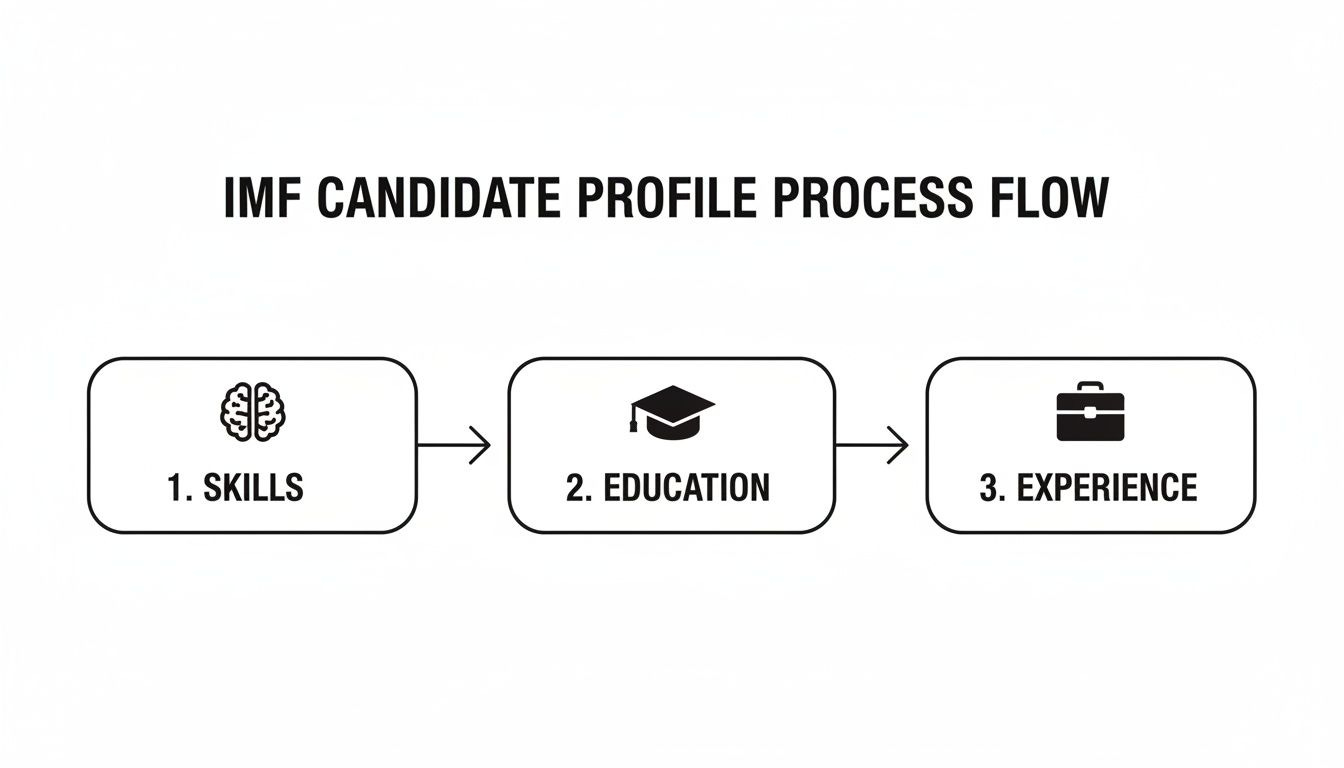
As the graphic shows, a successful profile is a balanced combination of all three elements. Excellence in one area won’t make up for a serious deficiency in another.
To help you map out your journey, here’s a look at the typical stages and what you can expect in terms of timing. These are estimates, and the process can vary depending on the role and department.
Typical IMF Hiring Timeline And Stages
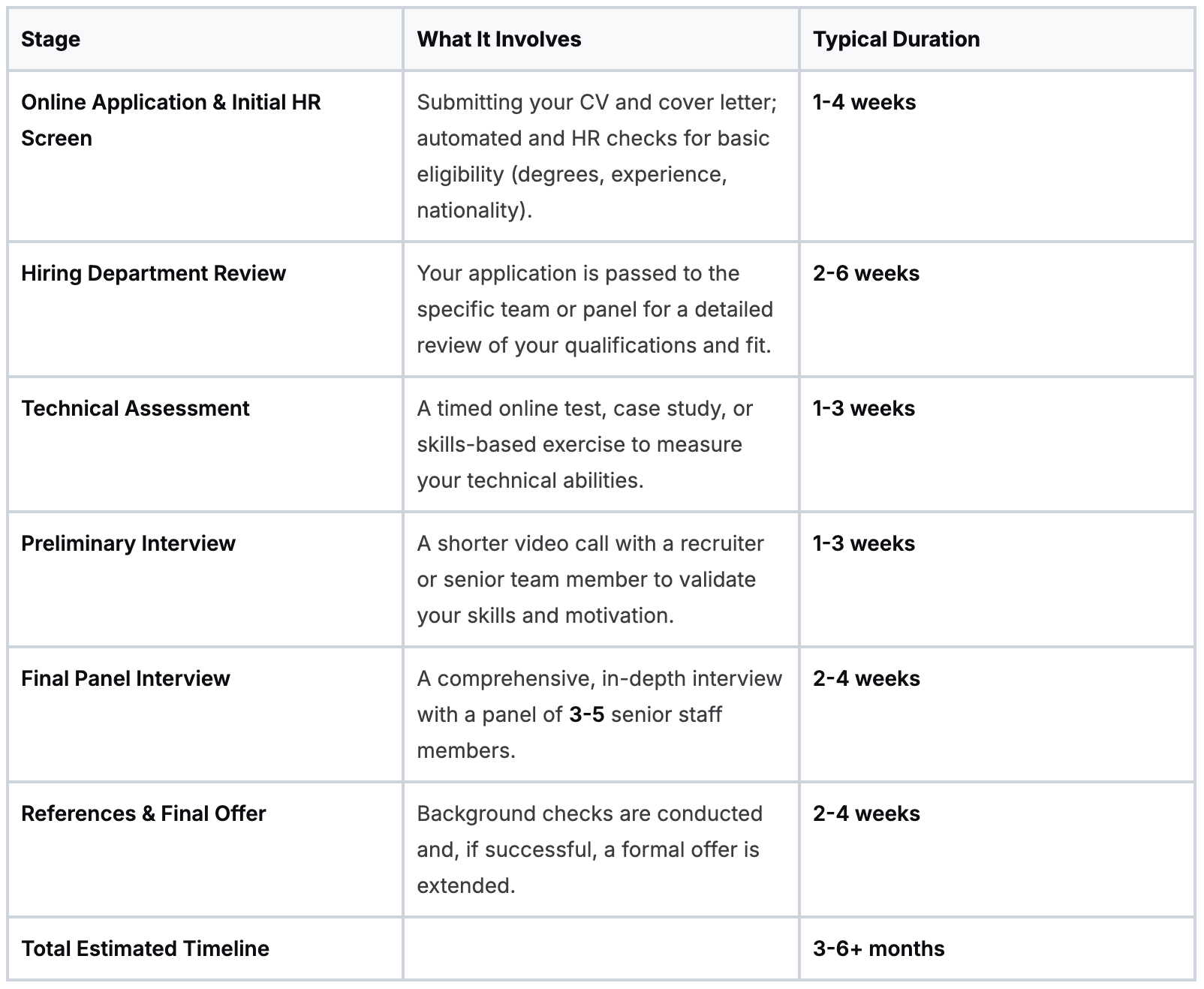
Again, this timeline is a guide. The key takeaway is to be prepared for a lengthy process and to stay focused at each step.
The Application And Initial Screening
Everything starts with the online application. This is the first filter where systems and HR specialists screen for the basics. They are checking for non-negotiables: the right degree, the required years of relevant experience, and an eligible nationality. A generic application that doesn’t explicitly match these criteria is the fastest way to an early exit.
Once you’re past that initial gate, your materials go to a hiring manager or a review panel in the relevant department. This is where the substance of your CV and cover letter gets a much closer look. They’re trying to figure out if the quality and relevance of your experience actually align with their team’s needs.
Technical Assessments And Preliminary Interviews
If your profile looks promising, you’ll move to the assessment phase. This stage is about objectively measuring your technical horsepower. For economist roles, this almost always involves a timed online test on macroeconomic theory, econometrics, and policy analysis. For specialized jobs, it might be a technical case study or another skills-based assessment.
Pass the assessment, and you’ll likely face a preliminary video interview. This is a shorter, focused conversation, often with a recruiter or a senior person from the team. The goal is simple: validate the skills on your resume, understand why you want to join the IMF, and get a first impression of your communication style.
The assessments and early interviews are about proving you have the raw technical ability for the job. You’re demonstrating your analytical skill in a real, measurable way.
The Final Panel Interview
The final stage is the panel interview. This is the most comprehensive and demanding part of the process, and where the real decision is made. You’ll typically meet with a panel of three to five senior staff members, including your potential boss and people from related departments.
This interview is a deep dive into your technical expertise and behavioral competencies. Expect to be challenged with complex policy scenarios, asked to defend your analytical choices, and questioned on your ability to work collaboratively in a high-pressure, multicultural setting. This is where they decide if you have the judgment, poise, and intellectual agility to thrive at the Fund.
Success here comes down to your ability to articulate your thinking clearly, provide evidence-based answers, and show you understand the IMF’s mission. It’s the final and most important test. For a deeper look into the hiring journey, you might be interested in our guide on how to find and win IMF job vacancies.
Crafting An Application That Gets Noticed
Let’s be blunt: a generic application is the fastest way to get rejected for an International Monetary Fund job. Recruiters are experts, and they can spot a copy-paste job from a mile away. To get past the first screening, your CV and cover letter must speak their language and show you’re the solution to their specific problem.
You need to translate your experience into the IMF’s world. Prove you get their mission and can contribute from day one. Sending the same CV you’d use for a job in the private sector is a rookie mistake that will kill your chances instantly.
Tailoring Your CV For Maximum Impact
Think of your CV as a strategic document, not a historical archive. Every line needs to be laser-focused on the specific IMF position you’re chasing. Your first step is to dissect the job description like it’s a code you need to crack.
Pull out the key technical skills, competencies, and required experiences. These are now your keywords. Go through your history and weave these exact terms into your experience. If the role calls for “fiscal policy analysis,” your CV had better use that exact phrase to describe a relevant project you’ve worked on.
Here’s how to make it punchy and effective:
Relevance First: Put your most relevant skills and experience right at the top. Don’t make the recruiter hunt for the good stuff. They won’t.
Quantify Everything: Don’t just say you “analyzed economic data.” Say you “analyzed quarterly fiscal data for three emerging markets to identify drivers of a 5% budget deficit.” Numbers add serious weight and credibility.
Speak IMF: Show you’re already part of the club. Use terms like “surveillance,” “technical assistance,” and “program design” where they genuinely fit. This signals you understand the Fund’s core business.
This targeted approach does more than tick boxes. It shows you’ve done your homework and are genuinely invested in this role, not just blasting out applications to every opening you see.
Writing A Cover Letter That Tells A Story
Your cover letter is your chance to connect the dots for the hiring manager. A great one builds a compelling story that answers one crucial question: “Why are you the perfect person for this specific job at the IMF?”
Think of it as your personal policy memo: concise, persuasive, and backed by evidence. Start with a direct opening that names the position and immediately hits them with your most relevant qualifications.
Your cover letter must spell out a clear reason for wanting to work at the Fund. Is it the mission? A specific area of research? The chance to apply your skills on a global scale? Get specific and be authentic.
The body of your letter is where you link your past wins to the IMF’s current priorities. If you’ve worked on debt sustainability analysis for a national government, explain exactly how that experience equips you to contribute to the IMF’s work with low-income countries. This turns your application from a list of facts into a powerful argument for hiring you.
Keep it to one page. Brevity is a sign of clear thinking, a trait that’s highly prized at the Fund.
What You Really Earn: A Look at IMF Salaries and Benefits
Let’s be honest: compensation is a major factor in any career decision. An IMF career is no different. The package is built to attract the best global talent away from top-tier finance ministries, central banks, and private sector firms. So, what can you actually expect to earn?
The whole system revolves around a transparent grade structure. Your salary is tied directly to your assigned grade level, which reflects your seniority and experience. As you move up the ladder, your pay increases accordingly.
The Salary Structure
IMF salaries are benchmarked against a specific group of public and private sector institutions to stay competitive enough to pull in the world’s sharpest economic minds.
The pay scale is divided into clear bands. An entry-level economist just starting at grade 1 might see a starting salary around $90,000. On the other end, senior roles like division chiefs can command salaries well north of $250,000.
A 2023 survey found that 92% of staff reported high job satisfaction, which speaks volumes about the impact they feel they’re having on global economic policy. Recent macroeconomic challenges have driven a hiring surge, with openings for macroeconomists jumping by 35%, mainly targeting PhDs from leading universities. For a deeper dive, you can learn more about the historical context of federal and international employment levels here.
Here’s the real kicker for many employees: the tax situation. For most non-U.S. citizens working at the IMF headquarters in Washington D.C., their salaries are exempt from U.S. income tax. This is a massive financial advantage that dramatically boosts your take-home pay compared to a similarly paid job in the private sector.
A Benefits Package Designed for a Global Life
Beyond the base salary, the benefits are extensive. The IMF gets that most of its staff are uprooting their lives from all over the world, so they’ve built a robust support system to make that move as smooth as possible for you and your family.
Here are the highlights of what’s typically included:
Relocation and Mobility Assistance: They cover shipping costs for your belongings, travel expenses, and often provide a settling-in grant to help you get on your feet in a new country.
Generous Leave: You can expect ample annual leave, sick leave, and parental leave policies that are often far better than what you’d find in the private sector.
Health and Wellness: The Fund provides comprehensive medical, dental, and vision insurance plans for you and your eligible family members.
Retirement Plan: The IMF offers a seriously attractive retirement plan, designed to give its staff long-term financial security.
This entire package is a core part of what makes International Monetary Fund jobs so competitive. To see how these perks stack up against a similar institution, check out our complete World Bank salary guide. This comprehensive support lets staff focus on their demanding roles, knowing their personal and family needs are taken care of.
Got Questions About IMF Jobs? We Have Answers.
When you’re aiming for a career at an institution like the IMF, you don’t have time for vague answers. Let’s cut through the noise and tackle the big questions that come up time and again. Getting these straight will save you time and help you focus your application where it counts.
Is a PhD in Economics a Must-Have?
This is the million-dollar question. The answer isn’t a simple yes or no.
For the flagship Economist Program, a PhD is non-negotiable. It’s the ticket to entry. The same goes for most senior economist roles.
But the Fund is a massive organization. It needs elite talent in finance, law, communications, IT, and HR to keep the mission moving. For these operational and support roles, a Master’s degree paired with deep, relevant professional experience is the benchmark. Always check the specific job description. It’s your single source of truth.
How Much Does a World Bank or UN Background Matter?
Let’s be real: prior experience at an institution like the World Bank or a regional development bank gives you a leg up. It proves you already speak the language, understand the culture, and get the mission-driven nature of the work. You’ve been in the system.
However, it is absolutely not a dealbreaker. The IMF actively seeks expertise from national central banks, finance ministries, and even the private sector. They’re looking for the best skills, not just the most familiar logos on a CV.
What truly matters is whether your experience is directly relevant to the Fund’s work. Can you prove you have the analytical, policy, and interpersonal skills they need? That’s the key.
The name on your old business card isn’t what gets you hired; relevance is. A stellar track record in public financial management at a national treasury is often far more valuable than a peripheral role at another international organization.
Can I Apply for Multiple Jobs at Once?
Technically, yes. But you need to be smart about it.
The “spray and pray” method of blasting a generic application to a dozen different openings is the fastest way to the rejection pile. Recruiters spot it a mile away, and it screams a lack of serious interest. Don’t do it.
A much better strategy is to pinpoint 2-3 positions where your profile is a rock-solid match. Pour your energy into crafting a perfectly tailored CV and cover letter for each one. Trust me, a few high-quality, targeted applications will always beat a high volume of generic ones.
What’s the Official Language?
The working language of the IMF is English. Full stop.
All internal memos, reports, board meetings, and day-to-day business are conducted in English. You must have complete professional fluency to be effective. There’s no wiggle room on this.
That said, speaking other languages is a huge advantage. Fluency in languages like French, Spanish, Arabic, or Portuguese is highly valued, especially for roles that involve country missions and direct engagement with government officials. It gives you a clear edge and makes you a far more versatile candidate for a truly global institution.
Ready to stop searching and start applying? Multilateral Development Bank Jobs is the essential resource for professionals aiming for a career at the IMF, World Bank, and other major MDBs. We deliver curated job lists and insider guides directly to your inbox three times a week, giving you the edge you need to land your dream job.
Subscribe now and get the next curated list of opportunities.