



Choosing between the World Bank, International Monetary Fund (IMF), and Asian Development Bank (ADB) can be tough.
On paper, they seem quite similar, but each institution offers distinct paths, compensation structures, and work cultures that can really shape your development finance career.
Here's what you need to know before making your move.
Institution Overview and Mission Comparison
World Bank Group
The World Bank operates as the largest multilateral development institution, serving 189 member countries with 140 offices worldwide. Its mission centers on ending extreme poverty and boosting shared prosperity through financing, knowledge sharing, and policy advice. The Bank's scope spans infrastructure, education, health, agriculture, and governance across developing nations.
Primary Focus: Poverty reduction and sustainable development
Geographic Reach: Global, with strong presence in Sub-Saharan Africa, Latin America, and South Asia
Staff Size: Approximately 15,000 employees
International Monetary Fund (IMF)
The IMF functions as the global financial system's guardian, promoting international monetary cooperation and financial stability. Unlike development banks, the IMF focuses on macroeconomic policy, exchange rate stability, and crisis response rather than project financing.
Primary Focus: Global financial stability and macroeconomic policy
Geographic Reach: Global headquarters-based operations with country missions
Staff Size: Approximately 2,700 employees
Asian Development Bank (ADB)
The ADB specifically targets Asia-Pacific development, positioning itself as the region's premier development finance institution. It's recently pivoted toward becoming the "Asian climate bank," emphasizing climate financing and green infrastructure.
Primary Focus: Asian development with climate emphasis
Geographic Reach: 68 member countries, primarily Asia-Pacific
Staff Size: Approximately 3,200 employees
Career Opportunities and Specializations
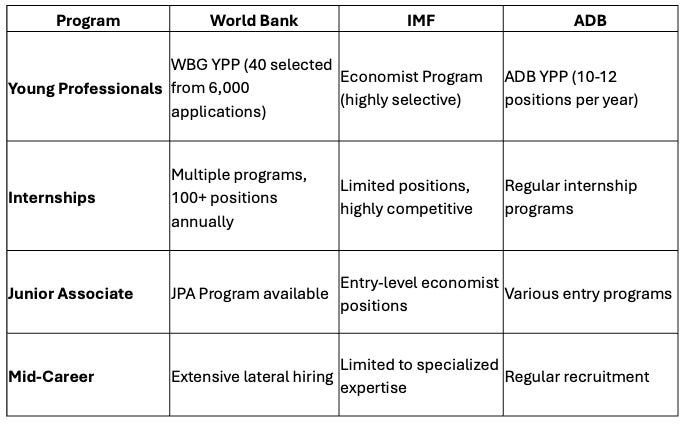
Entry Points and Programs
Technical Specializations
World Bank Strengths:
Infrastructure and urban development
Education and health systems
Agriculture and rural development
Governance and institutional development
Environmental and social safeguards
IMF Strengths:
Macroeconomic analysis and forecasting
Monetary and fiscal policy
Financial sector assessment
Crisis management and surveillance
Exchange rate policy
ADB Strengths:
Climate change and environmental finance
Regional cooperation and integration
Infrastructure development in Asia
Private sector development
Knowledge management and innovation
Career Progression Paths
World Bank: Offers the most diverse career trajectories with opportunities to specialize in sectors (health, education, transport) or functions (operations, research, strategy). The institution's size creates multiple advancement paths, though competition is intense.
IMF: Provides deeper specialization in macroeconomic analysis with clear progression from economist to senior economist to division chief. Career paths are more linear but offer significant expertise development.
ADB: Focuses on regional expertise and cross-sector knowledge. Career progression often involves rotations across different country offices and technical specializations within the Asia-Pacific context.
Compensation and Benefits Comparison
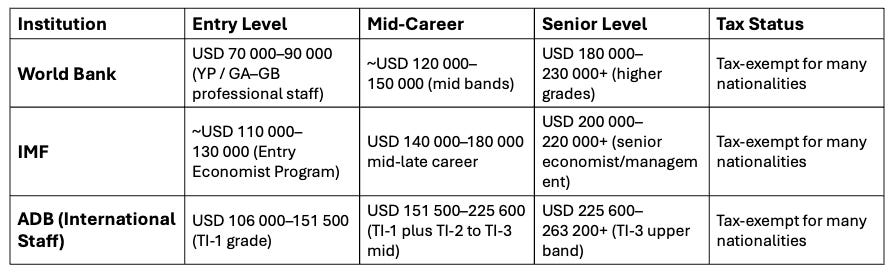
Salary Structures
Benefits Package Analysis
World Bank Benefits:
26-30 annual leave days (increases with tenure)
Comprehensive global health coverage
Education assistance for dependent children
Retirement plans with employer contributions
Home leave and relocation support
IMF Benefits:
Up to 26 annual leave days, increasing to 30 with service
World-class medical benefits with global coverage
15 days sick leave annually
Generous final salary pension plan
Spouse and partner support services
ADB Benefits:
26-30 annual leave days (increases with tenure) plus 10 public holidays
Worldwide medical insurance for staff and dependents
Life and disability insurance coverage
Education assistance and travel for international staff
Market-driven compensation reviews
Employee Satisfaction Data
Recent satisfaction surveys reveal interesting patterns:
Compensation Satisfaction:
IMF: 77% report fair compensation (highest among the three)
World Bank: 70% report fair compensation
ADB: 4.1/5 stars for compensation package
Culture Ratings:
World Bank: Highest rated for organizational culture
ADB: Higher ratings for career opportunities and CEO approval
IMF: Strong ratings for compensation but mixed on culture
Work Culture and Environment
World Bank Culture
The World Bank operates with a project-focused, country-driven approach. Teams work across multiple time zones, and the culture emphasizes collaboration and knowledge sharing. The institution's size creates both opportunities and bureaucratic challenges.
Strengths:
Diverse, multicultural environment
Strong learning and development opportunities
Extensive global network
Emphasis on innovation and results
Challenges:
Complex bureaucracy and approval processes
High pressure and demanding travel schedules
Internal competition for advancement
Frequent reorganizations
IMF Culture
The IMF maintains a more academic, research-oriented culture with emphasis on economic analysis and policy advice. The working environment is intense and intellectually demanding, with high standards for analytical rigor.
Strengths:
Intellectually stimulating work environment
Direct interaction with government officials
Clear career progression paths
Strong analytical training and development
Challenges:
High-pressure environment with tight deadlines
Limited geographic diversity in assignments
Intense competition among economists
Work-life balance challenges
ADB Culture
The ADB combines Asian cultural sensitivity with international development practices. The Manila headquarters creates a unique blend of local and international perspectives, with emphasis on regional cooperation.
Strengths:
Regional focus allows for deep expertise development
Growing emphasis on innovation and climate
Collaborative work environment
Strong work-life balance compared to peers
Challenges:
Smaller size limits career mobility
Manila location may not appeal to all candidates
Less global recognition compared to World Bank/IMF
Limited opportunities outside Asia-Pacific
Geographic Opportunities
World Bank
Headquarters: Washington, D.C.
Field Presence: 140 country offices globally
Mobility: Extensive opportunities for international assignments
Regional Focus: Global with particular strength in Africa and Latin America
IMF
Headquarters: Washington, D.C.
Field Presence: Limited country offices, primarily mission-based
Mobility: Mainly headquarters-based with short-term missions
Regional Focus: Global but centralized operations
ADB
Headquarters: Manila, Philippines
Field Presence: 31 field offices across Asia-Pacific
Mobility: Strong opportunities within Asia-Pacific region
Regional Focus: Exclusively Asia-Pacific with growing Pacific presence
Career Progression Prospects
Advancement Speed and Opportunities
World Bank:
Promotion cycles every 2-3 years for strong performers
Multiple career tracks (operational, research, managerial)
Opportunities to specialize or generalize
Leadership development programs for mid-career professionals
IMF:
Merit-based promotion system with clear criteria
Typically 3-5 years between promotions
Strong emphasis on analytical skills and policy expertise
Limited but prestigious leadership positions
ADB:
Regular promotion opportunities with performance-based assessments
Growing organization creates advancement opportunities
Emphasis on regional expertise and cross-sector knowledge
Leadership roles often require Asia-Pacific experience
Long-term Career Value
World Bank Alumni Network: The largest and most influential development finance network globally. Former staff lead major development organizations, consulting firms, and government agencies worldwide.
IMF Alumni Prestige: IMF experience carries significant weight in central banking, finance ministries, and academic institutions. The analytical rigor and policy experience are highly valued.
ADB Regional Influence: Strong network within Asia-Pacific development community. Particularly valuable for careers focused on Asian markets and climate finance.
Application Difficulty Analysis
Recruitment Competitiveness
World Bank:
Young Professionals Program: 6,000 applications for 40 positions (0.7% acceptance rate)
General recruitment: Highly competitive with extensive assessment processes
Selection timeline: 75 days from advertisement to selection
Assessment methods: Multiple interviews, case studies, presentations
IMF:
Economist Program: Extremely selective, typically recruiting from top economics PhD programs
Entry-level rejection rates: 21% for job offers (many withdraw before offers)
Mid-career rejection rates: 6% (understated due to self-selection)
Assessment focus: Technical economic analysis and policy expertise
ADB:
Generally less competitive than World Bank/IMF
Internal candidates often favored for promotions
Growing organization creates more opportunities
Regional focus may limit applicant pool
Success Factors
For World Bank Success:
Advanced degree in relevant field (economics, public policy, engineering)
Developing country experience essential
Strong project management and analytical skills
Multilingual capabilities advantageous
For IMF Success:
PhD in economics or related quantitative field
Strong econometric and modeling skills
Policy experience in central banking or finance ministry
Publication record in academic or policy journals
For ADB Success:
Regional expertise in Asia-Pacific markets
Climate and environmental finance knowledge
Cross-cultural communication skills
Technical expertise in infrastructure or climate
Making Your Decision
The choice between these institutions depends on your career goals, technical interests, and lifestyle preferences.
Choose World Bank if:
You want the broadest development experience
Global mobility appeals to you
You prefer project-based, hands-on development work
You value institutional prestige and alumni network
Choose IMF if:
You have strong quantitative and analytical skills
Macroeconomic policy interests you more than project work
You prefer Washington, D.C.-based career
You want to influence global financial policy
Choose ADB if:
You're passionate about Asia-Pacific development
Climate finance and green development excite you
You prefer regional specialization over global scope
Work-life balance is a priority
Each institution offers excellent paths to impactful development careers.
And don’t think that just because you land a job in one, that you can’t pivot into another.
In fact, there’s a lot of cross-pollination between these organisations.
So with that said, I hope you can get value from this newsletter, as I collate all jobs going in the MDB space to make your life easier.