

If you’re targeting a career with a Multilateral Development Bank (MDB), you’re not looking for just another job. You’re choosing to apply your professional skills to a global mission, working at the intersection of high finance, public policy, and international relations.
Your Path to a Career in a Multilateral Development Bank
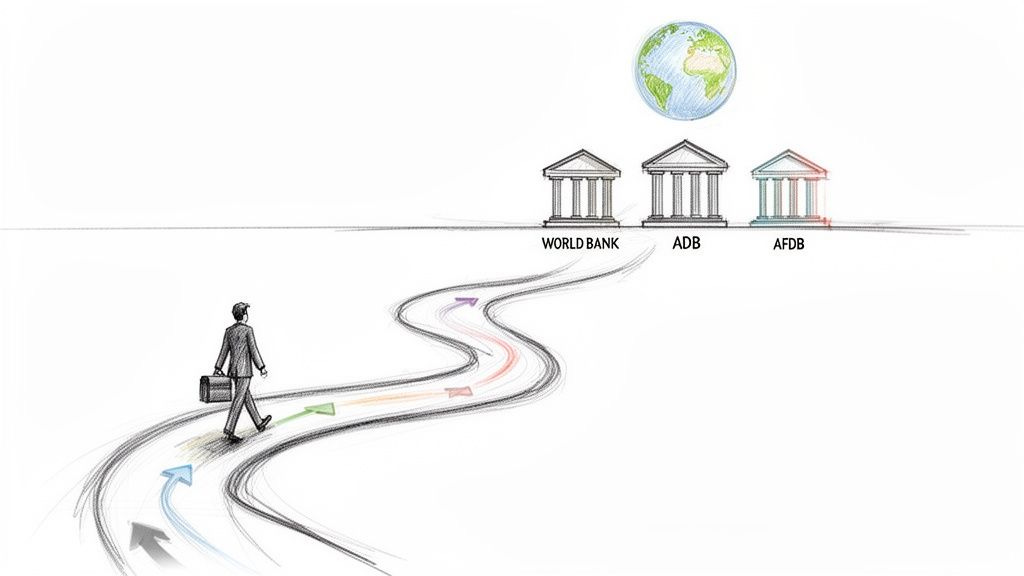
Getting hired by an institution like the World Bank or the Asian Development Bank is a different challenge than the private sector. It requires a specific mindset and a strategic approach. These organizations are unique ecosystems.
The appeal is straightforward. On one side, you have incredibly stable, financially robust institutions. Many hold AAA credit ratings and manage portfolios worth billions. This provides serious job security, even when the global economy is volatile.
On the other side, their entire purpose is development. Every project, whether financing a renewable energy grid in Southeast Asia or funding a public health initiative in Africa, is designed to make a real, tangible difference. That level of purpose is hard to find elsewhere.
Why MDBs Offer Resilient Careers
The world of work is in constant flux. The World Economic Forum’s Future of Jobs Report projects that major labor market shifts will reshape 22% of all jobs by 2030, driven by technology and the green transition. You can read the full breakdown in the official WEF report.
While this churn creates uncertainty in other sectors, MDBs act as anchors of stability. Their work is long-term and mission-critical, especially in the emerging markets where they are most active.
This stability means they are almost always hiring. To execute their complex mandates, they need a huge range of professional skills.
Here’s a look at the major players and what they generally look for.
Major MDBs and Their Core Focus Areas
This table gives you a snapshot of some of the largest MDBs, their geographic focus, and the kinds of jobs they typically offer. This helps you start thinking about where your skills fit best.
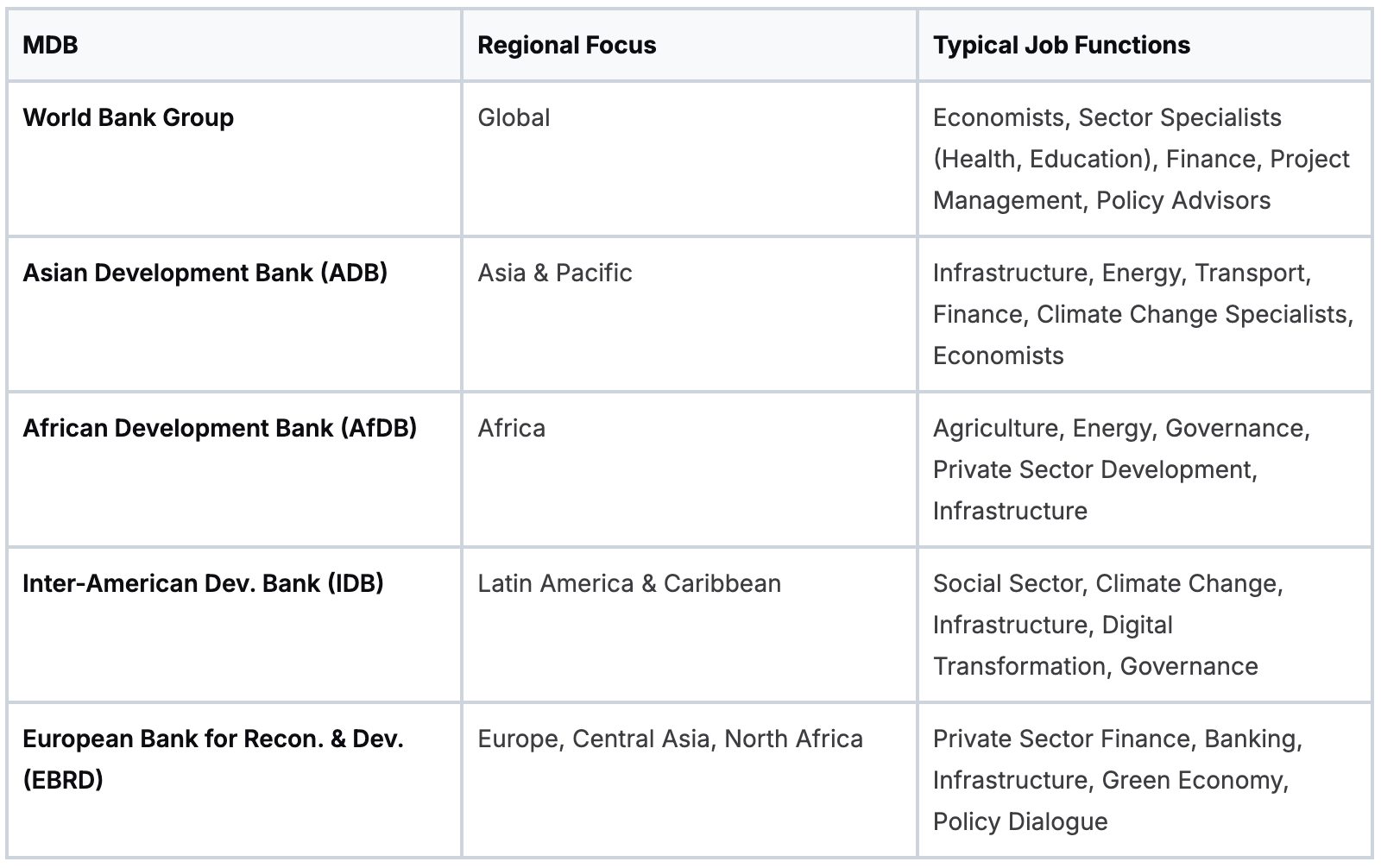
This isn’t an exhaustive list, but it highlights the core functions. From project managers to climate scientists, MDBs are constantly searching for top talent.
Some of the most consistently in-demand roles include:
Economists and Policy Experts: The bedrock of MDBs. They conduct research, advise governments, and shape lending priorities.
Project and Portfolio Managers: These are the people who run the show, overseeing development projects from start to finish.
Sector Specialists: Experts with deep knowledge in critical areas like climate, energy, transport, health, or education.
Finance and Investment Officers: The ones who structure deals, manage risk, and find ways to bring in private capital.
You’re positioning yourself inside a system built for massive impact. The work connects directly to global development goals, and you can often draw a straight line from your contribution to a specific outcome on the ground.
Understanding this context is your first real step. It’s a mental shift from “I need a job” to “I am strategically pursuing a role within a mission-driven machine.” Each MDB has its own culture; for example, the African Development Bank has a unique focus and hiring process. You can see what that looks like in our deep dive on careers in the African Development Bank.
This guide will give you the insider’s playbook for landing one of these coveted roles, from finding the right openings to acing the unique application and interview process.
How to Actually Find MDB Jobs (Staff and Consultant)
You can’t land a job at the World Bank or ADB if you don’t know where to look. The MDB ecosystem is transparent, but the opportunities are scattered across dozens of different websites. Your first task is to build a smart, efficient search system that covers all your bases without wasting your time.
First, you have the official career portals. Every MDB, from the African Development Bank to the EBRD, runs its own job board. This is your primary source for permanent, full-time staff positions. These are the backbone roles of the organization that come with long-term contracts, a clear career ladder, and full benefits.
Stopping there is a huge mistake. You also need to track consultant opportunities. These are project-based contracts, ranging from a few weeks to a year or more. A consultancy is one of the best ways to get your foot in the door, build a track record, and prove your value on a real project. These roles are often posted on separate portals or through aggregators like the UN Global Marketplace.
Building Your Job Search System
A random, “I’ll check a few sites today” approach gets you nowhere. You need a system. Start by setting up targeted job alerts on the official MDB portals. Don’t just search for “jobs.” You have to think like a recruiter.
What specific terms would they use to find you?
By Sector: Use specific titles like “transport economist,” “social safeguards specialist,” “climate finance expert,” or “public health advisor.”
By Function: Search for roles like “project manager,” “procurement specialist,” “monitoring and evaluation,” or “investment officer.”
Set up these alerts for every MDB you’re interested in. This turns a soul-crushing manual search into a simple daily email review, ensuring you never miss a relevant opening.
The real pro-move is to create a matrix of alerts. Combine your keywords with specific grade levels and locations. An alert for “GF/GG grade economist” at the World Bank or “IS-5 energy specialist” at the ADB will deliver hyper-relevant jobs straight to your inbox. You’ll stop sifting through hundreds of irrelevant listings.
Why Are There So Many MDB Jobs?
This steady stream of jobs exists for one reason: MDBs are financial powerhouses. Their financial strength directly translates into job security and a constant demand for skilled professionals.
The landmark Multilateral Development Banks Comparison Report 2025 showed that MDBs have covered all their operating costs and built up US$230 billion in reserves since they were founded. This financial muscle allows them to supercharge their operations, which means they need to hire thousands of staff and consultants every year. You can read more about how MDBs maintain their financial power in the full report.
Staff vs. Consultant: Picking Your Path
Choosing between a staff and a consultant role is a strategic decision that shapes your career trajectory.
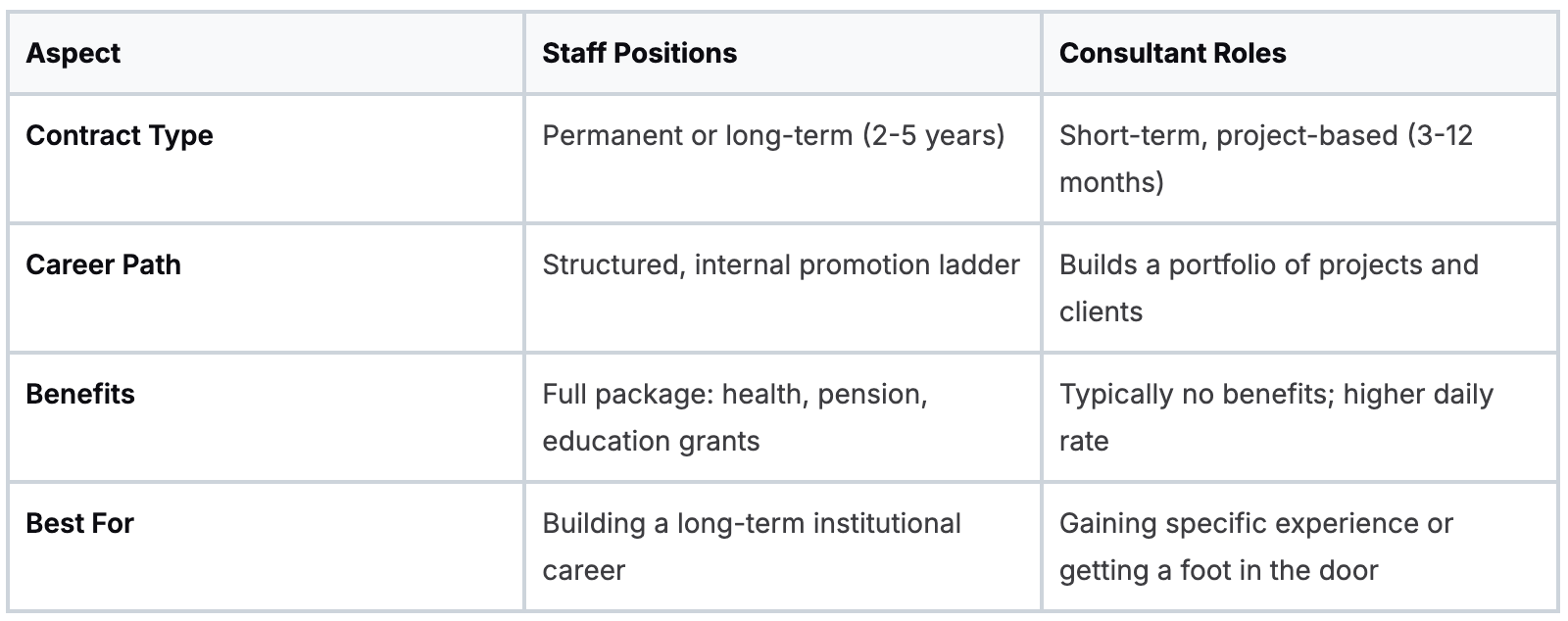
Don’t underestimate consulting. Many of the most successful MDB careers started with a short-term contract. Acing a consultancy makes you a known quantity. When a full-time staff role opens up, you’re no longer just a name on a CV. You’re the person who already delivered.
The Smart Way: Use Curated Newsletters to Save Time
The official portals are non-negotiable, but trying to monitor 30+ of them yourself is a recipe for burnout. This is where curated newsletters become your secret weapon.
Publications like our own Multilateral Development Bank Jobs do the grunt work for you.
We scan dozens of MDBs and international organizations and sort the listings into two simple, weekly emails:
Mondays: A complete list of all new full-time staff openings.
Fridays: A digest of consultant opportunities and short-term assignments.
Using a service like this frees you from the frantic daily search. You can spend your time where it counts: writing killer applications for the handful of roles that are a perfect fit.
Navigating Nationality Rules and YPP Applications
Before you tailor your CV, you need to pass a hard filter: eligibility. It doesn’t matter if you’re the perfect candidate on paper. If you’re not eligible, you’re wasting your time. The two biggest hurdles are nationality rules and the strict requirements for Young Professional Programs (YPPs).
For many staff positions, especially at institutions like the World Bank and IMF, your passport matters. These banks are “owned” by member countries, and they use nationality quotas to keep their staff diverse and representative of their shareholders.
Understanding Nationality Restrictions
You’ll hear terms like G-5 or G-7 nationality rules. This is shorthand for saying that for certain jobs, the bank will only hire citizens from its member countries. If your country isn’t a member, you’re usually out of the running for these core staff roles.
If you’re from a non-member country or one that’s already “over-represented,” don’t give up. Be more strategic.
Focus on Regional Banks: Institutions like the Asian Development Bank (ADB) or African Development Bank (AfDB) naturally prefer to hire talent from their own regional member countries. If you’re from the region, this gives you a home-field advantage.
Target “Open” Positions: Not every job is locked down by nationality. Look for vacancies that explicitly state they are open to all nationalities. You’ll see this more often for highly specialized technical roles where the talent pool is small.
The Consultant Route: This is the classic foot-in-the-door strategy. Short-term consultant (STC) roles are almost always exempt from the strict nationality rules. It’s your best bet to get inside, build a network, and prove your worth. Many staff members started as consultants.
This flowchart helps you visualize the decision process and figure out where to focus your energy.
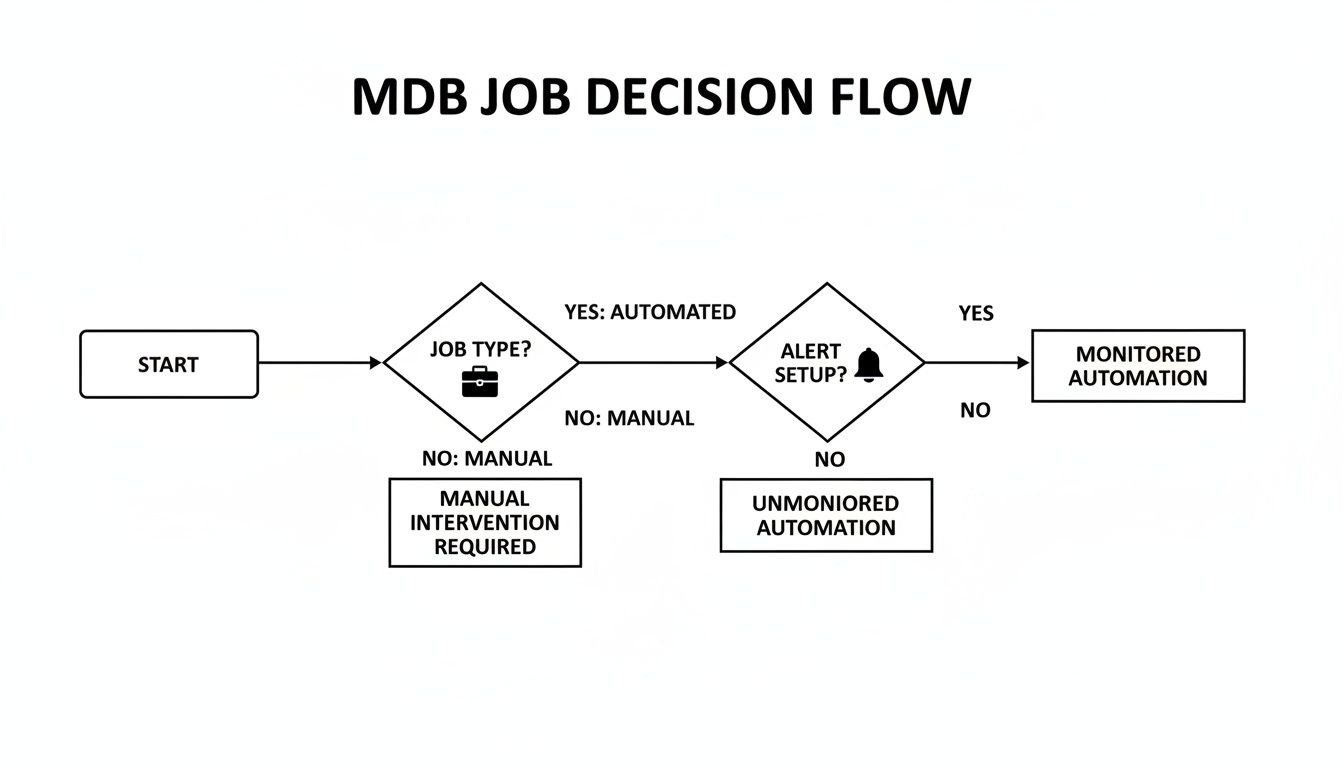
The bottom line is to play smart. One of the most common mistakes is firing off applications for jobs you were never eligible for in the first place.
A Deep Dive into Young Professional Programs
The Young Professional Program is the holy grail for early-career professionals wanting to break into an MDB. These are brutally competitive, multi-year programs designed to build the next generation of institutional leaders. They offer incredible training, rotations through different departments, and a clear path to a permanent staff job.
A spot in a YPP is a golden ticket. It puts you on an accelerated career track within the institution. The competition is fierce because everyone knows what’s at stake.
The entry requirements are non-negotiable. If you don’t meet them, don’t apply.
Let’s break down some of the most popular YPPs.
Key Young Professional Program (YPP) Details
This table gives you a snapshot of the key requirements for the major MDB Young Professional Programs. Application windows can shift slightly each year, so always double-check the official MDB careers site.
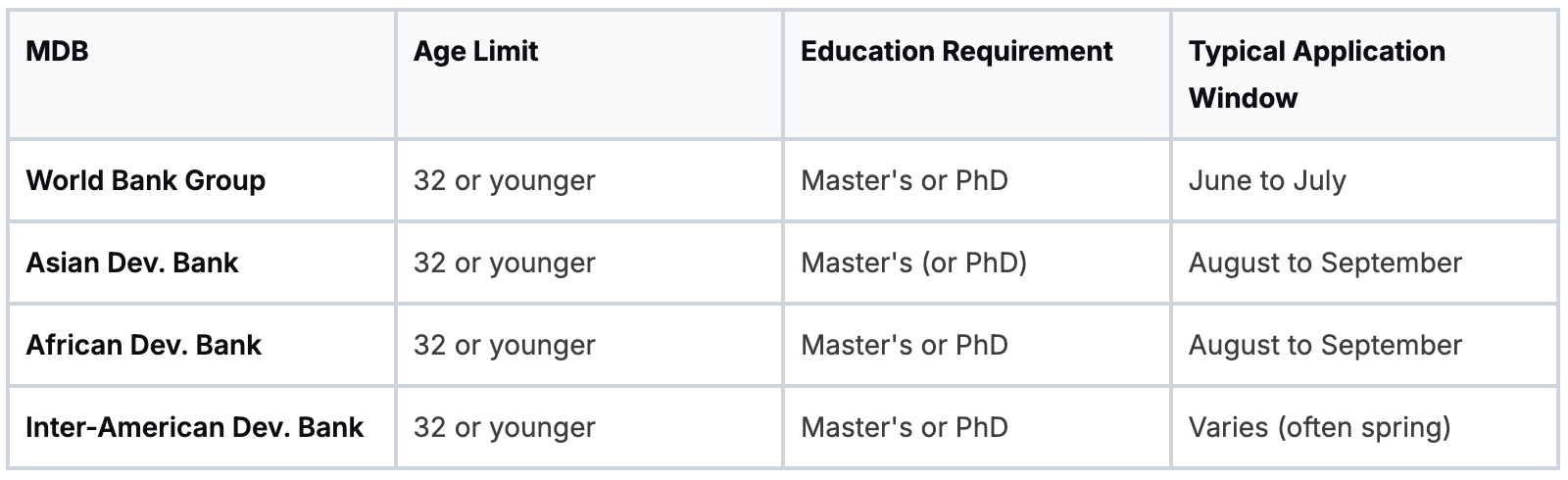
These programs are the most structured entry points, but they are far from the only ones. The application process is a gauntlet. It often runs for months and involves detailed online forms, technical reviews, video interviews, and a final, high-stakes panel interview. They want to see top-tier academics, solid professional wins, and a demonstrated passion for development.
For instance, another popular route is the World Bank’s Junior Professional Associate program. It has its own distinct set of rules and is a great option if you’re exploring entry-level roles. You can learn more in our dedicated guide on the World Bank Junior Professional Associate program.
Remember, MDBs are huge drivers of global employment. When the World Bank Group officially made job creation a project goal in 2025, it signaled a massive demand for professionals who can manage these initiatives. This need is most acute where skills gaps are widest, jumping from 10.1% in high-income economies to a staggering 27.6% in low-income ones.
This creates a constant flow of over 100+ weekly positions across more than 30 MDBs, from coveted YPP slots with strict quotas to high-paying consultant gigs. As outlined in the NDB’s 2025 comprehensive MDB comparison report, the $200+ billion in annual MDB lending is a massive engine for job growth, and for your next career move.
Crafting a CV and Cover Letter for MDB Recruiters
Your application package is your opening pitch. For MDB jobs, a generic CV and cover letter from a private sector application is the fastest way to get binned. You have to tailor every word to prove you understand the unique mission and operational language of these institutions.
This isn’t about listing past job duties. MDB recruiters hunt for evidence of impact and a real understanding of the development world. Your task is to translate your experience into their language, showing you can hit the ground running from day one.
Structuring Your CV for MDB Impact
First thing’s first: forget the one-page resume rule. In the MDB world, a two to three-page CV is normal and often expected, especially for roles that demand serious experience. The format is different, too. It’s all about concrete results and specific, quantifiable achievements, not a bland list of responsibilities.
Your CV needs to prove you’ve managed projects, influenced policy, or delivered results in complex environments. Every bullet point should answer the recruiter’s silent question: “So what?”
For instance, don’t just say you “Managed a sales team.” Translate that into development-speak:
The Old Way: Managed a regional sales team of 10 people.
The MDB Way: Led a cross-functional team of 10 professionals to secure a 15% expansion in a new market segment by deploying a data-driven strategy and leading targeted stakeholder engagement.
See the difference? The MDB version shows leadership, measurable growth, stakeholder management, and strategic thinking. These are all core competencies for development work.
Translating Your Experience into Development Language
Your biggest challenge, especially coming from the private sector, is to adopt the MDB lexicon. Recruiters scan for keywords that signal you’re an insider, or at least that you’ve done your homework. Your background in consulting, banking, or an NGO is valuable, but only if you frame it right.
The most common mistake is applicants assuming MDB recruiters will connect the dots for them. They won’t. You have to explicitly show how your “client management” experience is actually “stakeholder engagement,” or how your “product launch” was a form of “project cycle management.”
Weave these terms into your experience section wherever they genuinely fit. They’re looking for things like:
Project Cycle Management: Experience from project identification and preparation through to implementation and evaluation.
Stakeholder Engagement: A track record of working with governments, civil society, private companies, and local communities.
Results Frameworks: Using metrics and logical frameworks (logframes) to measure project success and impact.
Fiduciary and Safeguards: Familiarity with financial management, procurement, and environmental and social standards.
Think about it this way: MDBs run on policy papers, country strategies, and project appraisal documents. Your CV should read like it belongs in that world. A strong command of these concepts proves you have the analytical skills needed for any MDB role. If you need to brush up, our guide on how to improve your analytical skills is a great place to start.
Writing a Compelling MDB Cover Letter
Your cover letter is not a stuffy formality or a rehash of your CV. It’s your chance to tell a story that connects your personal drive with the bank’s specific mission. This is where you show your passion and prove you understand the soul of the institution.
A winning MDB cover letter does three things very clearly:
It proves you know the bank. Mention a specific project, a recent report, or a strategic priority that resonates with you. Show them you’ve read the latest Country Partnership Framework for the region you want to work in. This signals genuine interest.
It connects your story to their mission. Give them a brief, powerful narrative about what draws you to development work. Why this bank? Why this role? Why now? Make it personal, authentic, and compelling.
It spotlights 2-3 killer achievements from your CV. Pick your most relevant wins and explain how they’ve prepared you for this specific role. Use the MDB’s language to frame your successes and show you’re the solution they’ve been looking for.
Ditch the generic pleasantries. Start with a confident, direct opening that names the role you’re applying for and immediately states your top qualification. End with a powerful closing that reinforces your enthusiasm and your value. Every sentence should work to convince the recruiter that you’re the one.
Mastering the MDB Interview and Selection Process
If you’ve landed an MDB interview, congratulations. You’ve passed the notoriously difficult screening process. Now comes the hard part: proving you have the substance to back up the CV.
MDB interviews are a different beast. They are structured, formal, and almost always conducted by a panel of senior staff who will grill you from every angle.
You won’t just talk about what you did in your last job. You’ll be tested on your ability to think like a seasoned development professional. That means preparing to discuss high-level institutional strategies and showing you’re genuinely aligned with the bank’s core mission.
Understanding the Panel Interview Format
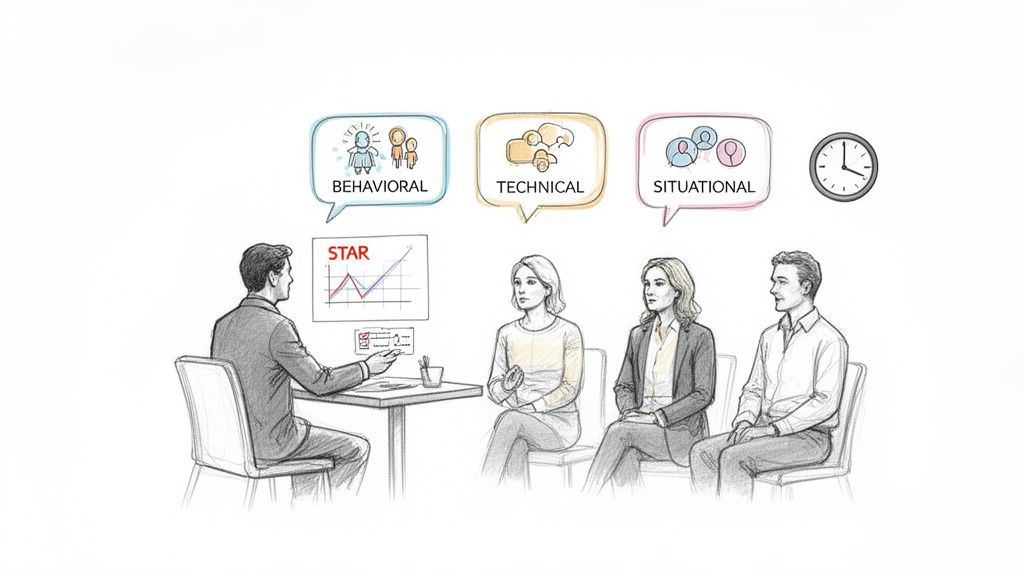
Get ready to face a panel of anywhere from three to five people. This usually includes the hiring manager, a technical expert from the team, someone from HR, and often a director or senior manager. Each person is there to assess a different part of your profile.
This format can feel like an interrogation, but it’s a test of your ability to engage with diverse stakeholders. This is a critical skill for any MDB role. Your goal is to connect with each person on the panel. Make eye contact and direct your answers to the whole group, not just the person who asked the question.
The Three Types of Interview Questions
MDB interviews are designed to test your competence across three key areas. You need a specific strategy for each to deliver a convincing performance.
Behavioral Questions: These are about your past performance. The panel wants to hear how you’ve handled real-world challenges.
Technical Questions: This is where they test your subject matter expertise. Your depth of knowledge in your field is non-negotiable.
Situational Questions: These questions use hypothetical scenarios to see how you would think and act in a future role.
A common mistake is over-preparing for technical questions and neglecting the others. You have to show strong behavioral competency to prove you can function within the bank’s unique culture and political environment.
You’re not just being hired for your skills. You’re being vetted for your fit within a complex, mission-driven bureaucracy. Your ability to articulate how you handle pressure, manage difficult stakeholders, and align with institutional priorities is just as important as your technical expertise.
Tailoring the STAR Method for MDB Jobs
The STAR method (Situation, Task, Action, Result) is a solid framework for behavioral questions, but you have to give it an MDB-specific twist. Your “Result” can’t just be about saving money or increasing efficiency. It has to connect back to development impact.
Let’s say they ask, “Tell us about a time you managed a project with conflicting stakeholder interests.”
Situation: Briefly set the scene. “While working on a renewable energy project in Southeast Asia, we faced strong opposition from a local community concerned about land use and environmental impact.”
Task: Define your objective. “My goal was to secure community buy-in to ensure the project could move forward without delays and, more importantly, meet its social safeguard requirements.”
Action: Detail what you actually did. “I organized a series of town hall meetings, brought in an independent environmental assessor to address their specific concerns, and worked with the team to revise the project plan. We created a buffer zone and developed a community benefits-sharing agreement.”
Result: Connect it to impact. “This approach led to full community support, allowing the $50 million project to proceed on schedule. It also became a model for stakeholder engagement that was later adopted by the country office for other infrastructure projects.”
Preparing for Technical Assessments and Presentations
For many technical roles, the interview process will include an assessment. This could be a written exam, a case study analysis, or a full-blown presentation on a specific topic.
If you’re an economist, you might be asked to analyze a dataset. If you’re a project manager, you might get a project appraisal document and be asked to critique it. The goal is to see your skills in action and confirm you can do the work.
If you’re asked to prepare a presentation, keep it concise, well-structured, and focused on the prompt. This is your chance to showcase your analytical and communication skills live.
Finally, brace yourself for a lengthy background check. MDBs are extremely serious about security and professional integrity. This process often involves detailed reference checks and security clearances, which can add several weeks or even months to the hiring timeline after you receive a conditional offer. Patience is essential here.
MDB Careers: Your Questions Answered
When you look seriously at MDB jobs, the practical questions come thick and fast. Let’s cut through the official-speak and tackle the big ones so you know what you’re really getting into.
How Do MDB Salaries Stack Up Against the Private Sector?
Let’s be blunt: the compensation is excellent. While the base salary might not hit the absolute peak of a Wall Street or Big Tech gig, the overall package is where MDBs truly compete.
For most international staff working at headquarters, salaries are net of income tax. Depending on your nationality, this alone is a massive financial win. But it’s the add-ons that build the full picture:
Generous pension plans that you don’t see in the private sector anymore.
Comprehensive global health insurance for you and your family.
Education grants for your kids, which can be worth tens of thousands of dollars a year.
When you add it all up, the total compensation of solid pay, incredible benefits, and unmatched job security is hard to beat for mission-driven work.
Can I Get an MDB Job Without a Master’s Degree?
Yes, absolutely. Don’t let the sea of PhDs and Master’s degrees in policy roles intimidate you. While those advanced degrees are standard for many economist and senior technical positions, they are not a requirement for every job in the bank.
Plenty of critical roles in operations, administration, IT, and finance are open to candidates with a bachelor’s degree and solid, relevant experience. For these jobs, a proven track record and specialized skills often matter more than another line on your academic CV. Don’t count yourself out.
What’s the Lifestyle Actually Like?
There’s no single answer. It completely depends on your role and where you’re based. Your life at HQ in Washington D.C., Manila, or Abidjan will be worlds apart from a country office posting.
At headquarters, you can expect a fairly professional and predictable routine. If you’re in a field-based role, get ready for a more dynamic life, packed with frequent mission travel and direct, on-the-ground work with projects and local partners.
Work-life balance is generally taken more seriously than in many high-pressure private sector jobs. That said, when a project deadline looms or you’re on an intense multi-country mission, long hours are part of the deal, especially for anyone in an operational role.
At Multilateral Development Bank Jobs, we cut through the noise to bring you the opportunities and insights you need. Get weekly emails with curated staff and consultant roles from over 30 MDBs delivered straight to your inbox. Find out more at https://mdbjobs.com