

If you want a competitive job at a Multilateral Development Bank (MDB), you need to get good at one thing: analysis. This skill is about building a mental toolkit to break down messy, real-world problems, spot the patterns that matter, and make rock-solid judgments when the stakes are high.
It’s a skill you can train, and it’s what gets you noticed by recruiters.
Why Analytical Skills Are Your Ticket Into an MDB
Let’s get one thing straight: for MDBs, strong analytical skills are the price of admission. These institutions are data-driven to their core. Every single project, policy paper, and investment decision is built on a foundation of rigorous, evidence-based analysis.
Recruiters at the World Bank, IMF, or Asian Development Bank need professionals who can wade into complex, often incomplete information and pull out clear, actionable insights. They are not looking for people who can simply read a spreadsheet.
This is a structured way of thinking you have to master. MDBs operate in environments where one policy recommendation can impact millions of lives and shift billions of dollars. Your ability to dissect a problem, weigh evidence, and build a logical case for action is your most valuable currency.
Expert Take: Your analytical ability is the proof that you can handle the immense complexity and responsibility of global development work. It’s what tells a hiring manager you’re ready.
What MDB Recruiters Actually Mean by ‘Analytical Skills’
When you see “strong analytical skills” on an MDB job description, it’s not a vague buzzword. They’re looking for a specific set of competencies you need to demonstrate.
I’ve broken down what these core competencies mean in the context of a development bank job. This is the language recruiters use and the skillset they expect you to bring to the table.
Core Analytical Competencies for MDB Roles
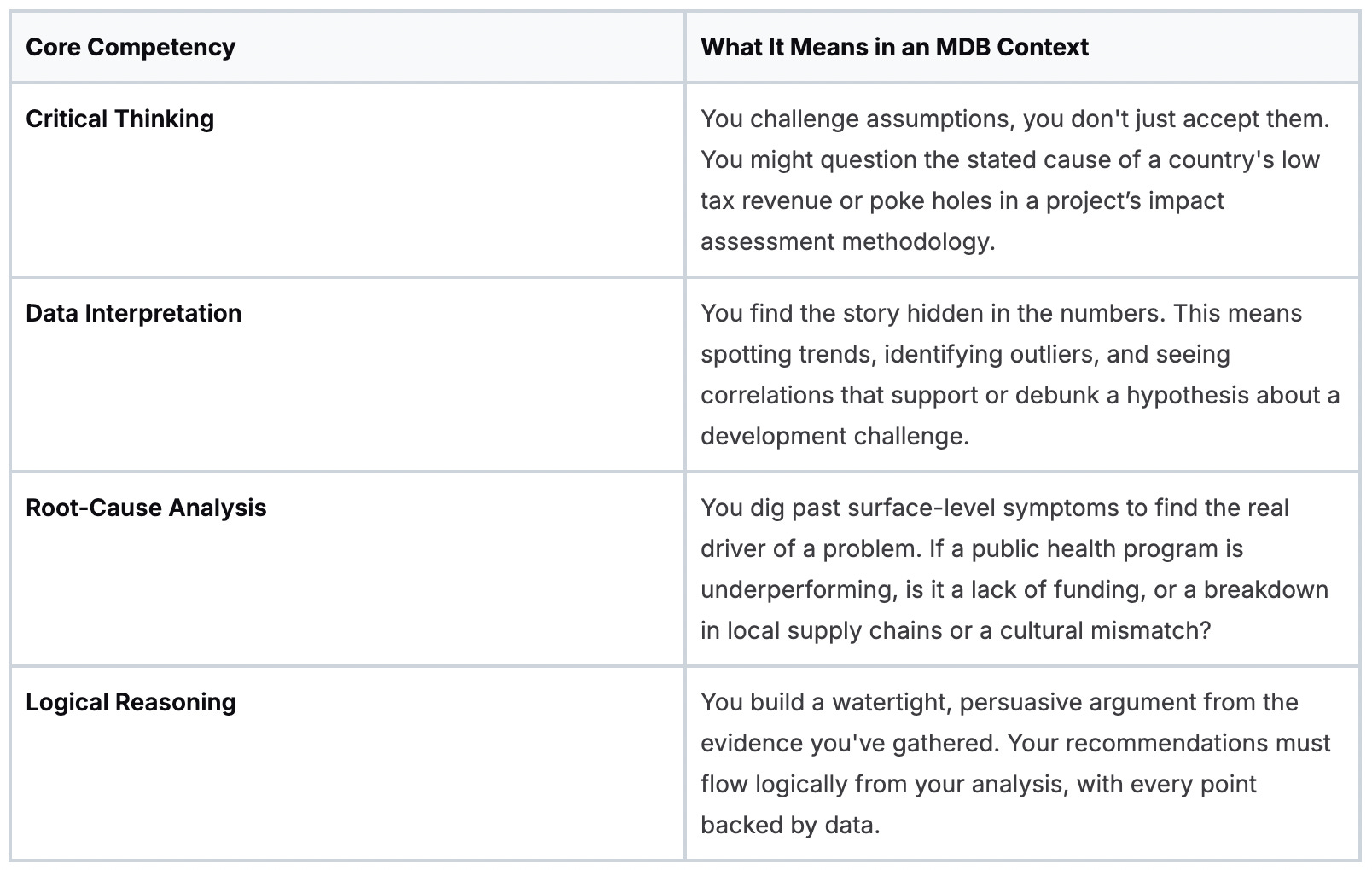
Mastering these four areas is your first and most important step. They are the building blocks for the high-impact work you’ll be expected to do from day one.
For example, professionals in policy dialogue and research roles constantly turn massive global datasets into sharp, compelling policy notes. This analytical work directly influences market reforms and underpins loans that can be worth over $500 million a year. According to World Bank research, a significant number of social protection policies adopted since 2015 have had MDB input, showing the real-world impact of this analysis.
If you’re targeting a specific MDB, you must understand how these skills are applied in its unique operational context. For a closer look at job-specific examples, check out our deep dive on careers in the African Development Bank.
Mastering Analytical Frameworks That Recruiters Value
What separates a good candidate from a great one in a high-stakes interview? It’s structured thinking. The best candidates use proven frameworks to build their analysis.
This gives them a massive advantage in case interviews and on the job itself. Frameworks are like scaffolding for messy, complex problems. They ensure your analysis is thorough, logical, and persuasive.
When a recruiter from the World Bank or ADB throws a complex scenario at you, they’re testing your ability to think systematically under pressure. They want to see if you can break down a real-world issue into manageable parts without getting lost. Adopting these frameworks shows them you can.
All good analysis follows a simple but powerful flow: from raw data to real-world impact.
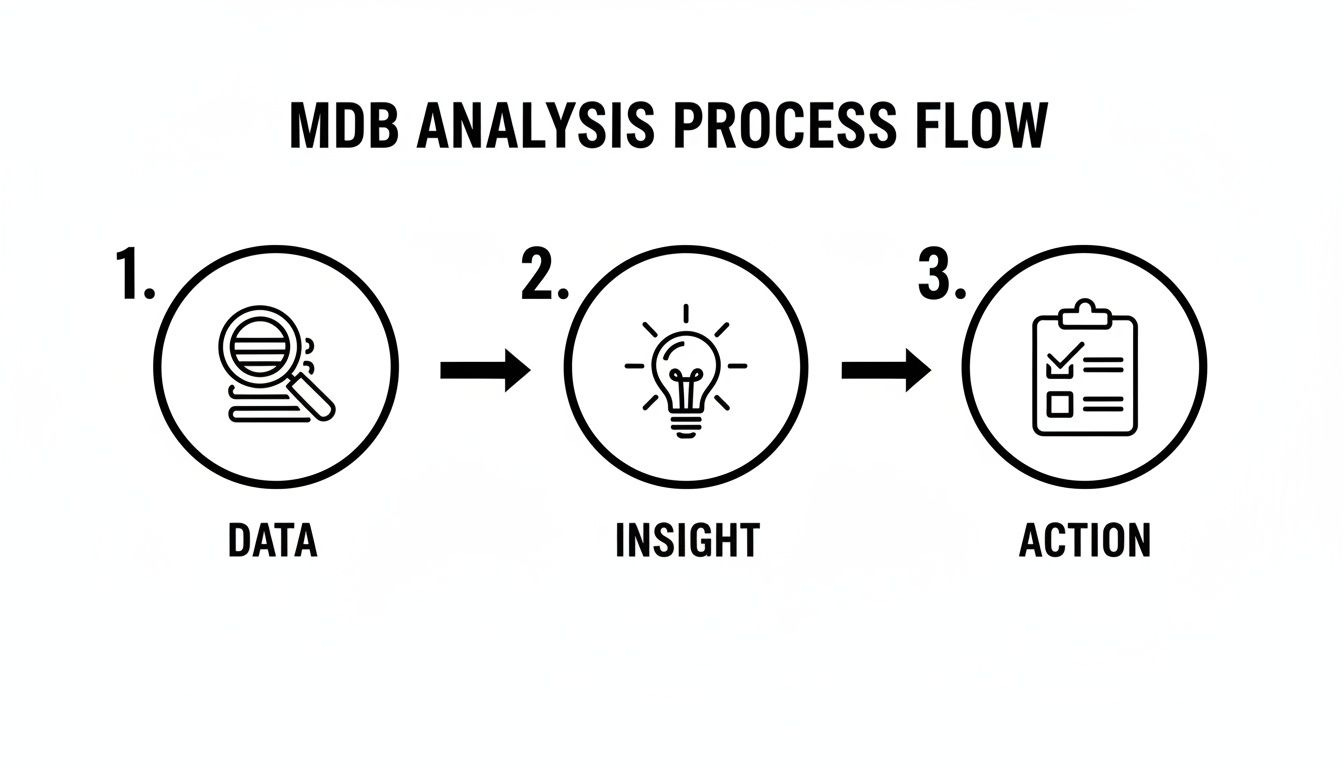
The key takeaway here is that data is the starting point. The real value, the kind that gets you hired and promoted, comes from turning that data into insights that lead directly to concrete, measurable actions.
Use MECE to Structure Your Analysis
The MECE Principle is a non-negotiable tool for any analytical role, especially within MDBs. The concept stands for Mutually Exclusive, Collectively Exhaustive.
This means you break a problem down into components that don’t overlap (mutually exclusive) and that, when combined, cover all possible issues (collectively exhaustive).
Let’s say you’re asked to analyze why a youth employment program in a developing country is underperforming. A MECE approach helps you organize your thoughts instantly. You could break the problem down into a few distinct buckets:
Program Design: Are there issues with the curriculum, the training methods, or the program’s duration?
Participant Outreach: Are we failing to recruit the right candidates? Is the selection process flawed?
Employer Partnerships: Are we struggling to secure job placements? Is there a mismatch between the skills taught and what employers actually need?
External Factors: Are there broader issues at play, like an economic downturn, regional instability, or transportation challenges preventing participants from attending?
Each category is distinct, and together they cover all the likely reasons for the program’s struggles. This structure prevents you from missing a critical angle and helps you present your findings clearly and confidently.
Using a MECE structure instantly signals to an interviewer that you are a clear, organized thinker. It shows you can build a comprehensive and logical argument, which is a core skill for project evaluation and policy work.
For a deeper look into how MDBs track project success from design to completion, you might find our guide on results-based management helpful.
Uncover the Real Problem with Root Cause Analysis
MECE helps you map out the entire problem landscape. Root Cause Analysis (RCA) is about digging deeper to find the problem’s true origin. It helps you move beyond treating symptoms to actually solving the underlying issue.
One of the simplest yet most effective RCA techniques is the 5 Whys. You keep asking “why” until you get past the surface-level issues and uncover the fundamental cause.
Let’s walk through a common MDB scenario.
Problem: A new water sanitation project is experiencing significant delays.
Why? Critical equipment hasn’t been delivered to the project site. (First Why)
Why? The shipment is stuck in customs at the port. (Second Why)
Why? The import paperwork was filled out incorrectly. (Third Why)
Why? The local project team wasn’t trained on the country’s new customs documentation requirements. (Fourth Why)
Why? The initial project launch plan didn’t include a budget or timeline for local regulatory training. (Fifth Why: The Root Cause)
See what happened? The initial problem looked like a simple logistical issue. The real root cause was a flaw in the project planning phase.
Fixing the paperwork solves the immediate crisis, but training the team and updating planning protocols for future projects prevents this from happening again. This is the kind of deep, impactful analysis MDBs value and it sets top candidates apart.
Building Practical Skills with Real-World Exercises
Frameworks are just theory until you get your hands dirty. To really sharpen your analytical skills, you have to dig into real problems and messy data. This is where you graduate from knowing the concepts to truly owning them, building the confidence and competence MDB recruiters are looking for.
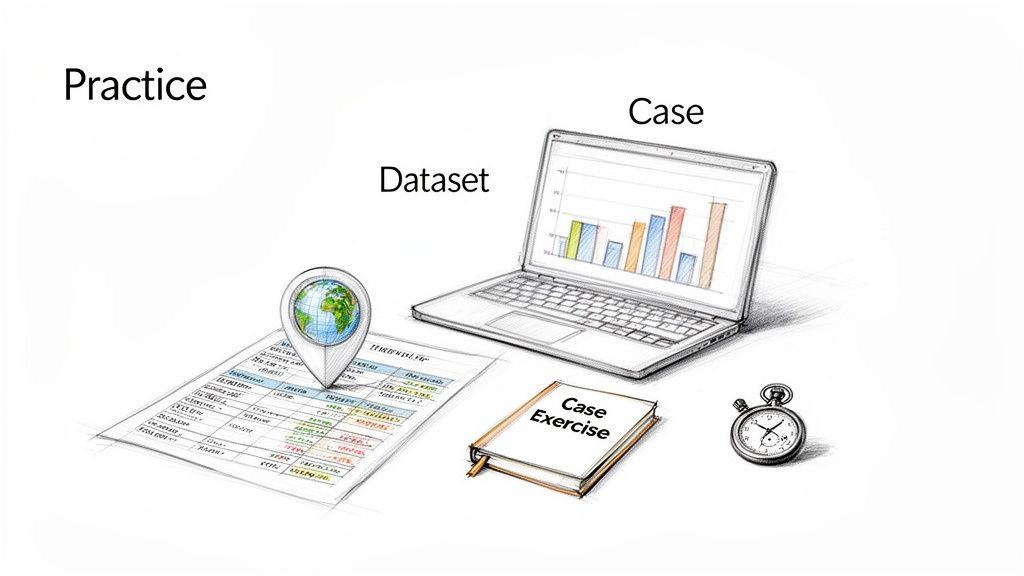
It all comes down to hands-on repetition. The goal is to make analysis second nature, so you’re polished and ready when an interviewer throws a tough question at you, or when you’re tasked with a complex project on day one.
Practice with Case Questions
MDBs live and breathe case interviews. They don’t want a “correct” answer; they want to see how you think. Can you structure a vague problem, apply logic, and talk them through your process?
Start by creating your own mini-cases pulled straight from development headlines.
The Problem: A government has $50 million to improve rural secondary education. Where should they invest it to get the biggest bang for their buck?
Your Method: Use a MECE approach. Break the problem down into distinct buckets: teacher training, infrastructure (classrooms, labs), student incentives (scholarships, free meals), and curriculum reform.
The Analysis: For each bucket, what are the key drivers and metrics? For teacher training, you’d look at certification rates and their link to student performance. For infrastructure, maybe you’d analyze student-to-classroom ratios.
This exercise forces you to think exactly like an MDB analyst, breaking a massive, abstract question into a series of solvable, smaller ones. This is a core skill you’ll use every single day on the job.
Interpret Real-World Data
You have to become fluent in the language of data. The fastest way to do that is to work with the exact same public datasets that MDBs like the World Bank use themselves. Portals like World Bank Open Data are absolute gold mines for this.
The site gives you direct access to global development data on everything you can imagine.
You have access to a huge array of datasets covering everything from economic policy and trade to public health and gender.
So, download a dataset that looks interesting, pull it into Excel or Google Sheets, and start asking questions. Frame a simple research question, like, “How has female labor force participation changed in Southeast Asia over the last 20 years?”
Pro Tip: Your first step should always be cleaning the data. Look for outliers, missing values, and weird formatting. After that, use pivot tables to summarize key trends and whip up some simple charts to visualize what you’ve found. This basic workflow is the bread and butter of data analysis.
At MDBs, being a wizard with pivot tables can be a game-changer for landing an analytical role. For example, a recent UNDP support position for MDB partnerships explicitly asked for candidates who could turn raw Excel files into pivot tables, analyze financial trends, and create infographics. These are exactly the skills that get your profile noticed for full-time jobs.
You can see for yourself how critical these practical skills are by checking out similar job postings, like this one on UN Talent.
The Analyst’s Toolkit: Tools and Resources That Actually Matter
Becoming a top-tier analyst requires having the right tools in your arsenal and knowing how to use them. Continuous learning is a non-negotiable part of the job. You need a curated set of resources focused squarely on what MDBs actually use and value. This is your roadmap to building a practical, in-demand toolkit.
Your foundation is advanced Excel. This isn’t optional. Recruiters at the World Bank or ADB assume you’re already fluent. We’re not talking about basic formulas here. You need to be able to wrangle complex datasets with pivot tables, effortlessly merge data using functions like VLOOKUP and INDEX-MATCH, and build dynamic charts that tell a compelling story. If you’re not there yet, make it your first priority.
Go Beyond Spreadsheets with Statistical Software
Once you’ve got Excel down cold, it’s time to level up to the software that MDB research departments use for their serious analytical work. For any real economic and policy analysis, a working knowledge of a statistical package is what separates the contenders from the pretenders.
Stata: This is the undisputed workhorse in development economics. It’s built for the kind of regression analysis and large panel datasets that are the bread and butter of MDB research.
R: As an open-source language, R has a massive, active community. It’s incredibly powerful for everything from data manipulation and complex statistics to creating stunning, publication-quality visuals with packages like
ggplot2.
You don’t need to become a coding wizard overnight. The goal is to get comfortable with the basics: importing and cleaning a dataset, running fundamental statistical tests, and interpreting the output. Just having this skill on your resume makes you a far more credible and competitive candidate.
Sharpen Your Skills with Project-Based Online Courses
Online learning platforms like Coursera and edX are fantastic for getting structured, hands-on training. But you need to be strategic. Focus exclusively on courses that are project-based.
A certificate is nice wall art. What actually gets you hired is the ability to confidently take a messy, real-world dataset, clean it, run a meaningful analysis, and then clearly explain what you found and why it matters.
Hunt for specializations like “Data Analysis and Visualization” or “Statistics with R/Stata”. These programs will equip you with the tangible skills that MDB hiring managers are desperately looking for.
To get you started, here is a curated list of tools and resources that will accelerate your journey. Think of this as your personal learning stack for becoming an MDB analyst.
Essential Tools and Resources for MDB Analysts
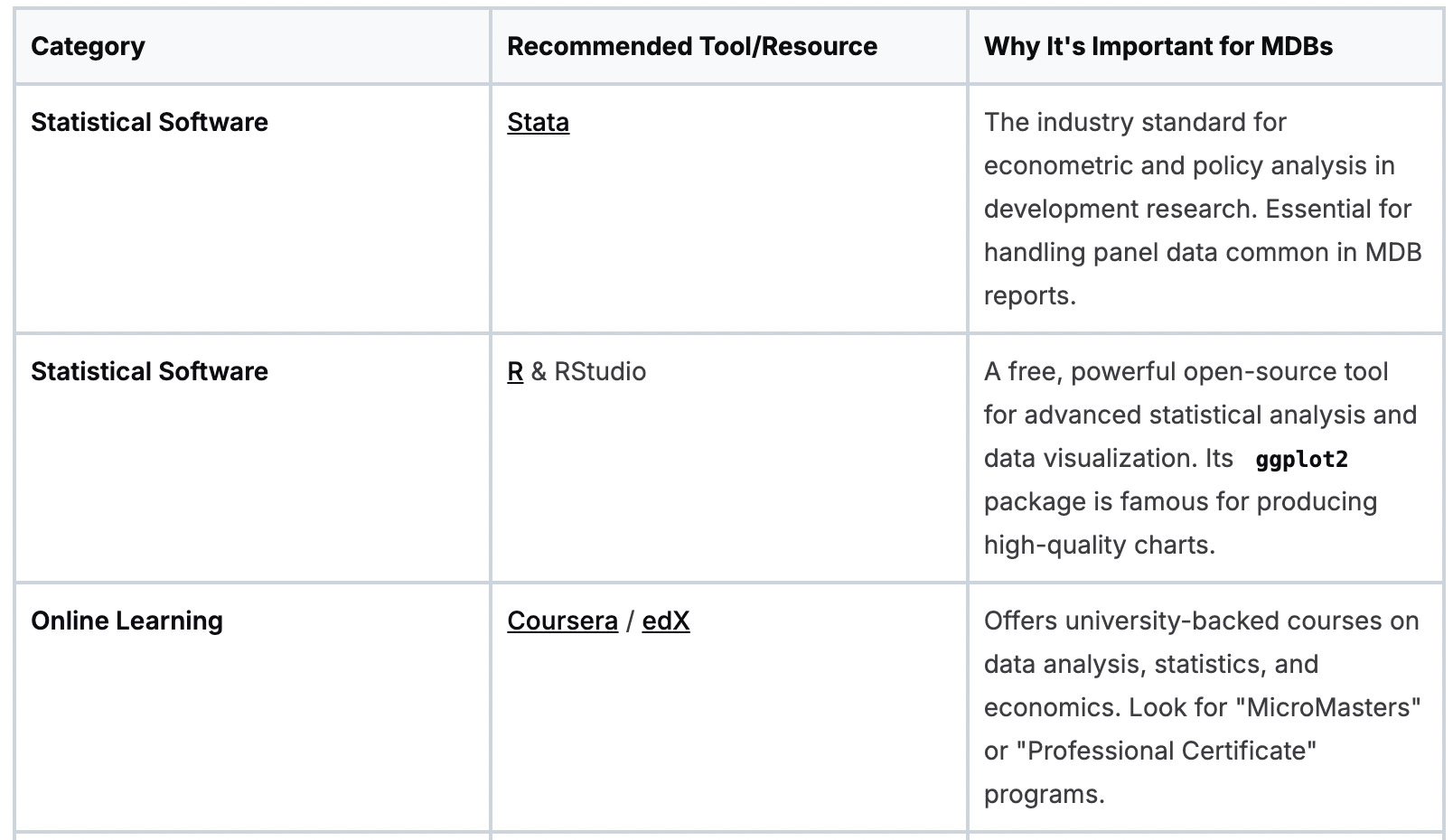
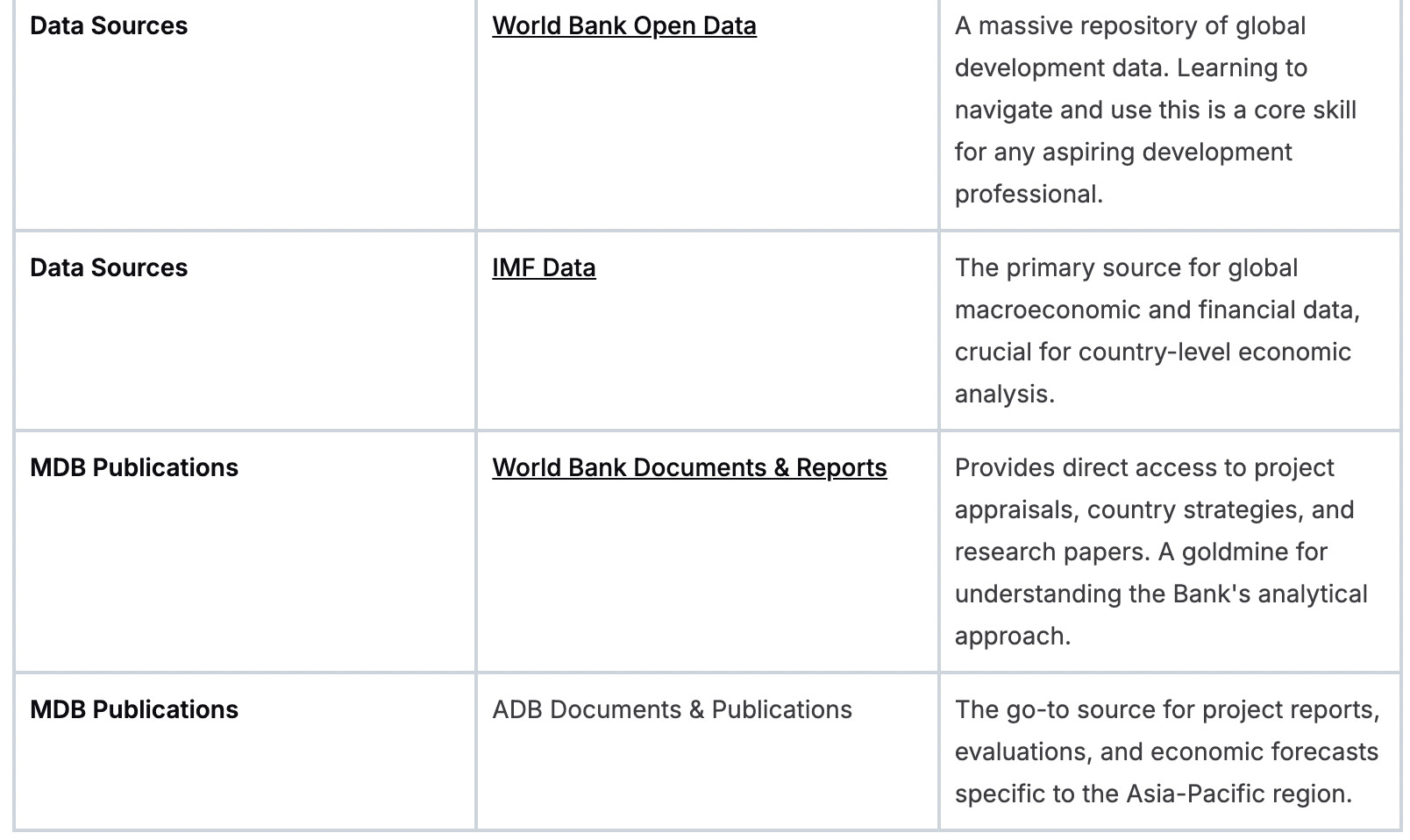
This table isn’t just a list; it’s a guide to what you should be spending your time on. Mastering these tools and regularly consuming content from these sources will put you miles ahead of the competition.
Think Like an MDB Analyst by Studying Their Work
Want the ultimate insider tip? The best way to learn how MDBs think is to read what they produce. Their own websites are a goldmine of reports, case studies, and project evaluations.
Seriously, go to the publications section of the World Bank, Asian Development Bank, or African Development Bank. Download a few recent project evaluation reports or a country economic memorandum.
As you read, pay close attention to how they operate:
How do they structure their arguments? Notice that every single claim is backed by data. There’s no fluff.
How do they visualize data? Look at the specific charts and graphs they favor. They prioritize clarity and impact over flashy designs.
How do they frame recommendations? See the direct line they draw from their analysis to the final, actionable policy advice.
This is active reverse-engineering of their analytical process. By dissecting their final output, you’re learning exactly what will be expected of you, giving you an incredible advantage in showing you already know how to meet their standards.
Demonstrating Your Analytical Skills to Get Hired
Having sharp analytical skills is one thing. Proving you have them to a hiring manager is another game entirely. This is where you package your abilities to make an impression on recruiters at institutions like the African Development Bank or the Asian Infrastructure Investment Bank.
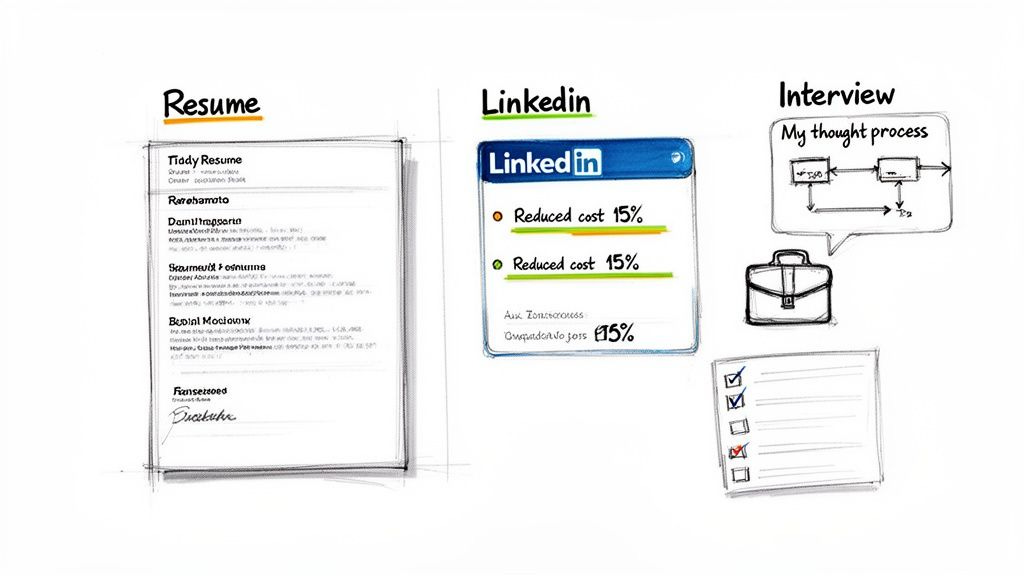
Your resume, LinkedIn profile, and interview performance are the three battlegrounds where you have to showcase your analytical talent. This is about providing cold, hard evidence that you can turn data into impact.
Translate Your Experience Into Quantifiable Achievements
Hiring managers at MDBs scan for results. Generic lines like “analyzed project data” are useless. You have to connect your actions to specific, measurable outcomes. This separates the candidates who get interviews from those who get ignored.
Before touching your resume, review every project or role. For each analytical task you did, ask yourself:
So what? What was the actual result? Did it lead to cost savings, efficiency gains, or a critical new insight?
How did my analysis change things? Can I put a number or a percentage on that change?
What was the scale? Was I analyzing a $10 million project budget or a dataset with 500,000 records?
This process transforms your resume from a list of duties into a portfolio of achievements.
Key Takeaway: Always use the “Action-Impact” framework. Start with a strong action verb, describe what you did, and then—most importantly—end with the quantifiable result. This is the hard evidence recruiters are desperate to see.
For example, evaluation roles at MDBs demand razor-sharp qualitative and quantitative skills. The experts who can master mixed-methods analysis are the ones who can drive more impactful project learnings.
At the Asian Development Bank, for instance, evaluation specialists dissect completed loans to figure out what actually worked. They use skills in sectoral analysis, data collection, and narrative synthesis to do it. Those skills became even more critical after the bank expanded its evaluation unit post-2008.
Nail the Case Study Interview
The case study interview is the ultimate test. The interviewer cares less about whether you get the “right” answer and more about how you get there. This is your chance to show them you can think in a structured, logical way, even under pressure.
When you’re handed a case, don’t just jump in and start talking. Articulate your framework first.
Clarify and Scope: First, repeat the problem back in your own words. This confirms you’ve understood it. Then, ask clarifying questions to pin down the scope and constraints of the problem.
Structure Your Approach: Explicitly state the framework you’re going to use, whether it’s MECE, the 5 Whys, or something else. Say something like, “To tackle this, I’m going to break down the potential causes into three distinct areas: program design, resource allocation, and external market factors.”
Think Out Loud: Walk the interviewer through your thought process, step-by-step. Explain your assumptions and how you’re using the data they give you to test those assumptions.
This structured, vocal approach proves you aren’t just guessing. It shows you have a reliable method for wrestling with complex, ambiguous problems, which is the core of almost any job at an MDB.
For a comprehensive look at the entire application journey, check out our guide on how to apply for World Bank jobs. It breaks down the whole process and what you should expect.
Frequently Asked Questions
You’ve got questions about how to sharpen your analytical skills for an MDB career. I’ve got direct answers based on my experience helping candidates navigate this exact path. Let’s get straight to what you need to know.
How can I practice analytical skills if my job isn’t data-heavy?
You don’t need a data-centric job to build these muscles. Start with public datasets from sources like the World Bank or your country’s national statistics office. It’s all there for the taking.
Pick a topic that genuinely interests you, say, health outcomes or education levels, and form a specific question you want to answer. Then, fire up Excel to clean the data, build pivot tables, and visualize the trends. This simple exercise perfectly mimics the daily work of an analyst.
You can also volunteer for organizations that need data help. Programs like the UN Volunteers often have remote opportunities that directly build the kind of analytical experience MDBs want to see on a resume.
What is the most important analytical skill for MDB interviews?
Structured problem-solving. This is the single most critical skill you can demonstrate. In a case interview, recruiters are evaluating how you think, not whether you have a magic “right” answer.
Your process is everything. They want to see you:
Define the problem clearly.
Break it down logically using a framework like MECE.
Ask smart, clarifying questions to fill in the gaps.
Use the data provided to build and support your conclusion.
Get in the habit of talking through your logic out loud. This shows the interviewer you have a repeatable, reliable method for tackling complex issues, which is exactly what they need in their analysts.
Do I need to be a programmer to get an analyst role at an MDB?
Not always, but it gives you a massive advantage. Let’s be clear: Advanced Excel proficiency is the non-negotiable baseline. For economist and research-heavy roles, knowing a statistical package like Stata or R is often mandatory.
For other analyst positions, coding skills make you a much more competitive candidate. If you have zero programming experience, master Excel first. Then, seriously consider an introductory course in R or Stata designed for data analysis. It’s a high-leverage investment of your time.
Knowing how to run a basic regression or clean a dataset with code signals that you’re ready for more sophisticated analytical tasks. It’s a clear differentiator that can push your application to the top of the pile.
How do I measure my progress in improving analytical skills?
Track your development by creating a personal project portfolio. For every practice exercise or mini-project you complete, write a one-page summary.
Detail the problem, your methodology, and your key findings. And make sure to include one powerful chart that tells the story. Over time, you’ll create a tangible record of your progress and see the complexity of the problems you can tackle increase.
You can also time yourself on case study exercises. Aim to reduce the time it takes to structure your analysis and reach a sound conclusion, all while maintaining the quality of your work. This builds both speed and confidence.
At Multilateral Development Bank Jobs, we help candidates like you find and land these competitive roles. We send out listings for full-time staff positions, consultant opportunities, and deep-dive career guides to give you the inside edge. Learn more and subscribe at
https://mdbjobs.com
.