

Working at the African Development Bank is not a typical finance gig. It’s where capital markets and technical know how fund projects that build real infrastructure, boost economies, and improve lives across the continent. Your skills, whether in engineering, economics, or public policy, become the tools for driving sustainable growth.
What Working At The African Development Bank Really Means
First, let’s get one thing straight: forget the image of a traditional, profit driven bank. The AfDB is a financial institution with a powerful development mandate. Every loan approved, policy paper written, and project managed is measured by its contribution to Africa’s economic and social progress. A career here is about delivering tangible results for the people of Africa.
This mission is channeled through a clear, strategic framework known as the High 5s. Think of these five priorities as the operational heartbeat of the bank. They are the lens through which every potential investment and intervention is viewed. If you want to work here, understanding them is your first and most critical step.
The High 5s: The AfDB’s Strategic Pillars
The High 5s give you a direct roadmap to see where your expertise fits. These are not abstract goals; they are concrete areas where the Bank directs its money, energy, and hiring.
How do your skills connect to this bigger picture? It’s straightforward. The Bank has laid out its key priorities, and each one requires a specific blend of talent.
Let’s break down where you might fit.
African Development Bank High 5s and Relevant Career Fields
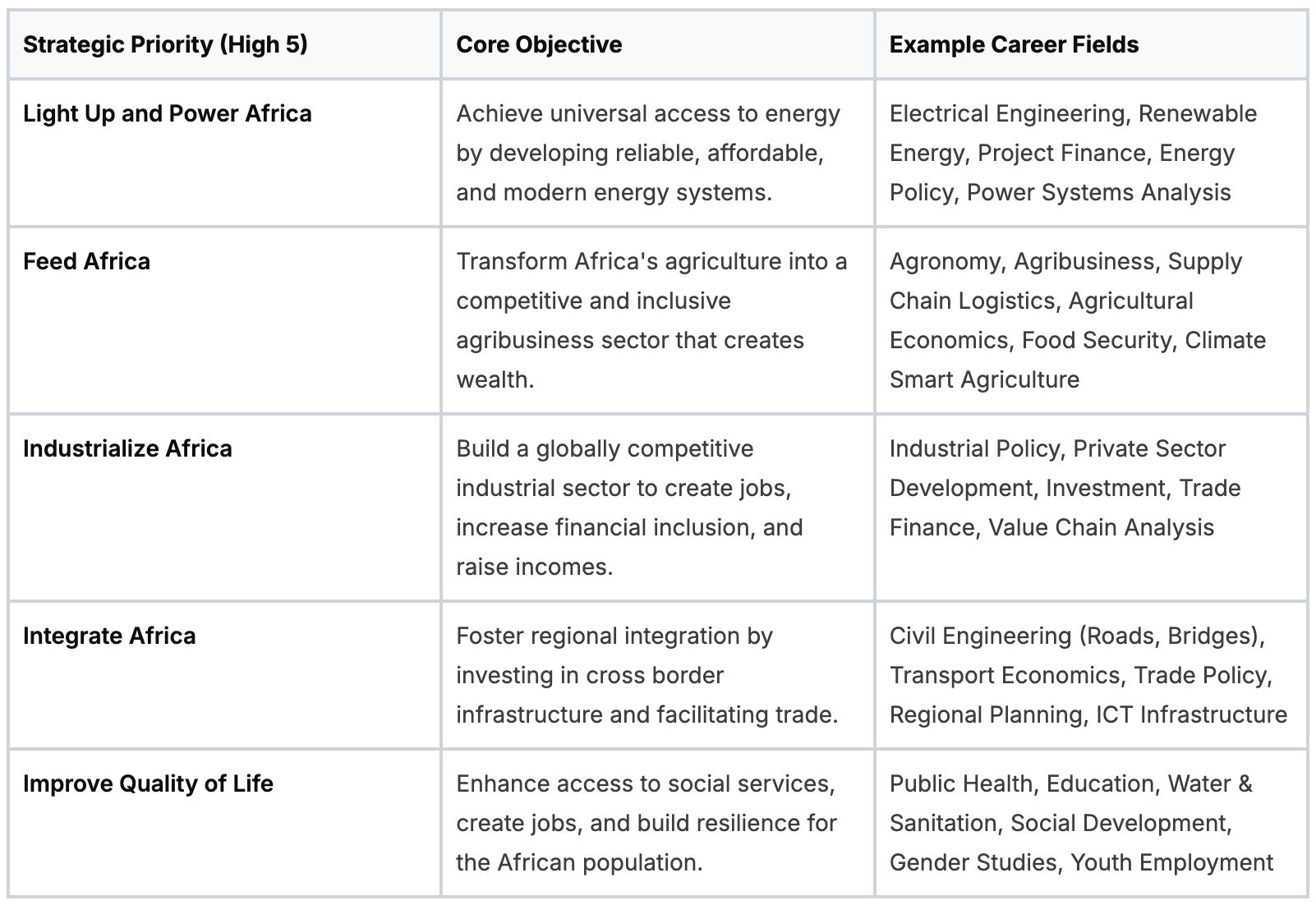
The Bank’s work is incredibly diverse. Whether you’re a transport economist or a public health specialist, there’s a place for you if your skills align with these core missions.
Every professional at the bank, no matter their job title, pushes one or more of these foundational goals forward. When you apply, you need to show you have the skills and understand exactly how they plug into this impact driven agenda.
Take the fifth pillar: improving quality of life. Youth unemployment is a huge hurdle. In response, the AfDB launched its Jobs for Youth in Africa (JfYA) strategy, an ambitious plan to create 25 million jobs and directly support 50 million young people. This initiative actively targets growth sectors like agriculture and ICT, which is vital when youth make up a staggering 60% of the continent’s unemployed. You can learn more about the AfDB’s strategy to create jobs and see what it means for Africa’s future.
The Main Ways to Get a Job at The AfDB
There’s no single front door to the African Development Bank. The institution uses a few different channels to bring in talent, each built for different experience levels and career goals. Your job is to figure out which one fits your background and aim your application there.
Think of it like trying to get into a city. You can take the express train, a regional bus, or a local taxi. Each serves a different purpose. Understanding these routes is the first step in planning your journey.
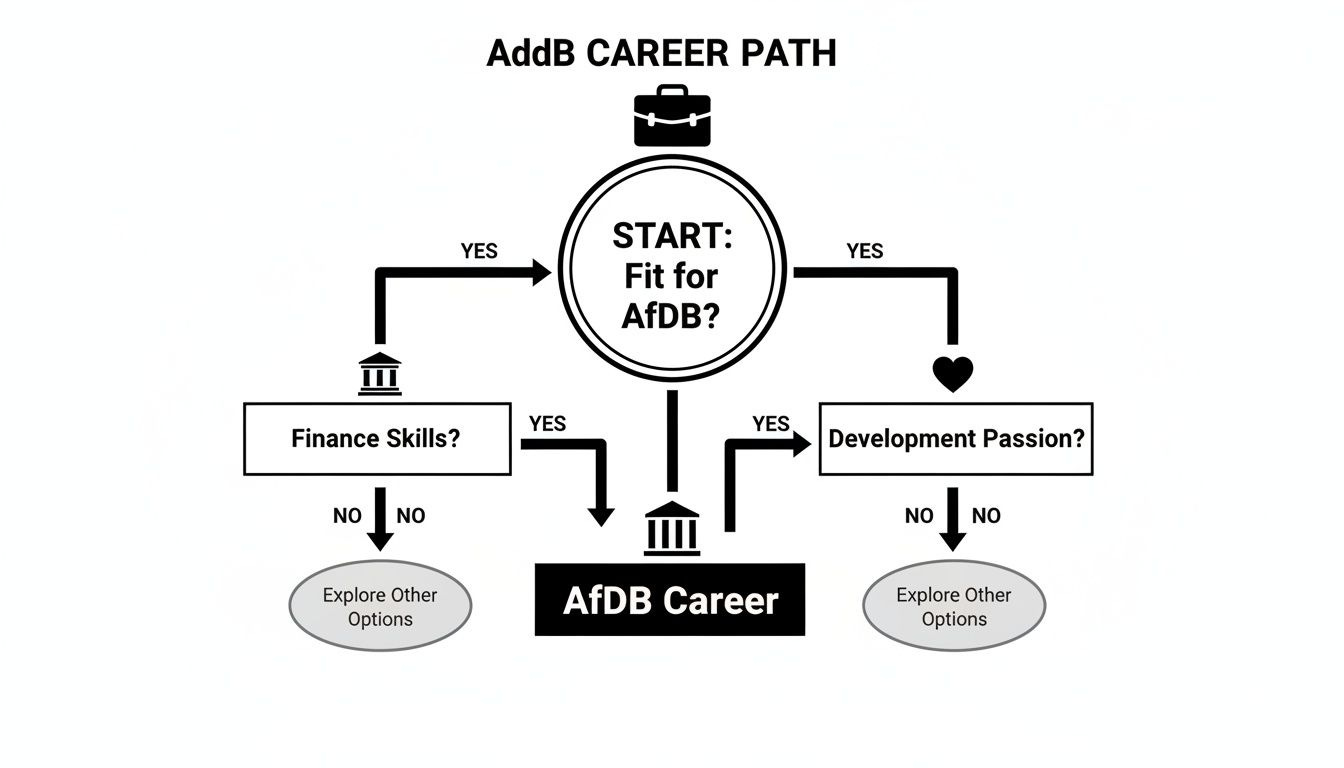
This decision tree shows that whether your background is in hard finance or mission driven development, there’s a potential path for you at the AfDB. The trick is to channel that expertise through the correct application stream.
Here’s a comparison of the main recruitment channels at the AfDB. It breaks down who each channel is for, the kind of contract you can expect, and the key requirements.
Comparing AfDB Recruitment Channels
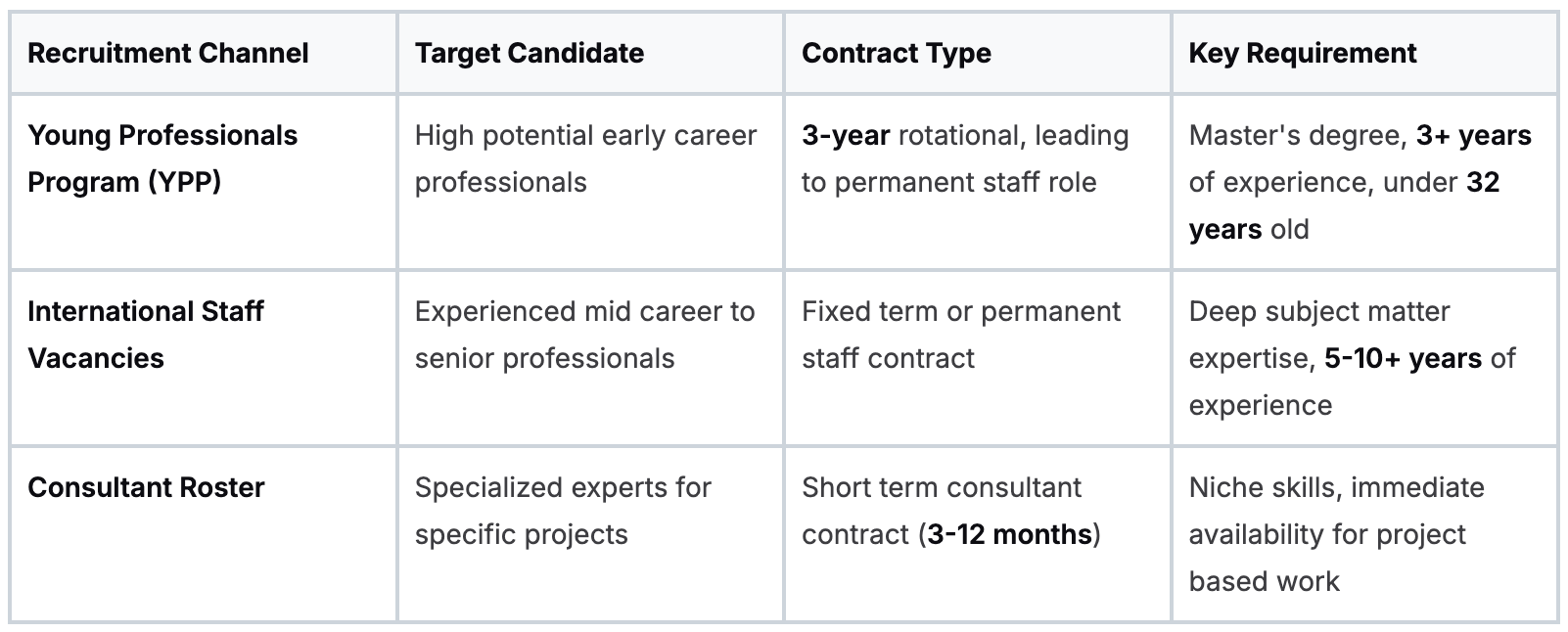
Each of these channels is a viable way into the Bank, but they serve different needs. Choosing the right one is your most important first step.
The Young Professionals Program (YPP)
The YPP is the AfDB’s flagship program for bringing in the next generation of leaders. It’s incredibly competitive and designed to build a pipeline of future talent for the bank. The “Young” in the title is misleading; this is not a program for recent graduates.
To be a serious contender, you need to hit some strict criteria:
Be a citizen of a regional or non regional member country.
Be 32 years of age or younger by the time the program starts.
Hold a Master’s degree in a relevant field.
Have at least three years of solid, relevant work experience.
The YPP is a structured, multi year rotational program. It’s designed to give you broad exposure to different departments, putting your professional growth on the fast track. The point is to groom people who can eventually step into leadership roles.
A winning YPP application shows sharp academic credentials, real world professional experience, and a clear, demonstrated passion for African development. You have to prove you’ve got the technical chops and the right mindset.
International Staff Vacancies
This is the most common route for experienced professionals. The AfDB regularly posts openings for specific roles, from Senior Investment Officers to Principal Transport Engineers and Communication Specialists. These are typically permanent or long term positions for people who can hit the ground running.
Unlike the YPP, there are no age restrictions. The main requirement is deep expertise and a proven track record in your field, usually meaning at least five to ten years of experience for mid career and senior jobs. Your application must speak directly to the skills and qualifications listed in the job description.
If you’re trying to move from a different sector, like an NGO, you’ll need to learn how to frame your experience for a Multilateral Development Bank (MDB). We’ve written a guide on how to successfully transition from an NGO to an MDB career.
The Consultant Roster
For anyone looking for more flexibility or a way to get a foot in the door, the consultant roster is a fantastic option. The AfDB keeps a database of pre vetted experts who can be hired for short term gigs, usually lasting from a few weeks to a year.
Consultancies are all about projects. A department might need a specialist to run a feasibility study, give technical advice on a new energy project, or help write a country strategy paper. These roles require very specific skills and are often on a tight deadline.
To get on the roster, you submit your CV and credentials to the bank’s supplier portal. Hiring managers then search this database when a need pops up. It’s a great way to build a relationship with the bank and prove your value on real projects.
Key Roles and Professional Streams Inside The Bank
If you’re thinking about a career at the AfDB, understand that it’s not a monolith of economists and bankers. The Bank is a massive, complex machine, and it takes all kinds of specialists to keep it running. Getting a handle on the main professional streams is how you’ll figure out where your skills plug into the bigger picture.
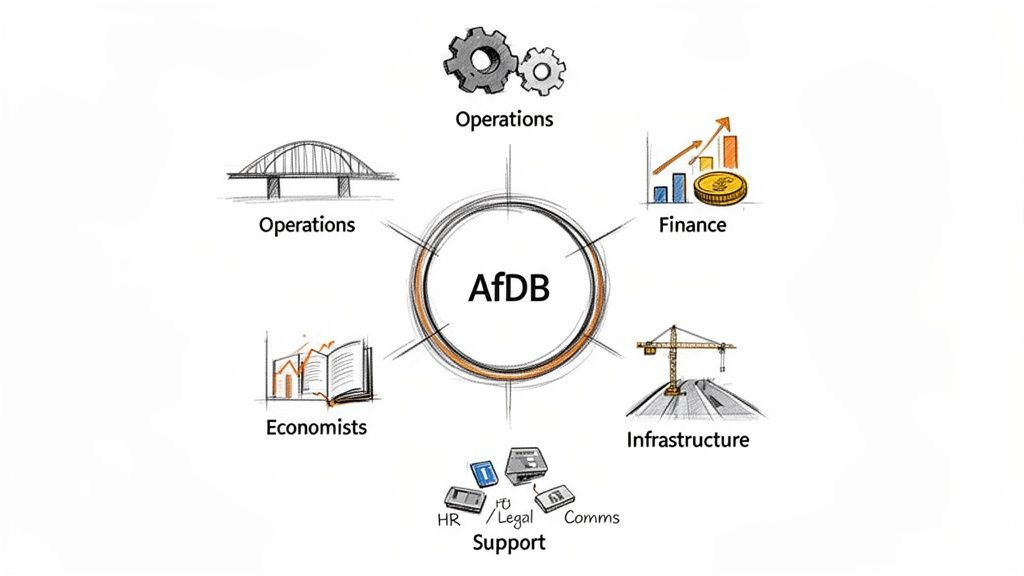
I think of the AfDB as a small, self contained city. You’ve got the city planners and builders (Operations), the municipal treasury (Finance), the engineers making sure the lights stay on and the water flows (Infrastructure), the data analysts studying population trends (Economists), and all the administrators who keep city hall running (Support).
Each district is distinct, but they all work together. Finding your place at the AfDB is about figuring out which district you belong in.
Operations: The Engine Room of Development
If you want to be on the front lines, Operations is where the action is. The Bank’s development mandate becomes reality here. The professionals in this area design, appraise, and supervise the actual projects that the AfDB funds across the continent. It’s where you’ll find the deep sector specialists who live and breathe their subject matter.
Roles here are incredibly diverse and are directly linked to the Bank’s High 5s strategic priorities. You’ll find spots for experts in:
Agriculture and Agribusiness: People working on projects to boost food security and build sustainable value chains.
Energy and Power Systems: Engineers and specialists designing everything from huge hydroelectric dams to small scale off grid solar projects.
Water and Sanitation: Professionals focused on the critical work of delivering clean water and improving public health infrastructure.
Social Development: Specialists in education, gender, and public health who ensure projects are inclusive and benefit everyone.
A word of warning: working in Operations is demanding. It often involves a lot of travel to project sites, sometimes in tough environments. You need serious technical expertise and rock solid project management skills to thrive here.
Finance and Treasury: The Bank’s Financial Core
While the Operations teams spend the money, the Finance and Treasury complex raises it and manages it wisely. This part of the Bank functions a lot like a traditional investment bank, dealing with global capital markets, complex risk management, and sophisticated financial modeling.
These are the people who manage the AfDB’s balance sheet, issue bonds on international markets, and protect the Bank’s AAA credit rating. This is a critical function. Without that top tier rating, there would be no cheap capital to fund development projects.
This is where you’ll find roles for treasury officers, risk analysts, financial modelers, and investment specialists. A strong quantitative background and hands on experience in capital markets are non negotiable for these positions.
Economists and Infrastructure Specialists: The Brain Trust
The Bank’s analytical foundation is built by its economists and technical specialists. They are the brain trust. Economists conduct macroeconomic research, produce the country strategy papers, and analyze economic trends to guide the Bank’s investment decisions. They’re the ones who assess a country’s readiness for a loan or predict the economic ripple effects of a new project.
Alongside them, you have infrastructure specialists who provide the hard technical oversight needed for massive projects. This includes civil engineers, transport planners, and ICT experts who ensure that a bridge is built to last or that a new fiber optic network is designed for maximum impact.
The Bank’s work is deeply intertwined with the continent’s economic future. Projections from the OECD show Africa’s real GDP is set to grow by 3.9% in 2025. This creates a huge demand for the kind of skilled professionals the AfDB hires. It also presents a massive “twin jobs challenge”: creating quality employment for a working age population expected to grow by over 620 million by 2050. You can dive deeper into these trends by exploring Africa’s development dynamics and the jobs challenge on oecd.org.
Essential Support Functions: The Backbone
An organization of this scale cannot function without a robust corporate support system. The AfDB has a full suite of professional services that are vital to its daily operations. These are fantastic career paths for professionals whose skills are not tied to a specific development sector.
You’ll find critical roles in departments like:
Information Technology
Human Resources
Legal Services
Communications and External Relations
Audit and Internal Control
These teams make sure the Bank runs efficiently, complies with all its regulations, and communicates its impact to the world. A career at the African Development Bank is absolutely possible even if your background isn’t in economics or engineering.
How Nationality and Eligibility Rules Work
Before you pour a minute into polishing your CV, you have to answer one simple question: are you eligible to apply?
Your nationality is the first and most important filter at the African Development Bank. It is not a minor detail on an HR form; it’s a hard rule that decides whether your application gets a first look.
The AfDB is a multilateral institution, which means it’s owned by its member countries. These fall into two buckets: Regional Member Countries (RMCs), which are the 54 nations on the African continent, and Non Regional Member Countries (NRMCs), which include 28 countries from the Americas, Asia, and Europe that contribute capital and support the Bank’s work.
Your passport determines which bucket you’re in, and that has a massive impact on your chances for most roles.
Regional vs Non Regional Member Countries
For the vast majority of international staff jobs, and especially for the hyper competitive Young Professionals Program (YPP), you must be a citizen of a member country. It doesn’t matter if it’s a regional or non regional one. Simple as that.
Here’s the inside baseball you need to understand: the Bank has a mandate to build African capacity. This translates into a strong preference, and sometimes an explicit requirement, for candidates from Regional Member Countries. The YPP, for example, often uses nationality quotas to ensure a balanced representation from across the continent. This is a core strategic goal for the Bank, not just a suggestion.
This dynamic is crucial. Two candidates with identical qualifications can have wildly different outcomes based solely on their passports. It’s about what you know and about helping the Bank fulfill its institutional mandate to its shareholders.
This preference for RMC nationals is the practical reality of the hiring process. Non regional candidates get hired all the time for their specialized expertise, but you have to go in with your eyes open to this underlying priority.
Key Eligibility Factors to Check
Before you apply, confirm your status. Your entire application strategy hinges on it.
Member Country Citizenship: Is your country one of the 82 regional or non regional members? If the answer is no, you are not eligible for international staff roles.
Specific Program Rules: Dig into the fine print for programs like the YPP. They often have much stricter rules on both nationality and age.
Consultant Eligibility: The rules for short term consultants can sometimes be more flexible, but nationality still frequently comes into play, particularly for projects funded directly by the Bank.
Wasting your time on applications you’re not qualified for is the fastest way to burn out. Do your homework first. You can get a better sense of how these rules work across different institutions with this helpful guide to MDB eligibility.
The AfDB’s hiring choices reflect its identity as an African institution supported by global partners. Knowing where your nationality positions you is the first step toward a smart application. It gives you a clear eyed view of your real opportunities and helps you aim your efforts where they have the best chance of paying off.
Crafting An Application That Gets Noticed
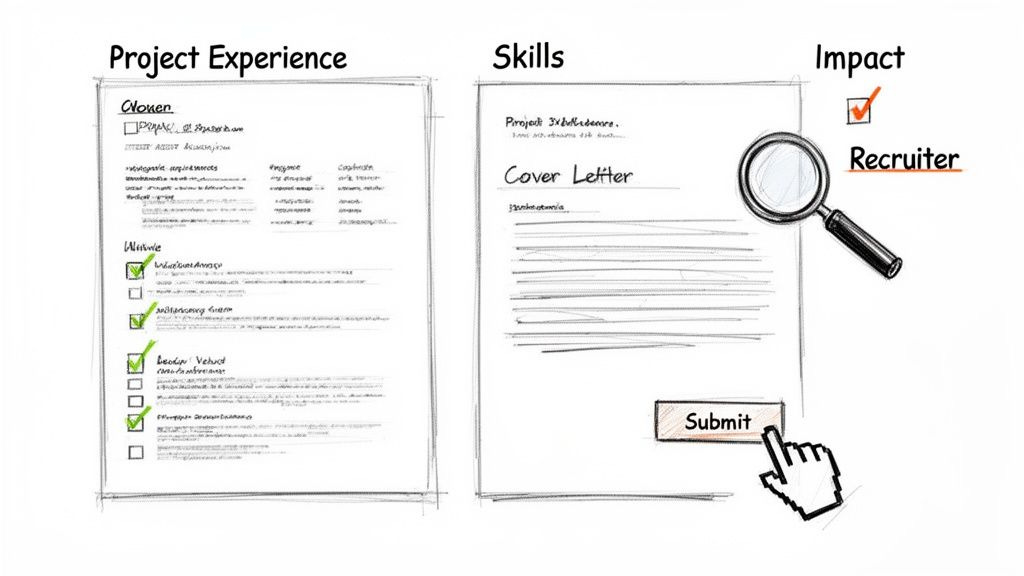
Let’s be blunt: sending a generic application to the African Development Bank is a waste of your time. The hiring managers are seasoned experts, and they can spot a copy paste job from a mile away.
To get a first look, you have to prove you understand their world and speak their language. This means tailoring every single document, your CV and your cover letter, to the specific role and the bank’s mission. You have to connect the dots between your background and their strategic priorities, like the High 5s. Your goal is to make it impossible for them to ignore you.
Decoding The Job Description
First, treat the job description like a cheat sheet. It is a detailed breakdown of the exact problems the hiring manager needs to solve. Your job is to prove you are the solution.
Print it out and get a highlighter. Hunt for keywords related to skills, competencies, and project types. Pay close attention to the language they use. If they say “project appraisal,” you use that exact phrase in your CV, not “project evaluation.”
This is about showing you understand the specific context of working at a Multilateral Development Bank (MDB). That understanding needs to be obvious from the first line of your application.
Structuring Your CV For Maximum Impact
Your CV for an AfDB role needs to be built around tangible results and hard technical skills. Forget fluffy summaries about being a “hard working team player.” They need to see what you’ve actually accomplished.
Structure your CV with these principles in mind:
Lead with a powerful summary. In two or three lines, state your expertise, years of experience, and a key achievement that aligns directly with the role. For instance: “A development economist with 8 years of experience in infrastructure finance, specializing in energy sector reform and public private partnerships in West Africa.”
Focus on quantifiable achievements. Don’t just list your responsibilities; show the impact you made with numbers. Instead of “Managed project budgets,” write “Managed a $15 million portfolio of renewable energy projects, delivering them 10% under budget.”
Align with the High 5s. Explicitly link your past work to the bank’s strategic pillars. If you worked on an agricultural value chain project, mention how it contributed to the “Feed Africa” priority.
The best AfDB CVs read like a project portfolio, not a job history. Each entry should demonstrate your technical competence and your direct experience delivering results in a relevant sector.
Writing A Cover Letter That Tells A Story
Your cover letter is where you move beyond the data points on your CV and reveal your motivation. This is your chance to tell a compelling story about why you are committed to African development and why the AfDB is the right place for you to make an impact.
Avoid the trap of repeating your CV. Instead, pick two or three of your most relevant accomplishments and expand on them. Explain the context, the challenge you faced, and the specific actions you took to get the result.
Most importantly, connect your personal mission to the bank’s. Show you’ve done your homework by referencing a specific AfDB project or a recent report that resonates with you. This proves your interest is genuine and well researched, setting you apart from the hundreds of other applicants who just want any job. Your passion for the continent’s progress must shine through.
Understanding The AfDB Compensation and Benefits Package
Let’s talk about the money. A career at the AfDB is professionally rewarding and financially competitive. When you’re considering an international move, you need to know the numbers. The Bank knows this and structures its offers to pull in top talent from around the globe.
The foundation of the package is a tax free salary. This is a massive advantage. Your salary is paid in Units of Account, the Bank’s internal currency, which is pegged to a basket of major world currencies. This detail is designed to shield your earnings from exchange rate swings, a real concern for international staff. The exact amount you’ll earn is tied to a grade level system that reflects the seniority and complexity of your role.
Core Components of Your Financial Package
Beyond the base salary, the AfDB builds a financial safety net around you with a suite of allowances and benefits. The idea is to let you focus on your mission driven work without worrying about big life expenses, particularly if you’re uprooting your family to join the Bank.
Here are the most common elements you’ll find in an offer:
Dependency Allowances: Extra financial support for your spouse and any dependent children.
Education Grants: This is a big one for families. The Bank provides substantial help, covering up to 75% of education costs for your kids, from primary school through university.
Comprehensive Insurance: You and your family get robust medical, dental, and life insurance plans with global coverage.
This structure is standard across Multilateral Development Banks. To see how it stacks up against others, you can dig into this overview of MDB salaries and the numbers you really want to know.
Relocation and Retirement Benefits
Moving across continents is a huge undertaking, and the Bank gets it. They offer serious relocation support to make that transition as smooth as possible. It’s a practical package designed to get you and your family settled.
New international hires can typically expect:
A shipping allowance to get your household goods to your new home.
A settling in grant to cover initial, unexpected costs.
Flights to the duty station for you and your eligible family members.
The goal is to remove the logistical and financial friction of an international move. The AfDB invests in getting you set up for success from day one because they need you focused on the mission.
Finally, let’s touch on the long game: retirement. The AfDB has a robust staff retirement plan. It’s a defined benefit pension plan, a critical long term financial asset that’s becoming rare in other sectors. Both you and the Bank contribute throughout your career, building a solid foundation for your future. It’s crucial to look at the whole picture. The total value is far greater than just the number on your payslip.
Got Questions About a Career at the AfDB? Let’s Get Real.
Thinking about a major career move like joining the African Development Bank brings up big questions. Getting straight answers is not always easy, so let’s cut through the noise and tackle what candidates really want to know.
Consider this the practical, no nonsense advice you need before diving in.
How Long Does The AfDB Recruitment Process Actually Take?
Let’s be blunt: patience is critical. For a standard international staff role, you should budget anywhere from four to eight months for the entire process. That clock starts ticking after the application window closes.
This is not bureaucratic delay. The timeline covers everything from longlisting and shortlisting thousands of CVs, to technical assessments, multiple rounds of competency based interviews, and finally, deep dive reference and background checks. The Young Professionals Program is on its own rigid annual schedule, but it’s just as intensive.
The process is deliberately thorough. The Bank makes a huge investment in every person they hire. They take their time to bring on the absolute right person for the job.
Seriously, How Important is French?
The AfDB’s official working languages are English and French. While not every role demands perfect bilingualism, proficiency in both is a massive career advantage. It’s a fundamental tool for effectiveness.
This is especially true for any operations role. If you’re engaging directly with governments and project partners in francophone Africa, your French needs to be solid. Job descriptions are very clear about language needs, so pay close attention.
If a role is based in Abidjan, Tunis, or Dakar, fluency in French shifts from a “nice to have” to a practical necessity for daily life and getting work done. If you’re serious about building a long term career at the AfDB, investing in your French skills is one of the smartest professional moves you can make.
Can I Apply For Multiple Jobs At Once?
You can, but you have to be smart about it. Firing off applications for a dozen different roles that don’t match your profile is a terrible look. It signals a lack of focus and tells recruiters you haven’t thought about where your skills fit.
Here’s the better approach: find two or three positions where your experience is a rock solid match for what they’re asking for. Then, put all your energy into submitting a high quality, meticulously tailored application for each one.
It’s about quality over quantity. Your goal is to make it impossible for the hiring manager to ignore you because you’ve shown you know exactly what they need and that you’re the person who can deliver it.
What’s The Work-Life Balance Really Like?
There’s no single answer to this. Your work life balance will depend almost entirely on your specific job and department.
An operational role, like a Senior Transport Engineer who is constantly traveling to remote project sites, will have a completely different rhythm than a headquarters based job in HR or IT. The reality of development work is that it’s often driven by urgent deadlines and high stakes.
You should expect a challenging, fast paced environment. While the Bank has policies to support its staff, the mission itself is demanding by nature.
Ready to find your place at a Multilateral Development Bank? Multilateral Development Bank Jobs is the top resource for discovering opportunities and navigating the hiring process. Get curated job lists and expert guides delivered to your inbox to fast-track your career. Start your journey at
https://mdbjobs.com
.