

If you want to work at the African Development Bank (AfDB), your first move is figuring out where you fit. The Bank offers three distinct career streams: long-term international staff positions, fixed-term consultant roles, and the highly competitive Young Professionals Program.
Each path is a different way to contribute to the Bank’s mission of driving economic growth and social progress across Africa. Knowing which one aligns with your experience is the essential first step before you touch your CV.
Decoding The AfDB Career Landscape
Working at the African Development Bank is a complex ecosystem of roles, each designed to tackle Africa’s biggest development challenges from a different angle. To get a real shot, you need to understand the fundamental differences between these career tracks.
You have to tailor your entire application to show you’ve done your homework and understand exactly what they’re looking for. The Bank runs on a combination of permanent experts, project-based specialists, and a pipeline of emerging leaders.
This flowchart breaks down the main career paths. It shows how the structured, long-term staff roles differ from the more flexible, project-focused consultant route and the specialized entry-level Young Professionals Program.
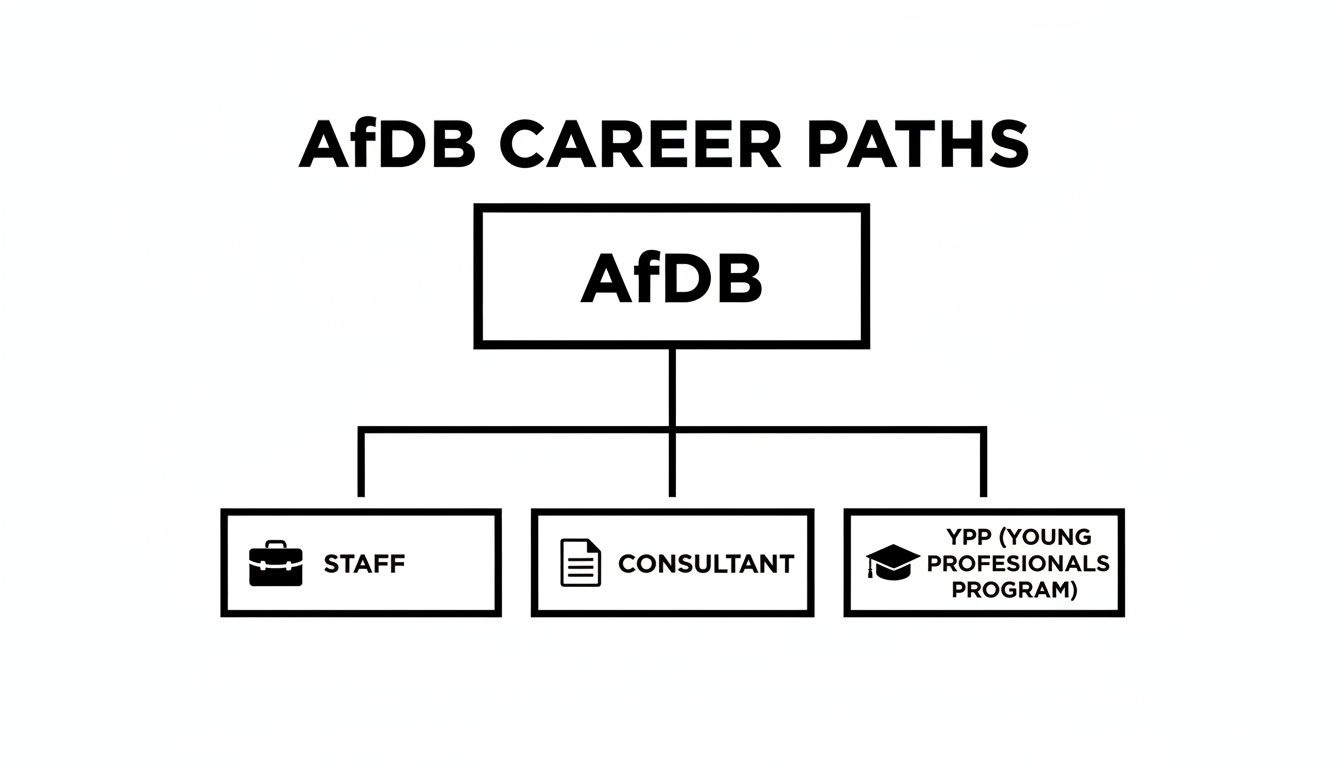
As you can see, each track serves a very different purpose within the institution.
The Three Main Career Tracks
Which door is right for you? It comes down to your career stage, your specific expertise, and what you want to achieve professionally. Let’s break them down.
International Staff: These are the core, full-time employees on long-term contracts. They form the backbone of the institution, running the Bank’s departments, managing massive portfolios, and executing its strategic vision.
Consultants: These are specialists brought in for their specific skills on a short-term or project basis. A consultant might be hired to conduct a feasibility study for a new dam, design a technical solution for a digital finance project, or provide niche policy advice for a limited time.
Young Professionals Program (YPP): This is the Bank’s prestigious, multi-year talent pipeline for exceptional young professionals. YPs rotate through different departments to get a bird’s-eye view of the institution, with the ultimate goal of landing a permanent staff role and becoming a future leader.
The responsibility of a leader at the Bank is to build on the past, to look far into the future, and to find within themselves what courage it takes to stand up for Africa’s interests. This mission-driven mindset is central to the culture you’ll find in any role.
To make it even clearer, here’s a table comparing the three tracks side-by-side. Use it to quickly see where your profile and ambitions might align best.
Comparing AfDB Career Tracks
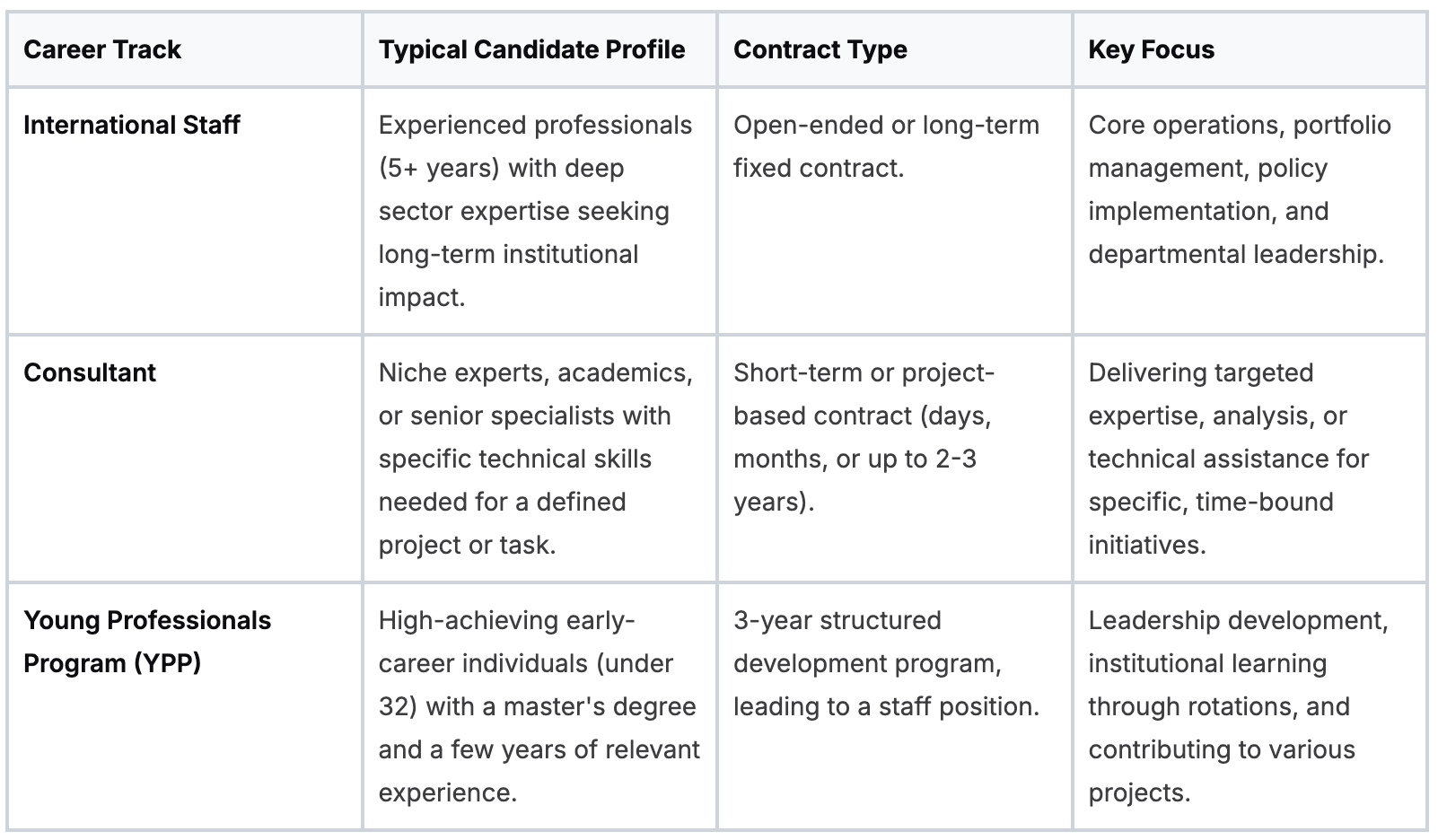
The right path depends on whether you’re looking to build a long-term career inside the institution (Staff/YPP) or offer specialized, flexible expertise from the outside (Consultant).
How These Roles Support The Bank’s Mission
Every job at the AfDB, whether it’s a permanent staffer or a short-term consultant, is tied directly to its “High 5s” strategic priorities. These are the big goals: lighting up and powering Africa, feeding Africa, industrializing Africa, integrating Africa, and improving the quality of life for its people.
For example, an energy specialist (staff) might manage a multi-billion dollar renewable energy portfolio, while a trade finance expert (consultant) advises on a single cross-border infrastructure project. You can get a broader sense of how these institutions function in our guide to regional MDBs.
The Bank is laser-focused on tackling Africa’s youth employment crisis, a massive challenge as the continent’s working-age population is set to surpass China and India by 2035. This reality drives a huge internal need for experts in youth skills, private sector finance, and education, creating opportunities right at the heart of the Bank’s mandate.
Finding And Applying For Open AfDB Positions
Knowing where to look is half the battle. The good news is the AfDB keeps most of its recruitment in one place, which simplifies your search. Your first and most important stop is always the Bank’s official career portal.
Seriously, this is the definitive source for everything. International staff roles, consultant gigs, and the Young Professionals Program are all posted here. Don’t waste time scrolling through third-party job boards for your initial search. Go straight to the source to get the real story, right when it’s posted.
Navigating The Official AfDB Careers Portal
The AfDB’s recruitment platform is your mission control. It’s where you find every opening, build your profile, and submit your applications. The Bank uses the SAP SuccessFactors system, a common setup for big international organizations, so it might feel familiar.
Here’s a quick look at the main vacancies page.
The portal lets you filter jobs by family, location, and role type. This makes it easy to cut through the noise and find what’s relevant. Getting the hang of its search and alert functions is essential.
Your first move should be creating a detailed candidate profile. Treat this like your master application. You’ll upload your CV and fill out information about your work history, education, and skills. Do it right once, and you can tweak it for each specific job you pursue later.
Setting Up Strategic Job Alerts
Hoping to stumble upon the perfect role is a recipe for disappointment. The best applicants don’t wait for opportunities; they create a system to find them. That means setting up targeted job alerts so you never miss a beat.
Inside the AfDB portal, you can create alerts based on specific keywords and filters. You need to think like a recruiter.
Use Broad and Specific Keywords: Set up alerts for general terms like “Health Specialist” and for more niche titles like “Health Economist” or “Public Health Financing.”
Filter by Job Family: If your background is in infrastructure, create an alert for the “Infrastructure & Urban Development” category.
Specify Your Grade Level: If you’re aiming for a Principal Officer role (PL4), you can often filter your search for that professional level.
This automated approach saves you time and ensures you’re one of the first to know when a job that fits your profile pops up.
The most successful candidates are systematic. They don’t just browse; they build a system that brings opportunities directly to them. Setting up precise alerts is the first part of that system.
Leveraging Professional Networks
While the official portal is your go-to, professional networks like LinkedIn are goldmines for tracking opportunities and gathering intel. The AfDB has an active presence there, sharing high-profile vacancies and major news from the Bank.
Following the Bank and its key executives gives you a direct line of sight into its current priorities. This context is pure gold when you’re writing a cover letter. If the President is constantly talking about the Bank’s new push into green infrastructure, you should highlight your own experience in that space.
Use LinkedIn to:
Identify Team Members: Look up people who work in the department you’re targeting. Check out their backgrounds and the language they use to describe their work. This is a great way to tailor the tone of your application.
Follow Relevant Hashtags: Keep an eye on tags like #AfDB, #JobsForYouthInAfrica, and #High5s to see which projects and initiatives are getting traction.
Connect with Recruiters: The Bank’s HR team is on LinkedIn. Don’t spam them, but a well-crafted connection request can get you on their radar.
Think of LinkedIn as your reconnaissance tool. It gives you the story behind the job post. For a deeper look into the world of MDB careers, you might be interested in your guide to jobs in African development. Combining sharp portal management with smart networking will put you miles ahead of the competition.
Crafting An Application That Gets Noticed
Let’s be direct: your CV and cover letter are your first real test. Sending a generic, copy-paste application is the fastest way to land your file in the “no” pile. Recruiters at the African Development Bank are trained to spot them a mile away.
Your application has to prove two things: you understand the Bank’s mission, and you’ve delivered tangible results in your career. This means building a rock-solid case for why you are the person to help solve Africa’s development challenges, not just listing past duties.
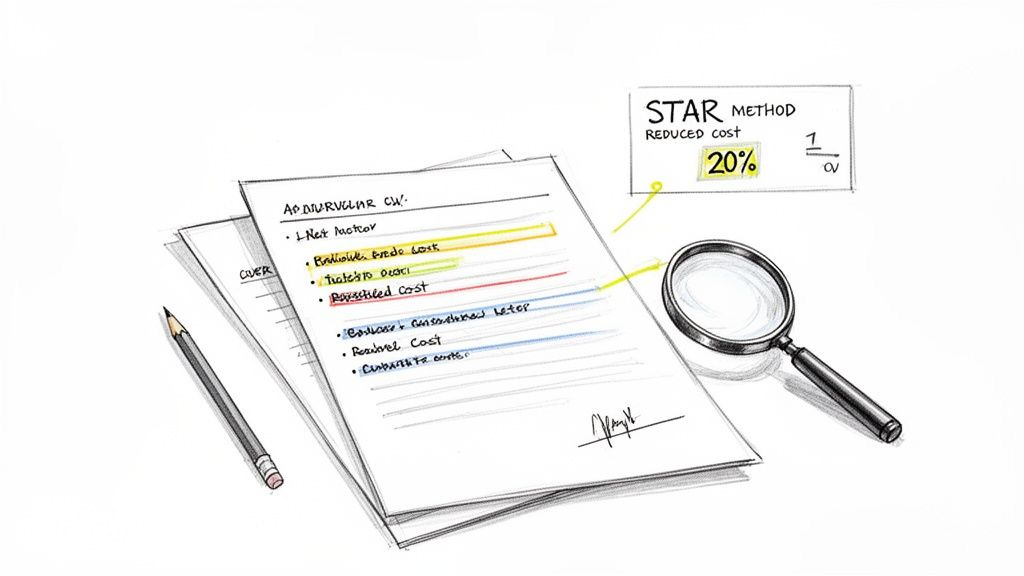
Think of yourself as a consultant pitching a solution. That solution is you. Every line of your application needs to be tailored to that pitch.
Structuring Your CV For Impact
The AfDB wants to see hard evidence, not claims. A CV packed with results and numbers will always beat one filled with vague responsibilities. It’s time to get surgical with your details.
Your goal is to make it simple for the reviewer to connect your experience to the job requirements. Lead with your most relevant achievements. If you have international development experience, quantitative analysis skills, or language abilities, especially French, put them front and center.
The single most effective way to frame your accomplishments is the STAR method. This framework forces you to describe the Situation, the Task, the Action you took, and the measurable Result you achieved. It turns your experience from abstract to concrete and powerful.
Applying The STAR Method To Your CV
Let’s see this in action. Most applicants write descriptive but weak bullet points. A results-focused approach is a game-changer.
Here’s how to transform a standard CV entry into a high-impact statement.
Weak Version: “Responsible for managing project budgets and tracking expenses for the energy sector.”
Strong Version: “Restructured project budget tracking for a $15M renewable energy portfolio (Situation/Task), implementing a new real-time expense monitoring system (Action) that reduced reporting errors by 30% and cut administrative overhead by 15% in the first year (Result).”
See the difference? The second version gives context, details your specific action, and proves your impact with hard data. This is what AfDB hiring managers look for.
“The High 5s have impacted on the lives of over 565 million people across Africa. These are not just figures. They are futures. They are hopes realized.” - Akinwumi Adesina, AfDB President
This quote from President Adesina gets to the heart of the Bank’s focus on tangible, massive-scale impact. Your CV needs to echo that same results-driven mindset, even if your projects were smaller. Every bullet point should contribute to a narrative of delivering measurable outcomes.
Writing A Cover Letter That Connects
Your cover letter is not a summary of your CV. Its real job is to tell a story and connect your professional drive directly to the Bank’s strategic priorities, known as the “High 5s.” This is where you prove you’ve done your homework.
Pick one or two of the High 5s that genuinely resonate with your background. If you’re a finance expert, talk about how your skills can help “Industrialize Africa” by structuring deals for SMEs. If you’re an agronomist, connect your experience directly to the “Feed Africa” initiative.
This shows you are looking specifically for an African Development Bank job, not just any job. Your letter should answer one fundamental question for the recruiter: why you, for this role, at this bank, right now?
Common Mistakes That Get You Rejected
Many highly qualified candidates get rejected because of simple, avoidable mistakes. These errors signal a lack of attention to detail, a major red flag for an institution managing billions of dollars in development funds.
Here are the top pitfalls to steer clear of:
Generic, Untailored Content: Sending the same CV and cover letter for every role is a fatal error. Every single application must be customized for the specific job description.
Focusing on Duties, Not Results: Listing your responsibilities tells them what you were supposed to do. Showing your results proves what you actually did.
Ignoring Keywords: The AfDB uses applicant tracking systems (ATS). Your application must include keywords from the job description to make it past the first digital screening.
Typos and Grammatical Errors: These are inexcusable. Proofread your documents. Then proofread them again. Then have someone else read them. A single mistake can instantly undermine your credibility.
Avoiding these common traps is half the battle. A polished, tailored, and results-focused application is your ticket to the interview stage.
Understanding Eligibility And Nationality Rules
Let’s get one thing straight: working for a multilateral development bank like the AfDB has specific, strict, and non-negotiable rules. If you get this part wrong, your application is dead on arrival, no matter how qualified you are.
The single most important rule is nationality. The AfDB is an institution owned and funded by its member countries, and this directly impacts who can apply. Wasting your time on a vacancy you’re not eligible for is a classic rookie mistake.
Regional vs. Non-Regional Member Countries
Your passport is the first filter for most African Development Bank jobs, especially international staff positions and the Young Professionals Program. The Bank splits its 81 member countries into two groups.
Regional Member Countries (RMCs): These are the 54 African nations the Bank was created to serve. If you’re a citizen of one of these countries, you’re eligible for almost any position.
Non-Regional Member Countries: These are 27 countries from the Americas, Asia, and Europe that contribute capital and support the Bank’s mission. Citizens from these nations are also eligible for most international staff roles.
The system ensures the Bank is staffed by a diverse group of professionals from the countries that own and fund it. Always double-check the specific job posting, as some roles, particularly certain consultancies, might have unique nationality requirements.
This distinction is fundamental. Before you read a job’s requirements, you must confirm that your country of citizenship is on the official member list.
Matching Your Experience to Professional Levels
Beyond nationality, the AfDB uses a clear grading system called the Professional Level (PL) scale to define seniority. Each PL grade corresponds to a specific minimum requirement for education and years of professional experience. Applying for a job above your grade is a guaranteed rejection.
The scale typically runs from PL-6 (junior roles) up to PL-1 (department directors). For most mid-career professional roles, you’ll likely be looking in the PL-6 to PL-4 range.
Here’s a rough breakdown of what to expect:
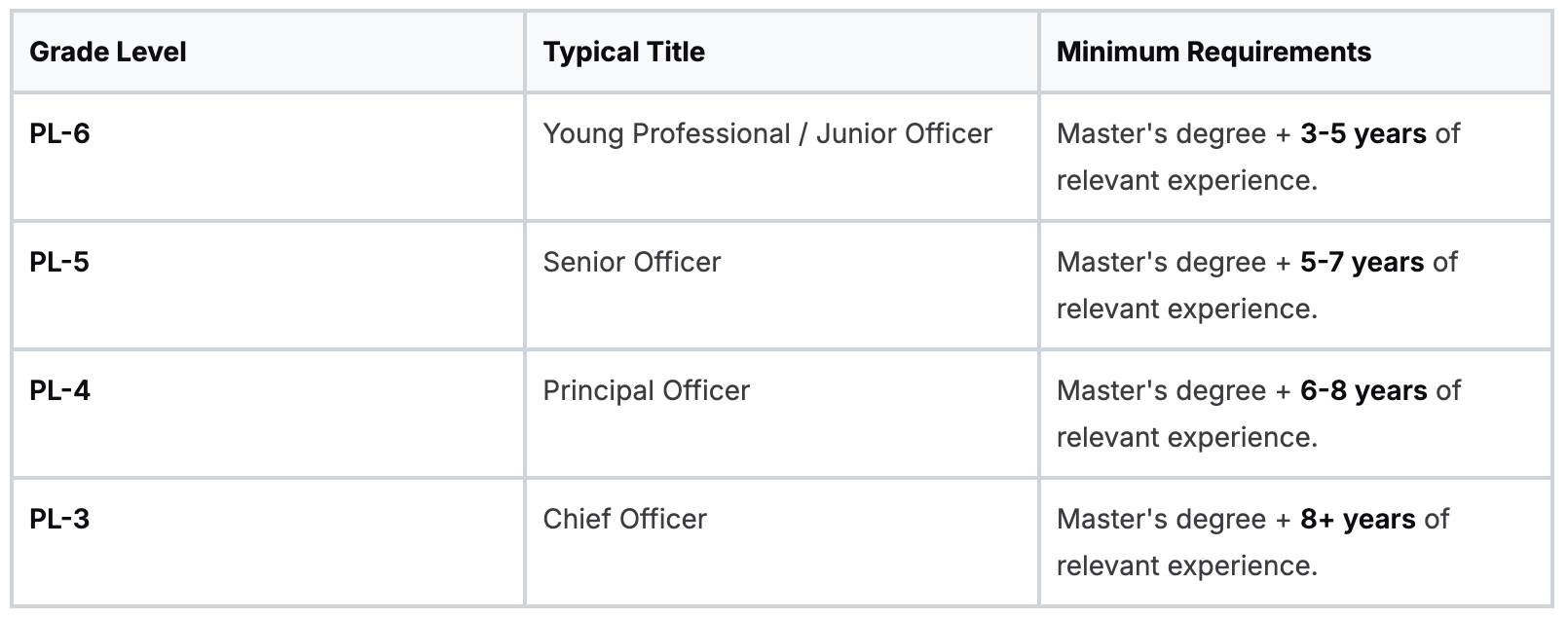
Keep in mind, these are baselines. A highly competitive role will attract candidates with far more experience than the stated minimum. Be realistic about where you fit.
The Bottom Line on Eligibility
The AfDB is actively working to speed up its hiring. The Bank’s own effectiveness reviews point to a major push to accelerate recruitment and fill vacancies faster, a metric they track closely as “time to fill.” This means they are looking for candidates who clearly tick every box to keep the process moving. You can learn more about their internal HR strides and their focus on its 54 regional member countries in their latest review.
Before you hit “apply,” do a simple self-audit. Do you hold citizenship from a member country? Does your master’s degree meet the minimum? Does your professional experience line up with the PL grade? If the answer to any of these is “no,” save your energy and find a different role. The system has zero flexibility on these core requirements.
Winning The AfDB Interview Process
If your application makes it past the initial screening, you’re in the game. Now the real work begins. The African Development Bank uses a structured, multi-stage selection process designed to test what you know and how you think and solve problems on your feet.
Getting through requires preparation, not charm. You have to anticipate what’s coming, from technical assessments to deep-dive panel interviews, and be ready to prove your value every step of the way. Think of it as a series of controlled assessments, not a casual chat.
From Screening To The Panel Interview
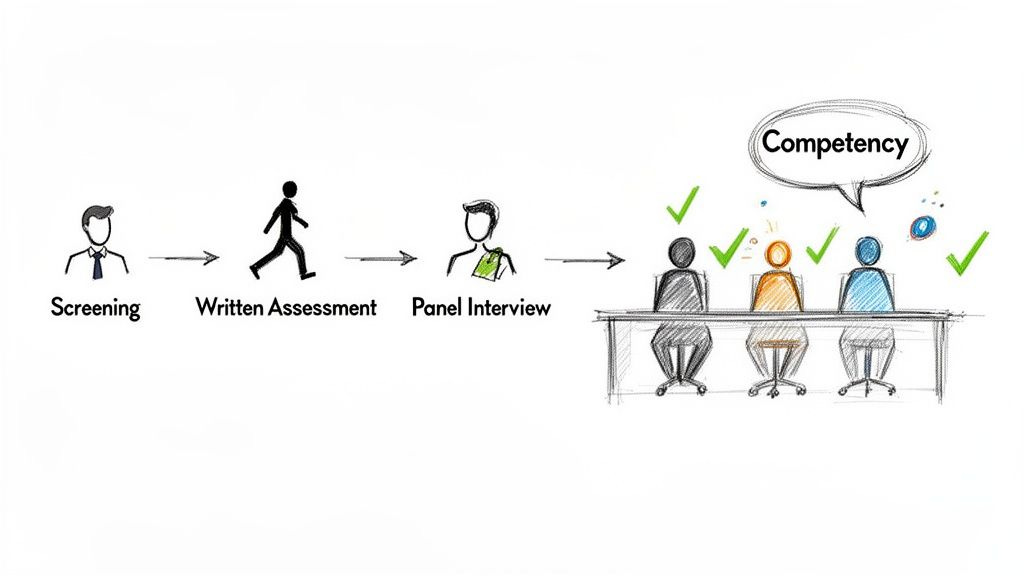
The AfDB interview process is a marathon, not a sprint. While the exact steps can shift depending on the role, you can generally expect a few key hurdles after your application gets shortlisted.
Initial Screening: This is usually a preliminary call with an HR representative. Their goal is straightforward: verify the details on your CV, confirm your eligibility, and get a basic feel for your motivations. Take it seriously, but know the tough technical questions are still to come.
Written or Technical Assessment: For most professional roles, you’ll face a written test or a case study. This is a critical filter. An economist might be asked to analyze a dataset and draft a policy brief. A project manager could be tasked with developing a risk mitigation plan for a hypothetical infrastructure project.
Competency-Based Panel Interview: This is the main event. You’ll be in front of a panel of 3-5 interviewers, including the hiring manager, technical experts from the team, and someone from HR. The entire interview is built around assessing the specific competencies they need for the job.
This final stage is where you win or lose the offer. Your ability to perform under pressure and give structured, evidence-based answers is what the panel is there to measure.
Mastering The Competency-Based Interview
The AfDB leans heavily on competency-based interview questions. These questions require you to provide real-world examples from your past that prove you have the skills they’re looking for. They almost always start with phrases like, “Tell me about a time when...” or “Give me an example of...”
To nail this, deconstruct the job description. Pinpoint the core competencies listed, things like “Client Orientation,” “Teamwork,” or “Operational Effectiveness.” Then, prepare specific stories for each one using the STAR method we covered earlier (Situation, Task, Action, Result).
For example, if the job calls for “Strategic Thinking,” have a story ready:
Question: “Describe a time you had to develop a long-term strategy for a complex project.”
Your Answer: Start with the Situation (”We were facing declining engagement in a rural development program”). Explain the Task (”My goal was to design a new three-year strategy to boost farmer participation by 50%“). Follow with the specific Actions you took and, most importantly, the measurable Result (”The new strategy was approved, and within 18 months, we’d blown past our target with a 65% increase in participation”).
“This is not a job. If anyone is looking for a job, please don’t take it. This is not a job. This is a mission.” - Akinwumi Adesina, AfDB President
This mindset is what the interview panel wants to see. They want a genuine commitment to the mission, backed by a history of delivering tangible results. Your stories have to reflect that drive.
Handling Technical Questions And Case Studies
For specialized roles, prepare for a technical grilling. The panel will include experts in your field who will push you on your knowledge of specific methodologies, models, or sector-specific challenges.
There’s no faking it here. Your prep should include diving into the Bank’s recent publications and projects in your sector. Understand their current strategic priorities, like the big push for a circular economy, which is projected to create 11 million jobs in Africa.
If a case study comes your way, stay calm and structured. The interviewers are testing your thought process as much as your final answer. Talk them through your assumptions, how you’re breaking down the problem, and the logic behind your recommendations. A well-reasoned but imperfect answer is better than a perfect answer you can’t explain.
Breaking Down AfDB Salaries And Benefits
A job at the African Development Bank is about the mission, and it also comes with a serious compensation package built to attract top global talent. To weigh an offer, you have to look past the base salary and see the whole picture. The Bank offers a competitive, internationally-benchmarked salary that’s tax-free for most non-US nationals.
The entire package is designed to support you and your family, whether you’re moving to the headquarters in Abidjan or a regional office. It’s a holistic approach, and you need to factor in everything when making your decision.
The Tax-Free Salary Structure
The core of the package is your base salary, determined by the Bank’s unified grade structure. This number is pegged to your professional level (PL) and years of relevant experience. The key benefit is that as an employee of an international organization, this income is generally exempt from national income taxes.
That tax-free status gives your take-home pay a massive boost compared to an equivalent salary in the private sector. It’s one of the biggest financial perks of an African Development Bank job. For a deeper dive into the numbers, you can see how MDB salaries stack up against other sectors.
Salaries are paid in Units of Account (UA), the Bank’s internal currency, which is pegged to a basket of major world currencies. This detail helps shield your earnings from volatile currency swings.
A Comprehensive Benefits Package
The AfDB’s benefits are designed to give its international staff and their families real security and support. This package goes well beyond what you’d find at most private companies and makes up a huge part of your total compensation.
You can expect a robust set of benefits covering health, family, retirement, and relocation. These are substantial financial pillars of your contract, not just minor perks.
Here are the cornerstones of the benefits package:
Global Health Insurance: The Bank provides a comprehensive medical and dental plan for you, your spouse, and your dependent children. This coverage is worldwide, giving you access to quality care no matter where your job takes you.
Generous Retirement Plan: Staff contribute to a defined-benefit pension plan, which lays a solid financial foundation for your future. Think of this as a significant long-term financial asset.
Education Grants: For staff with kids, the AfDB offers education grants to help with the costs of primary, secondary, and university education. This is a game-changer for expat families.
The full value of an AfDB offer lies in the complete package. Don’t just look at the salary. Consider the tax benefits, the world-class insurance, the pension plan, and the family support systems. It all adds up to a powerful proposition.
Allowances And Relocation Support
For international staff moving for a position, the Bank provides a ton of support to make the transition smooth. This is a full-blown support system, not just a moving stipend.
Typically, the Bank covers the cost of shipping your personal belongings, airfare for you and your family, and a settling-in grant to help with initial expenses. On top of that, depending on your duty station, you might be eligible for other allowances, like a housing allowance, to help offset the cost of living.
Through its Jobs for Youth in Africa (JfYA) initiative, the African Development Bank aims to create 25 million direct jobs over the next decade. Professionals targeting AfDB careers will find that these strategic priorities spotlight a high demand for specialists in agribusiness and green energy. These sectors are core to the Bank’s portfolio and a magnet for multilateral development bank jobs worldwide. Find out more about Africa’s push into renewable energy.
Common Questions About AfDB Careers
Thinking about a job at the African Development Bank? You probably have a lot of questions. Let’s get you straight answers to the most common ones.
What Is The Typical Application Timeline?
Patience is key. From the day a job posting closes to a final offer, the process can take anywhere from three to six months. It’s a marathon. The Bank has a thorough, multi-stage process with many people involved, so don’t get discouraged if you don’t hear back right away. If you’re shortlisted, they will contact you.
How Important Are Language Skills?
You must be fluent in either English or French, the Bank’s two official working languages. That’s the baseline.
The real secret is that being bilingual in both is a massive advantage. It makes you a much stronger candidate for almost any professional role, especially if you’ll be working directly with the Bank’s diverse member countries across Anglophone and Francophone Africa.
Many people think you can get by with one language. While that’s technically true for eligibility, the reality is that bilingual candidates often have a clear edge. It reflects the way the Bank operates on the ground.
Can I Apply For Multiple Jobs At Once?
Yes, but don’t go crazy. A scattergun approach rarely works. It’s far better to be selective and focus only on roles where your skills, experience, and background are a dead-on match. Think quality, not quantity.
What If I Don’t Have A Master’s Degree?
For any professional-level (PL) staff job, a Master’s degree or an equivalent advanced degree is almost always non-negotiable. It’s a standard requirement.
Consultant positions can sometimes be more flexible. If you have extensive, specialized, high-level professional experience, it can sometimes compensate for the lack of an advanced degree. The key is to read the specific vacancy announcement carefully; it will always spell out the exact educational requirements.
At Multilateral Development Bank Jobs, our goal is to pull back the curtain on the hiring process at institutions like the AfDB. Our newsletter brings you curated job lists, insider guides, and expert advice to help you secure your next mission-driven role. Check out our resources at
https://mdbjobs.com