

To get a real shot at a job at the African Development Bank, you first need to figure out where you fit. The Bank is a complex institution with very different career tracks built for specific needs. Getting this right is the most important first step.
Decoding Your Career Path at the AfDB
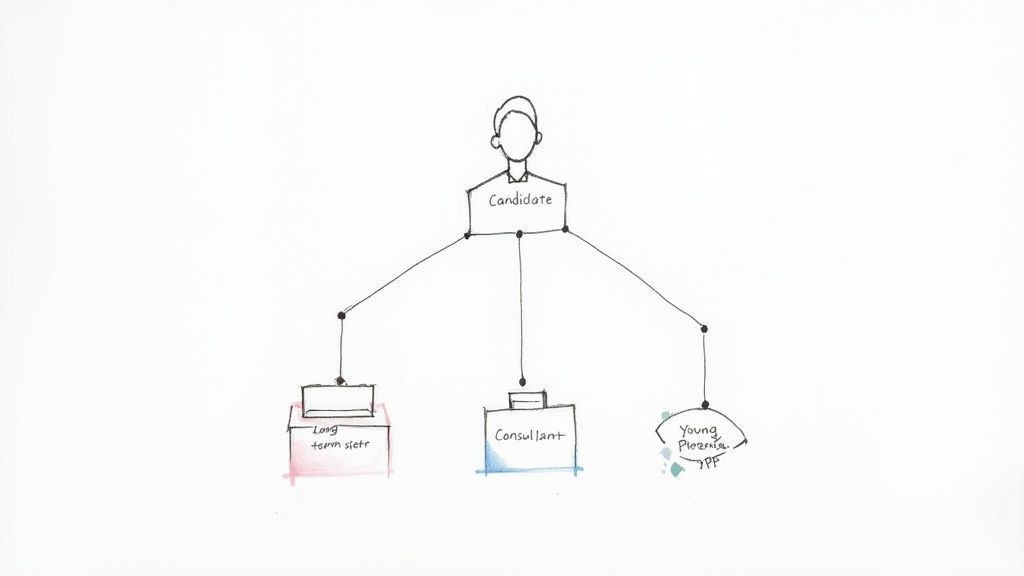
The AfDB’s workforce has three main pillars. Each one supports the Bank’s mission, but they do it differently, with unique contracts, expectations, and career paths. Your job is to find the pillar that matches your background and professional goals.
The worst thing you can do is spray and pray, applying for everything and hoping something sticks. A smarter approach is to understand these categories, see yourself in one of them, and then build your entire application strategy around that specific track. It shows you’ve done your homework and understand how the Bank works.
Here’s a breakdown of the main employment types at the AfDB to help you pinpoint the best fit.
AfDB Employment Categories at a Glance
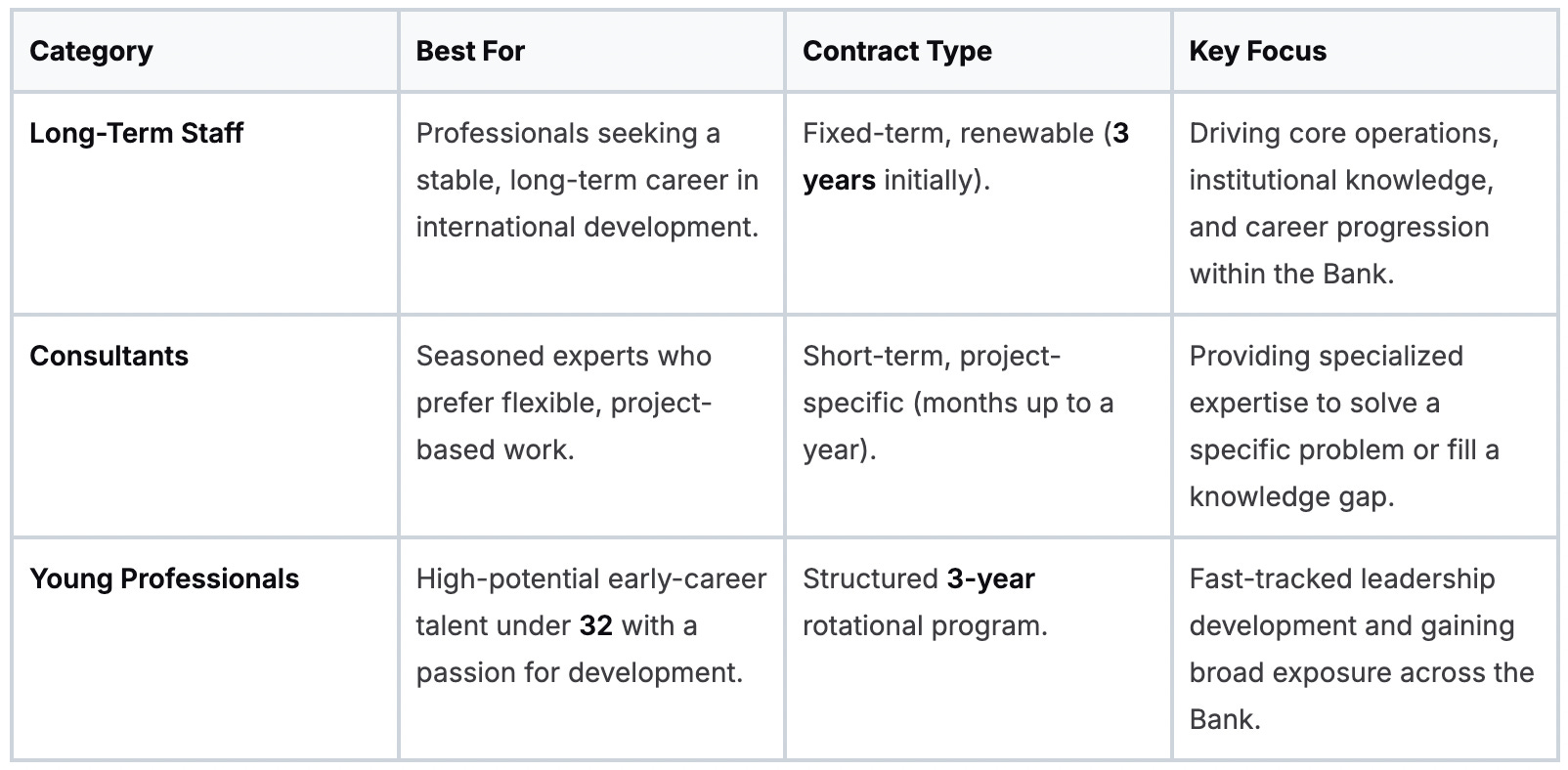
This table gives you the lay of the land. Let’s dig into what each role means for your career.
Long-Term Staff Positions
These are the people who run the African Development Bank. Long-term staff are the permanent engine of the institution. They do everything from designing billion-dollar infrastructure projects to managing internal budgets and shaping country-level strategies.
These roles usually start as fixed-term contracts of three years, which are renewable and offer a clear ladder for climbing the Bank’s hierarchy. They come with the full package: a pension, health insurance, education grants, and real job security. This is the path for people committed to a long-haul career in international development.
Consultant and Short-Term Roles
Consultants are specialists brought in for their deep expertise on a specific project. Think of them as the Bank’s highly skilled problem-solvers, hired to tackle a particular challenge or fill a temporary knowledge gap. Their contracts are shorter, usually lasting from a few months to a year, and are laser-focused on a single deliverable.
This track is perfect for seasoned experts who value flexibility and project-based work over a permanent desk. You don’t get the same long-term security or benefits as staff, but it’s a fantastic way to work on high-impact projects. It’s also a common entry point for professionals looking to build a relationship and track record with the Bank.
It’s a myth that consulting is a guaranteed backdoor into a staff position. The roles are fundamentally different. Treat a consultant application with the same seriousness as a staff application, focusing entirely on the specific skills needed for that assignment.
The Young Professionals Program
The Young Professionals Program (YPP) is the AfDB’s flagship initiative for finding its next generation of leaders. This is an extremely competitive, highly structured program designed to scoop up exceptional young talent passionate about Africa’s development.
Participants go through a demanding three-year rotational program, getting exposure to different departments and operations across the Bank. The YPP is a leadership accelerator. It’s built for people under 32 with a Master’s degree and solid experience who have already shown real leadership potential.
For a deeper dive into the YPP and other opportunities, check out the complete guide to the African Development Bank.
Can You Actually Work for the AfDB? Checking Your Eligibility
Before you polish your CV, there’s a critical first step: eligibility. This is about the passport you hold. Get this wrong, and your application is dead on arrival.
The African Development Bank is a multilateral institution, owned and governed by its member countries. As a result, it primarily hires nationals from this specific group of nations. The good news is this club is bigger than you might think. It includes all 54 regional member countries in Africa, plus another 27 non-regional member countries from the Americas, Asia, and Europe. If your country is on that list, you’re in the game.
The All-Important Nationality Rule
Your citizenship is the first and most important box you need to tick. The Bank’s rules require a diverse international staff, and that diversity is drawn directly from the countries that fund and oversee its work.
The list of member countries is public and non-negotiable. Here’s a look at the official list.
The geographic spread is huge, stretching from Argentina to Austria and from Canada to China. You must confirm your country is on this list before you go any further. This is standard practice across most multilateral development banks, a topic you can learn more about by reading which MDBs you can work for based on nationality.
Core Professional Qualifications
Once you’ve cleared the nationality hurdle, the focus shifts to what you bring to the table professionally. The AfDB has a high bar for its international staff and looks for a specific combination of credentials.
Education: A Master’s degree (or equivalent) is the standard expectation for most professional roles. Your field of study needs to line up with the job you’re targeting, whether that’s finance, economics, engineering, or public policy.
Experience: The Bank wants proven experts. For most mid-career roles, this means you’ll need a minimum of five to eight years of solid, relevant professional experience. Senior positions demand significantly more.
Language Skills: The Bank’s official working languages are English and French. You must be fluent in at least one. Being bilingual is a massive advantage. Professional command of both English and French will unlock far more opportunities and make you a much more compelling candidate, especially for roles involving diverse governments and partners across the continent.
The bottom line is this: The AfDB isn’t a place for learning on the job. It hires proven experts who can deliver results from day one. Your application must signal that you meet these non-negotiable standards of nationality, education, experience, and language.
Finding and Applying for Open Positions
Okay, you’ve ticked the eligibility boxes. Now it’s time to find the right role and craft an application that gets you noticed.
This isn’t a numbers game where you fire off dozens of generic CVs. Success at the AfDB means knowing where to look and understanding their application system. A thoughtful, well-prepared submission is what cuts through the noise.
The only place you should be looking for jobs in african development bank is the official AfDB Career Portal. This is the single source of truth for every staff position, consultancy, and program opening. Get comfortable with this platform. Learn how to filter your searches by job family, grade level, and location to zero in on what fits.
Better yet, be proactive. Set up targeted job alerts for your areas of expertise. This way, relevant vacancies land directly in your inbox the moment they’re posted, ensuring you never miss a perfect match.
Navigating the Online Application
The AfDB uses a standardized online recruitment system. Like any system, it has its quirks, and paying attention to detail here is critical. Small technical mistakes can get your application screened out by an algorithm before a human ever sees it.
Here’s a practical walkthrough of the key steps:
Create Your Candidate Profile: Think of this as your digital CV inside the AfDB’s system. Fill out every section completely: work history, education, language skills, the lot. Don’t take shortcuts. This profile is the foundation for every application you submit.
Upload Your Documents: You’ll almost always need to upload a detailed CV and a cover letter. Make sure your documents are in the right format (usually PDF) and are clearly named. Double-check that you’ve attached the correct files to the right application. It happens more than you think.
Address the Selection Criteria: Most job postings list specific, numbered criteria. Your cover letter and CV must speak directly to these points. Use the same keywords and language from the job description to signal to the hiring manager that you are a direct fit.
Before your application gets a detailed review, it has to pass a few basic checks.
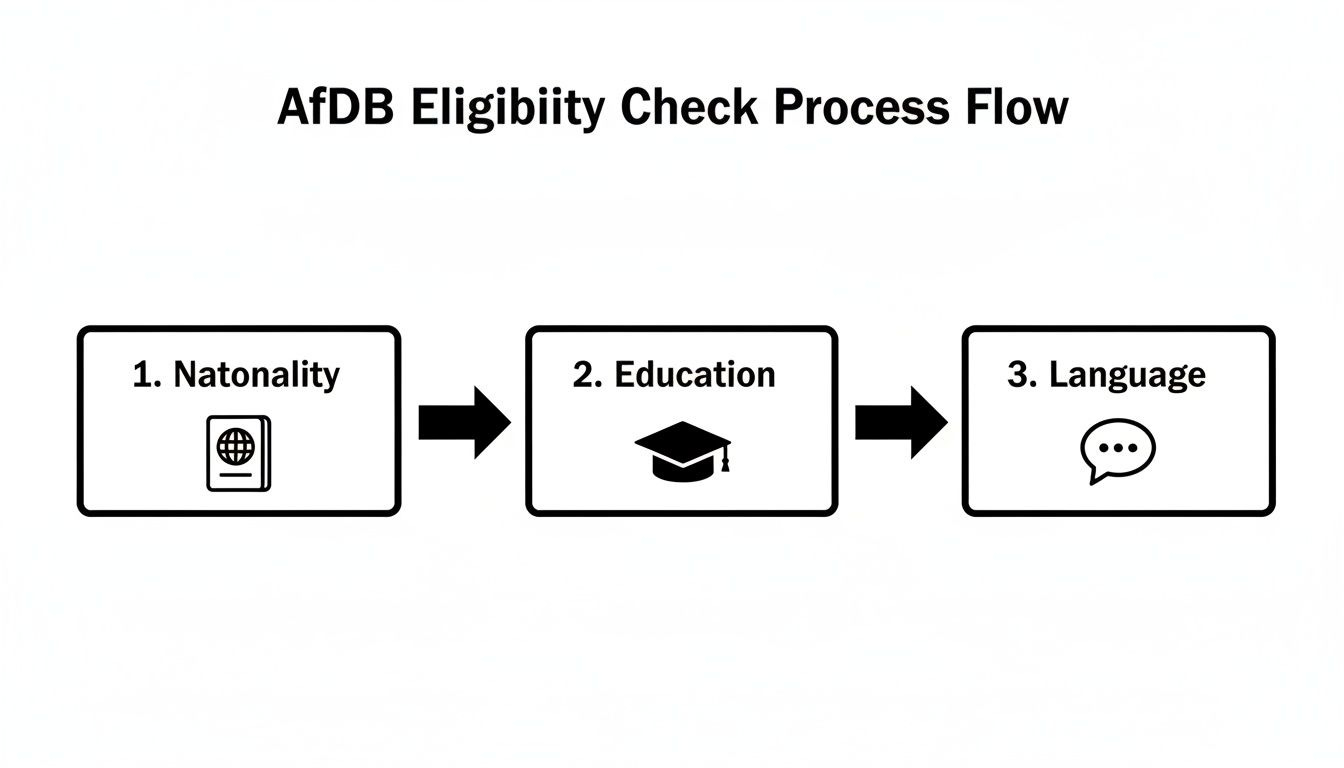
This simple flow shows that nationality, education, and language are non-negotiable gates. If you don’t pass one, you don’t move on.
Aligning Your Application with the High 5s
Having the right qualifications on paper isn’t enough. To make your application stand out, you have to connect your experience to the Bank’s core strategic priorities, known as the High 5s. These are the pillars that guide everything the AfDB does.
The High 5s are: Light up and Power Africa, Feed Africa, Industrialise Africa, Integrate Africa, and Improve the Quality of Life for the People of Africa. Your application needs to prove you can contribute to one or more of these goals.
You have to frame your achievements in this context. For example, don’t just say you “managed a financial portfolio.” Instead, explain how that portfolio funded renewable energy projects (Light up and Power Africa) or supported agribusiness startups (Feed Africa). This simple shift shows you understand the Bank’s mission and see exactly where you fit. It’s a massive differentiator.
The Bank’s own internal evaluations have noted challenges in reducing hiring times and consistently aligning new hires with these High 5s. You can read more about these recruitment findings and their context yourself.
What does that mean for you? It means a clear, direct application that explicitly links your skills to the Bank’s strategic goals is more important than ever. You are making the hiring manager’s job easier by connecting the dots for them. It’s the difference between saying “I am qualified” and proving “I can help you achieve your mission.”
Crafting a Standout CV and Mastering the Interview

Let’s be blunt: a generic CV that just lists your past job duties is dead on arrival. To get a second look at the African Development Bank, your CV needs to prove you’re a problem-solver who gets things done.
Hiring managers at the AfDB are trained to spot the difference. They scan for evidence of achievement. If all they find is a laundry list of responsibilities, your application goes to the “no” pile. You have to shift your mindset from describing what you did to proving what you accomplished.
The best way to do this is to frame your experience around measurable outcomes. Every key bullet point should tell a miniature story of success, drawing a clear line from a challenge you faced to a tangible, positive result. This makes your application impossible to ignore.
Frame Your Achievements with the STAR Method
The STAR method is a simple, powerful framework for turning vague duties into compelling achievements. It forces you to provide the context and results that recruiters want to see.
For every significant accomplishment on your CV, make sure it answers these four questions:
Situation: What was the context or challenge you were facing?
Task: What specific goal were you responsible for achieving?
Action: What concrete steps did you personally take to address the situation?
Result: What was the measurable, quantifiable outcome of your actions?
Think about it this way. Instead of a bland statement like, “Managed the project budget,” you use STAR to transform it into a powerful achievement story:
“Reduced project overhead by 15% (Result) by implementing a new vendor negotiation process (Action) for a $5 million infrastructure project (Situation) that was consistently over budget (Task).”
See the difference? The second version proves your value. It’s specific, it’s quantified, and it directly answers the hiring manager’s real question: “Can this person solve our problems?”
Quantify Everything You Can
Numbers are your best friend. They cut through ambiguity and provide hard proof of your capabilities. Your mission is to sprinkle your CV with as many relevant metrics as possible.
Don’t just say you improved a process; state by what percentage. Don’t just mention you managed a team; specify how many people were on it.
A CV without numbers is just a collection of opinions. A CV with numbers is a portfolio of proven results. The AfDB is a data-driven institution, and they expect their candidates to think and communicate the same way.
Hunt for opportunities to quantify your work. Look for things like:
Financial Impact: Money saved, revenue generated, budgets managed.
Efficiency Gains: Time saved, processes streamlined, productivity increased.
Scale and Scope: Number of people managed, countries covered, users served.
This discipline improves your CV and forces you to think like a results-oriented professional, which is exactly the kind of person the AfDB hires.
Mastering the Competency-Based Interview
If your CV does its job, you’ll face a competency-based interview. This is a structured format where interviewers hunt for specific skills like teamwork, problem-solving, and client orientation. They will ask for real-world examples from your past.
The questions are almost always behavioral, starting with predictable phrases:
“Tell me about a time when you had to manage a difficult stakeholder.”
“Describe a situation where you had to work with limited resources.”
“Give an example of a project that failed and what you learned from it.”
Your prep work here is simple: prepare your stories. The STAR method is the perfect formula for structuring your interview answers. Before you walk into that room, you should have five to six solid STAR stories ready to go, each demonstrating a different core competency listed in the job description.
Using this approach stops you from rambling and ensures you deliver a concise, powerful answer that directly addresses the interviewer’s question. It shows you’re prepared, articulate, and have the exact experience they need.
Navigating the Technical Assessment and Panel Interview
The final stages often include a technical assessment and a panel interview. The technical part tests your hard skills. It could be a case study analyzing a policy document or a written exam on project finance principles. You either know your stuff or you don’t.
The panel interview is the last hurdle. You’ll sit across from senior managers and potential future colleagues. At this point, they’re assessing more than just your skills; they’re looking for cultural fit. They want to see how you think under pressure and whether you can hold a professional, strategic conversation.
Your goal in the panel interview is to show confidence, a deep understanding of the Bank’s mission, and a genuine passion for development in Africa. Whenever possible, connect your answers back to the High 5s. Show them you’re not just looking for another job. You’re looking to contribute to a larger mission.
What You Really Earn: A Look at the AfDB’s Salary and Benefits
Compensation is a big deal. The African Development Bank knows this, and its package is built to attract and keep top international experts. It’s a whole system designed to support a global career.
One of the biggest draws is that salaries for most international staff are typically tax-free. This is a game-changer. Because of international treaties, this single perk dramatically boosts your take-home pay compared to a similar-grossing job in the private sector. It’s a major reason why competition for jobs at the AfDB is so fierce.
This structure allows the Bank to stay competitive and pull in the talent it needs to accomplish its mission.
How Salaries Are Structured
The AfDB uses a clear grading system to determine your pay. Professional jobs fall into “PL” levels (Professional Level), which run from entry-level roles up to senior directors.
Every job you see advertised will have a grade attached, like PL-6 or PL-5. Where you land on that grade’s salary scale depends on your years of relevant experience, your qualifications, and the job’s complexity. The system is transparent and aims to be fair.
The grade level is non-negotiable. Your focus during your application and interview should be on proving you’re the best person for that specific grade, not trying to talk your way into a higher one. The Bank has its structure, and your experience either fits the box or it doesn’t.
Figuring out where you fit is critical. If you have eight years of experience, you should be targeting a certain level; if you have fifteen, you should be looking higher. Misjudging your level is a fast way to get your application tossed out. For a detailed breakdown of how MDB salaries stack up, you can get more context by exploring the numbers you want to know about MDB salaries.
Beyond the Basic Salary
If you’re only looking at the base salary, you’re missing a massive part of the picture. The real power of an AfDB package is in the benefits, which create a serious safety net for you and your family.
Here’s a quick look at what the total package includes:
Comprehensive Health Insurance: The Bank’s medical plan is solid, covering you and your eligible family members worldwide. It includes medical, dental, and vision, giving you peace of mind wherever your job takes you.
Generous Pension Plan: The AfDB offers a defined-benefit pension plan, which is rare these days. Both you and the Bank pay into it, building a substantial retirement fund over your career.
Education Grants for Children: For eligible international staff, this is huge. The Bank offers significant grants to help pay for your kids’ education, from primary school right through university. For families, this benefit alone is worth a fortune.
Relocation and Leave Policies
The AfDB understands that moving your life across continents is a big deal. They’ve put together a strong support package to make the transition as painless as possible.
Relocation Support:
Shipment of Household Goods: You’ll get generous allowances to ship your personal belongings to your new post.
Settling-In Grant: This grant helps with the upfront costs of setting up a new home.
Travel Expenses: The Bank pays for flights for you and your family to get to your new duty station.
Leave Policies:
Annual Leave: You get a good amount of annual leave days to rest and recharge.
Home Leave: To ensure international staff stay connected with their home countries, the Bank provides paid travel for them and their families every two years.
When you put it all together—a tax-free salary, world-class benefits, and real relocation support—the AfDB’s total compensation is one of the most attractive in the international development field.
How Your Role Supports Africa’s Youth Employment Goals

A job at the African Development Bank is a direct role in tackling some of the continent’s most pressing challenges, and youth unemployment is critical. Understanding this context is key to framing your application and showing you get the bigger picture.
The Bank drives strategic initiatives with massive continental implications. One of the most important is the Jobs for Youth in Africa (JfYA) strategy. This is a core pillar of the Bank’s mission, shaping where money flows and what skills are in demand.
Launched in 2016, the JfYA strategy was a direct response to a massive demographic shift. The strategy is designed to create 25 million jobs and equip 50 million young people with relevant skills by 2025 by catalyzing private sector investment and supporting entrepreneurship. You can discover more insights about the AfDB’s strategic role in Africa’s future on csis.org.
This focus directly impacts the types of jobs in african development bank that are prioritized. It means the Bank is actively looking for professionals who can contribute to this goal, regardless of their specific department.
Connecting Your Skills to the JfYA Strategy
So, what does this mean for you as a candidate? You need to connect the dots between your expertise and the goal of creating jobs for young people. The Bank’s approach is built on three core pillars that give you a roadmap for how to frame your experience.
The three pillars of the JfYA strategy are:
Integration: This involves weaving youth employment goals into every project the Bank funds. Whether it’s an infrastructure project or an agricultural program, the question is always: “How does this create jobs for youth?”
Innovation: This focuses on new approaches to support youth, especially in high-growth sectors like ICT, renewable energy, and modern agribusiness.
Investment: This pillar is about mobilizing private sector capital. The Bank knows it can’t create millions of jobs alone, so it acts as a catalyst for private investment.
When crafting your application, think about how your past work fits into these areas. An energy specialist should highlight experience in renewable energy projects that train local young technicians. A finance expert should showcase work on SME lending facilities that empower young entrepreneurs.
Your ability to articulate how your technical skills support private sector growth and youth job creation will set you apart. It shows you aren’t just a subject matter expert; you’re a development practitioner who understands the Bank’s strategic imperatives.
The Skills That Are in High Demand
This strategic focus on youth employment creates a clear demand for specific skill sets. The Bank is always looking for professionals with proven experience in areas that drive economic growth and job creation at scale.
These high-demand areas include:
Private Sector Development: Expertise in public-private partnerships, investment climate reform, and financial instruments that de-risk private investment.
Agribusiness and Value Chain Development: Skills in modernizing agriculture to create entrepreneurial opportunities for rural youth.
Digital Skills and ICT: Experience in projects that leverage technology for education, job matching, and digital entrepreneurship.
Skills Development and TVET: Knowledge of Technical and Vocational Education and Training systems that align with market demands.
Showing you have experience in these forward-looking fields signals that you are not just qualified for a job today but are equipped to help the Bank meet its goals for tomorrow. Frame your career as a solution to one of Africa’s biggest challenges, and you’ll make a powerful case for why you belong at the AfDB.
Your Questions Answered: Navigating AfDB Recruitment
You’ve got the basics down. Now, let’s get into the nitty-gritty questions I hear all the time. These are the practical details that can make or break your application strategy for a job at the African Development Bank. Knowing the answers upfront helps you manage your expectations and play the long game.
And it is a long game. The hiring process at the AfDB is a marathon, not a sprint. It’s built to be thorough, which means patience is non-negotiable for anyone serious about landing a role.
How Long Does the AfDB Recruitment Process Actually Take?
From the day a job posting closes to the day you get an offer, you should brace yourself for a process that can easily stretch over several months. This isn’t a sign of inefficiency; it’s just how multilateral institutions work.
Every application goes through multiple layers of review: an initial HR screening, longlisting, shortlisting by the hiring department, technical tests, and finally, panel interviews. Add the sheer volume of applications for every opening, and you can see why it takes time. You can usually see where you are in the process via the Bank’s online portal, but be prepared to wait.
Is French a Deal-Breaker?
While not every job demands it, being professionally fluent in both English and French gives you a massive leg up. The AfDB is a bilingual organization, and that’s reflected in how business gets done every day.
For many senior positions, client-facing roles, or jobs in Francophone Africa, French shifts from a “nice-to-have” to a must-have. Always check the specific language requirements in the job description. If you’re planning a long-term career at the Bank, investing in your French skills is one of the smartest moves you can make.
What’s the Difference Between Short-Term and Long-Term Staff?
A short-term appointment is a temporary gig. These contracts are typically for less than 12 months and are designed to fill an urgent project need or cover for someone on leave. The key difference is that these roles usually don’t come with the full benefits package, like pensions or education grants.
A long-term, or fixed-term, appointment is the standard professional contract. It’s usually for an initial three years and is renewable. These are the jobs that come with the full suite of benefits and represent a stable career track inside the Bank.
Can I Apply for More Than One Job at a Time?
Yes, you can apply for multiple positions at once, but only if you genuinely meet the qualifications for each one. Be warned: a scattergun approach is a fast track to the rejection pile.
Your strategy has to be about quality, not quantity. Firing off a generic, one-size-fits-all application to dozens of openings is a complete waste of time. You have to meticulously tailor your CV and cover letter to the specific demands of every single job you apply for, making it impossible for them to ignore you.
At Multilateral Development Bank Jobs, we break down the complex hiring processes of institutions like the AfDB. Our newsletter delivers hand-picked job listings, expert guides, and insider tips straight to your inbox three times a week, giving you the advantage you need to land your next role. Subscribe today to start receiving full-time staff, consultant, and UN opportunities.