

You want a career at the World Bank Group. Good goal. Success isn’t about luck; it’s about understanding the institution’s three distinct front doors: the Young Professionals Program (YPP) for rising leaders, direct staff roles for seasoned experts, and consultant positions for specialized, project-based work.
Which door is right for you? It comes down to your experience and career goals.
Decoding World Bank Group Careers
Trying to land a role at the World Bank Group (WBG) can feel like navigating a maze. The secret is knowing which door to knock on. The WBG is a collection of distinct agencies that hire people through different channels.
You can’t fire off a generic resume and hope for the best. That approach doesn’t work here. You must be deliberate, targeting your application to a specific career stream that fits your professional background. Each one has its own rules, its own expectations, and a specific profile of the ideal candidate.
Here’s a breakdown of the main ways people join the World Bank Group.
Key Career Streams at the World Bank Group
Career Stream Target Candidate Typical Role Type Key Feature Young Professionals Program (YPP) Early-career individuals with advanced degrees (Master’s/PhD) and a few years of solid experience. 5-year developmental contract, leading to a permanent role. A highly competitive, structured program that builds the WBG’s next generation of leaders. Staff Positions Mid-career to senior professionals with deep, established expertise in a specific field. Permanent, long-term employment. Hired for a specific, defined vacancy based on deep subject-matter knowledge. Consultant & Temporary (C&T) Specialists at all levels with skills needed for a specific project or task. Short-term or extended-term contracts (STC/ETC). A flexible entry point, often used to gain WBG experience before pursuing a staff role.
This structure is different from the private sector. If you want to understand how the institution works, our complete guide to the World Bank is a great place to start.
The official WBG careers portal gives you a sense of their priorities and what they’re looking for right now.
The page highlights the Bank’s core mission and directs you to explore different areas, from front-line operational roles to corporate support functions. This signals that they hire for a massive range of specializations, not just Ph.D. economists.
The biggest mistake candidates make is applying indiscriminately. You must identify whether you’re a fit for the YPP, a specific staff vacancy, or a consultant roster. Each requires a different approach, a tailored resume, and a clear understanding of the role you’re targeting. One-size-fits-all applications get rejected.
The Three Main Entry Points: YPP, Staff, and Consultants
To have a real shot at a World Bank Group career, you must first understand its structure. It’s not one big building with a single front door. It’s three separate towers, each with its own entrance, gatekeeper, and rules. Your job is to pick the right door for your career stage and expertise.
Trying to walk through the wrong one is the fastest way to get your application tossed. Let’s break down who each of these entry points is for, so you can focus your energy where it counts.
The Young Professionals Program: The Future Leader Pipeline
The Young Professionals Program (YPP) is the World Bank Group’s crown jewel for recruitment. It finds and grooms its next generation of leaders. Let’s be clear: this isn’t a fresh-out-of-college graduate scheme. It’s a hyper-competitive program for early-career professionals who already have serious academic credentials and solid work experience.
YPP candidates typically hold a Master’s degree or PhD in a field directly relevant to the Bank’s work like economics, finance, public health, or infrastructure. They also need a few years of hands-on experience that proves their potential for high-level impact. The program is a demanding five-year rotational assignment that puts participants on a fast track to significant roles.
The competition is brutal. The WBG gets tens of thousands of applications for a small number of spots, making it one of the most selective professional programs on the planet. For instance, the 2023–2024 YPP cycle pulled in over 20,000 applications for roughly 80–100 final spots. That’s an acceptance rate well below 1%. You can get a sense of the global talent landscape from this report on the future of jobs.
Staff Positions: The Expert Track
For mid-career and senior professionals, direct staff positions are the most common way in. These roles are not part of a structured development program. You’re hired for a specific, vacant position that requires deep, proven expertise in a particular area.
The WBG uses a grading system to classify these roles, mainly the “G-level” scale, which runs from GA (entry-support) up to GK (senior management). Professional jobs usually start at the GE level and go up from there.
GE Level: These are often Analyst or Specialist roles. You’ll need a Master’s degree and several years of direct, relevant experience.
GF/GG Levels: This is Senior Specialist or Technical Lead territory. It demands substantial professional experience and a track record of major accomplishments.
GH+ Levels: These are leadership roles like Sector Leaders or Practice Managers, reserved for seasoned experts with extensive management experience.
When you apply for a staff role, you have to prove you can walk in and deliver results from day one. It’s about your existing expertise, not your potential.
Consultant roles are the WBG’s secret backdoor. They offer a lower-barrier entry point to gain invaluable institutional experience, build a network of internal champions, and demonstrate your value directly to hiring managers, often leading to staff positions.
Consultants and Temporary Roles: The Strategic Backdoor
The third major way in is through consultant and temporary contracts. These are project-based roles that can last from a few weeks (Short Term Consultant, STC) to a year or two (Extended Term Consultant, ETC).
Consultants are brought in to provide specific skills for a set period. This could be anything from conducting niche research to helping a country office manage a new infrastructure project. Honestly, this path is a fantastic way to get your foot in the door.
This decision tree helps visualize how your background might point you toward one of these three paths.
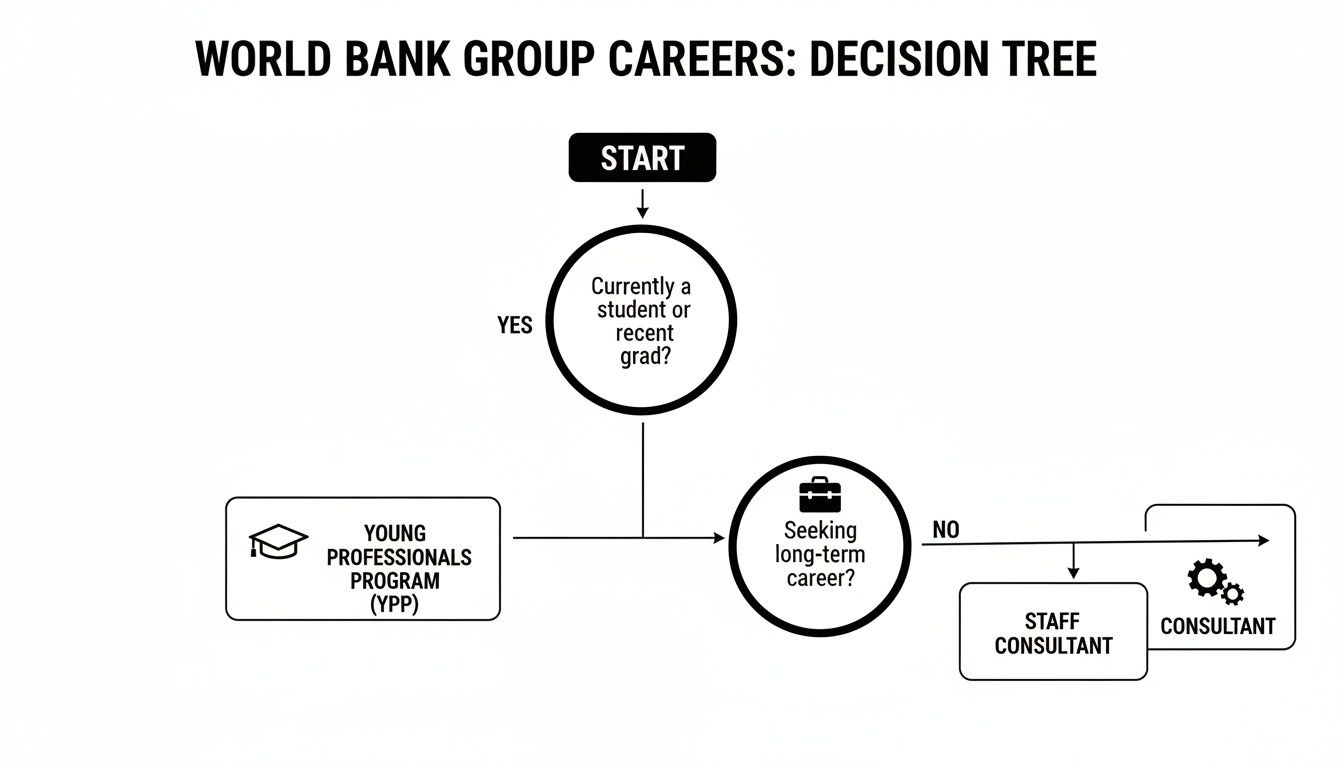
Your career stage, whether you’re a student, an early-career professional, or an established expert, is the biggest factor in choosing the right door. This flexibility lets the Bank bring in targeted expertise exactly when and where it’s needed, opening opportunities for a huge range of professionals.
Who the World Bank Hires and Where They Work
You know the main ways to get into the World Bank Group. Now for the next big questions: who do they actually hire, and where are these jobs?
There’s a common myth that the WBG is just a building in Washington D.C. filled with PhD economists. That picture is decades out of date.
The workforce is incredibly diverse, both in professional background and geographic location. Nailing this down is key to finding your opening. Your success depends on mapping what you can do to what the Bank needs on the ground, which is often thousands of miles from headquarters.
Operational Versus Corporate Roles
First, understand the fundamental split in the WBG’s workforce: operational versus corporate roles. Getting this right is the first filter for your job search.
Operational Staff are the frontline experts. These are the economists, infrastructure specialists, health advisors, and education experts who design and manage the projects that define the Bank’s mission. They work directly with governments and live their specific sectors and regions.
Corporate Staff are the engine room. They keep this massive global institution running. Think Human Resources, IT, legal, accounting, and communications. They don’t manage country projects, but the operation would grind to a halt without them.
Your professional background will almost certainly slot you into one of these two camps. An energy sector engineer with 15 years of experience in Sub-Saharan Africa is an operational candidate. A certified public accountant who has spent their career in institutional audits is a corporate candidate.
The Geographic Spread of Opportunity
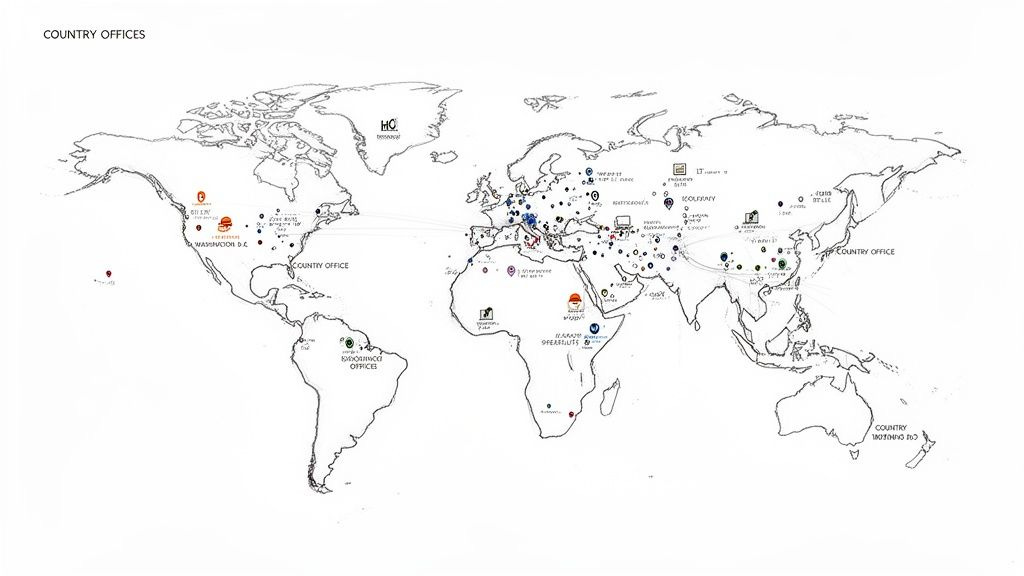
Here’s the most important strategic insight for any applicant: the World Bank is a decentralized organization. Yes, the headquarters in Washington D.C. is the nerve center, but a huge portion of the real work happens in its 120+ country offices.
This is a deliberate strategy to bring expertise closer to the clients. The World Bank Group has between 15,000 and 17,000 staff globally, and a massive chunk of them are based outside the United States. Nearly 50% of operational staff are located in regional and country offices. This is part of a broader push for building resilient economies and smart development on the ground.
This creates a massive advantage for candidates with deep local or regional knowledge.
A common hiring mistake is focusing exclusively on D.C.-based roles. The real action and greater opportunity often lie in the country offices, where local expertise is essential for project success.
The Power of Local Expertise
In its country offices, the WBG relies heavily on National Staff, professionals who are citizens of the host country. These folks bring irreplaceable local context, language skills, and networks that an international hire cannot replicate overnight. In many of the Bank’s regional hubs, National Staff make up 60% to 80% of the local team.
What does this mean for your job search? If you are a professional with strong expertise and are a national of a country where the WBG has a significant presence, your application for a country office role carries immense weight. You have an insider’s understanding of the local political economy, the culture, and the business environment.
This preference for local talent is a practical advantage. Someone who understands the nuances of navigating Nigeria’s power sector or the specifics of agricultural supply chains in Vietnam is more effective. When screening for country-level roles, hiring managers actively look for this. Your nationality and local work history are strategic assets.
Your Guide to the Application and Assessment Gauntlet
Landing an interview at the World Bank Group is a huge win, but it’s just the start of a demanding, multi-stage process. Forget the typical corporate job search; the WBG’s selection gauntlet is built to rigorously test your technical chops, your problem-solving skills, and how you behave under pressure.
First, a word on timing: this is not a fast process. From the day you hit “submit” to getting a final offer can take several months. Your online application is the first and biggest hurdle. It’s meticulously screened, often by automated systems before a human sees it. Only candidates whose profiles are a near-perfect match for the job description make it past this stage.
Surviving the Interview Stages
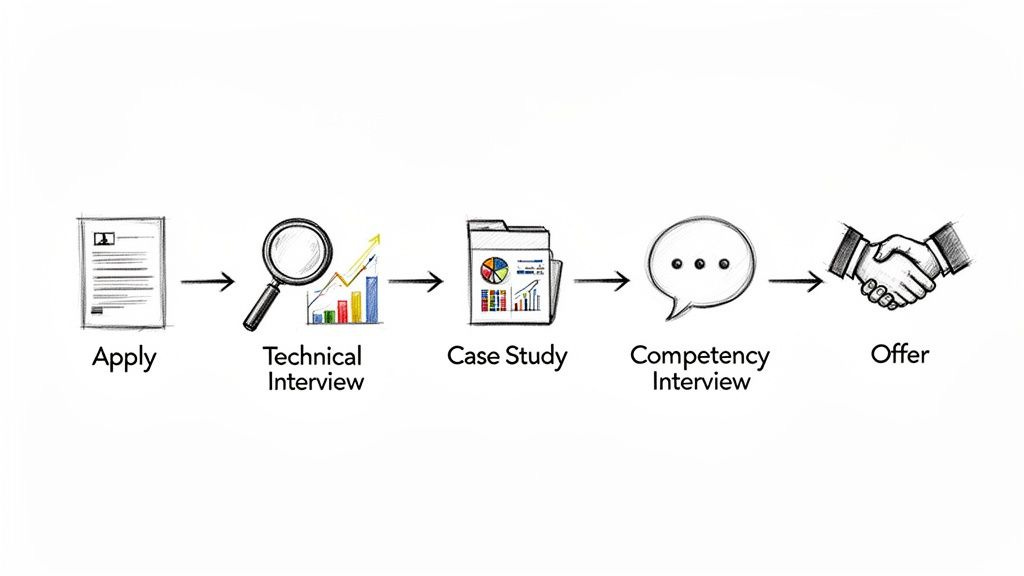
Once you’re shortlisted, get ready for a series of assessments. The exact format changes depending on the role and department, but most professional hiring tracks follow a similar pattern designed to challenge you in different ways.
Here’s a breakdown of what you’re likely up against:
The Initial Screen: A quick phone or video call with someone from HR or the hiring team. Think of it as a basic sanity check to confirm your experience and motivations line up with your application.
The Technical Deep-Dive: You’ll be grilled by senior specialists in your field who will probe the depth of your knowledge and practical experience. Be ready to go deep.
The Case Study or Written Test: You might get a real-world problem, a policy challenge or a project scenario, and a set amount of time to analyze it and present your solution. This could be a written report or a full presentation.
The Competency-Based Panel: This is often the final hurdle. You’ll face a panel of interviewers who will hit you with behavioral questions. Their goal is to see if you have the soft skills and core values the WBG prizes.
This process ensures new hires have the right technical skills and the collaborative, resilient mindset needed to get things done inside a massive institution.
How to Master Each Stage
To succeed, you can’t be good at just one thing. A technical genius can easily bomb the competency interview, and a smooth talker will get exposed in the technical round. You need a specific strategy for each stage.
For the technical interview, dust off your portfolio and be prepared to talk about your projects in excruciating detail. They want to hear about your methodology, the roadblocks you hit, and the results you delivered. They’re testing if your expertise is real or just résumé-deep.
The case study is all about structure and analytical thinking. Don’t leap to a conclusion. The key is to break the problem down, spot the core issues, use the data they give you, and build a logical, evidence-based recommendation. They care more about how you think than you finding a single “correct” answer.
The single best tool for the competency interview is the STAR method: Situation, Task, Action, Result. For every behavioral question (“Tell me about a time you dealt with a difficult stakeholder”), frame your answer with a clear beginning, middle, and end. It forces you to be specific and outcome-focused, which is exactly what the panel is looking for.
Finally, for the competency-based interview, the STAR method is your best friend. You need compelling stories from your past that prove you can handle teamwork, show leadership, focus on clients, and bounce back from setbacks. Vague, generic answers are a major red flag.
For a deeper look, our guide on how to apply for World Bank jobs offers more detailed strategies. Preparing for these interviews isn’t about memorizing answers; it’s about reflecting on your career and knowing which stories best show what you’re capable of.
Understanding Compensation, Benefits, and Contracts
Let’s talk about what a World Bank Group offer really looks like. You need a clear-eyed view of the total package to understand what a role truly means for you and your family. The package is a complex mix of pay, benefits, and contract types that are worlds apart between staff and consultant roles.
An offer from the WBG is not a standard corporate package. The type of contract you receive is the single most important factor, dictating everything from your job security and tax status to whether you get access to their world-class benefits. Getting this right is critical.
Decoding the WBG Pay Structure
The World Bank Group’s pay system is structured and transparent, built around a grading system. For professional roles, you’ll typically see grades like GG or GP. Each grade has a defined salary band, and where you land within that band hinges on your years of experience and the specific demands of the role.
Your cash compensation has two key parts: a base salary and, for internationally-recruited staff, a “post adjustment.” Think of the post adjustment as a cost-of-living allowance that equalizes purchasing power across different duty stations, using Washington D.C. as the baseline. This means a GG-level economist in a high-cost city like Geneva will have a higher total pay than a colleague in the exact same role based in a lower-cost location.
Based on publicly available WBG salary documents, mid-career professional grades often have base salaries ranging from USD 80,000 to USD 160,000 before any adjustments or benefits are factored in.
The biggest variable is the contract type. A staff appointment comes with a full suite of benefits, while a consultant contract is essentially a fee for service. Don’t just look at the gross pay; the net value of these two offers can be dramatically different.
Contract Types Explained
The contract you’re offered defines your entire relationship with the Bank. They generally fall into two main buckets:
Open-Ended/Term Staff Appointments: This is the gold standard, the equivalent of being a permanent or long-term employee. You are a full WBG staff member with access to the entire benefits package, including a phenomenal pension plan, comprehensive global health insurance, and relocation support. These are the most sought-after and secure positions.
Consultant and Temporary (C&T) Contracts: These are for specific, time-bound assignments. You’re hired as an independent contractor, not an employee. This means you’re paid a daily or monthly fee and are responsible for your own taxes, health insurance, and retirement savings. While they offer far less security, thousands of these contracts are issued every year, making them a very common entry point into the Bank’s ecosystem.
For a much deeper dive into the numbers and how these grades translate into real dollars, you might find this complete World Bank salary guide useful.
World Bank Group Contract Types at a Glance
To make sense of the different pathways, it helps to see the main contract types side-by-side. Each serves a different purpose for the Bank and offers a very different experience for the individual.
Contract Type Typical Duration Benefits Package Path to Permanent Role Open-Ended/Term Staff 3+ years to indefinite Full (pension, health, leave, etc.) This is the permanent role Extended-Term Consultant (ETC) 1-3 years Limited benefits (some leave, insurance options) Common pathway to a Term contract Short-Term Consultant (STC) Up to 150 days/year None (fee for service) Possible, but requires networking to secure longer-term roles Young Professionals Program (YPP) 5-year term contract Full benefits package Designed as a direct pipeline to a long-term staff career
This table simplifies a complex system, but the core takeaway is clear: staff appointments offer security and incredible benefits, while consultant roles provide flexibility and a common way to get your foot in the door.
The Comprehensive Benefits Package (For Staff)
For those who land a staff contract, the benefits package is a massive part of the total compensation and is exceptionally competitive on a global scale. It’s designed to support an international workforce and their families, no matter where they’re stationed.
Here are the highlights:
Global Health and Life Insurance: Top-tier medical, dental, and life insurance plans that cover you and your family worldwide.
Retirement Plan: A generous pension scheme where the Bank’s contribution is significant, setting you up for long-term financial security.
Relocation and Mobility Benefits: Financial support for moving, shipping your belongings, and grants to help you get settled in a new country.
Education Grants: A major perk for expatriate staff, this provides substantial support for the educational costs of dependent children.
Generous Leave: Competitive policies for annual vacation, sick leave, and parental leave.
You have to look at the full picture. A staff role with a lower base salary might offer far greater financial security and peace of mind than a higher-paying consultant gig once you account for these benefits.
Building Your Winning Application Strategy
Theory is one thing; a job offer is another. All the knowledge in the world means nothing without an execution plan. This is where you turn everything we’ve talked about into a concrete strategy that builds an application that gets noticed.
Think of your application as your opening argument. A generic resume and cover letter will get you nowhere. You must meticulously tailor every document to the specific role and the World Bank Group’s unique language and values. This is non-negotiable.
Tailoring Your Resume and Cover Letter
The WBG uses specific language for a reason. Their job descriptions are loaded with keywords tied to their core competencies and strategic goals. Your first job is to dissect the vacancy announcement and mirror its language in your application.
If a role emphasizes “client orientation” and “results for development,” your resume bullets must give concrete examples of how you’ve delivered results for clients or stakeholders. Use the exact phrases from the job description.
Action-Verb Driven: Start every bullet point with a strong action verb that shows you did something (e.g., “managed,” “analyzed,” “negotiated,” “delivered”).
Quantify Everything: Don’t say you managed a project. Say you “managed a $5 million infrastructure project, delivering it 10% under budget and improving service delivery for 50,000 people.” Numbers cut through the noise.
Competency Alignment: Group your skills and experiences under headings that directly match WBG competencies, like “Project Management,” “Policy Analysis,” or “Stakeholder Engagement.”
Your cover letter is where you connect the dots. Don’t rehash your resume. Tell a concise story about why your specific background makes you the perfect solution to the problems this role is designed to solve.
Networking with Purpose
Networking in the development world is about building genuine relationships based on professional respect and shared interests. Your goal isn’t to ask for a job; it’s to gain insider knowledge.
Platforms like LinkedIn are invaluable for this. Find current or former WBG staff in your target sector or country office. Follow their work, engage with their posts, and when you do reach out, make it specific. A message that says, “I read your recent article on digital finance in East Africa and was impressed by your analysis of...” is infinitely more effective than a generic “Can I connect?”
A well-placed informational interview is worth a hundred blind applications. Your goal is to learn what a hiring manager’s biggest challenges are, so you can position yourself as the solution in your application. People are often surprisingly willing to share insights if you approach them with genuine curiosity and respect for their time.
Essential Resources for Your Journey
The final piece of the puzzle is using the official channels correctly. Bookmark these pages. Check them regularly. They are your primary source of truth for all openings and application procedures.
WBG Careers Portal: This is the central hub for all staff and consultant vacancies. You should set up job alerts for your specific keywords and technical areas immediately.
Young Professionals Program (YPP) Site: If you fit the YPP profile, this is your dedicated resource. It has specific timelines, eligibility criteria, and application instructions that are totally different from standard staff roles.
The strategy is clear. Deconstruct the job description, tailor your documents with precision, network to gain intelligence, and use the official portals to apply. This methodical approach separates the successful applicants from the thousands who just fire off resumes and hope for the best.
A Few Common Questions About WBG Careers
Let’s cut to the chase. Navigating the path to a World Bank Group career brings up a lot of questions. Getting straight answers helps you focus your energy where it matters.
This isn’t about reciting the official rulebook. It’s about understanding the practical realities of what it takes to build an application that gets noticed and, eventually, a career inside the institution.
So, Do I Really Need a PhD?
Look, a PhD is a powerful asset, but it’s not a golden ticket for every role. If you’re aiming for the Research Group, the Development Economics Vice Presidency (DEC), or many of the pure economist jobs, then yes, it’s pretty much a requirement. The same goes for the hyper-competitive Young Professionals Program, where a doctorate gives you a serious edge.
However, for the vast majority of operational roles, the answer is a firm no. A Master’s degree combined with deep, hands-on field experience in a sector like infrastructure, public health, or digital development is far more valuable. Hiring managers for these jobs are looking for a proven ability to manage complex projects on the ground. Your track record of getting things done in your technical area is what gets you hired.
How Important Is Previous Development Experience, Really?
It’s critical. The World Bank Group is not an entry-level organization for people switching careers with zero exposure to international development. The institution hires professionals who already understand the landscape. This means you need experience from other multilateral development banks, national government agencies, international NGOs, or private sector firms directly involved with development projects.
If you’re earlier in your career, this experience can come from substantive internships or Junior Professional Officer (JPO) programs. The key is to show that you understand the unique challenges of working in developing economies and can hit the ground running.
What Are the Most In-Demand Skills Right Now?
While specific needs are always shifting, a few skill sets are perpetually in high demand. First, strong quantitative and analytical skills are the bedrock of almost every professional role. You have to be comfortable with data. Simple as that.
Expertise in high-priority sectors is also a major advantage. Right now, these include:
Climate change adaptation and finance
Digital development and transformation
Public health systems and pandemic preparedness
Infrastructure and project finance
Fragility, conflict, and violence (FCV) contexts
Finally, language skills are a massive differentiator. Fluency in languages beyond English, especially French, Spanish, or Arabic, opens up a much wider range of opportunities. This is particularly true for roles in country offices where the day-to-day business is done in the local language.
It is absolutely possible to transition from the private sector, but you must do the work of translating your experience. Frame your background in investment banking or management consulting in terms of public-private partnerships, policy advisory, or financial modeling for large-scale infrastructure. Show them you understand their world.
Is It Possible to Jump from the Private Sector?
Yes, and it’s a well-trodden and encouraged path. The WBG actively looks for talent from the private sector, especially from fields like investment banking, management consulting, project finance, and technology. These professionals bring a level of financial rigor and project execution discipline that is highly valued.
To make the jump successfully, you have to reframe your experience. Your resume needs to speak the language of development. You must articulate how your skills in financial modeling, stakeholder management, or strategic planning directly apply to solving development challenges. Connect your private sector wins to public sector outcomes.
Finding the right role at the right time is the biggest challenge. At Multilateral Development Bank Jobs, we simplify the process by sending curated lists of staff and consultant openings from over 30 MDBs directly to your inbox every week. Sign up to get the latest MDB job opportunities.