


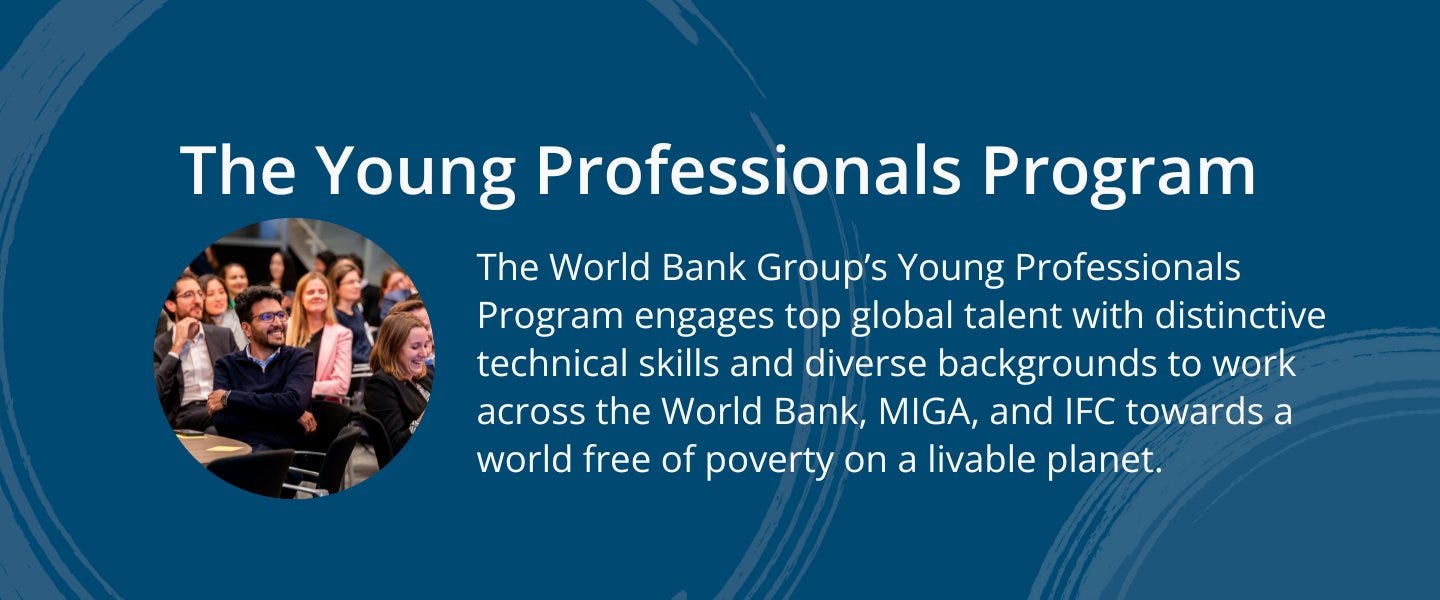
You're reading this because you want to get into one of the most competitive (and prestigious) development programs in the world.
If you play your cards right, the Young Professionals Program is a gateway to a career that shapes global economic policy and impacts millions of lives.
After six decades of operation, the World Bank YPP has become the gold standard for launching international development careers.
Here's everything you need to know to make it through their notoriously selective process.
Why the World Bank YPP Matters
The World Bank Group operates across 189 member countries with over 130 offices worldwide.
When you join as a Young Professional, you're securing a five-year term contract that positions you at the center of global development work, with an initial salary ranging from $105,000 to $140,000 annually.
The program gives you something most graduate programs can't: immediate impact.
From day one, you'll work on real projects affecting poverty reduction, climate change, and economic stability across developing nations.
Your first two years include rotational assignments across the World Bank, IFC, and MIGA, exposing you to everything from infrastructure financing to policy reform.
The Brutal Numbers
Let's address the elephant in the room.
Approximately 6,000 people apply each year. Only around 40 get selected.
That's a 0.67% acceptance rate, making it more selective than Harvard Medical School.
But here's what those statistics don't tell you: most applicants don't understand what the Bank actually wants. They submit generic applications that read like consulting firm cover letters.
The successful candidates on the other hand demonstrate deep technical expertise combined with genuine commitment to development work.
Eligibility Requirements You Can't Negotiate
Age Limit: Born on or after October 1, 1991 for the 2025 cohort. No exceptions, not even for a single day.
Education: Master's degree or higher in a relevant field, completed by September 1, 2025. If you're pursuing a PhD, your dissertation must be substantially complete with all written work submitted by this date.
Experience: Four years of full-time work experience post-undergraduate degree. Doctoral studies in relevant areas count toward this requirement.
Language: Excellent English proficiency is mandatory. Additional languages are advantageous but not required.
Citizenship: Must be a national of a World Bank Group member country or country of operations.
Employment Status: Cannot currently hold a World Bank Group staff appointment, though consultancy positions are acceptable.
Application Timeline and Critical Dates
The 2025 application cycle opened September 1, 2024, and closed September 30, 2024 at 11:59 UTC. No late applications are accepted. Period.
Here's how the timeline typically unfolds:
September 1-30: Application submission window
December 2024 - January 2025: Interview and assessment invitations
February 2025: Final selections announced
September 8, 2025: Program start date (no deferred entry)
The Selection Process Breakdown
Round 1: Application Screening Your online application includes three critical essays with strict character limits:
Qualifications for your selected work program (250 words)
Motivation and commitment to WBG mission (400 words)
How your expertise contributes to poverty reduction on a livable planet (400 words)
You'll also submit your CV (maximum 2 pages), passport photo, transcripts, and two professional references. The screening team evaluates technical depth, breadth across sectors, and leadership potential.
Round 2: Video Interviews Successful candidates receive HireVue interview invitations. These recorded interviews assess communication skills, technical knowledge, and cultural fit.
Round 3: Panel Interviews Live competency-based interviews with senior World Bank staff. Expect questions about development economics, your research, and scenario-based leadership challenges.
Round 4: Assessment Center Individual and group exercises testing analytical thinking, collaboration, and problem-solving under pressure. IFC candidates face additional financial modeling tests.
Work Program Selection Strategy
You must choose between three institutional tracks:
World Bank (IBRD/IDA): Technical Specialists and Economists working on country programs, policy research, and sector-specific projects. Strong fit for those with economics, public policy, or sector expertise in health, education, infrastructure, or governance.
IFC: Associate Investment Officers focusing on private sector development. Ideal for candidates with finance, business, or engineering backgrounds interested in project finance and emerging markets.
MIGA: Underwriters, Economists, and Technical Specialists supporting political risk insurance and investment guarantees. Best suited for those with legal, finance, or risk management experience.
Your choice must align perfectly with your demonstrated experience. Don't apply to IFC if you've never worked in finance. Don't choose governance if you lack policy experience. The selection committee can spot misalignment immediately.
Common Disqualification Mistakes
Generic Applications: Writing essays that could apply to any development organization. The Bank wants specific understanding of their work and strategic priorities.
Academic Focus Without Practical Experience: Having impressive credentials but no evidence of real-world problem-solving or leadership in challenging environments.
Mismatched Work Program Selection: Applying to areas where your experience doesn't align with technical requirements.
Poor Reference Quality: Submitting references from people who don't know your work well or can't speak to your potential for development work.
Language Issues: Underestimating the English proficiency requirement. Your essays and interviews must demonstrate sophisticated communication skills.
Program Structure and Rotations
Your first five years include two phases:
Years 1-2: Structured Development Comprehensive orientation covering World Bank Group operations, development theory, and sector knowledge. You'll complete two 18-month rotational assignments across different departments or institutions.
Years 3-5: Specialization Deeper focus in your chosen area with increasing responsibilities. Performance evaluations determine contract renewal beyond the initial term.
The rotation system is designed to break down institutional silos. You might spend your first rotation in a country office working on education policy, then move to headquarters for infrastructure financing work. This breadth is what makes YPP alumni so valuable throughout their careers.
Comparing MDB Programs
IMF Economist Program More specialized focus on macroeconomics and monetary policy. Requires PhD completion within one year of starting. Three-year program with two departmental rotations. Smaller cohort (roughly 20-25 annually) but limited to economics roles.
Asian Development Bank YPP Three-year fixed-term program with 18-month Manila headquarters placement followed by rotational assignment. Salary ranges $80,000-$120,000 with strong benefits package. Less competitive than World Bank (roughly 10-20 selections from 2,000-4,000 applications) but geographically focused on Asia-Pacific.
The World Bank YPP offers broader institutional exposure and global reach, making it the most versatile launching pad for international development careers.
Alumni Career Outcomes
World Bank YPP alumni occupy leadership positions across the development ecosystem. Many advance to become World Bank country directors, IMF mission chiefs, or cabinet ministers in their home countries. Others leverage their experience to lead major NGOs, consulting firms, or academic institutions.
Ultimately, the program's strength lies in its network effect. Your cohort becomes a lifelong professional network spanning continents and sectors. When you need expertise on infrastructure financing in Africa or climate policy in Southeast Asia, you likely know someone from your YPP class working in that area.
Recent alumni trajectories include:
World Bank Country Director positions within 10-15 years
Senior economist roles at central banks and finance ministries
Leadership positions at development finance institutions
Founding roles at impact investing firms and social enterprises
Final Application Strategy
Start your preparation at least six months before applications open. Successful candidates typically:
Demonstrate Deep Technical Expertise: Your work experience must show genuine specialization in areas relevant to development work.
Show Cross-Sector Adaptability: Evidence of working across different contexts, cultures, or sectors.
Prove Leadership Potential: Concrete examples of leading teams, managing projects, or driving change in challenging environments.
Articulate Development Commitment: Genuine passion for poverty reduction and sustainable development, backed by relevant experience.
Understand WBG Strategy: Detailed knowledge of World Bank Group priorities, recent initiatives, and how your skills address current challenges.
The World Bank YPP is your pathway to becoming future leaders of the global development community. If you can demonstrate that potential while meeting their technical requirements, you'll join an elite group shaping the world's approach to ending poverty and building sustainable prosperity.
Your competition is fierce, but the opportunity is transformational.
What happens if I missed out on the YPP?
That said, the YPP is NOT the only way to join the World Bank.
In fact, it can be significantly easier to join the World Bank through a normal advertised position.
So if you miss the cut off, or aren’t successful in landing a YPP position, don’t stress.
The typical way for people to score staff positions at the World Bank are:
Short term consulting (STC) position → extended term consulting (ETC) position → staff position.
But while this is the most common way, this doesn’t mean the World Bank doesn’t just recruit people from other jobs (be it other MDBs, companies or academia).
Make sure you subscribe to MDB Jobs to get the latest vacancies delivered straight to your inbox each week.