

Your resume lists what you’ve done. Your statement of interest explains why it matters.
For hyper-competitive roles at Multilateral Development Banks (MDBs), this document is your strategic argument. It’s the one place you get to connect the dots between your background and the specific needs of the bank.
Why Your Statement Is Your Most Important Document
Your statement of interest is the bridge between your past accomplishments and your future contributions. This is the document that makes a hiring manager decide if your application is worth a serious look or if it’s just another resume in a pile of thousands.
At institutions like the World Bank or the Asian Development Bank, this document often gets reviewed before your CV. Let that sink in.
If your statement fails to grab their attention in the first few lines, they may never get to your impressive qualifications. This is your one shot to frame the narrative, ensuring the reader sees exactly how your skills solve their specific problems.
It Answers the ‘So What?’ Question
Your resume is a factual record. It’s a list of jobs and projects, but it lacks interpretation. A busy hiring manager scans your CV and thinks, “Okay, they worked on an infrastructure project in Southeast Asia. So what?”
The statement of interest answers that question head-on. It tells the reader why that specific project is relevant to their organization. You’re doing the work for them, showing you understand their mandate and can hit the ground running.
Your statement isn’t a summary of your resume. It’s an argument for your candidacy, using your resume as evidence. You are interpreting your experience through the lens of the MDB’s mission.
This is especially critical for programs like the Young Professionals Program (YPP), where articulating a compelling vision for your role is what separates the accepted from the rejected. For a full breakdown of what that looks like, check out our guide on the World Bank hiring playbook and its timelines.
Setting the Tone for Your Application
Beyond the content, your statement of interest sets a professional tone. A thoughtfully written document signals key attributes about you:
Attention to Detail: A clean, error-free statement shows you’re meticulous. It proves you take your work and this application seriously.
Strategic Thinking: It demonstrates your ability to synthesize a complex career history into a coherent, persuasive argument.
Genuine Motivation: A customized, insightful statement reveals a real passion for development work, not just a desire for any prestigious job.
Without a strong statement, your application is a list of facts without a story. Let’s make sure your story is the one they remember.
Structuring Your Statement for Maximum Impact
Before you write a single word, you need a blueprint. A winning statement of interest is a carefully constructed argument that guides the reader exactly where you want them to go.
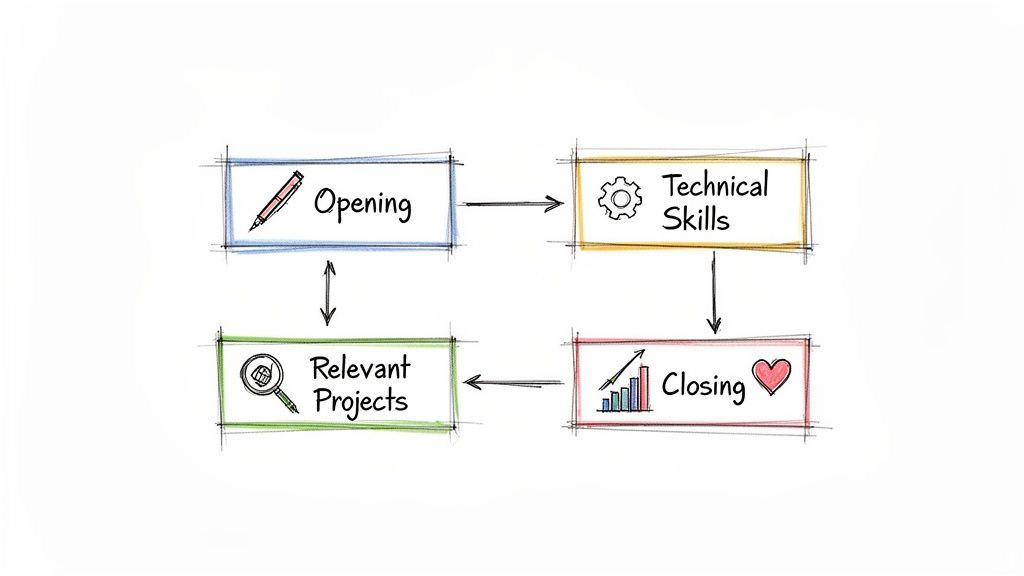
Think of it this way: a disorganized statement signals a disorganized mind. A clear, logical flow shows you’re a strategic thinker. The goal is to make it effortless for the hiring manager to connect the dots and conclude that you’re the perfect fit.
This is about building your case, brick by brick. Let’s break down the essential framework that consistently gets results.
The Powerful Opening
Your first paragraph has one job: get their attention and state your purpose. Don’t waste precious real estate with generic lines like, “I am writing to express my interest.” They already know that.
Jump right in. Immediately connect your core ambition with the specific role and the institution’s mission. Show you’ve done your homework from the first sentence.
For example, a strong opener might be: “My career in private sector finance has been driven by a commitment to scaling sustainable infrastructure, an ambition that aligns directly with the World Bank’s goal of mobilizing private capital for climate action.” It’s confident, specific, and instantly relevant.
Building Your Core Argument
The body of your statement, typically two or three paragraphs, is where you lay out the evidence. Your goal here is to interpret your resume, not just repeat it. Connect your skills and experiences directly to what the job description is asking for.
Dedicate each paragraph to a specific theme or competency. For instance, one paragraph could focus on your technical expertise in blended finance, while the next highlights a major project that shows off your project management and cross-cultural communication skills.
This thematic approach keeps your story clean and easy to follow. A busy hiring manager can quickly grasp your strengths without getting bogged down in a chronological list of your past jobs.
Your statement should be organized by competency, not by chronology. Group your experiences to prove you meet the core requirements of the role, showcasing the impact of your work, not just the tasks you performed.
If the job demands deep expertise in policy analysis, pull your best examples from across your career, even if they happened years apart, and present them together. This proves you understand what matters for this role.
Showcasing Relevant Skills and Projects
Within these core paragraphs, you have to bring your skills to life. This is where you move beyond listing what you can do and start proving it with concrete examples.
Quantify Your Achievements: Don’t say you “managed a large budget.” Instead, specify that you “managed a $5 million project budget, delivering the program 10% under cost.” Numbers stick.
Detail Your Role in Projects: It’s not enough to say a project was a success. What was your specific contribution? Were you the lead analyst who built the financial model? Did you coordinate between government and private stakeholders to get the deal done?
Connect to Institutional Goals: Explicitly draw a line from your past work to the MDB’s current priorities. If you worked on a water sanitation project, connect that experience to the bank’s strategy for improving public health outcomes in developing nations.
This level of detail shows you’re qualified on paper and have delivered measurable results in contexts that are highly relevant to the MDB’s work. You’re making a powerful case that you can do it again for them.
The Memorable Closing
Your final paragraph should be short, sharp, and forward-looking. Its job is to reinforce your enthusiasm and leave a lasting, confident impression.
Summarize your core value proposition in a single, powerful sentence. Reiterate your strong interest in both the role and the institution, tying everything back to the motivation you mentioned in your opening.
End with a professional and direct call to action. Something as simple as, “I am eager to discuss how my background in renewable energy finance can contribute to your team’s objectives,” is perfect. It’s confident, proactive, and signals you’re ready for the next step.
Tailoring Your Statement for MDBs and YPPs
A generic statement of interest is a fast track to the rejection pile. Multilateral Development Banks like the World Bank, Asian Development Bank (ADB), and African Development Bank (AfDB) are not interchangeable. Each has its own mandate, a distinct internal culture, and its own language.
Applying with a one-size-fits-all document screams laziness and a fundamental misunderstanding of the institution. You have to show you’ve done your homework.
It’s the same story for Young Professional Programs (YPPs), but with a twist. They’re hunting for a very specific profile, prioritizing leadership potential, adaptability, and a global mindset over decades of deep, narrow experience. Your statement needs to be surgically precise, proving you are qualified and that you are the right kind of qualified for that specific opportunity.
Decoding the MDB’s Internal Language
The first step is research, but not the superficial kind. Forget the “About Us” page. You need to dig into the documents that guide the bank’s actual operations. This is where you’ll find the keywords and strategic priorities that hiring managers live and breathe.
Here’s where to look:
Annual Reports: These give you the high-level view of the bank’s achievements and strategic direction over the last year.
Country Partnership Frameworks (CPFs): These are goldmines. A CPF outlines the bank’s multi-year strategy for a specific country, detailing priority sectors like energy, health, or education.
Sectoral Strategy Papers: Look for recent publications on topics like climate finance, private sector development, or digital transformation. These reveal the bank’s current thinking and investment focus.
When you’re reading these, you’re actively hunting for the specific terminology the bank uses. If their latest energy strategy paper repeatedly mentions “just energy transition partnerships,” that exact phrase needs to appear in your statement, connected directly to your own relevant experience. This shows you speak their language.
Aligning Your Story with Their Strategy
Once you’ve got the vocabulary down, you have to weave it into your personal narrative. Connect your past accomplishments to their future goals. Be explicit; don’t make the reader guess how your experience is relevant.
For instance, if the AfDB’s latest strategy emphasizes agricultural value chains, you don’t just mention your work in agribusiness. You frame it like this: “My experience developing a private-sector-led financing model for smallholder farmers in Kenya directly supports the AfDB’s strategy of strengthening agricultural value chains to enhance food security.”
The best statements interpret experiences through the lens of the institution’s strategic priorities, making a direct and undeniable case for your alignment.
This approach transforms your statement from a passive summary into an active argument. You’re not just another candidate with good skills; you are a strategic asset who gets the mission and can contribute from day one. This level of preparation is rare, and it gets you noticed. Considering how few candidates take this step, it’s a powerful way to get ahead. You can learn more about strategic positioning by exploring our guide on how to land an MDB job and what timelines to expect.
Cracking the YPP Code
Young Professional Programs are a different beast. While your technical skills are a must, the selection committees are screening for future leaders. Your statement has to reflect this.
The focus shifts from “what I have done” to “who I can become.” You need to demonstrate core competencies that signal high potential.
These include:
Leadership Potential: This isn’t about formal titles. Talk about a time you influenced a team, persuaded difficult stakeholders, or took the initiative on a complex problem.
Global Mindset: Show you have experience and are comfortable working across different cultures and contexts. Highlight international projects or collaborations.
Adaptability and Learning Agility: MDBs are complex, and YPs are expected to rotate through different departments. Frame a past experience where you had to quickly master a new subject or work in a totally unfamiliar environment.
Your YPP statement must be forward-looking. Articulate a clear vision for your career within the institution and explain why the YPP is the critical next step to get you there. You’re selling your potential as much as your past.
Ultimately, whether you’re targeting an MDB role or a YPP, tailoring is non-negotiable. It’s your job to do the deep research and connect your unique story to their specific mission.
Learning from Good and Bad Examples
Theory only gets you so far. To nail your statement of interest, you have to see the principles in action. The gap between a weak statement and a powerful one is a night-and-day difference that recruiters spot in seconds.
Let’s dissect what works and what falls flat. We’ll start with a generic, ineffective statement, the kind that gets a two-second glance before being deleted. Then, we’ll look at a rewritten, compelling version for the exact same role to show you how specific changes make all the difference.
The Ineffective Example: Why It Fails
Imagine you’re applying for an Infrastructure Finance Specialist role at the World Bank. Here’s a paragraph that, unfortunately, is all too common:
“I am very interested in the Infrastructure Finance Specialist position at the World Bank. My background in finance and project management makes me a good candidate for this role. I have worked on several important infrastructure projects and have a passion for international development, which I believe aligns with the Bank’s mission to end extreme poverty.”
This paragraph is the written equivalent of a limp handshake. It’s a collection of generic, unsubstantiated claims that do nothing to build a case for the candidate. You’re telling them you’re a great chef but haven’t mentioned a single dish you can cook.
Let’s get specific about why this doesn’t work:
Vague Language: Phrases like “good candidate,” “important projects,” and “passion for development” are noise. They are empty calories; they take up space but offer zero substance or proof.
No Metrics: Where are the numbers? The dollar signs? The percentages? Without mentioning budget sizes, project outcomes, or efficiency gains, your impact is completely invisible.
Passive Framing: This is all about what the candidate has. It doesn’t connect their past achievements to what they can do for the Bank’s future. It’s a summary, not a proposal.
This kind of writing makes the hiring manager do all the heavy lifting to connect the dots. Spoiler alert: they don’t have the time or the inclination.
Crafting a strong statement means building a strategic argument from the ground up.
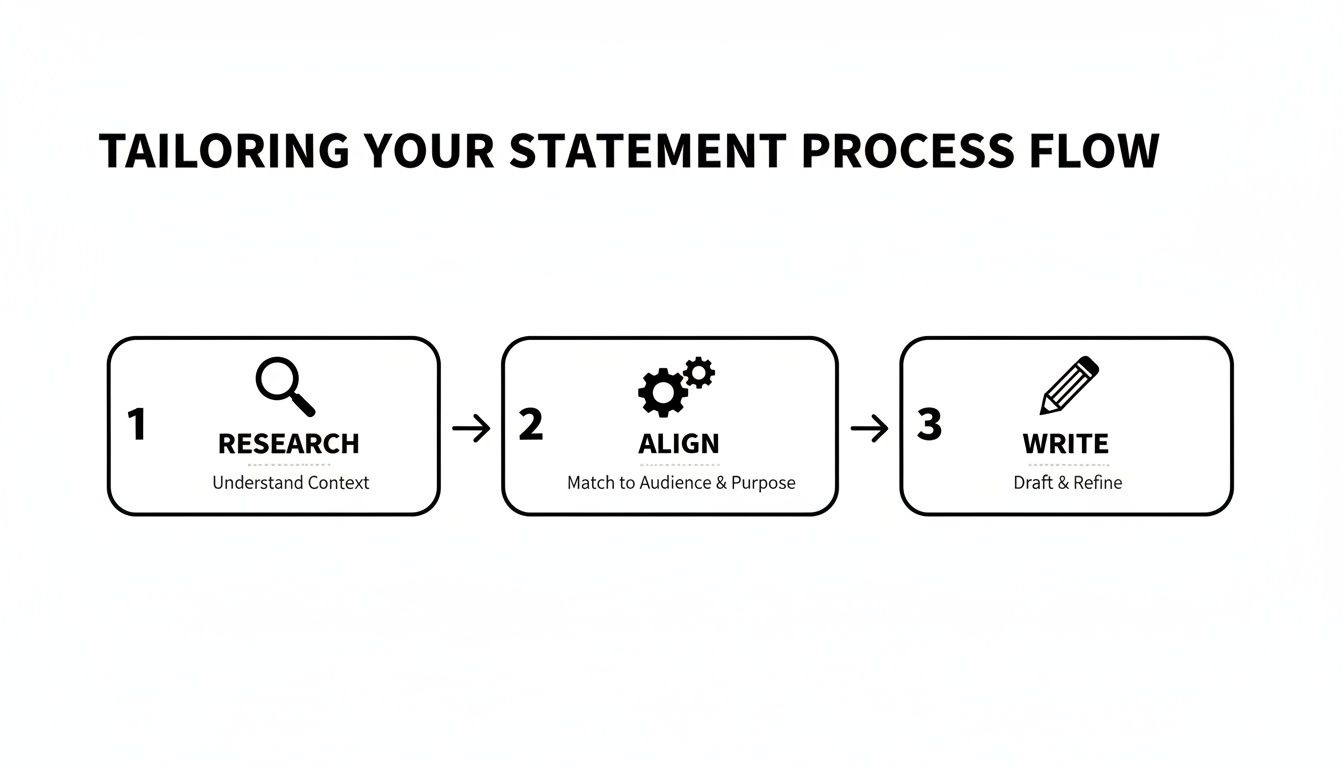
As you can see, the actual writing is the final step. It has to be built on a solid foundation of deep research and clear alignment with the institution’s goals.
The Powerful Rewrite: What Works
Now, let’s take that same candidate, for the same role, and rewrite that paragraph with precision, confidence, and evidence.
“My experience structuring a $250 million blended finance facility for a solar energy project in East Africa directly aligns with the World Bank’s strategy to scale up private capital mobilization for climate action. By leading the financial modeling and negotiating with both public and private stakeholders, I helped secure a 15% reduction in project costs and accelerate its delivery by six months, a model I am confident can be replicated to support your ‘Accelerating Clean Energy Transition’ initiative.”
See the difference? This version is sharp, specific, and makes a powerful, evidence-based argument. It proves competence instead of just claiming it.
Here’s the breakdown of why this one lands:
Specific Metrics: It’s packed with hard numbers: $250 million, 15% cost reduction. These figures are credible, memorable, and quantify the candidate’s impact.
Direct Alignment: The paragraph explicitly name-drops a specific World Bank strategy. This shows the candidate has done their homework and isn’t just spamming applications. This is critical, especially as MDBs laser-focus on specific goals. For instance, climate finance recently hit a record $137 billion across all MDBs.
Action-Oriented Language: Forget passive phrases. This version uses strong verbs like “structuring,” “leading,” and “negotiating” that paint a clear picture of an active, effective professional.
Forward-Looking Connection: It brilliantly connects a past success to a future contribution. The candidate isn’t just saying, “Look what I did.” They’re saying, “Here’s a blueprint for what I can do for you.”
This side-by-side comparison makes it clear: the journey from a weak statement to a strong one is about swapping vague assertions for concrete proof. You have to stop summarizing your past and start arguing for your future.
If you want to get inside the head of the person reading your application, check out our interview with an MDB panelist.
Common Mistakes That Get Applications Rejected
Even the sharpest candidates get sidelined by simple, avoidable errors. A single misstep in your statement of interest can signal a lack of attention to detail or a poor understanding of the institution. With a massive pool of applicants for every MDB job, recruiters have zero tolerance for it.
The recruiter’s first job is to thin the herd. They’re actively looking for reasons to disqualify you. Don’t give them an easy one.
These aren’t just minor stylistic preferences; they are fundamental errors that undermine your credibility. Let’s walk through the most common traps and how you can sidestep them.
Treating It Like a Resume in Paragraph Form
This is the most frequent and fatal error. Your statement of interest is not the place to rehash your CV in chronological order.
A sentence like, “First, I worked at Company X, then I moved to Company Y, where I was responsible for Z” is a complete waste of space. The recruiter can already see that on your resume.
Your job here is to interpret your history, not just repeat it. You need to connect those experiences to a central argument about why you are the perfect fit for this specific role. If you find yourself listing past jobs, stop. Every sentence must build your case for future contribution.
Showing a Lack of Genuine Interest
Recruiters can spot a generic, copy-pasted application from a mile away. Vague statements about wanting to “make a difference” or having a “passion for development” are meaningless without specific proof. It’s the professional equivalent of going on a first date and saying you “like music.”
Genuine interest is proven through specifics. Did you reference a recent country strategy paper? Did you mention a specific project the bank is leading that excites you? This is how you prove you care about their work, not just about getting any job.
A generic statement signals you’re mass-applying everywhere. A specific, tailored one shows you’ve made a deliberate choice to apply to this institution, for this role, for a clear and compelling reason. That’s what gets a recruiter’s attention.
Failing to customize your statement is a sign of disrespect for the reader’s time and for the institution’s mission. It’s a fast track to the “no” pile.
Focusing Only on the Past
Another common trap is writing a statement that is entirely retrospective. You might have an impressive track record, but the hiring manager is primarily interested in what you can do for them tomorrow.
Your past achievements are only useful as evidence of your future potential. Frame every accomplishment with a forward-looking perspective. Instead of saying, “I managed a large infrastructure project,” you should say, “The cost-saving methodologies I developed for that $100 million infrastructure project can be directly applied to enhance the efficiency of your urban transport initiatives.”
Using Jargon Without Context
Yes, MDBs are filled with acronyms and technical terms. But assuming your reader understands the niche jargon from your previous field is a huge mistake. While you should use the MDB’s internal language to show you belong, avoid obscure terms from past roles unless you briefly explain their relevance.
Similarly, much of the public information about MDBs focuses on high-level financial data, like lending volumes or climate finance disbursements. Dropping these terms into your statement to sound smart will almost certainly backfire; it’s completely irrelevant to your application. If you want to get a better sense of what data matters, you can explore tools that track MDB financial activities on findevlab.org to distinguish between operational metrics and application-relevant information.
Your goal is clarity and impact. If a term doesn’t directly support your argument, cut it. Your ability to communicate complex ideas in a simple, direct way is a skill they are actively screening for.
To make this clearer, here’s a quick cheat sheet for turning common mistakes into compelling fixes.
Mistake vs. Correction
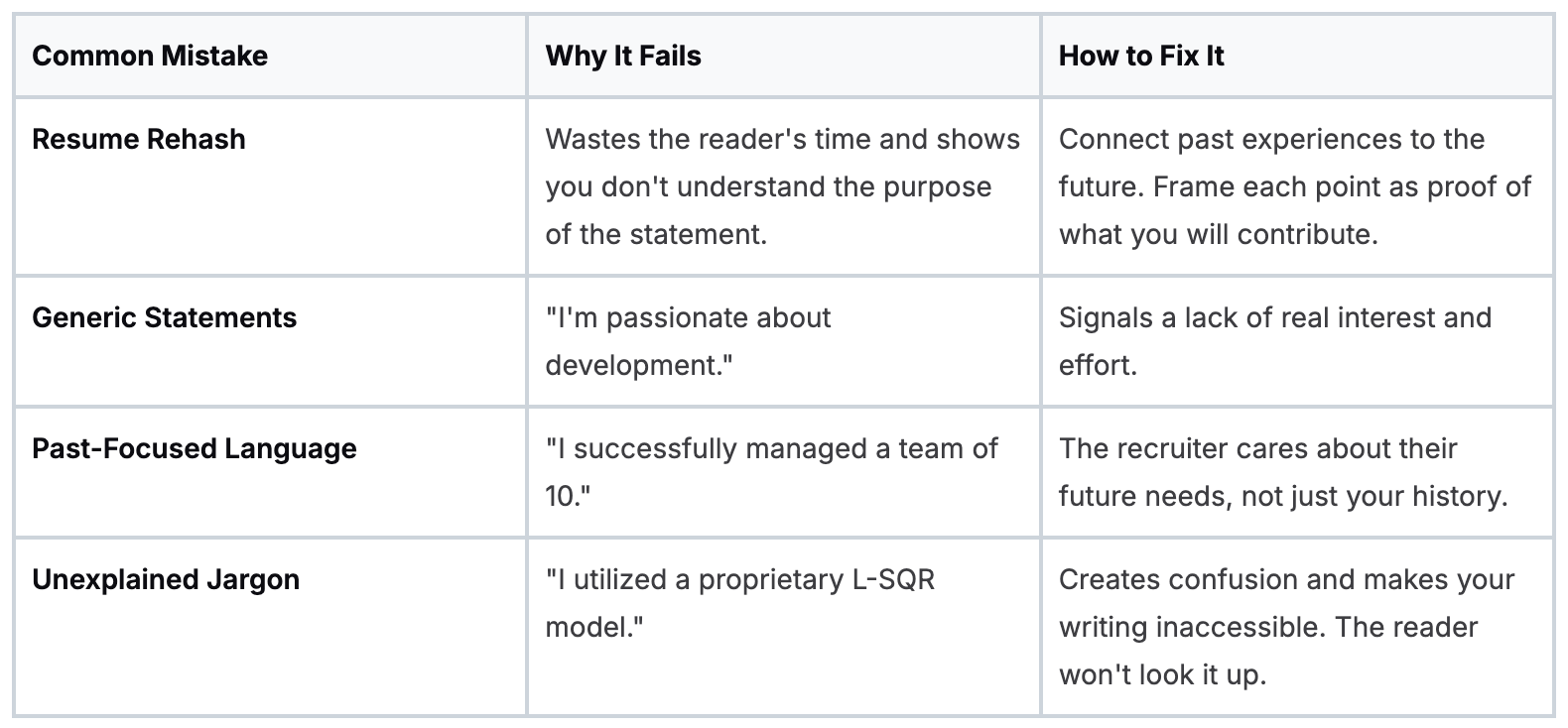
Think of this table as your final gut check before you hit submit. If you spot any of these mistakes in your draft, you know you still have work to do.
Your Questions, Answered
Let’s tackle some of the most common questions that come up when you’re drafting a statement of interest. Getting these details right can make all the difference, so use these insights to sharpen your final draft and hit ‘submit’ with confidence.
How Long Should a Statement of Interest Be?
Keep it to one, single-spaced page. That’s the gold standard. In terms of word count, this usually shakes out to somewhere between 500 and 800 words.
Tempted to go longer? Don’t. It’s a huge gamble. MDB hiring managers are sifting through hundreds of applications. A two-page document is practically begging to be skimmed or, even worse, tossed aside. Your mission is to make a powerful, condensed case for yourself.
If the application portal gives you a specific word or character limit, treat it as sacred. Going over signals that you can’t follow basic instructions. That is not a great first impression.
Is This Just a Glorified Cover Letter?
No, and confusing the two is a critical mistake. They play entirely different roles in your application strategy.
A cover letter is tactical. It’s a direct response to a specific, advertised job, and your main goal is to show how you tick the boxes listed in the job description.
A statement of interest is strategic. It’s much broader, zeroing in on your long-term vision, your core motivations, and why you’re a fundamental match for the organization’s mission.
For highly competitive roles at MDBs and programs like the YPP, the statement of interest carries far more weight. It’s where you reveal your deep-seated commitment to development and your nuanced understanding of the institution’s place in the world. It’s less about this one job and more about your entire career trajectory.
Think of it this way: a cover letter says, “I’m the right person for this specific job.” A statement of interest says, “I’m the right person for this entire institution.” It’s a much bigger, more compelling claim.
What’s the Right Tone to Strike?
You’re aiming for a careful balance: professional, confident, and direct. You want to come across as an experienced practitioner who already gets the institutional culture.
Ditch the overly academic jargon or dense, bureaucratic prose. It just makes you sound stuffy and out of touch. On the other hand, this isn’t an email to a friend, so keep it polished and avoid being overly casual.
Your best bet? Use the active voice, punchy verbs, and clear, straightforward sentences. The idea is to project competence and intelligence without tipping into arrogance. Let your experience do the talking through clear, direct communication.
Should I Mention Personal Details Like My Nationality?
Absolutely not, unless the application explicitly asks for it.
Your statement needs to be laser-focused on your professional qualifications, your skills, and your motivations. Personal details like your nationality, age, marital status, or where you were born are completely irrelevant to your professional merit.
This type of information is captured elsewhere in the formal application. Squeezing it into your statement only distracts from your core message and can come across as unprofessional. Keep the spotlight on the value you bring to the table.
At Multilateral Development Bank Jobs, we do more than just list jobs; we give you the insider playbook to actually get hired. For weekly job lists, consultant opportunities, and deep-dive career guides delivered straight to your inbox, subscribe today.