

An Inter-American Development Bank internship is a paid, hands-on opportunity to get your foot in the door of multilateral development and contribute to projects that directly shape Latin America and the Caribbean.
These competitive roles, offered both at the IDB’s headquarters in Washington, D.C., and in its country offices, are a direct entry point into development finance and policy.
What Is the IDB Internship Program
The IDB internship is a professional development program for current university students. It’s not an academic exercise. You’re hired as a consultant and embedded directly within a department, working on real projects with real deadlines.
It’s a highly focused apprenticeship. You’re matched with a team based on your skills, whether that’s in economics, data science, public policy, or communications, and you’re expected to contribute from day one. This ground-level view of how a major multilateral development bank (MDB) operates is the program’s real value.
A Gateway to Development Careers
Landing an IDB internship is a strategic career move. The experience you get is immediately recognized and valued by other MDBs like the World Bank, regional development banks, and international organizations. Hiring managers in this tight-knit sector know the rigor of the IDB’s programs.
The selection process is tough. It pulls in top students from across the IDB’s 48 member countries. Because it’s so competitive, having it on your CV sends a clear signal: you’ve been vetted and can tackle complex development challenges.
Program Structure and Focus
The IDB internship operates in two distinct ways.
Structured Cohorts: These are the formal Summer and Winter internship programs. They have fixed dates, a centralized recruitment process, and are based at the IDB’s headquarters in Washington, D.C.
Country Office Internships: These are far more flexible. Positions open up throughout the year based on the specific needs of individual IDB offices across Latin America and the Caribbean.
Your work will be tied to the IDB Group’s core mission of improving lives through financial and technical solutions. One day you might analyze economic data for a country report. The next you could help design a digital infrastructure project or draft communications for a new climate initiative. You can find a wide array of Inter-American Development Bank jobs and related opportunities on specialized career platforms.
The goal is to fully immerse you in the bank’s work. You’re there to learn, but you’re also there to produce tangible work that helps your team meet its objectives. It’s a real job with real responsibilities.
Understanding the Different IDB Internship Types
The Inter-American Development Bank internship is a collection of distinct tracks. Your first move is figuring out which one fits your goals and academic schedule. Knowing the difference between the big, structured D.C. programs and the more flexible country office gigs is critical.
The IDB Group is made up of the main bank, IDB Invest (which handles the private sector), and IDB Lab (the innovation hub). Your choice of internship comes down to two things: where you want to be and when you can do it.
The Headquarters Programs: Summer and Winter
The best-known IDB internships are the Summer and Winter programs at the bank’s headquarters in Washington, D.C. These are the classic, structured experiences where you join a cohort of other interns and follow fixed application windows and start dates.
Summer Internship: This program typically runs from mid-June to mid-August. It’s the most popular and competitive track because it lines up with the summer break for most universities in the Northern Hemisphere.
Winter Internship: This one usually goes from mid-January to mid-March. It’s a great alternative if you’re on a different academic calendar or want to face a slightly less crowded application pool.
These HQ internships drop you right into the nerve center of the IDB. You’ll work alongside the teams designing major regional policies, managing massive loan portfolios, and producing influential research. For the duration, interns are hired as consultants, giving you an unfiltered look at how the bank’s internal machinery works.
Being part of a cohort is a huge advantage. You go through orientation together, instantly building a network of ambitious students from around the world. It’s a built-in professional community from day one.
The flowchart below gives you a clear picture of how an IDB internship connects to the bank’s development mission and sets you up for future career growth.
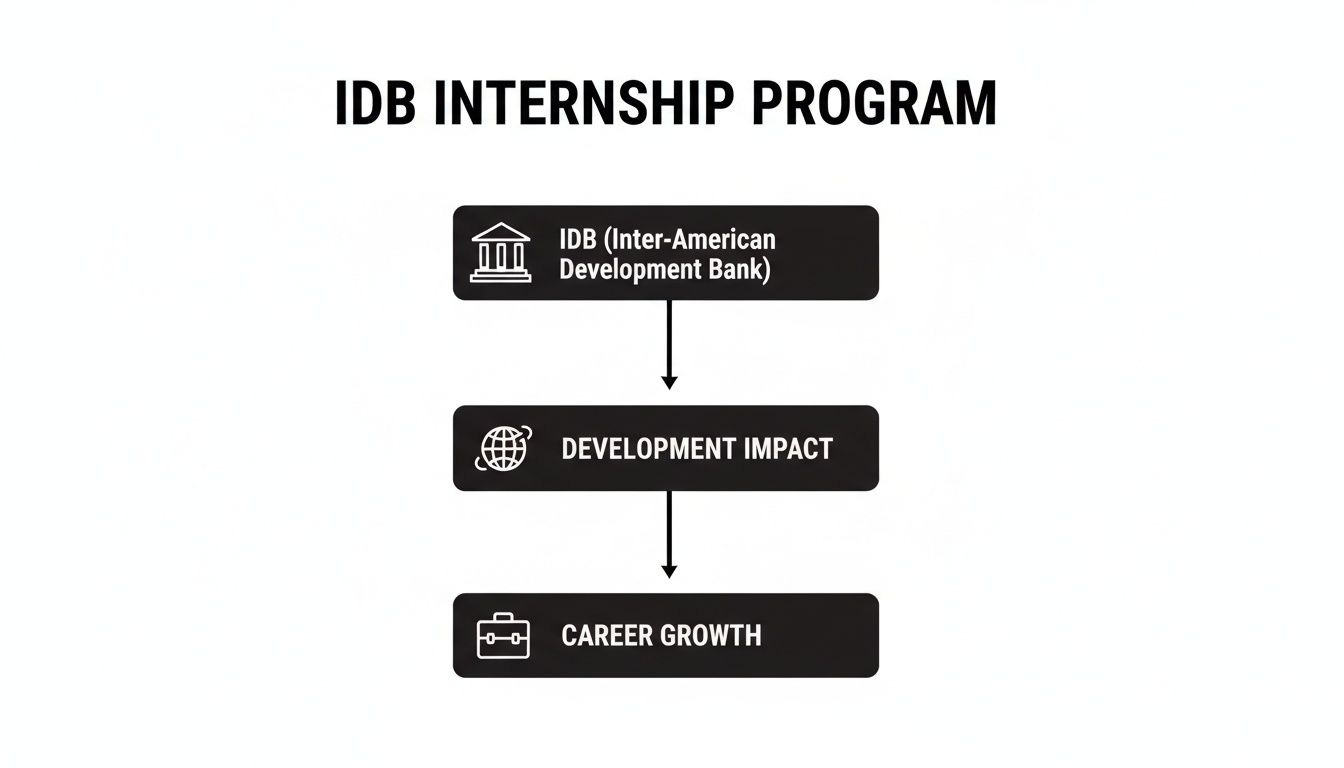
An internship is designed to directly feed into both global development work and your own long-term career path.
Country Office and IDB Invest Internships
Beyond the big D.C. programs, the IDB also offers internships at its 26 country offices across Latin America and the Caribbean, plus roles within IDB Invest. These are a different game.
Unlike the fixed cycles at HQ, these internships are posted on a rolling basis. When a specific department in Colombia or Costa Rica needs help, they’ll post an opening. This makes them less predictable, but it also means opportunities can pop up year-round.
Key Differences for Country Office Roles:
Timeline: Completely flexible. Applications are posted and accepted whenever a need arises.
Duration: Varies widely, from two to six months, depending on the project’s requirements.
Focus: You’re much closer to the action. These roles are often tied to the direct implementation of projects on the ground, offering a very different perspective from the high-level policy work at HQ.
IDB Invest, the private-sector arm of the Group, also runs its own recruitment. These internships are all about corporate finance, impact investing, and infrastructure financing. They’re looking for candidates who can build a financial model and have sharp business analysis skills.
The IDB’s global structure, with 48 member countries, makes these internships a strategic launchpad. The bank sources talent from major economies like the U.S. and Japan and connects them with its work across Latin America, the Caribbean, Asia, and Europe. To recap, the HQ internships run in fixed cycles, Winter (Jan 16-Mar 15) and Summer (Jun 16-Aug 15), while country offices offer rolling 2-6 month terms. You can see how these opportunities compare to others in the development field in this helpful overview from Stanford University.
Meeting the Eligibility and Nationality Requirements
Before you polish your CV, understand that the Inter-American Development Bank has a set of hard eligibility rules. They aren’t suggestions. They’re deal-breakers.
If you don’t tick every one of these boxes, your application is dead on arrival. The IDB is serious about keeping its process fair and merit-based, so let’s walk through exactly what they’re looking for.
The Core Academic Requirement
First, you must be an active student. This means you are currently enrolled in either an undergraduate or graduate degree program at an accredited university. No exceptions.
Your graduation date has to fall after the internship’s end date. If you’re applying for a summer internship that ends in August and you graduate in December, you’re fine. But if you graduate before the internship finishes, you are not eligible. The IDB is strict on this because the program is built specifically for current students, not recent grads.
Nationality: The Member Country Rule
Your citizenship is one of the first things the IDB will check. For any internship at the headquarters in Washington, D.C., you must be a citizen of one of the bank’s 48 member countries. This covers the borrowing members in Latin America and the Caribbean, plus non-borrowing members like the United States, Canada, Japan, and many European nations.
If you’re targeting an internship in a specific country office, the rule is even more direct: you must be a citizen of that country. This is standard practice for Multilateral Development Banks because it helps them cultivate local talent.
This rule is completely non-negotiable. It’s the first filter recruiters apply, so confirm your country is on the member list before you start anything else. Don’t waste your time if it isn’t.
Conflict of Interest Policies
The IDB has firm guardrails in place to prevent favoritism and keep the hiring process purely meritocratic. They take this very seriously.
You are automatically disqualified if you fall into any of these categories:
Former Staff: You cannot be a former employee of the IDB or any other IDB Group entity.
Former Contractors: If you’ve previously worked as a consultant or contractor, you are also ineligible.
Family Members: You cannot have close family relatives currently employed at the IDB Group. The policy is specific, extending to the fourth degree of consanguinity and second degree of affinity.
The Bank’s highly competitive Summer Internship Program, for instance, hires only about 35 interns for its two-month term. With candidates coming from all member nations, the process has to be ironclad. The program is strictly for first-timers, with zero tolerance for applicants who have prior IDB employment history or close family ties. You can get a sense of this merit-first approach in this overview of IDB internship programs.
Language Proficiency Requirements
Finally, let’s talk languages. Professional fluency in English is mandatory. All official business at the IDB’s headquarters is done in English, so your ability to communicate effectively is non-negotiable.
Speaking one of the bank’s other official languages gives you a massive advantage.
Spanish: As the dominant language across Latin America, Spanish proficiency is a huge asset. You’ll see it listed as a preferred qualification on most postings.
Portuguese: Absolutely essential if you’re interested in roles focused on Brazil or regional projects involving the country.
French: Critical for any work related to Haiti or other French-speaking Caribbean nations.
English is the baseline. Adding another of these languages shows you have a genuine, deeper commitment to the region, making you a far more compelling candidate for an Inter-American Development Bank internship.
To help you keep track, here’s a quick summary of the main hurdles you’ll need to clear.
IDB Internship Eligibility at a Glance
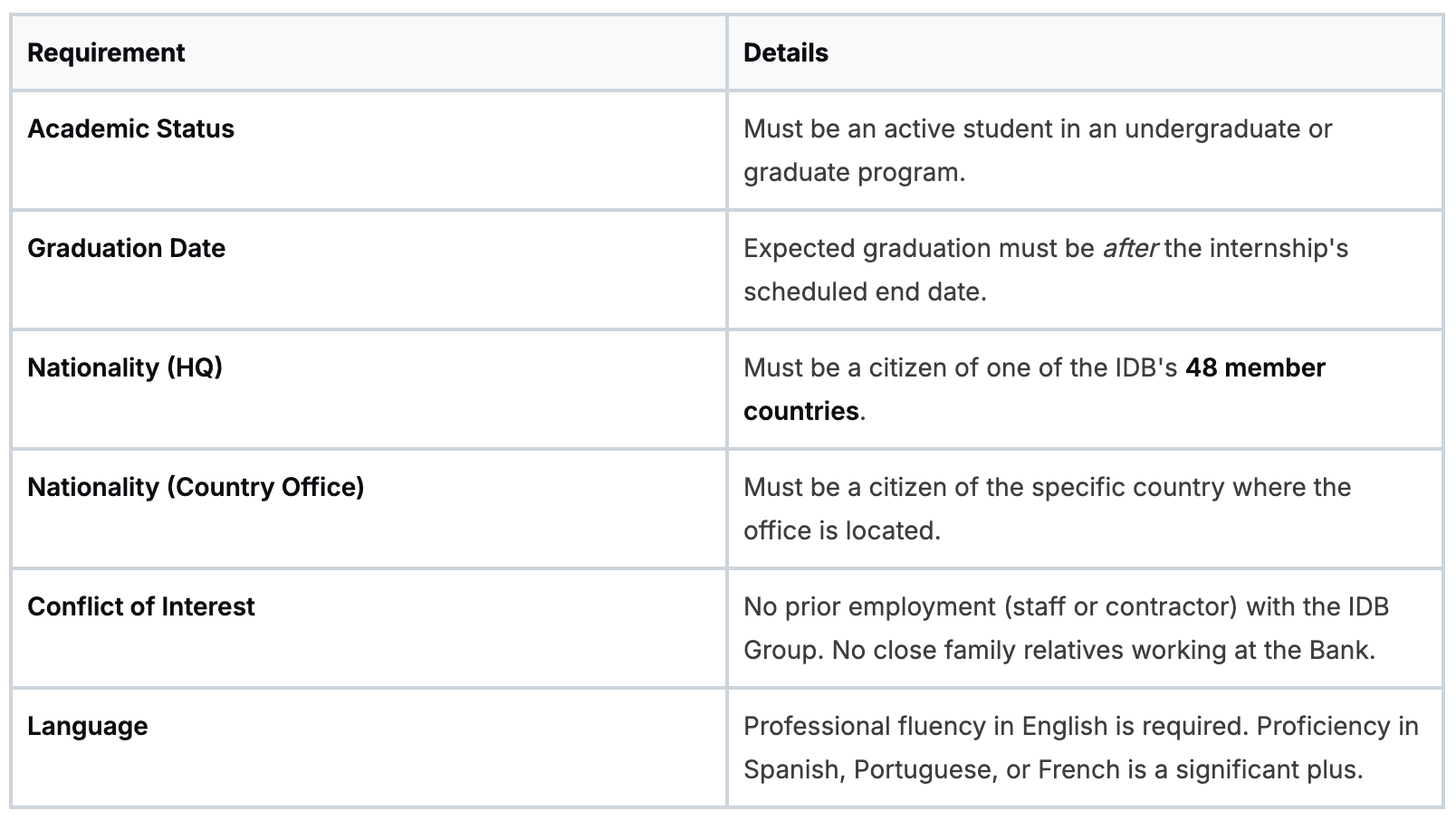
Make sure you can confidently say “yes” to every item on this list. If you can, it’s time to start thinking about how to make your application stand out.
Navigating the Application Timeline and Process
When it comes to the Inter-American Development Bank, timing is everything. Missing a deadline for one of their structured internship programs means you’re out of the running until the next cycle. The process is predictable, but you have to be ready to act fast.
Let’s walk through the timeline and exactly what you need to do to get a sharp, timely application in front of the hiring managers.
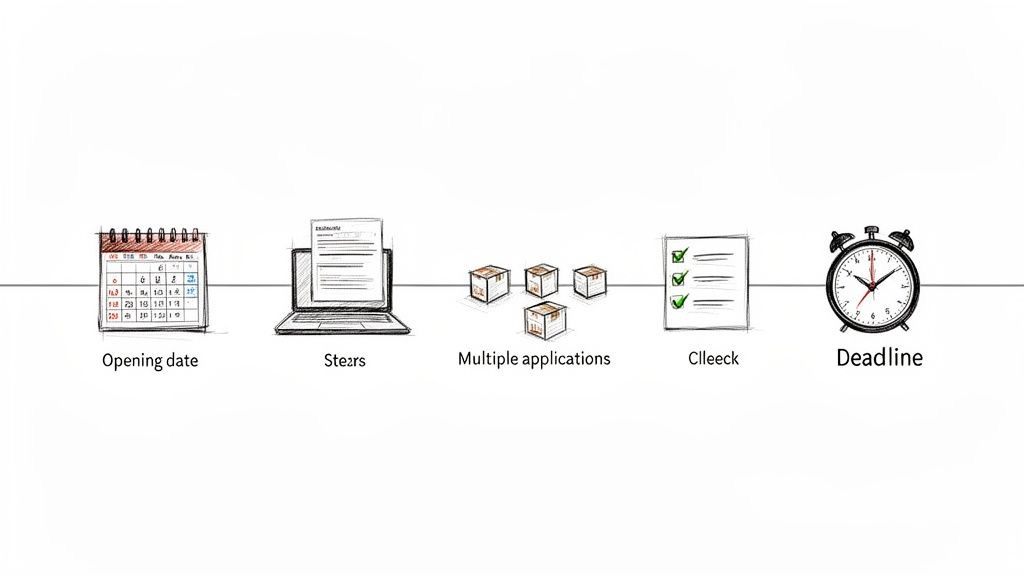
Key Dates for HQ Internship Programs
The IDB’s headquarters in Washington, D.C. runs two big internship cohorts each year: Winter and Summer. While the exact dates can shift slightly, the application windows are consistent. You absolutely need to get these on your calendar.
Let’s use the 2026 cycle as a working example. Based on past patterns, here’s what to expect:
2026 Winter Internship (Jan 16 – Mar 15): The application window for this cohort will likely open around early September 2025 and close by the end of September 2025. It’s an incredibly short window, often just a few weeks long.
2026 Summer Internship (Jun 16 – Aug 15): Applications for the hyper-competitive summer program usually open in early February 2026 and close by the end of February 2026.
These are firm deadlines. The bank is flooded with applications, so they don’t look at late submissions. Your best bet is to set a calendar alert months in advance so you’re ready to act the day the postings go live.
The Application Portal Walkthrough
All applications are funneled through the IDB’s official online careers portal. The system is user-friendly, but a classic mistake is waiting until the last minute to create a profile. Don’t do it. Get your profile set up well before the application window opens to avoid any eleventh-hour tech drama.
Here’s the game plan:
Build Your Profile: Go to the IDB careers site and create a complete personal profile. This is your master file where you’ll upload your main CV and input your personal details, academic background, and language skills.
Find the Openings: Once the application period starts, the specific internship postings will appear. Each one is tied to a different department or project.
Select and Apply: Read through the available roles. The portal lets you apply for up to three different internship openings per cycle.
Submit Your Documents: For each individual application, you will need to attach your CV and a tailored cover letter. You’ll also need proof of your student status and your expected graduation date ready to upload.
Your general profile is just the foundation. You have to actively submit a separate application for each position you target. Simply having a profile won’t get you considered. You must complete the submission for each of the (up to) three roles.
How to Strategically Apply for Three Positions
The ability to apply for three positions is a huge advantage if you use it smartly. The worst thing you can do is pick three at random. Be methodical.
Choose roles that tell a coherent story about your expertise and professional interests. For instance, you could apply for:
An economic research role in the Social Sector.
A data analysis position in the Infrastructure Department.
A policy support role in the Climate Change Division.
This combination paints a clear picture: you’re interested in data-driven policy analysis and can apply those skills across different development challenges. It tells a much more compelling story than applying to one finance role, one communications role, and one IT role, which just makes you look unfocused. Choose your top three wisely to show the IDB exactly where you’d fit.
Crafting an Application That Gets Noticed
Think of your application for an Inter-American Development Bank internship as a direct sales pitch. Recruiters are drowning in CVs from smart, qualified students. Yours has to do more than list accomplishments. It needs to tell a compelling story about why you’re the right person for this specific role and for the bank’s mission.
Let’s break down how to build an application that gets pulled from the stack. This is about substance, strategy, and showing you genuinely get what the IDB does.
Tailoring Your CV for the IDB
A generic CV is a one-way ticket to the “no” pile. Period. Each application you send needs a tailored approach that speaks directly to the internship description. The IDB’s work is highly specialized, and your resume must reflect that.
Start by dissecting the internship posting. Pinpoint the key skills and responsibilities they’re asking for. Is it quantitative analysis, policy research, project management, or financial modeling? Once you have that list, go through your CV line by line and reframe your experience to match their needs.
Academic Projects: Don’t just list a course title. Describe projects that mirror the IDB’s work. Did you analyze trade data for a specific Latin American country? Did you model the economic impact of an infrastructure project? Frame it like real-world experience.
Skills Section: Get specific. Instead of a vague “Data Analysis,” write “Data analysis using Stata, R, and Python for econometric modeling and visualization.” This shows you have the tools to do the job from day one.
Highlight Regional Focus: If you’ve done any work related to Latin America or the Caribbean, even a major research paper, make sure it’s front and center. It proves you’re already invested in the region they serve.
Your goal is to make it easy for the recruiter to connect the dots between what they need and what you can do. Don’t make them guess.
Writing a Cover Letter That Shows Motivation
The cover letter is where you answer the “why.” Why the IDB? Why this specific role? A common mistake is writing a letter that’s all about you and your ambitions. The best cover letters are about them and how you can help them hit their goals.
Your cover letter should answer one fundamental question: “How will my skills and experience help this specific department solve its problems?” Frame your motivation in terms of contribution, not just personal gain.
For example, instead of saying, “I am passionate about development and want to learn from the best,” try something more direct: “My experience analyzing renewable energy policy in emerging markets aligns directly with your division’s work on sustainable infrastructure in Central America. I can immediately contribute to your ongoing research on grid modernization.”
Show them you’ve done your homework. Mention a specific IDB project or report that caught your eye. This demonstrates genuine interest and proves you aren’t just spamming applications. For more direct advice, check out our guide on how to write a compelling statement of interest.
Preparing for the Interview
If your application makes the cut, you’ll move on to the interview. IDB interviews are typically a mix of behavioral and technical questions designed to test both your personality and your hard skills.
Behavioral Questions: These are your classic “Tell me about a time when...” questions. They want to see how you handle teamwork, pressure, and failure. Prepare concrete examples using the STAR method (Situation, Task, Action, Result). Have a few stories ready to go.
Technical Questions: These will be specific to the role. An internship in the finance division might get a case study on project valuation. A data science role might be asked about a specific statistical model. Review the job description and be ready to prove you have the technical chops they’re looking for.
The bank’s focus is increasingly interdisciplinary. For 2026, the IDB sought undergraduates in Industrial Engineering and Data Science for a Visa Master Data Intern role, while graduate positions in Education Data Analysis required skills in Economics and Statistics. This blend of Business, Finance, and Data/Technology shows the real-world, cross-functional nature of MDB work.
Language skills also play a huge role. Having a working knowledge of Spanish, French, or Portuguese can increase your evaluation score by 20-30%. You can learn more about these types of specialized roles on the IDB’s career site.
Life as an IDB Intern: What to Expect
An internship at the Inter-American Development Bank is a real job. It’s not an academic exercise or a summer of making coffee. The IDB hires you as a full-time consultant, plugs you directly into a department, and gives you substantive work that matters to your team’s goals.

You’ll be dropped into a professional, fast-paced, and genuinely international environment. These are seasoned development economists, policy advisors, and financial analysts who have built their careers tackling the toughest challenges in Latin America and the Caribbean. They will treat you like a junior colleague. You get a ton of responsibility, and the bar for your work is set incredibly high.
Your Day-to-Day Responsibilities
What you’ll do depends entirely on which team you land on. Your tasks won’t be busywork. They’re critical pieces of much larger, ongoing projects.
Here’s a taste of what your days might look like:
Data Analysis: You could be digging into massive datasets on public health outcomes, trade flows, or educational attainment. This often means using Stata, R, or Python to spot trends that will shape policy advice.
Research and Writing: Many interns contribute to internal reports, country briefs, or even public-facing research papers. This is your chance to conduct literature reviews, synthesize complex findings, and draft sections of documents your team depends on.
Project Support: You might help a project team prep for a mission to a member country. That could involve building out presentations, preparing background documents, or coordinating logistics.
Financial Modeling: If you’re in a division like IDB Invest, you could find yourself building financial models to stress-test the viability of a new infrastructure project or dissecting a company’s balance sheet for a potential loan.
The work is demanding. It requires you to apply your academic knowledge to messy, real-world problems. If you’re looking to sharpen that edge, it’s worth checking out our guide on how to improve your analytical skills.
Compensation and Learning Opportunities
This is a paid, full-time gig. While the exact stipend shifts a bit year to year, it’s designed to be competitive and help you cover living costs, especially if you’re moving to Washington, D.C. for a headquarters-based program. The pay signals that the Bank sees you as a professional, not just a student.
The real value is the on-the-job learning. You get a front-row seat to how a major multilateral development bank works, from internal politics to the technical nuts and bolts of project finance.
The most valuable part of the experience is the direct mentorship. You have a direct line to experts in your field who can offer career advice, review your work, and connect you with others in their network. No classroom can replicate this access.
You’ll also be part of a cohort of interns from all over the world. These are your peers, your future colleagues, and the start of your professional network in the development world. The IDB usually organizes networking events and special learning sessions for the intern class, giving you a structured way to build connections that will pay dividends long after the internship is over.
Common Questions About the IDB Internship
Let’s cut through the confusion. When you’re navigating the IDB application process, a few key questions come up again and again. Getting straight answers will save you time and help you avoid simple mistakes.
Here’s the no-nonsense breakdown of what you need to know.
Can I Apply if I Have Already Graduated?
No. To be eligible for an IDB internship, you must be an active student at an accredited university for the entire program. Your graduation date has to be after the internship officially ends.
This isn’t a flexible policy. The program is explicitly designed as a bridge between academic life and a professional career. If you’ve already graduated, you’re past the stage this program targets.
The IDB has plenty of other doors. You should be looking at consultant roles and full-time staff positions on their main careers portal instead.
Are IDB Internships Only for Economics and Finance Majors?
No. An economics or finance background is a huge asset, but the Bank’s work is incredibly interdisciplinary. They actively look for a diverse mix of skills to solve the region’s complex development challenges.
The IDB consistently seeks out interns with backgrounds in:
Data Science and Analytics: For everything from impact evaluations to predictive modeling.
Public Policy and Administration: To help design and analyze government programs.
Communications and Marketing: To share the bank’s work and its real-world impact.
Environmental Science: For critical projects on climate change, biodiversity, and sustainability.
Engineering and Urban Planning: For roles in infrastructure, transport, and digital connectivity.
The key is connecting the dots. You have to clearly show how your specific academic skills solve a problem for the department you’re applying to. Read the internship description and tailor your application to be the solution.
Your major is less important than your ability to apply your skills to real-world development challenges. The IDB cares about what you can do, not just what you studied.
Are the Internships Remote or in Washington DC?
The main Summer and Winter internship programs are based at the IDB’s headquarters in Washington, D.C. You should plan on being there in person.
The in-person model is designed for deep immersion. It allows for better collaboration with your team and gives you far more opportunities to network with staff and your fellow interns. It’s a core part of the experience.
Internships based in one of the IDB’s country offices will be located in that specific country across Latin America or the Caribbean. While some roles might offer a hybrid option, the default expectation is on-site work.
How Important Is Speaking Spanish?
English fluency is non-negotiable. All official business at the headquarters is done in English, and you must be proficient.
That said, a working knowledge of Spanish is a major competitive advantage. It’s often listed as a preferred qualification, and for good reason. Spanish is the primary language in most countries the IDB serves, so being able to communicate in it makes you a far more effective and attractive candidate.
For many roles, especially those involving fieldwork or direct contact with regional stakeholders, fluency in Spanish, Portuguese, or French can be a game-changer. It shows a deeper commitment to the region and lets you contribute on a different level.
Finding the right role at a multilateral development bank can feel like a maze. Multilateral Development Bank Jobs cuts through the noise, delivering curated job lists and expert guides directly to your inbox. We send out full-time staff roles every Monday, consultant opportunities each Friday, and deep-dive career guides every Wednesday to help you land your next job in development. Find your opportunity at https://mdbjobs.com