

A proper database officer job description is about being the guardian of the critical data that underpins massive global development projects. These are the people who ensure the integrity, security, and accessibility of information used by economists and policymakers making billion-dollar decisions.
What a Database Officer Actually Does
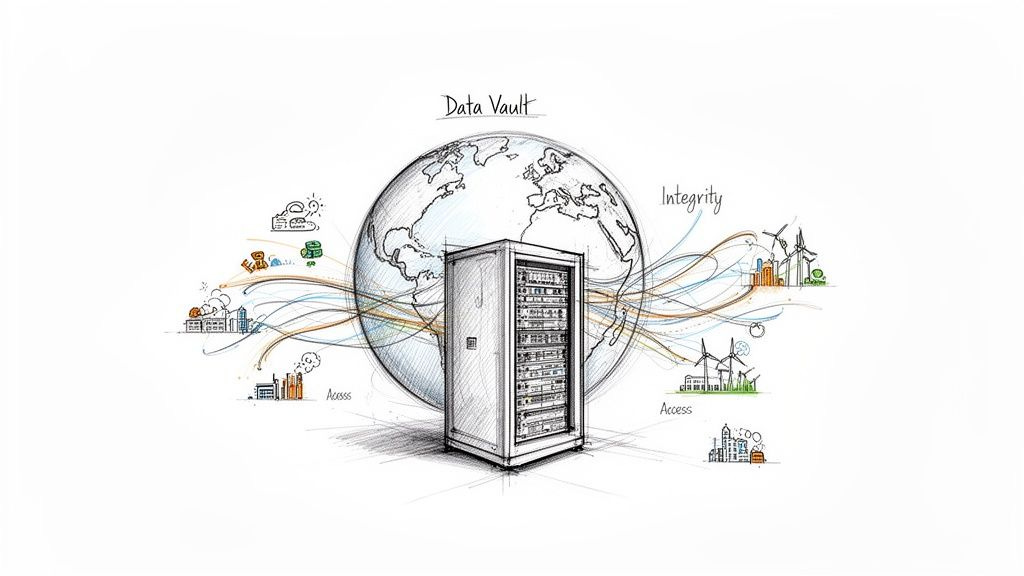
Let’s cut through the jargon. A Database Officer, especially inside a Multilateral Development Bank (MDB), isn’t fixing technical glitches. They are the architects and managers of the institution’s information backbone. They’re responsible for the systems that track enormous loan portfolios, monitor project outcomes, and store sensitive economic data from member countries.
Take an MDB like the World Bank. Its operations generate staggering amounts of data on everything from infrastructure projects in Asia to public health initiatives in Africa. The Database Officer ensures all this information is properly structured, secure, and ready for the teams who need it. Their work is the bedrock for analysis and decision-making at the highest levels.
The Guardian of Global Data
The title “Officer” is important. It signals a level of responsibility beyond a typical administrator, implying ownership and strategic oversight of the data itself. You’re not running scripts; you’re building and protecting the vault that holds the bank’s most valuable non-monetary asset.
This role demands a unique blend of deep technical skill and a grasp of the bigger picture. You have to know the technology inside and out, but you also need to understand why the data matters. A dataset on vaccination rates is a critical tool for measuring public health progress and deciding where to allocate future funding.
The core job is to maintain the single source of truth. When an economist pulls a report on poverty reduction in a specific region, they have to trust that the data is accurate, current, and hasn’t been tampered with. The Database Officer is the person who makes that trust possible.
Key Functions in an MDB Context
Within an MDB, the Database Officer’s tasks are tied directly to the organization’s mission. The goal is to enable developmental impact. Their day-to-day work usually revolves around a few key functions:
Data Integrity and Security: Implementing rock-solid protocols to shield sensitive national and programmatic data from corruption or unauthorized access.
Performance Optimization: Ensuring that huge, complex databases can be queried efficiently by hundreds of users simultaneously, from project managers in the field to research analysts at headquarters.
System Architecture: Designing and rolling out new database systems to support new lending instruments, research initiatives, or entire operational departments.
Compliance and Governance: Ensuring every data-handling practice lines up with the bank’s internal policies and international data protection standards.
This role is fundamental to an MDB’s ability to function. Without effective data management, tracking development outcomes would be impossible. If this kind of work interests you, our guide to World Bank Group careers provides great context on how these roles fit into the larger organizational structure: https://www.mdbjobs.com/p/your-guide-to-world-bank-group-careers.
Core Responsibilities and Daily Tasks
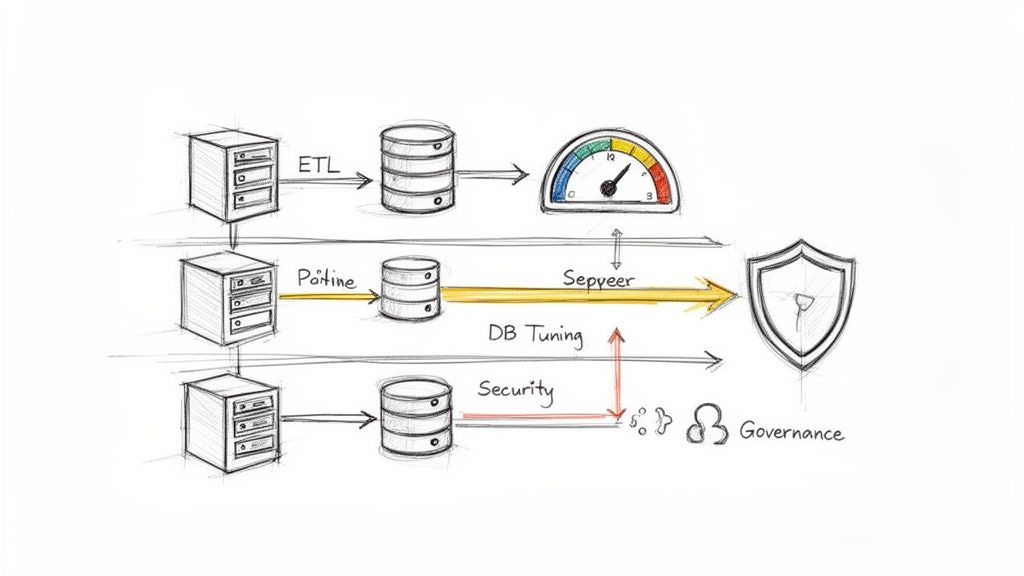
So, what does a Database Officer actually do? The role is a mix of architecture, hands-on maintenance, and high-level strategic oversight. Forget the stereotype of someone watching servers blink. This is about actively building and defending the data infrastructure that underpins everything from complex financial instruments to global development programs. You’re both the engineer and the guardian.
Your day-to-day work shuffles between deep technical tasks and broader governance. One moment, you might be buried in complex SQL queries, trying to squeeze more performance out of a system handling terabytes of economic data. The next, you’re drafting security protocols to shield that same sensitive information from the latest cyber threats.
Architecting Data Solutions
A huge part of the database officer job description is design and implementation. When a new development project gets the green light, you’re the one designing the database structure from scratch. This means getting in a room with project managers and economists to understand their data needs, then choosing the right technologies to build a scalable and secure system.
You’ll create the schemas, define data relationships, and set up the physical and logical data models. This work is foundational. A poorly designed database will create performance nightmares and data integrity headaches for years. Getting it right from day one is everything.
Imagine a new climate finance initiative. It needs a database that can track thousands of transactions, monitor environmental impact metrics, and pull in data from a dozen external sources. You’re responsible for architecting a solution that can handle all that complexity without falling over.
Owning Performance and Security
Once a system is live, your focus pivots to keeping it running fast and safe. Performance tuning is a constant battle. You’re ensuring queries execute in milliseconds, not minutes, and that critical applications remain responsive for users across the globe. This involves analyzing execution plans, creating indexes, and sometimes re-architecting parts of the system to smash through bottlenecks.
Security is the other side of that coin, and it’s non-negotiable. You will develop and enforce tough security protocols, manage user access with an iron fist, and implement robust encryption. MDBs handle incredibly sensitive data, from national economic statistics to the personal information of project beneficiaries, so the security standards are sky-high.
Your job is to make sure data is both available and protected. It’s a constant balancing act between accessibility for those who need it and airtight security to keep it safe from those who shouldn’t have it.
Data Governance and Compliance
A massive chunk of your time is spent on data governance. You own the rulebook: the policies and procedures that dictate how data is managed, stored, and used across the entire institution. You’re the one ensuring that every data-handling practice complies with international standards like GDPR and the MDB’s own stringent internal policies.
This isn’t just paperwork. It includes hands-on tasks like data quality management, metadata management, and establishing a clear data lifecycle from creation to archiving. You are the final authority on data standards for the bank.
The scale of this is hard to overstate. Take the Inter-American Development Bank (IDB). Database officers there manage the data behind massive financing operations. In 2022 alone, the IDB approved roughly $14,846 million in developmental assets. That surge in activity, including disbursements hitting $10,707 million that year, requires an incredibly powerful and well-governed database infrastructure to track it all. You can read the full annual report to get a sense of the sheer volume.
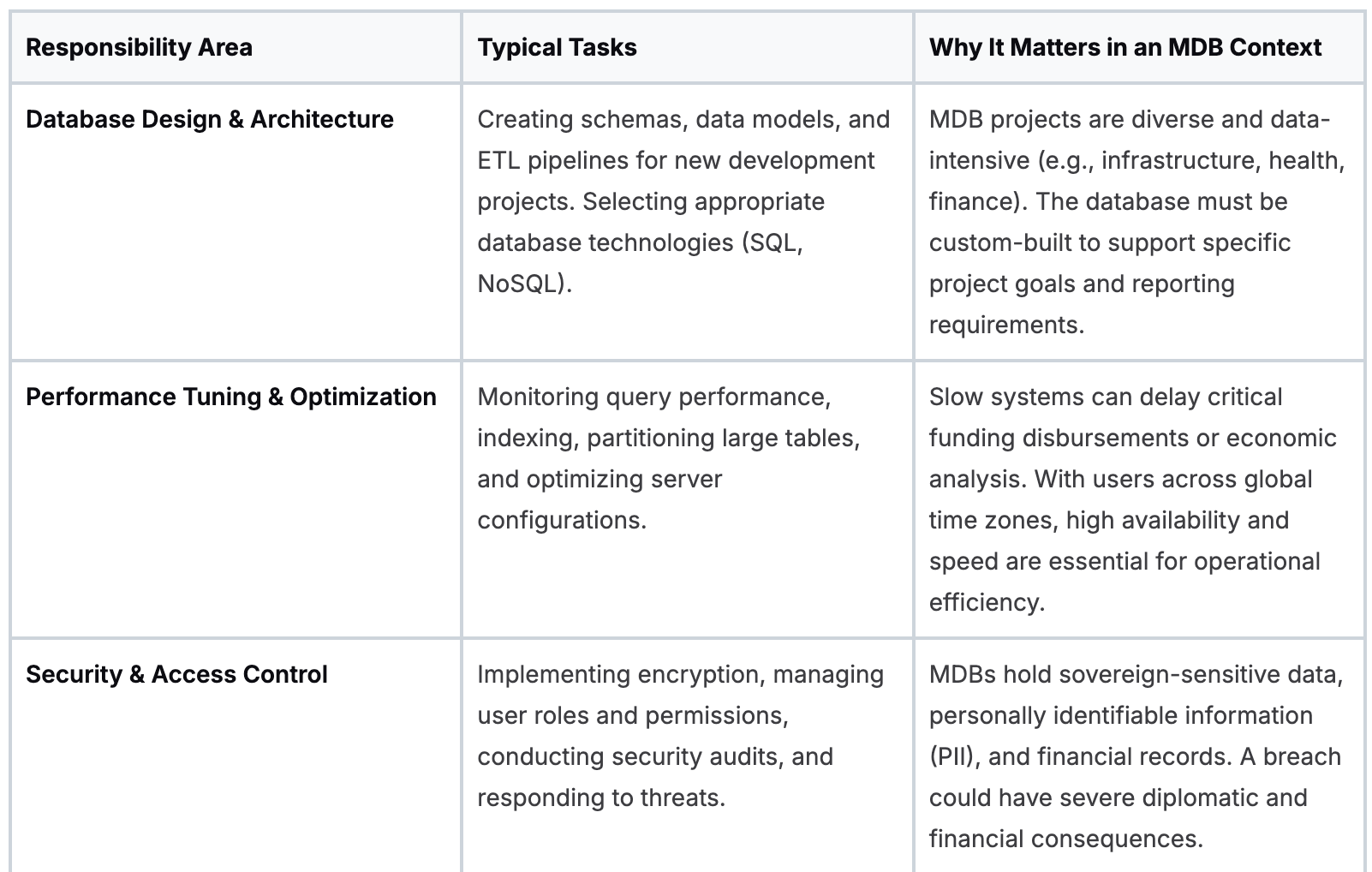
To give you a clearer picture, here’s a breakdown of these duties in the specific context of a multilateral development bank.
Key Database Officer Responsibilities in MDBs
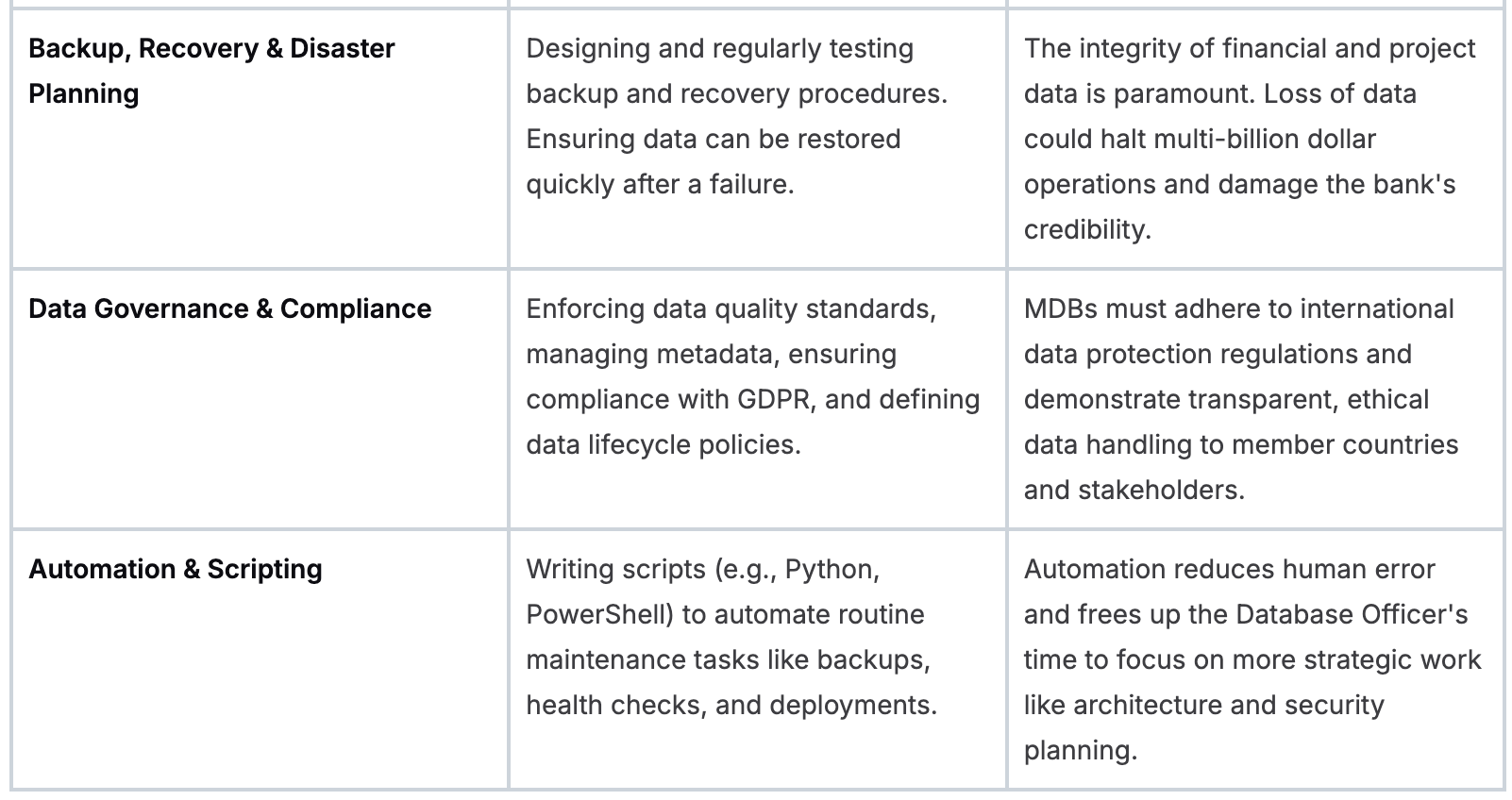
This combination of deep technical precision and high-level strategic oversight defines the role. You are intimately involved in the nuts and bolts of the technology while also shaping the policies that govern the organization’s most critical asset: its data.
The Skills That Get You Hired
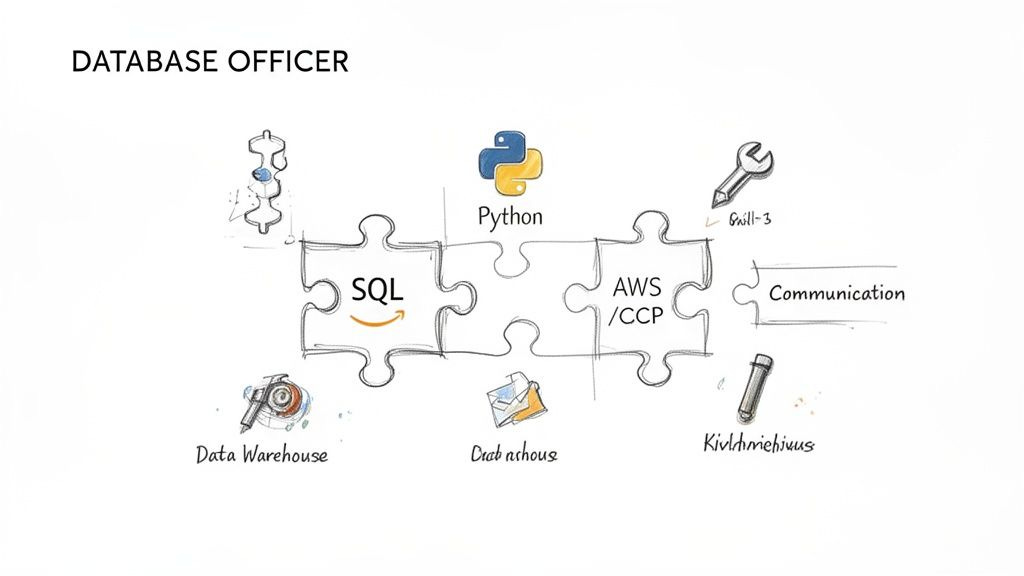
Landing a Database Officer role at an MDB requires a specific, battle-tested mix of deep technical skills and genuine people skills. Hiring managers need someone who can own complex data infrastructure and explain its value to leaders who don’t speak tech.
Your technical skills get your CV noticed. Your soft skills get you through the interviews and make you successful on the team. Both are critical. Let’s break down exactly what these institutions are looking for.
The Non-Negotiable Technical Skills
Some skills are table stakes. Without them, your application won’t get past the first screening. These are the tools and technologies you’re expected to know inside and out from day one.
First, you need an expert-level command of SQL. I’m talking about writing complex, efficient queries in your sleep, including advanced joins, window functions, and stored procedures.
Next is deep experience with major relational database management systems (RDBMS). MDBs run on platforms like Oracle, PostgreSQL, and Microsoft SQL Server. These are the workhorses, and you have to know how to build, manage, and optimize them.
Modern data roles also demand serious cloud skills. Experience with a major provider like AWS, Azure, or Google Cloud Platform (GCP) is a requirement. You’ll be expected to manage cloud-native database services like Amazon RDS or Azure SQL Database as a core part of the job.
A common mistake on CVs is a laundry list of every technology under the sun. Don’t do it. Focus on demonstrating deep expertise in a few core areas. An MDB would rather hire a true Oracle expert who can pick up new systems than a generalist with surface-level knowledge of everything.
Advanced Data and Scripting Abilities
Beyond the basics, MDBs look for skills related to managing data at massive scale. Experience with data warehousing and ETL (Extract, Transform, Load) processes is huge. You’ll be the one building and maintaining the data pipelines that move information from operational systems into analytical platforms.
A solid scripting language is also essential for automation and data wrangling. Python is the clear leader here, thanks to its powerful data science libraries like Pandas and its ability to automate routine admin tasks. PowerShell is also a valuable asset, especially in Windows-heavy environments.
You’ll use these skills to manage data flows for massive initiatives, like global climate finance funds or public health monitoring programs, where accuracy and efficiency are everything.
Soft Skills That Make the Difference
The technical stuff gets you in the door, but your soft skills make you a valued colleague. A Database Officer at an MDB works with a diverse group of people, from economists and policy experts to project managers out in the field.
Strong communication is at the top of the list. You must be able to explain complex technical concepts to non-technical stakeholders in a way they can understand. They don’t care about normalization forms; they want to know if the data can help them make better decisions.
Collaboration and problem-solving are just as important. You’ll be part of cross-functional teams from all over the world, working together to solve tough data challenges. The ability to listen, contribute ideas, and work toward a common goal is key. You are a service provider to the rest of the bank, and your success hinges on building solid working relationships.
The table below breaks down this blend of skills, showing how they apply directly to the unique context of a multilateral development bank.
Essential Skills for an MDB Database Officer
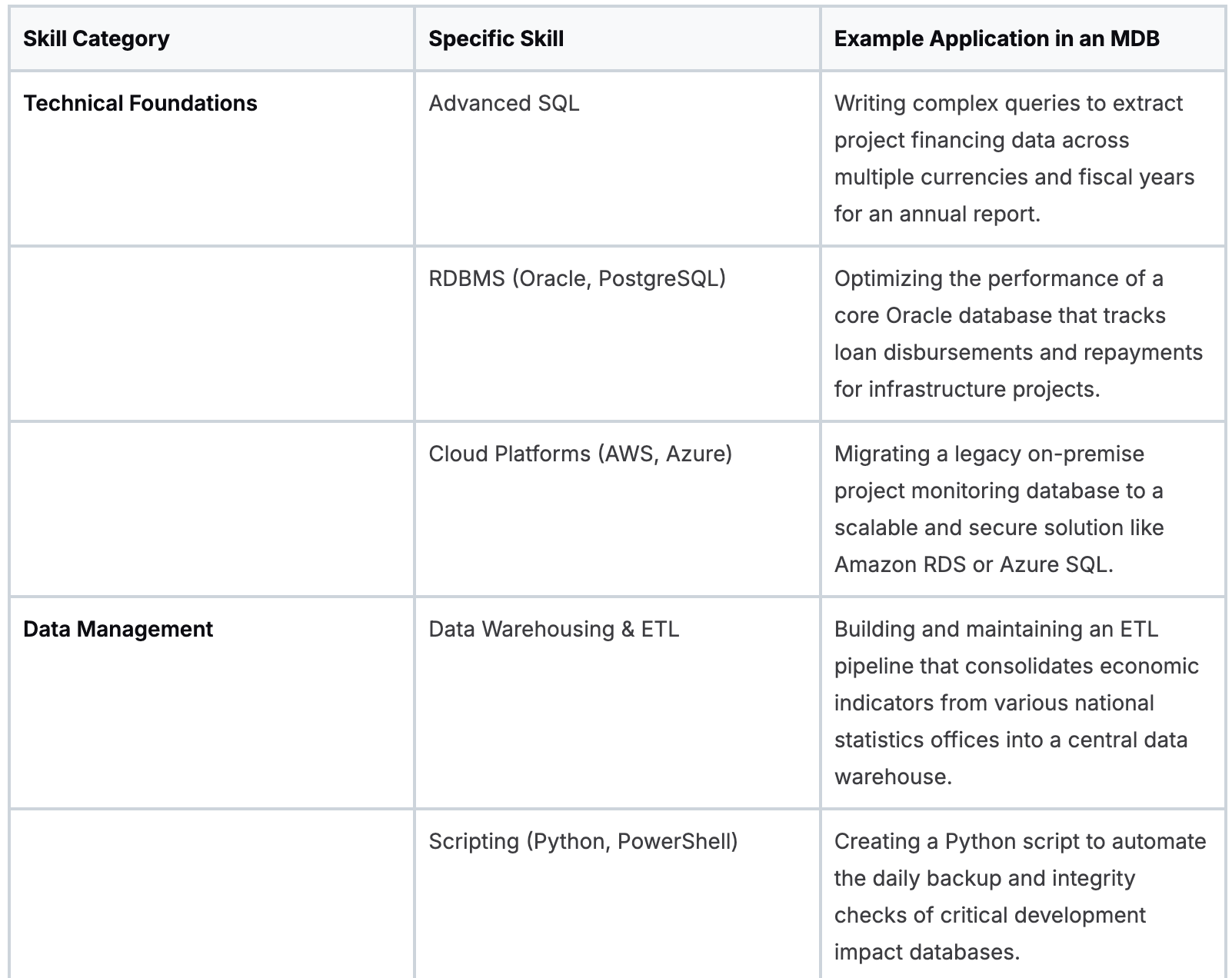
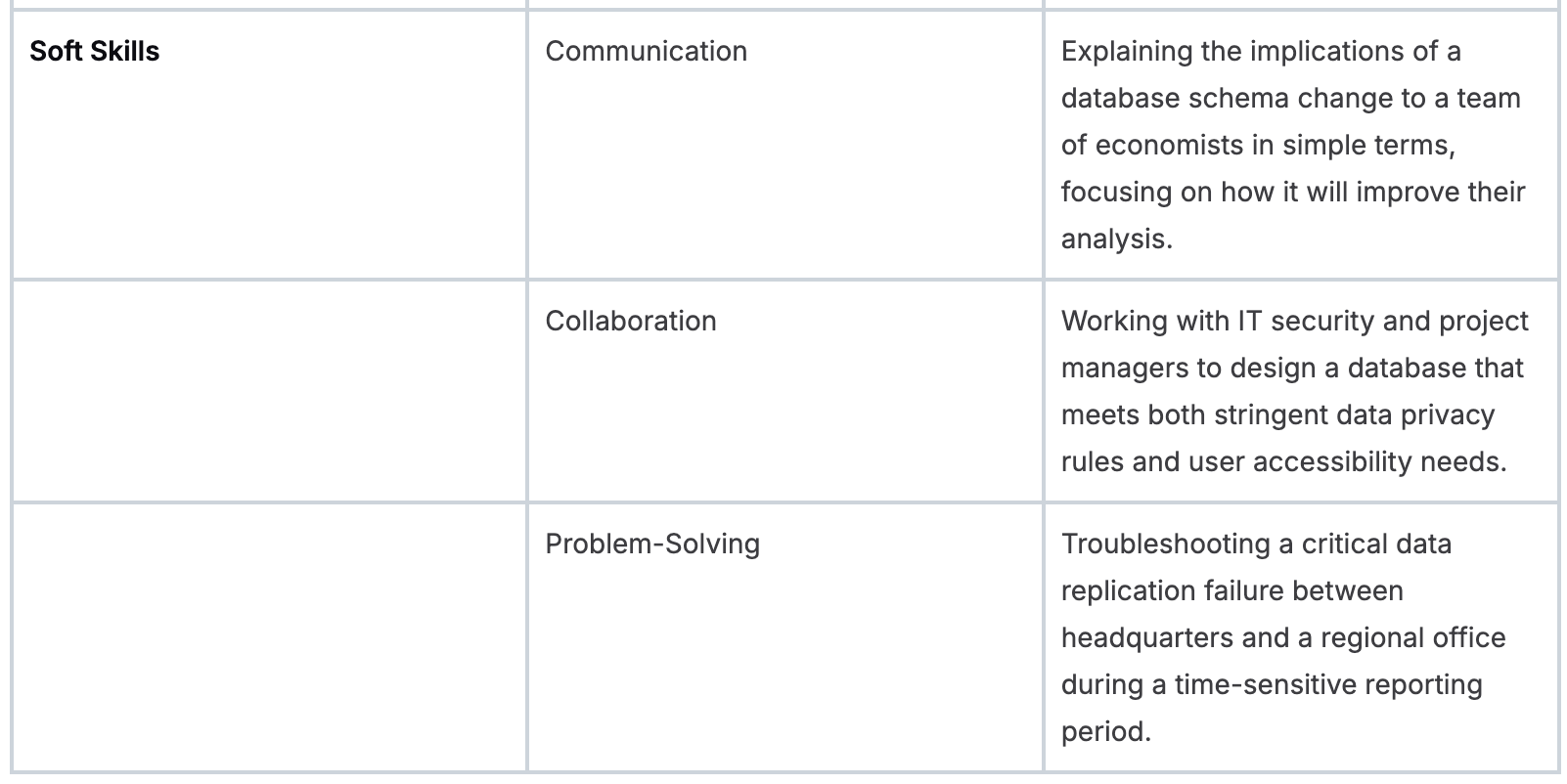
Succeeding in this role means being the bridge between the data itself and the people who use it to make billion-dollar decisions.
Hiring managers at institutions like the Inter-American Development Bank look for this exact blend. For instance, their job postings for roles like Senior Data Engineer Officer often specify 4-8 years of experience in data warehouse design, analytics architecture, and cloud platforms. They also value certifications like the Azure AI Engineer Associate, which validate this mix of technical prowess. You can get a good sense of the IDB’s priorities by checking out their annual reports to see how data underpins their entire operation.
Required Education and Experience
So, what does it take to land a Database Officer job at a Multilateral Development Bank? Let’s be direct: these are highly competitive roles, and hiring committees have a clear checklist. If you don’t tick the foundational boxes, your application won’t get a second look.
Think of it as a three-legged stool: formal education, proven experience, and validated skills. You need all three.
Foundational Academic Credentials
Your journey starts with a solid academic background. A bachelor’s degree is the minimum entry ticket.
The most straightforward path is a degree in a technical field. Hiring managers look for qualifications in one of these areas:
Computer Science: This is the gold standard. It provides a deep, theoretical understanding of computing principles, algorithms, and data structures.
Information Technology (IT): An IT degree signals a strong grasp of network infrastructure, systems administration, and the practical side of making tech work in a big organization.
Information Systems: This is a great choice because it bridges the gap between technology and business operations. It’s highly relevant for understanding how data serves the MDB’s massive operational goals.
Engineering or a related technical field: Degrees in software or computer engineering are also highly valued. They prove you have the sharp analytical and problem-solving mindset needed for the job.
While a bachelor’s gets you in the door, an advanced degree can be a serious advantage. A master’s degree or higher, especially one focused on data science or database management, signals deeper expertise. It’s often what helps you stand out in a sea of qualified applicants, particularly for senior roles.
Demonstrating Hands-On Experience
Education might open the door, but real-world experience gets you the job offer. MDBs need to see that you’ve managed complex, high-stakes data environments without cracking under pressure. They’re looking for a track record of at least 3-5 years of direct, hands-on experience, and often more for senior positions.
This experience needs to be in one or more of these core areas:
Database Administration: You need a proven history of managing, backing up, securing, and fine-tuning production databases like Oracle, PostgreSQL, or SQL Server.
Data Architecture: Have you designed database schemas, data models, or entire data ecosystems for large, complex organizations? That’s a huge plus.
Data Engineering: A proven ability to build and maintain ETL pipelines and manage large-scale data flows shows you can handle the sheer volume of data MDBs work with.
Your experience section needs to tell a compelling story. Don’t just list duties. Frame your accomplishments to show you’ve thrived in environments with high stakes, complex requirements, and a need for extreme reliability, just like an MDB.
Validating Your Skills with Certifications
Professional certifications prove your technical skills are sharp, current, and meet industry benchmarks. They’re the concrete evidence that you’ve mastered a specific technology or platform.
For a Database Officer role, these credentials carry serious weight:
Oracle Certified Professional (OCP): One of the most respected certifications in the database world, proving your expertise in wrangling Oracle databases.
Microsoft Certified Azure Database Administrator Associate: Validates your skills in managing both relational and non-relational data on the Azure cloud platform, which many MDBs are migrating to.
AWS Certified Database – Specialty: Shows you can design, recommend, and maintain the right AWS database solution for a specific need.
These certifications show you’ve invested in your own development and can handle the specific technologies MDBs rely on. They complete the trifecta of qualifications: education, experience, and validated expertise.
Salary and Career Path Insights
A Database Officer role at a multilateral development bank is a career with a clear upward trajectory and a competitive salary. Understanding the numbers and potential pathways is the first step to deciding if this is the right move for you.
MDBs are in a global race for talent, so their salaries have to compete with top-tier private sector jobs. But the raw number is only half the story.
The mean annual wage for a U.S. database administrator was $102,530 in May 2022. A Senior Database Administrator at the World Bank Group might earn a similar figure, around $102,936 annually. The real kicker is the tax exemptions that many MDB employees receive. That base salary suddenly looks a lot bigger. For a full breakdown of these financial perks, check out our guide on MDB salaries for the numbers you want.
The Career Ladder for a Database Officer
The Database Officer role is your entry point into a long and rewarding career in the development world. The skills you sharpen here, including data governance, architecture, and security, are your ticket to more senior, strategic positions. You’re mastering the data-driven engine of a global institution.
This experience is your springboard. After a few years and some solid wins, the natural next step is a promotion to Senior Database Administrator or Lead Database Officer. These roles come with more responsibility: you’ll spearhead complex projects, mentor junior team members, and make the big technical calls.
The Database Officer role is the command center for your career. You get a ground-level, operational view of how the entire bank runs on data. That insight is invaluable and opens up specialized leadership tracks later on.
Once you’re in a senior role, your path can branch into several exciting directions.
Potential Senior and Leadership Roles
Where you go next often depends on what you’re good at and what you enjoy. The most common advanced roles are:
Data Architect: If you love designing systems and seeing the big picture, this is a perfect fit. Data Architects create the master blueprint for the organization’s entire data infrastructure, making decisions that shape how the bank operates for years.
Data Governance Manager: If you have a knack for rules, policy, and standards, a leadership role in data governance could be your calling. You’ll set the guidelines for data quality, security, and usage across the institution.
Data Strategy Lead: This is a more business-facing role. You’ll work to connect the bank’s data capabilities directly to its strategic development goals, making sure that data is used to drive real-world impact.
This infographic lays out the core qualifications that launch this career path. It’s a combination of a solid degree, hands-on experience, and specialized certifications.
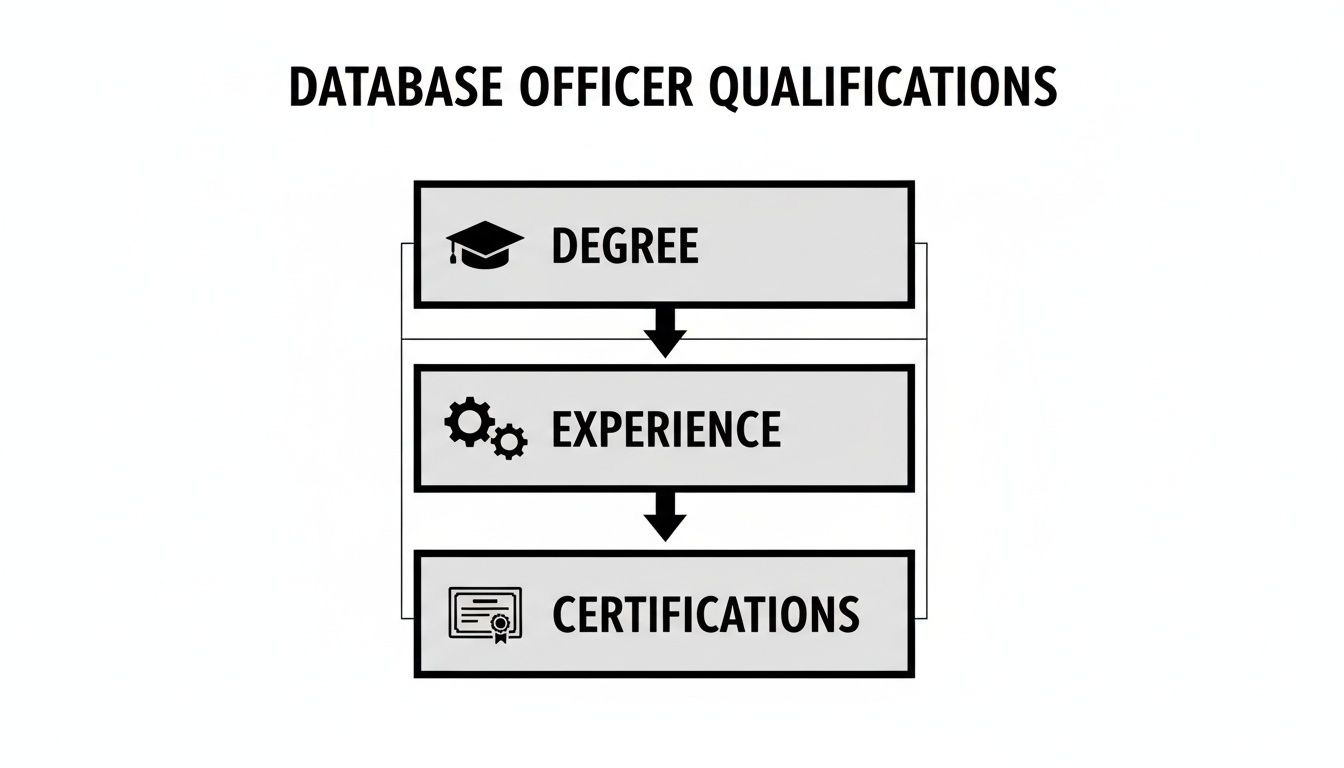
Each element builds on the last, creating the well-rounded profile that MDBs are always looking for in these critical data roles. It’s this blend of education, real-world application, and validated skills that unlocks these long-term career opportunities.
How to Tailor Your Application
Let’s be blunt: a generic resume is a guaranteed rejection. To land a Database Officer role at an MDB, your application must prove you understand their world and speak their language.
This starts by dissecting the database officer job description. I mean really picking it apart, line by line. Pay close attention to the verbs they use. Are they looking for someone to “manage,” “architect,” “secure,” or “optimize” data systems? Mirror that exact language in your CV and cover letter. This shows you’ve done your homework and are a direct fit for what they need.
Your goal is to make it incredibly easy for the reviewer, both the automated system and the human, to see the perfect match between your experience and their requirements.
Deconstruct the Job Description
Before you write, grab the job description and break it down into its core parts. MDB postings can be dense, but they give you every clue you need.
Create a simple two-column list: “Their Requirement” on the left, “My Experience” on the right. Go through the posting and pull out every key responsibility and required skill. Then, for each one, write a punchy bullet point from your own history that hits it head-on.
For example, if the job description asks for “experience in managing large-scale data migration projects,” your corresponding point should be something like, “Led a six-month project to migrate a 10TB Oracle database to AWS RDS, completing the transfer with zero downtime and 100% data integrity.” Be specific. Use metrics.
Use Keywords to Pass the First Test
Your first hurdle is almost always an Applicant Tracking System (ATS). This software scans your resume for keywords from the job description. If you don’t have enough matches, a human will never see your application.
To get past the bots, you have to weave the right keywords into your application naturally. These are the powerful terms you’ll see again and again in MDB job postings.
Technical Keywords:
Oracle,PostgreSQL,SQL Server,AWS RDS,Azure SQL,Data Warehousing,ETL,Data Governance,Data Integrity,Python,PowerShell.MDB-Specific Phrases:
Development Context,Programmatic Data,Data Security Protocols,Compliance,Stakeholder Management,International Standards,Data-driven Decision-making.
Don’t just dump these into a skills section at the bottom of your resume. Weave them into the descriptions of your work experience. A phrase like “ensured data integrity for a portfolio of development projects across three continents” is infinitely more powerful than a sterile list of buzzwords.
Frame Your Experience for Impact
The final piece is framing your technical wins within the MDB’s mission-driven world. They care that your database optimization matters to their goals. You have to connect your technical work to real-world outcomes.
Instead of saying, “Improved query performance by 40%,” try this:
“Optimized the query performance of a project monitoring database by 40%, which enabled country economists to access critical data faster for time-sensitive reporting on development outcomes.”
This subtle shift in framing shows you get the bigger picture. You’re not just a technician; you’re a partner in achieving the bank’s development mission. For more detailed strategies on making your application stand out, check out your practical guide to landing jobs in this sector. This approach demonstrates you have both the technical chops and the strategic mindset they’re looking for.
Got Questions? Here Are Some Real Answers
Let’s cut through the noise. Here are straight-talking answers to the questions that always come up about the Database Officer role, especially inside an MDB.
How Much Will I Actually Be Coding?
You will be writing code. A lot of it. SQL is your bread and butter, and you’ll be expected to write complex queries, stored procedures, and functions almost every day. It’s the core of the role.
Beyond that, you’ll need a solid scripting language in your toolkit, and Python is the usual suspect. You’ll use it to automate routine tasks like backups, system health checks, and data validation scripts. Getting that automation right frees you up to think about bigger picture items like database architecture and security strategy.
What’s the Real Story on Work-Life Balance?
The work-life balance is one of the biggest draws of this role at an MDB, especially compared to the relentless pace of a fintech startup or an investment bank. The environment is mission-driven, which naturally creates a more sustainable work culture.
That said, it’s not always easy. When there’s a major system migration, a critical security incident, or a fiscal reporting period closing, you can expect to put in longer hours. The key difference is that these high-pressure moments are the exception, not the daily grind.
How Different Is This from a Regular Corporate Gig?
The mission. That’s the single biggest difference. In a corporate job, your work ultimately drives revenue. At an MDB, your work is the technical backbone supporting global development projects, from critical infrastructure to public health programs. It gives your work a powerful sense of purpose.
On the technical side, the scale is often massive, and the security requirements are dialed up to eleven. You’re handling sensitive sovereign information. The stakeholder map is also more complex, bringing together economists, policy experts, and project managers from incredibly diverse international backgrounds.
Your core job shifts from protecting commercial assets to safeguarding the data that underpins global economic stability and development. That fact changes the entire context of every technical decision you make.
What’s the Job Outlook Like for This Role?
The demand for sharp database professionals is strong and growing. As MDBs and similar global organizations collect and analyze more data than ever, the need for experts who can manage, secure, and govern that information is only getting more critical.
The U.S. Bureau of Labor Statistics projects a solid 4% growth for database administrators and architects through 2034. That translates to about 7,800 openings each year, mostly from people retiring and the sheer explosion of data coming from fields like development finance. You can dig into the specifics by checking out the career outlook findings on bls.gov. The bottom line: it’s a stable and very promising career path.
At Multilateral Development Bank Jobs, we demystify the hiring process for institutions like the World Bank and IMF. Our newsletter delivers curated job listings, insider guides, and career advice directly to your inbox, giving you the edge you need to land your next role. Subscribe on mdbjobs.com to start your journey.
Brilliant. Another strong piece building on your data architecture insights.