


You’re thinking about a job in Geneva. Good choice. But first, understand this: you’re not targeting one city, you’re targeting two different professional worlds that share the same location.
There’s the high-stakes finance sector, and there’s the influential sphere of international organizations. Getting this distinction right from day one is everything. The way you apply for a UN role is worlds apart from how you approach a private bank. Using the wrong strategy is the fastest way to get your CV ignored.
Understanding the Geneva Job Market
Geneva is a global nerve center for diplomacy, humanitarian work, and finance. This unique concentration of power creates a job market that is both incredibly specialized and fiercely competitive.
Landing a great role here takes more than a polished resume. It requires a real understanding of the city’s professional DNA.
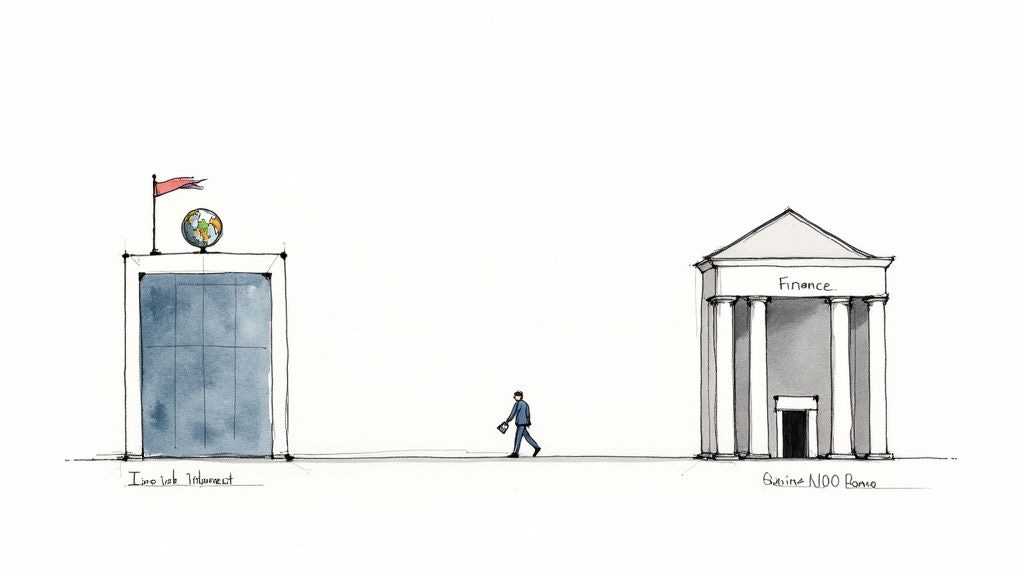
The market is split clean down the middle. On one side, you have “International Geneva,” a massive cluster of United Nations agencies, non-governmental organizations (NGOs), and diplomatic missions. On the other, you have a private banking and commodity trading powerhouse that manages staggering amounts of global wealth.
These two pillars pull in top-tier talent from every corner of the globe, which makes the job hunt exceptionally tough.
The Two Pillars of Employment
Think of these sectors as parallel universes. They operate in the same city, but they follow different rules and have their own cultures and hiring rhythms.
International & NGO Sector: This world is mission-driven and often bureaucratic. Hiring processes are painstakingly long and formal, with a heavy emphasis on specific technical skills in fields like public health, human rights, or international law. It’s about process and mandate.
Finance & Banking Sector: This side is fast-paced, results-oriented, and intensely private. Success here is all about commercial savvy, sharp quantitative skills, and navigating a maze of complex financial regulations. It’s about the bottom line.
Your first task is to be honest about where you fit. If you apply a corporate, “move-fast-and-break-things” approach to a UN application, you’ll fail. If you bring a slow, bureaucratic mindset to a trading floor, you’ll be shown the door.
Geneva isn’t one job market; it’s two. Your approach must be tailored to the specific rules and culture of the sector you’re targeting. A generic application is a waste of time.
Why the Competition Is So Fierce
The combination of influential organizations and high salaries is a powerful magnet for ambitious people. You’re not competing against locals; you’re up against a global talent pool that is deep, qualified, and motivated.
For many roles, especially within the UN system, a single opening attracts hundreds of qualified applicants.
This insane competition means employers can afford to be incredibly picky. They want candidates with the right skills on paper. They also want candidates who genuinely understand the organization’s mission, its challenges, and the unique pressures of working in this city. They’re looking for the perfect fit, and you have to prove that’s you.
Getting to Grips with Geneva’s Job Market
To land a job in Geneva, you need a map of its professional landscape. The city’s economy doesn’t tick like most others; it’s driven by a few specific, high-stakes sectors that demand a particular kind of expertise. Figuring out where you fit is your first move.
The Swiss economy, and Geneva especially, is built on the service sector. This is the absolute engine of job creation here. The Lake Geneva region saw cantonal employment shoot up by 20.7% between 2011 and 2023, leaving the national average behind. While some job markets cooled in early 2025, French-speaking Switzerland, including Geneva, held strong with only a minor -2% dip in vacancies.
This structure creates two dominant, parallel universes for job seekers. Let’s break down where the real opportunities are.
The “International Geneva” Machine: IOs and NGOs
This is “International Geneva.” It’s a dense, interconnected web of UN agencies, international organizations (IOs), non-governmental organizations (NGOs), and diplomatic missions. The big names like the World Health Organization (WHO) and the World Trade Organization (WTO) are just the tip of the iceberg.
Beneath them are countless smaller, influential organizations working on everything from humanitarian aid and human rights to disarmament and global health policy.
The jobs here are highly specialized and mission-driven. They’re always on the lookout for:
Program Managers: People who can design, run, and oversee complex international development projects.
Policy Analysts: Subject-matter experts who can research and shape global conversations on issues from climate change to trade law.
Communications Specialists: Pros who know how to manage public relations and advocacy for a global, often sensitive, audience.
Legal Officers: Lawyers with a deep understanding of international public law, human rights, or the governance of these massive institutions.
The Powerhouse: Finance, Banking, and Trading
Running parallel to the world of global policy is Geneva’s other beast: its formidable financial sector. This is the exclusive, high-stakes world of private wealth management, asset management, and commodity trading. Geneva is one of the planet’s most important hubs for managing the fortunes of the ultra-wealthy and for trading oil, grains, and precious metals.
This industry moves fast and demands absolute precision. The most coveted roles include:
Private Bankers & Relationship Managers: Discreet professionals who manage the vast assets of high-net-worth individuals, requiring impeccable market knowledge.
Compliance Officers: Experts who navigate the labyrinth of Swiss and international financial regulations.
Commodity Traders: Highly analytical minds who buy and sell physical commodities, juggling immense risk and complex logistics.
Quantitative Analysts (“Quants”): Specialists who build the sophisticated financial models that underpin investment and trading strategies.
Your entire job search hinges on knowing which of these two worlds you belong to. They hire differently, value different skills, and offer different career trajectories. Pick your lane and tailor your whole approach, from your CV to your networking.
To make this distinction clear, it helps to see them side-by-side. The culture, pace, and definition of “success” in each sector are worlds apart. One is driven by global missions and policy, the other by markets and profit.
Geneva’s Core Employment Sectors at a Glance
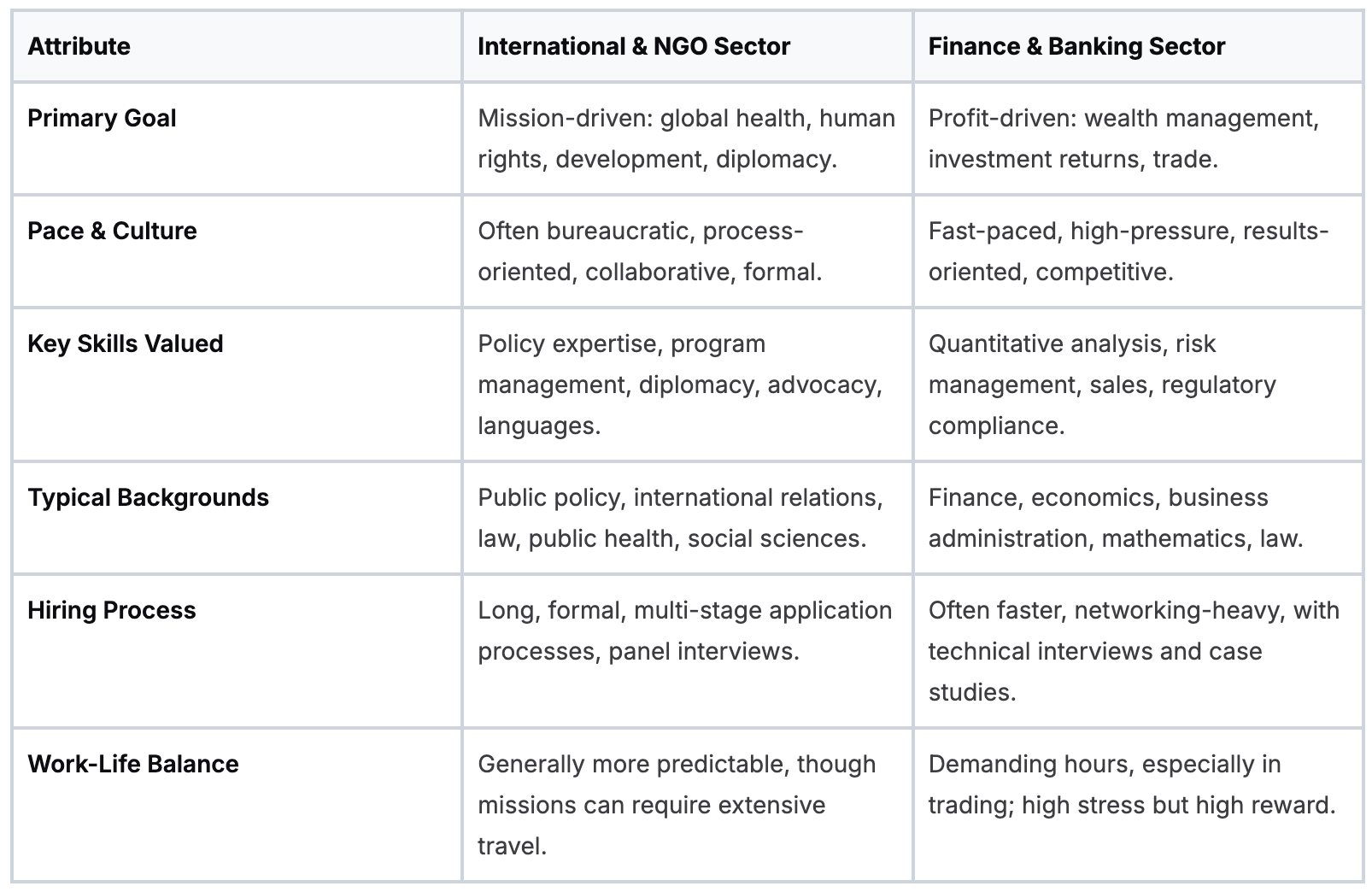
Understanding this divide is the key. Are you passionate about shaping global policy and working within large, multilateral frameworks? Or are you wired for the high-energy, data-driven world of global finance? Answering that question is the first and most important step in your Geneva job hunt.
Where to Find High-Quality Job Openings
If you’re scrolling through generic, big-name job boards, you’re wasting your time. The high-caliber roles in Geneva are almost never posted there. It’s a closed circuit.
Success comes from knowing exactly where serious employers list their vacancies. This is about fishing in the right, specific ponds. Mastering these channels is the difference between finding real opportunities and getting lost in irrelevant listings.
This is your playbook. Focus your energy here.
Portals for International Organizations and NGOs
For anyone serious about “International Geneva,” your job search begins and ends with a handful of key portals. These are the official hubs where UN agencies and major NGOs announce their openings. You need to be on these daily.
UNjobs.org: This is the central nervous system for the entire United Nations system. It pulls in listings from every major agency, fund, and program. If you want a UN job, this is your primary source.
ReliefWeb: Managed by the UN’s own humanitarian coordination office (OCHA), ReliefWeb is the beating heart of the humanitarian and development sector. It lists openings from thousands of NGOs, with a huge concentration of roles based in Geneva.
Devnetjobs.org: This site casts a slightly wider net, covering the full spectrum of international development. You’ll find everything from short-term consultancy gigs to senior positions at influential think tanks and NGOs that orbit the core UN system.
Treat these sites like market intelligence tools. By monitoring them, you’ll quickly get a feel for which organizations are expanding, what skills are in high demand, and how different roles are structured. Setting up alerts is non-negotiable.
Channels for Finance and Corporate Roles
Geneva’s private sector plays by different rules. It’s far more discreet. While you’ll see some roles pop up on LinkedIn, the most lucrative opportunities are found through two main channels: direct applications and specialized headhunters.
You won’t find a senior private banking role on a public job board. Access comes from knowing the right headhunters and directly monitoring the career pages of major banks and trading houses.
First, go straight to the source. The careers sections of the big players are essential. Make a habit of checking the sites for firms like Pictet, Lombard Odier, UBS, and Credit Suisse. Commodity trading giants like Trafigura and Vitol also list their specialized roles directly on their own websites.
For the unlisted, “hidden” job market, you need to connect with recruiters. You need firms like Michael Page, Robert Walters, and the smaller, boutique recruiters who specialize exclusively in Swiss finance.
Building a relationship with a good headhunter is one of the smartest career moves you can make in Geneva. These people know the market inside and out. They have direct lines to hiring managers and can put your CV on the right desk, bypassing the digital pile-up. This is how a huge number of high-level finance jobs in this city get filled.
Cracking the Code on Work Permits and Eligibility
This is where most international job searches in Geneva hit a brick wall. Getting a Swiss work permit is a frustrating process if you don’t know the rules. Once you understand them, it’s completely manageable.
Your job-hunting strategy hinges on one simple fact: your nationality. The Swiss system draws a hard line between citizens from the EU/EFTA and everyone else.
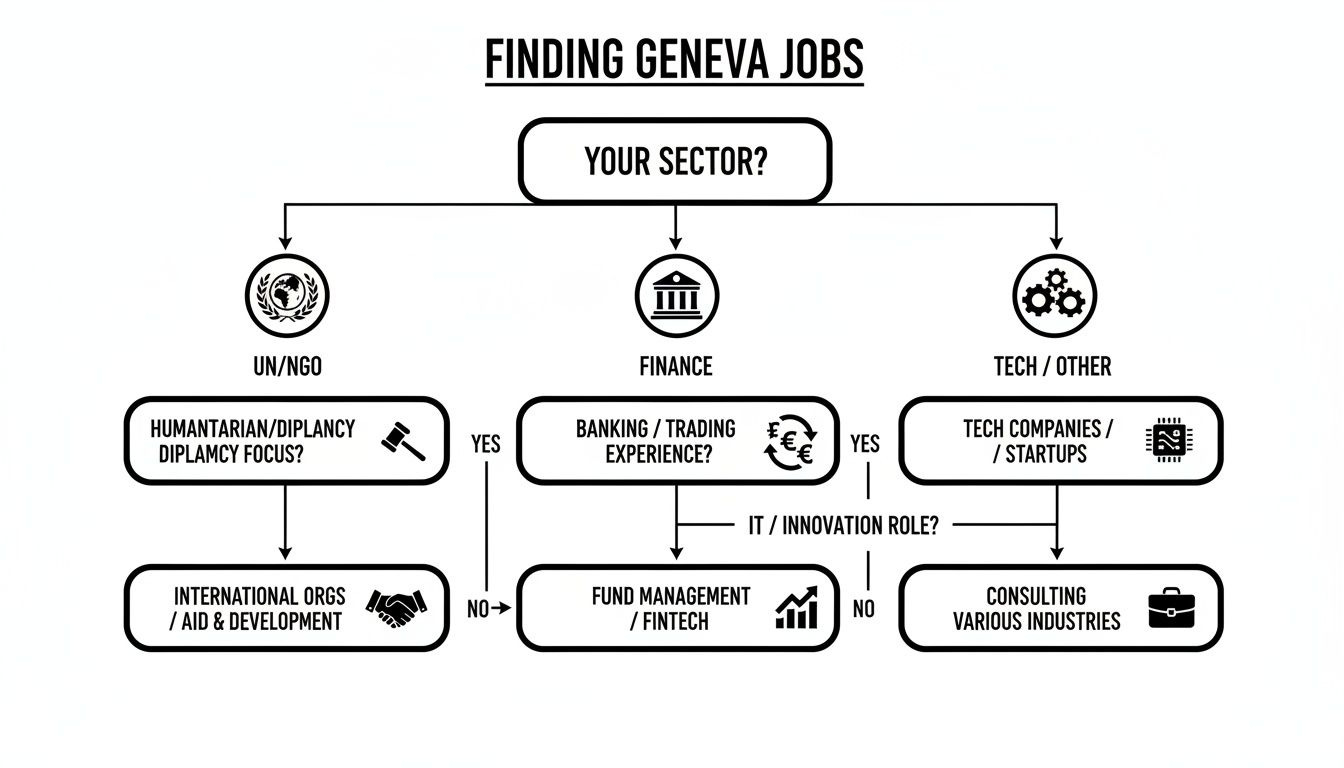
This flowchart maps out the typical decision-making path. No matter what sector you’re targeting, figuring out your visa route is the first, most critical step.
The Two Tiers of Applicants
Switzerland’s immigration system is a two-tier model. It’s a straightforward but rigid distinction.
EU/EFTA Nationals: If you’re a citizen of the European Union or the European Free Trade Association (Iceland, Liechtenstein, and Norway), you’re in the priority lane. Thanks to the Agreement on the Free Movement of Persons, getting a permit is largely a formality once you have a job contract.
Non-EU/EFTA Nationals (Third-State Nationals): For everyone else, the hill is much steeper. To hire you, an employer must prove to the Swiss authorities they couldn’t find a qualified candidate in Switzerland or the entire EU/EFTA bloc. That’s a very high bar to clear.
This means that for most corporate jobs, companies will only sponsor a non-EU/EFTA national for a highly specialized, senior-level role where the talent pool is genuinely thin.
The blunt reality for non-EU/EFTA candidates is this: you must be an exceptional candidate filling a specific, high-demand skills gap. Otherwise, an employer simply won’t have the justification needed to sponsor your permit.
Understanding Swiss Permit Types
Once you have a job offer, your employer will help you apply for a specific residence permit. Each one serves a different purpose.
Permit L (Short-term): This is for fixed-term contracts, usually up to one year. It’s common for temporary projects or initial assignments.
Permit B (Initial Residence): The standard permit for most professionals on longer-term or open-ended contracts. It’s typically valid for one to five years and is renewable.
Permit C (Settlement): This is the goal: a permanent residence permit. You can usually apply after five or ten years of continuous residence in Switzerland, depending on your nationality and integration.
The International Organization Exception
Here’s the crucial exception that changes everything. UN agencies and other big international organizations operate under special agreements with the Swiss government. This means they are exempt from those strict labor market rules.
They can hire the best candidate for the job. Nationality doesn’t matter. They don’t have to prove they couldn’t find an EU citizen first.
For non-EU/EFTA professionals, this makes the international sector one of the most accessible routes into Geneva. It’s a massive advantage. Your eligibility for these roles often comes down to the organization’s own internal rules, not Swiss immigration law. For a detailed breakdown, you can learn more about which MDBs you are eligible to apply for on our site. This is the key reason so many global professionals focus their search on these institutions.
That Big Geneva Salary… and What It Really Means
The salaries for jobs in Geneva look staggering. It’s easy to get carried away when you see a six-figure number on a job description. But you need a serious reality check about the city’s finances. That impressive figure doesn’t mean much until you understand Geneva’s notoriously high cost of living.
So, let’s talk numbers. A senior role in private banking can push CHF 150,000–250,000, sometimes higher with bonuses. In international organizations, a mid-career professional, like a P3 or P4 level, might land a base salary between CHF 90,000 and CHF 130,000. These jobs often come with generous, tax-free benefits, which is a huge plus. These are solid benchmarks, but they’re only half the story.
If you want a detailed look at what these figures mean for your take-home pay and lifestyle, check out our deep-dive guide on MDB salaries.
Your Monthly Budget: The Reality Check
That big salary gets eaten up, and fast. The single biggest drain on your finances will be housing. A decent two-bedroom apartment in or near the city center will easily set you back CHF 3,000–4,500 per month. The rental market is brutal, so when you find a place, you must move quickly and be ready to pay a hefty deposit.
Beyond rent, a few other major costs are non-negotiable:
Mandatory Health Insurance: This is a legal requirement for every resident. Expect to pay between CHF 400 and CHF 600 per person, per month for a basic plan.
Transportation: The public transport system (TPG) is fantastic, and a monthly pass costs about CHF 70. Owning a car is a luxury thanks to the high costs of parking, insurance, and fuel.
Groceries and Food: Your daily expenses will be steep. A weekly grocery shop for two people can easily hit CHF 200–300. Eating out is a treat, not a habit.
The Big Picture on Geneva’s Economy
Geneva’s unique economy creates this high-cost, high-reward dynamic. In 2023, the region had over 905,900 people in the labor market, with the service sector fueling an impressive 20.7% employment growth between 2011 and 2023.
That growth comes with a catch. The unemployment rate was 6.6% in 2023, which is higher than the Swiss average. This reflects how intense the competition is for good jobs. You can find more of this data for Switzerland on the EURES portal.
After you subtract rent, mandatory insurance, taxes, and daily living costs, even a six-figure salary can feel surprisingly average. Your true net income is what matters, not the gross figure on your contract.
Ultimately, whether you thrive financially in Geneva comes down to careful budgeting. You must calculate your potential net income after all these deductions to get a real sense of the lifestyle you can afford. A job here is an incredible career move, but walk in with a clear-eyed view of the financial commitment.
Building a Winning Application and Network Strategy
A strong CV isn’t enough to get you hired in Geneva. The competition is too deep. You need a strategy built for the city’s unique professional culture. International organizations and the private finance sector both demand a level of formality and detail that catches many people by surprise.
Think of your application as a formal introduction. Swiss and IO standards are rigorous. Your CV must be flawless, and your cover letter has to be a direct, compelling argument for why you’re the solution to their problem. You have to address every requirement in the job description.

Proactive Networking in a Reserved City
Geneva is a city built on trusted relationships. Applying online and waiting for a call is a losing game. You have to get out there and build connections, often before a job is even posted. Treat networking as part of the job search itself.
Start by overhauling your LinkedIn profile so it speaks directly to your target sector. Your headline and summary should immediately tell anyone in the UN system or finance world what you’re an expert in.
Then, use it strategically:
Identify and follow key organizations and the big names in your field.
Find alumni from your university who are already working in Geneva and connect with them.
Engage with content posted by your target employers. It keeps you on their radar.
This groundwork makes it much easier to reach out directly later on.
A generic application gets lost. A personalized message to a relevant contact after you’ve applied can be the one thing that moves your file from the digital slush pile to the hiring manager’s desk.
This isn’t optional. It’s essential. Up to 80% of jobs are never advertised publicly; they’re filled through internal referrals and professional networks. Your goal is to break into that hidden job market.
Find the key professional associations in your sector. Attending their events, even virtual ones, is a direct line to the people making hiring decisions.
Hiring timelines for big players like the World Bank can be incredibly long. You can get a sense of what to expect and how to plan your application for an MDB job in our guide. Building those relationships early pays off.
A Few Lingering Questions About Geneva Jobs
Let’s tackle the most common questions for anyone serious about landing a job in Geneva. Getting straight answers here will save you a ton of guesswork.
So, Do I Really Need to Speak French?
English is the working language inside most international organizations, but not speaking French puts you at a serious disadvantage. For any role that requires interaction with local government, partners, or the public, it’s a dealbreaker. Many finance and administrative roles also list it as non-negotiable.
Speaking French also signals a genuine commitment to integrating into the city and its culture. It opens up a much wider world of opportunities, both professionally and personally. You can survive without it, but your job search will be infinitely easier with it.
How Long Does This Hiring Process Actually Take?
You need patience. The hiring cycle for big international organizations is notoriously slow, often taking four to nine months, and sometimes longer. It’s a marathon.
The process is designed to be meticulously fair and transparent, which takes time. Expect multiple stages: longlisting, written exams, competency-based interviews, and exhaustive reference checks. The private sector moves faster, but even there, senior roles can easily take two to three months from application to offer.
Don’t get discouraged by the silence after you apply to the UN or a major NGO. A long wait is part of the system. It’s a reflection of a process built on layers of procedure, not a reflection on you.
Can I Get a Job in Geneva Without a University Degree?
It’s tough. The Geneva job market is packed with highly educated professionals. Most roles in international affairs, development, and finance require at least a bachelor’s degree, and a master’s is often the unwritten standard.
It’s not impossible, though. If you have deep, relevant experience and strong language skills in skilled trades, high-level administration, or hospitality, doors can open. For these roles, your network is critical. You’ll need champions who can get your profile in front of the right people and vouch for your experience over formal credentials.
Finding your way into the Geneva ecosystem requires insider knowledge and persistence. At Multilateral Development Bank Jobs, we cut through the noise with weekly job listings, consultant opportunities, and deep-dive guides to help you navigate the system and land your next role at a top MDB. Learn more and subscribe at https://mdbjobs.com