

If you’re a grad student with your sights set on international development, the Asian Development Bank internship is a direct path to getting your foot in the door. This is a paid, hands on program that drops you right into the work of a major Multilateral Development Bank (MDB) focused on fighting poverty across Asia and the Pacific.
Your Entry Point to an MDB Career
Treat the ADB internship as a professional apprenticeship in the MDB world. You won’t be making coffee or filing papers. This is a structured, project based program where you’re expected to deliver real work that supports the bank’s mission from day one.
You’ll be placed in a specific department and contribute directly to projects tackling complex regional challenges. The experience is designed to be substantial, running anywhere from eight to a maximum of 26 weeks.
Who the Internship Is For
This program is built for current Master’s or PhD students serious about a career in development. The ADB wants candidates who can show a genuine commitment to building a prosperous, inclusive, resilient, and sustainable Asia-Pacific.
This internship is your audition for a long term career. It’s a direct pipeline to highly competitive roles, including the bank’s prestigious Young Professionals Program (YPP).
The competition for these spots is fierce. ADB runs two recruitment cycles each year, and thousands of ambitious students apply for a limited number of positions. For example, the bank recently advertised at least 22 paid internship positions with a February 15 deadline, drawing applicants for roles in high demand fields like IT, health, and economic research.
Here’s a quick summary of what the program involves.
ADB Internship at a Glance
This table breaks down the essential components of the ADB internship so you know exactly what to expect.
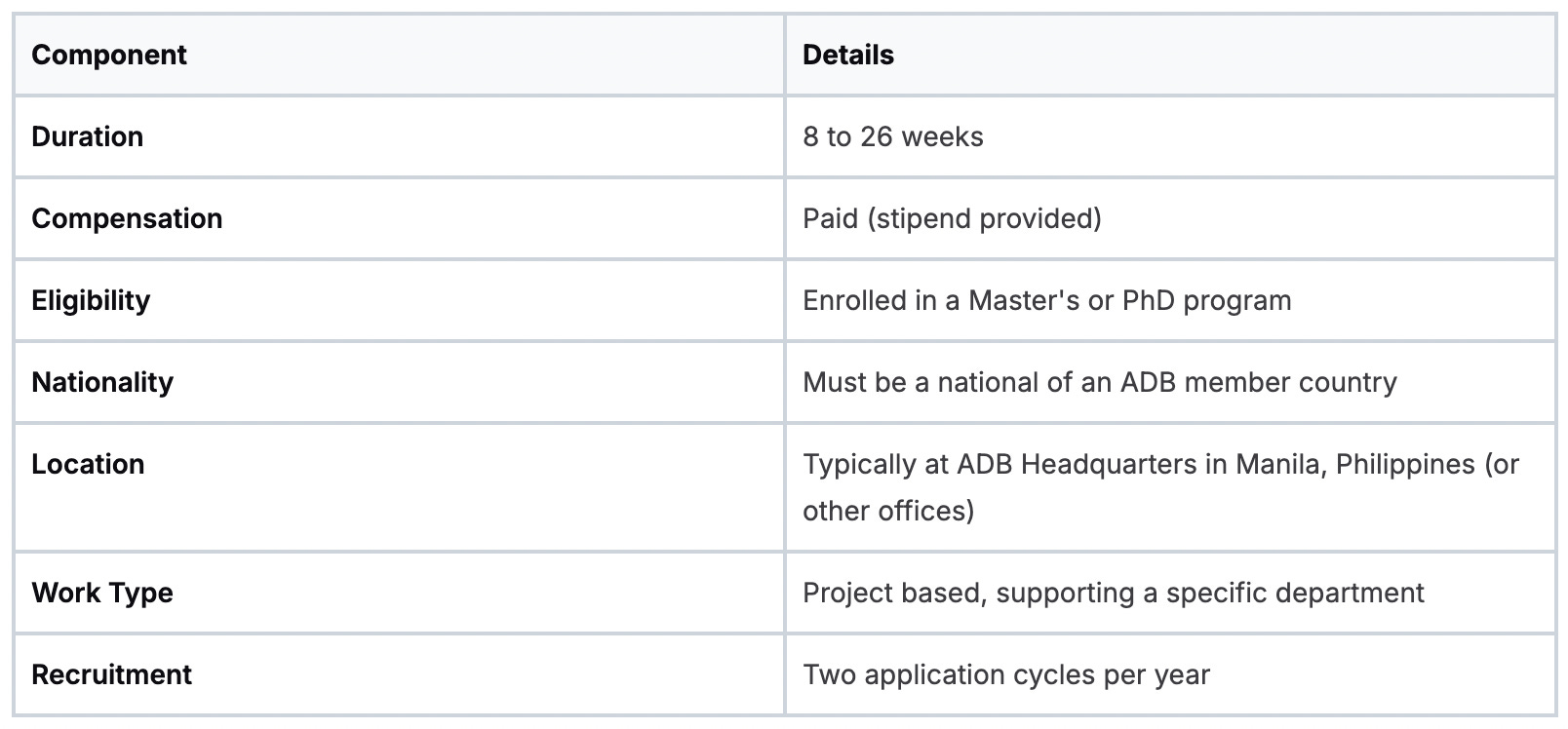
This structure ensures you get a meaningful, in depth experience.
What to Expect on the Inside
Once you’re in, you’re assigned to a department that matches your skills and academic background. Interns are placed across a huge range of areas, from operational departments to knowledge and research units.
Your day to day tasks could include:
Conducting research for an upcoming country partnership strategy.
Analyzing data for a technical assistance report on climate finance.
Helping draft sections of a major publication on regional economic trends.
You’ll be working alongside seasoned ADB staff, giving you direct exposure to how MDB projects are designed, funded, and implemented. This gives you a serious advantage when applying for full time roles later because you’ll understand the internal language and processes that outsiders don’t.
If you’re still weighing your options, understanding the differences between MDBs can clarify your career path. The ADB internship is an excellent way to see if the bank’s specific focus and culture are the right fit for you. To go deeper, check out our guide on how the World Bank, IMF, and ADB compare.
Navigating Eligibility and Application Timelines
Let’s get practical. The fastest way to get disqualified from the Asian Development Bank internship is by missing a basic requirement or a deadline. The ADB is strict on its rules, so understanding them is your ticket past the first screening.
The whole process is straightforward if you know what to look for. Your first job is to make sure you clear the non negotiable hurdles.
The Core Eligibility Checklist
The ADB has three core requirements every single applicant must meet. There’s zero flexibility on these points. Before you even think about your CV, confirm you can tick all these boxes:
Nationality: You must be a national of an ADB member country. This is the very first filter. If your country isn’t on that list, you’re not eligible.
Education: You have to be currently enrolled in a Master’s or PhD program at a school located in an ADB member country. You must be returning to your studies after the internship ends.
Language: You must be proficient in English. It’s the working language of the bank.
Having some work experience is a definite plus, but it’s your current academic status that gets you in the door. The ADB is looking for the fresh, advanced knowledge that graduate students bring. If you’re switching careers and have years of professional experience, frame it as a strength that adds a practical edge to your academic focus.
Timing Your Application Correctly
The ADB internship runs on a biannual schedule. This means there are two main application windows each year. If you miss them, you’re waiting another six months for your next shot.
The two internship batches are:
Annual Internship Program (First Batch): Applications usually open around August and close in September. Interns from this group typically start in the first quarter of the following year.
Annual Internship Program (Second Batch): This window usually opens in December and closes around January or February. These interns start their assignments mid year.
These timelines can shift a little, so always check the official ADB careers page for the exact dates. Mark your calendar way ahead of time. A rushed application is almost always a weak one.
The most common mistake I see is candidates scrambling to apply a day before the deadline. Give yourself at least two weeks. This buys you time to properly tailor your CV and write a cover letter that actually speaks to the specific internship you want.
For example, if the deadline is September 30, you should aim to have your main documents ready by September 15. That leaves plenty of time to research the department you’re targeting and polish your materials without the last minute panic.
Understanding the Age and Experience Nuances
The ADB doesn’t post a strict age limit for its internship program, but the academic requirement naturally creates a demographic of graduate students. You’ll be competing with candidates who are deep into their specialized fields of study.
If you have professional experience, use it. The bank loves candidates who can connect academic theory with real world application. For instance, if you worked in finance for five years before starting your Master’s in Public Policy, you have a unique advantage for an internship in the ADB’s private sector operations department. You can learn more about how the ADB structures its various roles in our complete guide to Asian Development Bank jobs.
The key is to frame your experience as the foundation that makes your academic knowledge even more valuable to the bank.
Crafting an Application That Gets Noticed
Your CV and cover letter are the only things standing between you and the thousands of other applicants. To an ADB recruiter, a generic application is a dead end. This is your one shot to show you understand the bank’s work and can contribute from day one.
The goal is to build an application that survives the screening process. This means ditching standard templates and adopting the results oriented language a Multilateral Development Bank (MDB) expects.
First, let’s get a handle on the initial stages of the process.
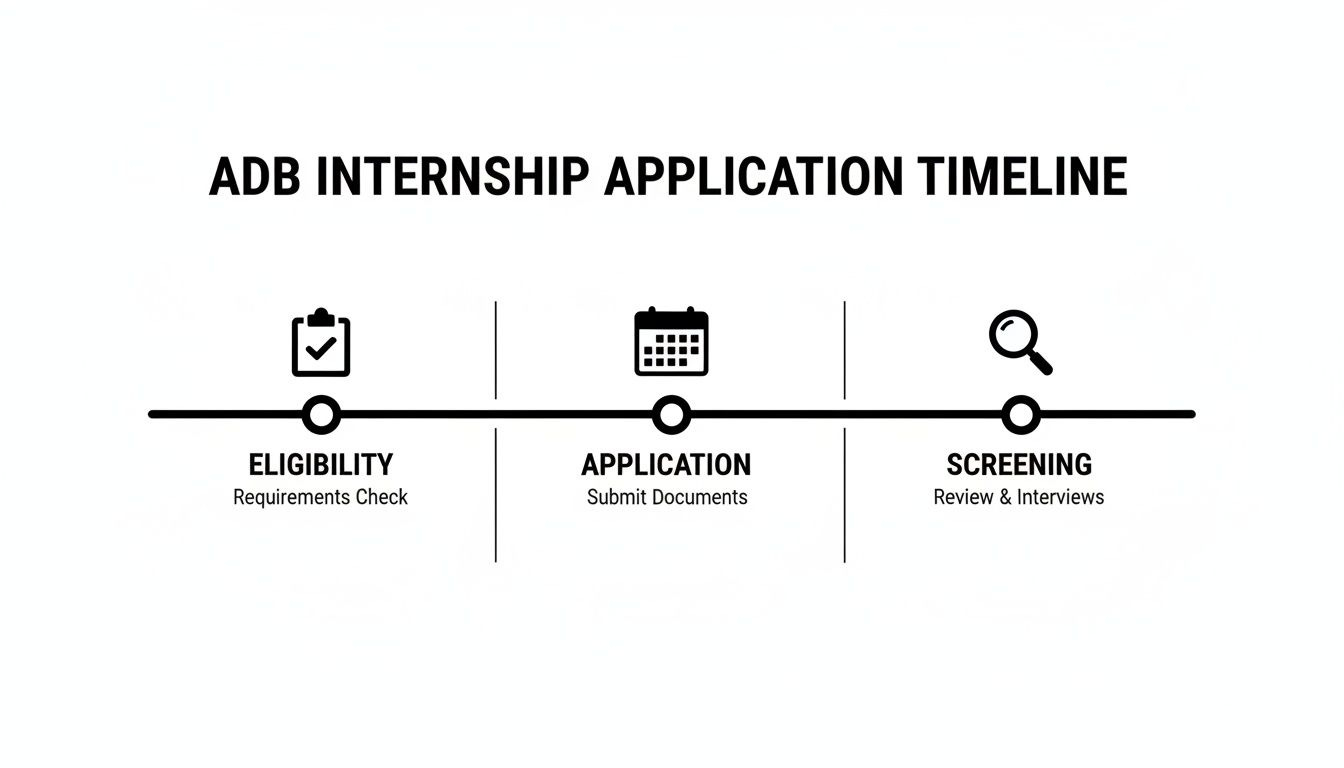
This visual shows the first three hurdles you need to clear: confirming your eligibility, getting your application in on time, and passing the initial screening. Nailing these basics is the bare minimum to stay in the running.
Structure Your CV for an MDB Role
An MDB recruiter scans your CV with a different lens than a corporate hiring manager. They’re hunting for specific keywords and skills: data analysis, econometric modeling, research, and project management. Your CV has to put these skills front and center, backed by hard evidence.
Use the STAR method (Situation, Task, Action, Result) to frame every bullet point, with a heavy emphasis on the “Result.”
For instance, this is what most people write:
Responsible for data analysis.
This is what gets you noticed:
Analyzed a 10,000-entry dataset on infrastructure financing in Southeast Asia, identifying a 15% efficiency gap that informed a new policy brief.
The second version proves your impact. That’s the difference maker.
Must-Have Skills to Emphasize
Recruiters at the Asian Development Bank are looking for specific competencies. Make sure these are impossible to miss in your application:
Quantitative Analysis: Name the software you’ve used (Stata, R, Python) and the types of models you’ve worked with.
Research and Writing: Include links to publications, policy briefs, or even significant academic papers. This is concrete proof of your skills.
Project Management: Detail any experience you have coordinating projects, managing timelines, or working with stakeholders. Even academic group projects count if framed correctly.
Regional Knowledge: Show you actually understand the Asia-Pacific region. Mention specific countries or sub regions you’ve studied or have experience with.
Your CV should read like a case study of your accomplishments. Each bullet point is a piece of evidence proving you have the technical skills and intellectual curiosity to contribute to the ADB’s mission.
Ditch vague phrases like “team player” or “strong communication skills.” Show these qualities through your action oriented descriptions instead of just claiming them. Our guide on how to get a job at the Asian Development Bank offers more context on what recruiters are looking for.
Write a Cover Letter That Connects
Your cover letter is where you connect the dots between your experience and the specific internship you want. It’s where you prove your interest is genuine. A generic “To Whom It May Concern” letter is a complete waste of an opportunity.
Start by breaking down the internship description. Pinpoint the key responsibilities and qualifications. Your letter needs to hit these points directly, making an undeniable link between their needs and your skills.
Next, show you’ve done your homework. Connect your background to the ADB’s high level priorities. For example, if you’re applying for a climate change internship, reference ADB’s Strategy 2030 and its focus on environmental sustainability.
A powerful cover letter follows a clear structure:
The Hook: State the exact internship position you’re applying for. Briefly introduce yourself and your academic focus.
The Proof: In your first body paragraph, link your most relevant experience to a key requirement from the internship description. Give a specific example.
The Connection: In the next paragraph, mention a specific ADB project or report that caught your eye. Explain how your skills could support similar work. This shows you’re serious.
The Close: Reiterate your enthusiasm for the Asian Development Bank internship and your confidence in your ability to contribute. End with a professional sign off.
This targeted approach shows you aren’t just spamming applications. It proves you want to work at the ADB and have a clear vision for how you’d fit in.
Nailing the ADB Interview
If you’ve landed an interview for an Asian Development Bank internship, congratulations. You’ve already beaten out hundreds, if not thousands, of other applicants. Now for the final hurdle: proving you’re the right person for the job.
The process usually kicks off with a quick screening call. This is a basic check in with someone from HR or the department to confirm your details and see if your interest is genuine. Pass that, and you’re on to the main event: the panel interview.
The Panel Interview: What to Expect
The panel interview is the most critical stage. This is where the real decision gets made.
You’ll typically face two to four people. This will almost always include the hiring manager, a technical expert from the team, and maybe someone from a related department. Expect it to last between 45 and 60 minutes.
They’ve already read your CV and cover letter, so don’t just recite what’s on them. They’re looking for depth and want you to elaborate on your experience. The questions generally fall into three buckets:
Behavioral Questions: These are the classic “Tell me about a time when...” questions. They use your past actions to predict your future performance.
Technical Questions: This is where they test your real world knowledge. Can you actually do the work?
Situational Questions: These are hypothetical scenarios designed to see how you think on your feet and solve problems.
Knowing how to handle all three is what separates the candidates who get an offer from those who don’t.
How to Answer Behavioral and Situational Questions
For behavioral questions, use the STAR method (Situation, Task, Action, Result) to tell a compelling story where you’re the hero. Don’t sound like a robot reciting a formula.
For example, if they ask about dealing with a difficult teammate:
Situation: “On a university project analyzing trade data, one team member was consistently missing deadlines, putting our grade at risk.”
Task: “I needed to get the project back on track without causing conflict or demotivating the team.”
Action: “I set up a quick one on one call with them. It turned out they were struggling with the statistical software, not avoiding the work. I spent an hour walking them through the tricky parts.”
Result: “They caught up within two days, we submitted the report on time, and our team ended up with one of the highest grades in the class.”
This is a clear, evidence based answer that shows problem solving and empathy.
For situational questions, talk them through your thought process. Explain the steps you’d take and, crucially, why you’d take them. They want to see your analytical skills in action.
Acing the Technical Questions
This is where you prove you have the chops. The questions will come straight from the internship description and the department’s work. Applying for an economic research role? Be ready to talk about econometric models. A health sector internship? Prepare to discuss public health policy challenges in the Asia-Pacific.
The single best way to prepare is to go deep on the department’s work. Read their latest reports, publications, and project descriptions on the ADB website. This isn’t optional; it’s the bare minimum.
For instance, if you’re interviewing with the Southeast Asia Department, you absolutely should know about their work on the Greater Mekong Subregion Economic Cooperation Program. Dropping a reference to a specific project or a recent report shows you’ve done your homework and are genuinely invested.
Finally, come prepared with your own questions. Asking smart, well researched questions at the end is one of the strongest signals you can send. Forget asking about salary or vacation days.
Instead, ask things like:
“What are the biggest challenges this team is facing right now?”
“I read the recent report on [specific topic]; I was wondering what the follow up actions have been?”
“From your perspective, what does a successful Asian Development Bank internship look like in this role?”
Questions like these frame you as a proactive, thoughtful professional who is ready to contribute from day one.
Leveraging Your Internship for a YPP Offer
An Asian Development Bank internship is the single best launchpad for a long term career at the bank, specifically into its highly competitive Young Professionals Program (YPP).
The smartest move you can make is to treat your internship as an extended interview for the YPP.
The YPP is ADB’s premier talent pipeline, a three-year rotational program designed to groom the next generation of leaders. Getting in is notoriously difficult, but a successful internship gives you a massive inside advantage that external candidates simply don’t have.

Understanding the YPP Pathway
First, the YPP isn’t for fresh graduates. It’s an entry level professional program for people with solid experience already under their belts. This is where your internship becomes a critical piece of the puzzle.
The core eligibility criteria are strict:
Age: You must be 32 or younger when you join the program. No exceptions.
Education: A Master’s degree or an equivalent is the standard.
Experience: You need a minimum of three years of relevant professional experience.
Your internship can be a game changer. That work, if it’s aligned with ADB’s operational areas like climate, health, or economics, can often count toward that three-year experience requirement, especially when combined with your prior roles.
The work must be directly relevant to the Bank’s Strategy 2030 and its operational priorities.
Making an Impression That Lasts
From day one, your mission is to be remembered as a top performer. This is about working smart, being proactive, and delivering high quality work that makes your team’s life easier.
Focus on these three things:
Own Your Project: Take full ownership. Dig deep to understand how your work fits into the department’s bigger goals. Ask insightful questions and, if you see a better way to do something, suggest it.
Be Incredibly Reliable: Meet every single deadline. Double check your numbers and your writing for accuracy. Your supervisor should see you as someone they can trust completely without constant hand holding.
Show You’re a Problem Solver: When you hit a roadblock, don’t just flag the problem. Come to your supervisor with the problem and a few potential solutions. This shows initiative and critical thinking, two things they want in YPs.
Your final intern report or presentation is your closing argument. It’s your last, best chance to showcase everything you accomplished. Make it sharp, data driven, and focused on the value you added to the team.
This final output often gets circulated within the department and sometimes even higher. A well executed project can get you noticed by the people who influence YPP hiring decisions.
Build Your Network Strategically
Your technical skills get you in the door, but your network gets you the job. This is especially true at a relationship driven place like the ADB. The connections you build as an intern are invaluable assets.
Your networking strategy needs to be intentional.
Key People to Connect With
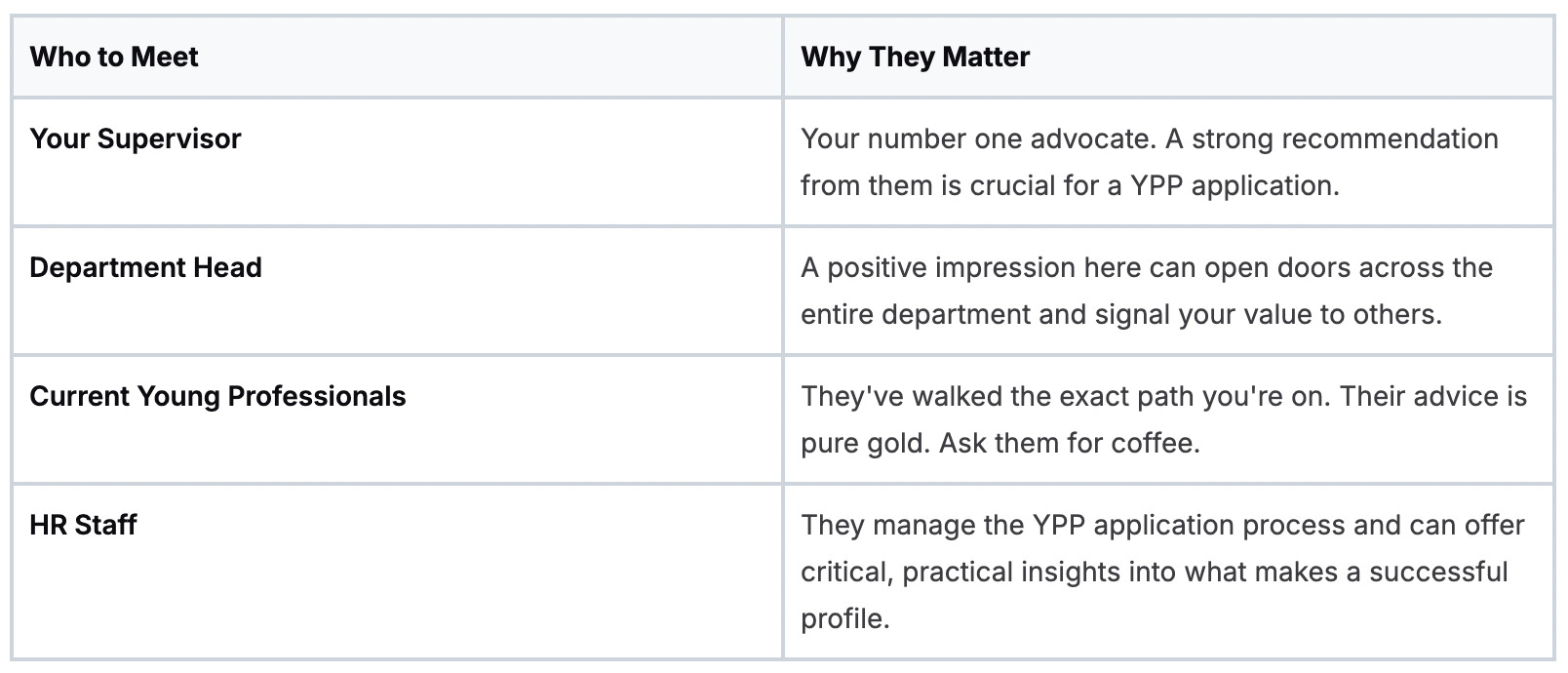
When you reach out for informational interviews, be respectful of people’s time. Come prepared with specific, thoughtful questions about their career, their work at the ADB, and any advice they have for someone aspiring to follow in their footsteps.
By the time your internship ends, you should have a solid list of people who know you, respect your work, and would be willing to put in a good word for you. This one two punch of proven performance and a strong internal network is what turns a great internship into a successful YPP offer.
Common Questions About the ADB Internship
Here are the most common questions I hear from candidates about the Asian Development Bank internship, with direct, no fluff answers.
Let’s clear up those final details so you can apply with confidence.
What Does the ADB Internship Stipend Actually Cover?
The money question is a big one. Yes, the ADB provides a monthly stipend to all its interns. This amount is calculated based on your duty station, which is almost always Manila, and it’s designed to cover your basic living costs.
That means it’s for things like:
Accommodation: Your rent for a room or a small apartment.
Food: Daily meals and groceries.
Local Transportation: Your commute to and from the ADB headquarters.
The most important thing to remember is that the stipend does not cover your flights to and from your home country. You have to budget for that yourself. The amount is livable for a student in Manila, but it’s not designed for a lavish lifestyle.
Is a Remote Internship an Option?
Historically, the answer has been a firm no. The ADB internship is an in person program at the headquarters in Manila, Philippines. The bank believes in the value of full immersion: face to face networking, spontaneous coffee chats, and absorbing the institution’s culture by being there.
That said, the bank has shown some flexibility during global events, leading to a few remote or hybrid arrangements. Your only source of truth here is the specific internship announcement. It will always state the location requirements. Don’t make assumptions; what the official posting says is the final word.
How Are Interns Assigned to Projects?
Your project assignment isn’t random. It’s a direct result of the skills in your application and the immediate needs of the hiring department. The interview is where this gets locked in. You’ll talk about your technical skills, your academic passions, and where you see your career going, all of which helps the team match you to a project where you can contribute.
You won’t be doing coffee runs. Interns are brought on to support active, ongoing initiatives, meaning your tasks are tied directly to a department’s core goals.
Your work as an intern is designed for practical immersion. You’ll engage in desk research, comparative analysis, and sometimes AI enhanced analytics, like replicating big data models for new regions, which directly supports the bank’s live operations.
This hands on approach is what the program is all about. The ADB wants you to get your hands dirty with real world applications, using the bank’s massive well of information, like its annual Basic Statistics series, to help tackle development challenges. Check out their public data resources; it’ll give you a fantastic sense of the data driven work you could be doing.
Does an ADB Internship Guarantee a Job?
Let’s be direct: an internship does not come with a job offer attached. It does give you a massive, almost unbeatable advantage over any external candidate.
Successfully completing an Asian Development Bank internship gives you two critical things:
Direct, relevant experience. You’ll understand the bank’s internal processes, its unique culture, and the full project cycle in a way no one on the outside could.
A powerful professional network. The connections you forge with your supervisors, department heads, and fellow staff are priceless.
Think of the internship as the best possible audition for a long term role. High performing interns are almost always the first ones encouraged to apply for future openings, especially for coveted spots in the Young Professionals Program (YPP). Your supervisors will know your work ethic and your skills, and a strong recommendation from them carries enormous weight.
What Happens if I Am Not Selected?
Rejection is a normal part of the game for these hyper competitive roles. Don’t let it knock you down. The first thing you should do is ask for feedback. You might not always get it, but any insight you can glean is gold for your next attempt.
After that, take an honest look at your application.
Was your CV really tailored to that specific role, or was it a bit generic?
Did your cover letter draw a clear line between your skills and the bank’s strategic priorities?
Were there technical skills in the job description that you could work on strengthening?
Use the experience as a lesson. Getting hired by an MDB is a skill. Every application you submit, every interview you do, makes you a stronger candidate for the next opportunity, whether it’s at the ADB again or a similar institution. Keep refining your approach, and don’t give up.
Landing a role at a top MDB is a marathon, not a sprint. To stay ahead of the competition and get exclusive access to job listings, insider guides, and career advice, subscribe to Multilateral Development Bank Jobs. We deliver the latest full time staff roles, consultant opportunities, and deep dive career guides directly to your inbox. Join our community and get serious about your MDB career at
https://mdbjobs.com
.