

Thinking about a career at the Asian Development Bank? Your first move is to figure out where you fit. It’s not one type of job. Landing a role there means understanding the different doors you can walk through, whether as permanent staff, a specialized consultant, or through their Young Professionals Program. Each path is distinct and requires a completely different game plan.
Decode Your Career Options at the ADB
Before you touch your CV, you need a map of the territory. The ADB isn’t a monolith; it’s an ecosystem of different employment types, each designed for a specific purpose. Getting this wrong is the fastest way to waste your effort.
The Bank is a massive employer, and its workforce is tied to huge regional projects. To give you a sense of scale, its $20.5 billion COVID-19 response package supported and created jobs across key sectors. This isn’t a small operation.
Let’s break down the main entry points so you can aim your application with precision.
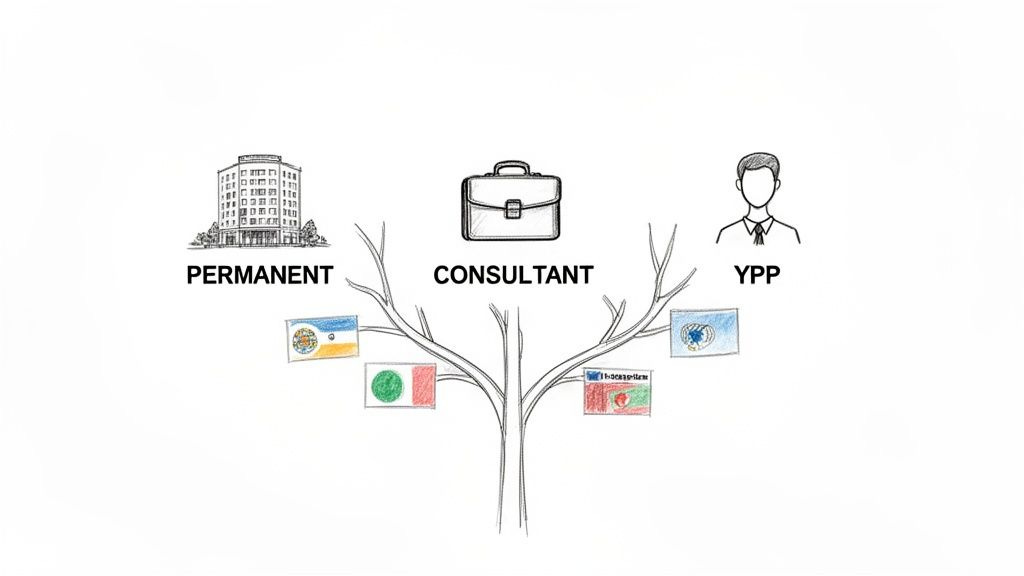
The Three Core Career Tracks
Your background, experience level, and career goals will point you toward one of three main tracks.
International Staff Positions: These are the permanent, full-time backbone of the bank. They come with long-term contracts, solid benefits, and a clear path for career growth. ADB hires for these roles to fill core functions, from economists and project managers to IT specialists and legal counsel.
Consultant Roles: Consultants are specialists brought in for specific, time-bound projects. These gigs can last anywhere from a few weeks to several years. This track is perfect for seasoned experts with deep niche skills, like transport logistics, renewable energy policy, or public health systems, who prefer project-based work.
Young Professionals Program (YPP): The YPP is ADB’s flagship program for up-and-coming leaders. It’s an incredibly competitive multi-year rotational program designed to build a pipeline of future managers. Candidates are typically under 32, hold a Master’s degree, and have a few years of solid work experience.
The biggest mistake applicants make is spraying and praying by applying for everything. The ADB hires for specificity. A candidate who is perfect for a short-term water sanitation consultancy is almost never the right fit for the broad, leadership-focused YPP. Know your lane.
ADB Job Categories at a Glance
To make it even clearer, here’s a quick side-by-side comparison of the three main tracks.
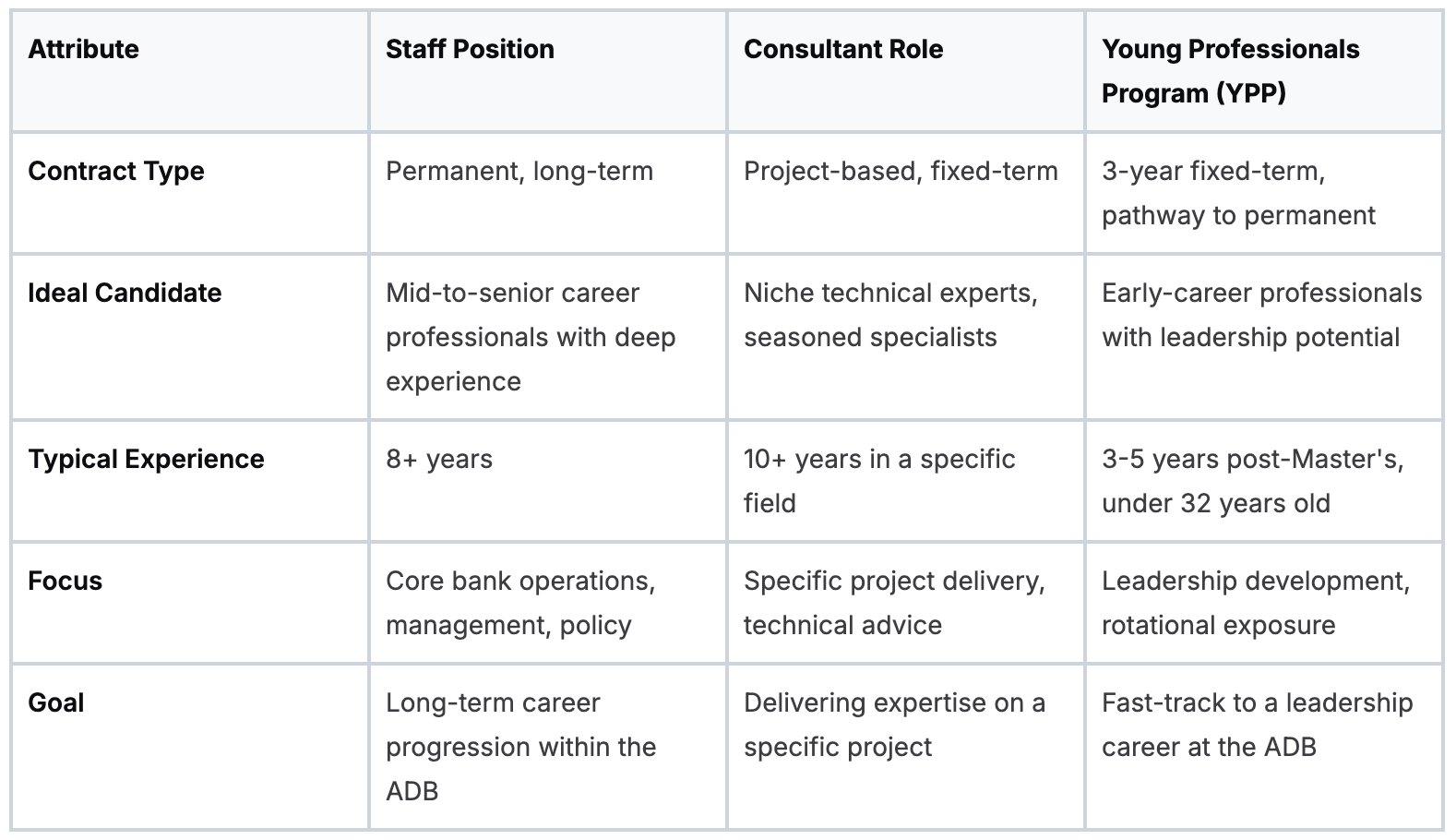
This table helps you quickly pinpoint which category best aligns with your profile and career ambitions.
The Unbreakable Rule of Eligibility
One rule cuts across every single job category: nationality.
You absolutely must be a citizen of one of the ADB’s 68 member countries to be eligible for any position.
This isn’t a suggestion; it’s a hard requirement baked into the bank’s charter. If your country isn’t on the list, you can’t be hired. Period. Check the official ADB member country list before you invest a single minute in an application. This one detail trips up more aspiring candidates than anything else.
Choose Your Strategic Path
Take a hard look at your profile. Are you a mid-career pro with a decade of infrastructure finance experience? An international staff position is your target. Are you a recent grad with a killer academic record and a passion for development? The YPP is the door you should be knocking on.
If you have highly specialized, in-demand technical skills, consulting offers a direct route to contribute to high-impact projects without the long-term commitment of a staff role. Each track has its purpose. Aligning your application with the right one is the foundation of a successful job search at the Asian Development Bank.
If you’re exploring similar roles at other institutions, our guide on which MDBs you can work for can give you a broader view of the landscape.
Master the ADB Career and Consultant Portals
Your journey to a job at the Asian Development Bank starts and ends on their official online portals. Forget third-party sites; go straight to the source. But knowing the portals exist isn’t enough. You have to know how to work them, because they aren’t the most intuitive systems.
Most people focus on the main careers page, but that’s only half the map. The ADB runs two completely separate platforms. Getting a handle on both is non-negotiable if you want to see all available opportunities.
The Two Portals You Must Know
First, you have the ADB Career and Employment System (ACES). This is the main hub for all staff positions: international, national, and administrative roles. If you’re looking for a long-term, permanent career at the Bank, this is your primary ground.
Second, and this is the one people miss, is the Consultant Management System (CMS). It’s a totally different site dedicated to short-term, project-based consulting gigs. If you’re a technical expert or a specialist, ignoring the CMS means you’re missing out on a massive number of potential jobs at the Asian Development Bank.
A classic rookie mistake is assuming everything is listed in one place. It’s not. I’ve seen highly qualified consultants wait months for a role to pop up on ACES, totally oblivious to the dozens of perfect-fit assignments posted on the CMS the entire time.
Navigate the Main Career Portal (ACES)
ACES is your go-to for staff roles. Use its features effectively instead of just endlessly scrolling through listings.
This is the main page you’ll be working with.
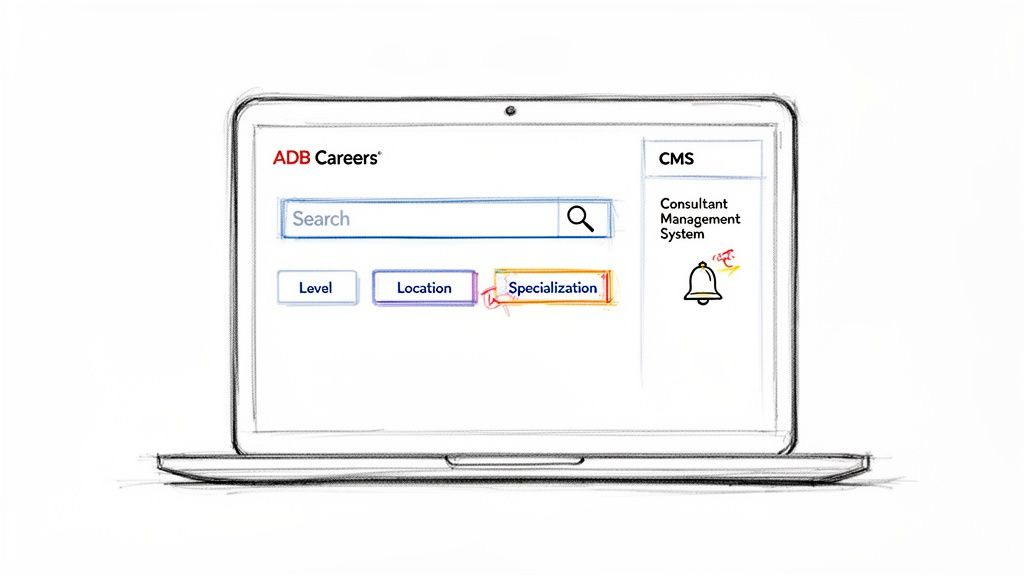
The filters on the left-hand side are your best friend. They are the key to cutting through the noise and finding what’s relevant to you.
Don’t just browse. Use these filters strategically to save time.
Job Level: This is critical. Levels range from support staff (AS) up to senior international staff (IS). Applying for a role miles above or below your experience level is a surefire way to get screened out.
Location: While many roles are based in Manila, the ADB has offices across Asia and the Pacific. If you have a specific country you want to work in, filter accordingly.
Job Family: This lets you drill down by your professional field, like “Economics,” “Project Management,” or “Information Technology.”
The single most powerful tool on the portal is the job alert. Set one up. Instead of compulsively checking the site, you can have relevant openings delivered right to your inbox. Use specific keywords like “climate finance specialist” or “transport engineer” to make sure the alerts are high-quality.
Unlock the Consultant Management System (CMS)
The CMS is a different beast. This is where you find opportunities for individual consultants, and the game is played differently. You’re not just applying for a job; you’re expressing interest in assignments and maintaining a profile that ADB project managers can search directly.
Build a Killer Profile: Think of your CMS profile as your living CV. It needs to be packed with details, loaded with keywords relevant to your expertise, and constantly updated. ADB team leaders search this database when they need an expert for a project yesterday.
Hunt for Opportunities: Use the “Individual Consultants” search function to find open assignments. These are often highly specific tasks with crystal-clear deliverables and timelines.
Express Your Interest (EOI): Instead of a full-blown application, you’ll submit an Expression of Interest. It’s a much quicker way to signal that you’re available and have the right skills for a particular gig.
Treat both portals as essential tools in your job-hunting toolkit. Spend an hour getting your profiles and job alerts set up properly. That initial time investment will pay for itself tenfold and ensure you never miss a perfect opportunity to land a job at the Asian Development Bank.
Craft an Application That Gets Noticed
Let’s be blunt: sending a generic application to the Asian Development Bank is a waste of your time. The bank’s recruiters have seen it all, and they can spot a lazy, copy-paste CV from a mile away.
To get past the first screening, your application has to prove you understand their world and speak their language. This means meticulously tailoring your CV and cover letter for each specific role. Your goal is to make it impossible for the reviewer to ignore you. You want them to draw a straight, undeniable line from the job’s requirements to your documented experience.
Dissect the Job Description
Your first move is to break down the job description. This document is your cheat sheet. It lays out exactly what the hiring manager is looking for, from core competencies to specific technical skills.
Print it out or open it in a doc where you can highlight text. Go through it line by line and pull out the key phrases, keywords, and qualifications.
You’re hunting for three things:
Action Verbs and Keywords: What exact terms do they use? Words like “safeguards,” “procurement,” “due diligence,” “stakeholder engagement,” and “climate finance” are critical signals of required expertise.
Core Competencies: The ADB values a specific set of competencies, such as “Communication,” “Teamwork,” and “Client Orientation.” The job description signals which of these are most vital for this particular role.
Required Qualifications: Pay close attention to the non-negotiables. These are the knockout factors, like “Master’s degree in Economics,” “minimum 8 years of relevant experience,” or “proven experience working in Southeast Asia.”
Once you’ve got this list, you have the building blocks for your entire application. Your job is now to mirror this language in your CV and cover letter, backing it up with hard evidence.
Reframe Your Experience for the MDB World
Corporate achievements don’t always translate directly to the development space. You have to reframe your experience to highlight what matters to an organization like the ADB: scale, impact, and complex, cross-cultural collaboration.
For example, a corporate project manager who “oversaw a $5 million software implementation” needs a rewrite for an ADB application. A stronger framing is: “Managed a multi-country technology project valued at $5 million, coordinating with technical teams and government partners across three time zones to ensure successful delivery.”
The second version screams international scope and stakeholder coordination, two critical elements in the MDB environment.
You must quantify your impact. Vague statements like “responsible for project management” are useless. Instead, write “Managed a portfolio of five infrastructure projects totaling $150 million, leading to a 15% improvement in transport efficiency for the region.” Numbers command attention and lend credibility.
Use the STAR Method for Every Bullet Point
The STAR method (Situation, Task, Action, Result) is the gold standard for writing powerful, evidence-based bullet points on your CV. It forces you to demonstrate actual, measurable accomplishments.
Here’s the breakdown:
Situation: Briefly set the scene. What was the challenge?
Task: Explain your specific responsibility. What were you asked to do?
Action: Detail the concrete steps you took. What did you do?
Result: Quantify the outcome. What was the measurable impact?
Let’s put it into practice.
Generic Bullet:
Responsible for analyzing economic data for reports.
Powerful STAR-Method Bullet:
Analyzed macroeconomic data for a lagging regional economy (Situation/Task) to identify growth bottlenecks, developing a new econometric model (Action) that forecasted a 10% potential increase in FDI, which was incorporated into the country’s strategic policy note (Result).
The second example is infinitely more compelling. It gives context, shows initiative, and proves a tangible, policy-level outcome. Apply this thinking to every bullet point on your CV.
Write a Cover Letter That Tells a Story
Your cover letter is not a summary of your CV. It’s your chance to tell a story and connect your qualifications directly to the bank’s mission and the specific needs of the role. Keep it sharp, professional, and no longer than one page.
A winning ADB cover letter follows this structure:
The Opening: State the exact position you’re applying for. Immediately express your enthusiasm and deliver your core value proposition. In one or two sentences, why are you the perfect candidate?
The Body (2-3 paragraphs): This is where you build your case. Dedicate each paragraph to a key requirement from the job description. Use specific examples from your career to prove you have the skills they need. Mirror their keywords.
The Closing: Reiterate your strong interest in the role and the ADB itself. Show you’ve done your homework by mentioning your understanding of their strategic priorities, like Strategy 2030. End with a professional closing and a clear call to action.
Your tone should be confident but grounded. Avoid generic platitudes about wanting to “make a difference.” Instead, show them exactly how your skills in public financial management or renewable energy policy will directly contribute to their goals.
By systematically breaking down the job description, reframing your experience, quantifying your achievements, and writing a targeted cover letter, you create an application that stands out. You make it easy for the recruiter to say “yes” and push you to the next stage.
Navigate the ADB Assessment and Interview Process
Getting an interview invitation from the ADB is a massive win. Now the real prep begins. The bank uses a structured, multi-stage process designed to test your technical chops, how you handle real-world situations, and whether you’ll fit in.
Making it through requires more than a great CV. You need a game plan for each stage, from the initial written exam to the final panel interview. Many brilliant candidates stumble here, not because they are unqualified, but because they are unprepared for the format.
The Initial Hurdles: Technical and Written Assessments
For most technical and specialist roles, your first test will be a written assessment or a case study. This isn’t a simple quiz. It’s designed to mirror the analytical work you’d be doing in the role.
You might get a messy dataset and be asked to draft a policy brief, or a project scenario where you need to spot the risks and map out a mitigation plan. They want to see how you think, structure an argument, and deliver quality work under pressure.
For Economists and Analysts: Expect data. You’ll likely have to clean and interpret it, maybe run some econometric analysis, and then package your findings into a clear memo.
For Project Management Roles: The focus will be on situational judgment. You could get a case study about a project that’s gone off the rails and be asked to draft a recovery plan.
For Sector Specialists (Energy, Health, etc.): These assessments are about your deep domain knowledge. You might be asked to critique a proposed policy or sketch out a high-level strategy for a specific development challenge.
No matter the task, focus on structure and clarity. Use headings. Use bullet points. Write clear topic sentences. They’re testing your ability to communicate complex ideas just as much as your raw technical skill.
Master the Competency-Based Interview
If you clear the assessment, you’ll move on to a competency-based interview. This is a highly structured conversation. Every question is engineered to dig into a specific skill or behavior, like teamwork, client orientation, or achieving results.
Forget vague, hypothetical answers. The interviewers want concrete proof of your skills. The only way to give them that is by using the STAR method (Situation, Task, Action, Result) for every answer.
This is the absolute core of your preparation. The infographic below breaks down the mindset you need to adopt.
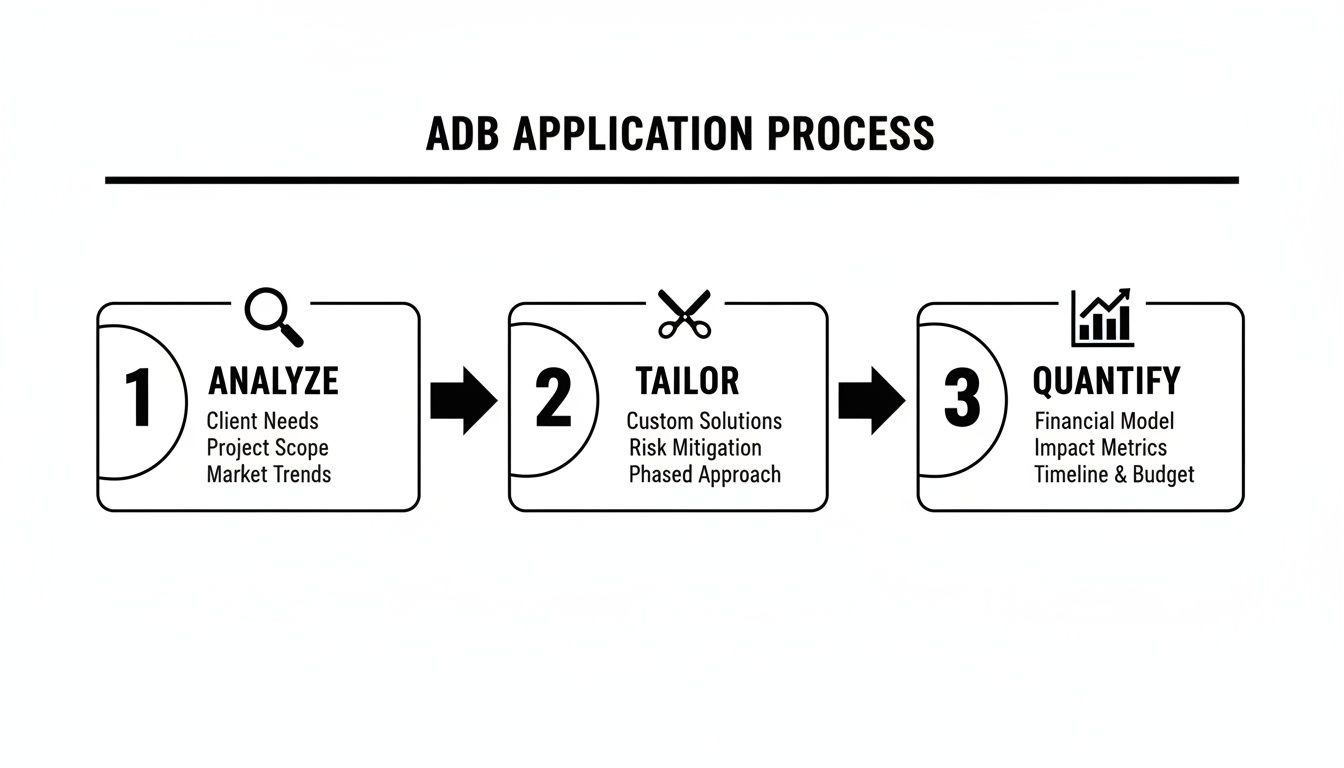
This process—analyzing the role, tailoring your experience, and quantifying your impact—is exactly what you need to do when building your STAR stories for the interview.
Your homework is to prepare at least two solid examples for each of the ADB’s core competencies. Write them down. Practice saying them out loud until they feel natural. Your stories need to be concise, compelling, and directly prove you have the skill they’re asking about.
Face the Final Panel Interview
The final stage is usually a panel interview. It can feel intimidating, but if you understand the room’s dynamics, it becomes manageable. You aren’t just talking to a hiring manager; you’re presenting to a group of key stakeholders.
The panel often includes:
The direct hiring manager for the role.
A senior representative from the department.
Someone from Human Resources.
A technical expert from a related field.
Each person on that panel is listening for something different. The hiring manager wants to know if you can do the job. The senior leader is sizing up your strategic thinking. HR is checking for cultural fit and core competencies. Your job is to speak to all of them.
Make eye contact with each panel member when you answer, even if the question came from just one person. It shows you’re a collaborator who can engage multiple stakeholders, a critical skill at the ADB.
Be ready for a mix of technical, behavioral, and forward-looking questions. They want to see how you connect with the bank’s bigger mission. This is where your research on ADB’s strategic priorities pays off. For instance, the bank’s pandemic response included a $20.5 billion assistance package that helped revive jobs in sectors like IT and healthcare. Mentioning how your skills could contribute to such large-scale initiatives shows you get the bank’s impact and operational scale.
The interview process for jobs at the Asian Development Bank is a marathon, not a sprint. Each stage is another chance to prove you have the technical depth, behavioral skills, and strategic mindset they need. Prepare thoroughly, and you’ll walk in with the confidence to show them you’re the right person. For some direct insights, check out this interview with an MDB panelist.
Align Your Skills with the ADB Mission
Landing a job at the Asian Development Bank is about showing you get the bigger picture.
The bank isn’t just filling seats. They’re looking for people who understand their core mission of creating a prosperous, inclusive, resilient, and sustainable Asia and the Pacific, and who can prove they’ll help drive it forward.
Your ability to connect your experience to this mission separates a decent application from a compelling one. It needs to be woven into your CV, your cover letter, and your interview answers.
Understand Strategy 2030: The ADB’s North Star
Everything the ADB does is guided by its long-term corporate plan, Strategy 2030. Think of it as the bank’s operational playbook. It dictates funding, projects, and, crucially for you, hiring priorities.
Showing you understand this strategy is a powerful way to frame your application and prove you’ve done your homework.
Strategy 2030 is built around seven key operational priorities:
Addressing remaining poverty and reducing inequalities.
Accelerating progress in gender equality.
Tackling climate change, building climate and disaster resilience, and enhancing environmental sustainability.
Making cities more livable.
Promoting rural development and food security.
Strengthening governance and institutional capacity.
Fostering regional cooperation and integration.
Your first task is to figure out where you fit. An urban planner is a clear match for “making cities more livable,” while a public finance expert can directly contribute to “strengthening governance.” The connection should be obvious.
Don’t just name-drop a priority. Explain how your background in water resource management directly supports the bank’s goals for climate resilience and food security. Make the connection so explicit that the hiring manager can’t miss it.
Connect Your Skills to Operational Priorities
Let’s get practical. You translate your background into the language of Strategy 2030 by mapping your technical skills and past achievements directly to one or more of these seven areas.
For example, if you’re a gender specialist, you don’t just say you have experience in gender analysis. You reframe it. You explain that your work designing gender-inclusive projects directly supports ADB’s operational priority of “accelerating progress in gender equality.” This simple shift in language shows you see how your micro-level skills contribute to the bank’s macro-level goals.
This mindset also helps you understand the data that drives ADB’s work. The bank is a data powerhouse, publishing its annual Basic Statistics series covering everything from GDP growth to unemployment across dozens of economies. This information shapes their projects and informs their hiring needs.
Demonstrate Your Fit Beyond Technical Skills
The ADB also looks for people who embody its institutional values. They want staff who are client-focused, results-oriented, and can work seamlessly in a team. Your CV bullets and interview answers should subtly reflect these competencies.
It’s also worth considering the difference between a permanent staff role and a consulting gig. Both demand technical excellence, but a staff member is expected to be a long-term carrier of the bank’s culture. For a deeper dive, our guide on the differences between an MDB consultant versus a full-time employee gives some valuable context.
Ultimately, showing your alignment with the ADB mission is about storytelling. You’re crafting a narrative that presents you as a qualified professional and a dedicated partner in their development work. This deeper understanding will resonate with recruiters and give you a real edge in the competitive race for jobs at the Asian Development Bank.
Common Questions About ADB Careers
When you’re navigating the application process for a major international institution like the ADB, a lot of specific questions pop up. Let’s tackle the most common ones.
What’s the Deal with Salary and Benefits?
Let’s be direct: the compensation is a major draw. ADB salaries are competitive and benchmarked against other large international organizations. For most international staff, that salary is tax-free.
The benefits package is where it really shines. You can typically expect:
Top-Tier Health Insurance: This plan covers you and your eligible family members globally.
A Real Retirement Plan: The bank offers a defined benefit pension plan, which is increasingly rare.
Full Relocation Support: If you’re hired internationally, the ADB provides shipping allowances, settling-in grants, and sometimes rental subsidies to get you started.
Help with Schooling: For international staff with children, education allowances are a standard part of the package.
Can I Apply If My Country Isn’t an ADB Member?
No. This is the first and most important eligibility check.
To be considered for any staff, consultant, or YPP role, you must be a national of one of the ADB’s 68 member countries. There are no exceptions to this rule; it’s baked into the bank’s charter. Before you pour hours into an application, take 30 seconds to confirm your country is on the official ADB member list.
How Long Does the Hiring Process Take?
Patience is a necessity. The hiring timeline at the ADB is much longer than in the private sector. The process often takes four to six months from the application deadline to a final offer, and sometimes longer.
Don’t mistake silence for rejection. The process involves multiple, deliberate stages of review, from technical assessments to panel interviews and final approvals. Long gaps in communication are normal, so don’t panic if you don’t hear back right away.
Does the ADB Help with Relocation?
Yes, they do it well for international staff positions. If you’re hired for a role that requires you to move from your home country, the ADB provides a solid relocation package.
They understand that moving your life across continents is a huge undertaking. The package is designed to smooth that transition for you and your family, typically covering travel, the shipment of your belongings, and a grant to help with the initial costs of setting up in a new country. While the specifics can vary by role, this support is a standard part of the offer for international hires.
Ready to stop searching and start applying with confidence? Multilateral Development Bank Jobs delivers curated job listings from over 30 MDBs directly to your inbox every week, along with deep-dive guides to help you land your dream role. Subscribe now to get the latest full-time staff and consultant opportunities at
https://mdbjobs.com.