
Before you apply, you need to understand what a UN consultant job actually is. These are not typical staff positions. They are project-based, specialized gigs for outside experts.
Getting this distinction right is the key. It’s how you position yourself as the indispensable problem-solver they need, not just another applicant.
Understanding the UN Consultant Landscape
The United Nations system runs on consultants. Agencies like UNICEF, UNEP, and UNIDO constantly bring in external experts to solve specific, time-sensitive problems that require niche skills their permanent staff don’t have.
Think of a hospital hiring a specialist surgeon for a complex operation. That’s you. You’re brought in for your unique ability to deliver a precise outcome, and then you’re on to the next challenge.
This creates a dynamic market for professionals who want high-impact work. At any given time, you can find over 50 active openings listed across major job platforms, a clear sign of consistent demand. This reflects the UN’s need for agility to tackle urgent global issues. You can see live examples and get a feel for this trend on Impactpool.
The Nature of UN Consulting Work
These are not long-term career posts. The system is built around projects with a clear start and end date.
Project-Based Focus: Your work is tied to a specific project with defined deliverables. You do not join a department for ongoing duties.
Specialized Expertise: They hire you for what you can do right now. There’s no long ramp-up period or on-the-job training. You are expected to deliver from day one.
Intense Competition: These roles are often high-profile and pay well, so you’re competing against a global pool of highly qualified people.
A UN staff member is hired to fill a role within the organization’s structure. A UN consultant is hired to deliver a specific result for a project. Your reputation is your passport to the next assignment.
Contract Realities and Work Environment
The terms of engagement for un consultant jobs are different from permanent roles. Contracts usually run from 4 to 12 months, aligning with specific project timelines.
The rise of remote work has also changed the game. Roughly 30% of postings are now home-based. This flexibility opens the door for talent from anywhere in the world, but it also means you must be incredibly self-reliant.
Success in this field demands a different mindset. You must be comfortable managing your own work pipeline, negotiating contracts, and proving your value quickly. To understand this ecosystem better, read our practical guide to UN development careers. Building this foundational knowledge is essential if you want to create a sustainable consulting practice within the UN system.
Where to Find UN Consultant Opportunities
Forget scrolling through generic job boards. Finding quality UN consultant jobs demands a targeted, surgical approach. Wasting time on broad searches is the fastest way to get discouraged. You have to know exactly where the real opportunities are posted and how to filter out the noise.
The official portals are your primary targets. They are the source. Your search must start here.
Top Platforms for Finding UN Consultant Jobs
While the official UN sites are essential, a few specialized platforms aggregate listings and provide a wider view of the market. Here’s where you should spend your time.
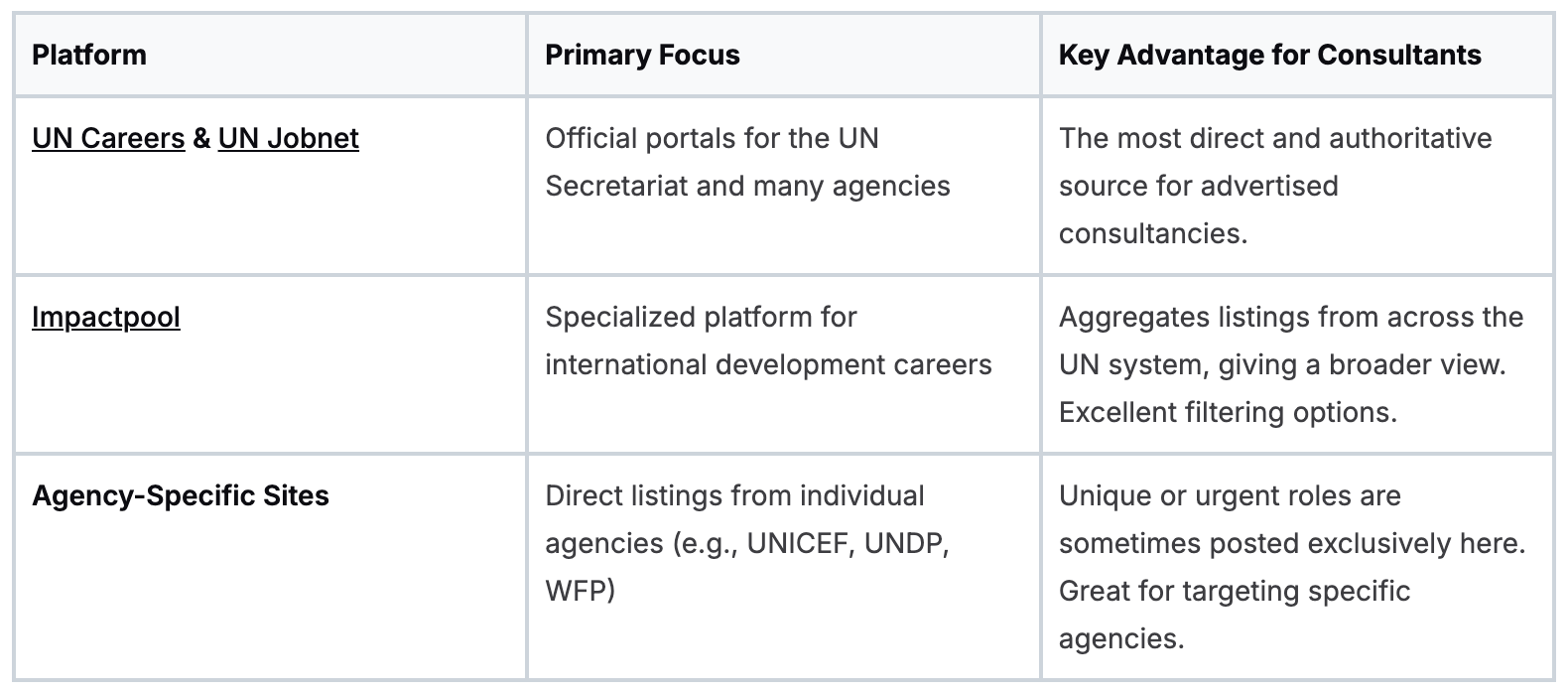
Setting up precise alerts on these sites is a non-negotiable part of the game. Use filters for “consultant,” your specific field (e.g., public health, M&E), and duty stations. This step turns your search from a passive chore into an automated pipeline of relevant openings.
Uncovering Opportunities Before They’re Advertised
The best consultants often land roles that aren’t public yet. This is a strategy, not luck. It means monitoring agency activities to anticipate their needs before they formalize them. You have to think like a hiring manager.
How do you do that?
Start tracking project pipelines and funding announcements. When a new multi-million dollar project gets approved for a specific country or sector, that agency will inevitably need consultants to help execute it. Follow agency press releases, country office websites, and donor portals. This is how you position yourself ahead of the curve, allowing you to connect with the right people before a formal Terms of Reference is even drafted.
This is the typical lifecycle of these roles.
The flow from project-based needs to short-term, often remote contracts highlights the agility required to succeed as a UN consultant. You must be ready to act on opportunities as they emerge.
For example, look at the growth of roles in statistics and data analysis. It shows a clear shift in how the UN addresses climate and gender issues. With agencies like UNEP advertising for five Statistics Consultants in Nairobi alone, the demand is obvious. UN career portals show a 40% year-over-year increase in these roles since 2023, driven largely by the 2030 Agenda.
The most successful consultants build a system for finding opportunities. They proactively track the ecosystem to see where the demand will be next instead of just reacting to job alerts.
This proactive mindset is especially critical for remote work. For a deeper dive, check out our comprehensive guide to landing remote UN jobs. Being strategic and targeted separates the consultants who are always in demand from those who are always searching.
How to Decode the Terms of Reference
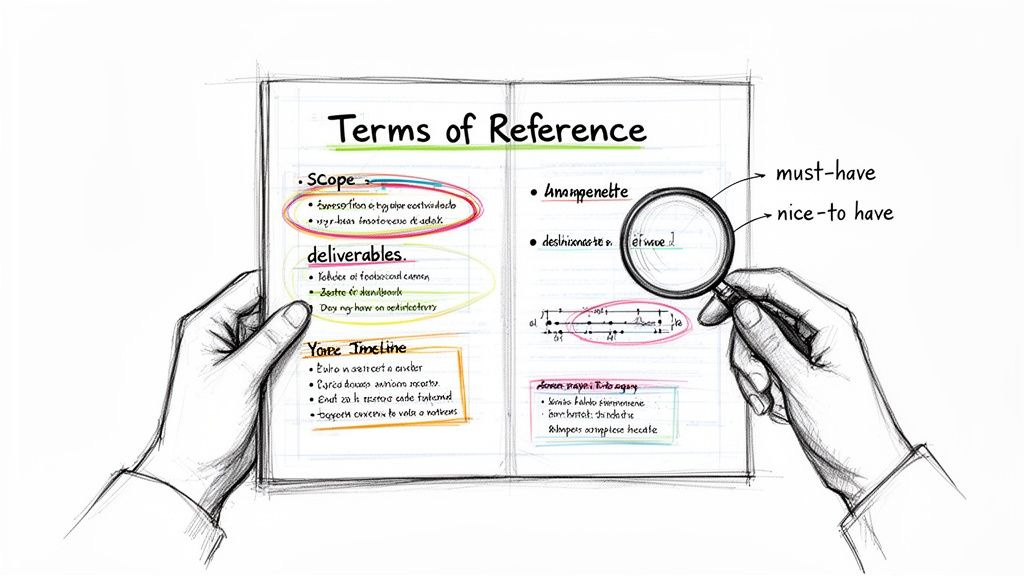
The Terms of Reference, or TOR, is the most important document in the entire application process. It’s a project blueprint, a contract, and a direct line into the hiring manager’s brain.
Most applicants give the TOR a quick skim and then submit a generic proposal. This is a massive mistake and where you can gain a serious edge. Your ability to dissect this document and read between the lines is what separates you from the competition.
Mastering the TOR lets you tailor a proposal with surgical precision, showing you understand the real problem better than anyone else. This is where you win the job.
Read It Like a Detective
Your first pass through the TOR is for the basics: what, where, and when. Your second and third read-throughs are where the real work begins. You’re hunting for what’s not being said directly.
You are trying to uncover the underlying problem the agency needs solved.
As you analyze the document, keep these questions in mind:
What is the real pain point here? Look for signal words like “urgently,” “challenge,” “gap,” or “barrier.” These words are flares, signaling the core issue.
Who is the ultimate audience for the deliverables? A high-stakes report for a major donor requires a different approach than an internal training manual for field staff.
Why now? Is this consultancy tied to a new funding cycle, a looming political deadline, or a response to a recent crisis? Understanding the urgency helps you frame your solution as timely and critical.
This level of analysis is crucial because UN consultant jobs, especially in technical fields, are growing. For instance, a recent UNICEF posting for an Impact Evaluation Consultant shows the high demand for data experts within its massive global footprint of 12,000+ staff across 145 countries.
This role is just one of a wave of over 20 new consultancies appearing on platforms like UN Jobnet, proving how specialized skills are constantly in demand.
Separate the Must-Haves from the Nice-to-Haves
A TOR is often a wish list written by a committee, which means not everything carries the same weight. Your job is to pick out the non-negotiable requirements and separate them from the “nice-to-have” qualifications.
The real priorities are almost always buried in the deliverables section.
Look for the verbs. The actions they list tell you exactly what the manager expects you to produce. “Develop a framework” is a world away from “conduct a workshop.” Focus your proposal around the high-stakes deliverables.
The scope of work tells you the what. The deliverables section tells you the how and the why. Pour your energy into proving you can produce the exact outputs they list. That’s what matters.
Identify the Unstated Problems
A TOR often describes symptoms, not the root cause. A request to “develop a new M&E system” might be a quiet admission that there’s a lack of trust between a donor and the country office.
If your proposal identifies that unstated political or operational challenge, you instantly become the front-runner.
For example, a TOR asking for a “communications strategy” could be a polite way of saying, “Our last project failed because nobody understood what we were doing, and we need to fix our reputation.”
Showing you grasp this deeper context proves you’re a strategic thinker, not just a hired hand who follows instructions. You need to position yourself as a problem-solver who understands the nuances of these roles. For more on these dynamics, our article on short-term consultancy positions offers valuable context. Make sure your proposal reflects this deeper understanding.
Crafting a Proposal That Wins Contracts
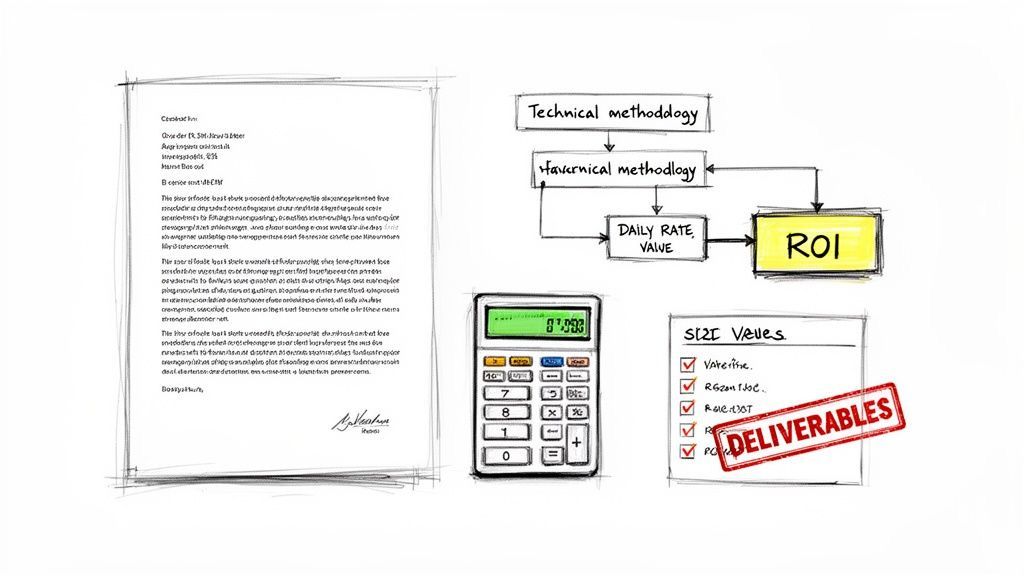
Your proposal is your sales pitch. It’s the single document that stands between you and an interview for that UN consultancy. It must be direct, compelling, and laser-focused on solving the problem in the Terms of Reference.
A generic proposal is a dead end. Every hiring manager can spot one from a mile away, and it goes straight to the “no” pile.
This is where you make your case. Forget fluffy language. We’ll break down how to frame your experience around concrete results, prove your value, and present a financial plan that positions you as a smart investment.
Structure Your Proposal for Impact
A winning proposal makes the hiring manager’s job easy. Structure it to mirror the TOR, addressing each requirement in the same order. This shows you’ve paid close attention and respect their time.
The best proposals have three core parts:
The Cover Letter: Keep it concise. One page, maximum. Your only goal is to connect your single biggest, most relevant accomplishment directly to their primary problem.
The Technical Proposal: This is the heart of your application. It’s where you lay out your methodology, timeline, and deliverables. This section must scream, “I know exactly how to do this.”
The Financial Proposal: This is your day rate and total cost. It needs to look professional and, most importantly, be justifiable.
Your reputation is your passport to your next assignment. Every proposal is a reflection of your professionalism and attention to detail. Treat it as the first deliverable of the project.
Remember, the UN moves fast on these things. Pulling together a high-quality, tailored proposal on a tight deadline is a crucial skill.
Detailing Your Technical Approach
The technical section is where you separate yourself from the pack. Vague promises about your skills are worthless. You need to outline your precise, step-by-step methodology for tackling the project.
Go through the TOR and for each deliverable, describe exactly what you will do. Do not just say you’ll “conduct stakeholder analysis.” That means nothing.
Instead, write something like this: “I will facilitate three focus group discussions with key ministry partners and conduct ten semi-structured interviews with field staff to map operational challenges and identify bottlenecks.”
That level of detail shows you’ve thought through the work. It builds immediate credibility and makes the hiring manager confident that you can hit the ground running. Your goal is to leave them with zero doubts about your ability to execute.
Pricing Your Services and Justifying Your Rate
Calculating your daily rate is a critical step. If you go too low, you signal a lack of confidence or experience. If you go too high, you might get knocked out of the running before they read your technical section.
Your rate has to be competitive and justifiable.
Start by benchmarking. Look at similar roles to see the market rate. Then, build your rate from the ground up. Do not pick a number out of thin air. Factor in your salary needs, business overheads, and the non-billable days you’ll spend on admin and finding the next gig.
Here’s a simplified way to think about it.
Example Daily Rate Calculation
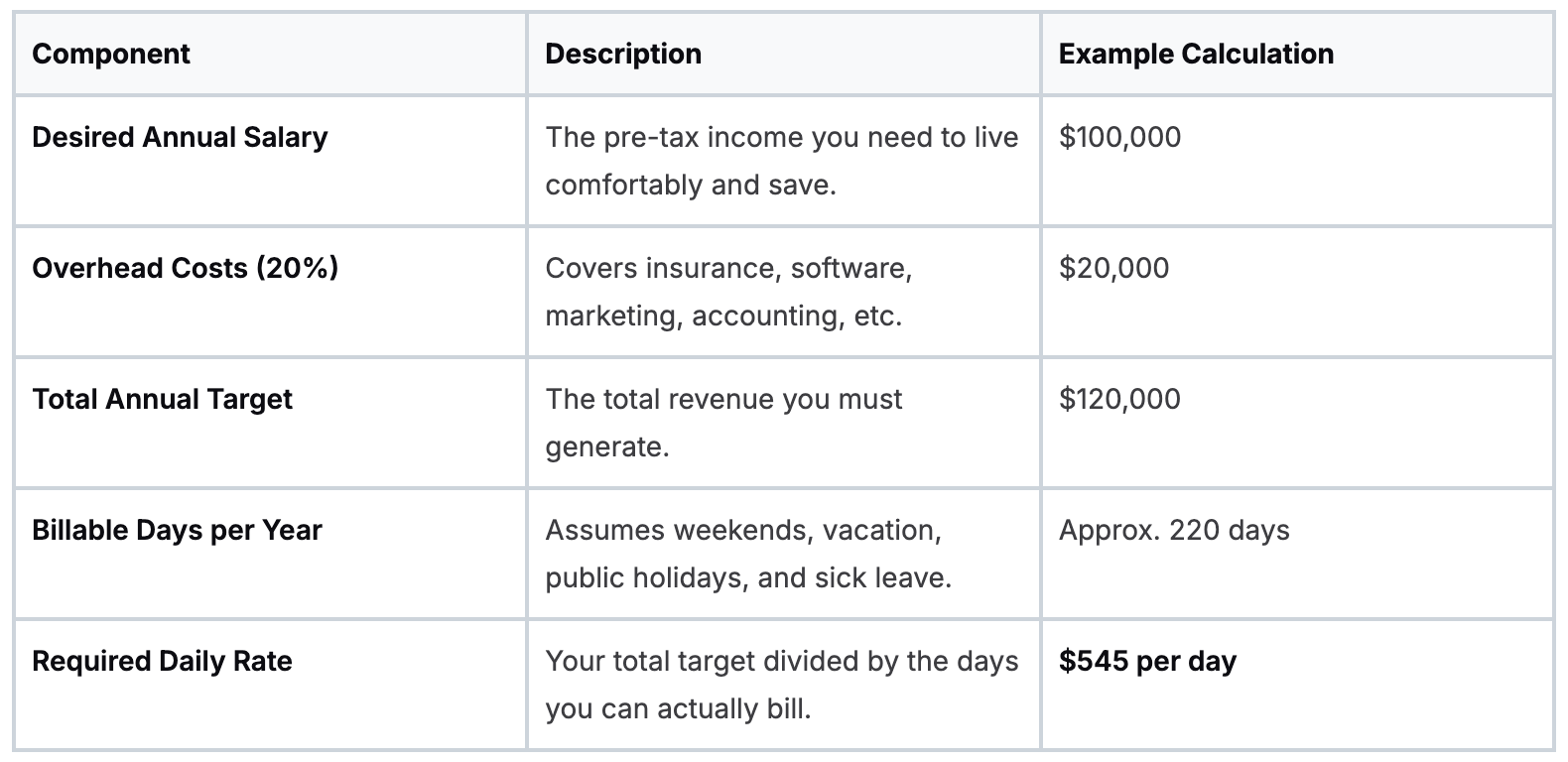
This is a starting point, but it gives you a logical foundation for your rate.
When you present your financial proposal, keep it clean and simple. State your daily rate, multiply it by the estimated number of working days from the TOR, and show the total cost. This transparent approach shifts the conversation from “how much does this cost?” to “what is the value we’re getting?” which is exactly where you want it.
Navigating the UN Consultant Interview
A slick proposal gets your foot in the door. The interview proves you’re the right person to walk through it.
Forget typical corporate interviews. UN interviews are not about charming the panel or having a friendly chat. They are a rigorous, methodical assessment of your competence.
This is your moment to bring your proposal to life. The panel has a project to deliver and needs to be 100% certain you can do it. Your job is to show them their confidence in your written submission was well-placed.
Preparing for a Competency-Based Grill Session
The whole process is designed for objectivity. The panel will use a structured interview format, meaning they ask every candidate the same core questions and score the answers against a predefined matrix. Winging it is a terrible idea.
They’re going to probe two main areas: your technical skills and your on-the-job behaviors.
Technical Questions: These get into the details of your proposal. They want to hear the “how.” Expect direct questions like, “Can you walk us through your proposed data collection methodology in more detail?” or “What specific risks do you see in Phase 2, and what are your mitigation strategies?” They need to know your plan is practical and well-thought-out.
Behavioral Questions: These are about seeing if your work style meshes with core UN values like integrity, professionalism, and respect for diversity. They will be framed using the STAR method (Situation, Task, Action, Result), and your answers must follow the same structure.
The interview is a demonstration, not a conversation. Every answer needs to be a piece of evidence that proves you can execute the project as the TOR demands.
Think of it this way: your proposal was the blueprint. The interview is where you prove you have the tools, skills, and experience to build the house.
Answering with Evidence, Not Opinions
When you get a behavioral question, your answer has to be a concrete story, not a vague generalization. If they ask, “Tell us about a time you worked with a difficult stakeholder,” the worst thing you can say is, “Oh, I’m great at building consensus.”
Instead, give them a specific, real-world example. Lay it out for them.
Describe the Situation (a project was stalled because two government ministries had conflicting requirements), the Task (you were responsible for getting it back on track), the Action you took (you facilitated a half-day workshop to map dependencies and get both parties to agree on a shared timeline), and the Result (the project was completed on schedule, and both ministries signed off on the final report).
This approach gives them tangible proof of your skills. It shows, not just tells. It proves you’ve been in the trenches and know how to get things done. Anecdotes without results are just stories. Connect every action to a positive, measurable outcome.
The Follow-Up That Makes a Difference
The interview is not over when you disconnect the call. The follow-up is a simple but powerful step that reinforces your professionalism.
Send a brief, professional thank-you email within 24 hours. Keep it short and to the point.
Thank the panel for their time, briefly reiterate your enthusiasm for the project, and mention one specific point from the discussion that you found interesting.
This is not the time to restate your qualifications or continue pitching yourself. It’s a simple, respectful gesture that signals attention to detail and genuine interest. In a field as competitive as UN consultant jobs, these small professional touches can keep you top of mind.
Common Questions About UN Consulting
Even with a clear strategy, you probably have practical questions about what it’s like to work as a UN consultant. It’s a unique career path, and the day-to-day realities are different from most other jobs. Let’s tackle some of the most common questions.
Getting straight answers helps you go in with your eyes open. It’s how you build a sustainable career, not just land a single gig.
How Long Does the Hiring Process Take?
The timeline for securing UN consultant jobs can be frustratingly long and unpredictable. From submitting your proposal to receiving an offer, it can take anywhere from a few weeks to several months.
This is not a reflection on you. UN agencies are massive bureaucracies with complex, multi-layered internal approval processes. Your application has to snake its way through the project unit, HR, finance, and other departments.
Plan your finances and pipeline of opportunities with the assumption that every recruitment timeline will be long. Never put all your hopes on one application. You have to keep multiple irons in the fire.
What Are the Different Contract Types?
The UN uses several kinds of contracts for consultants, and the differences matter. The most common is the Individual Contract (IC). This is a straightforward agreement between you and the agency for a specific set of deliverables.
You might also come across other arrangements:
UNOPS Contracts: Agencies sometimes hire through the United Nations Office for Project Services, which has its own rules for pay, benefits, and contract management.
Service Contracts: These are less common for international experts and are often geared more toward local support roles.
Rosters: Many agencies maintain pre-vetted lists, or rosters, of experts. Getting on a roster can be a game-changer, leading to faster, non-advertised opportunities because they can hire you directly without a full public competition.
You must read the fine print on any contract you’re offered. They have different implications for your tax obligations, health insurance, and paid leave (or the lack thereof). As a consultant, you are expected to be self-reliant.
Can I Negotiate My Daily Rate?
Yes, within reason. There is usually some wiggle room, but the UN system is not an open market negotiation. Most agencies have established pay scales or bands for consultants based on experience levels and the complexity of the work.
Your best chance to negotiate is when you submit your financial proposal. If your proposed rate is slightly higher than their initial budget but you can justify it with exceptional experience or a methodology that offers more value, they might meet you there.
However, trying to renegotiate after they’ve made a formal offer based on the rate you proposed is a bad look and rarely successful. All your leverage is in that initial proposal, so make sure your pricing is well-researched and reflects your true market value from the start.
Finding the right opportunities and navigating this complex world is a full-time job in itself. At Multilateral Development Bank Jobs, we do the heavy lifting for you, delivering curated lists of full-time and consulting roles from over 30 MDBs and the UN directly to your inbox every week. Stop searching and start applying with us.