

Landing a job at the UN Development Programme (UNDP) is an entry into the UN’s lead agency for international development. This career path is built on delivering tangible results, from poverty reduction and democratic governance to crisis prevention and climate resilience. The work is demanding, heavily field-oriented, and puts you right at the heart of global efforts to hit the Sustainable Development Goals.
What Working at the UNDP Is Really Like

Let’s get straight to it: working at the UNDP is about hands-on project implementation, not abstract policy debates in a high-rise office. The organization is on the ground in over 170 countries and territories, making it the operational backbone of the UN’s development work. Your day-to-day will involve managing projects, coordinating with local governments, and working directly with the communities you’re there to serve.
It’s important to understand how the UNDP differs from other major players. While an institution like the World Bank mainly acts as a lender for huge projects, the UNDP’s specialty is technical assistance, capacity building, and policy advice. The UNDP helps countries build the skills and institutions they need to drive their own progress long after a project ends.
The Core Mission and Structure
The UNDP’s DNA was formed in 1965 when two earlier UN bodies merged. The goal was to streamline technical help and stop duplicating what other development financiers were doing. This move cemented its role as the central UN hub for funding and coordinating technical cooperation, a mission it still carries today.
This history translates into a few key realities for anyone working there:
The project is everything. Most jobs are tied to specific projects with clear goals, timelines, and budgets. You could be setting up a solar grid one month and supporting a national election the next.
The action is in the field. While New York is the headquarters, the real work happens in the country offices. A UNDP career often means moving between different duty stations around the world.
Partnership is the job. You will collaborate constantly. Getting anything done means working with government ministries, NGOs, civil society groups, and other UN agencies.
Who Thrives at the UNDP
The ideal UNDP professional is a practical problem-solver. You must be adaptable, culturally sharp, and completely comfortable working in complex and often challenging environments. It’s a place for people who can take a high-level development goal and turn it into a concrete action plan that actually works on the ground.
A career with the UNDP is built on resilience and a commitment to implementation. It’s about making development happen. The work demands a unique blend of technical expertise and diplomatic skill.
The compensation package reflects these demands. Base salaries are competitive, and the significant allowances and benefits are designed for an international career. You can get a better sense of this by checking out our guide on UN staff benefits and entitlements.
If you’re looking for a career with direct, measurable impact and you’re prepared for the realities of field-based work, the UNDP is a powerful place to make your mark.
Understanding Staff Contracts vs. Consultant Gigs
When you start digging into jobs at the UN Development Programme, you’ll see two main types of opportunities: staff positions and consultancies. Understanding the difference is the first critical step in a smart job search. They represent entirely separate career tracks, each with its own rules, benefits, and strategic purpose.
A staff contract is the traditional career path. It’s a formal employment agreement with the UNDP, giving you stability, a predictable salary, and the full suite of UN benefits. This is the route for people looking to build a long-term career inside the UN system.
Consultancies are project-based gigs. You’re brought in as an outside expert for a specific, time-bound task, much like a freelancer. It’s a more entrepreneurial path that offers great flexibility and often high day rates, but it comes without the job security or benefits of a staff role.
The Staff Member Path
Staff contracts are the backbone of how the UNDP operates. They come in a few flavors, but the two you’ll run into most often are Fixed-Term Appointments and Temporary Appointments.
Fixed-Term Appointments (FTA): This is the classic staff contract, usually for one to two years to start, and it’s renewable. FTAs are for core roles essential to the UNDP’s mission. They come with the whole package: health insurance, pension fund, paid leave, and more. This is the track for anyone serious about career progression within the UN.
Temporary Appointments (TA): These are for shorter-term needs, typically less than a year. TAs often fill gaps during busy periods or for specific projects with a clear end date. While the benefits aren’t as comprehensive as an FTA, a TA can be a fantastic way to get your foot in the door.
Becoming a staff member means you’re part of the organization. You’ll have performance reviews, access to professional development, and a place in the internal structure. It’s a real commitment from both you and the UNDP.
The Consultant Gig Economy
The other major route is working as a consultant under an Individual Contract (IC). This is a completely different world. As an IC, you’re not an employee; you’re a service provider. The UNDP hires you to deliver a specific product, maybe a research report, a series of workshops, or a technical analysis.
The entire structure is different. Your payment is often tied to deliverables and laid out in a lump-sum contract. You are responsible for your own taxes, insurance, and retirement savings. There is no paid leave or pension plan.
The consultant track offers incredible flexibility and networking power. It’s the fast lane to building a diverse portfolio of experience across different UN agencies and development topics, positioning you as a known and trusted expert in the field.
This model is perfect for seasoned professionals who have a specific, in-demand skill set. If you’re exploring this path, it’s worth getting into the details of how these short-term roles work. You can find a deeper dive into what to expect from short-term consultancy positions and their strategic value.
UNDP Staff vs. Consultant: A Head-to-Head Comparison
To make the distinction clear, let’s put these two paths side-by-side. Seeing the key differences laid out can help you figure out which one aligns with your personal and professional goals.
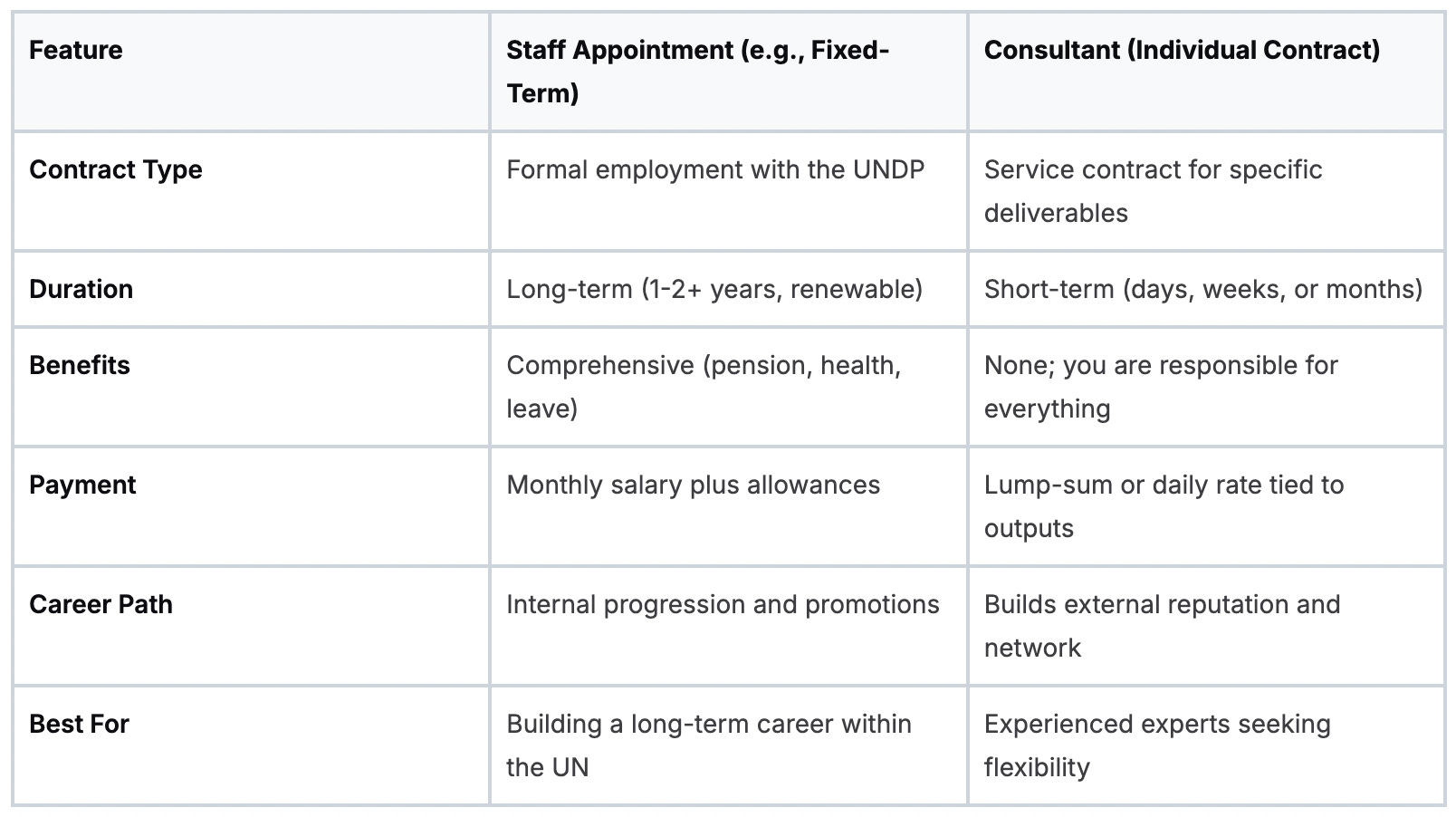
The choice comes down to what you want from your career right now. If your goal is stability and the chance to grow within one of the world’s most influential development organizations, target staff roles. If you value autonomy, possess a specialized skill, and want to build a powerful network across the entire development sector, the consultant route could be your ticket.
Your Step-by-Step Application Workflow
Getting a job at the UN Development Programme requires methodically building a case for yourself that speaks directly to the UN’s competency framework. This is your playbook for moving from the initial search to a submitted application that gets a serious look.
Your home base for this entire process is the official UNDP Jobs portal. While other sites list UNDP roles, the official portal is the source of truth. It’s where you’ll find the most detail and where you must submit your application. Mastering its search and alert functions is your first task.
The whole process boils down to a few core stages.
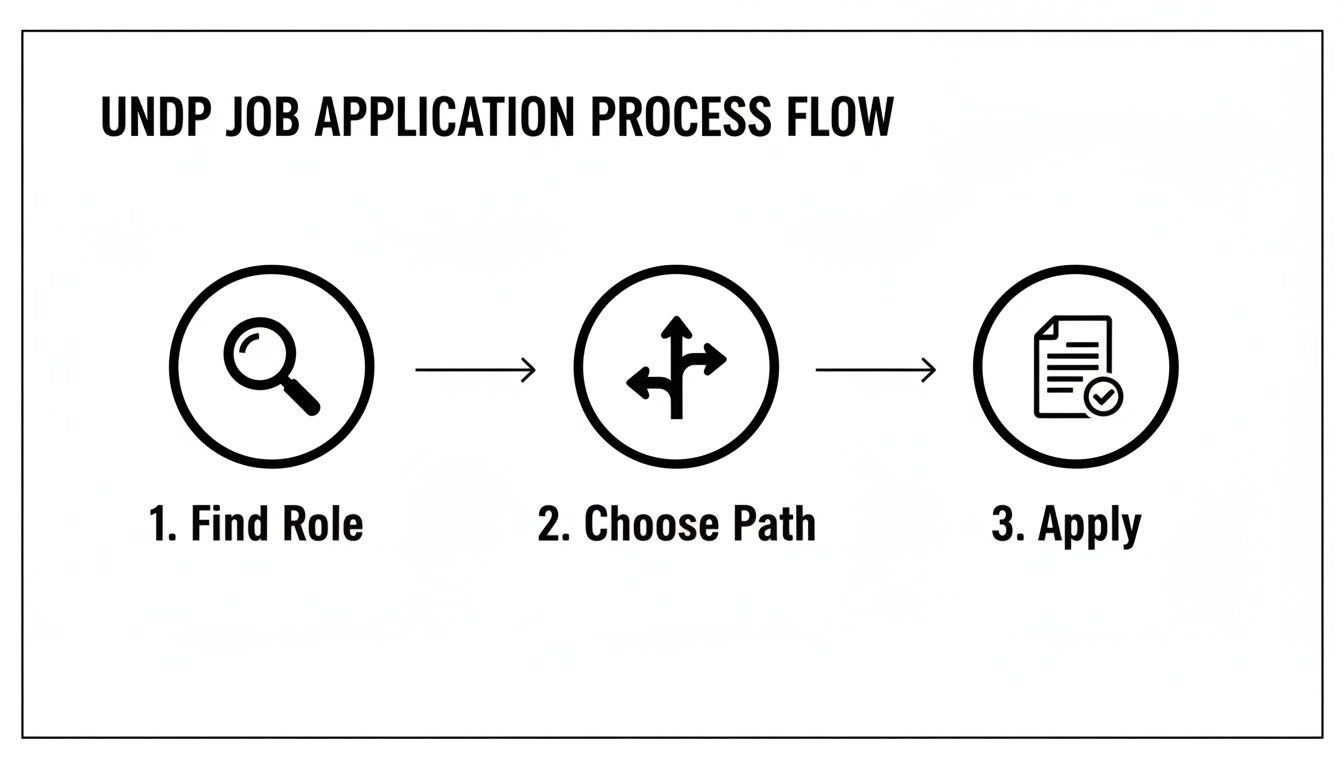
This simple flow, Find Role, Choose Path, Apply, is the foundation. It keeps your search efficient and stops you from getting lost.
Finding the Right Vacancy
First, you have to cut through the noise. The UNDP lists hundreds of openings at any given time. Using the portal’s filters is non-negotiable.
Here’s a practical way to narrow things down:
Job Category: Start here. If your background is in democratic governance, select that. Don’t waste time scrolling through general listings.
Contract Type: This is a big one. Are you aiming for a long-term Staff role or a project-based Consultancy? Decide now.
Duty Station: Get real about where you are willing and able to live and work. Filter by specific countries or broader regions to focus your energy.
Job Level: Be honest about your experience. The system uses P-levels for international staff and G-levels for general service roles. Applying for a P-5 role with only two years of experience is a waste of time.
Once you have a set of filters that match your profile, create a job alert. This is the single most effective thing you can do. The system will email you the moment a relevant new job is posted, giving you a head start.
For a wider net, you can also check out our guide on the 7 best places to find UNDP job opportunities, which points to other solid platforms.
Building Your Personal History Profile
The heart of your application is the Personal History Profile (PHP). It is a super-detailed, standardized CV that you build directly inside the UNDP’s system. It’s a bit of a slog the first time, but once it’s done, you can tweak it for future applications. Do not rush this step.
A strong PHP does two things perfectly:
It’s comprehensive. Fill out every section: education, work history, languages, references. Incomplete profiles are often the first to get screened out.
It uses the right keywords. Your PHP needs to mirror the language in the vacancy announcement. If the job description asks for experience in “project cycle management,” make sure those exact words appear in your profile.
The PHP is the primary data recruiters use to see if you qualify. A sloppy, incomplete PHP is the fastest ticket to the rejection pile, often before a human ever sees your application.
Writing a Cover Letter That Connects
The cover letter, which the UNDP often calls a “Motivation Letter,” is your chance to speak directly to the hiring manager. This is where you connect the dots between your experience and the UNDP’s mission. Keep it concise and targeted.
Many roles are directly tied to the organization’s historic focus on fighting poverty. Between 2004 and 2011, the UNDP poured over 25% of its total spending into anti-poverty initiatives, a massive investment that contributed to a global drop in extreme poverty. Showing you understand this context proves you’ve done your homework.
Structure your letter to answer three simple questions:
Why this specific job?
Why the UNDP?
Why you?
Use the vacancy announcement as your cheat sheet. Pick the top three or four required competencies and give a brief, powerful example for each from your own career. Keep it to one page. A long, generic letter is worse than no letter at all. Nail these steps, and you’ll have an application that is both technically complete and strategically compelling.
Decoding Nationality Rules and Duty Stations
If you want to speed up your job search, master the UNDP’s eligibility rules. Applying for a role you can’t be hired for is the fastest way to waste your time. The two big concepts you must get right are nationality requirements and duty station classifications.
The rules around who can apply for what are strict and non-negotiable. Getting them wrong is a classic rookie mistake. It all boils down to one distinction: are you a local hire or an international one?
International vs. National Posts
Every UNDP job falls into one of two buckets. Knowing which one you belong in will instantly focus your search.
International Professional (IP) posts: These are the jobs most people picture when they think of a UN career. They’re open to qualified candidates from any country, typically graded at the P-level (like P-3 or P-4), and you’ll be expected to relocate. The point is to bring in global expertise.
National Officer (NO) posts: These jobs are strictly for nationals of the country where the work is located. If you see a National Officer role in Nairobi, you must be a Kenyan citizen to be considered. These positions are crucial for building local talent and ensuring projects are deeply connected to the local context.
Your first move on any job portal should be filtering by “International” or “National.” This one click will immediately slash the number of vacancies and show you only the jobs that are open to you.
Many people dismiss national positions, but that’s a mistake. If you’re a professional looking to work in your home country, these roles offer a massive opportunity for impact. They’re also a powerful launchpad for a future international career.
Interpreting Duty Station Classifications
Every job posting lists a duty station, which is UN-speak for the city and country where you’ll be based. Not all duty stations are equal. The UN has a letter-based grading system that classifies locations based on living conditions, and this grade directly affects your pay, benefits, and whether you can bring your family.
The scale runs from ‘H’ (for Headquarters) down to ‘E’.
H Stations: These are the big headquarters locations like New York, Geneva, and Vienna. Think high quality of life and plenty of amenities.
A to E Stations: These are field locations, graded on security, healthcare, climate, and basic infrastructure. An ‘A‘ station is comfortable (like Bangkok or Panama City), while an ‘E‘ station is considered the most challenging, often in remote or post-conflict zones.
This matters because it tells you what you’re signing up for.
A job in a ‘D‘ or ‘E‘ duty station is almost always designated as “non-family.” It means you can’t bring your partner or kids. To make up for the hardship, these jobs come with significant extra pay like hardship allowance and danger pay, plus more frequent trips home. In contrast, jobs in ‘A’ or ‘B’ stations are usually family-friendly.
This is a practical guide to the lifestyle that comes with the job. It helps you make a clear-eyed decision about what you and your family can realistically handle, grounding your job search in reality from the start.
How to Master the UNDP Selection Process

Getting shortlisted for a UNDP job is a huge win, but it’s just the first hurdle. Now comes a series of demanding assessments designed to test your technical skills and core competencies. The entire process is about proving you can deliver results in the complex environments where the UNDP operates.
The selection process is multi-staged and can feel intense. Once you understand the logic behind each step, you can prepare strategically and show up with confidence. They aren’t trying to trip you up; they’re trying to find the best fit for the role.
Navigating the Assessment Stages
After you’re longlisted, expect to face one or more assessments before a final interview. The exact combination depends on the role, but the most common hurdles are technical written tests and asynchronous video interviews.
A technical written test is exactly what it sounds like. You’ll be given a task that simulates a real-world assignment, maybe drafting a project proposal, writing a policy brief, or analyzing a dataset. You’re being evaluated on your subject matter expertise and your ability to communicate complex ideas clearly, usually under a tight deadline.
Then there’s the asynchronous video interview. Platforms like HireVue are common. You’ll be given a set of pre-recorded questions and a short time to record your answers. It’s an odd format with no live person on the other end. The key is to practice speaking to your camera and treat it like a real, formal interview.
The Competency-Based Interview
If you clear the initial assessments, you’ll move to the main event: the competency-based panel interview. This is where it all comes together. You’ll sit down, usually virtually, with a panel of three to five people, including the hiring manager, someone from HR, and a couple of technical experts.
The panel is not interested in hearing you list your skills. They want proof. Every question is designed to get you to provide a specific example from your past that demonstrates a particular competency, like “Teamwork” or “Results-Based Management.”
This is where the STAR method becomes your best friend.
The STAR method is a simple, powerful framework for structuring your interview answers. It forces you to move beyond generic claims and provide concrete evidence of your capabilities, which is exactly what a UNDP panel needs to hear.
Let’s break it down:
Situation: Briefly describe the context. What was the challenge or project?
Task: What was your specific responsibility in that situation?
Action: What exact steps did you take? Use “I” statements, not “we.”
Result: What was the outcome? Quantify it whenever possible.
Mastering this structure is non-negotiable for success in any interview for UN Development Programme jobs.
Demonstrating Your Value and Alignment
Beyond your technical skills, the panel is looking for your alignment with the UNDP’s mission. They need to see that you get the big picture. The organization’s work is directly tied to complex global trends, from climate change to employment.
For example, a pivotal UNDP analysis highlighted the need for 734 million new jobs globally between 2010 and 2030 just to keep pace with population growth. This deep analytical work underpins development strategies worldwide. Mentioning your awareness of these macro-level challenges shows you’re not just looking for a job; you understand the mission you would be joining. You can dig into the full study on global employment forecasts and their implications to see what I mean.
Your task in the interview is to connect your personal experience directly to the UNDP’s core values. Prepare specific stories that show your integrity, professionalism, and respect for diversity. Come prepared, use the STAR method for every competency question, and you’ll make a powerful case for why you’re the right person for the role.
Your Questions About UNDP Jobs, Answered
You have questions about landing a job at the UN Development Programme. Everyone does. Here are the straight answers to the most common ones, cutting through the jargon to give you what you actually need to know.
Can I Get a UNDP Job Without a Master’s Degree?
Yes, but it’s the harder path for professional roles. For most international professional spots (the P-levels), a Master’s degree is the default expectation. Nearly all your competition will have one.
However, there’s often a workaround. Many job postings will state that a Bachelor’s degree is acceptable if you have additional years of relevant experience. This usually means you need two extra years of solid, qualifying work on top of what the role already requires. So, if a P-3 job asks for a Master’s and five years of experience, you might get by with a Bachelor’s and seven years.
This route is possible, but you have to build an incredibly strong case based on your hands-on achievements. Also, don’t forget other ways in. Internships and the Junior Professional Officer (JPO) programme are fantastic entry points for those with less formal experience or who are still finishing advanced degrees.
How Important Are Other UN Languages like French or Spanish?
For almost every international role at the UNDP, fluency in English is non-negotiable. It’s the main working language of the organization. You will not get far without professional-level command in both writing and speaking.
That said, fluency in another official UN language, especially French, Spanish, or Arabic, is a massive advantage. It’s often the tiebreaker between two equally qualified candidates. For many jobs in the field, particularly in regions where English isn’t the primary language, speaking a second language goes from a “nice-to-have” to a hard requirement.
If you’re serious about a long-term international career that involves moving between different duty stations, investing in your language skills is one of the smartest moves you can make. It directly signals that you’re committed to working effectively in a global, multicultural environment.
What Does a Realistic UNDP Salary Package Look Like?
When you look at UNDP pay, you have to look beyond the base salary. The UN system provides a competitive package that accounts for the realities of an international career. The total value is almost always much higher than the initial salary figure suggests.
The compensation for international staff is made up of a few key components:
Base Salary: This is set by your grade level (like P-3 or P-4) and is the same no matter where you are in the world. It’s the foundation of your pay.
Post Adjustment: This is the game-changer. It’s a multiplier that adjusts your base salary based on the cost of living in your duty station. It ensures your spending power is similar whether you’re in Geneva or a more affordable city. This can add a huge chunk to your take-home pay.
Benefits and Allowances: This is where the package really shines. It can include dependency allowances for a spouse and kids, an education grant for schooling, hefty contributions to the UN Joint Staff Pension Fund, and top-tier health insurance.
A UNDP job offer is a comprehensive financial and lifestyle support system, not just a paycheck.
How Long Does the UNDP Hiring Process Actually Take?
You will need patience. The UNDP hiring process is famously long, so manage your expectations from the start. From the application deadline to an offer, it’s common for the process to take six months or even longer.
This timeline is a result of the thorough vetting process. Every international hire goes through multiple layers of review: initial screening, written assessments, panel interviews, reference checks, and final approvals.
Don’t put your entire job search on hold while you wait to hear back. The best strategy is to apply, give each stage your best shot, and then keep pursuing other opportunities. The long wait is a reality of the system.
Applying for a UNDP job is a marathon, not a sprint. Knowing that upfront helps you stay sane. Keep your search active and treat any progress with the UNDP as a welcome bonus in your larger career plan.
At Multilateral Development Bank Jobs, we demystify the hiring processes of the world’s top development organizations. Subscribe to our newsletter for weekly job lists, consultant opportunities, and deep-dive career guides to land your next role at the World Bank, UNDP, and beyond. Learn more and sign up at
https://mdbjobs.com
.