

Finding a remote UN job is tough. It’s also entirely possible if you know how the system works. This guide is your playbook. It offers a clear, direct path to targeting and landing one of these coveted home-based roles.
The Reality of Remote UN Jobs

The United Nations was not designed for remote work. It’s a massive bureaucracy built on in-person diplomacy and field presence. But the world changed, and the organization is slowly catching up.
This shift creates more home-based opportunities now than ever before. It allows agencies to hire specialized talent from anywhere without the cost and logistics of relocation. These roles cover everything from short-term consultancies drafting a report to longer-term project support.
Understand why a position is remote in the first place. It’s usually for a specific, time-bound project that doesn’t require a physical presence. Think data analysis, report writing, or communications support. This setup is perfect for independent experts.
Why Competition Is Fierce
The demand for remote UN jobs has exploded. A portal like UN Talent might list dozens of home-based vacancies, but you’re competing against a massive global pool of candidates.
Remote work statistics from platforms like Vena Solutions show that while only about 10% of all job postings worldwide are fully remote, they attract 2.6 times more applications than in-person roles. The UN is no exception.
This intensity means a generic application is a waste of time. It will get lost. Success demands a focused approach, a solid understanding of contract types, and a clear grasp of what the hiring manager needs.
The biggest mistake candidates make is treating a UN application like any other corporate job. The UN has its own language, hiring culture, and rules. Learn them, and you’re ahead of 90% of the applicants.
Understanding the Different Paths
As you search, you’ll see that remote UN work falls into a few categories. Knowing the difference is critical before you apply.
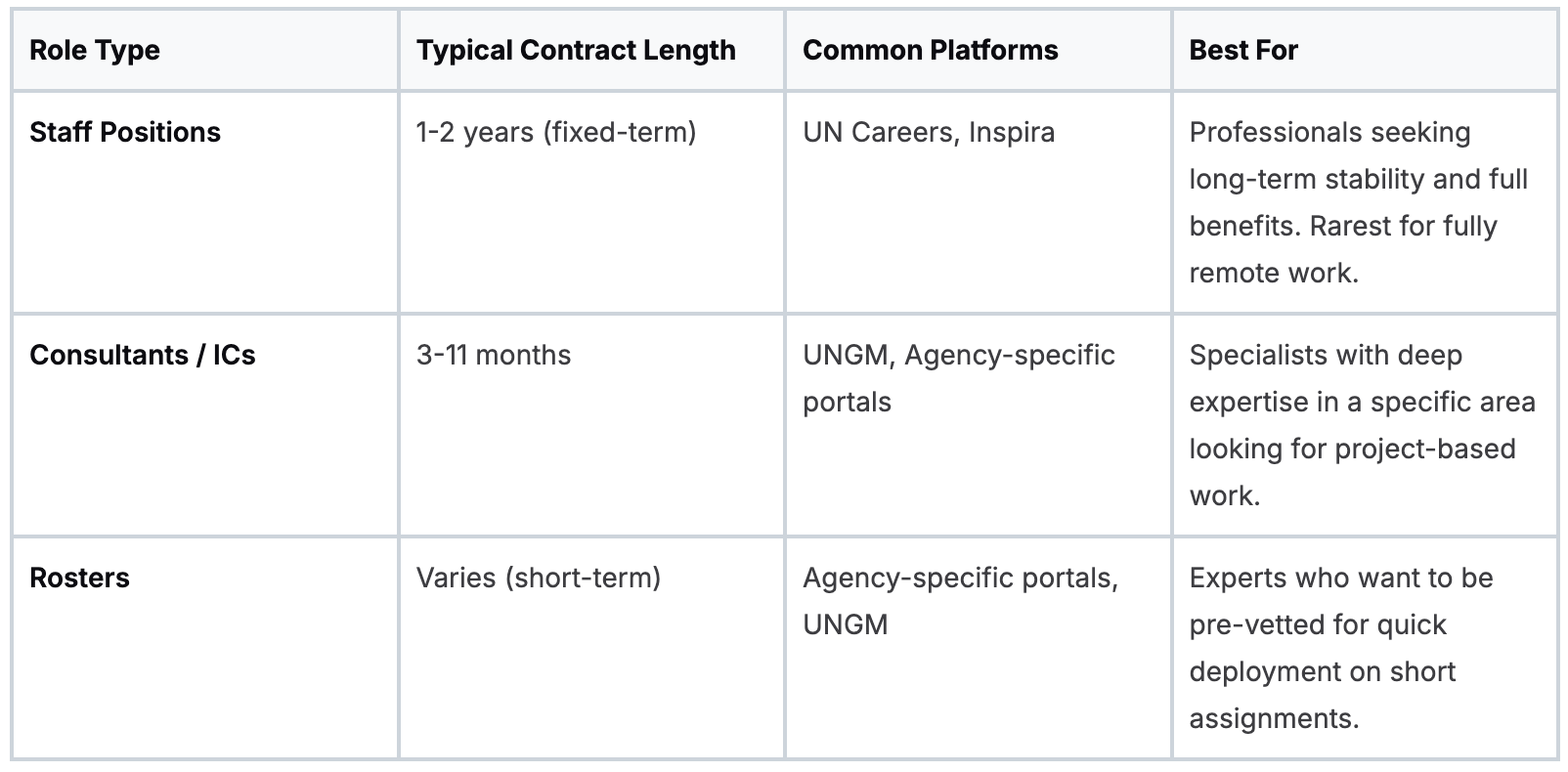
Here’s a quick breakdown.
Key Differences in Remote UN Roles
Let’s unpack these.
Staff Positions: These are the unicorns of remote UN work. When they appear, they are usually fixed-term and come with a full benefits package. They are traditional jobs done from home.
Consultants/Individual Contractors (ICs): This is where most remote opportunities are found. These are project-based roles for specialists, paid a daily or monthly rate without the full benefits of a staff member. It’s the UN’s way of bringing in specific expertise for a defined period.
Rosters: This is a strategic move. Rosters are pre-vetted pools of experts that an agency can tap for short-term assignments. Getting on one doesn’t guarantee work, but it puts you at the top of the list when a relevant opportunity arises.
Each path has different implications for pay, stability, and benefits. A staff role offers security. A consultant gig often provides a higher daily rate and more flexibility. Our detailed guide to UN staff benefits and entitlements covers these specifics.
Knowing these differences helps you tailor your search and manage expectations. This is the foundational work for building a winning job search strategy.
Where to Find Legitimate UN Opportunities
If you’re serious about landing a remote UN role, forget generic job boards. Scrolling through Indeed or LinkedIn for these specific opportunities is a losing game. The real action happens on a handful of official platforms and specialized partner sites. Go directly to the source.
The official UN Careers portal is the first place most people look. Frankly, it’s not where you’ll find the bulk of remote work. That site is built for full-time, long-term staff positions, which are rarely offered on a fully remote basis.
The goldmines for home-based work are agency-specific portals and consultant rosters. Check these platforms religiously.
The Essential Job Search Platforms
Focus your energy to build an effective search strategy. Bookmark these sites and build a routine around checking them.
UN Talent: This is a critical hub, especially for consultancies. It pulls vacancies from multiple UN agencies, including many roles from UNDP, UN Women, and UNFPA. Its search filters let you specifically isolate “Home-based” opportunities.
ReliefWeb: ReliefWeb runs a powerful job board that lists a significant number of remote consultancies from UN agencies and major international NGOs. It’s particularly strong for roles in disaster response, development, and human rights.
UN Global Marketplace (UNGM): This is the official procurement portal for the UN system. It looks like it’s for companies, but it’s also where many agencies post notices for Individual Contractor (IC) opportunities. It’s clunky but essential for anyone serious about consulting.
Agency-Specific Rosters: This is the inside track. Many UN agencies maintain their own rosters of pre-vetted experts. Getting on one is a game-changer. UNDP’s consultant roster is a primary source for their short-term gigs. You apply once to get vetted, and hiring managers can contact you directly for projects without a public advertisement. Learn more in our guide on the best places to find UNDP job opportunities.
Building a Smart Search Workflow
Create a system so you don’t get overwhelmed. Spending all day refreshing pages leads to burnout. You need an automated, focused approach.
Set up email alerts on every platform that offers them. Use specific keywords related to your expertise, like “health policy consultant,” “gender analysis,” or “climate finance,” and combine them with the “home-based” or “remote” filter. This brings the right opportunities to your inbox.
Your goal is to find the 3-5 highly relevant openings each month that perfectly match your skills. A targeted approach with exceptional applications beats a scattergun approach every time.
As of early 2024, a quick search on UN Talent reveals dozens of remote gigs: rural sanitation financing in Cameroon, civil protection manuals for disaster risk, carbon markets management for UNDP.
This constant flow reflects a bigger trend. Globally, about 26% of remote-eligible jobs are fully remote, and this number is growing. You can explore current remote UN listings on UN Talent to see the range of roles.
The sheer volume proves that a methodical search process is non-negotiable. Treat it like a project. Create a simple spreadsheet to track jobs, deadlines, and submission status. This organization keeps you from missing key dates and helps you spot patterns in the types of roles being advertised.
This professional discipline separates successful candidates from the rest.
Decoding UN Vacancy Types And Eligibility
To get a remote UN role, you have to speak the language. The system is built on specific contract types and eligibility rules that feel opaque from the outside. Cracking this code is the difference between applying into the void and targeting roles you can actually get.
First, UN “jobs” are not all created equal. The UN relies heavily on non-staff contracts for specialized, short-term expertise. This is where you’ll find most remote opportunities.
Staff vs. Non-Staff Contracts
The biggest divide is between staff and non-staff personnel.
A staff position is a traditional role with a fixed-term contract (usually a year or more), a full benefits package, and a structured salary. These are almost never fully remote.
Most home-based work uses non-staff contracts. These are project-based agreements for consultants or Individual Contractors (ICs). You’re hired for a specific task over a set period and are legally considered an independent contractor.
This decision tree gives you a quick visual on where to focus your job search based on the most common platforms for different UN roles.
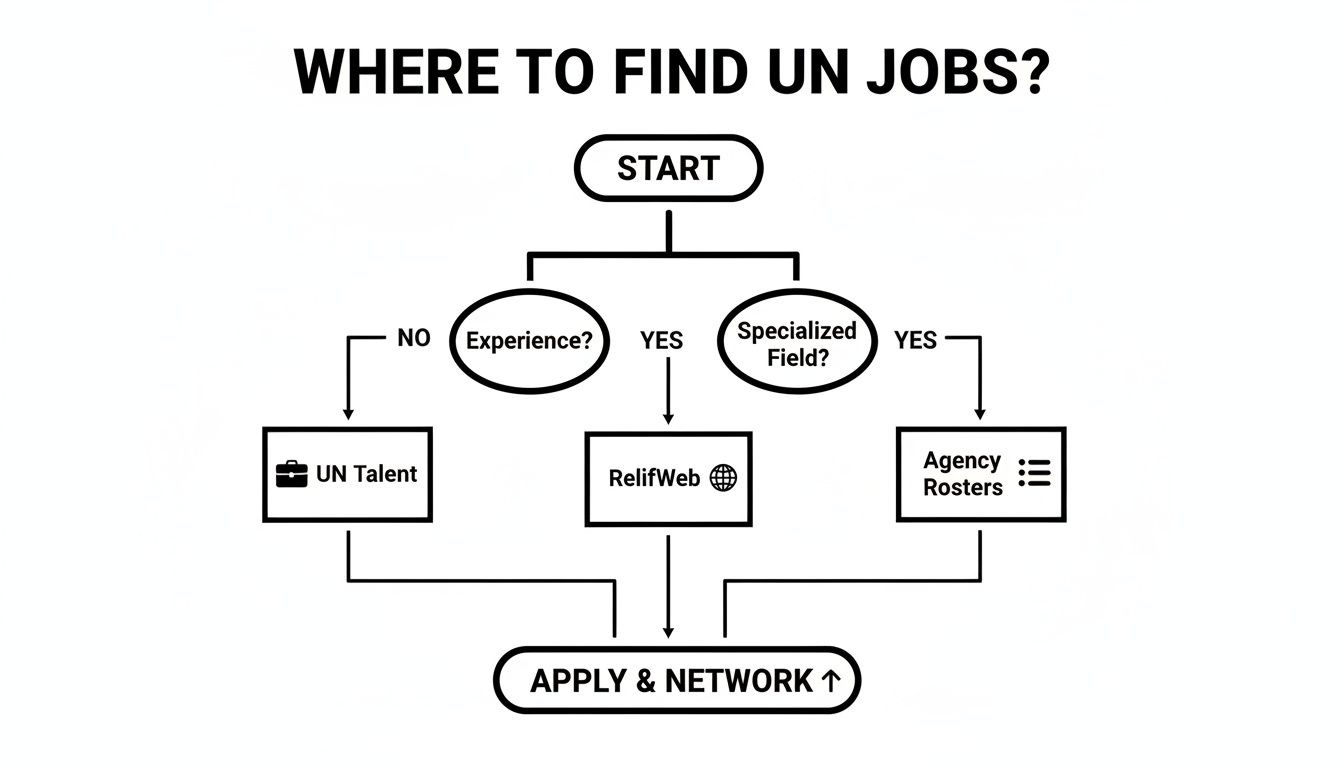
As the flowchart shows, specialized platforms like the UN’s own talent portals and individual agency rosters are goldmines for consulting gigs, though you shouldn’t ignore the broader job sites either.
The Reality Of “Home-Based” Consultancies
When a UN vacancy is listed as “home-based,” you are an independent contractor. You’re responsible for your own workspace, equipment, and taxes. You won’t get the standard benefits staff members do.
Here’s the breakdown:
No Benefits Package: There’s no health insurance, paid holidays, or pension contributions from the UN. You are on your own for all of it.
Tax Responsibility: You are personally responsible for paying all income taxes in your country of residence. The UN pays you a gross fee and does not withhold anything.
Flexibility and Autonomy: The trade-off is freedom. As a consultant, you’re paid for deliverables, not hours. This gives you significant control over your schedule.
You must factor the lack of benefits and your tax obligations into your financial calculations. A high daily rate for a consultancy looks attractive, but it needs to cover costs that a staff salary would otherwise include. Always consult a local tax professional.
This contractor model is central to UN operations. It lets them bring in world-class experts for specific needs without the long-term commitments of a full staff appointment. Explore a practical guide to UN development careers to dive deeper into these paths.
Remote UN Contract Types Compared
To help you decide which roles to target, here’s a quick comparison of the most common remote-friendly contract types.
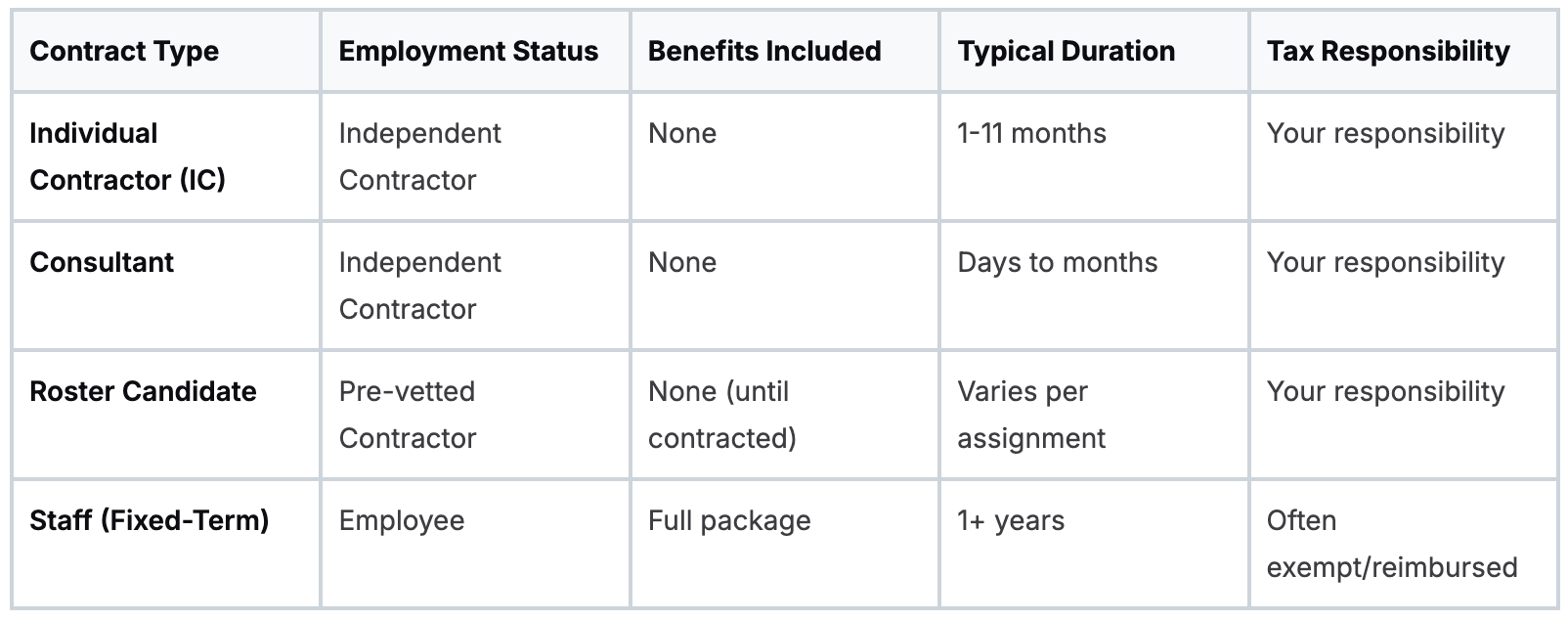
Most remote roles fall into the first three categories. Focusing on IC and consultancy contracts is your best bet.
Navigating Nationality Requirements
Eligibility is the other critical hurdle.
UN jobs, especially staff positions, are often subject to strict nationality rules to ensure geographical representation. It’s common to see vacancies open only to nationals of a specific country or region.
Consultancies are often more flexible. For many remote UN jobs advertised as “home-based,” the hiring manager’s main goal is to find the best expert for the job. Location and nationality are secondary to skill.
That said, some roles will still have restrictions.
Always check the “Eligibility” or “Requirements” section of the vacancy announcement first. This saves frustration. If it states “open to all nationalities,” you’re good. If it specifies certain countries, don’t apply unless you’re a citizen. It’s a non-negotiable filter.
How to Tailor Your Application for the UN System
Your standard corporate resume is a non-starter in the UN system. Applying with one is the fastest way to get your application tossed.
The UN uses a highly structured, competency-based screening process. To get past the initial algorithms and human reviewers, your application needs to speak their language. Every time.
Dissecting the Vacancy Announcement
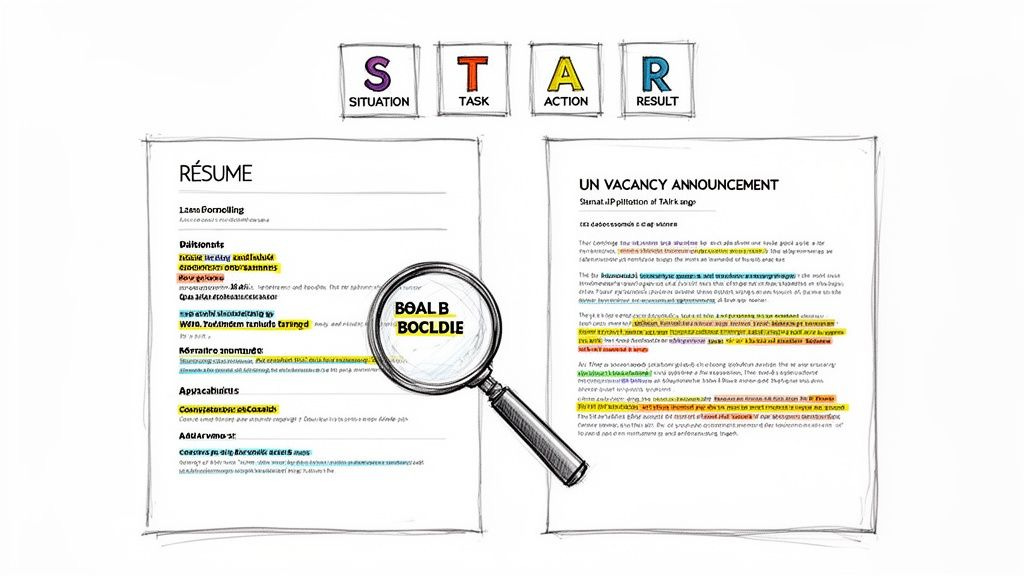
The Vacancy Announcement (VA) is your blueprint. It contains every keyword, competency, and requirement the hiring manager is looking for. Your job is to pull out these clues and mirror them precisely in your application.
Print it out. Use a highlighter. Go through it line by line and make separate lists for:
Duties and Responsibilities: These are the day-to-day tasks. Note the action verbs like “analyze,” “coordinate,” “draft,” or “monitor.” Use these same words to describe your experience.
Competencies: This is UN-speak for soft skills, and they are non-negotiable. You’ll always see Professionalism, Teamwork, and Planning & Organizing.
Required Skills and Experience: This section lists hard skills, academic qualifications, and years of experience. Look for specifics like “experience with statistical software” or “knowledge of international human rights law.”
This process creates a checklist. Your Personal History Profile (PHP) and cover letter must directly address every item you highlighted. If the VA asks for project management experience, you must show exactly where and how you’ve managed projects.
Building Your UN Application
The UN requires a detailed, comprehensive Personal History Profile (PHP), often completed in an online portal like Inspira. These forms are long and exhaustive by design.
Fill it out completely, weaving in the keywords from the VA. Don’t leave sections blank. For every professional role, write a description that directly reflects the duties and responsibilities in the job post.
The biggest mistake applicants make is being too brief. A UN application is not the place for modesty. Spell out your experience in excruciating detail, connecting every achievement from your past to the future needs of the role.
This is especially true for remote consultants, where demonstrating specific, technical expertise is everything. UN home-based jobs show how location-independent expertise has become critical, particularly in fields like data and statistics. A quick search on a platform like Indeed turns up over 100 international statistics remote positions, which shows the trend. A recent UN Careers post for a Statistics-focused Stakeholder Mapping role demanded skills in job network analysis that can be done entirely online.
Mastering the STAR Method for Impact
You can’t just state what you did. You have to provide concrete evidence of your skills. The entire UN system is built around the STAR method, and using it is the only way to frame your accomplishments effectively.
The STAR method provides a simple, powerful structure:
S - Situation: Briefly set the scene. What was the project or challenge?
T - Task: What was your specific responsibility?
A - Action: What exact steps did you personally take? Use strong action verbs.
R - Result: What was the outcome? Quantify it with numbers whenever you can.
Instead of a boring line like “Managed a project budget,” you transform it with STAR.
Situation: The project was facing a 15% budget overrun due to unforeseen procurement delays that threatened our work. Task: My task was to immediately realign the budget without compromising key project deliverables. Action: I conducted a line-by-line review of all expenditures, personally renegotiated contracts with two key vendors, and reallocated funds from non-essential travel to critical equipment. Result: This led to a 10% cost savings, bringing the project back on budget and ensuring its successful completion.
This approach gives the hiring manager tangible proof of your capabilities. It elevates your application from a list of duties to a portfolio of achievements.
Crafting a Compelling Cover Letter
Your cover letter is your one-page sales pitch. It is your best chance to make a direct, personal case for why you are the perfect candidate for this specific role.
Keep it to one page. Structure it clearly:
Introduction: State the exact position title and where you saw it advertised. Express your genuine enthusiasm for the role.
Body Paragraphs: Pick two or three of the most critical requirements from the VA. Dedicate a short paragraph to each one, explaining exactly how your experience meets that need. This is another perfect place to use a mini-STAR example.
Conclusion: Reiterate your strong interest in the role and the organization’s mission. State your availability and thank the hiring manager for their time.
Avoid generic fluff like “I am a hard worker.” Instead, prove it. Show them an example of how your hard work led to a measurable, impressive outcome. This tailored, evidence-based approach gets your application onto the shortlist.
Networking and Interviewing for Remote Roles

In the UN ecosystem, your application is half the story. Submitting your profile and hoping for the best is a rookie mistake. Connections are an integral part of how the system works.
Effective networking is about building professional relationships and gathering intel.
Your secret weapon is the informational interview. It’s a brief, focused conversation with current UN staff to get the inside scoop on their work, the agency’s culture, and its real challenges. This insight is gold when it’s time to tailor your application and succeed in the real interview.
Connecting with UN Insiders
LinkedIn is your primary hunting ground. It’s where you can find people working in the exact agencies or thematic areas you’re targeting.
Don’t just hit “Connect.” That generic request will be ignored 99% of the time. Your outreach message must be respectful of their time and clear about why you’re reaching out.
Here’s an effective message you can adapt:
“Dear [Name], I’m a [Your Profession] specializing in [Your Field] and have been following the work of [Their Agency] with great interest, particularly the [Specific Project or Initiative]. Would you be open to a brief 15-minute virtual chat in the coming weeks? I’d value your perspective on your experience at the agency.”
It’s specific, professional, and shows you’ve done your homework. You aren’t asking for a job; you’re asking for advice. This distinction dramatically boosts your chances of getting a “yes.”
Mastering the Competency-Based Interview
If your application makes the shortlist, prepare for a competency-based interview. This structured format is designed to remove bias. They assess your skills based on past behavior.
You won’t hear questions like, “How would you handle a conflict?”
Instead, they’ll ask, “Tell us about a time when you had to...” This is where the STAR method becomes your best friend. For a remote role, questions will focus on your ability to work independently and collaborate virtually.
Expect them to probe these core remote-work skills:
Communication: Tell us about a time you had to explain a complex technical issue to a non-technical stakeholder via email or video call. How did you ensure they understood?
Planning & Organizing: Describe a situation where you had to manage competing deadlines for a project while working from a different time zone than your team. How did you prioritize your tasks?
Teamwork: Give an example of a time you built a strong working relationship with a colleague you had never met in person. What steps did you take?
Before your interview, brainstorm specific stories from your career that match each competency in the vacancy announcement. Write them out using the STAR format. Practice saying them out loud until they sound natural.
Negotiating Your Remote Contract
For consultant and Individual Contractor (IC) roles, discussing money is a critical step. Unlike a staff position with a set salary grade, you’ll be asked to propose a daily or monthly rate. This is a negotiation.
First, do your homework. The UN often has internal bands for consultant fees based on experience levels. While these aren’t always public, you can find clues by talking to people in your network or checking similar roles.
Your proposed rate must be an all-inclusive figure. This is key. It has to cover everything:
Your professional fee.
All overhead costs (internet, software, equipment).
Health insurance and other benefits.
Tax liabilities in your country of residence.
When you present your rate, be ready to justify it based on your experience, the complexity of the work, and market rates. Frame it confidently. Pitching too low can signal a lack of experience. Treat it like a professional discussion about the value you bring.
Navigating UN Hiring Timelines and Follow-Up
If you’re applying for a remote UN job, patience is a non-negotiable requirement. The hiring process is famously slow. It’s normal to forget you applied, only to get an interview request months later.
The timeline depends on the role. A short-term consultancy can move fast, sometimes going from ad to offer in a few weeks. A full-time staff position can easily take six months or more. Multiple review panels and bureaucratic checks happen behind the scenes.
What Happens After You Hit ‘Submit’?
Your application enters a multi-stage process that explains the long silences.
Eligibility Screening: An initial check, often automated, makes sure you meet the minimum requirements for education and experience.
Creating the “Longlist”: HR reviews eligible applications, looking for candidates who clearly match the job description. This is where your tailored application pays off.
Making the “Shortlist”: The hiring manager and a review panel select the top candidates for interviews. Getting to this stage is a major win.
Assessments & Interviews: Shortlisted candidates face interviews, written tests, or both. Scheduling these can take weeks.
The Final Decision & Vetting: After interviews, the panel makes its pick. Their recommendation goes through more approvals, and then they check your references before drafting an offer letter.
This process can involve a dozen people. It’s not slow because it’s disorganized; it’s slow because it’s designed to be thorough.
Don’t take the silence personally. The UN system is built on process and procedure. It’s methodical by design.
The Right Way to Follow Up
Following up is a delicate dance. Pestering the hiring manager will get you remembered for the wrong reasons. A single, polite, and well-timed email is all you need.
Wait about two to three weeks after the application deadline has passed. If you’ve already had an interview, give it a week before you check in.
When you reach out, email the HR contact listed in the vacancy announcement. Keep it short, professional, and to the point.
Here’s a simple template:
Subject: Follow-up: [Position Title], [Vacancy Number]
Dear [HR Contact Name],
I hope this message finds you well.
I’m writing to follow up on my application for the [Position Title] role and to reiterate my strong interest. I particularly enjoyed learning more about [mention something specific from the interview or job description] and remain confident that my skills in [mention 1-2 key skills] would be a great asset to your team.
I was hoping you might be able to share a quick update on the status of the hiring process.
Thank you for your time and consideration.
Best regards,
[Your Name]
This approach is respectful and shows you’re still keen without being pushy. After you send this email, the ball is in their court. Focus on other applications.
Burning Questions About Remote UN Work
The idea of doing meaningful UN work from home is appealing, but it raises questions. Let’s tackle the most common ones.
Are These Jobs Open to Everyone, Regardless of Nationality?
It’s a mix. You have to read the fine print on every vacancy.
Many home-based consultant and Individual Contractor (IC) gigs are open to all nationalities. The hiring manager’s goal is to find the best expert for a specific task, regardless of location.
For staff positions and many consultancies, nationality rules are strict. This ensures geographical diversity. The first thing you should do is scroll to the “Eligibility” or “Qualifications” section of the job ad. If it specifies a nationality and you’re not a citizen, don’t apply. It’s an instant disqualification.
What’s the Pay Like?
Pay for remote UN work varies wildly by contract type.
Staff Positions: These are rare for remote roles but follow a rigid, public salary scale based on the job’s grade level (like P-3 or P-4). The pay is predictable but less common for home-based work.
Consultants/ICs: Most remote opportunities fall here. You’re paid a daily or monthly fee, which you negotiate. That rate must cover your expertise and all business overhead, like taxes and insurance. Rates can swing from $300 to over $1,000 per day for highly specialized, senior-level advice.
Do Remote Consultants Get UN Benefits Like Pensions and Health Insurance?
No. This is the most important thing to understand.
As a home-based consultant or Individual Contractor, you are not a UN staff member. You are an independent contractor. You are 100% responsible for your own health insurance, pension contributions, taxes, and paid time off.
The daily fee you negotiate must be high enough to cover all those costs yourself. Don’t underestimate this. It’s a massive financial difference compared to a staff role.
How Do I Stand Out From the Crowd?
Tailoring your application is everything. Sending a generic resume is the fastest way to get ignored.
Become a detective. Dissect the Vacancy Announcement, pull out the exact keywords and competencies, and mirror that language directly in your Personal History Profile (PHP) or resume.
When you describe your experience, use the STAR method (Situation, Task, Action, Result). Don’t just list what you did; show the impact you had with concrete, quantifiable examples. A bullet point that says “Increased project efficiency by 25% by implementing a new tracking system” is infinitely more powerful than “Was responsible for project tracking.” This is how you prove your value before you get to an interview.
At Multilateral Development Bank Jobs, we cut through the noise to bring you curated lists of staff and consultant opportunities from over 30 MDBs and the UN system. Subscribe to our newsletter for weekly job alerts and insider guides delivered straight to your inbox.