

The demand for skilled development economists is strong, and it’s coming from places you might not expect. This isn’t about being a stuffy academic or a lone analyst in a government basement.
Today’s field is driven by real-world challenges, from hitting the UN’s Sustainable Development Goals to helping tech giants break into emerging markets. This creates a variety of roles, from policy analysts at Multilateral Development Banks (MDBs) to data scientists in the private sector.
The Real Landscape of Development Economist Jobs
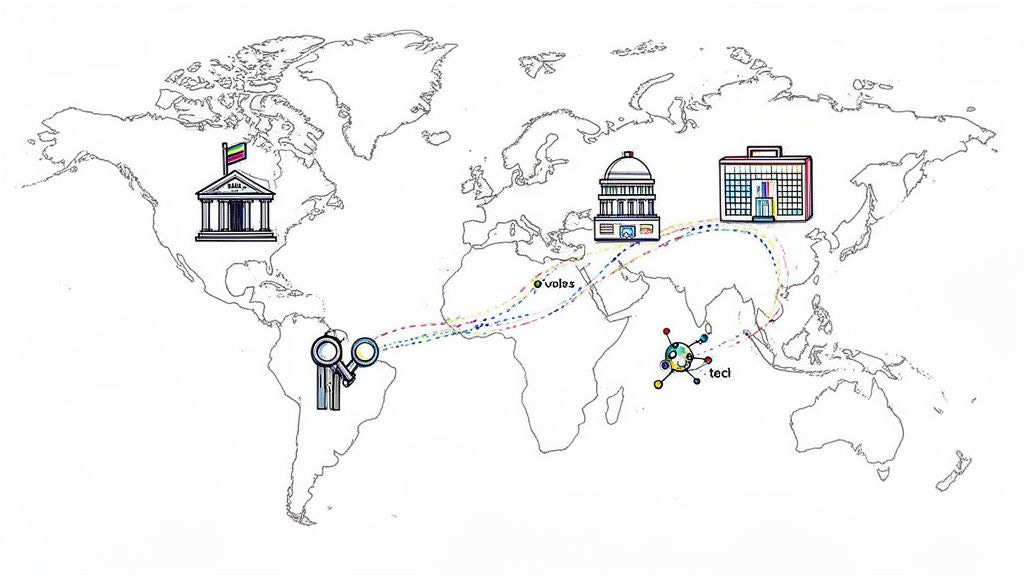
If you’re serious about finding a development economist job, you need to look past the obvious headliners like the World Bank or the International Monetary Fund (IMF). Those are great institutions, but they represent only part of the story. The real opportunities are scattered across a much wider ecosystem.
Think government agencies, high-powered think tanks, specialized economic consulting firms, and big tech companies. Your specific skills: managing messy datasets, running rigorous impact evaluations, and turning complex analysis into clear policy advice, are exactly what these places are hunting for.
Snapshot of the Development Economist Job Market in Early 2026
To give you a real-time feel for the market, here’s a summary of what you’ll find on major job boards right now. This isn’t an exhaustive list, but it paints a clear picture of the demand.

The opportunities are there, and they’re well-compensated. The key is knowing where to look and how to position yourself for the roles that best fit your skills.
Where the Demand Is Strongest
The need for your expertise is proven by the numbers. Right now, a platform like Indeed shows a healthy 969 development economist positions in the United States alone. These jobs run the gamut from entry-level analyst roles to senior positions demanding 10+ years of experience.
This demand is concentrated in a few key areas:
Multilateral Development Banks (MDBs): The usual suspects: the World Bank, Asian Development Bank (ADB), and African Development Bank (AfDB), are always hiring. They need economists for country-level analysis, project appraisal, and deep-dive sectoral research.
Economic Consulting: Firms like Berkeley Research Group or Analysis Group hire PhD-level economists to provide expert testimony and analysis for litigation, regulation, and corporate strategy, often touching on developing economies.
Government and Bilateral Agencies: Organizations like USAID or the UK’s Foreign, Commonwealth & Development Office (FCDO) are big employers. You’ll focus on program design, monitoring, and evaluating the effectiveness of aid.
The Private Sector: This is the big one people miss. Tech companies and multinationals need economists for market analysis, risk assessment, and forecasting as they expand into new regions.
Here’s the takeaway: Your quantitative training opens doors far beyond the traditional public policy track. Private sector firms now directly compete with MDBs for the same talent, especially for roles that blend economics with data science.
The Shift in Required Expertise
The job itself has changed. A decade ago, a solid grasp of macro or micro theory was your main ticket in. That’s not the case anymore.
Today, the game is all about applied empirical skills. Employers expect you to walk in with hands-on experience using statistical software (like Stata or R) and maybe some programming languages (like Python). Your ability to work with real-world data gets you hired.
What This Means for Your Job Search
This diverse landscape means a scattergun approach won’t work. Sending out a generic resume is a surefire way to get ignored. You have to tailor your application to the specific sector you’re targeting.
For an MDB, highlight your experience with policy analysis and large-scale surveys. For a consulting firm, emphasize your econometric modeling chops and ability to work under pressure. For a tech company, showcase a project where you used machine learning to predict user behavior in an emerging market.
Understanding this landscape is the first, most critical step. It lets you build a focused job search strategy and position yourself as the perfect fit for the roles you actually want. The jobs are out there. They reward the people who know how to play the game.
What Top Development Economist Jobs Actually Pay
Let’s cut right to it. You need to know what a career in development economics actually pays. The numbers are all over the map, so forget the simple averages. You need to understand where the real earning potential is.
Your pay packet will come down to three big things: the sector you’re in, your credentials (think Master’s vs. PhD), and your years of relevant experience. Getting a handle on these is how you plan your career and, just as importantly, negotiate your salary.
Publicly available data gives us a decent, if fuzzy, starting point. As of March 26, 2026, the average annual pay for a development economist in the United States sits around $82,064. Honestly, that number hides the massive upside. For a better look at premium roles, check out the latest salary data for development economists on ZipRecruiter.
The Private Sector Premium
If you’re chasing the highest salaries, look to the private sector. Tech companies and top-tier economic consulting firms consistently pay top dollar, putting a huge premium on specialized quantitative skills that can drive their bottom line.
A PhD is often your ticket into these roles. Just look at recent job postings. A Staff Economist role at Google in Virginia, for example, listed a salary range of $192,000 to $278,000. Over at Berkeley Research Group, a Managing Economist position commands between $200,000 and $260,000. These aren’t outliers. They reflect the demand for economists who can apply rigorous modeling to real-world business problems.
MDB Compensation Packages
Multilateral Development Banks (MDBs) play a different game. Their compensation is competitive but structured in a unique way. While the base salary might not always hit the absolute peak of a tech giant, the overall package is incredibly compelling.
For many international staff, these salaries are tax-free. This depends on your nationality and the bank’s charter, but it’s a game-changer.
Take the World Bank‘s Young Professionals Program (YPP), a highly sought-after entry point for PhDs and exceptional Master’s grads. A YP’s starting salary is internationally competitive and bundled with a serious benefits package, including health insurance, retirement plans, and relocation support. You can get a full breakdown in our comprehensive World Bank economist salary guide.
An MDB’s total compensation is more than the net salary. The tax-free status for many international staff, generous benefits, and pension plans create a financial package that often exceeds what a higher gross salary in the private sector can offer.
Compensation by Career Stage
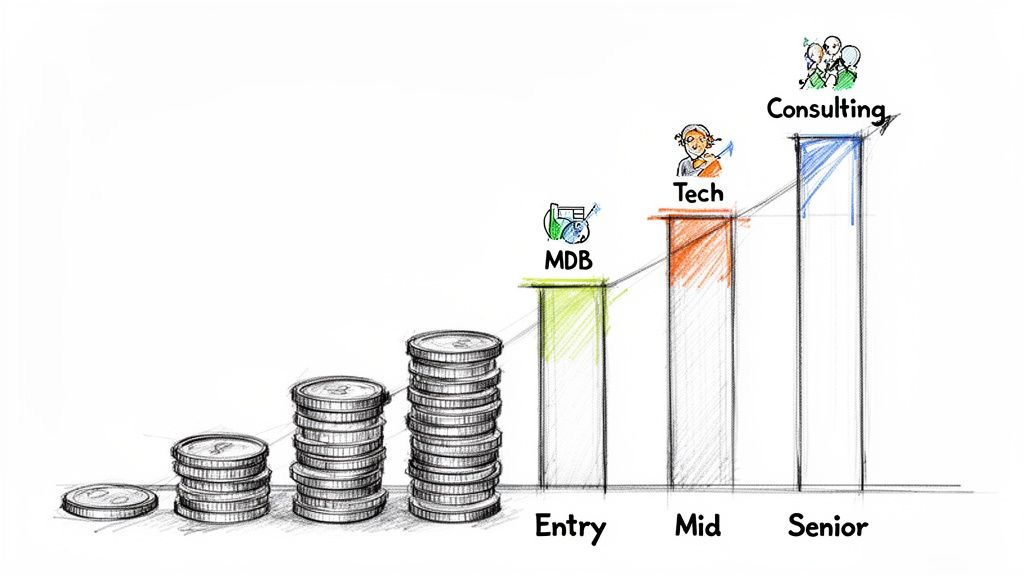
Your earning potential ramps up significantly as you gain experience and move into senior roles. Here’s a realistic look at what you can expect at different stages.
Entry-Level (0-3 years): With a Master’s, you’re likely starting as a research assistant or analyst in the $70,000 to $95,000 range. If you have a PhD and land a spot in an MDB program like the YPP, you could start closer to $110,000 - $130,000, plus all the benefits.
Mid-Career (4-10 years): This is where paths really start to diverge. An experienced economist at an MDB could be earning $140,000 to $190,000. In a private sector consulting role, you could easily push past $200,000 with performance bonuses.
Senior/Principal (10+ years): At this point, you’re leading teams and setting strategy. Senior economists at MDBs can earn well over $200,000. In tech or consulting, principal economists with in-demand expertise can command salaries pushing $300,000 or more, especially when you factor in equity and bonuses.
Understanding these benchmarks is critical. It helps you set realistic goals, target the right opportunities, and strategically build a career that matches your financial ambitions.
The High-Demand Skills That Get You Hired
A Master’s or PhD in economics is the entry ticket. Specific, practical skills actually land you the job. Top employers want to see what you can do. If you want to stand out from the thousands of other applicants with similar degrees, you need to master the real tools of the trade.
Let’s get into the exact competencies that hiring managers at places like the World Bank are looking for right now. This is your checklist for what to build and what to plaster all over your resume.
The Non-Negotiable Quantitative Toolkit
Your quant skills are your primary currency. Your degree proves you get the theory. Your ability to wrangle data and run models proves you have practical value from day one. You absolutely have to show proficiency with the software used for serious empirical work.
These are the core tools you’ll be expected to know:
Stata: This is still the undisputed workhorse for most development economists in MDBs and academia. You need to be comfortable with everything from data cleaning (
merge,reshape,egen) to running complex regressions and instrumental variable models (xtreg,ivregress).R: It’s getting more popular, especially in research-heavy units and among younger economists. Its power in data visualization (
ggplot2) and machine learning makes it a highly valuable skill.Python: Essential if you’re eyeing roles that touch on data science, which an increasing number of development economist jobs now do. Knowing libraries like
pandasfor data manipulation,statsmodelsfor econometrics, andscikit-learnfor machine learning is a huge plus.
You don’t need to be a god-tier expert in all three, but you must have deep expertise in at least one (realistically, Stata) and a solid working knowledge of another. This signals you’re adaptable and can plug into different teams without a massive learning curve.
Proven Experience with Data and Evaluation
Theory is one thing; hands-on experience is what separates contenders from pretenders. Hiring managers want to see that you’ve gotten your hands dirty with real-world data and messy projects.
The single most valuable asset on your CV is demonstrable experience with rigorous impact evaluation. It signals that you can move beyond correlation to credibly measure causal effects, the gold standard in modern development economics.
You need to show you have worked directly with:
Large-Scale Survey Data: This means experience with household surveys like the Living Standards Measurement Study (LSMS) or Demographic and Health Surveys (DHS). Show that you can handle complex survey weights, manage messy data, and construct meaningful variables from raw files.
Impact Evaluation Methods: You must be able to discuss and apply methods like Randomized Controlled Trials (RCTs), Regression Discontinuity (RD), and Difference-in-Differences (DiD). Having a project on your resume where you used one of these to answer a real-world question is a massive advantage. Our guide on how to improve analytical skills can help you frame this experience effectively.
The ‘Soft’ Skills That Seal the Deal
Your technical skills get your application noticed. Your soft skills get you hired and, more importantly, allow you to succeed in the job. Development economics is an intensely collaborative and often political field. You’re an advisor, a negotiator, and a communicator.
These practical skills are absolutely critical:
Stakeholder Management: You’ll be working with everyone from government ministers and local NGOs to internal project teams and senior bank management. You have to be able to listen to their needs, manage their expectations, and build consensus around your findings, especially when the results are politically sensitive.
Cross-Cultural Communication: Your work will take you across the globe. Demonstrating that you can communicate clearly and respectfully with people from wildly different cultural and professional backgrounds is a core requirement.
Translating Complexity into Action: This is perhaps the most important skill of all. Can you take your complex econometric results and explain them in plain language? A minister doesn’t care about your p-values. They want to know if a program is working and what to do next. Your real value is in bridging that gap between technical analysis and actionable policy advice.
A Practical Playbook for MDB Recruitment
Navigating the recruitment process for a Multilateral Development Bank (MDB) can feel like trying to find a specific room in a massive, unmarked building. It’s often opaque, confusing, and intensely frustrating if you don’t have a map.
This is your map.
The first mistake most people make is parking themselves on the main career portals of the World Bank or IMF and just hitting refresh. While you should absolutely monitor those sites, you’re missing a huge part of the picture. The real game is played elsewhere.
Finding the Right Opportunities
Your job search has to be active, not passive. This means getting yourself on the right mailing lists and niche job boards that pull together listings from across the entire MDB ecosystem.
Websites like MDBjobs.com are built specifically for this, sending curated lists of both staff and consultant roles directly to your inbox. This gives you a massive advantage over the candidates who only check the main bank websites sporadically. You see the roles first.
You also need to think beyond the “Economist” title. Your search should include keywords and titles like:
Program Officer
Operations Analyst
Research Analyst
Results Management Specialist
Sector Specialist (e.g., Health, Energy, Transport)
These jobs often demand the exact same quantitative and analytical skills. Because they’re housed in different departments, they frequently attract less direct competition from the thousands of other economists applying for the handful of explicitly named “Economist” jobs.
Tailoring Your Application
Once you find a role, sending in a generic CV is the fastest way to get your application deleted. MDB hiring is all about matching. Your application needs to be a direct, unignorable response to the specific language and priorities of that job description.
Think of your CV and cover letter as a direct answer to the job posting. Your goal is to make it incredibly easy for the recruiter to see that your experience lines up perfectly with their stated needs. Don’t make them dig for it.
For example, if the Asian Development Bank (ADB) lists “experience with results-based management frameworks” as a key requirement, your CV better have that exact phrase. Don’t just say you “monitored project outcomes.” Describe a project where you applied those principles. If you’re not fluent in this terminology, you need to be. You can get up to speed by reading our deep-dive on what results-based management actually is. This shows you speak their language.
Decoding the Job Description
MDB job descriptions are dense, but they contain all the clues you need. Get a highlighter. Print it out. Your mission is to pull it apart and find the core technical skills, the country or regional experience, and the specific institutional priorities they mention.
Here’s how to do it:
Isolate the Verbs: Look for all the action words like “analyze,” “evaluate,” “manage,” “design,” and “advise.” These are the verbs you need to use in your own CV’s experience section to describe your accomplishments.
Highlight Key Nouns: Find every specific tool (Stata, R), methodology (RCTs, CGE modeling), or policy area (climate finance, social protection) mentioned. These are your keywords.
Restructure Your CV: Create a “Technical Skills” section right at the top of your CV and list these keywords. Then, re-order the bullet points under your work experience to lead with the accomplishments most relevant to this specific role.
This infographic shows how your education is just the foundation. The skills you build on top get you hired.
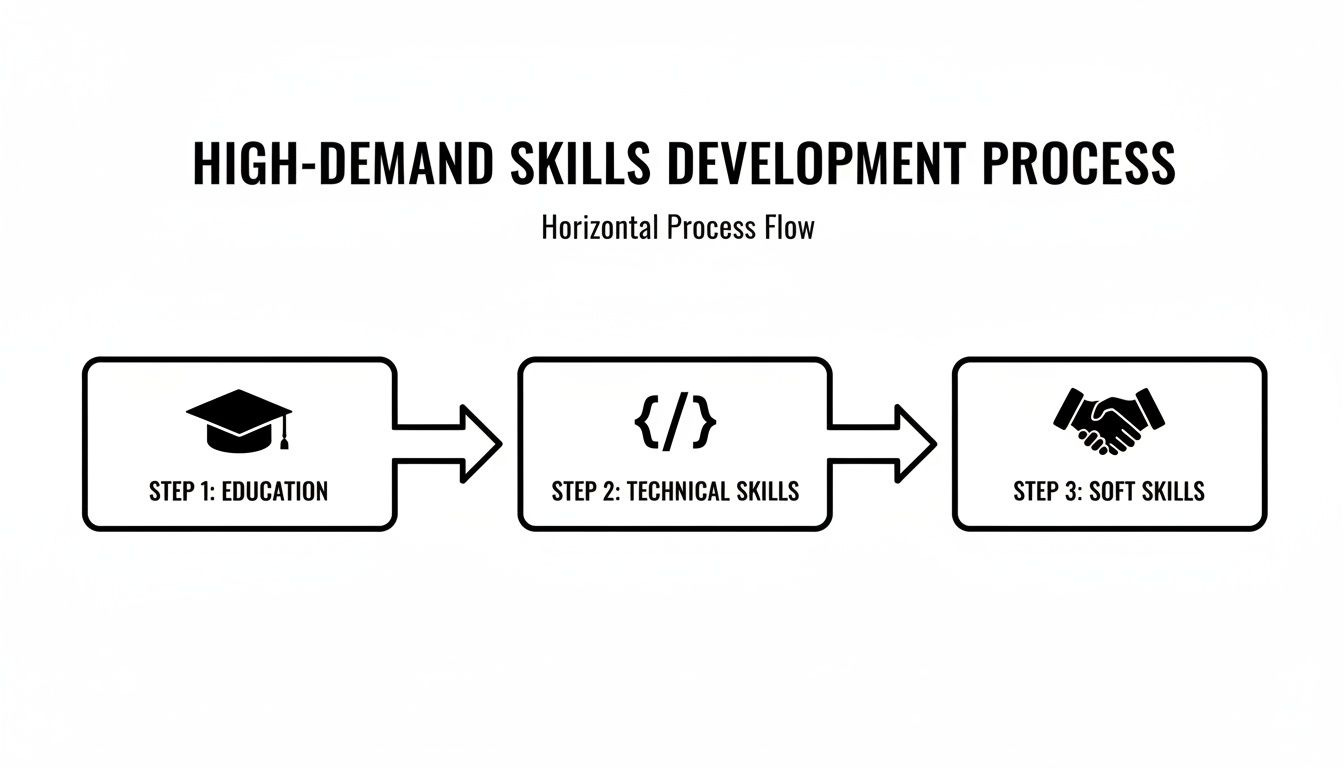
As the visual shows, your formal degree is just the starting point. It’s the combination of that education with specific technical and interpersonal skills that makes a candidate truly competitive for top development economist jobs.
Handling Nationality Requirements
Finally, let’s be direct about nationality. It is a critical, non-negotiable filter for most MDB staff positions. The banks are required to maintain a diverse staff representing their member countries.
Always check the eligibility requirements before you invest hours into an application. Young Professional Programs (YPPs) are especially strict with both nationality and age limits. If you don’t meet the criteria, you will be automatically disqualified.
It’s a hard rule. Don’t waste your effort. Consultant roles can sometimes offer more flexibility, but for staff positions, eligibility is king.
How to Nail the MDB Interview Process
Getting your tailored application through the screening process is just step one. Now for the hard part: the interview. Landing a development economist job, especially at a Multilateral Development Bank (MDB), means surviving an interview process that’s notoriously rigorous. They’re designed to test your technical skills, policy sense, and temperament all at once. Showing up unprepared is not an option.

The whole thing often unfolds in multiple stages. You might start with an initial screening call and end up in a full-blown assessment center with technical presentations, case studies, and panel interviews. Think of each stage as an elimination round. Your goal is to prove you’re a practical problem-solver who can actually get things done.
The Technical Interview and Case Study
This is where the rubber meets the road. The technical interview is your chance to prove you have the quantitative chops you claimed on your CV. If you’re a recent PhD grad, expect to be grilled on your job market paper. Be ready to defend your methodology, explain your identification strategy, and discuss your results without breaking a sweat.
The case study is a different beast entirely. You’ll typically get a dataset and a policy problem, then be asked to analyze the data and present your findings to a panel. This tests your Stata or R skills. It also tests your ability to think on your feet, manage time, and communicate complex findings clearly to non-specialists.
Here’s how to get ready:
Practice with Real Data: Don’t wait for the interview. Download public datasets like the LSMS or DHS and put yourself under the clock. Practice cleaning the data, running analyses, and whipping up some clear visualizations.
Know Your Econometrics: Be prepared to explain why you chose a specific model. Why was a difference-in-differences approach the right call? What were the threats to your identification strategy, and how did you handle them? They want to see your thought process.
Structure Your Presentation: Keep it simple and logical. Start with the policy question, briefly touch on your methodology, present your key findings with clean visuals, and finish with concrete, actionable policy recommendations.
The biggest mistake candidates make in the case study is getting lost in the technical weeds. Yes, the panel cares about your econometrics, but they care even more about what your results actually mean for policy. Your conclusion is just as important as your code.
The Panel Interview
The panel interview is often the final hurdle. You’ll find yourself in a room (or a video call) with a group of senior economists and managers from different departments. They’re trying to figure out if you’ll fit into the institution’s culture and if you can navigate a complex, multi-stakeholder environment.
The questions will be a mix of technical, policy, and competency-based inquiries.
Technical Questions: These will probe your deep understanding of development economics. A classic question might be: “What are the main arguments for and against microfinance as a poverty reduction tool?“
Policy Questions: These test your real-world awareness. Expect something like: “How would you advise a government on designing a cash transfer program in a fragile state context?“
Competency-Based Questions: These almost always follow the “STAR” method (Situation, Task, Action, Result). They’ll ask for specific examples of when you’ve demonstrated leadership, teamwork, or resilience. You absolutely need to have stories from your past work or research ready to go.
To nail this, you need to have well-formed opinions on the major debates in development. Read recent reports from the bank you’re interviewing with. Get a handle on their strategic priorities, whether it’s climate finance, gender equality, or private sector development. Showing you’ve done your homework and understand their mission makes a powerful impression and shows you’re serious about the role.
Your Top Questions Answered
Let’s clear up a few of the big questions that always come up when people try to break into development economics. Getting straight answers on these can save you a ton of time and wasted effort. This is real-world advice, based on what I see day in and day out.
Is a PhD an Absolute Must for an MDB Economist Job?
This is the million-dollar question. For a pure ‘Economist’ track role, especially at places like the World Bank and the IMF, a PhD is a massive advantage. In many cases, it’s a hard requirement. It signals the advanced quantitative and research skills they’re looking for to lead deep-dive policy analysis.
But does that mean you’re out of the running with a Master’s? Absolutely not. You just have to play the game differently.
Instead of targeting those pure ‘Economist’ titles, focus on operational roles, program officer positions, or jobs in specialized units. In these roles, deep field experience, language skills, and a strong project portfolio can easily put you on equal footing with a PhD fresh out of academia. A Master’s degree plus five years of rock-solid, in-country experience is often a winning combination.
A PhD opens specific doors, but it’s not the only key to the building. If you have a Master’s, your mission is to build a profile so rich with practical experience and specific skills that hiring managers can’t ignore you.
How Seriously Do They Take Nationality Requirements?
In a word: very. Nationality is a hard, non-negotiable rule. Most Multilateral Development Banks (MDBs) have strict restrictions, requiring candidates to be citizens of member countries for their core staff positions. This is partly about funding agreements and partly about ensuring broad representation.
This is especially true for the hyper-competitive Young Professional Programs (YPPs), where nationality and age criteria are enforced with zero exceptions.
Check eligibility first: Before you even think about tailoring your CV, find the eligibility requirements. It’s usually at the top or bottom of the job posting.
Don’t try to bend the rules: If you’re not a citizen of an eligible country, you will be automatically filtered out. There’s no way around it.
Consultant roles can sometimes offer more flexibility since they’re often hired directly by project teams to fill a specific, urgent need. For permanent staff jobs, ignoring the nationality requirement is the fastest way to get your application tossed.
Staff Role vs. Consultant: What’s the Difference?
Understanding this is absolutely key to mapping out your career strategy. These are two completely different ways to get your foot in the door and work for an MDB.
Staff Roles:
Think of these as the permanent or long-term contract jobs.
They come with the full package: a predictable salary, health benefits, retirement plans, and a clear spot on the org chart.
The hiring process is notoriously long, formal, and incredibly competitive.
Consultant Roles:
These are temporary gigs tied to a specific project or task. You might see them called Short-Term Consultant (STC) or expert assignments.
Hiring is much faster, often handled directly by a project team that needs someone now.
You get great flexibility, but there are no benefits, less job security, and you’re on your own for taxes and insurance.
Here’s the inside track: many, many people use consulting as a strategic entry point. It’s the best way to get inside the building, prove your skills on a real project, and build an internal network. A successful consulting gig is often the best interview you can possibly have for a future staff position.
It transforms you from a random name in an applicant portal to a proven, trusted colleague.
Multilateral Development Bank Jobs is a Substack newsletter dedicated to helping you navigate this complex world. We provide weekly lists of staff and consultant roles, plus deep-dive guides to help you land your next development economist job. Find your opportunity today.