

Getting a job at the World Bank requires the right resume, not just a great one. The Bank looks for a specific blend of top-tier education, hands-on international development experience, and an intuitive grasp of its unique hiring culture. This guide is your map to cracking that code.
What It Really Takes to Get Hired
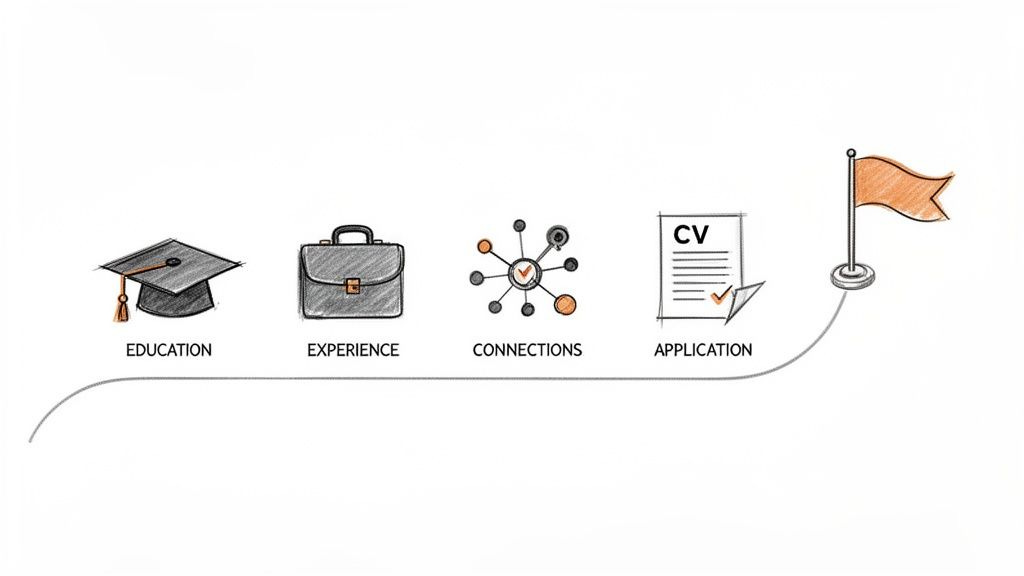
Landing a role at the World Bank is a strategic campaign, not a lottery. The organization hunts for candidates who have impressive credentials and fit a particular mold. Understanding this from the start is the most important step you can take.
Forget being a jack-of-all-trades. The Bank wants specialists. Generalists get lost in the shuffle. Your expertise in climate finance, public health policy, or digital infrastructure must prove you’re a serious player in a field that matters to the Bank’s mission.
An advanced degree is the price of admission. For almost any professional-level role, a Master’s degree or PhD is non-negotiable. It’s the baseline that signals you have the theoretical foundation and analytical rigor for the complex, high-stakes work the Bank does.
Your Professional Track Record
Next is experience. The Bank wants a history of tangible results, ideally earned on the ground in developing countries or with other international organizations. They value practitioners: people who have managed projects, run tough analysis, and navigated messy policy environments.
Your CV needs to show impact. Quantify your wins instead of just listing duties. How did your project in Ethiopia improve financial inclusion rates? What were the measurable outcomes of the policy analysis you did in Southeast Asia? These details make a hiring manager stop scrolling.
To get a better sense of the profiles the World Bank consistently hires, read our deeper dive into careers with the World Bank from an insider’s perspective.
The Four Pillars of a Strong Candidacy
Think of your application as a structure built on four essential pillars. A weak pillar can cause the whole thing to collapse. To be a competitive applicant for jobs at the World Bank, you need all four locked down.
Advanced Education: A Master’s or PhD in a relevant field like economics, public policy, finance, or international development is your entry ticket.
Specialized Experience: You need several years of hands-on work in a specific development sector. Field experience is a massive plus.
Analytical Skills: You must prove you can work with data. This means demonstrable skills in econometrics, data modeling, and policy evaluation.
Cultural Fit: The Bank looks for collaborative, mission-driven professionals who can thrive in a multicultural and bureaucratic setting.
The World Bank is investing in a long-term expert, not just filling a vacancy. They look for a clear career story that shows you’ve deliberately built the exact skills they need to advance their global mission.
Mastering these elements is the foundation of a successful application. Before you click “apply,” do an honest gut check on how your background stacks up against these four pillars. Then you can start crafting an application that speaks their language.
Understanding the Different Career Paths
The World Bank isn’t one type of employer. Sending a generic resume for “a job” is the fastest way to get ignored. The Bank uses different hiring channels for different needs, and you have to know which lane is yours.
It’s like a university. You have tenured professors, adjunct lecturers hired for a specific course, star PhD candidates, and undergraduate interns. Each role is distinct, with its own expectations and entry requirements. You wouldn’t apply for a tenured professorship with an undergrad CV.
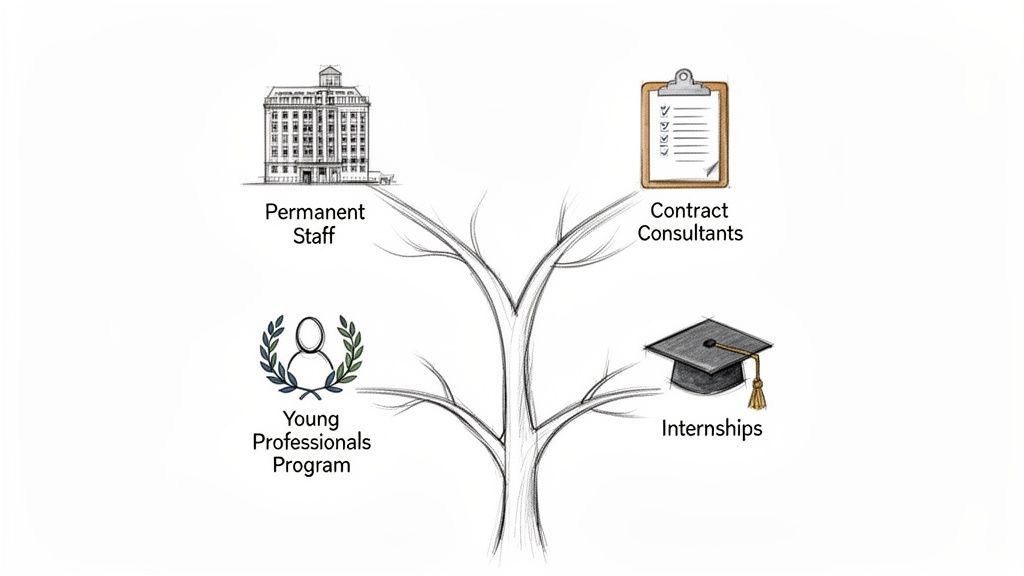
The same logic applies here. The four main paths into the Bank are Permanent Staff, Consultants, the Young Professionals Program (YPP), and Internships. Knowing the difference is the first critical step to a smart job search.
Permanent Staff: The Core of the Institution
This is the traditional, long-term career track and the backbone of the World Bank. Permanent staff are the economists, project managers, IT specialists, and operations analysts who drive the institution’s mission.
These are open-ended or fixed-term appointments that come with the full package: a comprehensive pension plan, health insurance, and long-term career stability. Hiring for these roles is incredibly competitive. The Bank looks for proven experts with significant, specialized experience who can hit the ground running.
Positions are graded on a scale. A common entry-point for professionals with a Master’s and several years of solid experience is the “GF” level. From there, you move up to GG, GH, and beyond, with each step demanding greater expertise and leadership.
Consultants: The Project-Based Experts
Consultants are freelance specialists brought in for a specific task with a clear finish line. They have deep, niche knowledge in an area the Bank needs right now, whether it’s digital payment systems in West Africa or renewable energy policy in Southeast Asia.
Their contracts, known as Short-Term Consultant (STC) or Extended-Term Consultant (ETC) agreements, last anywhere from a few weeks to a couple of years. This path is often the best way for professionals to get a foot in the door. A huge number of permanent staff started their Bank careers as consultants.
Consultants are hired for what they already know, not for what they might learn. Your value is your immediate, applicable expertise for a specific, time-bound problem. There’s no on-the-job training.
Young Professionals Program: The Future Leaders
The Young Professionals Program (YPP) is the World Bank’s premier recruitment initiative. It’s designed to find and groom the next generation of leaders. This is an extremely prestigious and competitive five-year program that puts you on an accelerated career track.
YPs are hired as full staff members and are immediately put into intensive training and rotational assignments across different parts of the Bank. The eligibility criteria are iron-clad and non-negotiable:
You must be 32 years of age or younger.
You need a Master’s or PhD plus relevant professional experience.
Your specialization must be directly relevant to the Bank’s work.
This is a direct pipeline for high-achievers with clear leadership potential to land influential roles within the organization.
Internships: The First Step
For current students, this is your main entry point. World Bank internships are paid opportunities for individuals currently enrolled in a Master’s or PhD program. It’s your chance to get hands-on experience on real projects alongside full-time Bank staff.
An internship is a fantastic way to test the waters, understand the Bank’s culture, build a network, and see if this world is right for you. Nailing an internship gives you a massive advantage when you later apply for full-time jobs at the World Bank.
Meeting the Core Eligibility Requirements
Before you spend hours polishing your CV and crafting the perfect cover letter, let’s do a reality check. The World Bank has a set of non-negotiable criteria that act as hard filters. Think of them as the security checkpoint before a high-stakes meeting. If you don’t have the right credentials, you’re not getting in.
This is about meeting a specific set of requirements that come from the Bank’s status as a technical, multilateral institution. Getting past the first screening for most jobs at the World Bank means ticking these fundamental boxes.
Nationality and Membership Rules
First, the World Bank is an international organization owned by its member countries. This fact leads to the most basic eligibility rule: you must be a citizen of one of the World Bank Group’s 189 member countries.
This rule is strict, with very few exceptions. If your country isn’t on the list, you are generally ineligible for staff positions. It’s the easiest thing for a recruiter to check, so confirm your status before you go any further.
Education and Experience Benchmarks
The Bank uses a formal grading system for its staff, and each grade level has clear expectations for education and professional background. For almost every professional role, an advanced degree is the standard.
Master’s Degree or PhD: This is the baseline for professional-grade jobs (GF level and above). A bachelor’s degree on its own is rarely enough for roles in policy, operations, or economics.
Relevant Field of Study: Your degree needs to match the job. Popular fields include economics, public policy, finance, international development, public health, and other specialized areas.
Years of Experience: Every job posting will state the minimum years of relevant, post-graduate professional experience required. For a mid-career GF role, this is usually at least five years.
The World Bank hires you for the expertise you already have. Your education and work history need to tell a clear, compelling story that you’re a specialist in your field.
Job Grades Explained
Understanding the job grade system will help you target your search and avoid wasting time. The “G” level staff are the core professionals, with GF being a common entry point for someone with a Master’s degree and a few years of solid experience.
Grades GA-GD: These are primarily administrative and support roles.
Grades GE-GJ: This is the sweet spot for professional and technical experts. Most applicants aim for a role in this range.
Grades GK and above: These are managerial and executive leadership positions.
Applying for a GG-level role when you only have three years of experience is a guaranteed way to get your application tossed. Be honest about where you fit and match your profile to the grade level in the job description.
Language Proficiency Requirements
Proficiency in English is mandatory. All official business at the World Bank is conducted in English, so your written and verbal communication skills must be excellent. This is non-negotiable for every job.
While English is required, fluency in other languages is a huge advantage. The Bank’s work is global, so skills in languages like French, Spanish, Arabic, Portuguese, or Russian can make your application stand out, especially if you’re eyeing a position in a country office. It shows you can engage directly with clients and partners on the ground.
The Bank’s work often involves analyzing local labor markets to create opportunities, which ties into broad economic indicators like the employment-to-population ratio. This metric reflects how well a country is using its workforce. You can explore more about this key labor indicator on the World Bank’s data portal. Meeting these core requirements is your first successful step toward a career at the Bank.
How to Nail Your Application and Interview
The World Bank’s hiring process is tough. It’s methodical, structured, and designed to weed people out. They test your technical skills, stress-test your professional judgment, and see if you genuinely align with their mission. Having the right experience isn’t enough; you have to present it in the specific way the Bank wants.
Your first move is to treat the job description as a blueprint, not a rough guide.
Decode the Job Description Like a Pro
Every World Bank job posting is a roadmap. It tells you exactly what the hiring team wants. Before you touch your CV, dissect the “Selection Criteria” section. This is where they spell out the precise skills, competencies, and experiences the role demands.
Your entire application, both CV and cover letter, must be a direct answer to these criteria. Don’t make recruiters dig for the important information. Map your skills and accomplishments directly to the points they’ve listed. If they ask for experience in project finance, your project finance work must be front and center on your CV, complete with numbers that prove you know what you’re doing.
At the most basic level, your application has to clear a few non-negotiable hurdles before anyone even looks at your professional background.
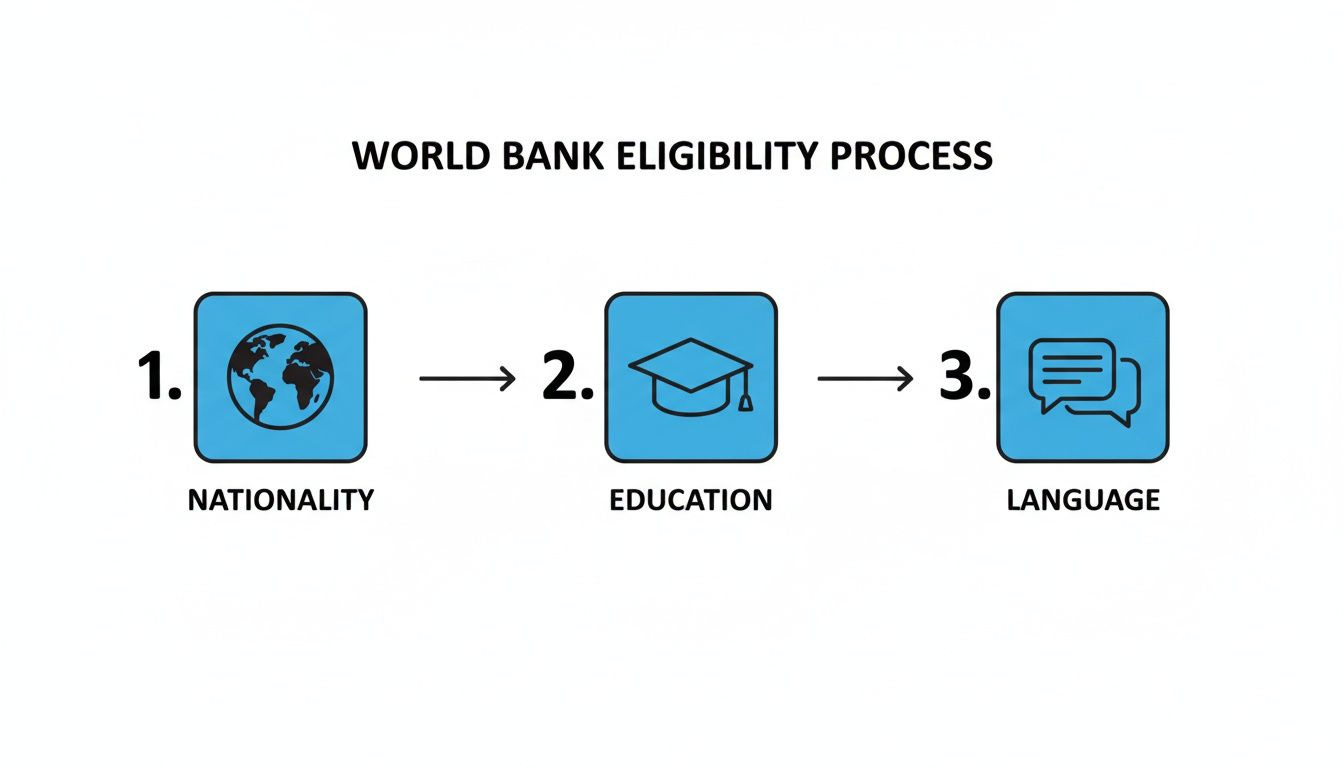
Think of it as a series of gates. If you don’t pass through all of them, your qualifications won’t even get a look.
Craft a CV and Cover Letter That Speak the Bank’s Language
Your CV is your most important marketing tool. It needs to be ruthlessly efficient and focused on results. Recruiters sift through hundreds of applications for jobs at the World Bank; they don’t have time for fluff.
Keep the format clean and conservative. No photos, no weird graphics, no distractions. The only thing that matters is content that proves your impact.
Don’t say: “Managed a portfolio of energy projects.”
Do say: “Managed a $50 million energy portfolio, securing 15% in co-financing and delivering projects 10% under budget.”
See the difference? Numbers talk.
Your cover letter connects the dots. It is not a summary of your CV. Pick two or three of the most critical requirements from the job description and tell a short, powerful story about how your experience directly meets them. And keep it to one page, tops. No exceptions.
If you want a deeper dive, we have a complete breakdown of how to apply for World Bank jobs in our dedicated guide.
Navigating the Interview Gauntlet
If your application makes it through the initial screening, you’ll move into a multi-stage interview process. Each stage is designed to get a deeper understanding of what you bring to the table.
The Screening Interview: This is usually a quick chat with HR or the hiring team. They’re verifying your application information, checking your basic qualifications, and making sure you’re still interested.
The Technical Interview: Now it gets serious. You’ll meet with subject matter experts, the people you’d actually be working with. They will grill you on your technical knowledge. If you’re going for an economist role, expect tough questions on econometrics. Applying for an infrastructure specialist position? Be ready to talk procurement and project lifecycle management in detail.
The Panel Interview: This is the final stage. You’ll face a panel of senior staff, which almost always includes the hiring manager and people from related departments. This interview is all about competencies.
The World Bank panel interview is about how you apply what you know. They are testing your judgment, your collaborative instincts, and your ability to use your expertise in complex, real-world development scenarios.
Master the Competency-Based Interview
The panel will use behavioral questions to see how you stack up against the Bank’s core competencies, like client orientation, teamwork, and leadership. The absolute best way to prepare is by using the STAR method.
For every competency listed in the job description, you need a concrete example from your past ready to go. Structure your answer like this:
Situation: Briefly set the scene. What was the context?
Task: What did you need to achieve?
Action: What specific steps did you personally take?
Result: What was the outcome? Quantify it if you can, and explain what you learned.
Prepare your STAR stories in advance. Write them down and practice saying them out loud. When the pressure is on in that panel interview, you’ll be glad you did.
Breaking Down Salaries and Benefits
Let’s talk about the money. A job offer from the World Bank is a full financial package that can shape your life and career. Understanding how it works is key to figuring out an offer’s real worth.
The most unique part is the net-of-tax salary system. Because the World Bank is an international organization, its direct employees generally don’t pay income tax on their Bank earnings in their home countries. The salary you see is what you take home, which is a massive financial upside.
This setup allows the Bank to keep its pay scale consistent across the globe. It means two people at the same grade level get the same net income, no matter the tax rates in their home countries.
Understanding the Pay Scale
The World Bank’s salary structure is tied directly to its job grading system. Every grade, from the administrative GA levels up to the professional GF, GG, and GH roles, has a set salary range with a minimum, midpoint, and maximum. Where you land in that range depends on your background, experience, and the job’s specific demands.
The Bank reviews its internal salary scale every year to make sure it stays competitive with other major public and private sector players. This is about attracting and keeping top talent. A higher grade means a higher salary. For a deep dive into the actual numbers, check out our complete World Bank Salary Guide.
Allowances That Boost Your Compensation
Beyond base pay, a huge part of the compensation comes from allowances. These are designed to support staff, especially those who relocate for the job.
Dependency Allowance: This gives you extra financial help for eligible dependents, like a spouse or children.
Education Grants: For staff who relocate, the Bank offers very generous grants to help cover schooling costs for their kids, from primary school through university. This is a game-changer for families.
Relocation and Mobility Benefits: When you take a job that requires a move, the Bank provides serious support. This includes grants for shipping your belongings, covering travel expenses, and a settling-in grant to help you land on your feet in a new city.
These allowances add significant value to the overall package, often making your total compensation much higher than the base salary suggests.
The Comprehensive Benefits Package
The World Bank’s benefits are genuinely world-class and a huge part of why people want to work there. They provide a rock-solid safety net for you and your family.
The benefits package is designed for long-term security. The pension, health insurance, and disability coverage are pillars of the employment offer, reflecting the Bank’s investment in its staff’s well-being.
The whole package is robust and built for peace of mind.
Health and Life Insurance: You get comprehensive medical, dental, and vision plans. The Bank also provides life and accident insurance to protect your family’s financial future.
Pension Plan: The staff retirement plan is a major highlight. It’s a defined benefit plan, which is becoming incredibly rare. Both you and the Bank contribute, and it provides a reliable income stream after you retire.
Leave Policies: Expect generous annual leave, sick leave, and parental leave policies that support a healthy work-life balance.
When you add it all up, the tax-free salary, allowances, and top-tier benefits make a job at the World Bank exceptionally competitive. It’s a package built for a long-term international career, not just a job.
Key Resources for Your Job Search
Reading one guide is a good start, but landing a job at the World Bank requires staying on top of new openings without letting the search consume your life.
This is your toolkit. These are the essential resources to monitor jobs at the World Bank and other big development banks, without the noise.
The Official Sources
First, go straight to the source. Bookmark these pages and make them your regular check-in points. Everything starts here.
World Bank Careers Portal: This is ground zero for all staff and consultant vacancies. Make it your first stop.
Young Professionals Program (YPP) Site: The YPP has its own dedicated portal and strict timelines. If you’re targeting the YPP, this is the only page that matters for that application.
World Bank Group Internships Page: The official hub for students hunting for internships. All details and deadlines are posted here.
Work Smarter, Not Harder
Constantly refreshing a dozen job boards is a massive waste of time. The smart move is to let the right opportunities find you. Specialized newsletters do the grunt work of tracking new roles and drop a curated list right in your inbox.
One of the best tools for this is the Multilateral Development Bank Jobs newsletter. It’s built to track roles at the World Bank and its sister institutions, sending weekly updates on staff positions and consultant gigs. It turns a reactive, time-consuming search into something you can manage in a few minutes a week.
Here’s a peek at what it looks like, so you can see how it organizes the latest openings.
As you can see, it cuts through the clutter, making it easy to scan for relevant roles. Subscribing to a focused resource like this means you won’t miss a great opening. It frees up your time to focus on what actually matters: crafting a killer application.
Got Questions? We’ve Got Answers
Let’s clear the air. Here are straight answers to the questions I hear most often from people trying to land a job at the World Bank.
Do I Really Need a Masters Degree to Work at the World Bank?
For professional-grade roles (GF-level and up), the answer is a firm yes. A Master’s or PhD in a relevant field like economics, public policy, finance, or international development is the baseline. It’s the price of entry.
You might find some administrative or support roles where it’s not a hard requirement, but for the vast majority of policy and operational jobs, an advanced degree is non-negotiable. That degree needs to be backed up by solid, relevant work experience.
How Important Is Networking, Really?
Networking is for intelligence gathering, not for skipping the line. The World Bank runs a formal, merit-based hiring process. Knowing someone on the inside can give you fantastic insights, like a team’s culture or upcoming projects, and maybe get your CV a second look. That’s where it ends. You still have to crush every stage of the formal application and interview process on your own merits.
Your goal should be to build genuine connections. Ask for information and advice, not for a job. A referral from a trusted colleague is powerful, but it’s worthless if your application and interview performance don’t hold up.
The formal hiring system is the ultimate gatekeeper. No amount of networking can substitute for a weak application or a poor interview. Use your network for intel, not shortcuts.
What Are the Most In-Demand Skills Right Now?
If you have deep expertise in high-priority sectors like climate finance, digital development, public health, and infrastructure, you’re already ahead of the game. On top of that, rock-solid quantitative skills, like econometrics and serious data analysis, are gold for many specialist roles.
Beyond technical jargon, the Bank hunts for a specific blend of practical skills that show you can get things done in the real world.
Project Management: Can you point to complex projects you’ve successfully managed in developing countries? This is a huge plus.
Language Fluency: English is a given. If you’re fluent in French, Spanish, or Arabic, your profile gets a significant boost.
Field Experience: Nothing beats having dirt on your boots. Proven success working on the ground in low or middle-income countries truly sets candidates apart.
How Long Does the World Bank Hiring Process Take?
Settle in, because this is a marathon, not a sprint. Expect the process to take anywhere from three to six months from the job ad closing date to a final offer. It’s a multi-stage gauntlet of screening, longlisting, shortlisting, technical tests, and multiple interview rounds.
Patience is your best friend here. The smartest move is to apply, put it to the back of your mind, and keep pursuing other opportunities. The Bank’s methodical pace is designed to find the absolute best fit, which means you have to manage your expectations and stay persistent.
Finding the right role is half the battle. Multilateral Development Bank Jobs does the hard work for you, dropping curated staff and consultant roles from over 30 MDBs into your inbox every week. Stop hunting and start applying at
https://mdbjobs.com
.