

You want to work at the World Bank. First, understand it isn’t a bank in the traditional sense. It’s a global development agency, a top-tier research institution, and a project financier rolled into one. If you approach it like a job at a commercial bank, a typical nonprofit, or a government agency, you’re already on the wrong track.
To get a real shot, you have to understand its unique structure and what kind of talent it actually needs to fulfill its mission of ending extreme poverty.
Understanding the World Bank Career Landscape
Getting a job at the World Bank is its own challenge. The place operates at the intersection of finance, policy, and academia, which creates a complex ecosystem that demands a specific kind of professional.
The Bank’s identity is split. It’s a knowledge hub producing world-class research and a massive lending institution funding multi-billion dollar projects. This dual nature directly shapes who they hire. They need two main types of people: deep technical experts who can crunch numbers and publish influential papers, and sectoral specialists who can design and manage huge development projects on the ground.
The Sheer Scale of It All
The World Bank Group is an enormous and diverse employer. The scale is difficult to comprehend. Its annual lending and advisory work recently surpassed $100 billion. Managing that kind of money and impact requires huge, specialized teams for every sector imaginable, from energy and infrastructure to health and education.
This reality drives their hiring. They are almost always looking for:
Economists for country-level analysis and deep research.
Sectoral Specialists in fields like climate change, public health, education, and digital development.
Operations and Project Managers who can guide projects from idea to completion.
Procurement and Financial Management Specialists to ensure the money is spent correctly.
Technical Experts like engineers, data scientists, and environmental specialists.
The diversity of roles reflects the many different angles needed to solve development problems.
Navigating the Different Doors In
There isn’t a single front door to a World Bank career. The organization uses several channels to bring people in, and you need to know which one is right for you.
Here’s a quick breakdown of the main pathways.
World Bank Career Pathways Overview
This table sums up the main entry points, who they’re for, and what to expect.
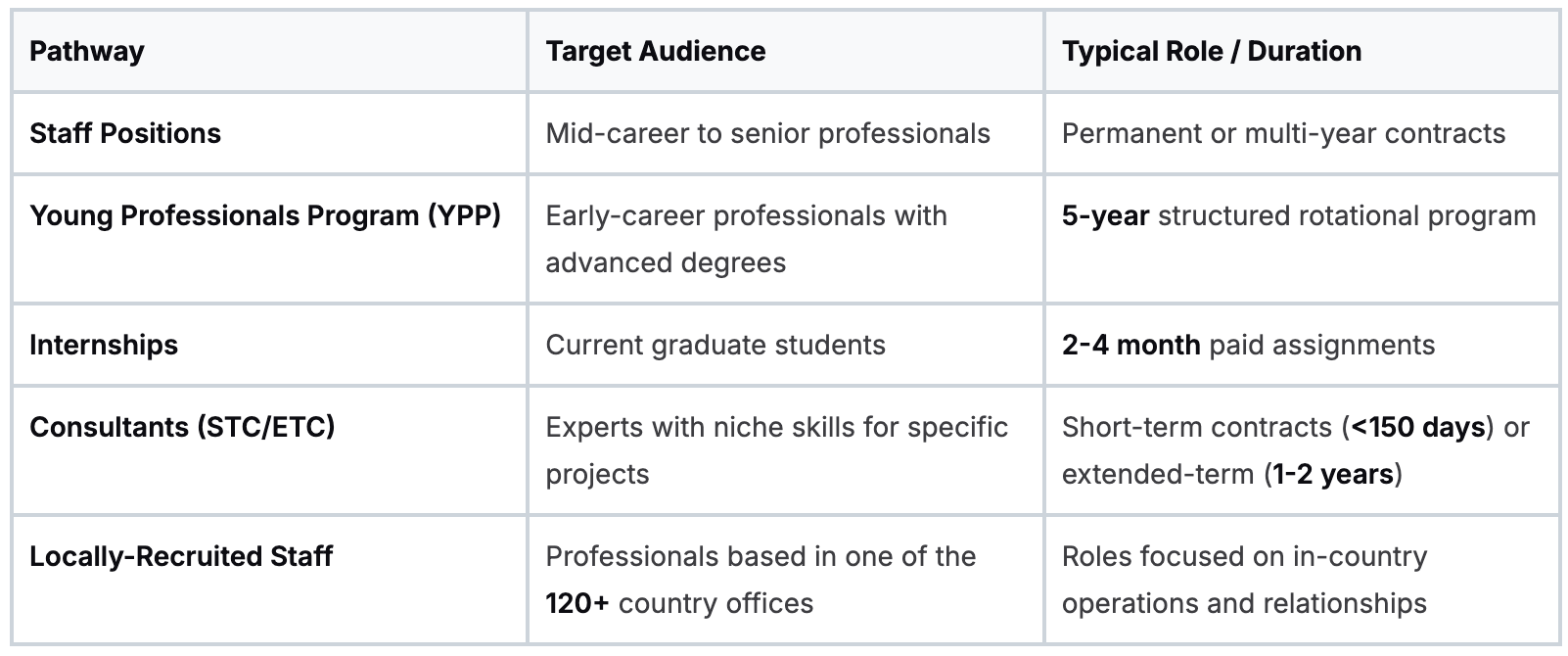
While this table gives you the lay of the land, the consultant route is the most common way people get a foot in the door before landing a permanent staff role.
Open, competitive staff jobs are the most obvious route, but they’re far from the only one. The Bank leans heavily on short-term consultants to staff projects or bring in niche expertise without a long-term commitment. A huge chunk of its workforce is also hired locally for its country offices. These are the people critical for making projects happen. If you want a deeper dive, this internal link provides more detail on how the World Bank actually works.
The Bank’s global footprint is a core part of its identity, as this snapshot from their careers page shows.
This image reinforces that every job, whether you’re in finance or public health, is directly tied to the Bank’s core mission on the ground.
The Bank has always prioritized candidates with advanced degrees. A Master’s or PhD is non-negotiable for most professional roles. This academic rigor is essential for the job’s analytical and technical demands. As of 2024, the World Bank Group employs around 12,000 staff worldwide. Many are based in Washington, D.C., but they also have a massive presence across more than 120 country offices.
This structure creates an internal culture of mobility. Staff are encouraged to rotate across different regions and specialties every few years as project needs change. You can learn more about the World Bank’s focus on jobs and growth on their official site.
Mapping Your Entry Point to the Bank
There’s no single door into the World Bank. The right strategy depends on where you are in your career and what you’re trying to accomplish. Think of this as your roadmap to the different pathways in, each with its own logic.
Picking the right door is about matching your specific background to the Bank’s immediate needs. The route for a recent PhD grad is worlds away from that of a senior infrastructure specialist with 20 years of experience. Your first job is to figure out which pathway gives you the strongest shot.
This decision tree helps visualize the key branching points, steering you toward your most likely entry point based on your credentials.
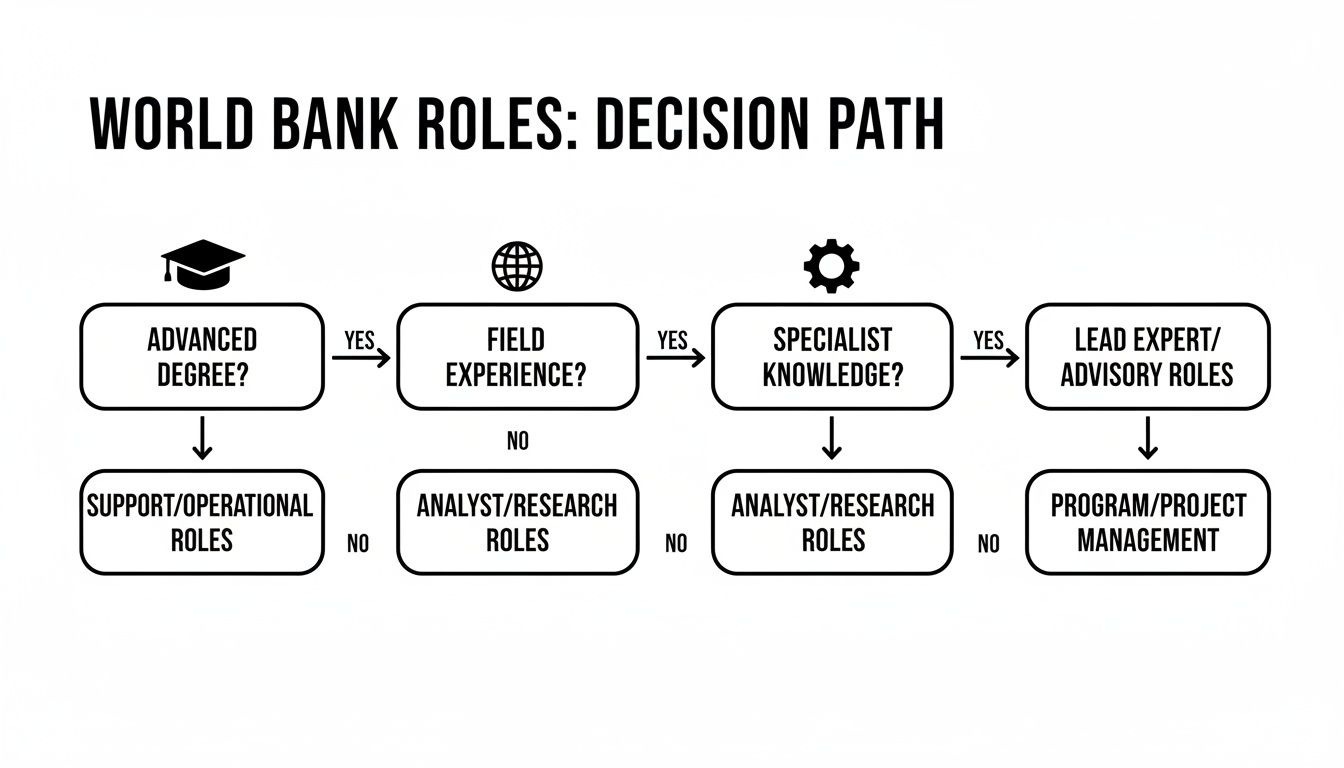
As you can see, an advanced degree and specialized field experience are massive differentiators. They channel you toward either the hyper-competitive programs or direct staff roles.
For Early Career Professionals
If you’re just starting out, aim for the structured talent programs. These are the Bank’s primary pipelines for cultivating its next generation of leaders.
The Young Professionals Program (YPP) is the crown jewel. It’s an intense, five-year rotational program built to fast-track high-potential candidates into leadership roles. It’s brutally competitive, attracting thousands of applicants for just a handful of spots each year.
To be a contender, you’ll need:
A Master’s or PhD in a relevant field.
Real-world professional experience related to development.
A clear, defined specialization, whether that’s in economics, public health, or another priority area.
The YPP isn’t for generalists. They hire for very specific business needs, so your application has to be a perfect match for one of their advertised profiles.
The other major pathway is the internship program. Don’t underestimate it. It’s a critical proving ground. A successful internship is one of the best ways to get on the radar for future opportunities, whether that’s the YPP or a consultant gig down the line. Internships are typically for current Master’s or PhD students and throw you right into the deep end of Bank projects.
For Experienced Professionals
If you’ve been in the game for a while, you have two main routes: go straight for a staff position or get your foot in the door as a consultant.
Staff positions (look for grade levels like GF or GG) are the permanent, pensionable roles that form the institution’s backbone. These are advertised publicly and are, no surprise, incredibly competitive. The hiring process is notoriously long, often dragging on for six months or more. For a deep dive into that marathon, check out our guide on how to apply for World Bank jobs. These jobs demand deep expertise and a proven track record.
A much more common, and often more strategic, way in is through consultant contracts. The Bank relies heavily on consultants for specific projects and specialized expertise.
You’ll generally see two types:
Short-Term Consultant (STC): Contracts for less than 150 days a year, usually for a specific, time-bound task.
Extended-Term Consultant (ETC): Longer-term contracts, typically for one to two years. These roles often feel a lot like a staff job but without the full suite of benefits.
Here’s the inside baseball: getting an STC or ETC contract is often about who you know. Hiring managers frequently tap their own networks to fill these roles fast. This makes networking absolutely essential for experienced hires.
Landing a consulting gig is the ultimate audition. It proves your value and makes you a known quantity inside the Bank, which dramatically improves your odds of securing a permanent staff position later. You get to build internal relationships and show you can deliver within the Bank’s unique culture. Trust me, a huge number of current staff members started out as consultants.
Crafting a CV That Gets Noticed
Let’s get one thing straight: your standard corporate resume won’t cut it for the World Bank. Sending a generic, two-page document that screams about your private-sector KPIs is one of the fastest routes to the rejection pile.
The Bank’s recruiters are hunting for a very specific story. It’s your job to tell it.
They need to see a direct, undeniable line between your experience and their mission of ending extreme poverty on a livable planet. You have to draw that line for them, clearly and compellingly. This means tearing down your old application materials and rebuilding them from the ground up to match what they’re looking for.
Frame Everything Around Impact and Results
The entire language of the World Bank revolves around development impact, not corporate profit or efficiency gains. Your CV must speak this language fluently. Every single bullet point must answer the question, “So what?” in a development context.
You have to translate your achievements. If you managed a massive infrastructure project for a private company, don’t just state the budget. Frame it by explaining how that project improved public services or created economic opportunities for a specific community.
For example, instead of this:
Managed a $50M urban transportation project, completing it on time and under budget.
Try this:
Led a $50M urban transportation project that reduced commute times by 30% for 200,000 residents in a low-income district, directly improving access to employment and essential services.
This reframing is everything. It shows you get it. The Bank’s investments are a means to an end, and that end is always poverty reduction and shared prosperity.
Highlight Your Cross-Cultural and Technical Skills
Life at the World Bank means operating in a deeply multicultural and ruthlessly data-driven environment. Your CV needs to prove you can thrive there.
First, show your cross-cultural chops. This is more than listing the languages you speak, though that’s important. It’s about proving you’ve successfully worked with diverse teams, navigated complex political economies, and adapted to different cultural norms. Mention specific projects where you collaborated with international counterparts or spent time on the ground in a developing country.
Your quantitative analysis skills are completely non-negotiable. The Bank is an evidence-based institution. You must show you can work with data, whether it’s through econometric modeling, statistical analysis, or rigorous program evaluation.
List your technical skills with precision. Be specific. Include software like Stata, R, or Python if you use them for analysis. Mention your experience with specific methodologies like impact evaluations or cost-benefit analysis. This signals you have the hard skills to contribute to the Bank’s analytical work from day one.
Structure Your CV for the Bank’s System
The World Bank uses an online application system that often parses your CV into a standardized format. To avoid getting garbled, keep your formatting clean, simple, and straightforward. Forget the fancy layouts, columns, or graphics.
Here’s a practical structure that works:
Contact Information and Nationality: Your nationality is a key eligibility requirement. Put it at the top.
Summary/Profile: A tight, 3-4 line statement that frames your entire career through the lens of international development. This is your elevator pitch. Make it count.
Education: List your degrees, most advanced one first. A Master’s or PhD is a de facto requirement for most professional roles.
Professional Experience: Use reverse chronological order. For each role, use the impact-focused bullet points we just discussed. Quantify everything you possibly can.
Skills: Break this out into clear subsections: Language Skills (specify your fluency level), Technical Skills (e.g., Stata, R, GIS), and Sectoral Expertise (e.g., Education Finance, Climate Adaptation).
This clear, logical structure makes it easy for a recruiter scanning hundreds of applications to quickly see you’re a match. Your goal is to make their job easier by directly mapping your skills and experience to the demands of a career with the World Bank.
Navigating The Rigorous Interview Process
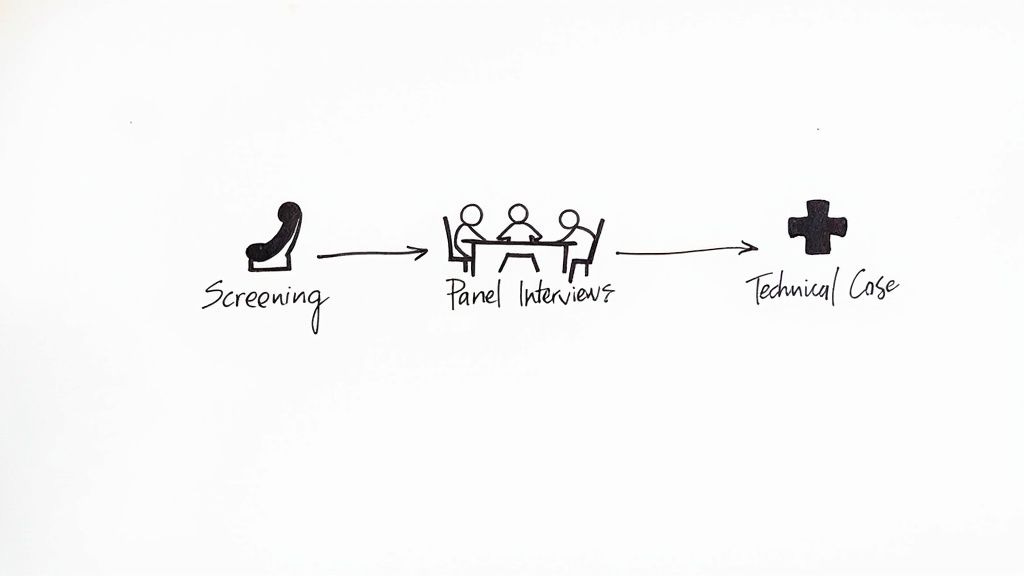
If your CV makes it past the initial screening, take a moment to celebrate. Seriously. Now, the real work begins. The World Bank’s interview process is demanding. It’s designed to systematically test every angle of your professional profile, from your deep technical knowledge to how you handle pressure in a team setting.
This isn’t a casual chat. Think of it as a structured evaluation to see if you have the intellectual horsepower and behavioral competencies to survive and thrive within the Bank’s unique culture. You need to be ready for every stage.
Understanding The Multi-Stage Gauntlet
For most staff positions, the interview process unfolds over several distinct stages. The exact sequence can shift depending on the role and department, but you should anticipate a similar progression.
It usually starts with a screening call, often with an HR representative or a junior member of the hiring team. This is a baseline check to verify your experience, confirm your interest, and get a feel for your basic communication skills. A weak performance here can end your candidacy before it even gets started.
Pass the screening, and you’ll likely face a technical interview or a case study assessment. This is where they stress-test your expertise. An economist might get asked to critique a policy paper on the spot. An infrastructure specialist could be handed a project scenario and told to identify key risks and mitigation strategies. This stage is purely about proving you have the hard skills to do the job.
The final and most critical stage is the panel interview. Get ready to sit across from a group of senior staff, which will almost certainly include your potential manager and colleagues from related departments. This is a comprehensive, competency-based interview where they’ll dissect your past experiences to predict your future performance.
Mastering The Competency-Based Interview
The World Bank relies heavily on competency-based (or behavioral) interviews. The logic is simple: past behavior is the best predictor of future behavior. They won’t ask what you would do; they will ask, in detail, what you did.
This is where the STAR method is non-negotiable. It gives you a clean, logical framework for your answers.
Situation: Briefly set the scene. What was the context?
Task: What was your specific responsibility or goal?
Action: Describe the precise steps you took to address the task.
Result: What was the outcome? Quantify it whenever you can.
You must prepare several detailed STAR stories for each of the Bank’s core competencies, which often include client orientation, teamwork, leadership, and knowledge creation. Have specific, real-world examples locked and loaded.
The biggest mistake candidates make is giving generic, theoretical answers. The panel wants to hear a concrete story about a real project where you faced a real challenge and delivered a measurable result. Vague responses are a huge red flag and signal a lack of substantive experience.
To help you prepare, here’s a breakdown of the interview formats you can expect and how to effectively tackle each one.
Common Interview Question Types and Preparation Strategy
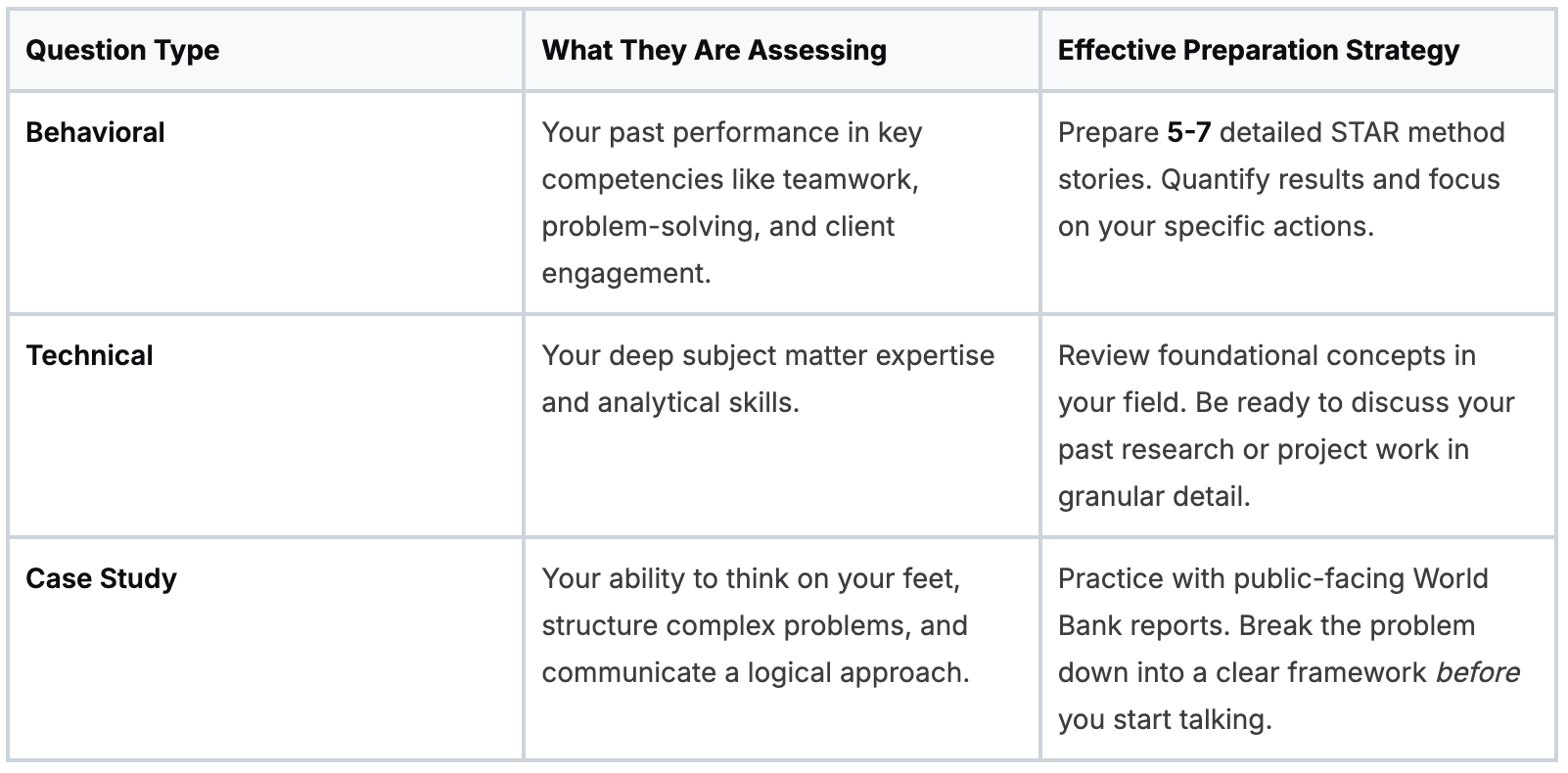
This table should be your starting point. The key is moving from theory to practice, so actively work through these strategies.
Preparing For Technical Deep Dives
The technical questions are designed to be tough. You are expected to command your field far beyond buzzwords. If you’re an education specialist, for example, be ready to discuss the latest evidence on improving foundational learning outcomes or the fiscal implications of different teacher training programs.
A great way to prepare is to immerse yourself in the Bank’s own research. Read recent publications from the department you’re applying to. Get a handle on their current priorities and the analytical frameworks they use. This immediately shows you’ve done your homework and are already thinking like a member of the team.
Navigating a career at the World Bank means proving you can connect your technical skills to real-world development challenges. Your performance in these interviews has to convince them you can think, collaborate, and deliver results in a complex global environment.
Building Your Network for World Bank Opportunities
Let’s be blunt. Firing off an application into the official jobs portal is a necessary step, but it’s almost never enough on its own. A huge number of opportunities at the Bank, especially for consultants, are filled through internal networks and referrals long before they ever hit the public website.
If you’re just clicking ‘apply’ and hoping for the best, you’re missing half the game.
This isn’t about schmoozing. Building a professional network is a strategic requirement for a career at the World Bank. It’s how you get the inside track, understand what a team is actually looking for, and put your name on the radar of the people making the hiring decisions.
Identifying the Right People
First things first: you need to find current and former World Bank staff in your specific sector. LinkedIn is your best friend here. Don’t just search for “World Bank” and call it a day. Get granular.
Think in terms of actual job titles. Use search terms like “World Bank education specialist,” “World Bank infrastructure finance,” or “World Bank climate adaptation.”
Your goal isn’t to collect random connections. You want to build a targeted list of professionals whose work genuinely interests you. Look for people who are:
Working in the specific practice group or region you’re targeting.
Alumni of your university. This is an instant warm connection.
Authors of recent World Bank publications or blog posts in your field.
This research phase is non-negotiable. Reaching out to a random managing director is a waste of everyone’s time. Your approach has to be focused, relevant, and respectful of their expertise.
Structuring Your Outreach
Once you have your list, it’s time to connect. Your first message needs to be short, professional, and dead clear about what you’re asking for. Spoiler alert: you are not asking for a job. You’re asking for advice and information.
The single best approach is to request an “informational interview”—a brief, 15-20 minute chat about their work and experience. This frames the conversation around learning, which people are far more willing to say yes to than a direct plea for a job.
Whether it’s a LinkedIn request or an email, keep it concise. Mention a specific project they worked on, a report they wrote, or a shared connection like your alma mater. This immediately shows you’ve done your homework. A generic “I’d like to connect” is easy to ignore; a thoughtful, specific request is much harder to turn down.
Conducting an Effective Informational Interview
If they agree to a chat, you need to be prepared to lead the conversation. You asked for their time, so it’s your job to make it valuable. Have a list of smart, open-ended questions ready to go.
Focus on gaining insight, not on pitching yourself. Try questions like:
“What do you see as the biggest challenges or priorities in your sector right now?”
“What kind of skills or experience does your team value most when bringing on new consultants?”
“Could you describe the culture of your specific practice group?”
“Based on my background in [your field], are there any specific areas within the Bank you think would be a good fit?”
Listen more than you talk. Your goal is to understand the institution’s pain points and figure out how your skills might solve them.
Always end the conversation by asking, “Is there anyone else you’d recommend I speak with?” This is the golden question that turns one connection into several.
And finally, following up with a thank-you note is absolutely non-negotiable. It’s a simple act of professional courtesy that keeps the door open for future communication and locks in a positive impression.
Common Questions About World Bank Careers
When you’re trying to break into an institution as complex as the World Bank, a lot of practical questions come up. Let’s cut through the noise and get you some direct, no-nonsense answers to the most common ones.
What Are the Nationality and Eligibility Requirements?
This one is a hard and fast rule you can’t get around. For almost all internationally recruited staff positions, including the prestigious Young Professionals Program, you absolutely must be a citizen of a World Bank Group member country.
There are no official age quotas for most roles, but specific programs have firm limits. The YPP, for instance, typically requires candidates to be under the age of 32.
For positions in the Bank’s 120+ country offices, the roles are almost always filled by citizens or legal residents of that specific country.
Fluency in English is completely non-negotiable. For many operational roles, professional proficiency in another language like French, Spanish, or Arabic is a massive advantage and often a stated requirement.
How Long Does the Hiring Process Usually Take?
Patience is a necessity here. The World Bank’s hiring process is notoriously slow and methodical.
For a permanent staff position, you should realistically budget for a timeline of three to nine months from the day you hit “submit” to the day you receive an offer. This period covers multiple, rigorous rounds of screening, panel interviews, technical assessments, and extensive background checks.
Structured programs run on their own clock. The YPP follows a strict annual cycle. Applications typically open in the summer, with final decisions rolling out the following spring.
The one exception is consultant hiring. If a team needs niche expertise for an urgent project, the process can be much faster, sometimes just a few weeks. This speed usually depends on the manager having a pre-vetted candidate in mind.
Can I Get a Job Without a Master’s or PhD?
It’s highly improbable for most professional-track roles. An advanced degree is the established norm and a de facto requirement for the vast majority of technical, specialist, and economist positions. The institution places a premium on deep academic training.
Some roles in corporate functions like IT, administration, or certain finance positions can be an exception. In those cases, you’d need to substitute the advanced degree with extensive and highly relevant professional experience, often 15+ years, to be considered competitive.
For any role focused on policy, research, or project management in a specific sector, a Master’s degree is the absolute minimum entry ticket.
One of the most common questions is about compensation. It’s a complex topic with different pay scales for international staff, consultants, and local hires. To get a clear picture, it’s worth reviewing a detailed breakdown of World Bank salaries and what you need to know.
What Are the Biggest Mistakes Applicants Make?
Many great candidates get rejected for avoidable reasons. Here are the most common pitfalls I’ve seen:
The Generic Application: This is the most frequent and fatal error. Submitting a one-size-fits-all CV and cover letter is a guaranteed way to get overlooked. Your application must be meticulously tailored to the specific role and demonstrate a clear understanding of the Bank’s mission.
Failing to Quantify Achievements: Stating you “managed a project” is meaningless. You need to show the results. Instead, say something like: “managed a $10M health project that increased vaccination rates by 15% in three districts.” Numbers prove your impact.
Ignoring the Behavioral Interview: The Bank is just as interested in how you work as it is in your technical skills. Many applicants neglect to prepare for questions about teamwork, navigating conflict, and working in diverse, multicultural teams. Being brilliant but difficult to work with is a fast track to a polite rejection.
Multilateral Development Bank Jobs provides a curated list of job openings, consultant opportunities, and deep-dive career guides for institutions like the World Bank every week. Stop searching and start strategizing at
https://mdbjobs.com
This piece really made me think. I've always held a somewhat skeptical view of global institutions, but your breakdown of the World Bank's unique structure, not just bank, is incredibly insightful. It's so important to understand its dual nature. Thank you for this perspective.