

An International Monetary Fund job is about one thing: keeping the global financial system stable. Every role, whether you’re a macroeconomist advising a government or an IT pro securing critical data, ladders up to this core mission. This focus makes working at the IMF a completely different beast from a job at a development bank.
What Working at the IMF Actually Involves
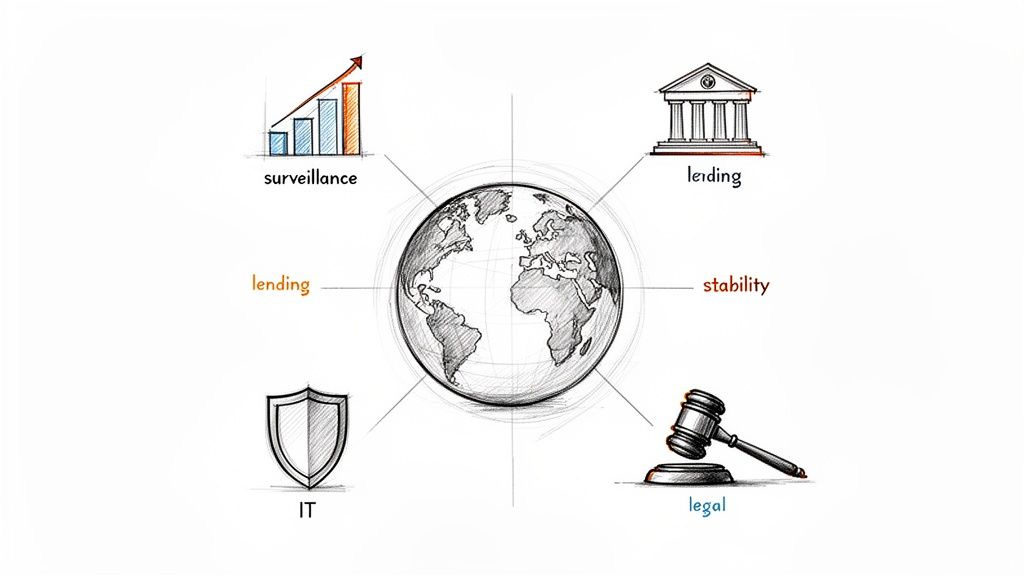
Before you polish your resume, you have to get the IMF’s DNA. It’s not the World Bank, which funds long-term projects like roads and schools. The IMF is the financial first responder for the world economy. The work is analytical, fast-paced, and centered on policy advice.
This mission drives the three main functions of the institution, and every role supports one of them.
Surveillance: This is about monitoring the economic health of member countries. IMF staff conduct regular check-ups, known as “Article IV consultations,” to spot risks before they become full-blown crises.
Lending: When a country faces serious balance of payments trouble, the IMF provides loans. These funds come with conditions requiring the country to implement tough policy reforms to get its house in order.
Capacity Development: The Fund also provides technical help and training, teaching countries how to build stronger economic institutions and manage their economies more effectively.
The Professional Landscape
The IMF hires a range of experts, but they fall into two main camps: economists and specialized professionals. Economists are the public face of the Fund, doing the core macroeconomic analysis. They’re the people on missions, sitting across the table from finance ministers and central bank governors.
An entire army of other professionals makes that work possible. These roles are just as critical and offer fantastic, if less visible, career paths.
The real work of the IMF happens where deep economic analysis meets practical policy implementation. It’s about translating complex data into actionable advice that governments can use to prevent or resolve financial crises.
Beyond the Economist Role
Many candidates think the IMF only hires PhD economists. That’s just not true. The institution relies on professionals with specific, non-economic expertise to function. You’ll find great opportunities in areas like:
Financial Sector Supervision: Experts who understand banking systems, financial regulation, and how to spot trouble in a country’s financial plumbing.
Legal Department: Lawyers who draft complex loan agreements and advise on everything from international law to the Fund’s internal rules.
Communications: Professionals who can explain the IMF’s complex work to the public, the press, and politicians in a way they understand.
Information Technology: Specialists who manage massive datasets and secure the communications required for a global financial institution to operate.
The institution was established in 1944 at the Bretton Woods Conference and has grown from 29 to 190 member countries. That global reach demands a diverse workforce with a shared commitment to economic stability.
Understanding this structure is your first step. It helps you see where your skills fit into the bigger picture and how your background aligns with the Fund’s actual needs. To see what’s available now, look at current jobs at the International Monetary Fund.
The Three Main Pathways into the IMF

Getting a job at the International Monetary Fund isn’t a one-size-fits-all process. The Fund has several distinct entry points, each built for a different career stage and skill set. Your first strategic move is figuring out which door is meant for you. Applying through the wrong one is the quickest way to get your resume trashed.
The three main routes are the Young Professionals Program (YPP), the experienced professional track, and consultant roles. Each has its own rhythm, expectations, and ideal candidate. If you’re serious, understanding these differences is non-negotiable.
The Young Professionals Program (YPP)
This is the IMF’s flagship recruitment program and its most competitive entry point. The YPP is a machine designed to find and mold the next generation of IMF economists. It’s a highly structured, two-year rotational program that fast-tracks you into a career economist role.
Think of the YPP as the IMF’s Ivy League graduate program. It’s built for high-achievers with advanced degrees, almost always a PhD in macroeconomics or a related field from a world-class university. Candidates are typically under 34 years old and have some relevant, though often limited, professional experience.
The real prize here is structured development. YPPs rotate through different departments, getting hands-on experience with country surveillance missions, lending programs, and policy research. This builds an incredible foundation for a long-term career at the Fund.
The Experienced Professional Track
This is the standard recruitment route for mid-career and senior experts. If you have a deep, specialized track record in fields like financial regulation, public finance, law, or strategic communications, this is your pathway. The IMF uses this track to bring in proven talent who can hit the ground running on day one.
These are direct-hire positions for specific, advertised vacancies. The focus isn’t on your academic potential; it’s on your proven history of concrete achievements.
To succeed here, your resume needs to scream deep expertise and quantifiable impact. For example, you didn’t “work on banking regulation.” You “led a team that implemented Basel III standards, reducing systemic risk by 15% across the national banking sector.” That’s how you prove you’re ready for a serious international monetary fund job.
The IMF hires for demonstrated expertise, not potential. For experienced roles, your past accomplishments are the only currency that matters. Your resume should be a highlight reel of your most significant professional wins.
Consultant and Contractual Roles
The third major pathway is through consulting and other contractual arrangements. This is often the most practical way to get your foot in the door, especially if your profile doesn’t perfectly fit a permanent opening or you’re transitioning from another sector.
The IMF keeps rosters of pre-vetted consultants for all sorts of specializations. When a department needs short-term expertise for a specific project, they pull from these lists. These assignments can range from a few weeks to several years.
Strategic Advantage: Contractual work lets you build an internal network and show your value directly to IMF managers.
Ideal Candidate: An expert with a niche skill set who can deliver on a specific project without needing months of onboarding.
The Goal: Many permanent hires at the Fund started as consultants. A stellar performance on a contract makes you a known quantity, dramatically boosting your chances when a full-time position opens up.
Choosing the right path is your first and most critical decision. To make it clearer, here’s a quick comparison to help you map your profile to the right entry point.
IMF Recruitment Pathways at a Glance
This table offers a direct comparison of the three main entry points into the IMF, helping you decide which path best suits your profile and career stage.
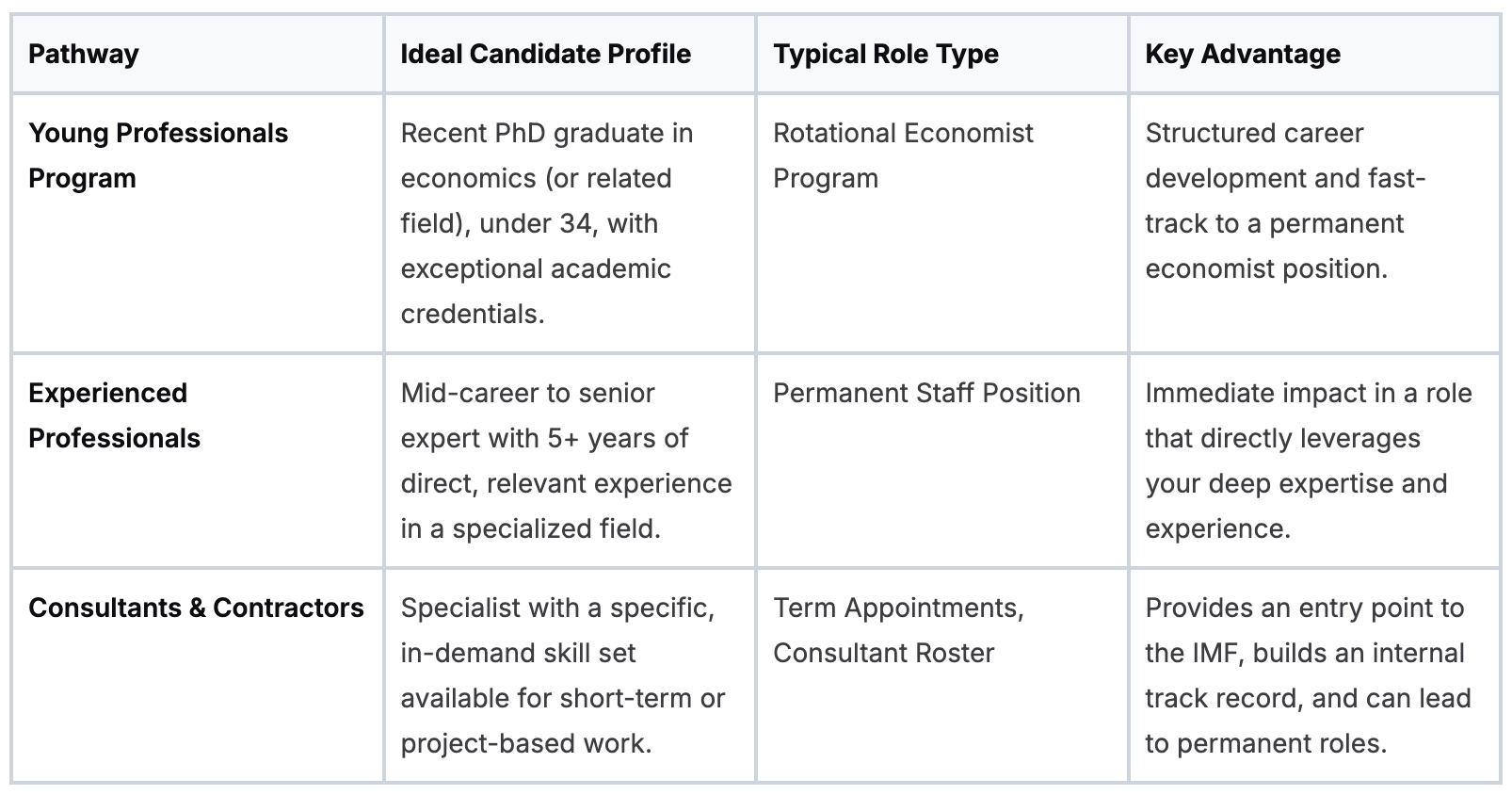
Focus your energy on the pathway that genuinely aligns with your experience and qualifications. A targeted approach shows you understand the institution and respect its hiring processes, which immediately sets you apart from the crowd.
Key IMF Roles and What They Actually Do
Job titles on a website tell you almost nothing. An international monetary fund job is a specific function inside a massive, complex machine. Figuring out the day-to-day reality of these roles is the only way to know if you’re a good fit and how to angle your application.
Let’s cut through the official jargon and look at what the core professional roles at the Fund really involve. This isn’t a list of job descriptions. It’s a practical guide to what the work actually feels like.
The Economist Role: The Core of the Mission
When people think of the IMF, they think of economists. They’re right. Economists are the engine of the institution, focused squarely on country surveillance, lending programs, and global economic research. If you land a role as an economist here, you won’t be tucked away in an academic ivory tower.
Your work will directly shape policy discussions with finance ministers and central bank governors. One week you might build a model to forecast a country’s GDP growth; the next, you could be on a plane to its capital to hash out fiscal consolidation measures. It’s intensely analytical, relentlessly data-driven, and demands both technical rigor and serious diplomatic skill.
The Economist Program (EP), the main entry point for PhDs, is a boot camp for this career path. You’ll rotate through different departments, learning the IMF’s unique approach to macroeconomic analysis and policy advice firsthand.
Beyond the Macroeconomists: The Specialized Support Crew
The IMF’s mission would grind to a halt without a deep bench of specialized professionals supporting the economists. These roles are just as competitive and offer incredible careers for those without a PhD in macroeconomics. They build the legal, financial, and operational framework that makes the Fund’s work possible.
Here are some of the key players:
Financial Sector Experts: These are the people who come from central banks, regulatory agencies, and big financial institutions. They dive deep into a country’s banking system, assess its stability, hunt for vulnerabilities, and advise on how to fix the financial sector’s plumbing.
Legal Counsel: The IMF’s lawyers are central to everything. They draft the incredibly complex legal agreements for lending programs, advise on the nuances of international law, and ensure the Fund operates strictly within its mandate.
Communications Officers: Explaining a currency devaluation or a sovereign debt restructuring to the public is an art form. These experts manage the IMF’s messaging, deal with the media, and ensure its policy advice is understood by a global audience.
IT and Data Specialists: The Fund runs on data. A lot of it. IT professionals manage the huge economic databases, lock down sensitive information, and build the analytical tools that economists use every day.
The IMF’s real power is its ability to combine world-class economic analysis with specialized legal, financial, and operational expertise. Every role contributes directly to the institution’s core mission of global financial stability.
So, What Does Your Day Actually Look Like?
Regardless of your title, the work culture has common threads. You’ll be surrounded by incredibly smart, driven people from all over the world. The environment is demanding, the deadlines are tight, and the stakes are always high.
An economist might spend their morning analyzing debt sustainability reports, their afternoon prepping briefing notes for a mission chief, and their evening collaborating with colleagues in the Research Department. At the same time, a lawyer down the hall could be redlining a multi-billion dollar loan agreement, while a financial sector expert stress-tests an entire country’s banking sector with sophisticated models.
A huge part of many roles is getting your hands dirty with massive datasets to spot trends. The IMF’s own Data Portal contains enormous labor statistics datasets, a treasure trove of global employment metrics. Professionals use this to track unemployment rates, labor force participation, and employment trends across all 190 member countries, which is vital for providing sound policy advice. For more context, you can explore some of the IMF’s economic issues on their official site.
This blend of deep, technical analysis and high-stakes practical application defines a career at the IMF. It’s about using your expertise to help solve some of the world’s most complex economic challenges.
Navigating the IMF Application and Interview Process
The IMF selection process is a marathon, not a sprint. It’s a multi-stage gauntlet designed to filter thousands of qualified applicants down to the handful with the right blend of technical skill, policy judgment, and institutional fit. Success isn’t about luck; it’s about disciplined preparation at every stage.
Your first hurdle is the initial screening, where your resume is your only weapon. The biggest mistake candidates make is writing a resume that just lists job duties. IMF screeners don’t care what you were responsible for; they care what you achieved. Every bullet point must show a quantifiable result.
Instead of writing “Analyzed fiscal policy for emerging markets,” try this: “Developed a fiscal forecasting model for three emerging markets that improved deficit prediction accuracy by 10% and was adopted for the department’s quarterly report.” The first is generic; the second proves you deliver real value. You have to relentlessly tailor your resume to the specific vacancy, using their keywords and highlighting the skills they’re asking for.
Surviving the Assessment Stages
If your resume makes the cut, you’ll move into the assessment phase. This part varies by role but almost always includes a preliminary screening interview and some form of technical evaluation. The goal is simple: verify your core expertise.
Preliminary Interview: This is typically a shorter conversation with an HR representative or a hiring manager. They’re confirming your background, understanding your motivations, and making sure you can communicate your experience clearly.
Technical Assessment: For economists, this might be a timed exercise where you analyze a dataset and draft a policy memo. For a legal role, it could involve a complex case study. You can’t fake this part; they are testing the fundamental, hard skills required for the job.
This is the point where your practical knowledge is put under the microscope. They’re looking for raw intellectual horsepower and the ability to apply your skills under pressure.
The Final Panel Interview
The last stage is usually a formal panel interview, often with three to five senior staff members from different departments. This is where everything comes together. The panel will dig into your technical depth, your behavioral competencies, and your real-world understanding of the IMF’s role.
They will use a mix of question types to get a complete picture of who you are.
Your performance in the panel interview is about more than giving correct answers. It’s about demonstrating that you think like someone who already works at the Fund: analytically, collaboratively, and with a deep respect for the institution’s mission.
Get ready for two main categories of questions: technical and behavioral. For technical questions, they will probe the depth of your expertise. Be ready to defend the analysis in your resume, discuss your research in detail, and walk them through your thought process on complex policy issues.
For behavioral questions, the STAR method (Situation, Task, Action, Result) is your best friend. They’ll ask things like, “Tell us about a time you had to deliver a difficult policy message.” You need to frame your answer with a clear story that highlights a specific situation, the task you faced, the action you personally took, and the positive result you achieved. This structured approach gives them concrete evidence of your skills. For more strategies, you can review our detailed guide on how to win an International Monetary Fund job.
The candidates who succeed are the ones who show they understand the bigger picture. Weave your knowledge of the IMF’s current priorities, whether it’s climate change, digital currencies, or sovereign debt, into your answers. Show them you’ve done your homework and are ready to contribute from day one.
Essential Eligibility Rules You Cannot Ignore
Before tailoring your resume or drafting a cover letter, you must pass the IMF’s non-negotiable eligibility checks. These aren’t suggestions; they’re hard filters. Getting this wrong means your application is dead on arrival, no matter how brilliant your qualifications are.
The most fundamental rule is nationality. To be considered for most staff positions, you must be a citizen of one of the IMF’s 190 member countries. This is a simple, straightforward check with no way around it.
If you clear that first hurdle, your application moves through a series of filters designed to test every part of your profile.
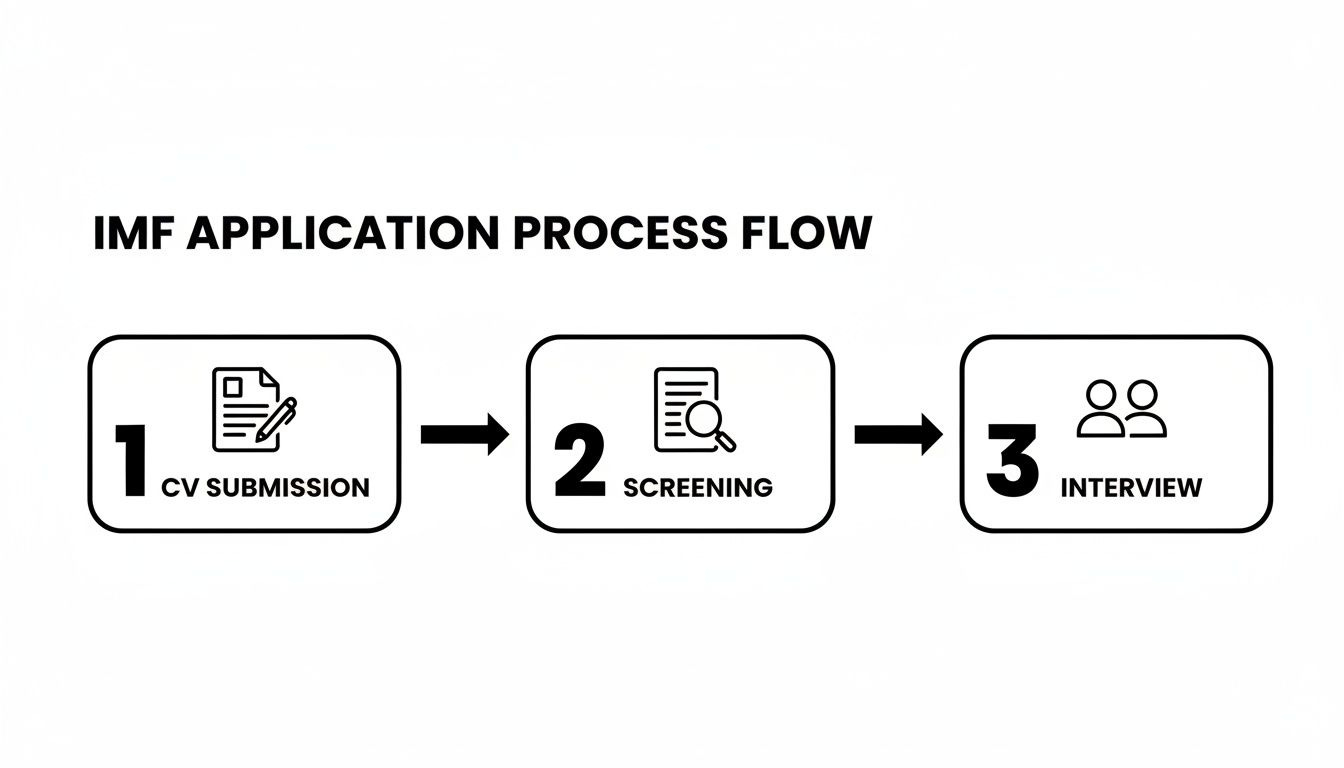
Each step whittles down the applicant pool, moving from your on-paper credentials to your performance under pressure.
Your Academic and Professional Credentials
The IMF is very specific about your educational and professional background. The bar is high.
For almost every professional role, a master’s degree is the absolute minimum. For an economist position, especially through the competitive Economist Program (EP), a PhD is the standard expectation. These degrees must come from well-regarded universities in fields like economics, finance, public policy, or law.
The experience requirements are just as demanding. They’re looking for a track record of relevant, post-graduate work. This isn’t about logging years; it’s about the substance of what you’ve done.
Entry-Level (e.g., Research Assistants): Requires a bachelor’s or master’s degree with little professional experience needed.
Mid-Career Professionals: You’ll need a master’s degree plus a solid five to eight years of hands-on, substantive experience in your field.
Senior Roles: This calls for an advanced degree and well over a decade of high-level, impactful work, almost always including leadership roles.
The IMF needs practitioners who have taken their academic knowledge and applied it in the real world to get concrete results. Your experience has to directly answer the needs of the job you’re applying for.
Finally, you must have full professional fluency in English, the working language of the Fund. This covers both your writing and speaking skills. While fluency in other languages like French, Spanish, or Arabic is a huge plus, rock-solid English proficiency is non-negotiable.
Understanding these hard lines from the get-go is the smartest thing you can do. It stops you from wasting energy on applications you have no shot at and lets you focus on the opportunities where you’re a genuine contender. If you tick all these boxes, you’re ready to move on.
Understanding IMF Salary Benefits and Lifestyle
Let’s get one thing straight: compensation for an international monetary fund job is unlike anything you’ll find in a typical corporate or government role. The headline feature is the tax-free salary.
Because the IMF is an international organization, most non-U.S. staff are exempt from income taxes on their Fund earnings. It’s a game-changer. This structure is designed to pull in the best talent from around the world.
To ensure offers are competitive, salaries are benchmarked against a basket of high-paying jobs in both the public and private sectors. This means the number on your offer letter is what you actually take home. It’s a massive financial advantage you have to factor in when weighing your options.
The Total Compensation Picture
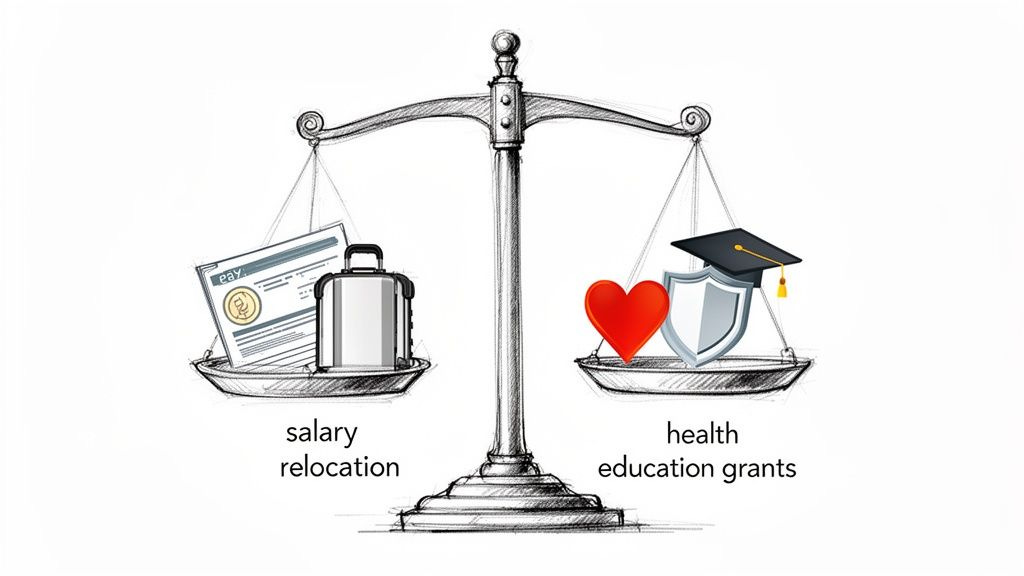
The tax-free salary is just the start. The benefits package is where the IMF really pulls away from the pack. It’s built to support an international workforce that’s often uprooting families and moving them across the globe.
The goal is simple: remove the logistical and financial headaches so you can focus on the demanding work.
Here’s a look at what that typically includes:
World-Class Health Insurance: The medical, dental, and vision plans are top-tier, offering comprehensive coverage almost anywhere in the world.
Generous Pension Plan: The IMF still offers a defined benefit pension plan, a true rarity these days. It provides a secure, predictable income stream when you retire.
Relocation and Settling-In Support: This is a huge deal for expat staff. The Fund usually covers moving expenses, airfare for you and your family, and provides grants to help with the costs of setting up a new home in Washington, D.C.
Education Grants: For staff with kids, the IMF provides substantial grants to help cover private school tuition, recognizing how disruptive moving between school systems can be.
The IMF’s compensation model is a comprehensive system built for a global lifestyle. The blend of a tax-free salary, robust benefits, and serious family support creates a value proposition that’s hard to beat.
Lifestyle and Work Environment
Be prepared for an intense and intellectually charged environment. You’ll work side-by-side with some of the sharpest minds in global finance and economics, tackling issues with very real consequences.
The work demands long hours and a high level of commitment, especially when you’re on a country mission or in the middle of a global financial event.
The D.C. headquarters is a deeply international and multicultural space. You’ll collaborate with colleagues from nearly all of the Fund’s 190 member countries. This creates a work environment that is professionally enriching and personally expansive. It’s one of the most compelling parts of the job.
You can get a better sense of how the Fund stacks up against similar organizations in our guide to World Bank vs IMF vs ADB careers.
Deciding on an IMF career means weighing the demanding nature of the work against an exceptional financial and lifestyle package. It’s a trade-off that continues to attract mission-driven candidates looking for a unique professional path.
Frequently Asked Questions About IMF Careers
Getting a job at the IMF is tough, and it’s easy to get lost in the process. I’ve seen the same questions pop up again and again from aspiring candidates. People want to know what recruiters are really looking for and which common traps to sidestep.
Here are the direct, no-nonsense answers to the questions I hear the most.
What Is the Biggest Mistake Applicants Make?
Hands down, the most common mistake is submitting a generic resume. It’s the one that reads like a laundry list of job duties. IMF recruiters don’t care about what you were supposed to do; they want to see what you accomplished.
Your application needs to scream impact. It has to prove you get tangible results.
Instead of saying, “Analyzed economic data for country reports,” you need to frame it like this: “Developed a new forecasting model that improved GDP prediction accuracy by 15% and was adopted as the department standard.” The first is passive and forgettable. The second demonstrates clear, quantifiable value. Always tailor your resume to the specific job you’re targeting, using their keywords and highlighting the skills they’re asking for.
How Important Is Networking for an IMF Job?
Networking can be a game-changer if you do it right. Blindly adding hiring managers on LinkedIn is worse than useless; it can hurt your chances. The smart approach is to use networking for intelligence gathering through targeted informational interviews.
Find current or former IMF staff in roles that interest you. Send them a short, respectful message asking for 15 minutes of their time to learn about their experience, the team’s culture, and its current priorities. This isn’t about asking for a job. It’s about showing genuine interest and becoming a well-prepared candidate long before your application lands on their desk.
A well-executed informational interview is your best tool for gaining insider knowledge. It transforms you from just another name on a list into a candidate who understands the institution’s real-world challenges.
Do I Need a PhD in Economics?
For the core economist track, especially the Economist Program (EP), yes. A PhD from a top-tier university is pretty much the price of entry. For those specific roles, it’s non-negotiable.
The IMF is a massive organization with dozens of other professional paths. For critical roles in finance, law, communications, HR, and IT, a Master’s degree is typically the minimum. In these fields, deep, relevant professional experience often carries more weight than a doctorate.
Don’t count yourself out just because you don’t have a PhD. Dig into the requirements for non-economist roles. You might find that your practical expertise is exactly what they’re looking for.
Finding the right opportunity is the first step. At Multilateral Development Bank Jobs, we track vacancies from over 30 international financial institutions, including the IMF. Get curated job lists and expert career guides sent directly to your inbox. Subscribe on Substack.