

When most people hear “international development,” they think of frontline aid workers in remote villages. That’s an important piece of the work, but it’s a small fraction of the reality.
The strategic core of the industry, where major funding and systemic change originate, is at institutions like the World Bank, the Asian Development Bank (ADB), and the African Development Bank (AfDB).
These organizations function as a hybrid of an investment bank and a public policy think tank. They deploy immense capital to solve country-level problems.
What an International Development Career Actually Involves
A career at a Multilateral Development Bank (MDB) means you aren’t just distributing supplies. You’re structuring a $300 million loan for a country to overhaul its energy grid or helping a government design a policy framework for its public health system.
You work on the architecture for a country’s long-term stability and prosperity. You’re fixing the systems, not just treating the symptoms.
The Reality of the Day-to-Day Work
Your work will be deeply analytical, strategic, and intensely collaborative. Professionals at MDBs spend their days digging into data, building economic models, and applying rigorous project management to massive, complex initiatives.
They identify a country’s core development challenges, design projects to tackle them, and ensure those projects get delivered effectively.
The goal is sustainable change. You’re building a national education system, not just funding a school. You’re strengthening a country’s entire healthcare infrastructure, not just financing a clinic.
This work demands a specific, high-level skill set. You’ll negotiate with government ministers, hash out technical details with engineers, and consult with local communities to bring a single, massive project to life. The impact is enormous, and the work is complex.
Moving Beyond Stereotypes
The most influential international development careers at MDBs are held by specialists in finance, policy, and engineering. These are the people who make systemic change happen.
Here’s a breakdown of the professional archetypes you’ll find:
The Economist: This person lives and breathes country-level economic data. They run forecasts, analyze trends, and advise governments on fiscal policy and trade.
The Project Manager: The orchestrator. They oversee a development project’s entire lifecycle, from design and funding approval through implementation and final evaluation.
The Sector Specialist: The deep technical expert. They bring world-class knowledge in a specific area, like climate finance, public health systems, digital infrastructure, or transport engineering.
The Policy Advisor: They work directly with governments, helping them design and implement reforms needed to create a better environment for investment and social progress.
An MDB career puts you at the intersection of global finance, public policy, and high-stakes problem-solving. It’s a chance to apply your skills on a scale few other industries offer.
Mapping Your Entry Point into MDBs
There isn’t a single door into the MDB world. The building has four different entrances, each designed for people at specific career stages. Your first step is figuring out which door is yours.
Trying to force your way through the wrong one is a fast track to rejection. Match your experience, qualifications, and goals to the right pathway.
Let’s break down the four main routes.
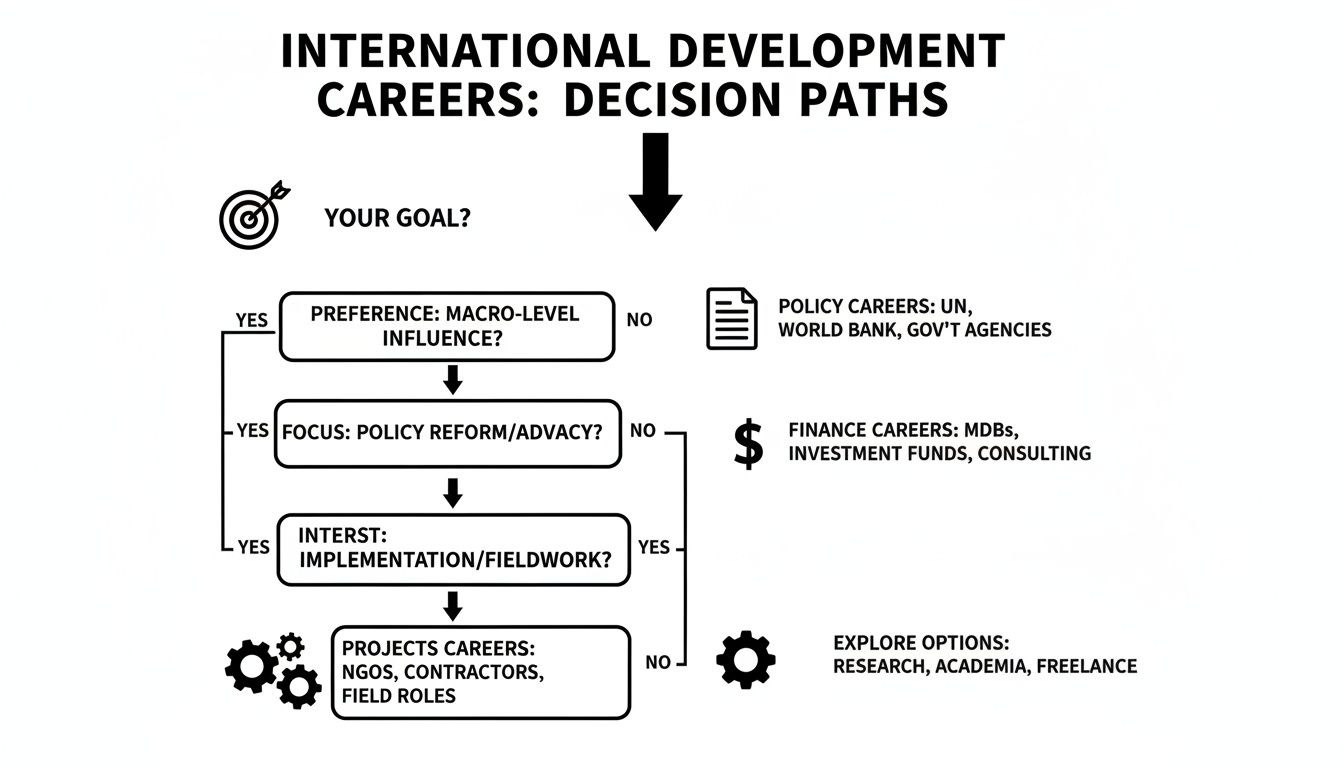
Your primary goal—policy, finance, or direct project work—points you toward a specific track, and each track has its own entry point.
Each route caters to a distinct profile, from the ambitious early-career professional to the seasoned industry veteran.
Comparing MDB Entry Routes
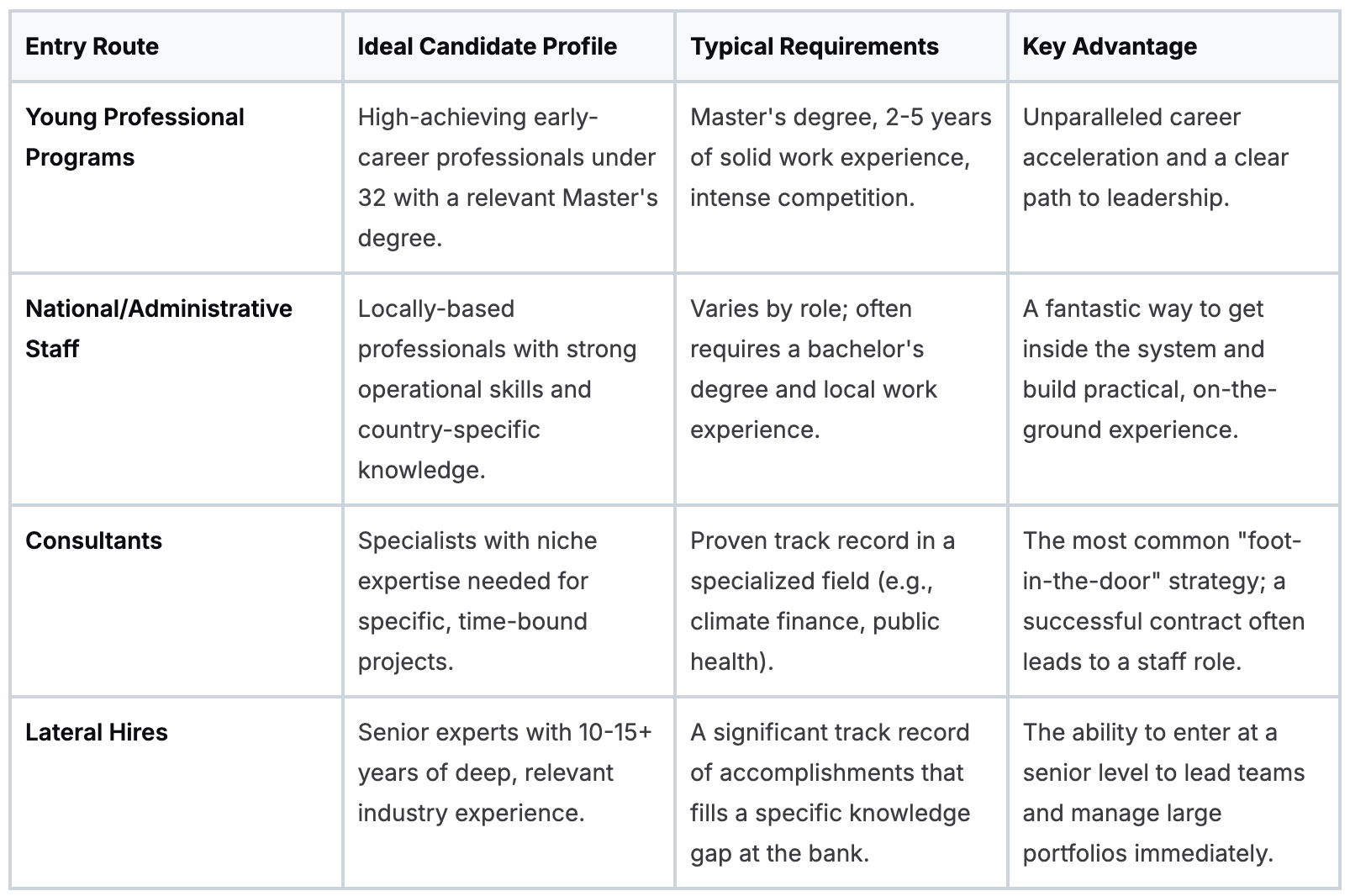
Understanding these distinctions is key. Let’s dive deeper into each pathway.
Young Professional Programs: The Golden Ticket
The Young Professional Program (YPP) is the most prestigious and competitive way in. It’s the MDB equivalent of a top-tier management consulting or investment banking analyst program, designed to groom the next generation of leaders.
These programs are intense, highly selective, and offer an unmatched career trajectory.
Who it’s for: Early-career professionals, usually under 32, who have a relevant master’s degree and a few years of solid work experience.
What to expect: A structured rotational program giving you exposure to different departments, sectors, and regions. You get world-class training, dedicated mentorship, and a clear path to a permanent staff position.
The catch: The competition is ferocious. Thousands of applicants compete for a handful of spots, and nationality requirements are often a non-negotiable factor.
National and Administrative Staff: The In-Country Foundation
This is a vastly underrated entry point. Joining as a national or administrative staff member in a country or regional office is a brilliant way to get inside the system. These people run MDB operations on the ground. They are the backbone, providing essential local expertise, operational support, and deep institutional knowledge.
Plenty of senior international staff I know started their careers this way. They proved their value in a country office and transitioned into international roles. This path builds deep, practical experience that many headquarters staff lack.
Consultants: The Flexible Specialists
The consultant route is the most common and flexible way to get your foot in the door. MDBs constantly hire short-term consultants (STCs) for specific projects that demand specialized skills. This could be conducting a feasibility study for a new dam or developing a communications strategy for a health program.
A consulting contract is your audition. It’s your chance to show off your skills, build a network of internal champions, and prove you can deliver results within the MDB system. A successful consultancy is often the most direct path to a staff position.
This route is perfect for professionals with a niche skill set. The banks need your expertise for a specific task, and it’s a lower-risk way for them to see what you can do. These institutions are financial fortresses. The first MDBs Comparison Report 2025 revealed that these banks have amassed $230 billion in reserves, giving them massive operational strength to fund countless projects.
Lateral Hires: The Experienced Experts
Lateral hires are strictly for seasoned professionals. If you have 10-15+ years of deep, proven experience in a high-demand field like infrastructure finance, climate policy, or public health systems, MDBs want to talk to you. They will bring you in at a senior level to lead teams and manage large, complex portfolios from day one.
This is not an entry-level option. MDBs hire laterally to fill very specific knowledge gaps with proven experts. You need a track record of significant, measurable accomplishments that directly aligns with the bank’s strategic priorities.
For a full breakdown of the institutions you could target, check our guide on which MDBs you can work for.
The In-Demand Roles and Sectors at MDBs
To build a career in international development, you have to follow the money. It’s that simple. MDBs recruit for specific skills needed to solve the world’s biggest problems, and those problems attract billions in funding.
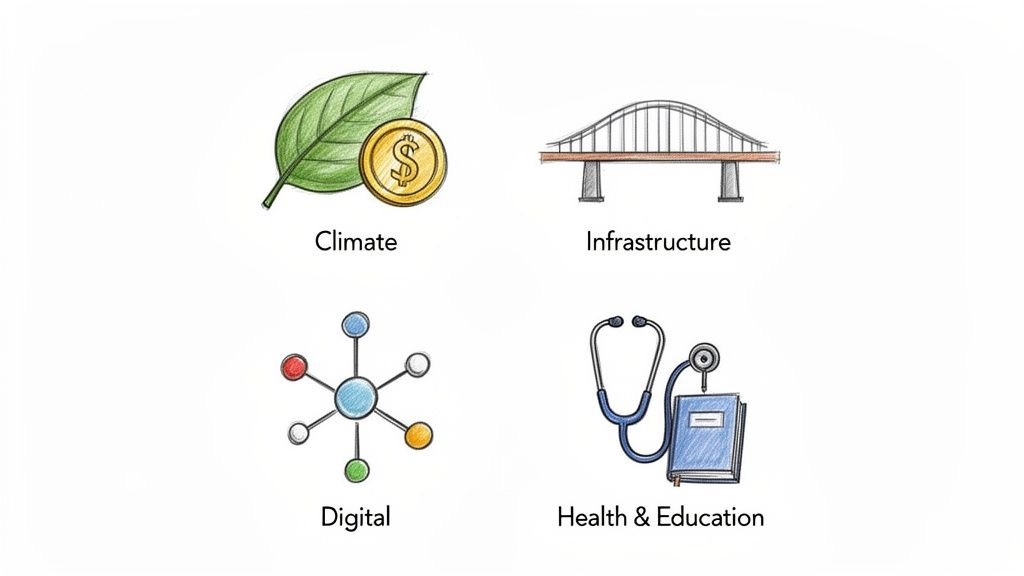
Your expertise is most valuable when it aligns with an MDB’s strategic priorities. Right now, three areas are white-hot, absorbing enormous capital and talent: climate, infrastructure, and digital transformation. If you have skills in these fields, you’re already ahead.
Core Operational Roles
Before diving into hot sectors, remember that MDBs are banks. They always need a solid group of professionals to keep the operational engine running. These roles are the organization’s lifeblood and are constantly in demand.
Economists: They are everywhere, from country economists poring over macroeconomic data to project economists running cost-benefit analyses.
Project Management Specialists: These people ensure a massive, multi-year dam or highway project stays on track, on budget, and delivers on its promises.
Procurement and Financial Management Specialists: When you’re lending billions, you need experts to ensure every dollar is spent transparently and by the book. These specialists guard the bank’s money.
Climate Finance and Green Growth
Climate is now the central organizing principle for a huge portion of what MDBs do. Shareholder governments are pressuring them to finance the green transition, making this one of the most explosive recruitment areas.
Jobs here are highly technical. MDBs desperately need specialists who can design, structure, and manage projects in renewable energy, climate-resilient agriculture, and sustainable cities. Think roles like Climate Finance Specialist, Environmental Safeguards Specialist, and Renewable Energy Engineer. If you can structure a green bond or model the financial viability of a solar farm, your phone should be ringing.
This demand will only grow. The Asian Development Bank (ADB) announced a massive 50% expansion plan for 2025 to scale up its climate lending. That translates to thousands of new jobs for specialists in project finance and environmental fields. You can see the details in the ADB’s strategic growth plans.
Infrastructure and Transport
Infrastructure is the classic bedrock of development and remains a massive part of every MDB’s portfolio. Countries need roads, ports, and power grids to grow their economies, and MDBs provide the cash and technical expertise to build them.
This has always been the heartland of MDB lending, and they are always hiring. They need Transport Economists, Civil Engineers, Energy Specialists, and Urban Planners. The focus now is on building “smart” infrastructure that is financially sustainable, environmentally sound, and resilient to climate change.
The core task here is structuring complex, long-term investments. You’re ensuring a new highway connects two cities, creates economic value, and withstands the impacts of a changing climate for the next 50 years.
Digital Transformation and Social Sectors
The third major growth area is digital. MDBs are pouring money into helping countries build digital economies. This covers everything from developing fintech regulations and funding digital payment systems to ensuring rural kids have internet access for school.
This has created a huge need for experts in data science, digital governance, and cybersecurity. The banks also hire for roles applying technology to traditional sectors, like ag-tech or ed-tech.
Finally, the social sectors of public health, education, and social protection remain crucial. Here, the banks need experts who can design and manage large-scale programs that build human capital. This means strengthening a national healthcare system or reforming a country’s education curriculum. These roles require a deep understanding of policy and on-the-ground implementation.
Navigating the MDB Hiring Maze
Applying for a job at a Multilateral Development Bank is a serious undertaking. It’s a marathon that will test your patience, preparation, and every line on your CV. The MDB process is its own beast, and you need a specific game plan.
The whole process, from submission to offer, can easily take four to six months, and sometimes longer. This isn’t a sign they’re ghosting you; it’s the nature of a massive, bureaucratic institution. Knowing this upfront saves you anxiety and helps you stay the course.
Crafting a CV That Gets Noticed
Your CV is the first gatekeeper. This is where most applications die. MDBs use a mix of automated screeners and human reviewers who scan for specific keywords and, more importantly, results. Your job is to make it past both.
Generic CVs listing job duties get tossed immediately. You have to focus on quantifiable results.
Don’t say you “managed projects.” That means nothing. Say you “managed a $5 million infrastructure project, delivering it 10% under budget and two months ahead of schedule.” Every bullet point must answer “So what?” Use hard numbers, percentages, and specific outcomes to show your impact. This is how you prove your value.
Decoding Eligibility and Nationality Rules
This is a rigid and misunderstood part of MDB hiring: the strict enforcement of nationality requirements. It’s a fundamental rule. MDBs are owned by their member countries, and a certain percentage of staff positions are informally earmarked for citizens of those countries.
If a posting is open only to nationals of shareholder countries and you don’t hold one of those passports, you will not be considered. Your qualifications don’t matter. Always check the eligibility requirements before you invest time in an application.
This is a non-negotiable part of the process. Some roles, particularly at headquarters, show a strong preference for candidates from underrepresented member nations to maintain a balanced staff. It’s how the system is wired.
Surviving the Interview Gauntlet
If your CV makes the cut, you’ve reached the next level. You’ll now enter a multi-stage interview gauntlet designed to test your technical skills, behavioral competencies, and cultural fit. This is where the real prep begins.
The interviews are almost always structured and formal. Expect a sequence like this:
Technical Assessment: This could be a written test, a case study, or a presentation. An economist might get a dataset and be asked to write a policy brief. A project manager might have to develop a risk mitigation plan for a hypothetical project. They want to see if you can do the work.
Panel Interview: This is the main event. You’ll likely face a panel of 3-5 interviewers, typically the hiring manager, a sector expert, someone from HR, and maybe a colleague from a related department. They will ask a mix of deep technical and competency-based questions.
Competency-Based Questions: Get ready for “tell me about a time when...” questions. They are looking for concrete examples of how you’ve handled specific situations. Be ready to talk about managing difficult stakeholders, navigating bureaucracy, and resolving conflicts. Use the STAR method (Situation, Task, Action, Result) to structure your stories in advance.
Your answers need to be specific, structured, and backed by real-world examples. Vague, theoretical responses won’t get you anywhere. They want proof you’ve been in the trenches.
Understanding the Opaque Timeline
Patience is a survival skill here. The MDB hiring process is notoriously slow and often feels like a black box. It’s normal to submit an application and hear nothing for months. This is part of the game.
Here’s a rough timeline of a typical recruitment process at a major MDB.
Typical MDB Hiring Timeline
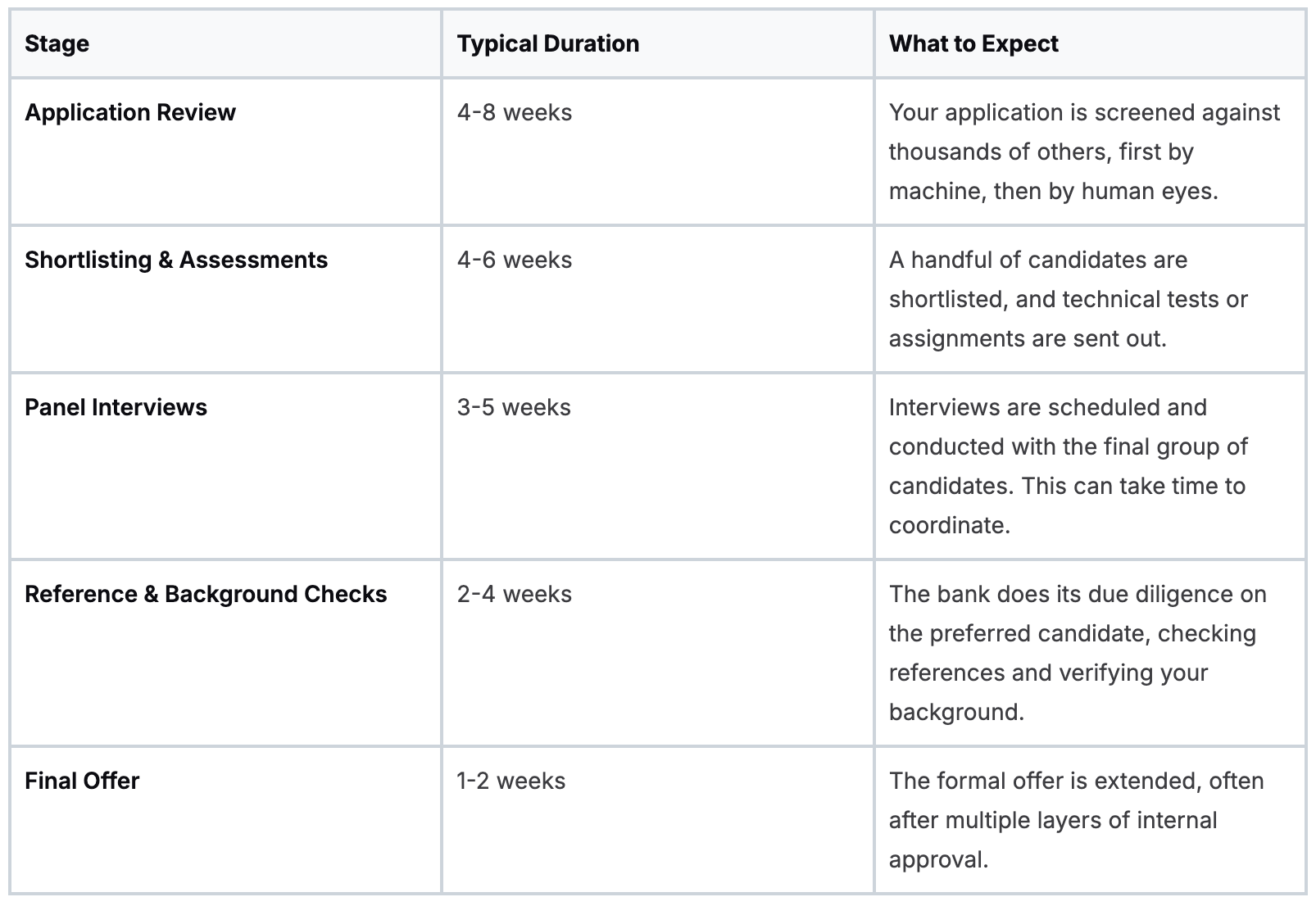
After an interview, it’s fine to send a polite thank you note, but resist pestering HR for updates. The best strategy is to apply, prepare, and mentally move on. If they want you, they will find you. In the meantime, keep pursuing other opportunities within international development careers.
Building the Right Skills and Credentials
Passion alone won’t land you a job at a Multilateral Development Bank. Good intentions are a starting point, but in MDBs, hard skills are the currency that matters.
These institutions are staffed by specialists. They want candidates with a potent mix of advanced degrees and proven, hands-on experience. Your profile needs to be undeniable on paper.
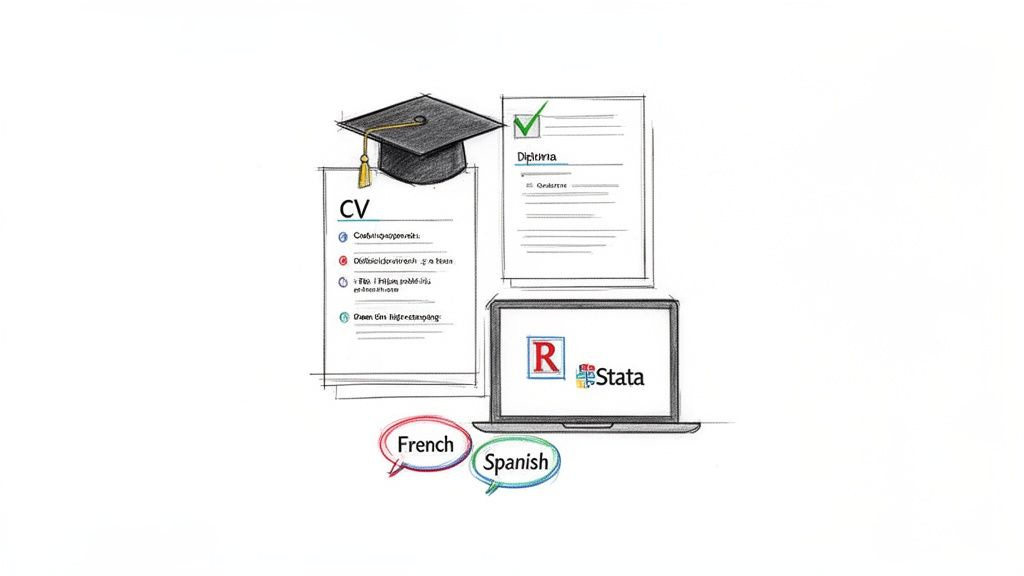
This is about proving you have the intellectual firepower and technical toolkit to tackle complex, billion-dollar problems from day one.
Your Academic Foundation
For almost any professional-level role at an MDB, a master’s degree is the minimum price of admission. Your bachelor’s degree is important, but hiring managers are looking for the deep, specialized knowledge from graduate-level training.
These degrees consistently get you in the door:
Economics or Finance: The absolute gold standard. MDBs are financial institutions. They need people fluent in macroeconomics, econometrics, and public finance.
Public Policy or Public Administration (MPP/MPA): Excellent for roles involving direct work with governments on policy reform, institutional strengthening, and program implementation.
International Relations or Development Studies: Strong choices that provide a great theoretical framework, but you must back them up with hard, quantitative skills to be competitive.
The key is specialization. A generalist degree, no matter how prestigious the university, is a much tougher sell than one that aligns directly with an MDB’s operational needs.
Your academic background is your foundation. What you build on top of it sets you apart in the crowded field of international development careers.
The Hard Skills That Matter Most
Credentials get your CV a second look; demonstrated skills get you the interview. MDBs need people who can do things. You have to show a portfolio of tangible, technical abilities you can deploy immediately.
Hiring managers are actively scanning for expertise in these areas:
Quantitative Data Analysis: Proficiency in statistical software like Stata, R, or Python is non-negotiable for most economist, research, and evaluation roles. You have to prove you can wrestle with large datasets and pull out actionable insights.
Financial Modeling: For any role touching infrastructure, private sector development, or corporate finance, you must be able to build and interpret complex financial models. It’s a core competency for assessing project viability.
Project Management: Formal training and certifications like PMP or PRINCE2 are highly valued because they prove you understand how to manage the scope, budget, and timelines of massive, multi-year projects.
Sector-Specific Technical Skills: This is where you really show your value. It could be anything from environmental impact assessment for an energy project to public health systems analysis for a social sector loan.
This focus on practical skills is tied to the MDBs’ core mission. The World Bank Group made job creation its central objective for 2025. This means every project is now designed to maximize employment. With the services sector projected to create 91 million new jobs by 2035, MDBs need staff with the technical chops to design the investments that will fuel this growth. You can get more insights in their 2025 resilient economies report.
The Language Advantage
Never underestimate the power of language skills. MDBs are global institutions where English is just the starting point.
Fluency in another of the bank’s working languages, especially French, Spanish, or Arabic, gives you a massive competitive edge. Being able to conduct meetings, write reports, and negotiate with government officials in their own language makes you exponentially more valuable.
If you’re looking to move from an NGO, language proficiency can be a powerful differentiator. For more on that switch, see our guide on repositioning your NGO experience for an MDB role in our article.
What to Expect: MDB Salaries, Benefits, and Lifestyle
Let’s get into the practical stuff: what life is really like in one of these roles. An MDB career is known for its competitive pay, but the total package is much more than the salary. For most internationally recruited staff, that salary is tax-free, which is a massive financial head start.
This is a fully supported professional life. The benefits package is designed to attract and retain top global talent, covering every angle of living and working abroad.
More Than Just a Paycheck
The MDB compensation structure is built to compete on a global scale. The benefits are a rock-solid support system for you and your family, wherever you’re based.
Typically, the package includes:
Global Health Insurance: Top-tier medical and dental coverage that follows you internationally.
Generous Retirement Plans: Serious pension schemes designed for long-term financial security.
Education Allowances: Financial support for your children’s schooling, a game-changer for expatriate families.
Full Relocation Support: Comprehensive help with your move, including shipping, travel, and a grant to get you settled.
These are fundamental parts of the deal when you work for an MDB.
The Realities of the Work Environment
The culture inside an MDB is unique. It’s a highly academic and analytical environment, driven by the unmovable deadlines of board meetings and project cycles. You’ll work alongside some of the sharpest people you’ve ever met, and the intellectual bar is set incredibly high.
That intensity impacts work-life balance, which can be a real struggle. The work is demanding and the stakes are high, often meaning long hours, especially when you’re pushing for a major project approval or heading out on a mission.
The work follows the mission. Frequent international travel is a standard part of the job for most operational roles. You will spend significant time on the ground in the countries you’re working with, which is both a huge perk and a major demand on your time.
This isn’t a simple nine-to-five. It’s a career that asks for a high level of commitment but offers an extraordinary level of engagement with the world’s biggest challenges.
Headquarters vs. The Field
Your day-to-day experience will be dramatically different depending on your duty station. A headquarters job in Washington D.C., Manila, or London is a world away from a role in a regional or country office.
HQ roles are more focused on strategy, policy, and the final approval of projects. Life in a field office puts you closer to the action. You’ll work directly with government counterparts and oversee project implementation on the ground, based in cities from Nairobi to New Delhi, gaining priceless firsthand experience.
Both paths offer incredible opportunities to build your career in international development. The right fit depends on what you’re looking for, personally and professionally. To get a clearer picture of what this means for your finances, check our detailed breakdown of MDB salaries and the numbers you want to see.
Common Questions, Answered
Let’s tackle the most frequent questions that come up when people are trying to break into the Multilateral Development Bank world.
Is a Master’s Degree Really a Non-Negotiable?
For professional, operational roles? Pretty much, yes. A master’s in economics, public policy, finance, or a relevant field is the de facto entry ticket. It’s the baseline qualification.
While there are exceptions for administrative or support staff, it’s incredibly tough to land an economist, project manager, or specialist job without a graduate degree. If you don’t have one, your best bet is the consultant route. Get in, do exceptional work on a project, and sometimes that can open a door to a staff position.
What Counts as “Field Experience”?
“Field experience” doesn’t mean you need to have worked for an NGO in a remote village. That’s a common misconception.
What MDBs are really looking for is proof that you understand the on-the-ground realities of the countries where they work. Solid experience in a developing country’s government ministry, a local consulting firm, or a private company is gold.
The real test is whether you can navigate complex local contexts and get things done. Time spent in a capital city’s finance ministry can be just as valuable as traditional fieldwork, if not more so.
How Much Does Networking Really Matter?
It’s everything. The MDB ecosystem is surprisingly tight-knit, and your professional network can be what sets you apart. A huge number of roles are filled by people who are already known quantities, often former consultants or people recommended by current staff.
The goal isn’t to cold-call someone for a job. It’s about building genuine relationships. Reach out for informational interviews, ask intelligent questions about their work, and show them you know your stuff. A warm introduction from a trusted connection is the single most effective way to get your CV a serious look.
Am I Too Old for This? Is There an Age Limit?
For the Young Professional Programs (YPPs), absolutely. They almost always have a strict age cap, usually around 32.
For every other staff and consultant role? No way. There’s no official age limit. MDBs constantly hire seasoned professionals at all career stages, from mid-level specialists to senior experts with decades of experience. For these lateral hires, that extensive experience is exactly what they’re paying for. The focus is on the skills and value you bring to the table.
What’s the Single Biggest Mistake People Make?
Hands down, it’s sending a generic, one-size-fits-all application. Hiring managers spot these from a mile away, and they go straight to the “no” pile.
You must tailor your CV and cover letter to the specific job description. Use their keywords and highlight the exact skills and quantifiable results they’re asking for. Failing to do this is the fastest way to ensure your application is ignored.
Finding the right opportunities and cracking the application code is the biggest hurdle in this field. Multilateral Development Bank Jobs makes it easier by sending curated job lists straight to your inbox. You’ll get full-time staff roles on Monday, consultant gigs on Friday, and expert career guides every Wednesday. Start your MDB job search at
https://mdbjobs.com
.