

Landing a coveted asian infrastructure investment bank job is about joining one of the world’s most significant new multilateral development banks (MDBs), an institution driving massive economic change across Asia and beyond.
These are high-impact, high-stakes roles financing huge projects, from green energy grids to cross-border digital highways.
What an AIIB Job Actually Is
Let’s be clear: an AIIB job is not a typical banking gig. You’re stepping inside a powerful engine for global development, one capitalized with a staggering USD100 billion.
The Asian Infrastructure Investment Bank (AIIB) is a modern MDB with a laser focus on building the “Infrastructure for Tomorrow.” In simple terms, that means bankrolling projects that are sustainable, wired for the future, and built to connect entire regions.

Working at the AIIB means you are directly tied to projects with real, tangible outcomes. This is not abstract policy work from an ivory tower. It’s financing the actual roads, data centers, and power plants that change millions of lives.
Understanding the Bank’s Scale and Impact
The AIIB’s growth has been explosive. Since it kicked off operations in 2016, it has quickly become a major force in global finance, earning a top-tier AAA credit rating. That financial muscle gives it the power to fund ambitious projects that most other organizations can’t touch.
The numbers speak for themselves. This table gives a quick snapshot of the bank’s operational scale just a decade into its existence.
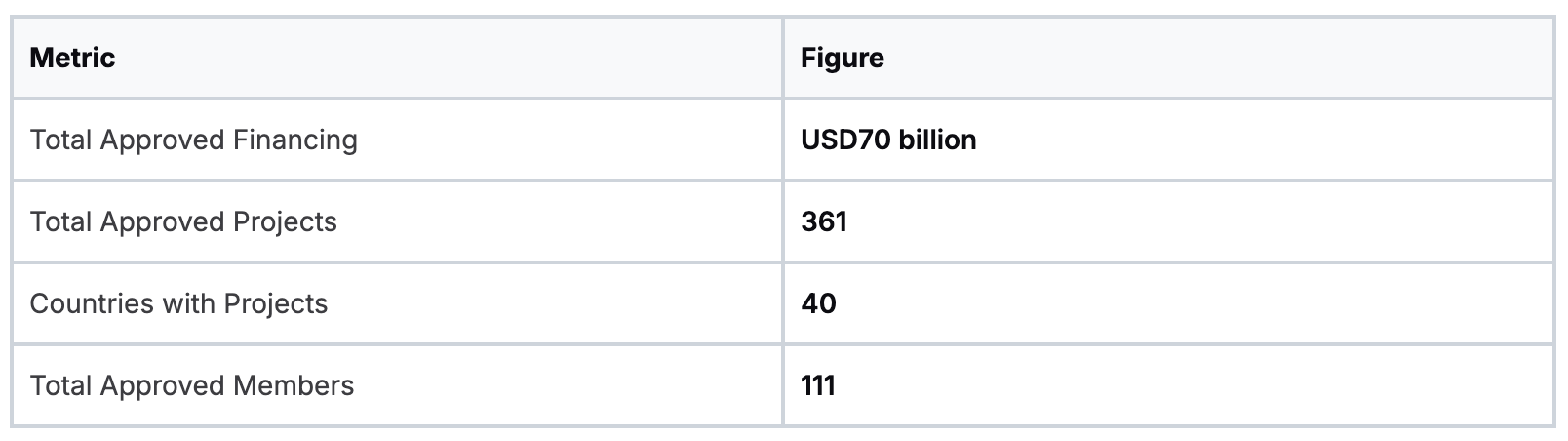
AIIB At a Glance: Key Statistics for 2026
This rapid expansion fuels a constant demand for top-tier talent in investment operations, economics, IT, legal, and risk management. You can dig into the bank’s project portfolio and growth story on its official website.
An AIIB career places you at the intersection of international finance and sustainable development. Your work could involve structuring a multi-billion dollar loan for a new railway or analyzing the economic benefits of a cross-border digital connectivity project.
Why AIIB Roles Are So Competitive
The competition for a spot at the AIIB is fierce, and it’s easy to see why. Everyone wants in for a few key reasons.
Top-Tier Compensation: The bank offers highly competitive salaries and benefits, on par with other leading MDBs. For most non-Chinese staff, this includes tax-free salaries, which attracts a global pool of incredibly qualified candidates.
Meaningful Work: Most jobs don’t let you contribute to nation-building infrastructure. Professionals are drawn to the chance to work on high-profile projects that directly foster economic growth and sustainability.
Modern DNA: The AIIB was built from the ground up in the 21st century. It has no legacy baggage, operating with modern technology and lean, efficient models. This is a huge draw for professionals who want to work in a forward-thinking organization without the bureaucracy of older institutions.
The AIIB is one of several MDBs that offer these kinds of impactful careers. If you’re weighing your options, our guide breaks down which MDBs you can work for.
The Professional Profiles AIIB Actively Recruits
Before you apply, you need to understand exactly where you fit inside the AIIB. The bank is a collection of highly specialized teams. Simply having “finance experience” on your CV won’t cut it. You have to know which department needs your specific skillset.
Think of the bank in two parts: the teams that find and manage the deals (the “front office”) and the teams that support and protect the bank’s operations (the “back office”). Your background almost certainly fits one side better than the other. Knowing the difference is the first step to crafting an application that gets noticed.
The Front Office: Investment and Operations Teams
These are the people on the front lines, directly executing the bank’s mission. They identify, structure, and manage the massive infrastructure projects that define the AIIB. Roles here are intense, focused on project outcomes and financial returns.
Investment Operations: This is the heart of the bank. Professionals here are the project finance experts, investment bankers, and deep sector specialists in areas like energy, transport, and digital infrastructure. They take a project from an idea on paper to a signed deal, handling everything from due diligence and financial modeling to high-stakes negotiations with governments.
Treasury: This team manages the bank’s USD100 billion in capital. They are responsible for funding strategies, issuing bonds on global capital markets, and managing the bank’s day-to-day liquidity. If your background is in capital markets, fixed income, or portfolio management, this is your arena.
Economics Department: These are the big-picture strategists. They conduct the macroeconomic analysis that determines country risk and provides the economic justification for the bank’s investments. They hire macroeconomists and researchers who can guide regional strategy and prove a project’s real-world impact.
The Back Office: Support and Risk Functions
These departments are the bank’s central nervous system. They make sure the institution runs efficiently, manages its risks properly, and complies with international standards. While they aren’t on the front lines of deal-making, their work protects the bank’s AAA credit rating and ensures its long-term survival.
The AIIB’s operational scale is immense. The bank has approved over USD70 billion for 361 projects. This explosive growth, which you can see in its official annual reports, creates a constant demand for specialized talent in both front and back-office roles needed to manage such a complex portfolio.
Key support departments include:
Risk Management: This team is the bank’s conscience. They evaluate credit risk, market risk, and operational risk for every single transaction. Their job is to protect the bank’s capital and ask the hard questions to ensure every investment is sound.
Legal Department: Every loan agreement, every investment, every policy needs a bulletproof legal framework. The lawyers here draft and negotiate these complex agreements, advise on international law, and ensure the entire bank remains compliant.
Corporate Services: This is where you’ll find critical functions like Human Resources, IT, and Communications. These teams recruit top talent, manage the bank’s modern digital infrastructure, and communicate its mission to the world.
Understanding this structure is your roadmap. Instead of searching for “finance jobs,” you can now target the Investment Operations team with a CV that screams project finance. This strategic approach shows you get their world and can start solving their problems from day one.
How to Get In: Choosing Your Entry Point to an AIIB Career
So, you’re set on a career at the AIIB. Great. Before you polish your CV, answer one critical question: which door are you trying to walk through?
Getting a job at the AIIB isn’t a single pathway. The bank uses three distinct recruitment channels to bring in talent. Picking the right one for your experience level is the most important strategic decision you’ll make. Trying to force your way through the wrong door is a surefire way to waste your time and theirs.
Let’s break down the main routes: International Recruited Staff, Consultants, and the Young Professionals Program (YPP). Each one is designed for a different type of professional with a specific purpose.
This decision tree can help you visualize how different skill sets align with the bank’s core operational needs.
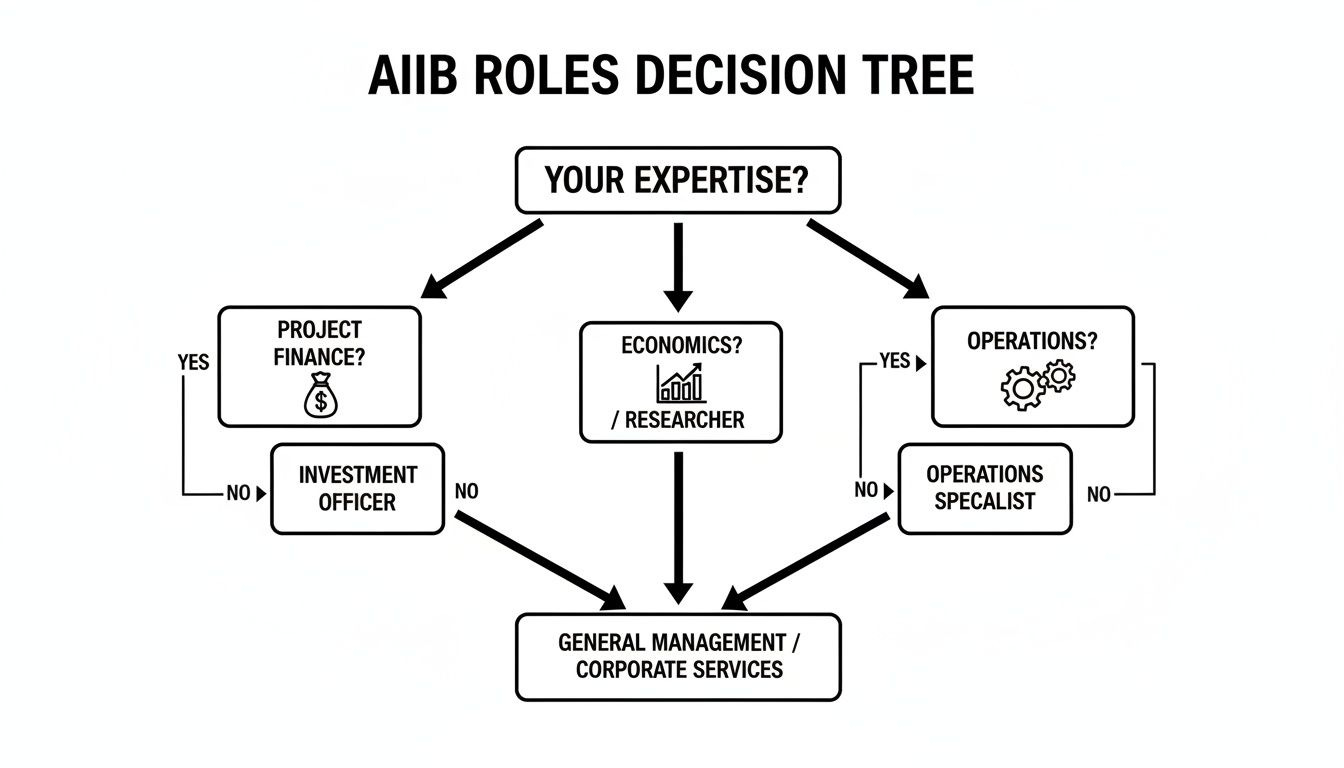
Think of this as your first filter. It gives you a clear starting point for where to focus your application efforts based on your core expertise.
International Recruited Staff: The Long-Term Career Path
This is the traditional, permanent employee route. International Recruited Staff (IRS) are the backbone of the AIIB, hired on open-ended contracts to form the core of its operational and support teams. These roles are for seasoned professionals who have a proven track record in their field.
Think of it as the partner track at a top-tier firm. You aren’t being hired for a single project; you’re being brought on to build a career and contribute to the bank’s long-term institutional strength.
Who they want: Mid-career to senior experts with at least 5-8 years of relevant experience, and often much more for senior positions. This is where you’ll find project finance specialists, seasoned economists, corporate lawyers, and risk managers.
The commitment: These are full-time, permanent positions based in Beijing. The bank is investing in you for the long haul.
The goal: To build the bank’s permanent capacity. You’re expected to contribute to the AIIB’s overarching strategy and mission from day one.
Applying for an IRS role means you have the deep experience needed to hit the ground running. It’s the most competitive path but offers the greatest stability and potential for career progression within the bank.
Consultants: The Specialized Problem-Solvers
Consultants are the bank’s special forces. They are brought in for a specific, time-bound assignment where a particular niche expertise is needed now. They are external experts hired to solve a defined problem or complete a project, not permanent employees.
The consultant pathway is ideal for seasoned professionals who prefer project-based work. You apply your deep knowledge to high-impact assignments without the long-term commitment of a permanent staff role.
This path is perfect for those with a very specific skill set. For example, the bank might need a port logistics expert for six months to evaluate a project in Southeast Asia, or a cybersecurity specialist to audit a new financial system. That’s when they hire a consultant. The contracts are fixed-term and focus entirely on a specific set of deliverables.
Young Professionals and Interns: The Talent Pipeline
The Young Professionals Program (YPP) and the Internship Program are the AIIB’s primary engines for building its next generation of leaders. Both are intensely competitive and serve as a direct pipeline into full-time roles at the bank.
The YPP is a two-year rotational program for exceptional early-career professionals. It’s designed to give them broad exposure across different departments, grooming them for future leadership positions. Make no mistake: YPs are considered full-time staff members from day one.
The Internship Program offers an even earlier entry point. For example, AIIB’s Global Internship Program for 2026 offers 37 fully paid positions for master’s and PhD students across more than a dozen departments, from Economics to Climate Finance. With applications closing February 28, 2026, this program is a golden ticket. Why? MDB statistics consistently show that over 30% of young professionals are hired after a successful internship.
You can learn more about the fully paid international internships offered by AIIB.
To make the choice crystal clear, let’s compare these pathways side-by-side.
Comparing AIIB Recruitment Pathways
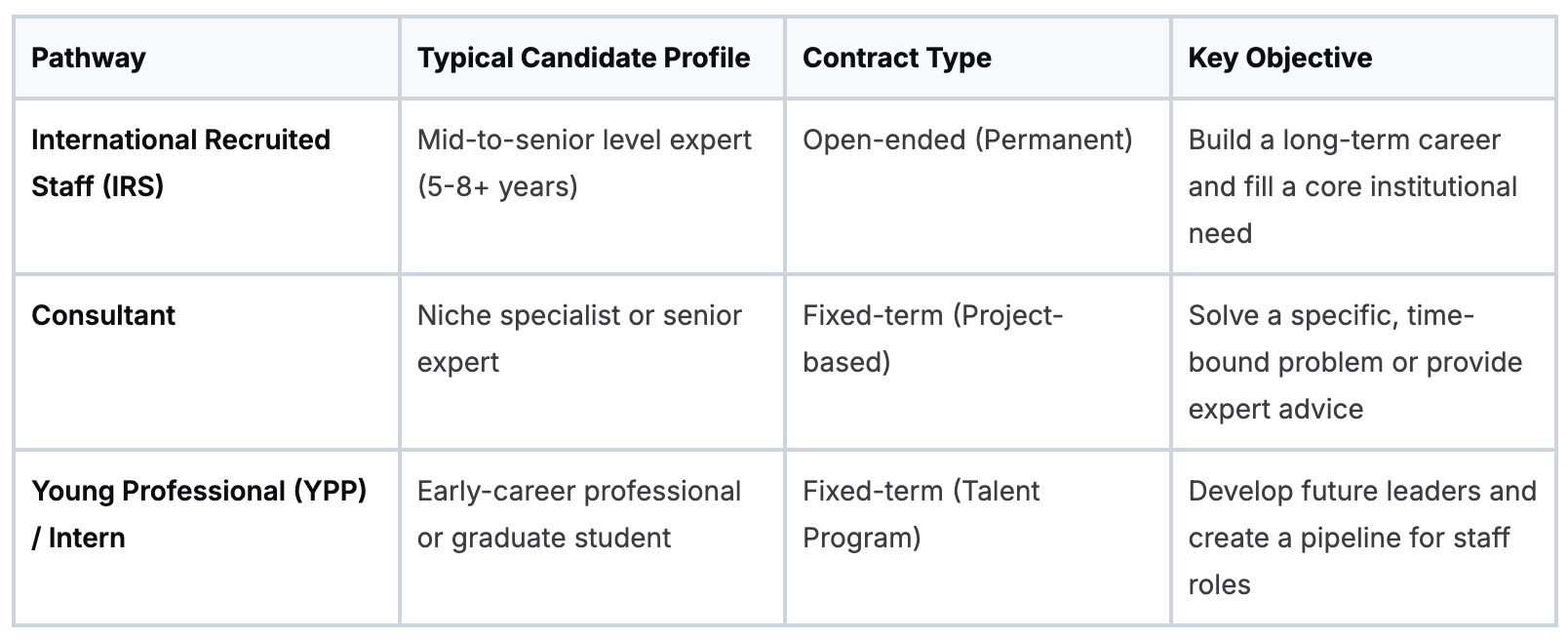
Choosing the right entry point comes down to an honest assessment of your career stage and goals. Are you an established expert ready for a permanent leadership role? A specialist who thrives on solving targeted problems? Or a rising star looking for the ultimate launchpad? Your answer will define your entire application strategy.
Crafting an Application That Gets Noticed
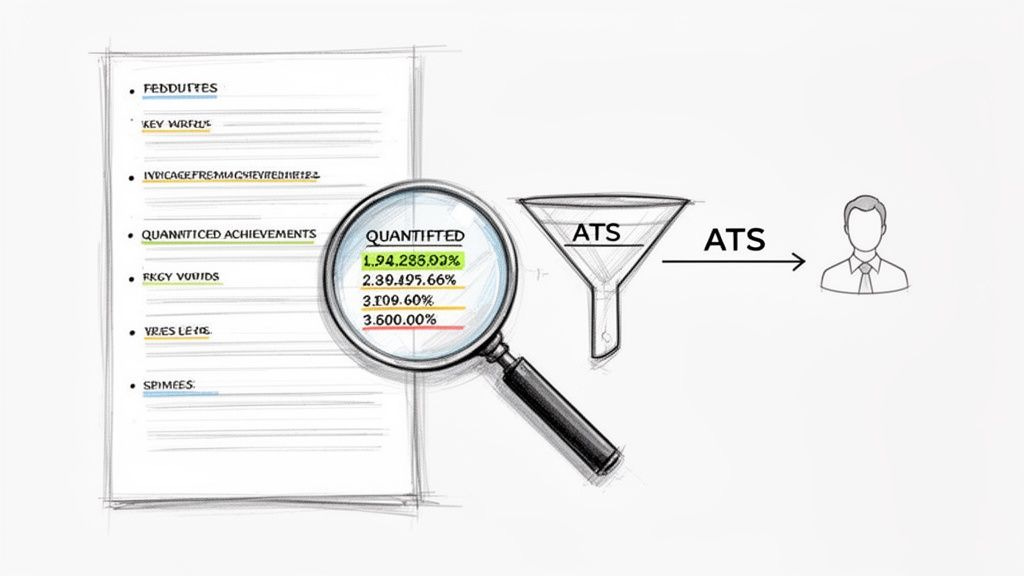
You’ve pinpointed your entry point and you’re ready to throw your hat in the ring for a job at the Asian Infrastructure Investment Bank. This is where most candidates stumble. The bank gets flooded with thousands of applications for every role. The first gatekeeper you need to impress isn’t human. It’s an Applicant Tracking System (ATS).
Your first job is to beat the machine. Your second is to wow a recruiter who has seen it all. This calls for a tactical approach that goes way beyond sending in a generic CV.
Find and Dissect the Job Description
First things first: only apply through the official AIIB careers portal. Don’t trust third-party sites; they often have outdated listings. Once you’ve found the specific opening you’re targeting, treat the job description as the blueprint for your entire application.
Seriously, print it out. Take a highlighter to the key requirements, the specific skills they list, and any words that signal the bank’s values, like “sustainable,” “lean,” or “client-focused.” These are the exact keywords the ATS is programmed to hunt for. Your task is to sprinkle them naturally throughout your CV and cover letter.
This isn’t about mindlessly stuffing keywords in. It’s about signaling that you speak their language and understand precisely what they’re looking for.
Transform Your CV from a List of Duties to a Showcase of Impact
Most CVs are a snoozefest, just a boring list of job duties. “Responsible for financial modeling.” “Managed a team of five analysts.” An AIIB recruiter will toss that in the ‘no’ pile without a second thought. They don’t care what you were responsible for; they care what you accomplished.
You have to translate every bullet point on your CV into a quantifiable, impact-driven achievement. This is the single most important change you can make to your application.
Stop describing your job. Start selling your results. The difference between “Managed project budgets” and “Managed a USD 50M project budget, delivering it 10% under forecast” is the difference between getting an interview and getting ignored.
Here’s a simple way to do it. For every point on your resume, ask yourself:
How much? (e.g., deal size, budget managed, funds raised)
How many? (e.g., projects completed, clients served, reports produced)
What was the result? (e.g., increased efficiency by X%, reduced risk by Y%, grew revenue by Z%)
Let’s look at a real-world example for an Investment Officer role:
Before: “Conducted due diligence on infrastructure projects.”
After: “Led due diligence on 12 potential infrastructure investments in the transport and energy sectors, with a total deal value of USD 1.2 billion.”
See the difference? The second version screams scale, context, and real-world impact. It proves you can handle the kind of work the AIIB actually does.
The Cover Letter Is Your Strategic Narrative
Your cover letter, which MDBs often call a Statement of Interest, is not a fluffy, rehashed version of your CV. Think of it as your strategic argument for why you are the perfect candidate for this specific role. It’s where you connect the dots between your biggest wins and the bank’s core mission.
Keep the structure clean and direct. Your opening paragraph should state the exact position you want and deliver a powerful, two-sentence punch explaining why you’re a great fit. Then, use the body paragraphs to highlight 2-3 of your most impressive and relevant achievements, explicitly linking them to the job’s stated requirements.
If the job description asks for experience in “climate-resilient infrastructure,” dedicate an entire paragraph to a project where you did exactly that, backing it up with hard numbers. It shows you’ve done your homework. If you need a bit more guidance on this, our team has put together a detailed guide on how to write a compelling Statement of Interest that will help you nail your story.
Acing the AIIB Interview Process
Landing an interview at the Asian Infrastructure Investment Bank is a major accomplishment, but don’t celebrate just yet. Getting your foot in the door is one thing; proving you belong there is another.
The AIIB interview process is a marathon, not a sprint. It’s a multi-stage affair designed to test how you think, communicate, and solve problems under pressure, not just what’s on your CV. It usually unfolds in three distinct phases: an HR screening, a technical deep-dive, and a final panel interview. Knowing what’s coming is your biggest advantage.
The Initial HR Screening
Your first conversation will likely be with a recruiter from Human Resources. This is a critical competency-based screen, not a formality. They are the gatekeepers. Their job is to filter for candidates who have the right motivations and soft skills to thrive in the Bank’s unique culture.
Expect them to dig into your story. You’ll get hit with the classics: “Why AIIB?” and “Why this specific role?” If your answer sounds like you just memorized their “About Us” page, you’re done. They want a genuine, compelling narrative that connects your personal journey and career choices to the Bank’s mission. Be clear, be concise, and show some real passion.
The Technical Deep Dive
This is where the rubber meets the road. You’ve talked the talk; now you have to prove you have the hard skills to back it up. Depending on the position you’re targeting, this stage can take a few different forms.
Case Studies: If you’re going for an investment role, get ready for a case study. You might be handed a project information memorandum for a fictional toll road or a renewable energy plant and be asked to analyze its financial viability, flag the key risks, and present your findings.
Technical Presentations: For highly specialized roles, you could be asked to prepare and deliver a presentation on a topic in your domain. An economist might have to present on the macroeconomic outlook for Southeast Asia; a cybersecurity specialist might need to outline a new data protection protocol.
Written Tests: Some positions, especially in economics, risk, or treasury, will include a timed written exam. This is a straightforward test of your quantitative and analytical horsepower.
The goal here isn’t just to get the “right” answer. They are far more interested in seeing how you think. Structure your analysis logically, state your assumptions clearly, and be ready to defend every step of your process.
The AIIB’s interview process is designed to find people who are more than just technical experts. They’re looking for strategic thinkers who can operate like a banker, an economist, and a development professional all at once.
The Final Panel Interview and Behavioral Questions
If you make it this far, you’ll face the final boss: a formal panel interview. You’ll be in a room (virtual or physical) with senior managers, department heads, and the very people who could become your future colleagues. This round is a blend of follow-up technical questions and situational, behavioral questions.
For the behavioral questions, you need one tool in your arsenal: the STAR method. This isn’t optional; it’s the standard.
The STAR method (Situation, Task, Action, Result) is a simple framework for telling a powerful story about your past experience.
Situation: Briefly set the scene. What was the specific challenge or context? (e.g., “On a tight deadline for a major project...”)
Task: What was your specific responsibility? What was the goal? (e.g., “...my task was to reconcile conflicting data from two departments.”)
Action: This is the most important part. Describe the exact steps you took. Don’t say “we,” say “I.” (e.g., “I organized a joint workshop, created a shared data validation tool, and led daily check-ins...”)
Result: What was the outcome? Use numbers and concrete facts to quantify your success. (e.g., “...as a result, we resolved the discrepancies 48 hours ahead of schedule and the final report was delivered with 100% data accuracy.”)
When they ask about managing a difficult stakeholder, don’t just say you “handled it well.” Walk them through the STAR framework. It shows you’re structured, results-oriented, and can perform under pressure. It’s the difference between claiming a skill and proving it, exactly what’s needed to land a top-tier Asian Infrastructure Investment Bank job.
What to Expect From Compensation and Life in Beijing
Landing a job at the Asian Infrastructure Investment Bank is a complete life and career package. Before you accept an offer, you need to understand the full picture, from the tax-free salary to what it’s actually like living as an expat in Beijing.
Let’s get into the practical details so you know exactly what you’re signing up for.
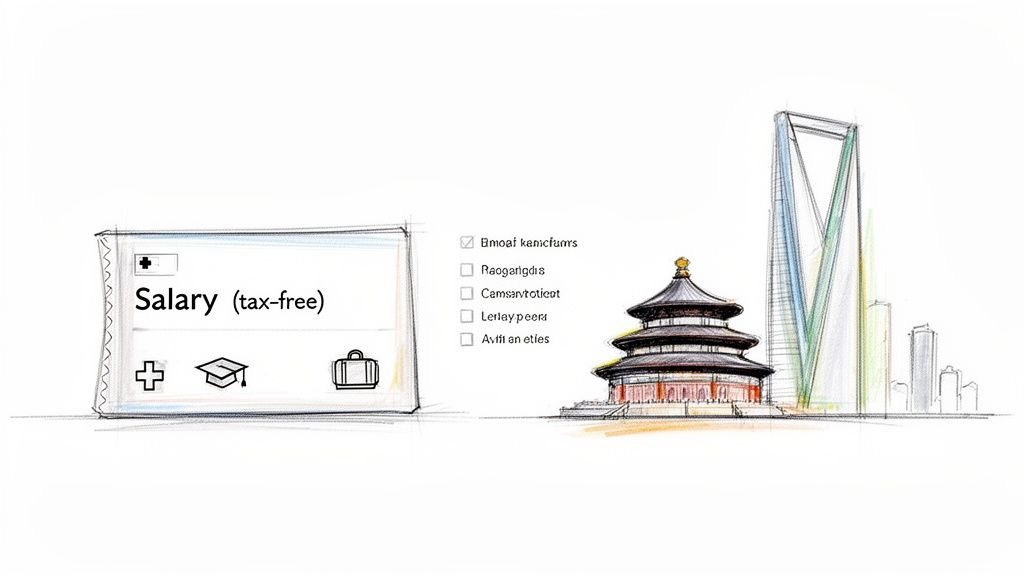
The AIIB puts together a globally competitive compensation offer for a reason: it needs to attract top-tier professionals from its 111 member countries. For most international hires, the centerpiece of this offer is a tax-free salary. This is standard practice across the major Multilateral Development Banks (MDBs) and represents a massive financial upside.
Understanding the Salary and Benefits Package
Your total compensation is much more than your payslip. The bank provides a comprehensive benefits package designed to make relocating and building a life in a new country as smooth as possible for you and your family.
The benefits are structured to give you serious peace of mind, letting you focus on the high-stakes work you were hired to do.
The AIIB’s financial offer is constructed to compete directly with other top MDBs like the World Bank and ADB. The combination of a strong base salary, which is exempt from income tax for non-Chinese nationals, and a robust benefits package makes it one of the most attractive compensation structures in the development finance world.
Here’s a breakdown of what a typical benefits package looks like:
Comprehensive Health Insurance: Global medical and dental coverage for you and your eligible dependents.
Retirement Plan: A generous, bank-contributed retirement scheme to help secure your financial future.
Education Assistance: Allowances to help cover the costs of international schooling for your children, a major factor for any expat family.
Relocation Support: A full-service relocation package that includes shipping your household goods, airfare, and a grant to cover initial settling-in costs.
Annual Leave and Home Leave: Generous paid time off, plus provisions for you and your family to travel back to your home country.
For more perspective on how these packages stack up across the industry, check out our deeper analysis of MDB salaries and the numbers you really want to know.
The Reality of Living in Beijing
An AIIB job means moving to its headquarters in Beijing, a sprawling and dynamic global city. While the bank’s official working language is English, your life outside the office will be a full immersion in Chinese culture. For many, this is a huge part of the appeal.
Beijing is a city of incredible contrasts, where ancient temples and historic hutongs sit right next to futuristic skyscrapers. The cost of living is generally lower than in other world capitals like London or New York, especially for housing and transportation. Your MDB salary will go a very long way here.
The city also has a large and well-established expat community. This means you’ll have easy access to high-quality international schools, grocery stores stocking familiar goods, and a diverse social scene. You’ll be joining a network of professionals from all over the world, creating a unique and stimulating environment both at work and after hours.
An AIIB career is a complete experience, blending high-impact work with life in one of the world’s most fascinating cities.
Frequently Asked Questions About AIIB Careers
Before you dive deep into an application, there are always a few practical questions that come to mind. Let’s tackle the big ones we hear from candidates all the time.
Do I Need to Speak Chinese to Work at the AIIB?
Let’s get this one out of the way first: No. The official working language of the AIIB is, and always has been, English.
Every internal email, every official document, and every meeting happens in English. Professional fluency is a non-negotiable requirement for getting work done. While knowing some Mandarin will certainly make your daily life in Beijing easier, it’s not a professional prerequisite for the vast majority of jobs at the Bank.
Does My Nationality Affect My Hiring Chances?
Yes, it plays a role. As a multilateral institution with 111 member countries, AIIB has a mandate to build a team that reflects its global ownership. The Bank actively works to ensure broad geographic representation across its staff.
That said, merit is always the deciding factor. Your skills, your track record, and how well you fit the specific needs of the role will always be the most important part of the equation. The goal is simple: hire the best person for the job, no matter where they’re from.
How Long Does the AIIB Hiring Process Usually Take?
You’ll need to be patient. The timeline can vary quite a bit depending on how senior the role is and how quickly the team needs someone, but you should mentally prepare for a process that takes several months.
From the day the application closes to the day you might receive an offer, you’re typically looking at a window of two to six months. The journey involves multiple hurdles, from initial shortlisting and several rounds of interviews to technical tests, reference checks, and final internal approvals.
Ready to find your place at a leading MDB? Multilateral Development Bank Jobs sends you curated staff and consultant listings every single week, plus insider guides to help you land the role. Sign up at https://mdbjobs.com to get started.