

Fewer candidates get turned away because they lack credentials than because they misread how these programs work.
Young professional programs in international organisations are small, controlled hiring channels. Institutions use them to solve staffing problems they cannot fix through ordinary vacancies: succession gaps, weak country representation, technical shortages, and the need to build a future manager before that person becomes expensive and hard to move.
That matters because selection is never just about merit in the abstract. It is about fit within a constrained intake. At the UN, nationality can decide whether you are even allowed into the process. At multilateral development banks, sector demand and mobility often matter more than a polished personal statement. Strong candidates lose every year because they apply as if the competition were a global graduate scheme with one ranking list. It rarely works that way.
The official criteria tell you who may apply. The true contest begins after that. Hiring teams and panels are trying to balance capability, institutional need, and representation at the same time. A candidate from an oversubscribed nationality is playing a different game from one coming from an under-represented member country, even if their CVs look similar on paper.
Use that as your starting point. YPPs are access routes into highly selective bureaucracies, but access is rationed for institutional reasons, not only academic ones. Applicants who understand those constraints make better choices early. They target the right program, time their application properly, and avoid wasting a cycle on a scheme that was never structurally open to them.
What Are Young Professional Programs Really
Fewer people get into these schemes than applicants usually assume, and the reason is simple. A Young Professional Program is not a graduate perk. It is a controlled intake tool for institutions that want to hire early, test hard, and shape people for posts they expect to fill over years, not months.
That staffing logic is what candidates miss.
A YPP sits much closer to succession planning than to campus recruitment. The organisation is buying option value. It wants people with strong technical foundations who can be moved across units, sent to difficult duty stations, absorbed into internal process, and trusted around country counterparts or sensitive political issues before they become expensive lateral hires.
Internships serve a different purpose. They give exposure, some signal, and occasionally a useful line on a CV. They do not usually put you into a managed staffing track with formal assessment, cohort handling, and an expectation of longer-term placement. A YPP does, even when the institution avoids saying it so bluntly.
That distinction affects how you should present yourself. Panels are not asking only, “Can this person do the work?” They are asking, “Can this person become useful in more than one setting, under pressure, with supervision, and without creating avoidable management cost?”
What a YPP is built to do
The official language will talk about talent pipelines, leadership development, technical excellence, and institutional renewal. Strip that back and the mechanics are clearer.
A YPP helps an international organisation solve four practical problems at once:
bring in talent before mid-career hiring gets expensive and rigid
fill technical gaps where ordinary vacancy rounds produce weak slates
improve future staffing options across offices, regions, or practices
manage representation needs without relying only on ad hoc recruitment
The fourth point matters more than many applicants realise. In some systems, nationality is not a side issue. It shapes who is eligible, who is competitive, and how many realistic slots exist for your profile in a given year. Two candidates with similar credentials can be facing very different odds because the institution is balancing member-country representation as well as capability.
That is why YPP strategy starts before the application form. It starts with whether your nationality, sector, language profile, and mobility match the intake logic.
What applicants often confuse with a YPP
Three routes get lumped together, and that creates bad decisions.
Internships: short-term exposure and limited institutional risk
JPO-style appointments: usually donor-funded or government-linked, with a separate staffing logic
Entry-level vacancies: direct recruitment for a job that exists now
A YPP is different because the institution is selecting for future deployment, not only immediate task delivery. The scrutiny is higher for that reason. You are being assessed as a prospective staff member with range, judgment, and staying power.
What selection panels are really testing
Candidates often overinvest in the technical story and underplay the operating story. Strong economics, health, infrastructure, climate, governance, legal, or finance credentials get you into the conversation. They do not finish it.
Selectors usually look for three things:
A credible technical base
Evidence you can work inside a rules-heavy institution
Signs you can grow across functions, countries, or teams without constant hand-holding
The third point decides more outcomes than applicants think. YPPs are expensive to run. If a panel believes you are brilliant but narrow, or impressive but immovable, they may pass. The candidate who looks slightly less polished but easier to place across the institution often wins.
That is also why it helps to study the broader market before choosing where to apply. A practical way to do that is to compare institutions across a current set of international development group jobs, then work backwards from who hires in your function, where they place people, and whether your profile fits their staffing reality.
A good YPP application, then, is not a generic “high potential” pitch. It is a disciplined case that you are worth training, worth moving, and worth holding onto.
The Landscape of YPPs in International Organisations
The field is broad, but it helps to sort it into a few buckets. The labels matter because each group hires for different reasons and rewards different profiles.
Multilateral development banks
This is the most obvious destination for candidates who want operational work tied to lending, advisory support, private sector development, infrastructure, economics, climate, governance, or public sector reform.
In this family, the World Bank is the flagship reference point because its YPP is formalized, selective, and explicitly developmental. Other banks and IFIs may run their own early-career pathways under different names, with different cohorts, timelines, and staffing logic. Some are rotational. Some are direct-placement. Some are heavily technical from day one.
If you’re mapping the market, a practical starting point is a curated list of international development group jobs so you can see which institutions recruit in your area rather than chasing every brand name.
The UN system
The UN ecosystem works differently. It is wider, more fragmented, and more political in how opportunities are distributed. The UN Secretariat’s YPP is a formal route into the Secretariat, but it is tightly governed by representation logic and exam-based filtering.
That matters because candidates often talk about “the UN” as if it were one employer with one hiring model. It isn’t. The Secretariat, agencies, funds, and programmes have different rules, cultures, and staffing incentives. A YPP opening in one part of the system tells you little about access elsewhere.
Other international organisations
Then you have organisations that don’t fit neatly into either camp but still run youth-facing pipelines or structured early-career schemes. These can include security-focused institutions, health organisations, and specialised bodies with strict citizenship rules or country-list restrictions.
Applicants often waste time by assuming all YPP-style programs reward a generic “global mindset.” In reality, each organisation defines “young professional” in its own operational language.
Here’s the overview in a more useful form:
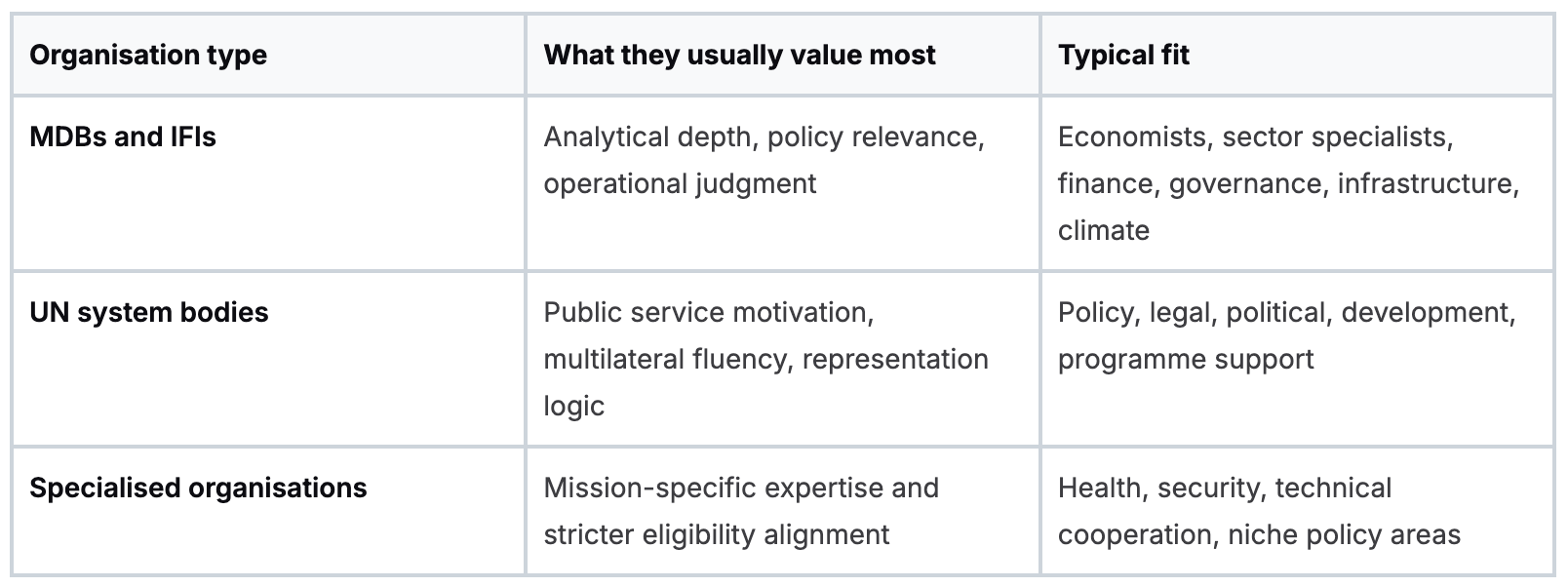
The career logic differs by institution
This is the point many generic guides miss. You’re not choosing only a prestigious employer. You’re choosing a system of career formation.
Some programs produce broad institutional operators. Others produce deep specialists who happen to enter early.
That distinction affects your daily work, your mobility, your likely supervisors, and the kind of profile you’ll have in five years. If you want field-heavy operations, one institution may suit you. If you want policy drafting, sovereign dialogue, or technical advisory work, another may fit better.
Prestige matters. Career architecture matters more.
Decoding Eligibility Rules and Nationality Requirements
Merit matters. Eligibility decides whether merit even gets reviewed.
That sounds harsh, but it’s how these programs work. Most applicants spend too much time polishing motivational language and too little time checking whether they are structurally eligible. In YPP hiring, the hard filters come first. Always.
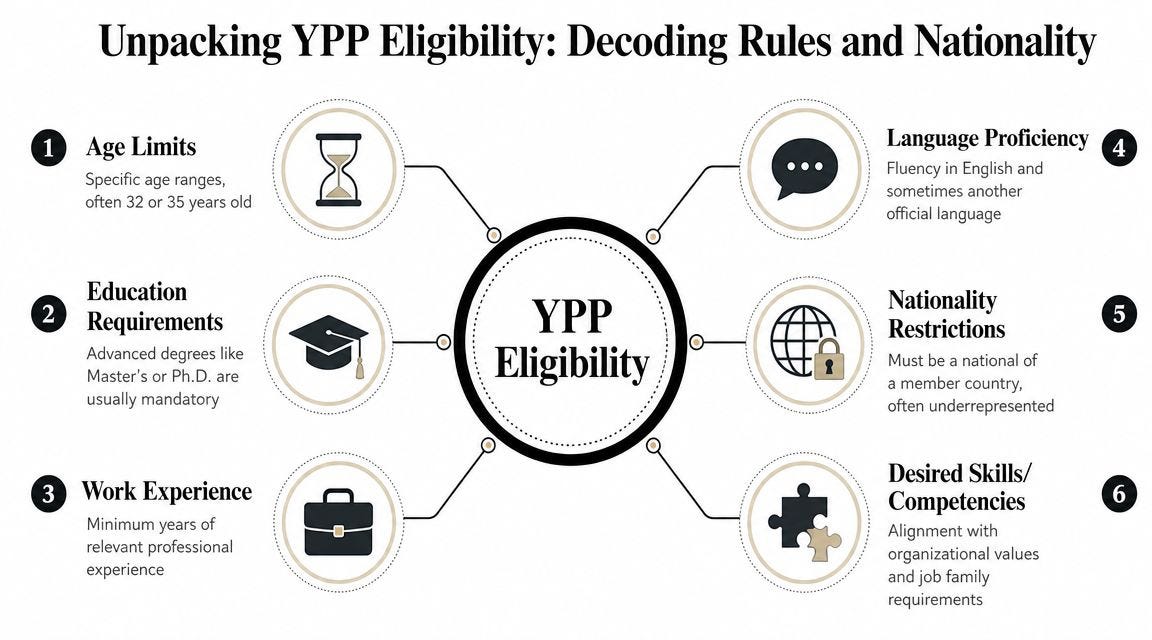
The obvious filters
Every program starts with some combination of:
Age requirements: Some programs have strict upper-age limits.
Education thresholds: Advanced degrees are often expected.
Work experience rules: Relevant experience may be mandatory even for “young” hires.
Language expectations: Strong working English is usually assumed, and some programs value or require more.
Field alignment: Your degree and experience need to match the job family or exam stream.
Citizenship rules: This is often the decisive gate.
Candidates understand the first four. They underestimate the last two, especially citizenship.
Nationality is not a footnote
A frequently ignored issue in young professional programs international organisations is representation strategy. Institutions do not always recruit YPP candidates on a purely open global basis. They often use nationality rules to correct staffing imbalances, reflect membership, or target specific country groups.
The clearest published example comes from the WHO Young Professionals Programme page, which highlights how program access can vary by nationality framework. WHO limits its YPP to a specific list of Least Developed Countries. NATO requires citizenship of a NATO member country and an age range of 21 to 32, along with a master’s degree and one year of experience. The UN YPP is tied to a changing list of underrepresented nationalities.
That leads to a much sharper question than “am I qualified?” The question is: is my passport currently eligible for this program at all?
If your nationality doesn’t fit the program design, your application strategy needs to change immediately. No amount of polishing fixes a closed door.
How to read eligibility like an insider
Don’t read the vacancy once and move on. Read it like a compliance officer.
Use this checklist:
Check nationality first. Before you update your CV, confirm whether your citizenship qualifies.
Read age language carefully. “At the time of application,” “during the exam year,” and “on the closing date” are not interchangeable.
Map your degree to the exact functional stream. Broad relevance is often not enough.
Audit your work history. Part-time, internship, fellowship, and post-degree experience may be counted differently.
Look for changing lists. Some nationality lists are revised periodically. A closed route this year may open later.
What works and what doesn’t
A common failure pattern looks like this: a candidate is academically excellent, has relevant internships, writes a polished statement, and applies to six programs without checking the nationality architecture. That candidate may be ineligible for half the list before anyone reaches the first sentence.
A better strategy is narrower and more disciplined:
Start with the programs your passport can access
Then screen for age and degree fit
Then assess whether your profile is technical enough
Only then invest serious time in tailoring
That sounds basic. It isn’t. Most applicants still reverse the order.
The Standard YPP Selection Process and Timeline
The process is long because each stage screens for a different failure risk. Institutions are not only asking whether you’re smart. They’re asking whether you write clearly, think under pressure, stay coherent in interviews, and fit a very specific institutional culture.
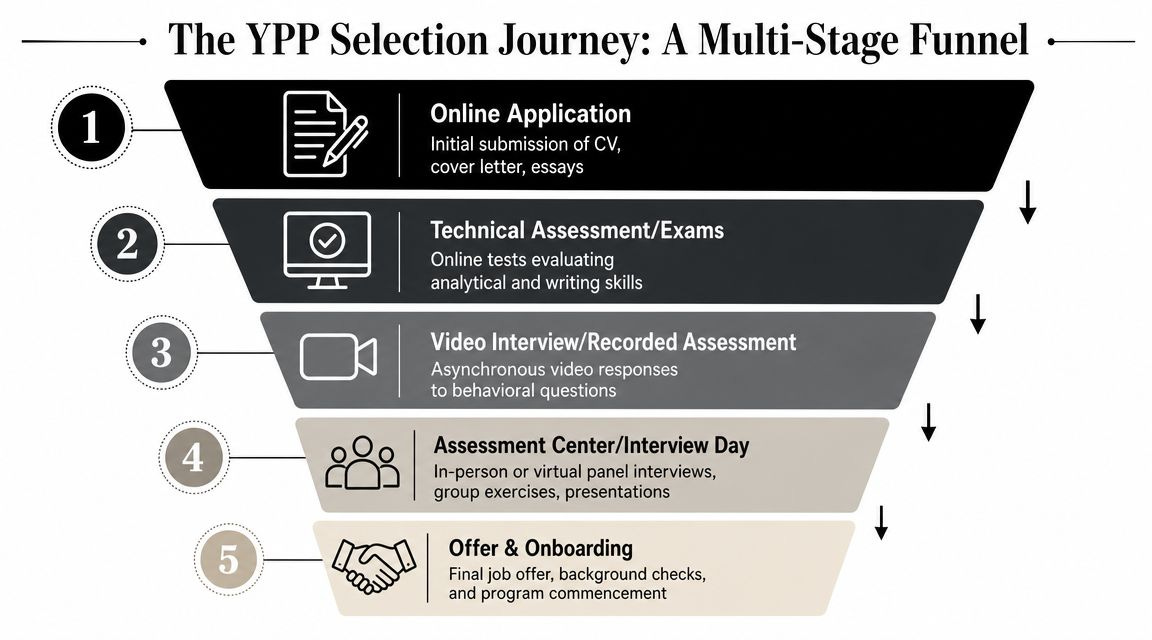
The stages usually follow a familiar pattern
While each organisation labels them differently, the funnel is broadly recognizable.
Application and initial screening
At this stage, a large share of candidates drop out. Some are ineligible. Some are too generic. Some clearly have talent but don’t match the role family the program is trying to build.
Selectors usually want evidence of relevance fast. If your first page is heavy on aspiration and light on substance, that’s a weak start.
Written assessment or technical testing
This stage matters more than most candidates think. A polished CV can get you into the room. A weak written assessment ends the run.
Programs use this stage to test whether you can structure an argument, solve problems, prioritize facts, and communicate under time pressure. In institutions that depend on notes, briefs, concept papers, and decision memos, this is a core skill.
Interview rounds
By the time you reach interviews, the institution is usually stress-testing judgment, self-awareness, motivation, and fit. The strongest candidates are specific without sounding rehearsed. They answer the question asked. They connect examples to institutional work. They don’t drift into broad humanitarian rhetoric.
Selection panels remember candidates who sound usable. They forget candidates who sound impressive but vague.
What the timeline feels like in real life
Candidates often underestimate the stop-start nature of the process. There can be long silent periods between stages. That doesn’t automatically mean rejection. It often means internal coordination, panel scheduling, assessment review, or budget timing.
A practical way to manage it is to treat the process as a campaign rather than an event:
Prepare documents early
Expect waiting periods
Keep examples ready for interviews
Don’t suspend your whole life around one outcome
The hidden skill behind the process
Stamina.
A YPP process rewards applicants who can stay sharp over months, not just people who peak during one good week. That’s one reason experienced early-career professionals often outperform brilliant recent graduates. They’ve had more chances to build disciplined work habits, not just intellectual range.
How Key YPPs Compare WB vs UN vs Regional Banks
The acronym matters less than the operating model behind it. If you compare programs only on prestige, you’ll miss the practical differences that shape your actual career.
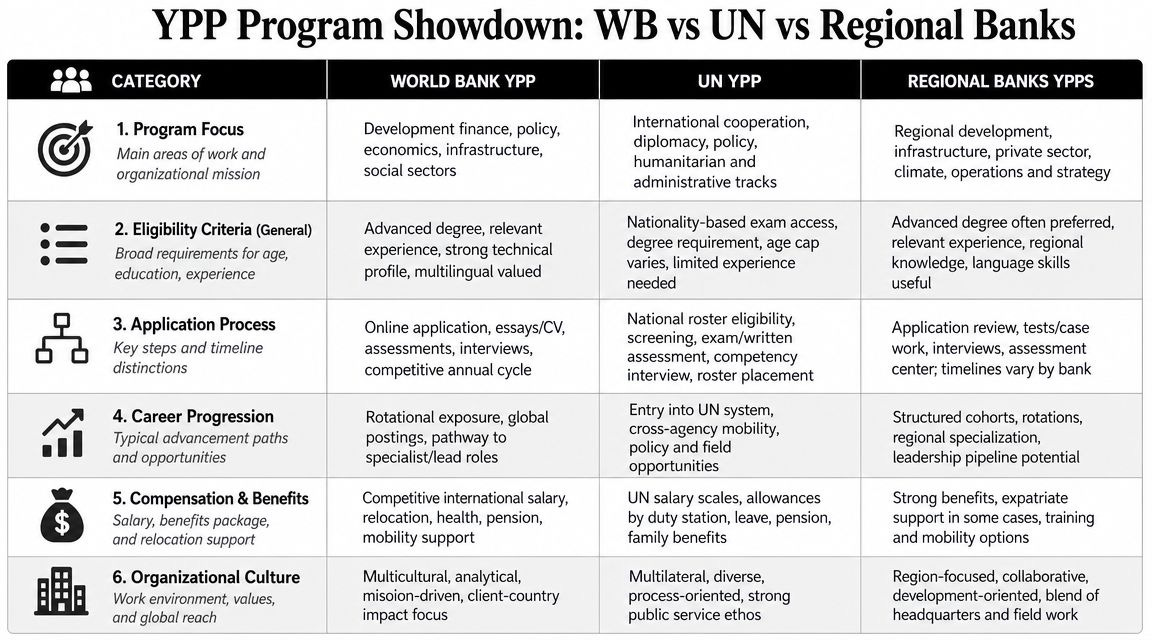
World Bank Group
The World Bank Group YPP is a structured institutional investment. The World Bank careers page on the Young Professionals Program describes a two-year pathway with initial HQ placement, field rotations, and individualized coaching and mentorship across the World Bank, IFC, and MIGA. That setup tells you a lot about what the institution values: technical development, internal mobility, and managerial shaping.
The profile they want is more than “promising.” It is early-career but already credible. If you’re exploring adjacent entry routes, this guide to World Bank jobs for fresh graduates helps distinguish the YPP from broader graduate-oriented options.
UN Secretariat
The UN route has a different logic. It is more tied to representation and rostering than rotational corporate-style development. The UN YPP is a formal gateway into the Secretariat, but the path feels more exam-driven and nationality-dependent than the World Bank model.
That changes how you should present yourself. In the UN environment, clarity, composure, and fit with multilateral public service matter heavily. You’re entering a rules-based system where process discipline counts.
Regional banks
Regional development banks vary. Some resemble the World Bank in professional culture. Others are more regionally anchored in mission, language, and institutional expectations. The central trade-off is usually breadth versus specificity.
A regional bank may offer stronger proximity to one geography and more direct relevance to a region’s policy agenda. It may also expect a more specific understanding of that region’s political economy. Candidates who apply with a generic global-development script often miss this completely.
The comparison that actually matters
Here is the practical side-by-side view:
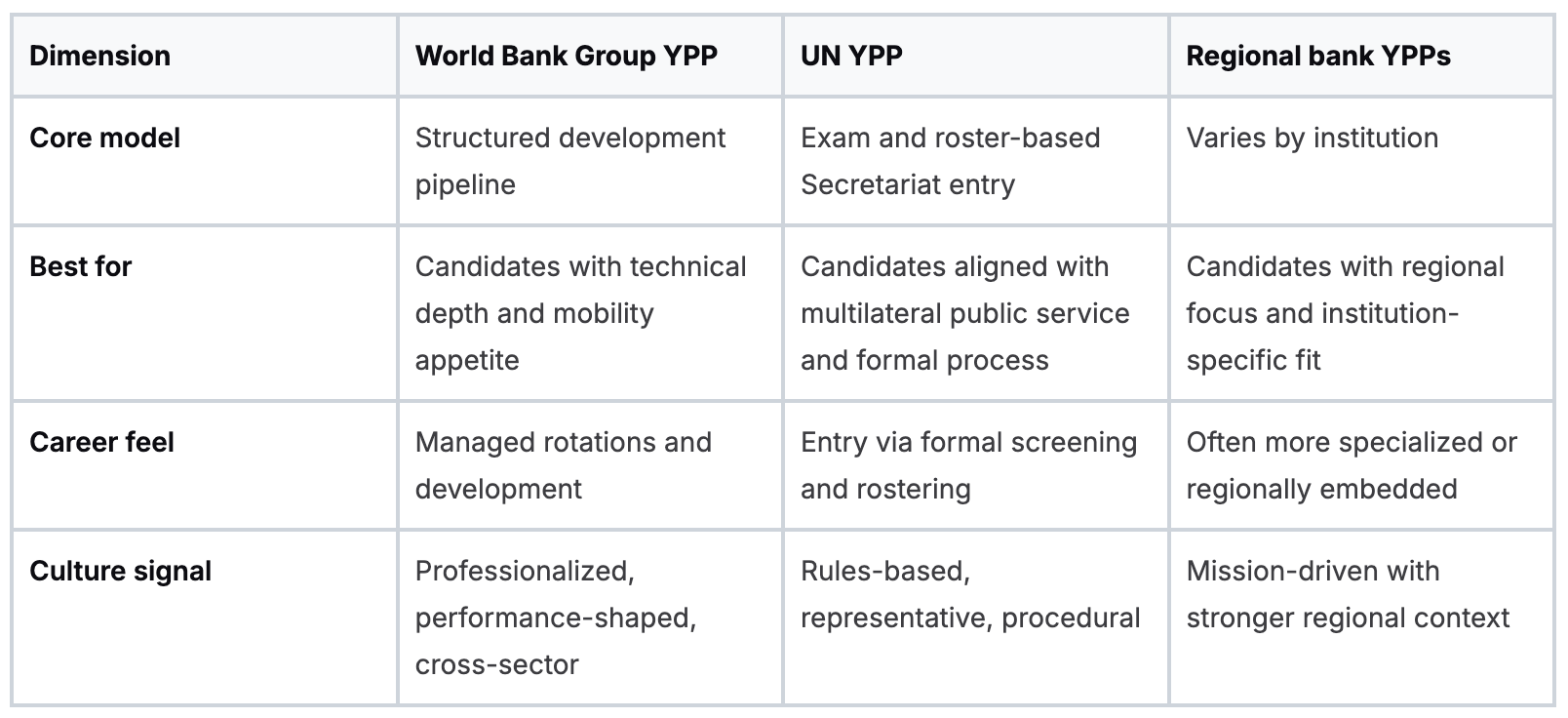
The right choice depends on where you want to build your capital. Bank capital is one thing. UN capital is another. Regional capital is another again.
Don’t collapse them into one prestige ladder. They are different systems.
Preparing a Winning Application Package
Shortlisting panels reject generic applications quickly because YPP hiring is not a prize for raw promise. It is a risk screen. The panel is asking a narrower question: can this candidate be placed into our system, with this passport profile, and become useful fast enough to justify the slot?
That last part matters more than many candidates realise. In oversubscribed national pools, your documents have to do more than show you are strong. They have to make the case easy. If your nationality is in a crowded category, vague excellence usually loses to clear institutional fit.
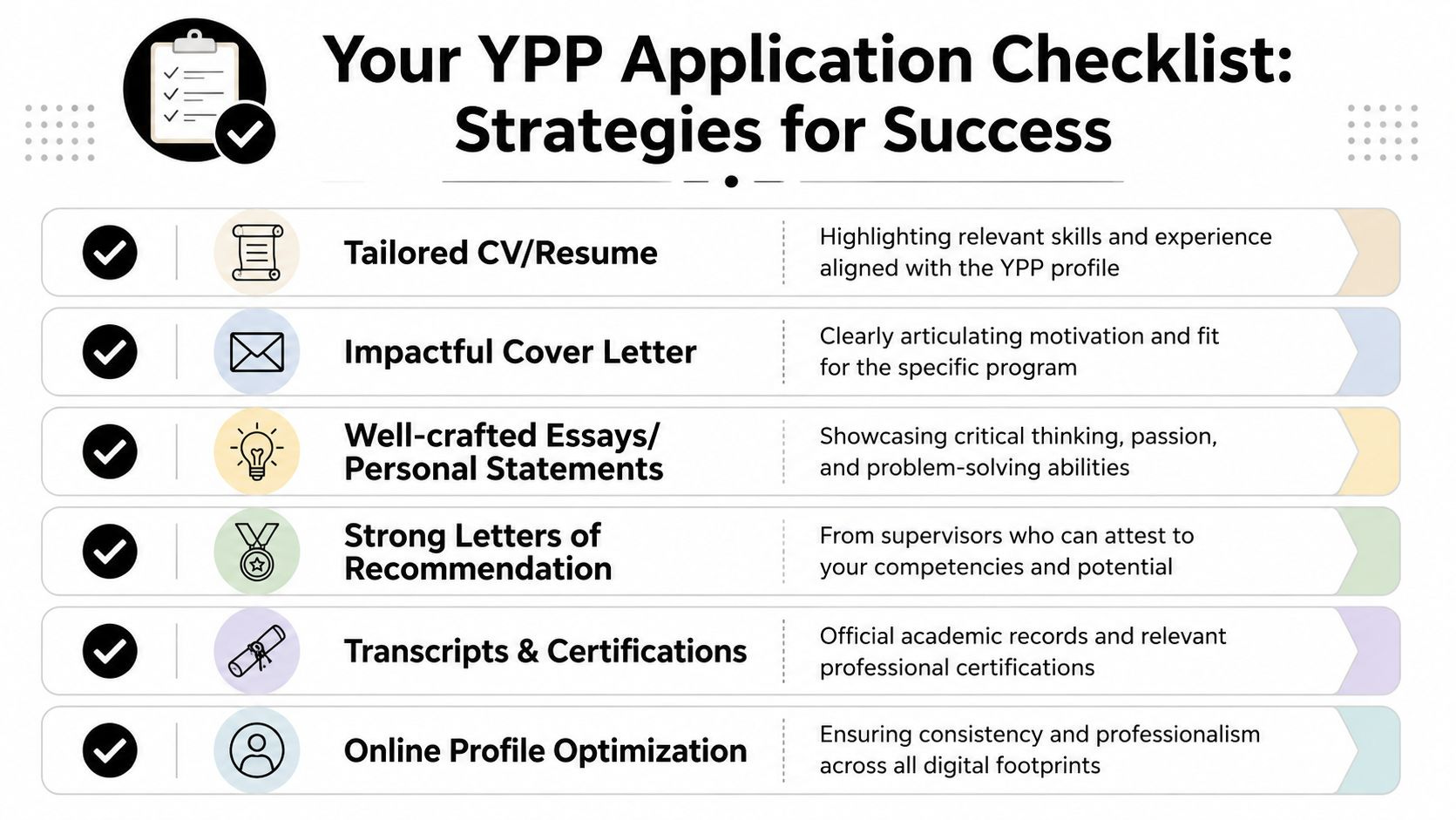
Your CV needs to sound operational
Many applicants submit a CV that reads like an academic success story. Good grades, coursework, conferences, and broad development interests can still leave a panel unconvinced.
A usable YPP CV shows professional traction. It makes the reviewer confident that you can analyse, draft, coordinate, and deliver in a formal institution with little hand-holding.
Strong CVs usually make four things easy to spot:
Analytical work: policy analysis, financial modelling, economic research, project appraisal, due diligence, results tracking
Institutional exposure: ministries, central banks, MDBs, UN entities, regulators, serious consulting teams, operational NGOs
Concrete outputs: memos, briefing notes, dashboards, project documents, client deliverables, board inputs, implementation support
Working range: cross-country assignments, stakeholder management, multilingual work, field exposure, politically sensitive environments
The trade-off is simple. A dense CV can show substance, but if the evidence is buried, it will not survive first review. Cut anything that does not prove judgement, output, or relevance.
The statement has to solve a selection problem
Your cover letter or personal statement should explain why your profile fits that institution’s immediate hiring logic.
For the World Bank or a regional bank, that usually means showing a clear match between your technical base and the way operations are staffed. For the UN, it often means showing discipline, public-service judgement, and comfort with formal processes. In both cases, broad declarations about impact are weak substitutes for evidence.
Panels discard the same patterns every year:
generic motivation that could be sent anywhere
long personal stories with no link to the role
flattering language about the institution with no sign you understand how it works
claims of leadership or passion that are not backed by work
A strong statement reads like it was written by someone who understands the institution’s constraints, not just its mission.
Essays and assessments eliminate candidates with good profiles
By the assessment stage, the competition is no longer about credentials alone. It is about composure, structure, and judgement under time pressure.
Prepare for that reality early. A practical approach looks like this:
Study the organisation’s operating language. Learn how it describes sectors, results, clients, risks, and competencies.
Practice timed written responses. Clear argument, prioritisation, and structure matter more than polished prose.
Build a story bank. Prepare examples on conflict, teamwork, analysis, failure, stakeholder management, and judgment.
Rehearse competency answers aloud. This guide on how to pass a competency-based interview is a useful starting point.
Track vacancies and deadlines systematically. One factual option is Multilateral Development Bank Jobs, as noted earlier.
I have seen candidates with excellent backgrounds lose ground here because they answered like students, not junior professionals. They gave long contextual set-ups, vague conclusions, and no clear recommendation. YPP assessors usually respond better to concise reasoning, an explicit trade-off, and a defensible course of action.
Recommendations should be chosen with care
A famous referee is less useful than a credible one.
Choose people who have seen your work closely and can describe how you write, revise, coordinate, and handle pressure. Specific examples carry weight. Generic praise from a senior figure who barely supervised you does not.
The best recommendations also reinforce your application story. If you are presenting yourself as someone ready for operational work, your referees should be able to confirm that you already perform at that level.
Common Pitfalls and Your Next Steps
The biggest mistake is treating all YPPs as interchangeable. They aren’t. Each one has its own gatekeeping logic, institutional culture, and career payoff. If you apply with one broad narrative, you’ll sound unfocused everywhere.
The second mistake is ignoring nationality strategy. For many candidates, that is the first real filter. It determines where effort is rational and where it’s wasted. A lot of discouragement in this space comes from applying to programs that were never structurally open.
The mistakes that cost strong candidates
A few patterns show up again and again:
Misreading eligibility: Candidates skim the rules and assume close enough is good enough.
Overweighting academics: Strong grades help, but they do not replace evidence of professional usefulness.
Submitting institutional fan fiction: Panels do not reward flattery. They reward fit.
Using one set of documents everywhere: Tailoring is not optional in YPP hiring.
Preparing too late for assessments: Written and interview stages punish candidates who rely on raw intelligence alone.
The next steps that actually move the process forward
Do these in order:
Build a target list based on nationality eligibility first.
Filter that list by age, degree, and work experience rules.
Choose two or three institutions that fit your profile.
Rewrite your CV around outputs, not biography.
Prepare timed written responses and competency stories before vacancies open.
That’s enough to change your odds meaningfully because it moves you out of the random-applicant pool and into the prepared-candidate pool.
Young professional programs international organisations reward discipline more than drama. The candidates who get through usually aren’t the loudest or the most idealistic. They’re the ones who read the rules carefully, align their story to the institution, and present themselves as people the system can use.
If you want a steady view of openings across multilateral development banks, plus practical guidance on hiring patterns, eligibility quirks, and YPP-style pathways, Multilateral Development Bank Jobs is a straightforward place to keep your pipeline organized.