

You’re probably here because you typed International Development Group jobs into search and got two different answers at once. One is a specific company, International Development Group, a contractor with a public opportunities page and internship program. The other is the broader world of development employers that use similar language but hire in very different ways.
That confusion matters. If you don’t sort it out early, you end up applying with the wrong CV, chasing the wrong titles, and misreading what an employer seeks to gain when it posts a role.
The hiring game in development is rarely about passion alone. It’s about fit with a funding model, a contract structure, a donor workflow, and a very specific set of skills. Once you understand that machinery, the sector gets a lot easier to operate in.
Decoding International Development Jobs
When people say international development group jobs, they often mean one of two things.
First, they may mean International Development Group (IDG), the company. IDG publicly states that it manages projects in over 90 countries worldwide on its company website. That tells you something important right away. This is the kind of employer that hires against a distributed project portfolio, not just a single office or labor market.
Second, they may mean the broader category of organizations that work in development. That category includes multilaterals, UN agencies, bilateral aid agencies, international NGOs, and contractors. Those employers all sit in the same ecosystem, but they don’t hire for the same reasons.
The two meanings lead to two different job searches
If you’re targeting the specific company, your questions are practical:
What role types appear on its opportunities pages
Whether openings are staff, internship, consultant, or project-based
How often new positions are posted
What skills show up repeatedly
If you’re targeting the sector, your questions are broader:
Which employer type matches your profile
Which functions your experience supports
Which contract structure you can realistically enter through
Which regions and sectors are active enough to generate hiring
Practical rule: Search by employer type and function, not by mission statement. “Program coordinator, donor reporting, grants, M&E, procurement” will get you farther than “impact” and “global change.”
Development hiring rewards people who understand how work gets funded and delivered. The strongest candidates don’t present themselves as generally committed. They present themselves as useful inside a delivery system.
That’s the key roadmap for this field.
The Major Players in International Development
A candidate says they want to work in “international development” and then sends the same application to the World Bank, USAID contractors, and a large INGO. Recruiters read that as a weak market read. These employers may share a mission vocabulary, but they run on different funding flows, different incentives, and different hiring logic.
That distinction matters even more here because “International Development Group” can mean two things. It can mean the specific firm mentioned earlier in this article, or it can mean the wider group of employers that make up the development field. If you miss that split, your job search gets fuzzy fast. If you understand it, the market becomes easier to map.
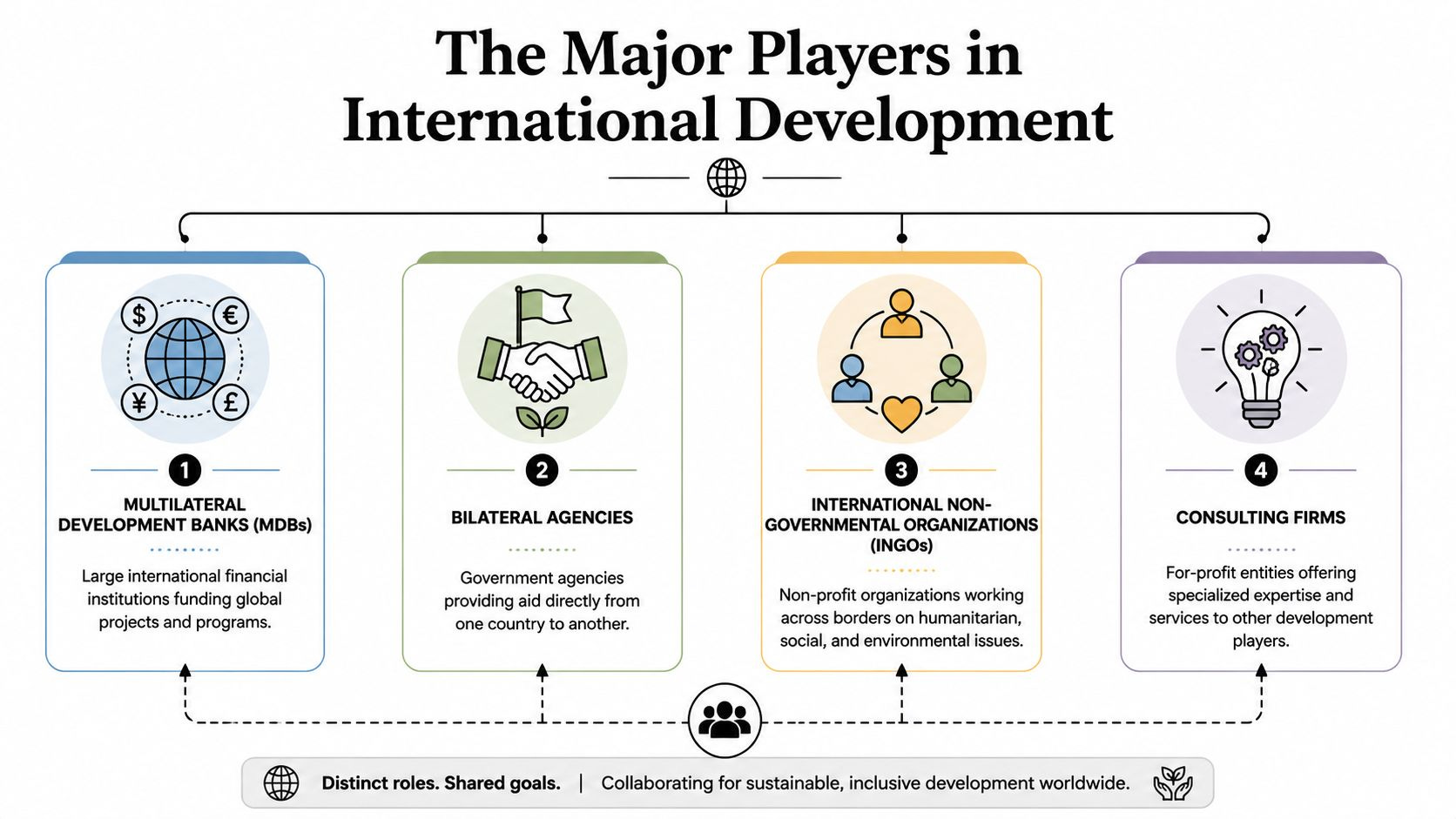
Multilateral development banks
Multilateral development banks sit near the top of the financing chain. They back large public sector reforms, infrastructure, private sector investment, and long-horizon institutional work. Jobs here tend to cluster around economics, public policy, procurement, safeguards, operations, results frameworks, and portfolio supervision.
The trade-off is straightforward. MDB roles often carry strong brand value and clear technical pathways, but hiring is slower, competition is heavier, and internal clearance processes can be dense. People who do well in these institutions can write precisely, handle government counterparts with care, and stay effective inside a review-heavy system.
Bilateral agencies
Bilateral agencies translate a government’s foreign assistance priorities into funded programs. They shape strategy, manage missions, issue awards, oversee implementers, and enforce donor rules.
For job seekers, policy and administration intersect. The work can sound high-level from the outside, but many roles are grounded in agreement management, compliance, procurement, monitoring, diplomatic coordination, and partner oversight. Strong applicants show judgment, discretion, and a clear grasp of how public money is controlled.
International NGOs
INGOs usually sit closer to delivery. They manage country programs, work through local partners, respond to crises, test program models, advocate for policy change, and report results back to donors.
This route suits people who want proximity to implementation and can tolerate imperfect operating conditions. Budgets shift. Access changes. Donor priorities move. A good INGO hire can keep programs moving while dealing with operational friction, partner relationships, and reporting pressure at the same time.
Consulting firms and contractors
Contractors and consulting firms occupy a different position in the system. They win bids, staff projects, provide technical assistance, run evaluations, produce research, and help donors or prime implementers deliver defined scopes of work.
The specific company meaning of “International Development Group” informs hiring strategies. Firms like that hire against project pipelines, proposals, live contracts, and surge needs. That usually creates more varied entry points than candidates expect, but it also means timing matters. You may be a strong fit and still miss the hiring window because a bid was delayed, a contract was not awarded, or funding shifted.
How the system actually fits together
The cleanest way to read the market is by role in the delivery chain, not by branding.
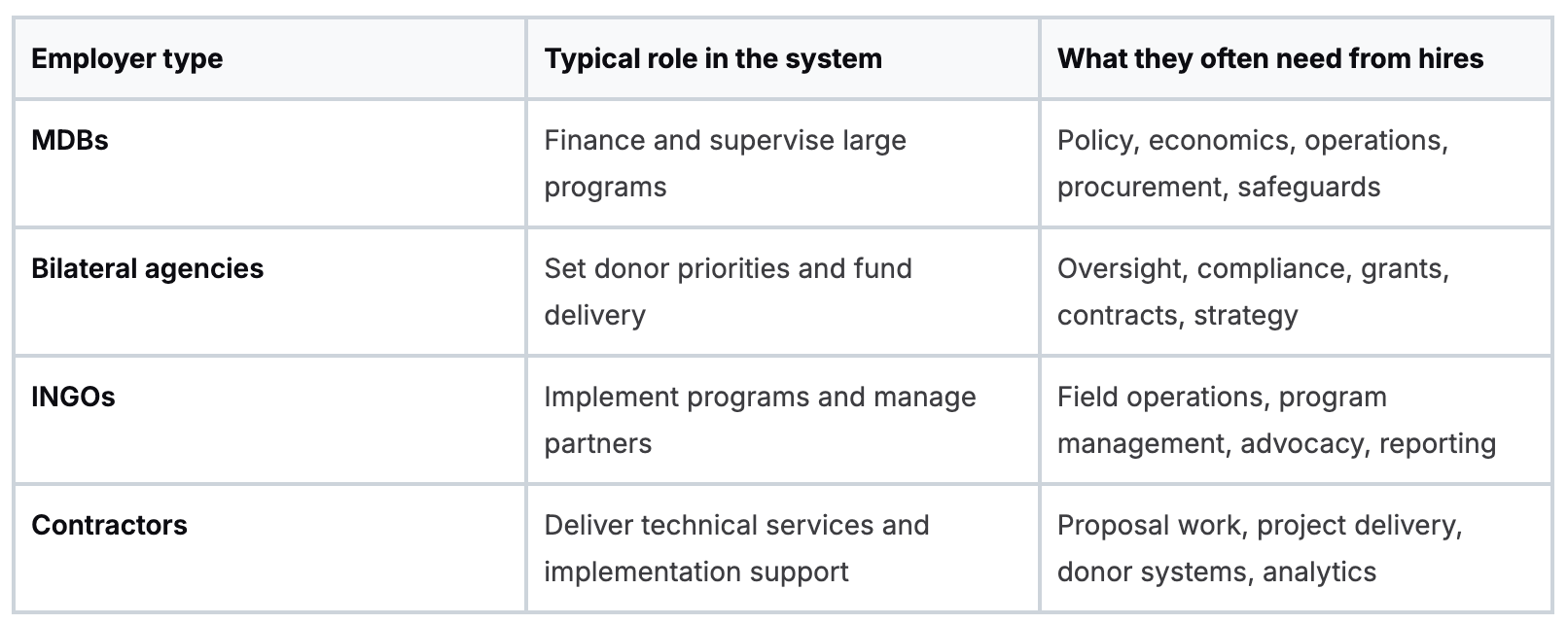
One practical point separates strong applicants from everyone else. Each employer type values “international development experience,” but they mean different things by it. An MDB may want policy analysis and sovereign project exposure. An INGO may care more about field coordination and partner management. A contractor may prioritize proposal support, donor compliance, or technical delivery on funded work.
So choose your lane before you apply. A targeted search beats a broad one every time.
Common Job Types and Contract Structures
Most development jobs fall into a small number of operational buckets, even when the titles look different. That’s why smart candidates search by function first and title second.
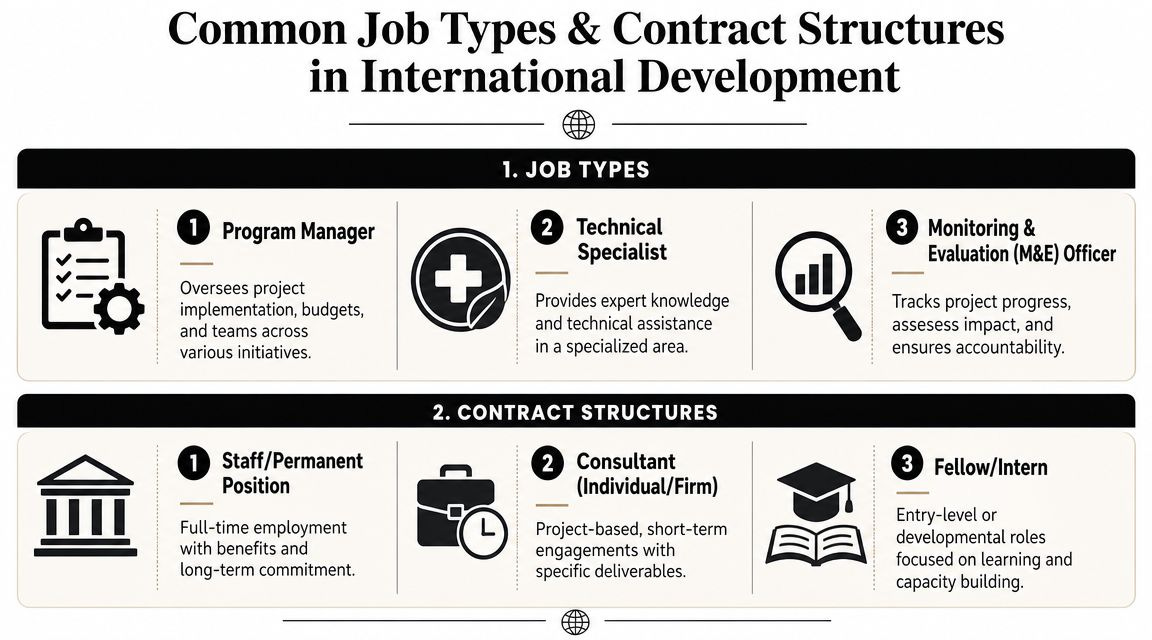
A useful framework from the Second Day international development career guide breaks the work into four core functions: advocacy, oversight, program management, and implementation. That’s a much better way to read job descriptions than getting distracted by branding.
The roles you’ll see most often
At entry and early-mid levels, these are the titles worth watching:
Project coordinator or project manager
Keeps implementation moving. Tracks timelines, budget inputs, partner tasks, reporting deadlines, and donor requirements.Communications associate
Converts program activity into donor-facing language, internal updates, visibility products, and external content.Development associate
Often sits near business development, fundraising, proposals, capture support, or donor engagement.Operations associate
Handles the machinery behind delivery, including contracts, procurement, logistics, travel, documentation, and systems.Research assistant or analyst
Pulls data, drafts memos, supports evaluations, summarizes evidence, and helps shape reports and proposals.
The same source notes that entry-level roles such as project coordinator, communications associate, and research assistant often support the lifecycle of an aid project by collecting field information and translating it into donor-facing reporting. That detail is worth paying attention to. Many junior candidates assume the sector mainly rewards broad international exposure. In practice, it rewards people who can turn field inputs into usable products.
Staff roles versus consultant roles
This distinction changes your day-to-day life more than the title does.
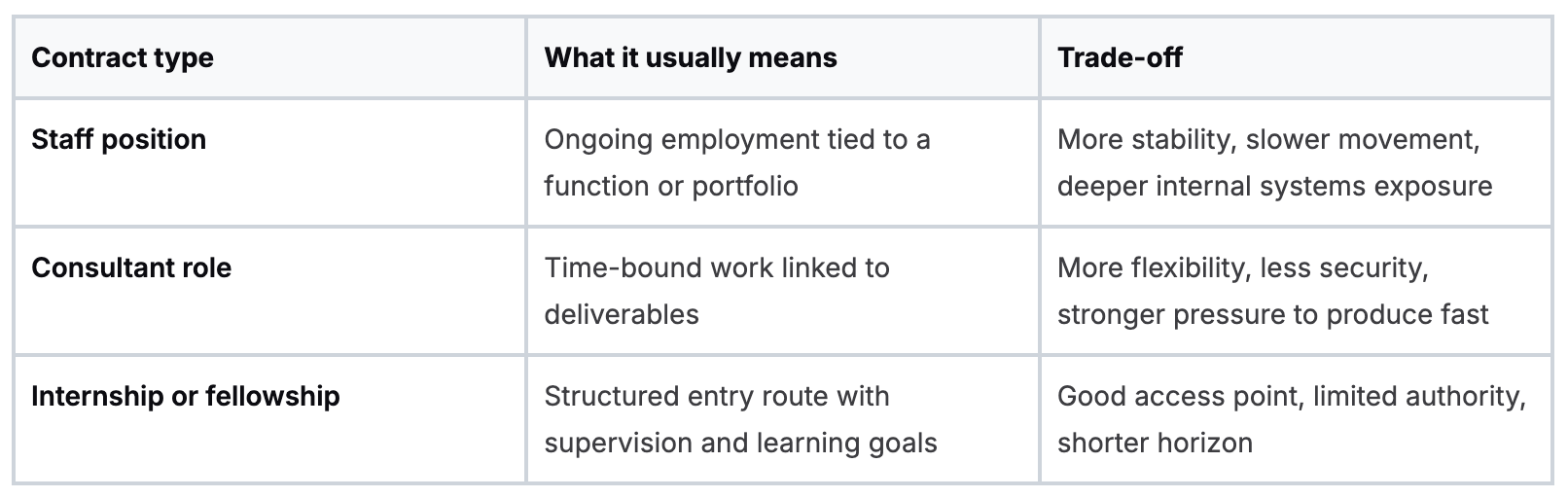
A lot of people chase permanent jobs too early and ignore consulting. That’s a mistake. In development, contract work is often a legitimate entry ramp. It gets you inside donor systems, exposes you to proposal and reporting workflows, and gives you names who can vouch for you later.
Field reality: Hiring managers remember candidates who already know how to track deliverables, clean up reporting, and manage comments across teams. They don’t remember generic “global citizen” language.
What actually makes you competitive
Candidates stand out when they can show evidence of these skills:
Monitoring and evaluation literacy
You don’t need to be a career M&E specialist, but you do need to understand indicators, reporting logic, and evidence use.Budget awareness
Even junior staff benefit from knowing how spending links to workplans and deliverables.Stakeholder reporting
Development runs on updates, briefs, slides, memos, and donor responses.Proposal support Many employers in practice value people who can help win work as well as deliver it.
People lose time by searching only for glamorous field-facing roles. Most international development group jobs are built on management, reporting, oversight, and coordination. Accept that early, and your search gets much sharper.
Eligibility Rules and Required Qualifications
At this stage, many applicants get filtered out before anyone reads the second half of the CV. Development employers may care about your motivation, but they screen first for baseline eligibility.
The broad pattern is simple. Employers look for education, experience, and transferable skills. The details vary by institution, but the logic doesn’t.
The baseline most employers expect
IDG’s internship criteria offer a useful floor for the field. Its internship program page states that applicants should be students pursuing a bachelor’s or master’s degree in a relevant field, and that at least 1 relevant internship experience is highly preferred. It also emphasizes organization, attention to detail, consistency, self-starting ability, strong writing, analytical, reporting, and communication skills, with additional languages preferred.
That profile is realistic. Entry-level development hiring usually favors candidates who can already prove they’ve operated in a professional setting. Volunteer work can help. Student leadership can help. But documented, relevant experience carries more weight than aspiration.
Degrees matter, but only in the right way
A degree gets you past one gate. It does not close the deal.
Relevant fields often include international relations, public policy, economics, regional studies, public health, environment, and related disciplines. For more technical and mid-career roles, advanced degrees often become more important, especially if the work is policy-heavy, analytical, or specialized.
What hiring managers test is whether you can connect your academic background to operational value.
Good answer:
You researched education finance and can synthesize policy material into briefings.
Weak answer:
You are passionate about global education.
Nationality rules are real
This catches people off guard. Multilaterals and UN bodies often have nationality or membership rules that shape who can apply to which tracks. Some vacancies are open broadly. Others are restricted by member-country citizenship, local recruitment status, or visa/work authorization constraints.
You have to read those lines carefully. They are not filler.
If you’re exploring junior routes into the World Bank system, the World Bank Junior Professional Associate guide is a useful starting point for understanding how one structured early-career pathway works.
The skills that carry across employers
The best junior profiles usually combine technical promise with professional reliability.
Strong writing because donor-funded work runs on concise, accurate documents
Analytical ability because teams need people who can process evidence, not just collect it
Attention to detail because reporting errors create real compliance problems
Communication skills because every project requires coordination across functions
Language capacity because multilingual environments still matter in many parts of the sector
Your first job usually goes to the candidate who looks easiest to trust with a deliverable.
That’s the standard to build toward. Not “interesting.” Not “passionate.” Trustworthy, organized, and useful.
Key Pathways into a Development Career
Many individuals don’t enter this sector through the front door. They come in through side doors, temporary doors, or doors they didn’t even know existed when they started looking.
That’s normal.
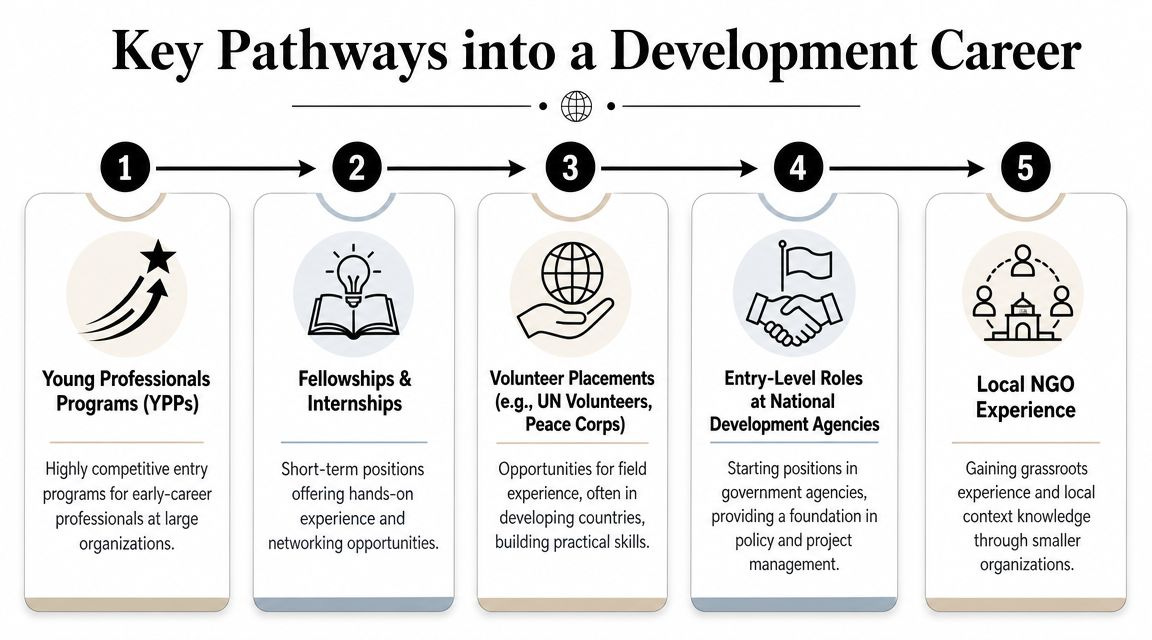
Structured early-career programs
Young professional tracks, junior associate programs, and formal analyst pipelines are the cleanest entry routes when you fit the profile. They’re built for early-career candidates who already show academic strength, international exposure, and professional discipline.
These programs are attractive because they offer brand recognition, internal exposure, and a clearer training environment. They’re also narrow funnels. You should apply if you fit. You should not build your whole strategy around them.
For readers interested in finance-facing roles and institution-specific pathways, this overview of international finance career opportunities is a useful reference point.
Internships and fellowships
Internships remain one of the most practical routes into international development group jobs because they let employers test how you work. That matters more than many candidates realize.
A strong internship can give you three things fast:
Work samples you can discuss in interviews
Referees who can speak about your reliability
System fluency in donor reporting, coordination, and internal process
This route works best when you treat the internship as a platform for proof, not just exposure.
Consultant rosters and short-term contracts
Short-term contracts are often overlooked by junior candidates who assume they’re only for senior experts. In reality, many teams need temporary support for reporting, research, coordination, procurement admin, editing, data work, or program operations.
This path is messy, but it works. It can also compound well. One short assignment can lead to another if you become the person who fixes drafts, catches gaps, and turns comments around quickly.
Local organizations and field-based experience
Plenty of strong development careers start with local NGOs, national agencies, research institutes, or implementing partners. That route often gives you sharper practical judgment than a more prestigious but insulated internship.
You learn what field constraints look like. You also gain the credibility that comes from dealing with local stakeholders, not just writing about them.
A year of solid responsibility in a smaller organization can beat a famous logo where you only observed.
Choosing the right path for your profile
Use this simple filter:
Academic strength and polished profile
Aim for structured programs, internships, and analyst tracks.Good skills but limited brand-name experience
Target contract roles, research support jobs, and project coordination openings.Strong local or sector experience Apply that to implementation roles, partner-management jobs, and specialist tracks.
Career changer from another field
Translate your existing function first. Budgeting, data analysis, procurement, communications, and operations all transfer better than vague motivation statements.
The common mistake is waiting for the perfect role. Development careers often start with a useful role. That’s enough.
Finding Openings and Nailing Your Application
You find a role that looks right. The title fits, the sector fits, and the deadline is in three days. Then you realize the employer uses a different title on LinkedIn, the vacancy sits on a separate procurement portal, and half the people doing that work are on short-term contracts that never hit the main careers page.
That is normal in this field.
It also gets confusing because people use “International Development Group” in two ways. Sometimes they mean the specific company. Sometimes they mean the wider set of development employers, from multilaterals and bilateral agencies to NGOs, contractors, foundations, and research shops. If you search too narrowly, you miss the market. If you search too broadly, you waste time on roles that do not match your profile.
A better approach is to search by employer type, function, and contract structure at the same time. A governance analyst role at a contractor, a program officer role at a foundation, and an operations role at a multilateral can ask for similar skills but use very different language. Good candidates learn those naming patterns early.
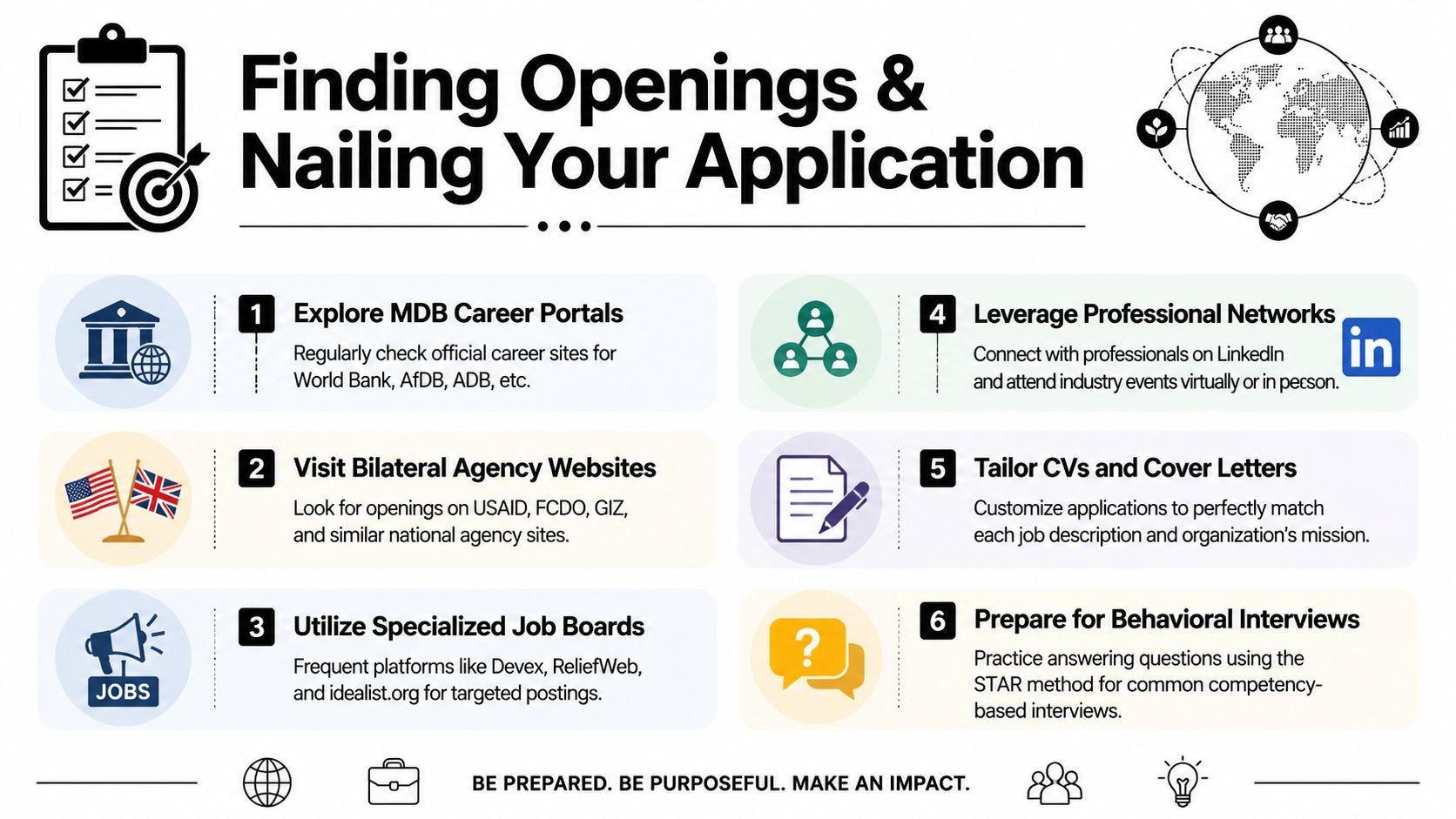
Where to look
Use a layered search system. One source is never enough.
Official employer portals Start with the institutions you want. Check MDB career pages, UN portals, bilateral agency sites, large NGO career pages, and contractor recruitment pages.
Specialized job boards
Devex, ReliefWeb, Idealist, and DevelopmentAid are useful for volume and for spotting patterns across sectors and locations.Niche career resources
Remote international development job listings and MDB career guidance can help if you are targeting multilateral-adjacent roles or trying to understand which jobs can be done partly or fully off site.Professional networks
LinkedIn works best as a tracking tool. Follow teams, note who gets hired, and study how roles are described across offices.Consultant rosters and vendor systems
Many short-term assignments never appear in the same place as staff jobs. If you want consulting work, register early and keep your profile current.
Here is the practical trade-off. Broad boards show more openings, but they also generate more noise and duplicate postings. Official portals are slower to search, but they show the exact grade, contract type, and screening requirements that decide whether your application survives first review.
Why generic applications fail
Hiring managers are usually screening for delivery, not enthusiasm. They want evidence that you can do the work under donor rules, internal processes, and deadline pressure.
So match your CV to the actual job. If the post asks for grants compliance, partner coordination, budget tracking, and donor reporting, show where you did those things. Use the terms in the vacancy when they are accurate. Do not swap in softer language because it sounds nicer. In development hiring, precision beats personality in the first round.
Use this checklist before you submit:
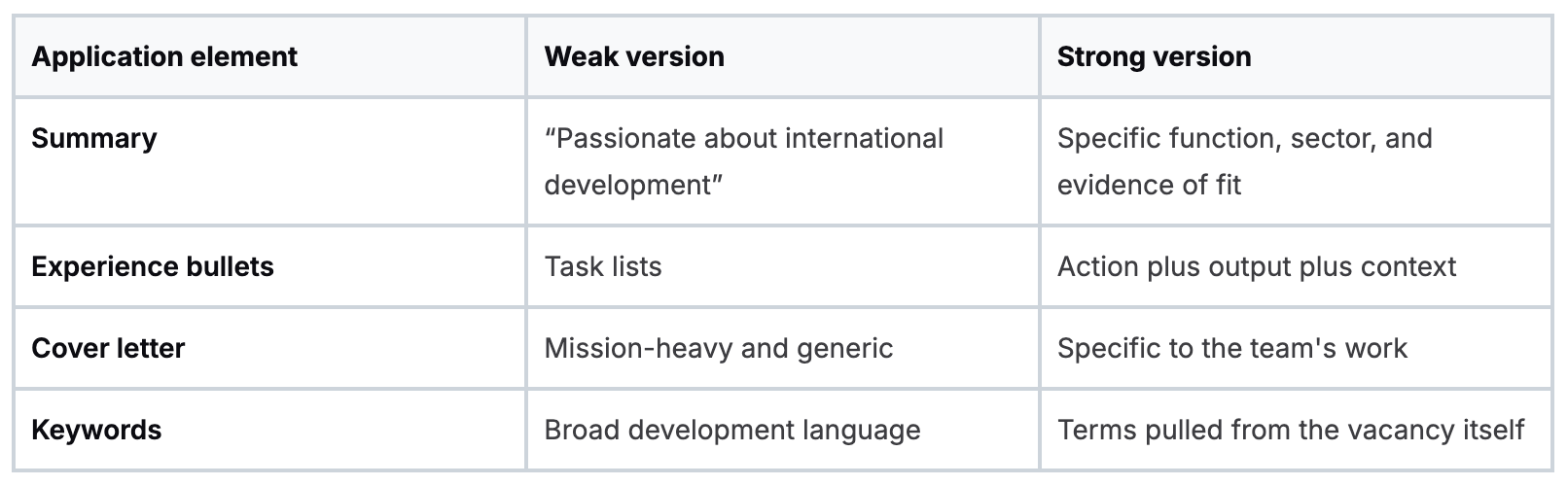
One more point that junior candidates often miss. Different employers read the same document differently. A UN team may care about formal eligibility and years of experience by grade. A contractor may focus on client fit and proposal relevance. A smaller NGO may care whether you can step in quickly and handle a messy workload with limited supervision. Write for the reader in front of you.
What to say in interviews
Development interviews usually test judgment, communication, and execution. The panel wants to know whether you can make sense of incomplete information, keep work moving across teams, and produce clean outputs without creating extra management work.
Prepare short examples with specifics. What was the assignment. Who was involved. What constraint mattered. What did you decide. What changed because of your work.
Bring examples with documents, timelines, and decisions. Abstract passion fades quickly in interviews. Concrete execution lasts.
Strong candidates sound clear and grounded. They know what they owned, where they supported someone else, and what they learned when the process went sideways. That level of honesty reads as maturity, not weakness.
Salary, Benefits, and Your Career Trajectory
Compensation in development varies widely by employer type, location, contract structure, and seniority. Anyone who gives you a single neat answer is oversimplifying the market.
MDBs and some UN entities often offer more formalized salary and benefits systems than NGOs or contractors. Contractors may pay well for specific expertise but tie that compensation to shorter-term deliverables. NGOs can offer compelling mission alignment and field responsibility, but terms may vary sharply across offices and funding streams.
Read the whole package, not just the title
When comparing roles, look at:
Contract duration
Benefits eligibility
Location status and mobility expectations
Education support or leave policies
Retirement structure
Whether the role is tied to a project lifecycle
A permanent-sounding role can still sit on fragile funding. A short contract can still be a smart move if it puts you inside the right institution or technical area.
Career progression follows funding patterns
Development careers do not move in a straight line. People shift between employers, donor models, and contract types. Someone may start in an NGO, move into a contractor role, then enter a multilateral or bilateral agency later with stronger implementation credentials.
Macro funding trends matter here. The World Bank’s Independent Evaluation Group noted that the International Development Association’s jobs strategy had a positive effect on employment in low-income countries in its analysis of IDA support for jobs. The practical takeaway is straightforward. Hiring tends to expand where donors and development finance institutions place money, urgency, and long-term program focus.
That means your long-term strategy should track three things:
Which sectors are getting sustained funding
Which regions have active project pipelines
Which functions stay valuable across donors
The safest career bet is building portable capability. Writing, operations, M&E, financial oversight, procurement fluency, technical depth, and stakeholder management travel well across institutions. Title prestige matters less than whether your skills keep converting into funded work.
If you want a more focused way to track multilateral hiring, Multilateral Development Bank Jobs publishes role listings and practical guides for candidates targeting institutions like the World Bank, ADB, AfDB, IMF, AIIB, and related organizations.