



A career at the World Bank provides a chance to shape global development and improve millions of lives. It’s a place where your work can have real impact, and it can give you an opportunity to work in numerous interesting places across the world.
So far, I’ve had the privilege of being able to work in places ranging from Hanoi, Vietnam to Belgrade, Serbia.
But I want to level with you.
The competition for staff or consultant positions is tough, and knowing how to navigate their complex system makes a big difference.
Understanding the World Bank Group Structure
Before you even think about applying, you need to understand that "World Bank" actually refers to five distinct institutions, each with different focuses and hiring needs:
IBRD (International Bank for Reconstruction and Development) provides loans and technical assistance to middle-income and creditworthy low-income countries. This is where you'll find the bulk of traditional development economist and policy advisor roles.
IDA (International Development Association) offers grants and concessional loans to the world's poorest countries. If you're passionate about working in fragile states or least developed countries, IDA positions should be your target.
IFC (International Finance Corporation) focuses exclusively on private sector development. Perfect for those with investment banking, private equity, or corporate finance backgrounds who want to transition to development work.
MIGA (Multilateral Investment Guarantee Agency) provides political risk insurance and credit enhancement. Ideal for professionals with insurance, risk management, or legal expertise.
ICSID (International Centre for Settlement of Investment Disputes) handles investment dispute resolution. A niche area primarily for lawyers and arbitration specialists.
Here’s a rundown of what each look for:

Each institution has its own culture, priorities, and hiring processes. Your first strategic decision is figuring out which one aligns with your skills and career goals.
Decoding the Grade Level System
The World Bank uses a 10-level grading system from GA (lowest) to GJ (highest). Here's what you actually need to know:
Administrative Positions (GA-GD) These entry-level roles typically require a bachelor's degree and 2-3 years of experience. Think Program Assistant, Research Assistant, or Team Assistant positions. While often overlooked by ambitious candidates, these roles can be excellent entry points into the system.
Professional & Technical Positions (GE-GH) The meat of World Bank operations. GE level requires a master's degree and 5+ years of experience. By GH, you're looking at senior technical specialists with 15+ years under their belt. Common titles include:
Operations Officer (GE-GF)
Economist (GF-GG)
Senior Financial Specialist (GG-GH)
Lead Urban Development Specialist (GH)
Managerial Positions (GH-GJ) These overlap with senior technical roles but focus on people and program management. Sector Managers start at GH, Country Directors typically sit at GI, and Vice Presidents occupy GJ level.
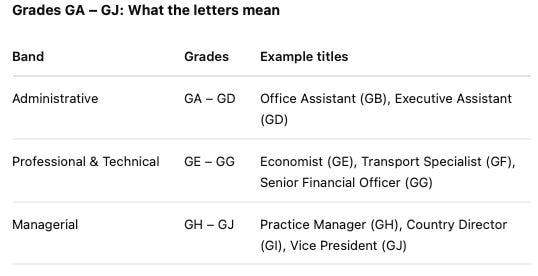
Young Professionals enter at GF level, which tells you something important: the Bank values this program highly, bringing YPs in at the same level as professionals with 8-10 years of experience.
The Real Numbers Behind World Bank Recruitment
Let's address the elephant in the room: getting hired at the World Bank is incredibly competitive. While exact figures vary by position type, the acceptance rates are sobering:
For the Young Professionals Program, approximately 5,000 candidates apply annually for just 44 positions. That's less than a 1% acceptance rate.
Regular positions see hundreds of applications for each opening, with typical postings attracting 200-500 qualified candidates.
However, most applicants fail because they don't understand the Bank's specific requirements and culture. In other words, it’s not because they lack qualifications.
Navigating the Application Process Timeline
The standard recruitment cycle follows a predictable pattern:
Weeks 1-2: Job Posting Positions typically stay open for just two weeks. Set up job alerts for your target areas because missing the window means waiting months for similar opportunities.
Weeks 3-4: Initial Screening HR and hiring managers review applications, often using screening questions to filter candidates. This is where 80% of applicants get eliminated.
Weeks 5-6: Longlist Review A Selection Advisory Committee creates a longlist of 10-20 candidates and narrows it to 3-5 for interviews.
Weeks 7-8: Interviews Expect either one-on-one sessions with 3-4 interviewers or a panel interview. Many positions also require case studies or technical assessments.
Weeks 9-10: Selection and Offer Reference checks, salary negotiations, and formal offer. The Bank targets completing the entire process within 75 days.
Salary Scales and Benefits: The Complete Picture
World Bank compensation is genuinely competitive, but the structure can be confusing. Here's what you can actually expect:
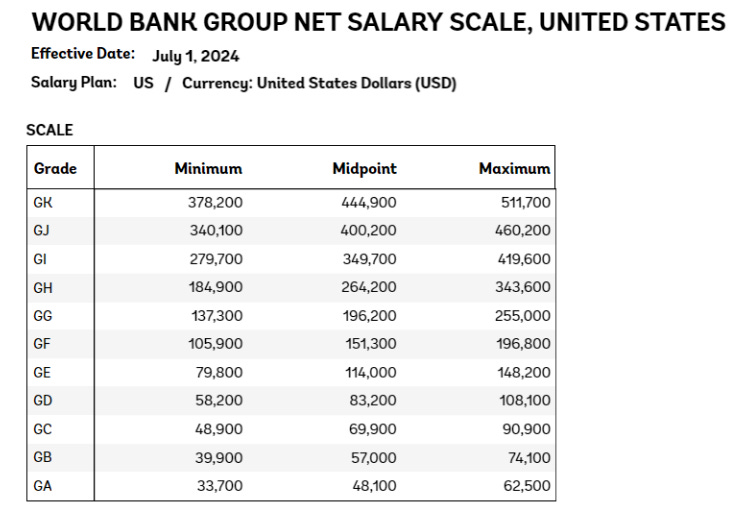
Young Professionals at GF level start around $105,900 net salary, but can be slightly more depending on experience and qualifications.
But salary is only part of the story.
Benefits add approximately 55% on top of base salary, including:
Comprehensive medical and dental insurance
Generous retirement contributions
Education grants for children
Home leave travel allowances
Mobility premiums for expatriate staff (worth $15,000-$32,000 annually)
For U.S. citizens, the Bank covers federal, state, and local tax liabilities. For everyone else, Bank income is tax-free in the U.S.
Career Progression Pathways
Unlike traditional corporations, the World Bank doesn't have automatic promotions. Career progression requires some careful strategic planning:
Technical Track: Deepen expertise in your sector, become the go-to person for specific issues, publish research, lead increasingly complex projects. Many professionals spend entire careers moving from Economist to Senior Economist to Lead Economist.
Managerial Track: Transition from managing projects to managing people. Requires demonstrating leadership on task teams before formal management roles open up.
Country Office Track: Build regional expertise, potentially starting in Washington then moving to country offices. Country Directors wield significant influence but require deep regional knowledge and political acuity.
Cross-Institutional Mobility: Moving between IBRD, IFC, and other arms of the Bank Group. Increasingly common and valued for senior positions.
Insider Tips from Former Employees
Based on reviews and insights from former Bank staff, here's what actually makes the difference:
Network Relentlessly: The Bank runs on relationships. Start connecting with current staff in your field months before applying. LinkedIn is your friend, but actual informational interviews are gold.
Master the Statement of Interest: This isn't a cover letter. It's your chance to demonstrate deep understanding of development challenges and how your specific experience addresses them. Generic statements get rejected immediately.
Understand the Development Discourse: Read World Bank publications, follow their blogs, understand current priorities like climate change, fragility, and digital development. Speaking their language matters.
Prepare for Behavioral Interviews: The Bank loves competency-based questions. Prepare STAR (Situation, Task, Action, Result) stories that demonstrate client orientation, teamwork, and innovation.
Consider Consultancy First: Extended Term Consultant (ETC) and Short Term Consultant (STC) positions offer easier entry points. Yes, job security is lower, but many consultants transition to staff positions.
Location Flexibility Helps: While everyone wants Washington DC positions, showing willingness to work in country offices, especially in challenging locations, significantly improves your odds.
Common Misconceptions Debunked
"You need a PhD": False. While PhDs are common, especially for research positions, many operational roles prefer practical experience over academic credentials.
"Only economists get hired": The Bank needs engineers, health specialists, education experts, lawyers, IT professionals, and dozens of other specialties.
"You must be from a developing country": While the Bank promotes diversity, citizens from all member countries are eligible. What matters is relevant experience and cultural sensitivity.
"Young Professionals Program is the only entry point": YPP is prestigious but represents a tiny fraction of Bank hiring. Regular recruitment offers far more opportunities.
"It's impossible without inside connections": Connections help, but the Bank's formal recruitment process is surprisingly merit-based. Strong applications do get noticed.
The Reality Check
Working at the World Bank offers amazing opportunities to impact global development, but it's not for everyone. The bureaucracy is real. Career progression can be slow. Consultants face constant job insecurity. Office politics exist like anywhere else.
But for those who thrive in multicultural environments, enjoy intellectual challenges, and genuinely want to reduce poverty, few organizations offer comparable opportunities.
Success requires patience, persistence, and strategic thinking. The advice I keep hearing is to treat your World Bank job search as a long-term campaign, not a quick application. Build relevant experience, expand your network, understand the institution deeply, and position yourself as someone who can contribute from day one.
The World Bank needs talented people who can navigate complexity while keeping focus on the ultimate goal: improving lives in developing countries. If that's you, I really think the effort to break in is absolutely worth it.
Make sure you subscribe to MDB Jobs to get the latest vacancies delivered straight to your inbox each week.