


You’re probably looking at World Bank jobs in the USA for one of two reasons. You want to work on serious global problems without leaving the U.S., or you’re already in Washington and trying to figure out whether the Bank is accessible to you.
That instinct is right. The opportunity is real. So is the confusion.
A lot of advice on this topic stays generic. It tells you to “tailor your resume,” “network,” and “be patient.” None of that is wrong. None of it is enough either. The World Bank runs on its own hiring logic, its own contract structures, and its own version of what counts as a strong candidate.
Your Guide to Landing a World Bank Job in the USA
You find a vacancy in Washington, DC, and assume the main question is whether you are qualified enough to compete. For World Bank jobs in the USA, the first filter is often different. You need to separate jobs that are based in the United States from jobs that are restricted by nationality or work authorization rules. Candidates miss that distinction all the time, then spend weeks applying to roles that were never realistic for them.
The size of the institution makes that confusion worse. The World Bank had 38,695 employees, and annual active postings fell from 328 in 2023 to 262 in 2024 and 200 in 2025, according to Revelio Labs workforce data on the World Bank. In practice, that means a large employer can still feel hard to access, especially from the outside.
I have seen strong U.S.-based applicants make the same mistake repeatedly. They search by location, see Washington, and treat the Bank like another policy employer in DC. That usually leads to poor targeting. A better approach starts with a narrower question: are you pursuing a role located in the USA, or a role open specifically to U.S. nationals or U.S.-authorized candidates?
That distinction changes your strategy from day one.
A Washington-based opening can attract economists from federal agencies, infrastructure specialists from private consulting firms, public health professionals from NGOs, and former multilateral staff who already know how Bank teams hire. Volume alone will not carry you through. Precision matters more.
The applicants who get traction usually do four things early:
Pick a technical lane. Health, education, transport, governance, climate, procurement, finance, data, and social development are screened differently.
Target the right entry path. A U.S.-based consultant role and a Washington staff appointment are not interchangeable options.
Read the vacancy for hidden filters. Sector language, required operational experience, country exposure, and reporting lines often show how the shortlist will be built.
Plan for more than one cycle. Many successful candidates are credible before they are selected.
If you are early in your career, the path looks different again. This guide to World Bank jobs for fresh graduates gives a useful breakdown of where newer applicants tend to fit, and where they usually face a tougher screening bar.
Treat this search like a specialized market, not a broad DC job hunt. The candidates who handle it well understand eligibility first, then contract type, then fit. That is how you avoid wasting time on the wrong USA opportunities and focus on the ones you can win.
Decoding the USA Job Landscape Staff vs Consultant
A candidate sees “Washington, DC” in a World Bank posting and reads it like a federal job. That is where many U.S.-based searches go off track. Office location and eligibility are separate filters, and if you mix them up, you spend time on roles you cannot win.
The World Bank explains on its careers page for global recruitment and eligibility that staff eligibility depends on nationality from a World Bank member country, while consultant roles do not carry the same nationality restriction. When considering “world bank jobs usa,” that distinction matters more than the city listed on the vacancy.
USA location and USA eligibility are separate questions
A role can sit in Washington, DC and still be open to non-U.S. nationals. A role can also be U.S.-based and limited by local recruitment terms, visa practicality, or contract rules that have nothing to do with citizenship. Those are different screens.
In practice, serious applicants usually need answers to four questions:
Can I legally and practically work in the U.S. under this contract type?
Does this posting require local recruitment or local presence?
Is this a staff competition or a consultant hire built around short-term delivery?
Am I applying for a role in the USA, or for a role that requires U.S. citizenship?
That last question gets missed too often.
A Washington address tells you where the work sits. It does not tell you who can be hired.
The two pathways that matter most
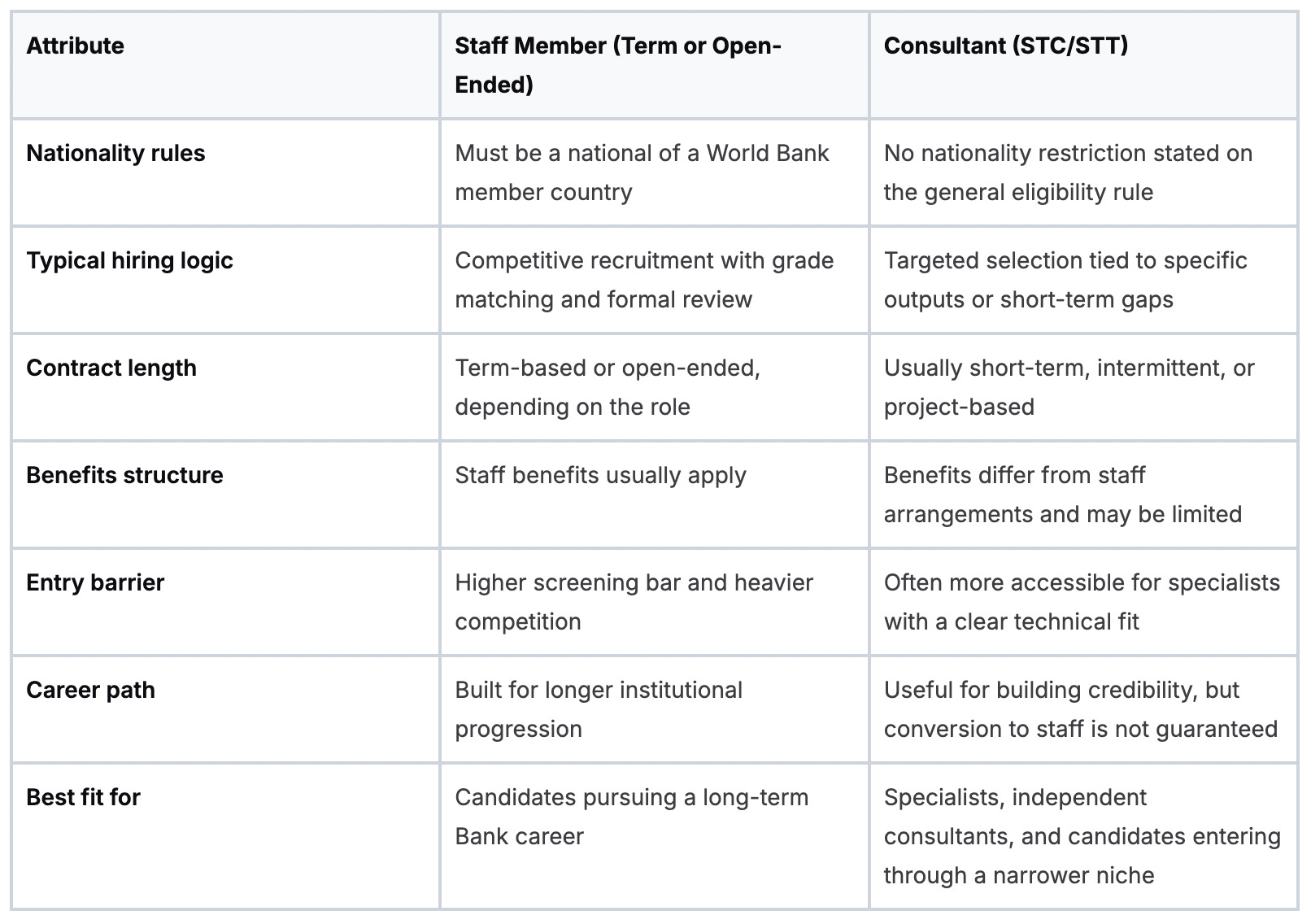
For U.S.-based candidates, the primary distinction is staff roles versus consultant roles. Staff roles include term and open-ended appointments inside the Bank’s formal employment structure. Consultant roles, often STC or STT, are usually tied to a team need, a work program, or a defined set of deliverables.
That difference shapes the whole hiring process. Staff recruitment is slower, more standardized, and more sensitive to grade fit. Consultant hiring is often faster and more practical. Teams ask a simpler question: can this person produce what we need, on the timeline we have?
If you want a broader view of how these contract types compare across institutions, this guide to international development group jobs and hiring models is useful background.
Which route makes sense for you
Staff roles suit candidates who want stability, internal mobility, and a clearer long-term career path. They also demand tighter alignment. In Bank hiring, a strong profile can still miss the shortlist if the level, sector exposure, or operational record does not match the grade.
Consultant roles suit a different type of candidate. They are often the better route for subject-matter specialists, professionals with private sector or NGO backgrounds, and applicants based in the U.S. who are eligible for Washington work but do not fit the assumptions attached to permanent staff hiring.
Three trade-offs matter in real searches:
Staff roles reward institutional fit. The team is assessing level, competencies, and whether your background matches the role architecture.
Consultant roles reward immediate usefulness. Hiring managers care about whether you can deliver fast with limited ramp-up time.
Posting language matters. Terms like “local recruitment,” “local hire,” and “Washington, DC” affect your odds in different ways and should never be treated as filler.
Candidates lose months by treating every U.S.-based World Bank opening as the same opportunity. Sort out the contract path first. The search gets narrower, but your chances improve.
Where to Find Openings and How to Qualify
A U.S.-based candidate sees “Washington, DC” in a World Bank posting and assumes the hard part is location. It usually is not. The first question is whether the job is based solely in the United States or whether it carries a citizenship, work authorization, or local recruitment condition that changes who can realistically compete.

Start with the official vacancy language
Read the posting like a screening document, because that is how it will be used. In Bank hiring, small phrases do real work. “Local recruitment,” “Washington, DC,” “term appointment,” and work authorization language can matter as much as the technical duties.
That distinction trips up many applicants in the U.S. A role located in the USA is not automatically a role reserved for U.S. citizens. In practice, there are different pathways. Some jobs are open to candidates already able to work in the duty station. Others are tied to a narrower eligibility pool. If you miss that early, you can spend hours tailoring an application for a role you were unlikely to clear.
A past Washington, DC Data Analyst posting illustrates the point. The position was listed as a 2-year local recruitment term, with a stated closing date, and asked for a master’s degree, 3 years of relevant experience, and working ability in R, Python, and STATA, as shown in this Indeed listing for World Bank Group data and statistics jobs.
Those details tell you what qualification really means in Bank hiring. It is usually a combination of subject training, tools, outputs, and eligibility conditions. Title alone tells you very little.
Where strong candidates actually look
Start with the official World Bank careers portal for active vacancies. That is still the main source for staff roles and many structured searches.
Then widen the search to a few practical channels:
MDB-focused publications and trackers. These help you compare World Bank openings with similar roles at IFC, IDB, ADB, and other institutions.
Selective job aggregators. Useful for spotting reposted or syndicated vacancies and for studying how requirements are phrased.
Direct professional contacts. Current or former team members can often clarify whether a posting is broad, highly technical, locally oriented, or already drawing a very specific pool.
Cross-institution job roundups. A resource like this roundup of international development group jobs is useful when you want to benchmark the World Bank against adjacent multilateral employers.
Save alerts by location, contract type, and job family. A broad “World Bank USA” search is too blunt to be useful.
How to qualify without wasting applications
Before applying, test your profile against the posting in three ways.
Eligibility fit. Confirm whether the role is U.S.-based, locally recruited, or tied to a narrower requirement such as existing work authorization. This is the missed distinction that filters many candidates out before technical review even starts.
Technical fit. Match the named methods, software, sector exposure, and output type. If the post asks for econometrics, survey design, lending operations support, or portfolio analytics, your CV should show real use, not general exposure.
Level fit. Check whether your experience aligns with the grade and scope of the work. A candidate can be strong overall and still look wrong for the level.
I have seen qualified U.S.-based applicants lose time by chasing every opening in Washington. The better approach is narrower. Separate “jobs in the USA” from “jobs requiring a specific eligibility status,” then apply where your profile clears both screens.
Crafting Your World Bank Application Package
Most applicants write for a recruiter. At the World Bank, you also need to write for the screening mechanism behind the recruiter.
That changes the document strategy. Your CV and cover letter need to line up tightly with the vacancy itself. General “international development” language won’t carry much weight if the role is clearly screening for labor-market analysis, survey methods, econometrics, infrastructure finance, procurement, or operations support.
Write for relevance before elegance
A polished CV that misses the vacancy language will lose to a plainer CV that maps directly to the role. That’s the rule.
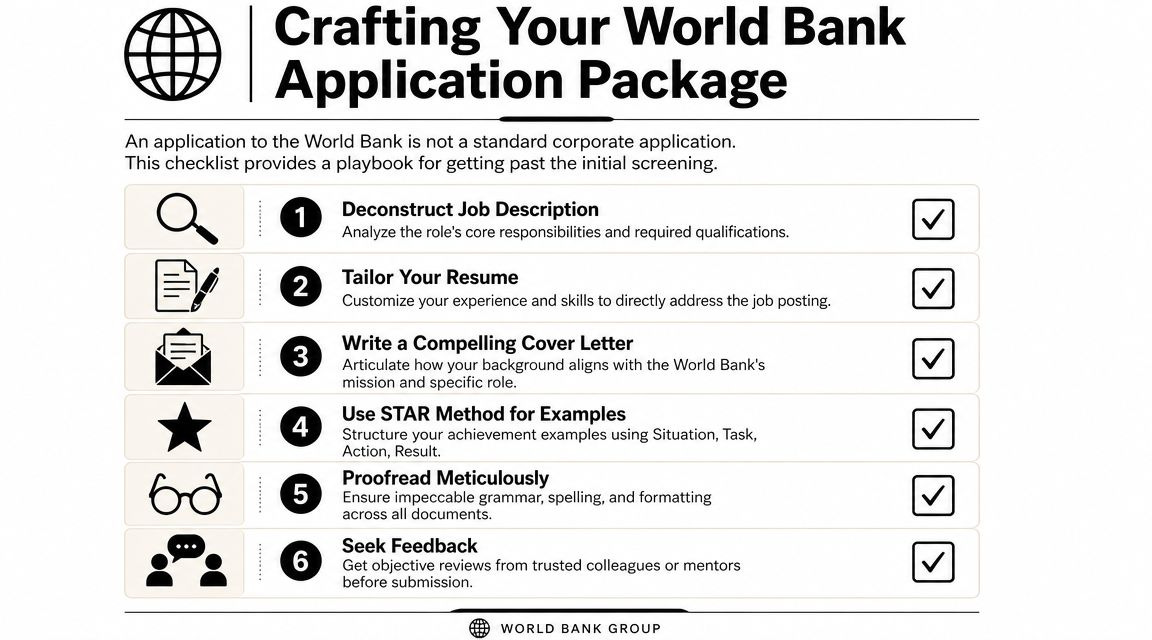
Start by marking up the posting itself. Pull out the core duties, technical requirements, sector language, and any phrases that signal how the team defines competence. Then rebuild your materials around those points.
A practical application package usually includes:
A targeted CV. Reorder bullets so the most relevant work sits first under each role.
A specific cover letter. Connect your background to the team’s actual mandate, not the Bank’s mission in the abstract.
Evidence of outputs. Publications, briefs, models, dashboards, evaluations, lending support, or operational contributions matter when they fit the job.
Clean formatting. Dense paragraphs and inconsistent dates create avoidable friction.
What strong CV bullets look like
The Bank responds well to evidence of scope, method, and result. You don’t need inflated language. You need clarity.
Weak bullet:
Supported labor market research for a development project.
Better bullet:
Analyzed household survey data, produced labor-market indicators, and drafted briefing materials for a country employment diagnostic.
Weak bullet:
Worked with cross-functional teams on policy issues.
Better bullet:
Coordinated with economists, operations staff, and government counterparts to synthesize findings into policy recommendations.
Application rule: Mirror the vacancy’s technical vocabulary when it honestly reflects your experience.
A short pre-submission check
Before you hit submit, check these points:
Role alignment: Does the first half of your CV make the fit obvious?
Keywords: Have you used the exact tools, sectors, and competencies from the posting where appropriate?
Achievements: Are your bullets outcome-focused rather than task-only?
Consistency: Do dates, titles, and employers line up across documents?
Tone: Does the cover letter sound informed and direct, not generic or overly reverential?
Many candidates undercut themselves by sounding broad when the role is narrow. Others sound impressive but vague. The strongest applications feel exact. They show the selector that you understand the work, the context, and the level of execution expected.
Mastering the Interview and Selection Process
You submit a strong application for a Washington-based World Bank role, the posting closes, and then nothing seems to happen. For U.S.-based candidates, that silence often leads to the wrong conclusion. A job located in the USA is not the same thing as a job reserved for U.S. citizens, and that distinction shapes the competition pool, the interview panel, and the level of experience you are measured against. According to the World Bank’s hiring process overview, vacancies are often open for about two weeks, screened into a longlist, narrowed by a Selection Advisory Committee to three to five interviewees, and usually filled within 60 to 90 days. The same source notes that some roles include a test, case study, or presentation, and that GF-to-GG candidates often have 10 to 12 years of experience.
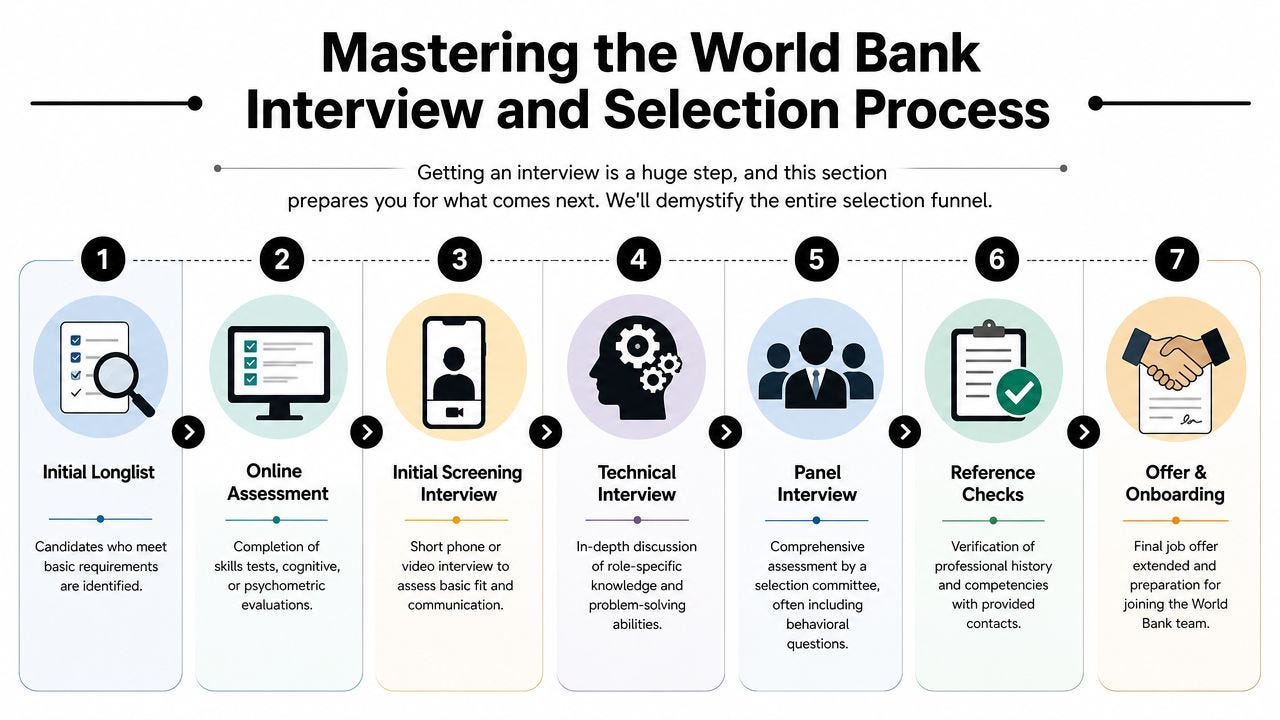
That comparison set matters.
A USA duty station, especially in Washington, DC, usually means you are competing against an international applicant pool unless the vacancy explicitly limits eligibility. Candidates who miss that point often prepare as if they are interviewing for a domestic policy role. The panel is usually testing something broader: whether you can do high-level analytical or operational work in a multilateral institution with country counterparts, internal review layers, and political constraints.
The first serious cut often happens before the interview. Screening is less about general quality and more about fit at the exact grade, sector, and contract type. A candidate can be strong and still fall out because the profile reads as too junior for a staff role, too U.S.-centric for a global practice team, or too strategic for a consultant assignment that needs immediate delivery.
By the time you reach the interview, the panel is usually checking four things at once:
technical depth,
judgment under constraints,
communication with mixed audiences,
ability to work across teams, clients, and review processes.
Strong answers are specific. They show the problem, the constraint, the action, and the result. STAR still works, but World Bank interviews reward candidates who add one layer many applicants miss: trade-offs. If you changed a recommendation, explain what evidence changed your view. If you had weak data, explain what you did to keep the analysis credible. If a government counterpart pushed back, explain how you adjusted without giving up the core objective.
For a useful prep structure, this guide to passing a competency-based interview helps translate private-sector, nonprofit, and government examples into language interview panels recognize.
One practical rule: answer at the level of the job.
For consultant roles, interviewers often care most about whether you can deliver a defined output quickly, work with limited supervision, and step into an existing workflow without much onboarding. For staff roles in the USA, especially at mid-level grades, the bar is usually broader. The panel may expect evidence that you can produce quality analysis, manage stakeholder friction, contribute to operations or policy dialogue, and exercise judgment that holds up under internal scrutiny.
That is where many U.S. applicants misread the room. They give polished leadership stories when the panel wants evidence of execution. Or they describe technical work in detail but never explain how it informed a lending operation, advisory engagement, or policy discussion.
The strongest examples usually sound like this:
Briefly define the development problem.
Clarify your role and decision authority.
Explain the method, tool, or operational move you used.
State the constraint.
Show the outcome, including any compromise or lesson.
“I led the analysis” is too thin. Explain the dataset, the disagreement, the timeline, the operational consequence, and what changed because of your work.
The Bank also tends to respond well to disciplined reasoning. For technical and policy roles, the World Bank’s Jobs Diagnostics step-by-step guide shows the kind of logic many interviewers respect: define the problem clearly, separate symptoms from causes, compare across contexts, and connect diagnosis to feasible action. If you work in labor, social protection, private sector development, monitoring and evaluation, or applied economics, that habit of thought matters as much as subject expertise.
Questions worth practicing include:
Tell us about a time you had to make a recommendation with incomplete data.
Describe a case where your analysis changed an operational or policy decision.
How did you handle disagreement with a government counterpart, manager, or technical peer?
Walk us through a project where delivery pressure forced a trade-off.
Explain a technical finding to a non-technical audience.
Use one example per answer. Build it fully. Panels remember clear judgment and credible contribution far more than a rushed list of achievements.
What usually works:
examples with real constraints,
clear ownership,
technical substance without jargon overload,
evidence of collaboration,
realistic judgment about trade-offs.
What usually falls flat:
generic motivation statements,
inflated claims of impact,
stories where your role is unclear,
answers that ignore implementation realities,
polished narratives with no sign of how you think.
The panel is looking for signal, not performance.
Strategic Networking and Positioning for the Future
A common mistake looks like this: a candidate based in Washington sees a World Bank opening in the USA and assumes local presence is the advantage that matters. Often it is not. A critical consideration is whether the role is a U.S.-located position open to international applicants, or a role tied to U.S. work authorization, security, or citizenship requirements outside the Bank’s standard international hiring model. If you miss that distinction, you can spend months building the wrong profile and talking to the wrong people.
Good networking fixes that problem because it gives you usable market intelligence. Ask staff and consultants how their team hires, which contract types they use, whether headquarters-based roles are globally recruited, and what constraints apply to U.S.-based candidates. Those conversations should help you sort roles into two buckets: jobs physically located in the United States, and jobs that specifically require U.S. citizenship or another form of domestic eligibility. The application strategy is different for each.
The Bank’s sector priorities also move over time, so positioning cannot stay generic. In official World Bank messaging on jobs and job creation, the institution highlights job creation across infrastructure, energy, agribusiness, healthcare, value-added manufacturing, and tourism. The same source notes that only about 420 million jobs are expected for the 1.2 billion young people entering the workforce over the next decade. That matters for U.S.-based applicants because hiring managers often respond to candidates who can connect their past work to the Bank’s current operational agenda, not just to broad development interest.
A stronger long-term position usually comes from three choices:
Pick a lane that a hiring manager can place quickly. Labor markets, private sector development, infrastructure finance, health systems, digital data systems, procurement, and results measurement are easier to understand than a broad “international development” profile.
Build depth that travels across contract types. Strong quantitative work, sector operations experience, country-facing client skills, and clear writing all matter for both staff jobs in the USA and consultant work that can later lead to staff consideration.
Maintain contact with purpose. A short update after a publication, project milestone, or new piece of field experience is useful. Repeated check-ins with no new information are not.
One practical rule: talk to people who sit near the work, not only senior names with impressive titles.
That usually means task team leaders, senior specialists, research staff, operations officers, and experienced consultants. They can tell you whether a vacancy is likely to be filled through a staff process, a short-term consultant contract, or a roster-based search. They also know something applicants regularly miss. A job posted in Washington is not the same thing as a job reserved for U.S. citizens, and a U.S. citizen has no automatic edge in a globally recruited Bank role unless the posting says so.
Patience matters here. I have seen strong candidates get traction only after they stopped chasing every USA posting, narrowed their value proposition, and targeted the contract path that matched their background. That is usually what turns interest into a profile a manager can use.
If you want a steady way to track openings across the World Bank and peer institutions, Multilateral Development Bank Jobs publishes recurring listings for staff roles, consultant opportunities, and practical guides on MDB hiring. It is a useful option if you want one place to monitor the market and keep your search organized.