

You’re probably reading this while weighing a trade that those around you don’t fully grasp.
An MDB offer can look like the clean answer to a messy career question: meaningful work, global relevance, serious colleagues, real compensation, and a brand name that travels. Then the private questions start. What happens to your family life if postings move? How often will your evenings disappear into calls across time zones? Will “flexibility” mean actual autonomy or just being reachable everywhere?
Those are the right questions.
In multilateral development banks, work life balance initiatives matter for a simple reason. The work is important and consequential, and the institutions can absorb as much time and energy as you let them. The professionals who last aren’t the ones who avoid pressure. They’re the ones who learn how to operate inside demanding systems without letting the system consume everything else.
What Work Life Balance Really Means in MDBs
Work life balance in MDBs doesn’t mean an even split between work and the rest of your life. That fantasy falls apart fast in any institution running lending operations, policy work, board deadlines, country missions, and crisis response.
It means sustainability.
A balanced MDB career is one where your work can stay intense without becoming permanently chaotic. You can absorb peak periods, travel cycles, portfolio pressure, and cross-border coordination because the role still leaves room for recovery, relationships, health, and some control over your calendar.
Balance is about operating range
In these institutions, some teams run hot by design. Operational departments often move faster than corporate services. Fragile-state portfolios demand more than low-drama middle-income programs. Teams tied closely to Board calendars or sovereign negotiations can have ugly stretches.
That doesn’t automatically mean the role is unhealthy.
The true measure is whether pressure comes in waves or as a permanent condition. Healthy teams have crunch periods and then normalize. Unhealthy teams treat urgency as culture.
Practical rule: Ask whether the role has predictable spikes or constant escalation. Peak pressure is manageable. Endless pressure is a staffing failure.
Prestige doesn’t solve bad team design
A lot of candidates assume they must accept poor boundaries as the price of impact. That’s the wrong frame. MDBs are large bureaucracies. Your day-to-day life will depend less on mission statements and more on your manager, unit norms, staffing mix, and whether priorities are sequenced.
A brilliant mandate can still sit inside a badly run team.
That’s why candidates should spend as much time studying team mechanics as they do studying the institution’s public image. If you’re mapping options across global organizations, this broader guide to international organization careers is useful context, but the decisive factor is always the team you join.
The career lens matters
The people who burn out fastest often chase maximum prestige, maximum scope, maximum travel, and maximum visibility all at once. That combination looks impressive for a while. It’s hard to maintain.
The better approach is more deliberate. Pick a role that stretches you without destabilizing the rest of your life. In MDBs, balance is less about comfort and more about staying effective long enough to build a serious career.
Why MDBs Are Finally Taking Balance Seriously
This shift isn’t happening because institutions suddenly became sentimental. It’s happening because poor balance damages execution.
According to the 2026 Gallup State of the Global Workplace report, only 20% of employees worldwide were engaged in 2025, the lowest level since 2020. Gallup also estimates $10 trillion in lost productivity, equal to 9% of global GDP. The same report ties the decline directly to weak work-life balance support and notes that the drop in engagement over two consecutive years was driven heavily by manager disengagement.
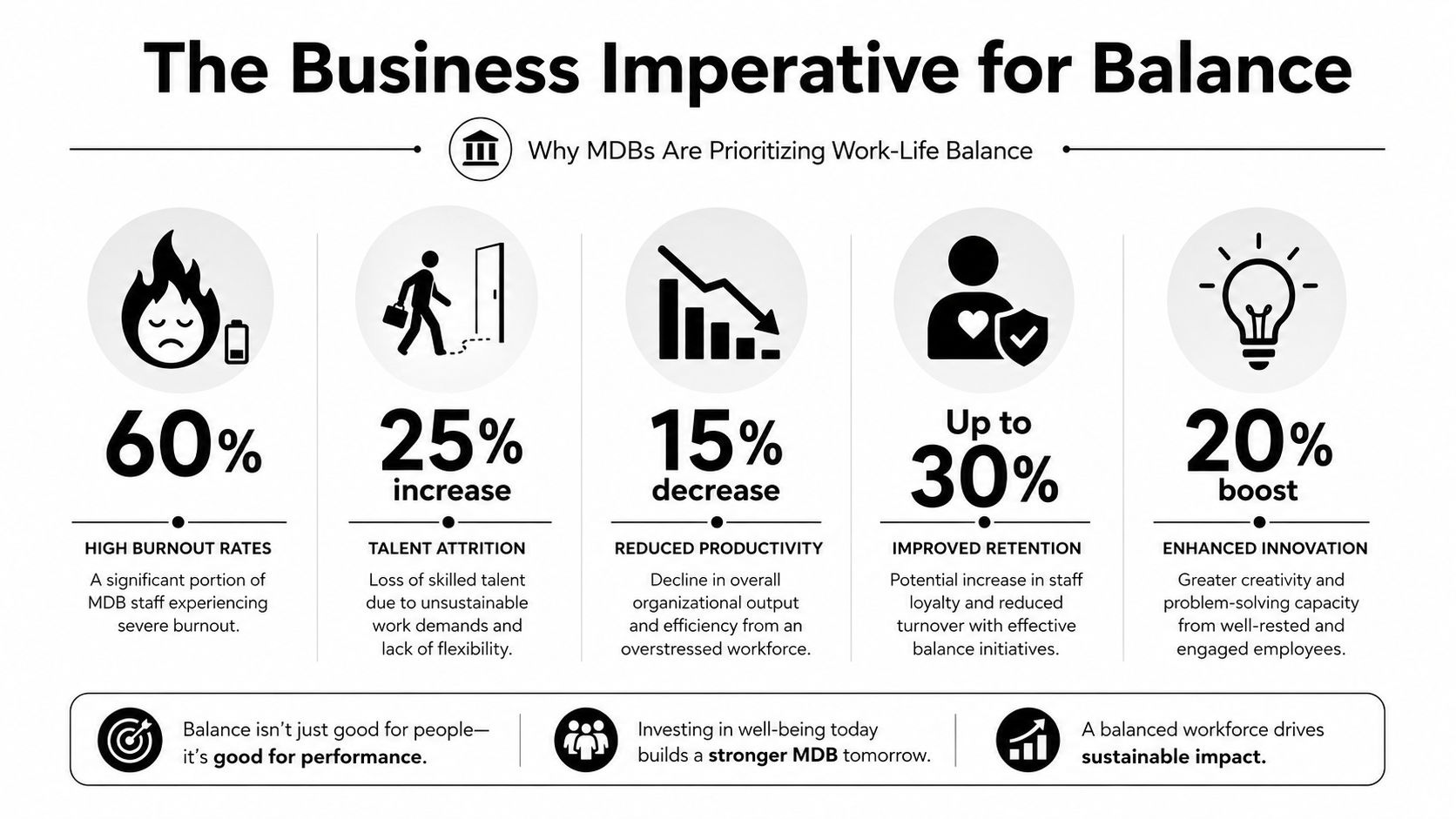
MDBs should pay attention to that because they rely on managers to hold together highly educated, internationally mobile, politically aware teams. When managers are depleted, everyone downstream feels it. Deadlines get murkier. Work expands to fill all available hours. Staff stop trusting “official” flexibility policies because local behavior overrides formal rules.
The talent market changed
Prestige still matters. Mission still matters. But they don’t carry the same weight they used to.
The 2025 Global Life-Work Balance Index by Remote points to a wider change in what workers value. The same source notes that 91% of respondents prefer remote work specifically because it offers better work-life balance, citing Owl Labs, and that 53% of people now prioritize health and well-being over work, citing Statista. It also highlights the aftershock from the Great Resignation, with the US Bureau of Labor Statistics reporting that over 47 million Americans voluntarily quit their jobs in 2021.
MDBs don’t compete only with each other anymore. They compete with organizations that offer stronger control over location, schedule, and personal boundaries. That matters whether the role sits in Washington, Manila, Abidjan, London, or a field office with heavy travel.
Retention is now an operational issue
When an economist, sector specialist, operations officer, or treasury professional leaves, the institution loses more than one employee. It loses project memory, relationship continuity, and internal navigation skills that take years to build.
That’s why serious work life balance initiatives have moved from HR language to management language. A unit head doesn’t need to love the vocabulary. They do need people who can stay productive without burning out.
Here’s the hard truth. MDBs can tolerate high standards. They can’t indefinitely tolerate churn among strong performers, especially in technical roles that are difficult to replace quickly.
A unit that burns through capable staff eventually weakens its own mission delivery, no matter how impressive the mandate looks on paper.
What this means for candidates
You should read every “well-being” message as a signal about institutional pressure points. If an MDB is talking more openly about flexibility, manager support, or burnout prevention, it usually means leadership has recognized a practical problem.
That doesn’t mean every team has changed. It means you’re negotiating in a market where balance has become a legitimate hiring issue, not a soft side topic.
The Anatomy of Effective Work Life Balance Initiatives
Most institutions advertise the visible parts. Flexible arrangements. Wellness resources. Leave programs. Those can help, but they don’t carry much weight without structural support underneath.
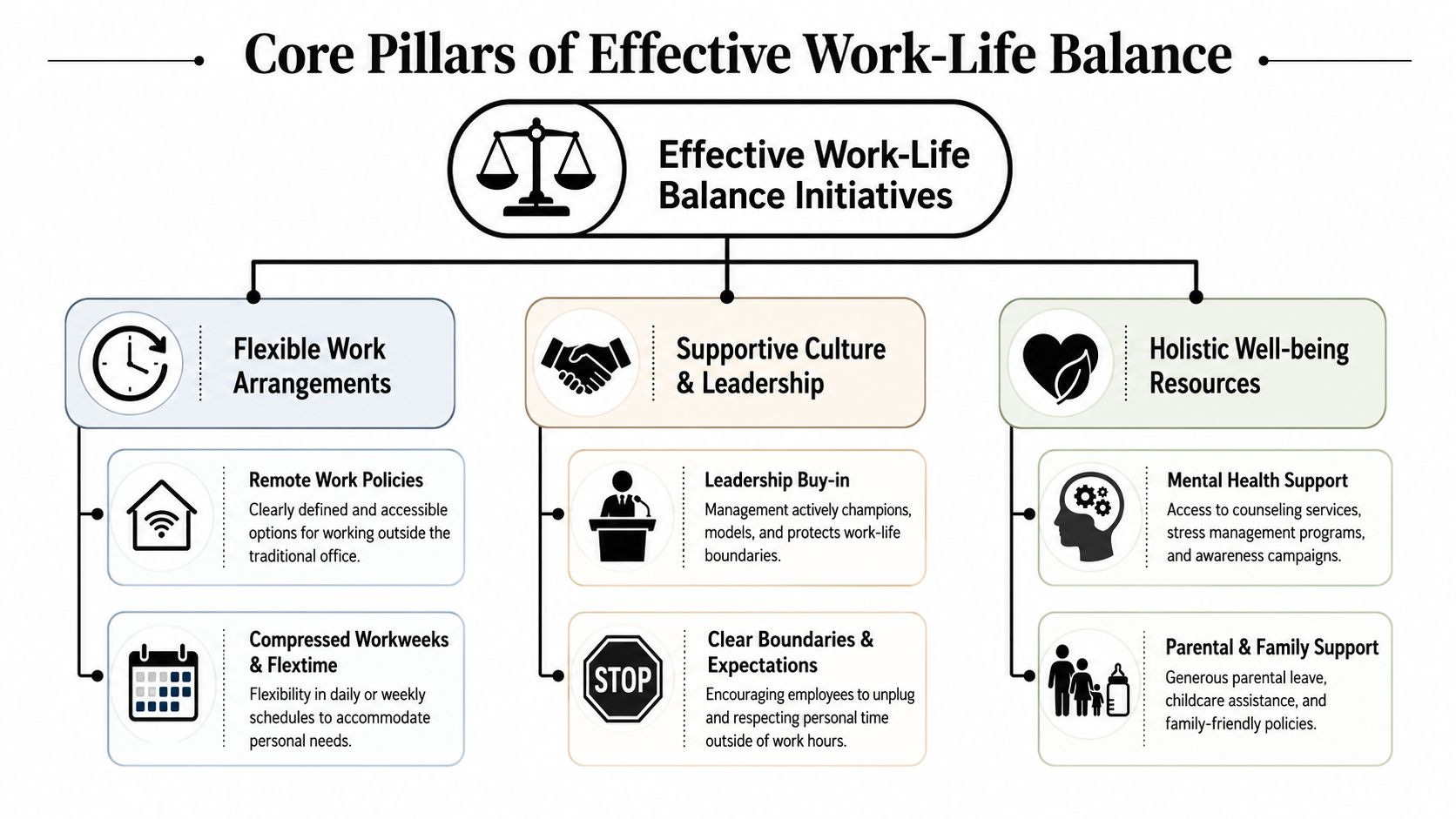
The strongest work life balance initiatives operate on three levels: job design, support systems, and leadership behavior.
Start with workload design
If the role is overloaded, no wellness webinar will save it.
The most important question is whether the team has designed the work around outcomes or around visible busyness. That distinction matters. According to CoreHealth’s review of emerging 2025 to 2026 data, 63% of employees say increased paid leave doesn’t reduce stress if core tasks remain unbalanced. The same source says results-oriented work models reduce burnout by 41% more than traditional time-off policies.
That lines up with what practitioners already know. Staff don’t feel better because they technically have leave. They feel better when priorities are narrow enough that taking leave doesn’t create a disaster on return.
A good manager does three things well:
Sets hard priorities so staff know what matters this week
Cuts low-value process work before it consumes nights and weekends
Measures output clearly instead of rewarding whoever stays online longest
Build support that people can actually use
The second layer is infrastructure. Counseling access, coaching, family support, parental leave, and manager check-ins all matter. But access has to be real.
If support exists only on paper, staff know it. If using the support is perceived as a weakness, staff know that too.
A practical way to judge infrastructure is simple. Can people use it during normal work rhythms without taking a reputational hit? If the answer is no, the institution has a communications campaign, not a support system.
Culture decides whether policy is real
Here, most organizations fail.
You can spot superficial balance programs quickly. Leaders praise flexibility, then schedule calls at unreasonable hours. HR encourages time off, then top performers get rewarded for constant availability. Managers say boundaries matter, then staff are expected to monitor messages across every time zone.
Here’s a more useful filter:

“If a team cannot say what is urgent, everything becomes urgent.”
That sentence captures most balance problems in MDB environments. The issue usually isn’t commitment. It’s weak prioritization.
Work Life Balance Policies You Will Find at MDBs
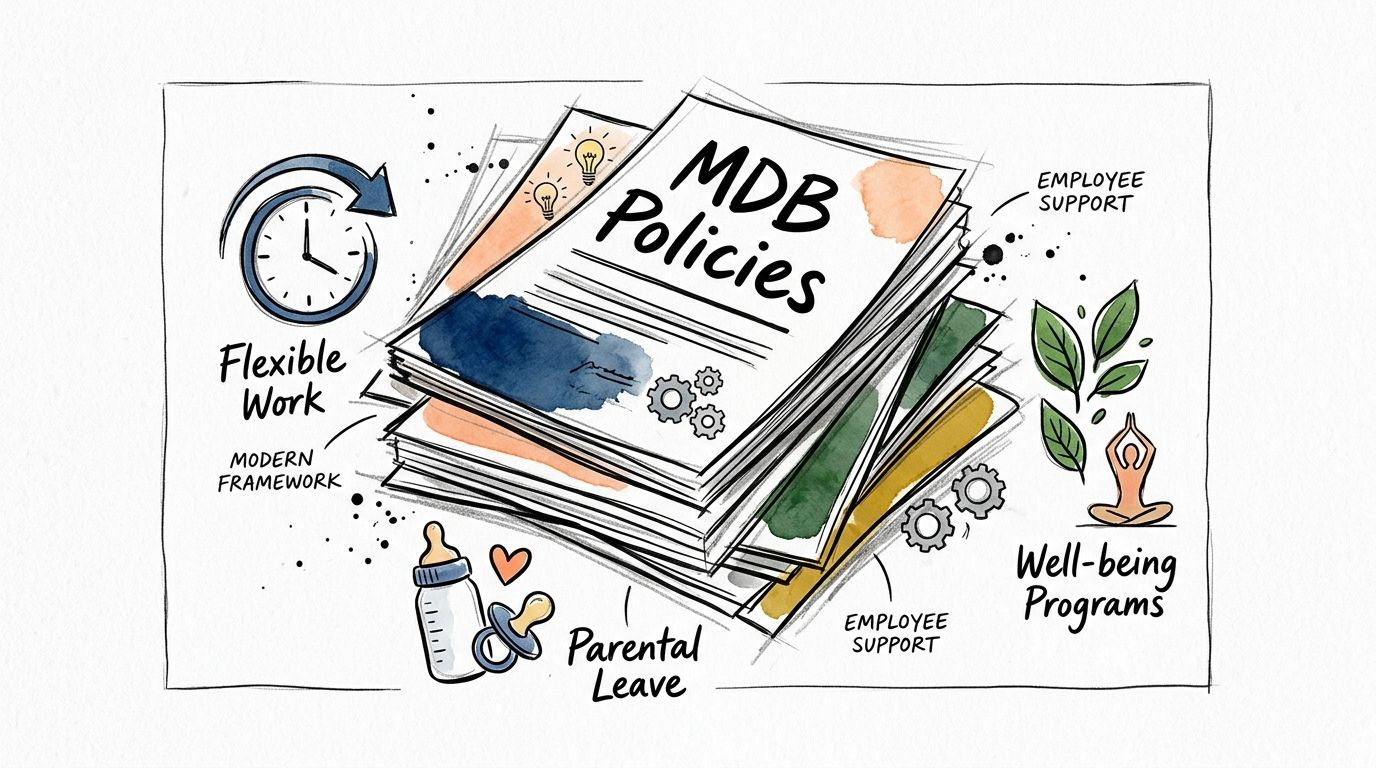
The official policy menu in MDBs often looks solid. Hybrid work arrangements, annual leave, family-related leave, health coverage, employee assistance resources, and mobility opportunities are common features. On paper, that compares well with many employers.
The lived experience is more complicated.
Mobility builds careers and destabilizes personal life
One of the most distinctive MDB realities is international staff mobility. That policy can accelerate learning, broaden operational judgment, and position you for leadership. It can also make private life harder than many candidates expect.
A UNU-MERIT article on starting a career at a multilateral development bank notes that a critical MDB policy is the International Staff Mobility clause, which can require relocation after 2–3 years. The same piece describes the resulting geographic churn as a barrier to retention and work-life balance because repeated moves disrupt family stability and continuity.
That trade-off is real. A single professional can often absorb it. A dual-career household, a family with school-age children, or anyone with elder-care obligations feels the cost much more sharply.
Flexibility often collides with time zones
Many MDB teams work across headquarters, country offices, clients, cofinanciers, and consultants. In practice, “flexible work” can become fragmented work. You might not be in the office, but your day still gets split by morning calls with one region and late-night coordination with another.
That’s why candidates should ask how teams handle cross-time-zone collaboration.
Some units rotate inconvenient meeting times fairly. Others push the burden to whoever has less power. That unwritten rule shapes daily life more than any broad institutional statement about flexibility.
Leave policy and leave culture are different things
Most MDB professionals can point to a colleague who had decent leave on paper and still struggled to take it cleanly. That happens for familiar reasons. Tight transaction schedules. Mission deadlines. Team understaffing. Managers who approve leave but continue sending work anyway.
A practical read of policy looks like this:
Annual leave is valuable when coverage exists and handovers are respected.
Parental and family leave matter most when return paths are realistic, not career-limiting.
Remote or hybrid options help when performance is judged by output rather than office optics.
If you’re exploring location-flexible roles, it helps to understand the distinct market for international development jobs with remote options. The key point is that remote eligibility alone tells you very little. What matters is whether the team has learned how to work that way without extending the workday indefinitely.
The unwritten rules carry more weight than the handbook
In MDBs, every formal policy has an informal counterpart. The formal version says you may work flexibly. The informal version tells you whether senior staff still expect immediate responses at all hours. The formal version says mobility broadens careers. The informal version tells you who pays the personal cost of moving.
Read both.
The people who work effectively with these institutions don’t dismiss official benefits. They just know that policy only becomes real when the team around you honors it in daily operations.
How to Spot Real Balance Before You Accept the Offer
Most candidates ask soft questions and get polished answers. “How’s the culture?” “Is the team collaborative?” “Do people have good work-life balance?” Those questions invite rehearsed language.
Ask operational questions instead.
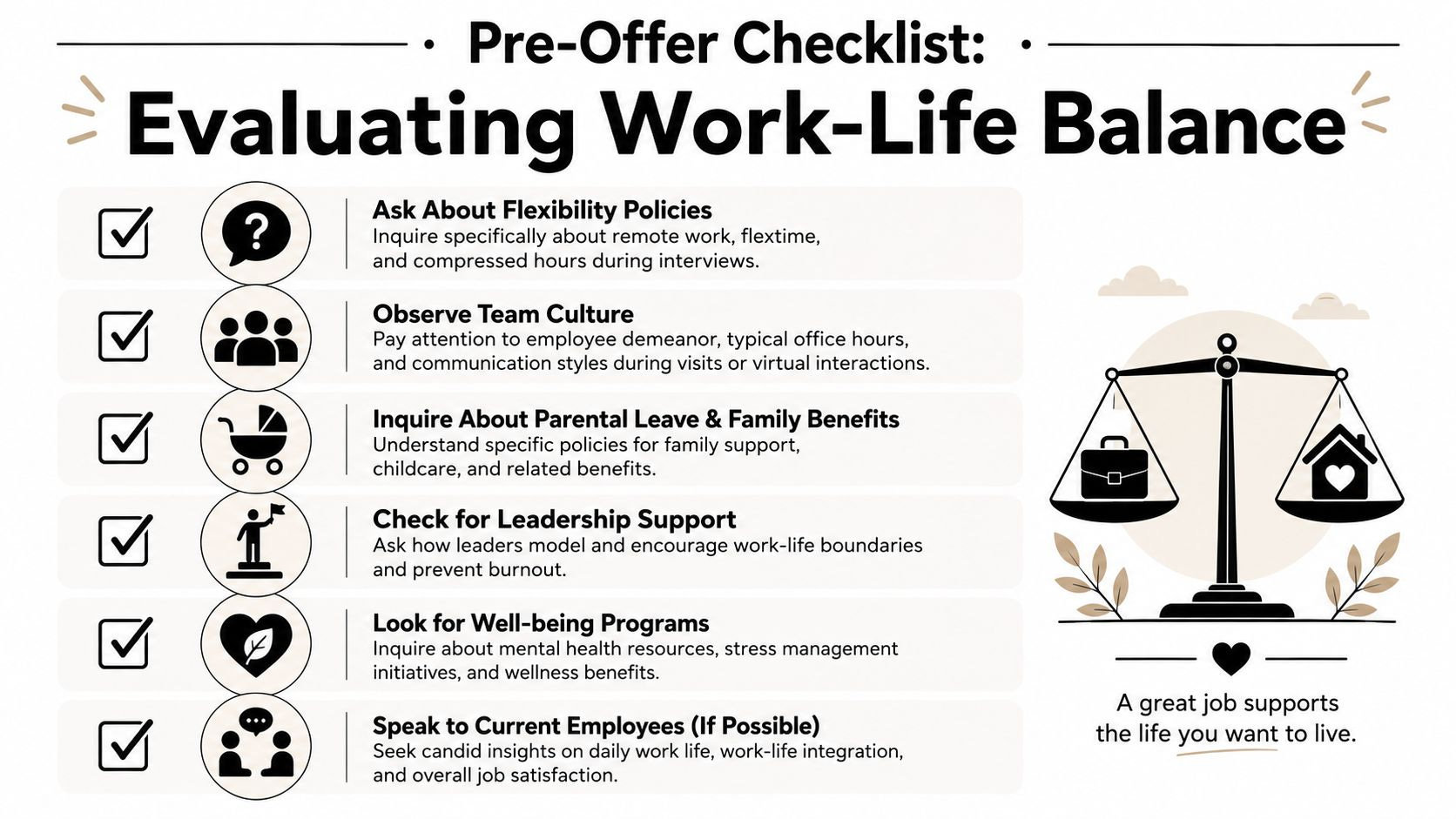
Ask about how the work actually moves
You want specifics on workload, communication, and decision rights. A few reliable questions:
What creates the busiest periods in this role?
Strong teams can answer this clearly. Weak teams say every period is busy.How do you handle urgent requests outside local working hours?
Listen for process. Escalation paths, rotation, planning discipline. Vague answers usually mean constant interruption.How is work redistributed when someone takes leave?
This reveals whether the team has real coverage or shifts hidden costs onto the person who returns.How often do staff work across multiple time zones in the same day?
That pattern has a huge effect on family life, sleep, and concentration.
Probe benefit access, not just benefit existence
This matters even more for consultants, remote hires, part-time professionals, and anyone in a nonstandard arrangement.
According to Leapsome’s analysis of work-life balance gaps, only 14% of remote workers receive equitable access to wellness benefits compared with 68% of full-time onsite staff. The same source flags an even wider gap for contractors and gig workers.
That should change how you interview. Don’t ask whether wellness resources exist. Ask whether your employment category can use them, how access works in practice, and whether remote or external personnel are treated the same as onsite staff.
A short checklist helps:
For remote roles ask which benefits are fully accessible from your duty station
For consultant roles ask which support sits outside the contract entirely
For family-related policies ask whether managers actively support use of the policy
For flexible work ask who approves exceptions and how often requests are denied
Watch for red flags in the conversation
The interview itself gives away a lot.
Field note: If every senior person frames long hours as proof of commitment, believe them. They’re telling you how the team rewards behavior.
Other red flags include:
Pride in chaos
People describe nonstop urgency like it’s a badge of honor.No clean answer on priorities
Interviewers can’t explain what the role owns versus what gets dumped in informally.Flexibility with caveats piled on
“Of course we’re flexible, except during missions, Board periods, supervision cycles, and major deliverables.” That can describe most of the year.Benefits language without manager examples
If nobody can tell you how leaders model healthy boundaries, the policy likely floats above the actual culture.
For a more detailed benefits lens, this breakdown of World Bank staff benefits from an insider’s perspective can help you frame sharper questions. Use it as background, then press for team-specific realities in the interview.
Read the unit, not just the institution
This is the final filter. The same MDB can house one team where people perform at a high level without constant spillage into personal time, and another where everyone stays on edge.
Candidates often overestimate institutional branding and underestimate local management.
Your offer is not from an abstract organization. It’s from a specific manager, in a specific team, with a specific operational rhythm. Evaluate it that way.
Building a Sustainable and Impactful MDB Career
A durable MDB career depends on two things. Choosing institutions and teams with credible work life balance initiatives, and using your own judgment once you’re inside.
No policy will protect someone who says yes to every request, accepts undefined scope, and mistakes exhaustion for importance. No amount of personal discipline will fully compensate for a unit built on chronic overload. You need both sides working together.
The long game wins
The strongest professionals in this sector usually become more selective over time. They still take on difficult assignments. They still travel when the work demands it. They still deliver under pressure.
But they stop performing availability as a virtue.
They learn which meetings need them, which don’t, which managers respect boundaries, and which role designs are sustainable. That’s how people stay effective long enough to lead substantial portfolios, build regional credibility, and keep a life outside the institution.
The question to ask yourself
Before accepting any MDB role, ask one direct question: Can I do this work well for years, not just for one intense season?
If the answer is yes, you’ve found something worth pursuing. If the answer depends on permanent sacrifice, the offer may still be prestigious, but it’s badly priced.
Work that matters deserves a career structure you can live with.
If you want a clearer view of which MDB roles, consultant openings, and career paths are worth your time, Multilateral Development Bank Jobs is one of the best practical resources available. It tracks opportunities across major institutions and publishes role-focused guidance that helps candidates make smarter decisions before they apply.