

Landing an offer from the World Bank is a big deal. If you only focus on the base salary, you’re missing the bigger picture. The real value is in the total compensation package, which is one of the best in the world.
For most non-U.S. staff, the salary is tax-free. Combine that with a monster pension plan, generous leave, and a full suite of global support benefits, and you start to see why the Bank can pull in top-tier talent from everywhere. This is not your typical private sector offer.
A Look Under the Hood of a World Bank Offer
When that offer letter hits your inbox, you’re getting a ticket to a complex, globally oriented compensation system. This guide gives you the unvarnished truth, the kind of breakdown you’d get from a seasoned staffer over coffee.
The details can make or break your decision. If you’re a mid-career pro weighing a Bank offer against a private sector role, you need to know how the allowances and pension stack up. If you’re comparing offers between the World Bank and another MDB, the fine print is everything. A lower base salary might put you way ahead financially when you factor in the family support or pension benefits.
What We’re Breaking Down
My goal is to give you the practical intel you need to make a smart choice. We’ll get into the actual numbers and policies so you can see the true financial weight of a World Bank offer.
Here’s what you’ll get:
Compensation and Pension: How the salary grid works and the mechanics behind that incredibly generous retirement plan.
Global Allowances: The real-dollar value of the mobility premium, hardship pay, and housing benefits.
Family and Wellness: The nitty-gritty on education grants for your kids, global health insurance, and parental leave.
The Bottom Line: How relocation works and how the tax exemption rules can dramatically increase your net pay.
This is the playbook an experienced staffer wishes they had on day one. It’s about understanding how the benefits function in the real world, whether you’re at HQ in Washington D.C. or running projects from a small country office.
Once you understand how every piece fits together, from salary and allowances to pension and leave, you can evaluate your offer with confidence and negotiate from a place of strength.
Understanding Your Total Compensation Package
When you get a World Bank offer, the base salary is the starting point. The real value is in the total compensation package, a structure built for long-term financial security. It’s a system designed to be competitive no matter where you are in the world.
The Bank doesn’t pull salary numbers out of a hat. Every year, it runs a rigorous review to benchmark its pay scales against what similar jobs pay in the local market. This makes sure your salary is competitive, whether you’re at headquarters in Washington D.C. or in a country office.
This infographic gives you a high-level look at the pillars of the benefits package.
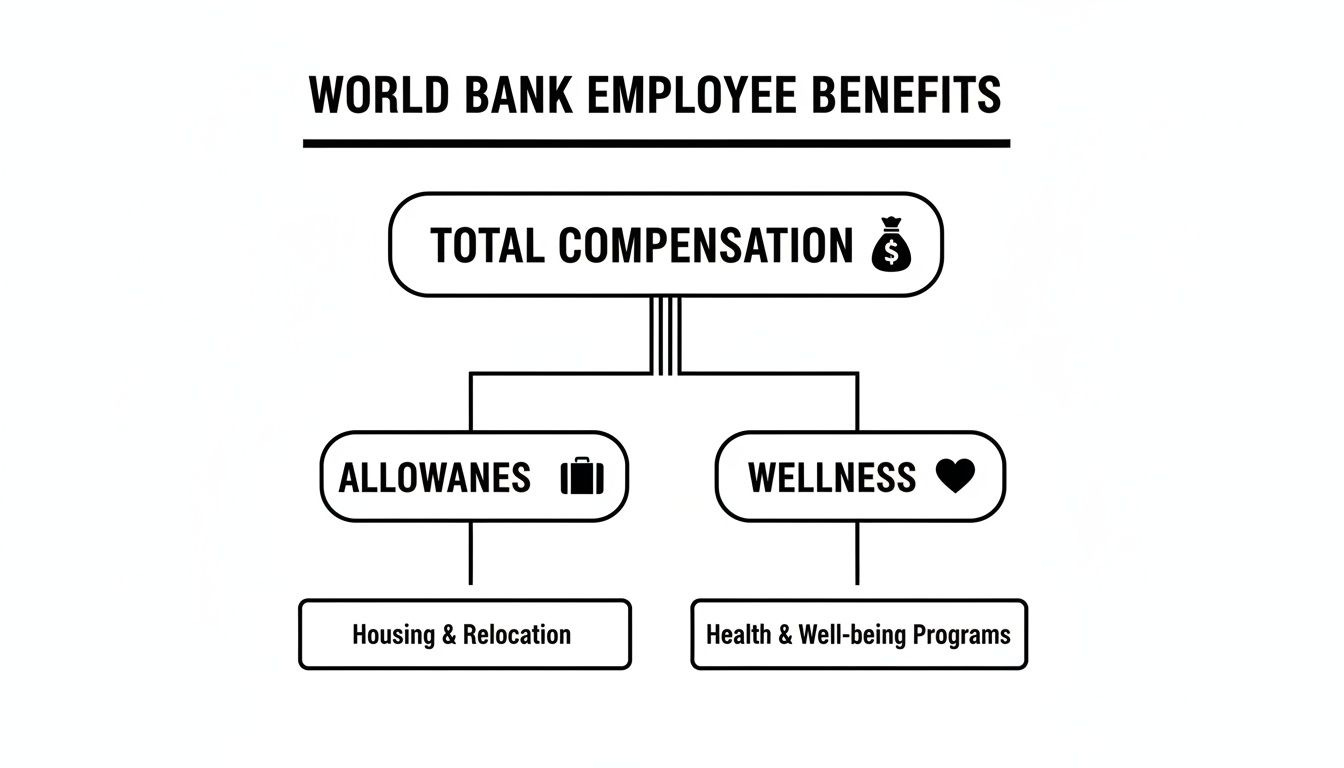
The package goes way beyond salary. It’s a mix of allowances, wellness programs, and long-term financial tools that add significant weight to the offer.
How Your Salary Grows
Your salary at the Bank is never static. It’s tied to your performance, measured through an annual appraisal system. Your performance review determines your merit increase for the year.
This model means your compensation is a ladder you climb through delivering results. Based on available data, the average salary at the World Bank is around $134,000 a year. This breaks down to about $112,000 for entry-level roles and climbs to over $194,000 for senior positions. The median pay, around $142,000, reflects the higher cost of living at HQ versus other duty stations.
The system is built on that annual market review and your individual performance. A solid performance review usually translates into a merit increase of 3-5%. On top of that, the Bank often makes additional adjustments for inflation, especially in countries with volatile economies.
This table gives you a snapshot of what you can expect at different career levels, based on 2026 estimates.
World Bank Salary Structure at a Glance (2026 Estimates)
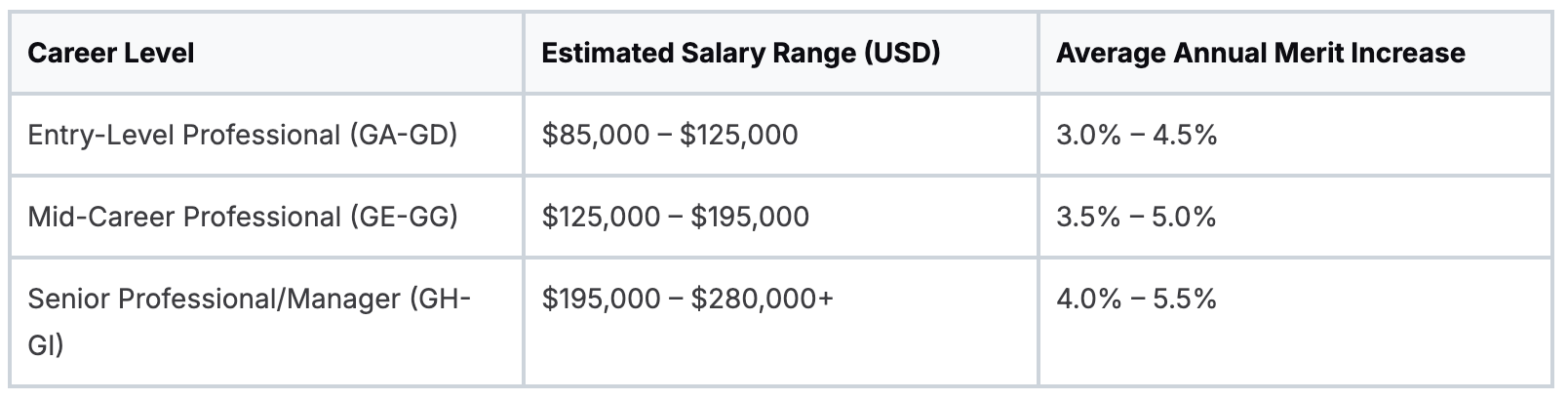
These numbers give you a clear path for salary progression. For a more detailed breakdown, you can check out our complete World Bank salary guide.
The Pension Plan: A Key Differentiator
The Staff Retirement Plan is one of the most powerful benefits the World Bank offers. It’s a huge factor that sets the Bank apart from almost any private sector employer. It’s a defined benefit pension plan, an increasingly rare benefit that provides a level of financial security few other organizations can touch.
The pension is engineered to provide a substantial part of your final salary in retirement, creating a reliable income stream for life.
Both you and the Bank pay into your pension, making sure it grows steadily. Staff contributions usually land between 7-11% of your gross salary. The real power comes from the Bank’s significant matching contribution. The combined pot is then managed to deliver strong, long-term growth.
The point of the pension plan is to give you financial stability when you retire. Projections often show that staff who serve a long career can retire with an annual pension that’s 60-70% of their final salary. This is a cornerstone of the Bank’s value proposition and a critical piece to weigh when you’re looking at a job offer. It provides a financial backstop that lets you focus on your work, knowing your future is secure.
Allowances That Support a Global Career
Your base salary is only one part of the equation. The World Bank’s allowances are what make a global career financially smart, turning a good offer into a great one. These benefits offset the real costs of an international assignment, so you can focus on your work without taking a financial hit.
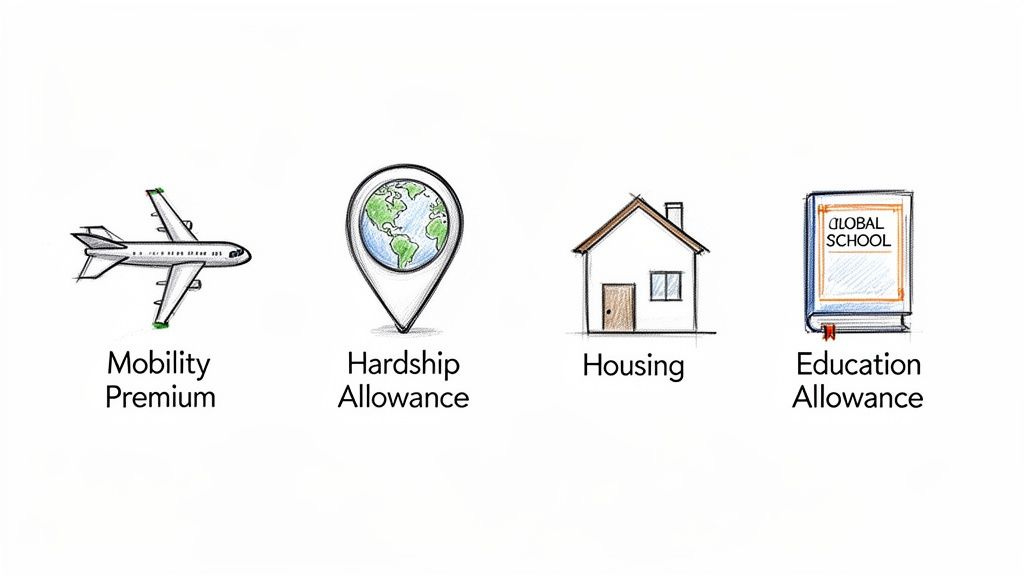
These are structural parts of your compensation. The Bank knows that working abroad, especially in challenging locations, comes with a price tag. Let’s break down how each one works.
The Mobility Premium
If you’re an expatriate staff member posted outside your home country, you’ll get a Mobility Premium. This is a straightforward financial incentive, paid quarterly for your first five years at a new duty station. It’s the Bank’s way of acknowledging the professional and personal effort involved in an international move.
The premium is a percentage of your net salary and changes based on your grade level and family status. The Bank understands that uprooting a family requires more support than moving as a single person. This premium automatically stops after five years, as it’s meant to smooth out that initial transition.
The Mobility Premium is the Bank’s investment in your successful landing. It’s direct compensation for being globally mobile and a key factor that makes these assignments attractive from the start.
This benefit is a clear signal that the institution values staff who build a career across different regions and country offices. It’s a core element supporting the World Bank’s global operational model.
Hardship and Housing Allowances
Assignments in difficult or dangerous locations come with extra compensation. The Hardship Allowance is a percentage of your net salary paid to staff in duty stations with tough living conditions. These places are graded using the United Nations’ hardship classification, which looks at everything from health risks and security to climate.
This allowance can be substantial, often ranging from 5% to 35% of your net pay. The more challenging the post, the higher the allowance, directly compensating you for the difficulties you and your family face.
Housing support is a critical benefit for expats in expensive cities. The Housing Benefit helps cover rental costs to make sure you can find suitable and secure accommodation. It provides a significant subsidy that makes living in places like Geneva, Tokyo, or Singapore financially manageable. The amount is tied to your grade level and family size.
Education Allowance for Your Family
For staff with children, the Education Allowance is one of the most valuable benefits the World Bank offers. This grant helps cover the costs of private international schooling for your dependent kids, from primary through secondary school.
Here’s the breakdown:
Eligibility: It’s available to expatriate staff whose children need to attend international schools because local public schools aren’t a viable option.
Coverage: The Bank covers a huge portion of tuition and mandatory fees, up to an annual ceiling that changes by country and city. The ceiling for New York, for example, is very different from the one for Nairobi.
Process: You pay the school fees upfront and then file a claim for reimbursement. The funds are then paid back to you with your salary.
This benefit is a game-changer. It makes it possible for your kids to get a consistent, high-quality education no matter where your career takes you. Without it, the cost of international schooling could wipe out the financial advantage of an overseas post. It’s a fundamental support system for globally mobile families.
A career at the World Bank is a marathon. The intense, high-pressure nature of global development work is sustainable only if you have solid support systems. The Bank understands this, and it’s reflected in a benefits package that goes far beyond perks.
These are structural supports designed to keep you and your family healthy, grounded, and prevent burnout. It’s about providing real security, no matter where your assignment takes you. This is the Bank’s core value proposition for retaining top talent.

Global Medical and Insurance Plans
The cornerstone of the Bank’s wellness package is the Medical Benefits Plan (MBP). This is a comprehensive health insurance program covering medical, hospital, vision, and dental services for you, your spouse or domestic partner, and your dependent children.
You’ll choose a plan from top-tier providers like Aetna or Cigna. You and the Bank contribute to the premiums, but the Bank picks up the lion’s share, making the coverage affordable for its quality. Your contribution is deducted from your monthly net salary.
The plan’s global portability is a real asset. You can get medical care in your duty station, back in your home country, or anywhere else you travel and still be covered. For a globally mobile workforce, this feature is critical.
The Bank also provides a safety net to protect your financial well-being.
Life Insurance: Staff are automatically enrolled in a basic life and accident insurance plan at no cost. You can purchase supplemental coverage for yourself and your family.
Disability Insurance: The Bank provides both short-term and long-term disability coverage. If an illness or injury keeps you from working, this ensures you continue to receive an income.
Generous Leave for Real Work-Life Balance
The World Bank’s leave policies are another area where it shines. The organization knows that intense work demands significant downtime. These policies are part of a culture that gives you the flexibility to manage your personal life and disconnect.
New staff get 26 days of annual leave, allowing you to recharge. This is on top of 15 days of sick leave per year.
The parental leave policy is particularly strong. Primary caregivers receive 100 paid days, while secondary caregivers get 50 days. This forward-thinking policy supports families within a diverse, global workforce recruited from over 180 member countries. You can read more about the official policies on the World Bank’s careers site.
How Parental Leave Works in Practice
The parental leave policy is one of the most progressive you’ll find. It applies to birth, adoption, and surrogacy, and it’s available to all staff regardless of gender or marital status. The primary caregiver, whether male or female, is eligible for the full 100 days.
This flexibility is huge. It empowers families to decide for themselves who takes on the primary caregiver role, or even to split it. It’s a modern approach that recognizes the reality of today’s families.
The Bank also offers other types of leave to support work-life integration:
Special Leave: This can be granted for reasons from pursuing further education to handling a family emergency.
Flexible Work Arrangements: Depending on your role and office, you might have access to telecommuting, flexible hours, or part-time work.
These policies are a clear signal that the Bank invests in its people for the long haul. They are designed to retain top talent by creating an environment where a demanding career and a healthy personal life can coexist.
Navigating Relocation and Tax Rules
Moving for a World Bank job means uprooting your life. The Bank gets this, and they’ve built a solid system of benefits to smooth out the bumps of a major international move.
Think of these benefits as a core part of the deal. They cover you from the day you move out to the day you eventually move back home. Understanding the relocation package and the unique tax situation is essential to figuring out what your net pay will look like.
Your Move Handled From Start to Finish
When you take an international post, the Bank handles the logistics. Their relocation package covers the big-ticket items involved in moving you, your family, and your household across the globe.
Here’s what that support looks like:
Shipment of Personal Effects: The Bank pays for shipping a generous amount of your household goods by sea or air.
Travel Expenses: This covers the airfare for you and your eligible family members to get to your new duty station.
Settling-In Grant: You’ll get a lump-sum payment to help with immediate costs like utility deposits or buying new appliances.
This support isn’t a one-way trip. When your time at the Bank is over, a similar package of repatriation benefits kicks in to get you and your belongings back to your home country. They support you on the way in and on the way out.
The Tax Exemption: A Game Changer
One of the biggest financial perks of working at the World Bank is the tax status of your salary. For most staff who are not U.S. citizens, your World Bank income is exempt from income tax in your duty station. This is laid out in the Bank’s founding agreements with member countries.
This tax exemption massively boosts your take-home pay. It’s a cornerstone of the entire compensation structure and a key reason Bank salaries are so competitive against private sector roles.
There’s one huge exception. The U.S. government taxes its citizens and green card holders on their income no matter where they earn it. If you’re an American citizen working at the Bank, you still have to file and pay U.S. taxes. You can read more about this in our deep dive on why MDB employees often pay no taxes.
How the Bank Handles U.S. Taxes
To ensure American staff aren’t penalized, the World Bank has a system called the Tax Allowance program to level the playing field. Its job is to offset the U.S. tax burden.
Here’s the process:
You Pay Your Taxes: U.S. staff file their federal, state, and local income taxes like any other American, paying what they owe on their Bank salary.
You File for Reimbursement: You then submit your tax returns to the Bank’s tax office.
The Bank Reimburses You: The Bank calculates the tax you paid purely on your World Bank earnings and then gives you a check for that exact amount. That payment is the “tax allowance.”
This system makes your Bank salary tax-neutral, putting U.S. staff on the same financial footing as their international colleagues. If you’re a U.S. candidate, understanding this process is critical. It ensures you know precisely what your financial reality will be.
When you’re weighing a World Bank offer, you need to see where it stands in the wider world of Multilateral Development Banks (MDBs).
The Bank is in a constant bidding war for global talent, competing directly with heavyweights like the International Monetary Fund (IMF) and the Asian Development Bank (ADB). While their missions look similar, the way they structure their benefits can be worlds apart.
Looking only at base salary is a rookie mistake. The real story is in the total compensation package. The fine print on allowances, pension plans, and family support can make a huge financial difference. One MDB might offer a higher mobility premium, while another has a more generous education grant. These details can swing the value of your assignment by thousands of dollars each year.
Salary and Pension Competitiveness
On the surface, base salaries across top-tier MDBs look consistent. They all benchmark against the same competitive markets. The IMF, for example, often has a slight edge on base pay, which reflects its sharp focus on macroeconomic and financial expertise.
The World Bank has a powerful ace up its sleeve: its pension plan. It’s widely considered one of the most robust defined-benefit plans still in existence.
The real contest isn’t over the starting salary. It’s about long-term wealth creation, and the World Bank’s pension plan is engineered for exactly that. It provides a more secure retirement than what many peers can offer.
The Bank’s plan is built to provide a significant part of your final salary in retirement. This level of security has vanished from most of the private sector and even many government roles. If you’re thinking about a 20 or 30-year career, this long-term financial stability is a massive part of the World Bank’s value proposition.
Comparing Key Allowances and Family Support
Here you start to see the daylight between institutions. Most MDBs offer a suite of benefits like relocation support, health insurance, and paid time off, but the specifics vary.
For instance, the World Bank’s parental leave policy is exceptionally progressive, offering 100 days for primary caregivers and 50 days for secondary caregivers. For candidates with young families, this is a huge draw. For a deeper dive into how these benefit structures compare, this guide to UN staff benefits offers valuable parallels.
To make this concrete, let’s put the major players side-by-side.
MDB Benefits Comparison Snapshot
Here’s a high-level snapshot comparing important benefits across the World Bank and its peers. This isn’t an exhaustive list, but it highlights the key areas where you’ll find the biggest differences.
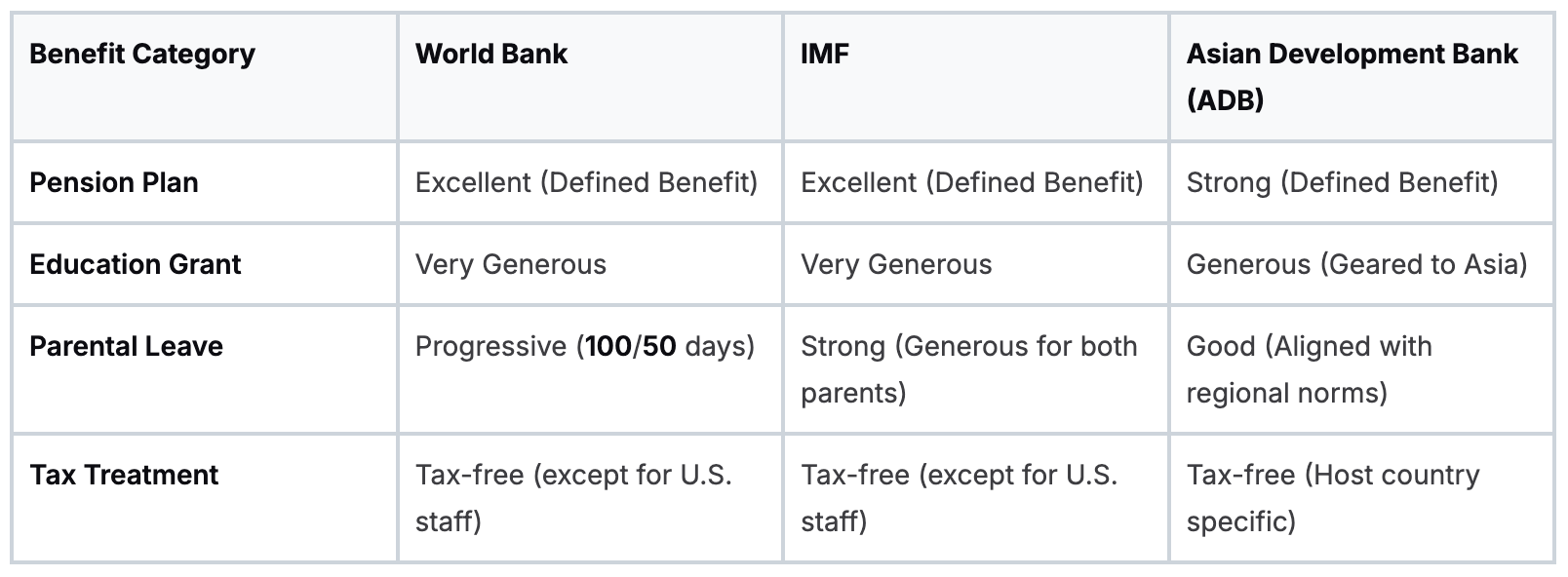
The core offerings are often similar, but the World Bank holds a competitive edge in key areas like parental leave while maintaining a top-tier pension that is hard to beat.
Knowing these distinctions gives you the strategic insight to properly evaluate an offer. It lets you negotiate from a place of knowledge, ensuring you land at the MDB that aligns with your long-term personal and financial goals.
Your World Bank Benefits Questions, Answered
When you’re looking at a World Bank career, the benefits package is a huge piece of the puzzle. It’s complex, and the details matter. Let’s get straight to the answers you’re looking for.
Are Benefits the Same for HQ and Country Office Staff?
Yes and no. The core foundation of the benefits package, like pension, health insurance, and annual leave, is the same for all staff, no matter where you are. That global consistency is a major plus.
Where things change is with allowances and salary scales. These are tailored to your duty station. A staff member in a high-cost city like Geneva or a hardship post will receive extra financial support that someone at the Washington D.C. headquarters won’t. This is how the Bank ensures your net pay is fair and competitive, whether you’re in a capital city or a remote field office.
Do Consultants Get the Same Benefits as Full-Time Staff?
This is a critical point: No, they do not. Short-Term Consultants (STCs) and Extended-Term Consultants (ETCs) operate on a completely different employment model.
Consultants are paid a gross daily or monthly rate. They are responsible for their own taxes, health insurance, and retirement savings.
The consultant rate is set higher on paper because it has to cover all the things you aren’t getting. You don’t get the pension plan, the internal health insurance, or any paid leave. It’s a fee-for-service arrangement, not a staff position.
How Does the World Bank Education Benefit Work?
For expatriate staff with kids, the education benefit is a game-changer. It helps you cover the steep costs of private international schooling for your dependent children, from primary through secondary school.
It works as a reimbursement grant. You pay the school fees upfront, then submit a claim to the Bank. The grant covers a significant percentage of tuition and mandatory fees, up to a set financial cap. This cap changes from country to country to reflect what local international schools cost.
For many families, this single benefit makes a long-term international career financially sustainable.
At Multilateral Development Bank Jobs, we help you go beyond the job description to understand the realities of a career at institutions like the World Bank. Subscribe to get weekly job listings, insider guides, and the strategic advice you need to land your next role. Find your opportunity at https://mdbjobs.com
.