

You’re probably in one of two places right now. You’ve spent hours scrolling UN jobs, World Bank vacancies, fellowship pages, and consultant postings, and the whole market feels opaque. Or you already know the organizations you want, but you can’t tell whether you should aim at staff roles, consultancies, or one of the selective graduate pathways.
That confusion is normal. International organization careers attract ambitious people with strong resumes, solid degrees, and genuine global experience. The problem isn’t motivation. The problem is strategy.
These institutions don’t hire like typical employers. They hire through formal systems, specialized tracks, nationality balancing, long timelines, and narrow role definitions. Candidates who treat the process like a standard job search usually burn time. Candidates who learn the system start making smarter choices fast.
The first shift is simple. Stop thinking like an applicant. Start thinking like someone mapping an ecosystem. That means choosing the right family of institutions, matching yourself to the right entry door, and building a profile that fits how these organizations recruit. If you want a focused overview of employers in this space, this roundup of international development group jobs is a useful reference point.
Breaking into the World of International Organizations
People often approach international organization careers with a broad goal and a vague story. They say they want impact, policy exposure, or a global role. Hiring teams don’t recruit on vague stories. They recruit against a vacancy, a grade, a function, and a competency profile.
That’s why talented candidates miss repeatedly. They apply too broadly, pitch themselves as generalists, and assume the logo matters more than the actual job family. It doesn’t.
Practical rule: Pick the role type first, then the organization. “I want to work at the UN” is weaker than “I’m competitive for monitoring and evaluation, economic analysis, procurement, or digital solutions roles in three specific institutions.”
This market rewards people who narrow intelligently. If your background is public health, project finance, macroeconomics, data, evaluation, procurement, governance reform, climate adaptation, or humanitarian operations, you need to say that clearly and repeatedly. A recruiter should understand your lane in seconds.
A strong campaign usually has three parts:
Targeting: Choose institutions that use your skill set.
Positioning: Present yourself as a specialist with international relevance.
Timing: Apply through the entry path that matches your profile today, not the one you wish fit you.
Most candidates need to hear one blunt truth early. These roles are competitive, but they’re not random. There are patterns in who gets hired, where they enter, and what credentials matter. Once you understand those patterns, the process gets less mysterious and much more manageable.
The IO Landscape Not All Orgs Are the Same
The biggest mistake in pursuing international organization careers is treating all institutions as one big category. A candidate who looks strong for UN programme roles can be weak for a World Bank operations post, and a profile that fits the IMF may not get traction in EU institutions. The logo category is too broad to guide a serious search.
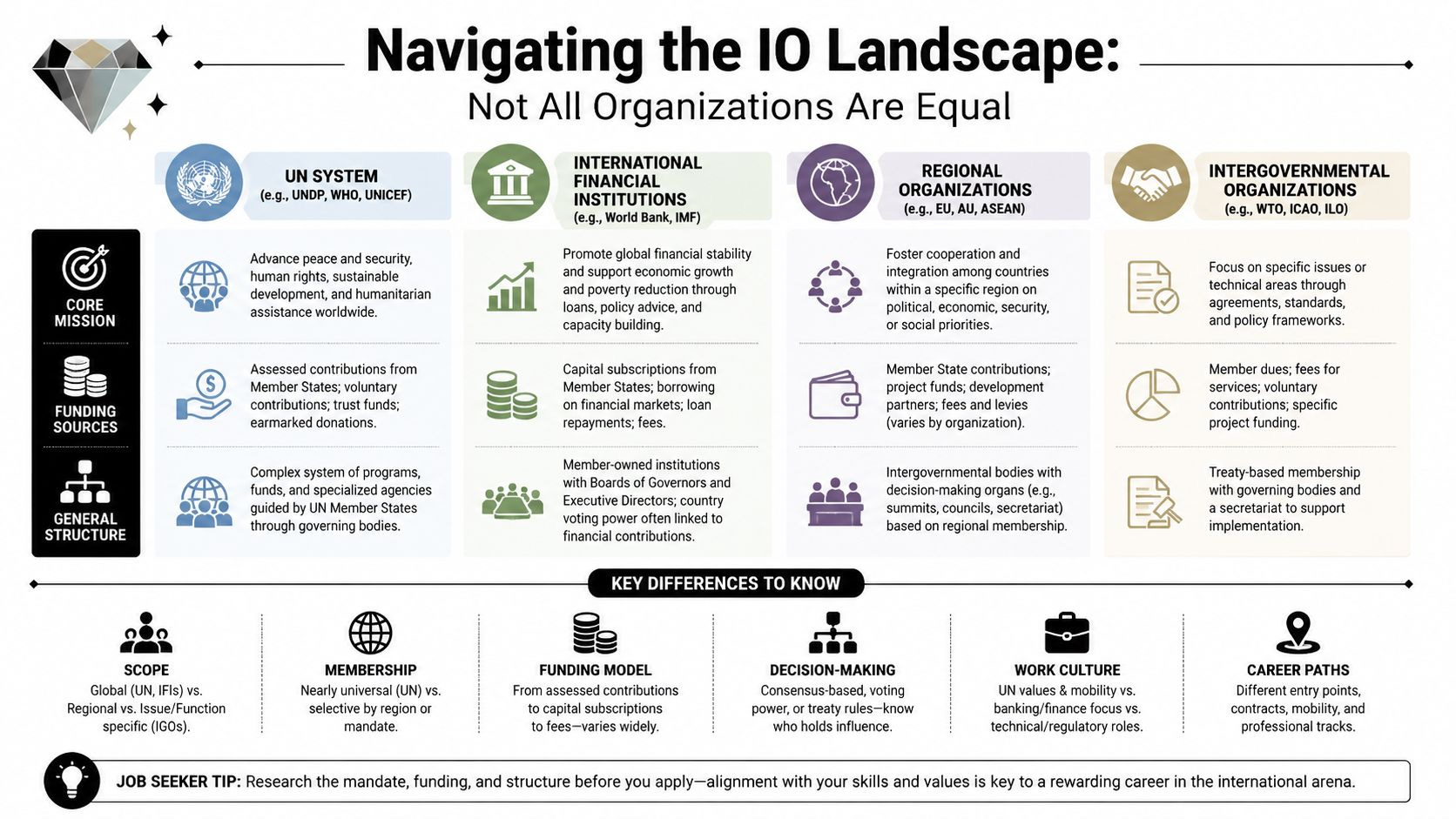
Hiring works by tribe.
If you understand that early, your applications get sharper. If you miss it, you end up applying across systems that reward different credentials, writing one generic CV, and wondering why nothing converts.
The UN system
The UN family is broad, but it has a recognizable hiring logic. It includes secretariat roles, funds and programmes, specialized agencies, and field missions. The work usually sits in policy support, programme delivery, humanitarian response, coordination, communications, human rights, governance, and administrative functions.
The culture is formal and process-heavy. Competency frameworks matter. Vacancy wording matters. Internal classifications matter. The UN Careers platform makes clear that hiring is segmented by career network and technical stream, including tracks such as Data Analyst and Digital Solutions Architect. That is a useful signal. “International affairs” is not a job family.
Candidates who fit the UN usually fall into one of three lanes:
Policy and programme: Governance, development, humanitarian work, social policy, public administration
Operations and support: Procurement, logistics, security, HR, administration, field coordination
Technical specialties: Data, digital systems, engineering, statistics, public health, sector expertise
The trade-off is straightforward. The UN often gives broader mandate exposure and more varied field or coordination roles. It also asks for more patience with process, longer timelines, and tighter screening against formal criteria.
Multilateral development banks
MDBs operate differently. The World Bank, regional development banks, and similar institutions are more tied to projects, lending, technical assistance, implementation support, and economic or sector analysis. They tend to value candidates who can connect ideas to financing, operations, and measurable delivery.
Many applicants misread the market. A general background in international relations is rarely enough on its own. Banks usually want depth in a sector or function: energy, transport, education, health, climate, procurement, public financial management, private sector development, digital, evaluation, or macroeconomics. They also put more weight on whether you have worked on real operations, not just policy discussion.
For early-career candidates, one of the clearest signals is whether your profile could plausibly fit the young professional programs at major international organizations. Those programs are selective, but the eligibility patterns tell you what these institutions value: graduate training, technical credibility, international exposure, and a profile that maps to operational business lines.
IMF and regional bodies
The IMF is its own tribe. It is narrower, more analytical, and less forgiving of weak economics fundamentals. Candidates without strong macroeconomics, fiscal policy, econometrics, or closely related training usually spend too much time chasing roles that were never realistic.
Regional organizations have another logic. EU institutions, for example, often reward legal and regulatory fluency, regional policy knowledge, multilingual ability, and comfort working inside a member-state political context. That profile is not interchangeable with a UN field candidate or an MDB operations specialist.
A useful shorthand is this:
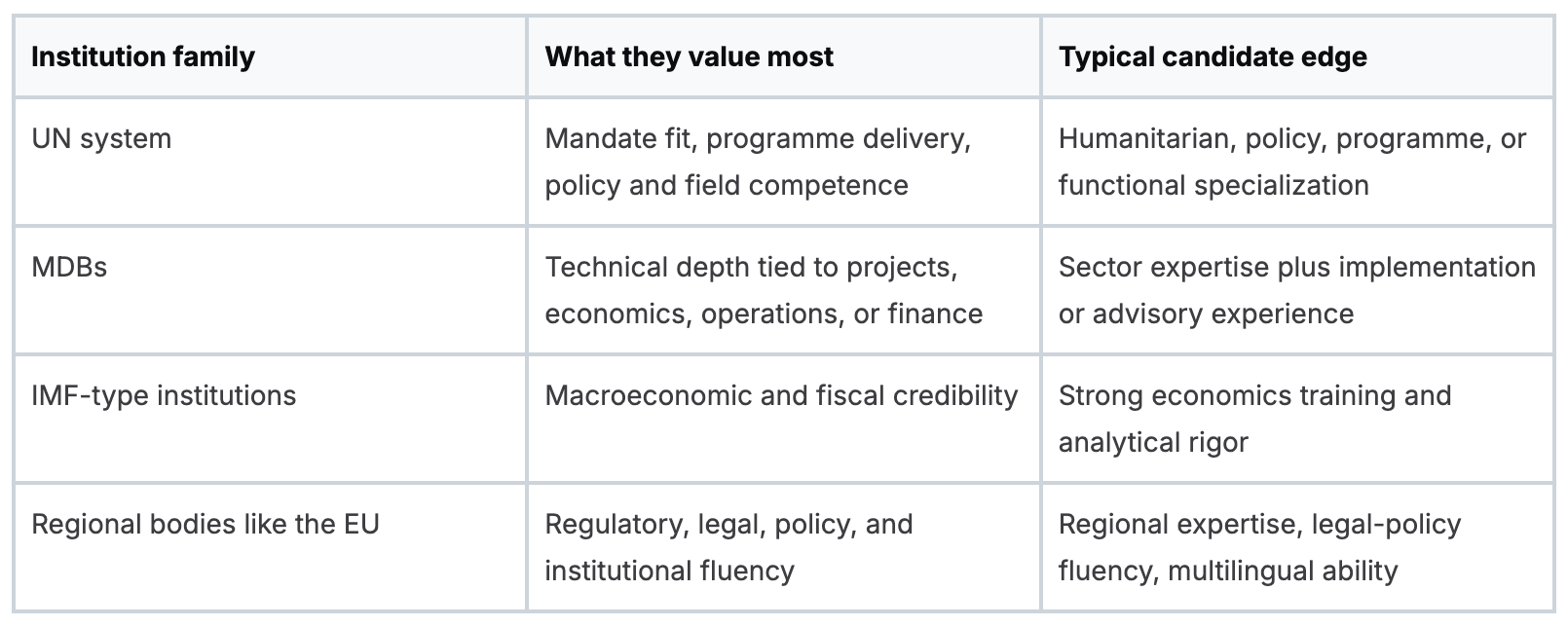
A smart search starts with institutional fit. Strong candidates usually pick one or two tribes, learn how those employers define credibility, and build their application strategy around that. Broad networking under the label of “international organizations” usually produces weak leads because the hiring rules are different.
Your Entry Point Staff Consultant or YPP
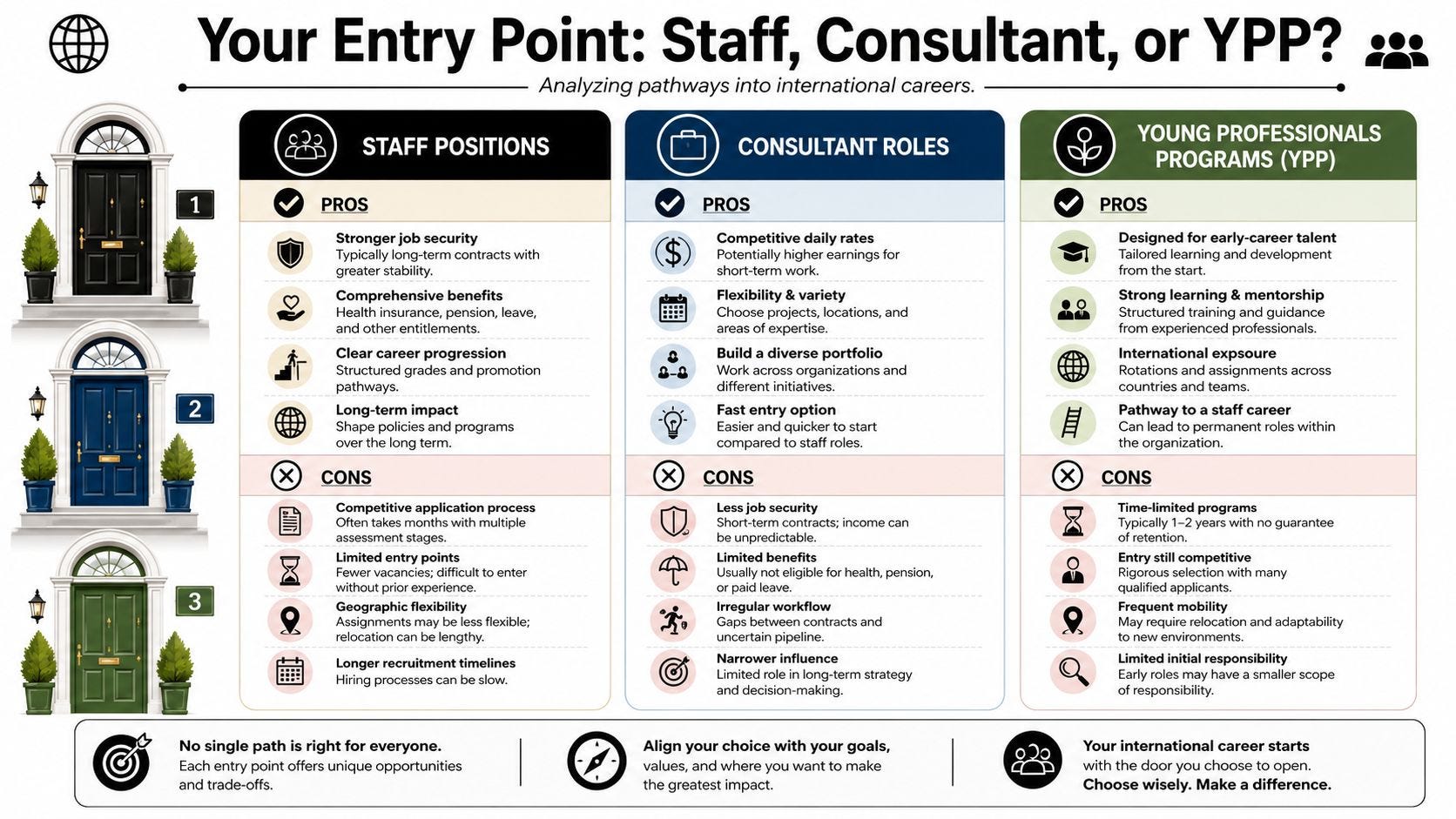
Individuals often won’t enter through the path they imagine at the beginning. They picture a permanent staff role. In reality, the most practical route often depends on career stage, specialization, and what hiring managers can justify right now.
Staff roles
Permanent or fixed-term staff roles are the classic long game. They offer the clearest career structure, internal mobility, and institutional legitimacy. They also come with the heaviest screening and the strongest competition.
These jobs work best for candidates who already have a clear track record in a recognized function. If you’ve led policy analysis, managed donor-funded programmes, worked on sovereign operations, built sector expertise, or handled complex international coordination, staff hiring starts to make sense.
What doesn’t work is applying to staff roles because you’re passionate and available.
Consultancies
Consultancies are the most underrated entry channel. Georgetown’s guidance on multinational organizations states that short-term consultancies are very common in inter-governmental organizations and often serve as a foot in the door to permanent work. The same guidance also notes that many organizations don’t list all internships publicly, which tells you something important about how informal and network-driven early access can be in this market. You can read that directly in Georgetown’s guide to multinational organizations.
Consultancies suit people who already have usable skills but not yet the full profile for staff competition. They’re especially effective for technical writing, research support, evaluation, operations, sector advisory work, and surge capacity assignments.
A realistic view of consultancies:
They build credibility fast: You get institution-specific experience on your CV.
They can be fragmented: Contract gaps and uncertainty are common.
They reward responsiveness: Teams often need someone who can contribute quickly, with minimal hand-holding.
They help you learn internal language: That becomes valuable in later staff applications.
If you’re exploring structured fast-track options alongside consulting, this guide to Young Professional Programs in international organizations is a practical reference.
Young Professional Programs
YPPs and similar graduate or early-career leadership schemes get disproportionate attention. They’re excellent when you fit them. They’re a distraction when you don’t.
These programs favor candidates with a very specific mix: elite academic performance, strong specialization, often international exposure, and a profile that signals long-term institutional potential. They can accelerate entry into staff tracks. They also absorb huge amounts of candidate energy for very limited openings.
Use this quick self-check:
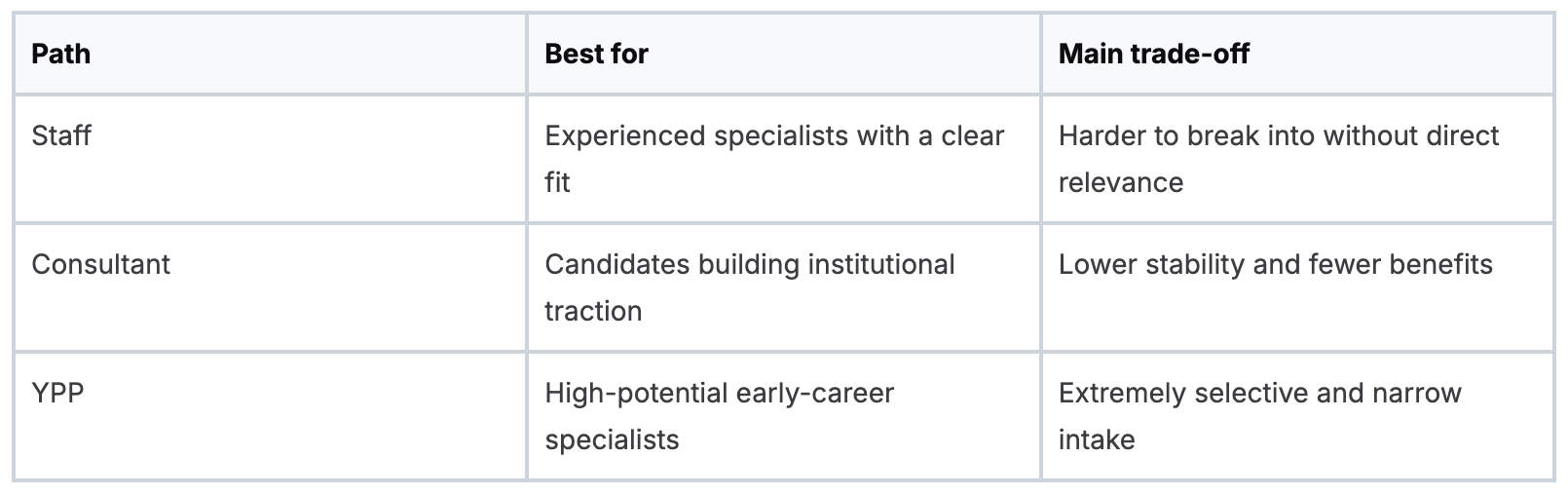
Consultant work often beats endless staff applications because it creates proof. Proof changes how your next application gets read.
The Unwritten Rules Qualifications and Nationality
A candidate applies to the UN with a strong international relations degree, Model UN experience, and real motivation. Another applies to the World Bank with a master’s in economics, three years on donor-funded public finance work, and a clean story about fiscal reform. The second profile gets read faster because international organizations hire for function first, then mission fit.
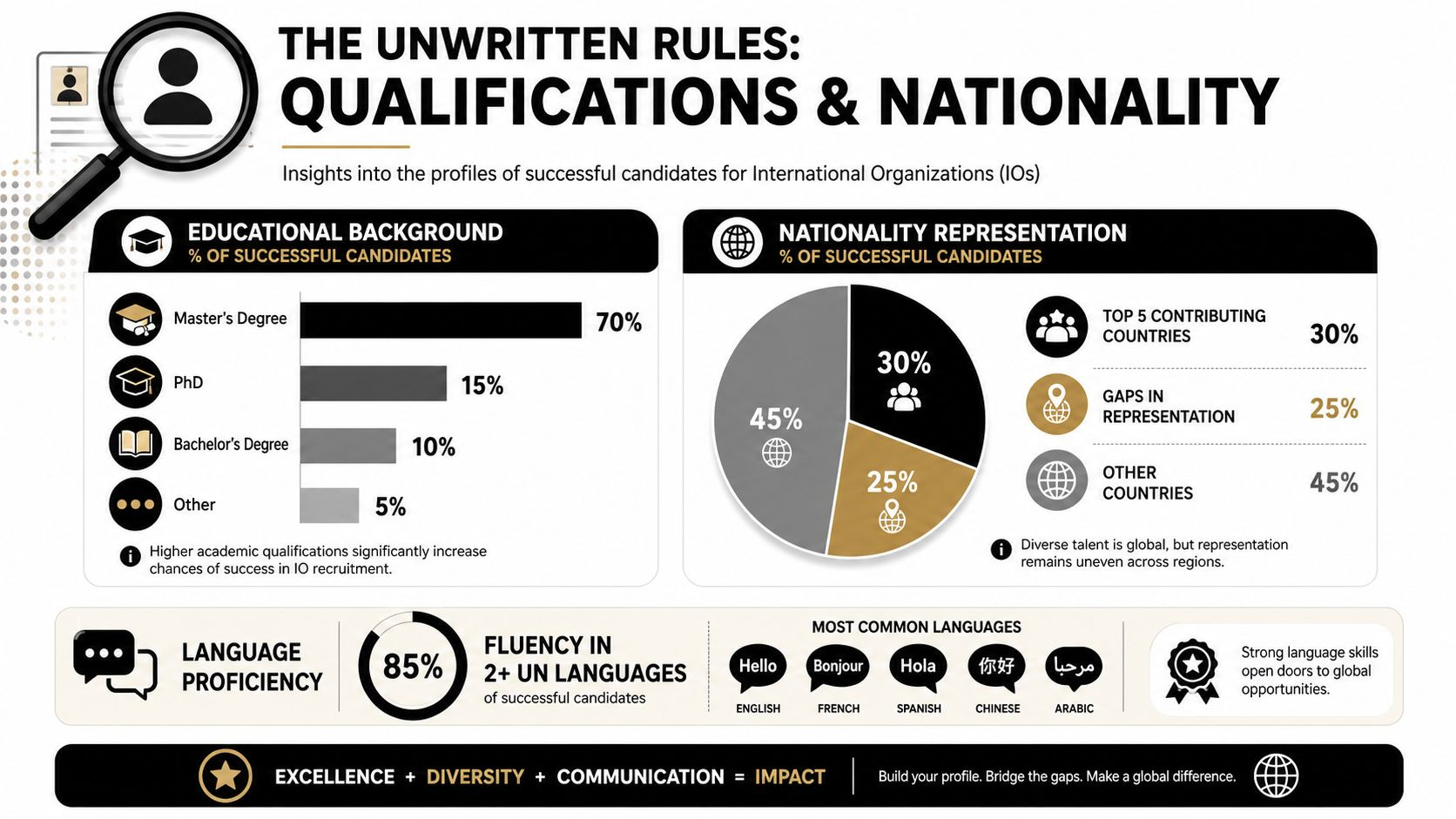
Education is a screening tool, not a differentiator
Across this field, postgraduate study is often expected for policy, research, programme, and technical roles, and successful candidates usually combine that with relevant experience, as noted earlier from LSE’s guidance on international organization careers.
The practical point is sharper than “get a master’s.” Your degree has to place you inside a hiring bucket. UN agencies often sort candidates into thematic and programme tracks such as health, education, humanitarian affairs, gender, monitoring and evaluation, procurement, or legal. Multilateral development banks sort more aggressively by technical function. Economists, transport specialists, energy specialists, water engineers, governance experts, financial management specialists, and safeguards staff are easier to shortlist because the fit is obvious. EU institutions also reward specialization, but often with a stronger emphasis on policy process, regulatory work, languages, and competition through formal exams.
A generic degree creates friction. Recruiters should not have to guess whether you are a policy officer, an education specialist, a labour economist, or a grants manager.
Credentials matter differently by institutional tribe
This is one of the biggest mistakes applicants make. They treat the UN, MDBs, and EU institutions as one job market.
They are not.
At many UN entities, country experience, languages, and programme delivery can outweigh prestige if your profile fits the mandate. At the World Bank, IFC, regional development banks, and similar institutions, technical depth usually carries more weight. A candidate with weak field exposure but strong sector credentials can still be competitive there. In the EU system, nationality rules, formal competition structures, and language requirements often shape access more directly than they do in the UN or MDB world.
That is why broad advice fails. The right qualification is not the most academic one. It is the one that matches how that institution screens.
Age and professional maturity shape your odds
Early-career applicants often underestimate how senior this field runs, especially for staff contracts. Many roles that look “mid-level” on paper still go to people with 8 to 15 years of experience, prior work with governments or donors, and evidence that they can operate in politically sensitive settings without much onboarding.
This is especially true in MDBs. Teams are lean, managers are risk-aware, and technical credibility matters on day one. UN agencies can be more varied because their mandates are broader, but even there, hiring managers usually prefer candidates who have already handled budgets, partners, reporting lines, or field coordination under pressure.
That does not block younger candidates. It changes the realistic route. The winning sequence is often specialist experience first, international organization staff role later.
Nationality matters, but rarely in the simplistic way people assume
Applicants tend to swing between two bad assumptions. One group assumes nationality does not matter at all. Another assumes it decides everything.
The truth sits in the middle.
For the UN and some other public international institutions, nationality can affect eligibility for specific programs, roster dynamics, and representation targets. For the EU system, nationality is often a formal gate for many roles. For MDBs, nationality matters most through member-country eligibility, visa practicality, and occasional representational considerations, but technical fit still dominates most competitive hiring rounds.
Use nationality strategically in practical ways:
Check whether the vacancy is restricted to nationals of member states, underrepresented countries, or specific program cohorts.
Read YPP and junior professional officer rules carefully. Some pathways are fully closed unless your passport fits the program design.
Do not treat nationality as an excuse for a weak profile. If you come from a heavily represented country, specialization and languages become more important.
If you come from an underrepresented country, use that advantage properly. It helps only if the rest of your application is strong enough to survive technical review.
The profile that gets traction is narrower than applicants expect
Strong candidates usually present four things clearly. A relevant advanced degree. A function that can be named in one line. Evidence of work across borders, institutions, or cultures. Proof that they can produce under formal processes, not just care about global issues.
That last point gets missed. International organizations are bureaucracies with political constraints, audit trails, and competency-based hiring. Candidates who understand that perform better at interview stage, especially in systems that test behavior and judgment as much as substance. If that format is new to you, review this guide on how to pass a competency-based interview.
A good profile is not broad. It is legible. Recruiters need to see where you fit, why now, and why this institution. Fast.
Nailing the Application CV Interview and Networking
You submit a strong application to the UN, the World Bank, and an EU institution. Same CV. Same cover letter. Three rejections, or worse, silence. That usually happens because applicants treat international organizations as one hiring market. They are not. Each tribe reads applications differently, values different signals, and screens for fit in its own way.
Execution matters more than applicants expect. Once you meet the baseline, small mistakes decide who gets shortlisted.
Build a CV for the system that will screen it
International organizations often hire through application portals, roster systems, and long forms that parse your background into fields before a human reviews anything. The U.S. government’s IO Careers portal reflects that reality. Applicants are expected to maintain reusable records, not just send a polished PDF.
Write for both the database and the hiring manager.
For UN roles, spell out duty-station context, field exposure, languages, and the exact functional area. For multilateral development banks, lead with transaction, lending, advisory, evaluation, economics, operations, safeguards, or sector expertise. For EU institutions and related bodies, process discipline and policy drafting often carry more weight than broad development language.
A CV that works usually follows three rules:
Mirror the vacancy language accurately. If the post asks for procurement, social protection, econometric analysis, trust fund management, safeguard compliance, or results measurement, use those terms where they describe your work.
Front-load the proof that matters for that institution. MDB recruiters look for technical depth and operational relevance. UN teams often scan quickly for mandate fit, languages, and hardship or field experience. EU panels often care about policy process, drafting, and institutional procedure.
Keep a master CV and customized versions. Serious applicants often manage several versions by function and institution type. One generic file is rarely enough.
One practical option for tracking openings is Multilateral Development Bank Jobs, alongside official employer portals. Its value is simple. It saves time and helps candidates spot patterns in who hires for what.
Write the cover letter like a hiring manager will read it
A weak letter repeats the CV. A useful one explains fit.
The best letters do three things in a page. They name the function. They show you understand the institution’s current work. They connect your past evidence to the actual responsibilities in the vacancy notice.
For example, a World Bank operations role may require evidence that you can work across ministries, draft implementation support inputs, and handle procurement or results issues under deadline. A UN humanitarian role may care more about coordination under pressure, inter-agency work, and field judgment. An EU policy role may expect concise drafting and comfort with formal review processes. The letter should reflect that difference.
Generic motivation is cheap. Institutional fit is harder to fake, and recruiters can tell the difference quickly.
Prepare for competency interviews with evidence, not enthusiasm
Despite their subject knowledge, strong applicants often lose ground by not answering in a way that fits competency-based hiring.
Use examples with four parts. Context. Your role. Your action. Result. Keep the example narrow enough that the panel can see what you did personally. If you say “we” for two minutes, the panel has no basis to score you.
Good answers also match the culture of the institution. MDB panels often probe judgment, stakeholder management, and technical trade-offs. UN panels may test values, teamwork across functions, and behavior in difficult operating environments. EU interviews often reward precision, structure, and respect for process.
If you need a practical model, study this guide to passing a competency-based interview.
Quantify results when you can. If you cannot share numbers, describe the operational consequence clearly. Approved by whom. Delivered on what timeline. Used for which decision.
Network for intelligence
Networking helps when it gives you better aim. It fails when applicants treat it as a shortcut around merit-based recruitment.
The point is to get information that the vacancy notice will not tell you. Which teams hire consultants before staff. Which grades are realistic for external candidates. Whether a posting is looking for a true specialist or a generalist who can survive process-heavy work. Whether language requirements are screened strictly or treated as a preference.
Ask questions like these:
What type of profile usually gets through first-round screening in this unit?
Does this team hire from rosters, consultant pools, or open competitions most often?
What separates candidates who are technically qualified from candidates who get interviewed?
Is this role closer to policy, operations, or stakeholder management in practice?
Good networking shortens your learning curve. In this field, that can save you months of applying to the wrong tribe with the wrong story.
Your Roadmap to an International Organization Career
A candidate spends eight months applying to UN agencies, gets no interviews, then wins a World Bank consultancy within six weeks after rewriting the profile around sector delivery and government-facing work. That is common. The problem is rarely effort alone. It is usually tribe fit, timing, and evidence.
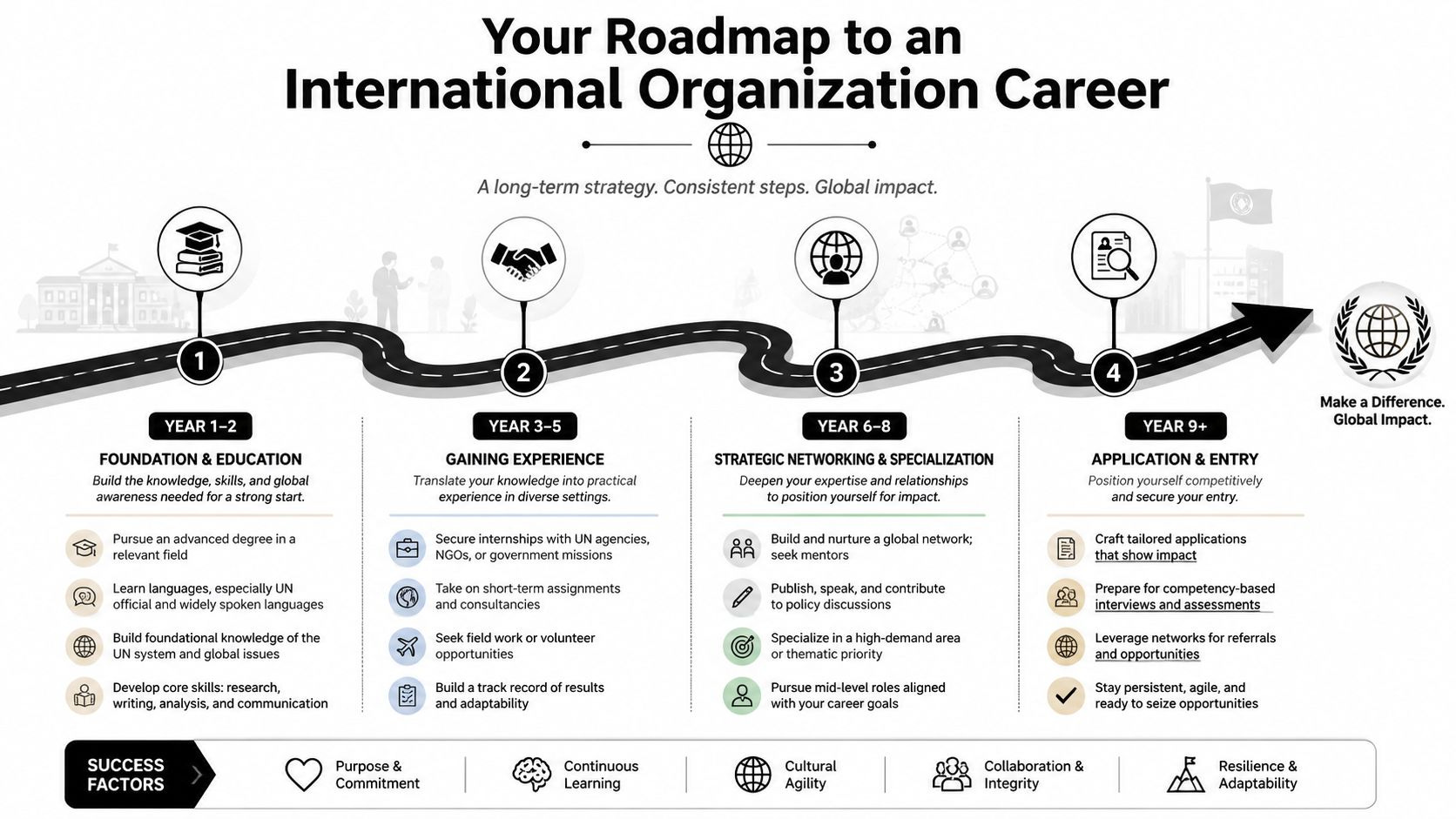
A workable plan usually takes years. Treat it like a sequence of bets.
Phase one. Pick the tribe before you stack credentials
UN, multilateral development banks, and EU institutions reward different profiles. A general degree plus broad interest in development is rarely enough for any of them.
Choose a lane that an IO can hire against. Public financial management, climate finance, procurement, social protection, transport, education policy, digital government, migration, health systems, monitoring and evaluation, or data science are concrete hiring categories. “International affairs” is not.
Then test the fit. UN paths often reward field exposure, languages, and coordination across agencies and partners. MDB paths usually reward technical depth, economic logic, and work that survived government scrutiny. EU paths often favor regulatory precision, drafting discipline, and comfort with formal process. The right roadmap starts when you stop treating these institutions as one market.
Phase two. Build proof that transfers
Your next role should give you evidence that a hiring manager can recognize in 20 seconds.
That can come from a ministry, central bank, regulator, development contractor, humanitarian NGO, research institute, consulting firm, or regional body. Title matters less than the proof you can extract from the work. A project officer who managed a donor-funded reform with three ministries may be more credible than a strategist with a polished title and no implementation record.
Build toward assets like these:
Cross-country or multilateral exposure: comparative policy work, regional programs, donor coordination, treaty or standards work
Operational proof: budgets managed, reforms implemented, systems launched, procurement completed, lending or grant preparation supported
Institutional fluency: regular work with government counterparts, IFIs, UN entities, delegations, or public agencies
Technical credibility: a skill that is easy to place, such as econometrics, fiscal analysis, safeguards, results measurement, health financing, or infrastructure planning
One strong example beats five vague ones.
Phase three. Match the entry route to your profile
Candidates typically lose time when they apply through the wrong door.
Early-career applicants with strong academics and the right nationality mix may have a real shot through YPP-style programs. Candidates with usable specialist experience often get in faster through consultancies or short-term appointments, then compete for staff roles after they have institutional references and internal credibility. Mid-career professionals with a clear technical niche should often skip junior programs and target staff competitions directly.
Each tribe has its own pattern. The UN uses rosters and temporary contracts heavily in some functions. MDBs often hire consultants as a low-risk way to test external talent. EU institutions are more process-bound and can require patience with long competitions. A good roadmap accepts those trade-offs instead of fighting them.
Phase four. Apply with discipline
By this stage, your story should be easy to read. Sector. Function. Grade. Institution type. Entry route.
Select roles that fit all four. If you are a public sector governance specialist with five years of ministry and donor experience, apply like one. Do not dilute the profile with unrelated human rights, communications, and general policy vacancies just because they mention development. Broad application volume feels productive. It usually lowers hit rate.
Keep your materials ready in modules. One CV version for UN-style competency screening. Another for MDB roles that expect technical delivery and counterpart management. A short bank of interview examples tied to leadership, teamwork, conflict, delivery under pressure, and analytical judgment. This is boring work. It is also where serious candidates separate themselves.
You do not need a perfect path. You need a path that makes sense to the specific tribe you are targeting.
If you want a practical way to monitor vacancies across the World Bank, IMF, ADB, AfDB, AIIB, the UN, and related institutions, Multilateral Development Bank Jobs is a straightforward resource. It tracks staff roles, consultant opportunities, and guidance for candidates targeting this market.