

You find a role that looks right. The title fits. The work matches your background. The listing says remote. Ten minutes later, you learn it is home-based only in Nairobi, tied to a local payroll in Jordan, or limited to nationals of a member country because the hiring unit sits inside a multilateral bank.
That is a standard first pass through this market.
Remote work in international development exists at meaningful scale, but the useful distinction is not between remote and non-remote. It is between roles that are built for distributed hiring and roles that only look flexible until you read the contract terms, tax constraints, security rules, or donor requirements. Candidates who get hired learn to read those signals early.
This field also has its own version of gatekeeping. A remote post may still require authorization to work in a specific country, prior experience with donor compliance, or eligibility tied to an MDB’s shareholder structure and staffing rules. Hiring teams are not only asking whether you can do the technical work. They are asking whether they can employ or contract you without creating legal, operational, or reporting problems.
That is the first unwritten rule. In this sector, remote expands the search radius. It does not relax the screening standard.
Strong candidates treat the listing as the start of the assessment, not the full description of the job. They check who can legally hold the contract, where the team sits, how meetings will run across time zones, and whether “remote” means remote-first or just temporarily offsite. That discipline saves time, and it is often what separates a serious application from one that gets filtered out early.
The Reality of Finding Remote Development Work
The fastest way to waste time is to treat this like a generic remote job search. International development hires through a layered market. Some roles are openly advertised. Some sit on institutional portals with weak filters. Some are effectively reserved for people who already understand donor systems, country office operations, or multilateral reporting standards.
A lot of candidates focus on volume. They apply widely and hope one sticks. That approach works poorly here because hiring managers in this sector screen for fit with unusual precision. They want to know whether you can handle distributed coordination across time zones, write to donor standards, manage sensitive data, and work with minimal supervision without disappearing into the background.
Practical rule: A remote development role is usually filled by the candidate who looks easiest to trust from a distance.
That trust shows up in very specific ways. Your CV has to signal judgment, not just activity. Your cover letter has to show you understand the institution’s operating model. Your interview has to prove you can communicate clearly through a screen, under time pressure, with people based in several countries.
There’s also a mindset shift that matters. Stop looking for a secret list of easy remote roles. Start reading the market as it is. Some jobs are location-flexible. Many are not. Some employers hire remote staff. Others hire remote consultants because they want expertise without putting someone on payroll. Those are different opportunities, with different risks and different rules.
Decoding What ‘Remote’ Means in This Sector
In international development, the word remote is sloppy. Recruiters use it loosely, and candidates read too much into it. You need a stricter definition.
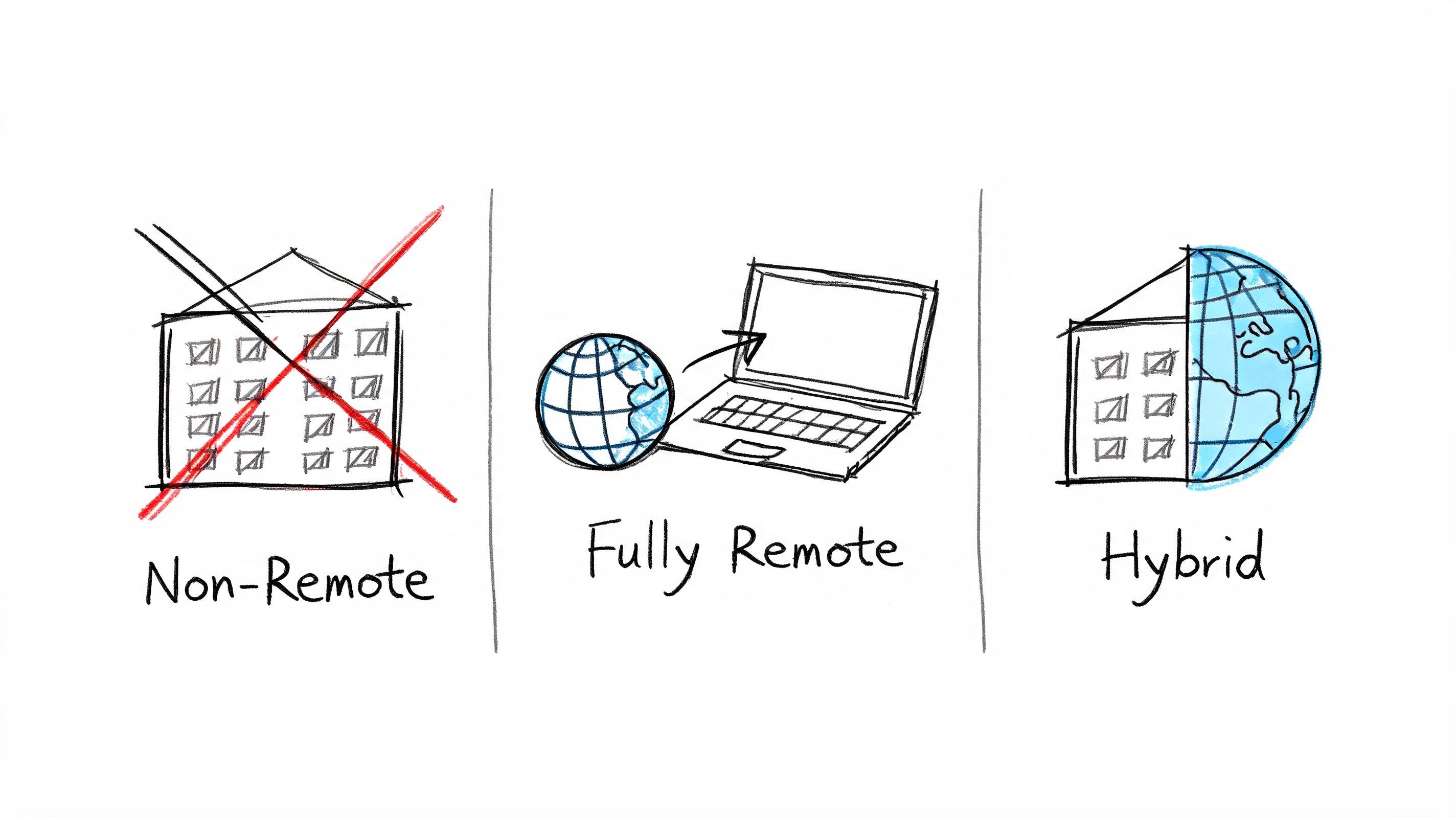
The three labels that matter
A short comparison helps.
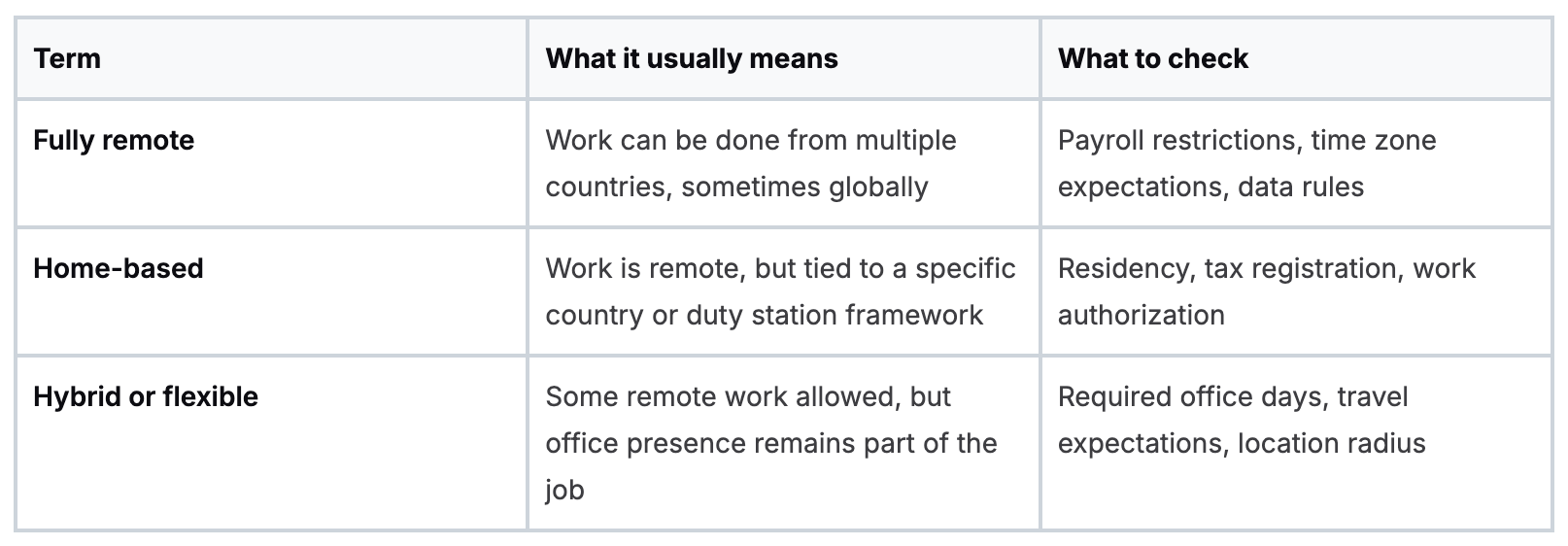
Fully remote is the rarest version in this field. It tends to appear in consulting, technical advisory, data work, research, editing, proposal development, and specialized knowledge roles.
Home-based is more common than people realize. UN agencies and large NGOs often use this term for roles that are remote in practice but still administratively anchored in one country or region.
Hybrid is where many candidates make mistakes. A listing may sound flexible, but if the contract assumes regular office attendance or short-notice travel to headquarters, it isn’t a workable remote role for someone based elsewhere.
Which functions actually go remote
Some work travels well across borders and some doesn’t.
Roles that commonly fit remote delivery include:
Monitoring, evaluation, and learning work because reporting, indicator tracking, dashboard management, and synthesis can be handled digitally.
Research and data analysis because the output is structured, document-based, and often asynchronous.
Proposal writing and donor communications because strong writing and version control matter more than physical presence.
Knowledge management and technical editing because these functions depend on coordination and judgment, not field logistics.
Roles that often stay in-country include operations, procurement, field coordination, stakeholder liaison with government counterparts, and community-facing implementation posts. Those jobs depend on relationships, compliance handling, and on-the-ground responsiveness.
If the job depends on local institutional access, it usually won’t be truly location-free.
Geography still shapes access
Remote development work is not distributed evenly across the world. Analysis of global remote work distribution found that middle-income countries disproportionately attract remote development jobs because of internet infrastructure, IT specialization, and English proficiency, with opportunities often concentrated in capital cities such as Mexico City, Manila, or Nairobi.
That matters in practical terms. Candidates in well-connected capital cities often have a cleaner path into remote delivery than equally qualified applicants working from locations with weaker infrastructure. Hiring teams may not say that directly, but they think about it. They think about internet reliability, meeting overlap, and whether a consultant can deliver without constant friction.
So read the listing carefully. If “remote” appears without country rules, timezone expectations, or contract language, assume nothing. The burden is on you to decode it.
Where to Find Genuine Remote Development Jobs
A candidate spends two hours on a major job board, saves fifteen “remote” roles, and later learns that ten require residency in Washington, London, or a specific programme country. That is normal in this sector. The search gets better once you stop treating all remote listings as equal and start sorting for hiring model, contract type, and institutional behavior.
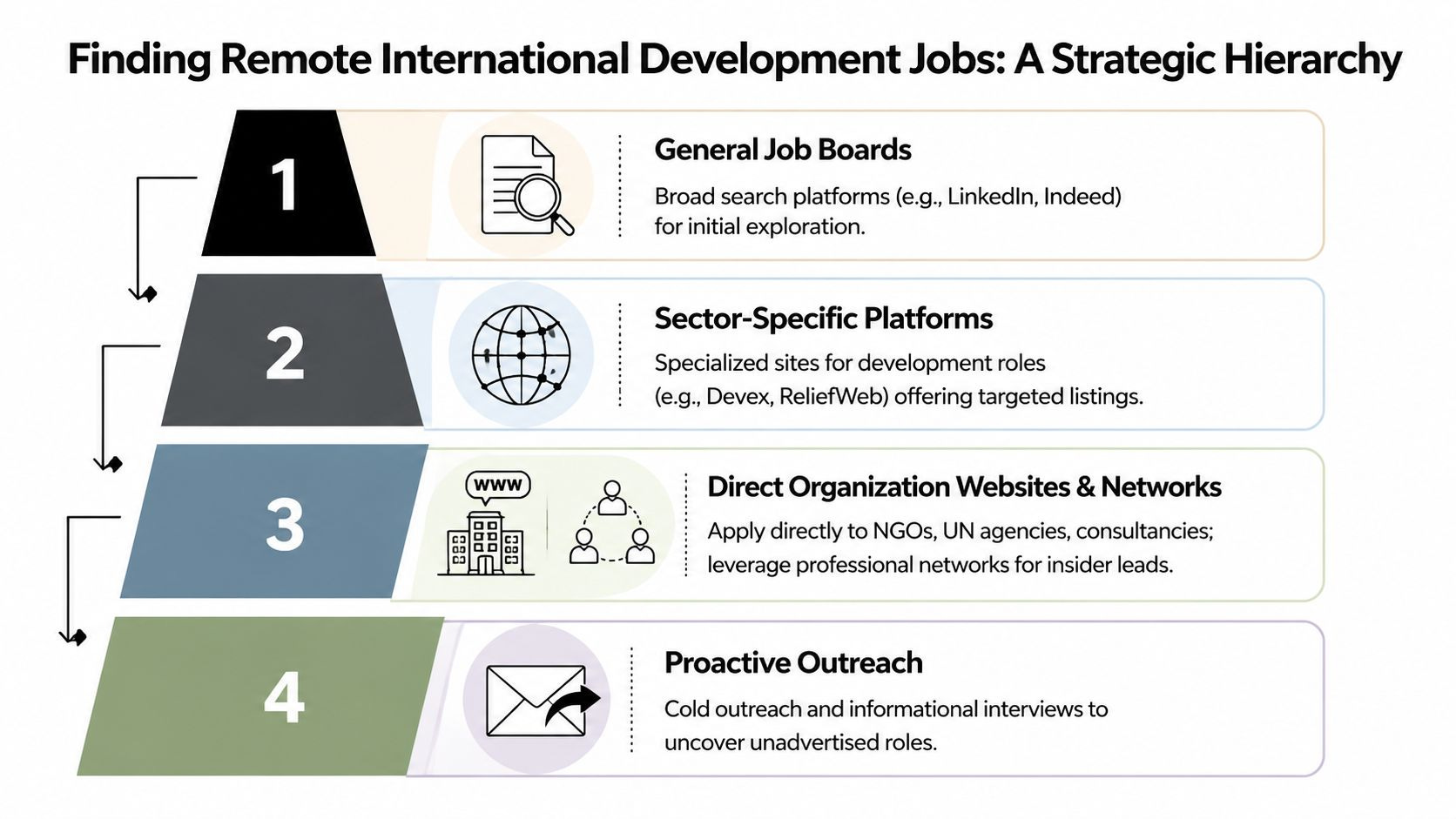
Start broad, then narrow fast
Broad job boards still have a use. They help you map the market. You can see which titles recur, which employers post remote work more than once, and which functions are actually being hired at a distance.
Use them for pattern recognition, not for your full application strategy.
Focus your scan on three questions:
Which titles repeat in your niche such as research consultant, MEL specialist, proposal writer, knowledge management advisor, or climate finance analyst
Which employers appear repeatedly instead of posting one-off remote roles with vague scope
Which terms show up in serious listings such as home-based, international consultant, remote within approved countries, retainer, roster, or global support
After that, move closer to the source. The best remote opportunities in development are often buried under weak tagging, inconsistent HR language, or institutional portals that do not classify roles cleanly.
Use sector-specific platforms to spot real hiring behavior
Specialized development job platforms usually produce better leads because the employer already expects applicants who understand donors, consulting structures, and multilateral hiring norms.
The value is not just the vacancy itself. It is the pattern behind it.
If one UN agency keeps posting home-based consultancies tied to research, evaluation, or policy drafting, that usually points to a team that already knows how to manage remote outputs. If another employer advertises remote roles that keep resolving to a duty station or national recruitment restriction, remove it from your target list.
For UN-focused applicants, this guide to remote UN jobs and how to land them is useful because it breaks down the difference between home-based consultancies and roles that only look remote at first glance.
Search direct employer sites like someone who has done this before
Institutional career portals are slow, inconsistent, and still worth your time. Stronger candidates separate themselves from people who rely on aggregators by using these platforms.
Go straight to:
Multilateral development bank career portals
UN agency recruitment pages
Large INGO career sites
Specialized consulting firms working on donor-funded contracts
Then search beyond the remote filter. Many genuine remote roles sit under labels that HR teams use inconsistently. Search terms such as home-based, consultant, international consultant, short-term consultant, retainer, remote within listed countries, and your technical specialty.
I also recommend saving vacancy PDFs or screenshots before they expire. Older postings reveal how a team defines deliverables, what software or reporting cadence they expect, and whether they hire remote specialists repeatedly. That history is often more useful than the current ad.
Track hiring units, not just vacancies
Development hiring is often team-driven. A governance unit that hires one remote political economy consultant may hire another six months later. An evaluation office that uses home-based reviewers this quarter may reopen a roster next quarter.
Build a simple tracker with the hiring unit, contract type, technical theme, and posting language. Over time, that gives you a practical short list of teams that already know how to work with remote talent.
This matters even more with MDBs and multilateral institutions. Some teams are remote-friendly in practice but still constrained by procurement rules, approved consultant rosters, or nationality and residency rules that sit outside the job ad. You will not catch that by reading titles alone.
Strong candidates study institutional patterns, not just individual vacancies.
Use your network for the assignments that never get labeled well
A lot of remote consulting work in development never appears as a polished public posting. It moves through former colleagues, framework vendors, consortium partners, and managers who need a specialist fast.
Generic outreach does not help much here. Specific outreach does.
Write when you can point to a concrete match. Mention the type of assignment you handle, the donor or thematic area you know, and the kind of remote delivery you can support immediately. A short note that shows fit for a live stream of work will get more attention than a broad message saying you are open to opportunities.
That is the unwritten rule. Public boards show demand. Actual hiring often follows trust, prior exposure, and evidence that you can deliver remotely without creating extra management work.
Tailoring Your Application for Remote Roles
A hiring manager opens your CV between calls. They have six minutes before the next meeting, a longlist of candidates, and a practical question in mind: can this person produce clean work from a distance without creating follow-up work for the team? That is the test your application has to pass.
Your CV has to show remote readiness
Remote hiring in development is not just a skills match. It is a management risk check.
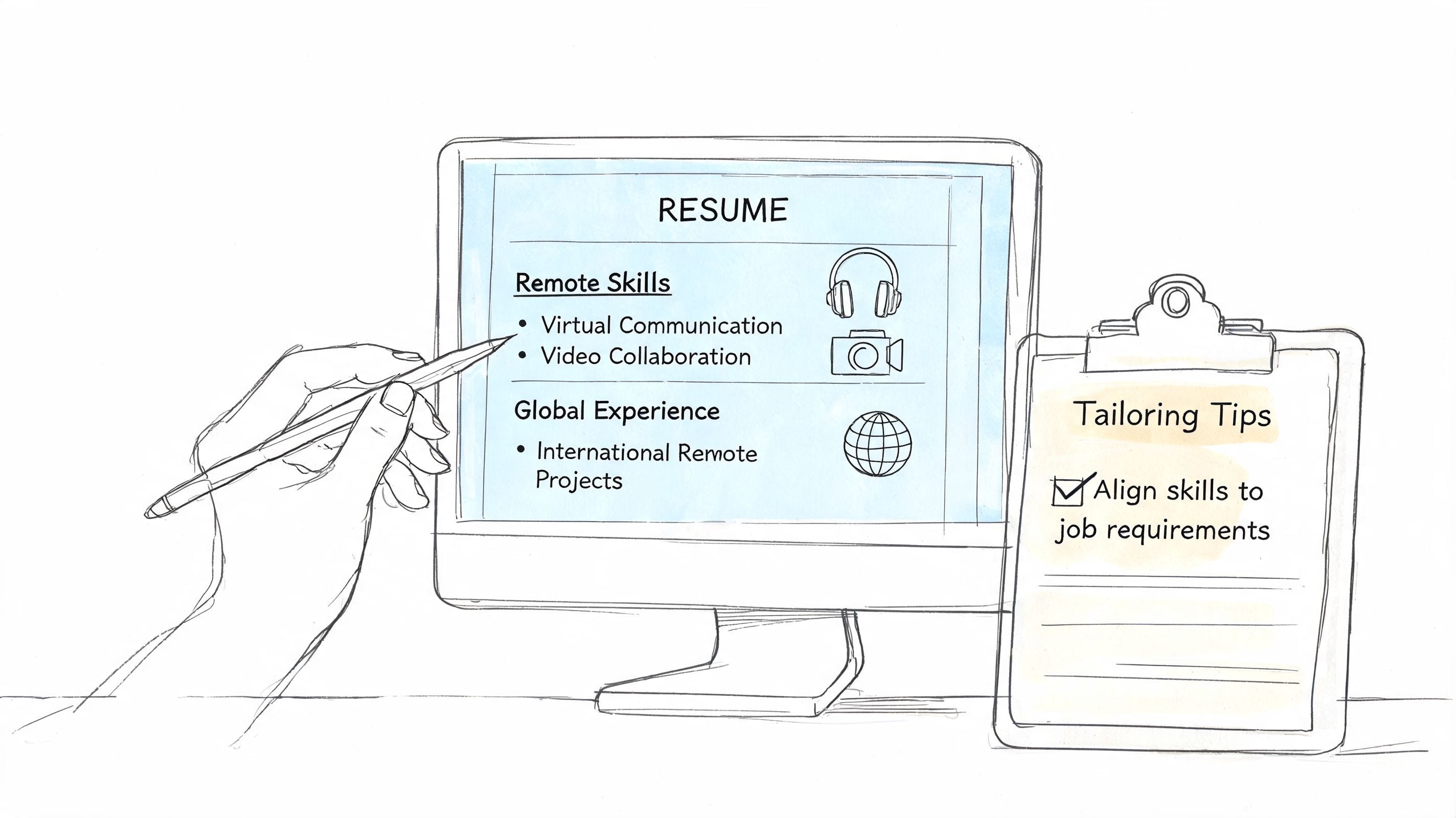
A lot of applicants still write CVs as if the employer will infer remote discipline from strong technical experience. They will not. Your CV needs to show how you plan work, communicate across time zones, and move deliverables forward when no one is sitting beside you.
Instead of writing:
managed donor reporting
coordinated stakeholders
supported research outputs
Write what delivery looked like in practice:
Led asynchronous donor reporting workflows across multi-country teams using shared review cycles, version control, and deadline tracking
Coordinated virtual consultations with country teams, government counterparts, and technical experts across time zones
Produced research memos, slide decks, and briefing notes designed for distributed review and decision-making
That level of detail changes how your experience reads. It tells the reviewer you understand the difference between being effective in an office and being reliable in a remote operating model.
Show that you understand the hiring setup
The screening layer has changed. Before a hiring manager reads your application, your CV may pass through an ATS, an HR screener, or a procurement-focused review that is checking title match, contract fit, and donor terminology.
Candidates often lose ground by being too generic. If the vacancy uses terms like proposal writing, humanitarian response, stakeholder engagement, data visualization, or monitoring frameworks, use that language where it truthfully reflects your experience. Do not stuff keywords. Do not rename your background. Translate it into the employer’s terms.
That matters even more for multilateral development banks and large institutions. A role may look broadly remote, but the first screen can still be rigid. Team leads might care about your writing and coordination judgment. HR may be checking grade level, consultant category, sector keywords, or prior work with MDB-style processes. Your application has to satisfy both audiences.
What to change before you hit submit
Strong remote applications usually make a few targeted adjustments:
Match the role family: “Consultant,” “Program Specialist,” “Research Analyst,” and “Operations Officer” signal different hiring tracks. Use the title language that fits the post.
Lead with outputs: Show reports delivered, systems improved, proposals drafted, workshops facilitated, dashboards built, or reviews completed.
Name remote delivery methods: Mention asynchronous coordination, distributed review cycles, virtual facilitation, or cross-time-zone stakeholder management when those were part of the work.
Use digital tools as evidence, not decoration: Teams, Zoom, SharePoint, Tableau, Airtable, Excel, or PowerPoint only help if they support a concrete achievement.
Make cross-cultural communication specific: Name the counterparts. Country offices, line ministries, donor representatives, implementing partners, consortium leads, or technical consultants.
One sentence can do a lot of work here. “Managed stakeholder engagement” is vague. “Ran weekly virtual check-ins with ministry counterparts and implementing partners across three countries to clear reporting bottlenecks” is stronger because it shows pace, setting, and ownership.
Application rule: If a reviewer cannot picture how you work remotely from your CV, the application is unfinished.
Cover letters need the same discipline. Keep them short. Open with fit, not motivation. State the type of work you do, the settings you know, and the kind of remote delivery you can handle from day one. If the role involves competency-based hiring, it helps to review how panels assess examples before you write. This guide on passing a competency-based interview is useful for shaping stronger evidence in both your cover letter and CV.
One last point separates average applications from strong ones. Remote-friendly and remote-first are not the same, and your application should reflect that difference. For a remote-friendly role, show that you can operate independently with periodic supervision. For a remote-first role, show that you already know how to document decisions, keep stakeholders aligned in writing, and maintain momentum without hallway conversations or office cues. Hiring managers notice that distinction fast.
Mastering the Remote Interview and Technical Test
Remote interviews reward control. Control of your setup, your pacing, your examples, and your screen presence. Candidates often underestimate how much competence is inferred from small signals in a video call.

Get the basics right before the panel sees you
Your setup needs to remove distractions, not showcase personality.
Check these before every interview:
Audio first: weak sound hurts you more than average video
Camera angle: eye level, stable, and close enough to read expression
Background: neutral, tidy, and quiet
Lighting: front-facing light so your face is visible without strain
Backup plan: second device, hotspot, charger, and files ready offline
None of this is complicated. It just signals that you work cleanly in a remote environment.
Show process, not just outcomes
A lot of development interviews ask competency questions, but remote panels also listen for workflow discipline. They want to hear how you manage ambiguity, coordinate across teams, and communicate when people are unavailable.
A useful preparation method is to build examples around:
the task
the constraint
the coordination challenge
the result
what you documented or changed afterward
For a deeper breakdown of that style, this guide on passing a competency-based interview is a strong companion.
Speak like someone who has run the work, not just supported it.
Expect a technical exercise
For international development jobs remote, the technical test often decides the shortlist. The format varies, but the logic is consistent. Hiring teams want proof that your written and analytical work holds up without supervision.
Common exercises include:
Timed policy or strategy memos
Excel-based data cleaning or interpretation
Slide deck synthesis for senior audiences
Short case presentations on a country, sector, or project issue
Drafting responses to a donor or management prompt
Practice under real conditions. Set a timer. Work in the same tools named in the vacancy. If the role is data-heavy, rehearse explaining your reasoning out loud. If the role is writing-heavy, practice concise, executive-level prose with clear recommendations.
The strongest candidates stay structured when the task is ambiguous. That’s exactly what remote teams need.
Navigating Contracts, Taxes, and MDB Eligibility
You get the offer. The title fits. The work sounds strong. Then the contract arrives and the essential questions start. Who employs you, where you are allowed to sit, how you get paid, and whether the institution can legally hire you from your country often matter more than the word remote in the vacancy.
That is the point where a remote-friendly role and a remote-first role part ways.
Staff role or consultant role
Treat contract type as a strategic filter, not paperwork.
A staff contract usually means you are entering the institution’s operating system. You get formal reporting lines, internal access, clearer performance management, and more predictable support on leave, benefits, and equipment. A consultant agreement is different. You are usually being hired to produce defined outputs over a set period, with fewer protections and more responsibility for your own tax, insurance, and working setup.
The distinction shapes practical issues fast:
Taxes
Benefits
Leave
Equipment
Legal status
How secure the role feels after the initial term
I have seen candidates accept consultant roles assuming the institution would treat them like staff once they started. That usually ends badly. If you want autonomy and know how to deliver without much internal scaffolding, consulting can work well. If you expect onboarding, career progression, and institutional backing, read the contract with colder eyes.
The hidden rule on eligibility
A role can be remote and still be closed to you.
This is common in MDB and UN-adjacent hiring. Some roles are open only to nationals of member countries. Others require residency in a country where the institution already has payroll, registration, or contracting capacity. Some are posted as remote but still expect the person to work from a short list of approved locations because of legal, tax, data, or procurement rules.
This explains why general job boards often mislead candidates in this niche. They typically display the vacancy title but omit the actual gatekeeping criteria.
Here is where eligibility usually gets decided:
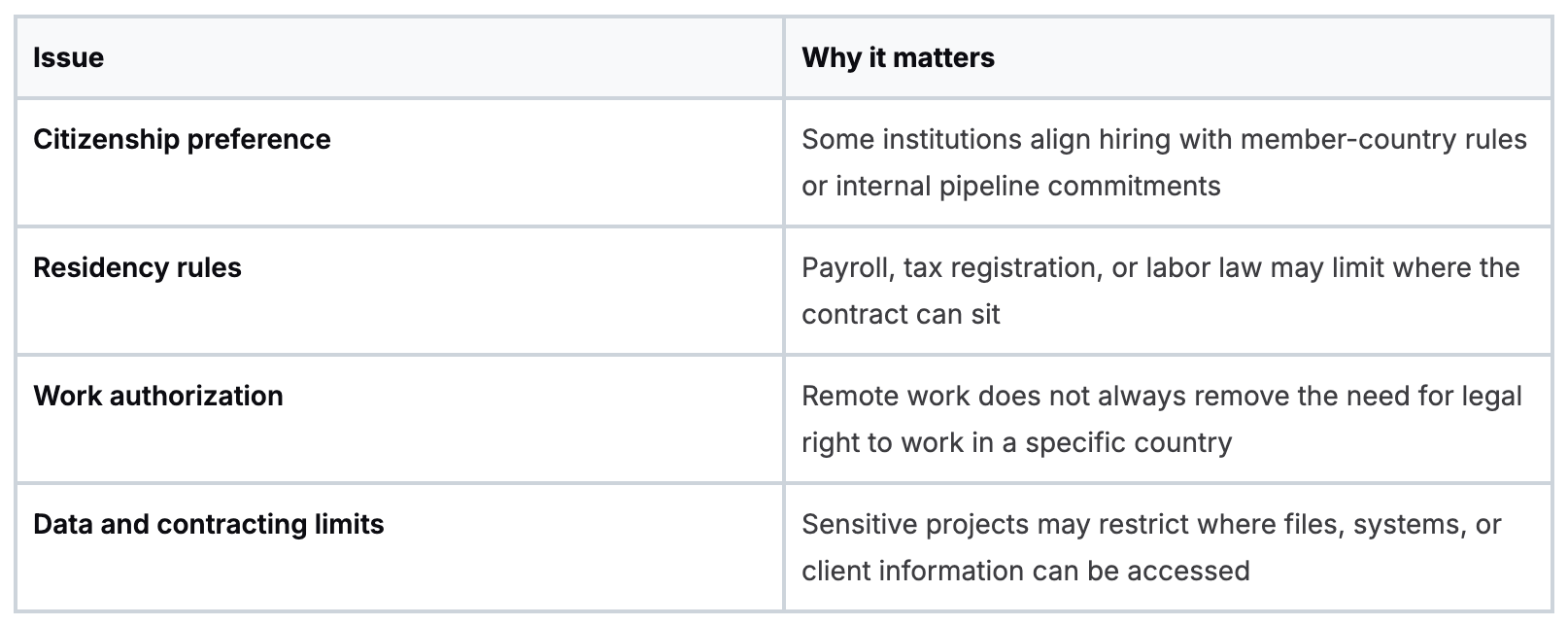
If the posting is vague, ask before you spend hours on a test or proposal. A direct note to HR or the hiring contact is enough: Is this role open to candidates based in X country, and would the contract be staff or consultant? Good teams answer clearly. Fuzzy replies usually signal problems later.
A remote vacancy is only real if your eligibility, contract structure, and work location all align.
Pay is uneven. Scarce expertise travels better than low-cost positioning.
Remote compensation in development is not one market. MDBs, INGOs, firms, and donor-funded contractors all price roles differently. Some benchmark to headquarters. Some localize by duty station, even for home-based work. Others pay consultant rates tied to output and seniority rather than location.
Analysts at the World Bank found in this paper on the international price of remote work that location still affects wages, but it does not explain remote pricing as neatly as many candidates assume. In practice, remote hiring rewards specialized credibility more reliably than a low-rate pitch.
That matters in development hiring because the strongest remote candidates are rarely competing on cost alone. They are competing on proof. Evaluation design. Climate finance. Fragility analysis. Health systems financing. Procurement under donor rules. Results frameworks that survive scrutiny. A clear niche gives employers a reason to work through contract friction and eligibility checks.
Questions to ask before accepting
Do not wait until the final call to sort this out. Ask early enough to walk away cleanly if the setup does not work.
Ask about:
Contract type and who the legal employer is
Expected work location and whether travel is mandatory
Timezone requirements for meetings
Tax handling and whether you invoice as an individual or entity
Equipment, software access, and reimbursable costs
Duration, renewal terms, and end-of-contract expectations
One more point for MDB consulting pipelines. Written proposals often shape who gets shortlisted, especially for short-term advisory, research, and transaction support assignments. If you are bidding for that type of work, this guide on how to write a consulting proposal will help you match what hiring teams are evaluating.
If an employer cannot explain the contracting model, approved work location, or payment setup in plain language, treat that as a warning. Remote work fails in this sector for operational reasons far more often than for technical ones.