

You’re probably here for one of two reasons. You saw an EIB vacancy and realized you need a sharper answer than “some EU bank in Luxembourg,” or you keep hearing the name in discussions about climate finance, infrastructure, innovation, or European competitiveness and want the plain-English version.
That’s the right instinct. If you want to work in development finance, you need to understand what is the european investment bank in operational terms, not in brochure language. The EIB matters because it sits at the point where EU policy, capital markets, and project finance meet. That combination shapes what it funds, how it hires, and what kind of people get traction there.
Most applicants understand the mission at a slogan level. Fewer understand the machinery behind it. That gap shows up quickly in interviews.
Your Guide to Europe’s Powerful Development Bank
You find an EIB vacancy in Luxembourg. The role asks for credit judgment, policy awareness, stakeholder management, and comfort with large, technical projects. That combination tells you a lot about the institution before you read a line of corporate copy.
The European Investment Bank is where EU policy gets turned into long-term financing decisions. If you want the practical definition, start there. The EIB backs projects that support European priorities and does it with the discipline of a serious public bank, not the loose logic of a grant agency.
For applicants, that distinction matters.
A strong candidate understands that the EIB sits between policymaking and execution. Teams still care about credit quality, due diligence, procurement, financial structuring, and whether a project will get built. At the same time, they care about whether the operation serves a policy objective the EU is prepared to support over the long run.
That shapes the work and the hiring. An infrastructure specialist who cannot explain policy relevance will look narrow. A policy candidate who cannot read a financing structure or discuss project risk will struggle for credibility. The people who do well usually connect public purpose to transaction reality.
The bank is large enough to influence how Europe finances energy, transport, innovation, housing, water, and business growth. That is why it appears so often in discussions about competitiveness, climate investment, resilience, and industrial capacity. It is also why the interview standard is higher than many applicants expect. The EIB is not looking for abstract enthusiasm about Europe. It is looking for people who can help move capital into sound projects under public constraints.
If you are assessing the EIB as an employer, focus on three practical questions:
What does the mandate reward? People who can turn policy priorities into investable operations.
How does the institution work? Through disciplined appraisal, risk review, and long decision cycles with many stakeholders.
What does that mean for your application? You need to show technical competence, judgment, and a clear understanding of why public banking is different from commercial lending.
The EIBs Core Mission as the EU Bank
You are in an interview for an EIB role. You explain a project well, the numbers are sound, and the sector case is credible. Then the panel asks a question that decides whether you really understand the institution: why should this bank finance it?
That is the core of the EIB. It is the EU’s long-term financing arm, created by treaty and owned by the member states. Its job is to support investment that serves EU policy goals and can stand up to financial, technical, and legal scrutiny.
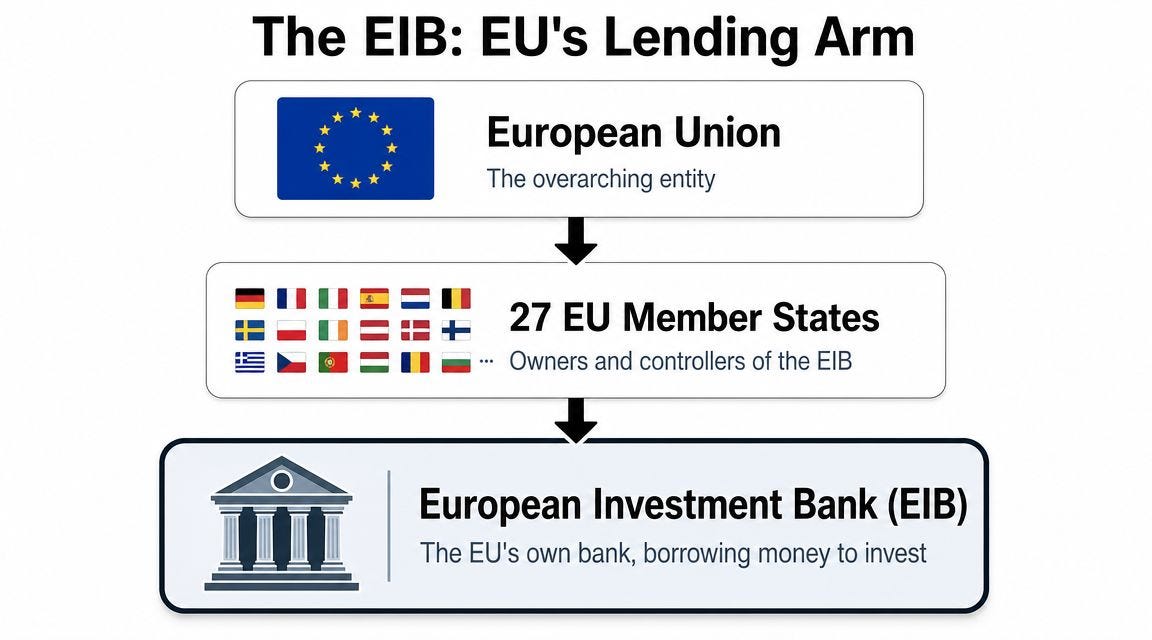
That sounds abstract until you see how it changes day-to-day work. The EIB is not there to fund any attractive transaction. It backs projects that fit EU priorities such as climate, infrastructure, innovation, cohesion, energy security, and competitiveness. In practice, that means a strong deal is still not enough. The operation also has to show public value that fits the mandate.
This is the first point many applicants miss.
A commercial lender can stop at credit quality, pricing, and portfolio limits. The EIB has to answer a wider question: does this operation justify public backing under an EU policy objective? That extra test affects how projects are screened, how papers are written, and how teams argue for or against approval.
What the mandate means in practice
Inside the bank, policy relevance is not a slogan attached at the end. It is built into appraisal.
Loan officers are expected to understand sector priorities as well as structure, tenor, and risk allocation.
Economists need to show how a project supports growth, productivity, market development, cohesion, or decarbonisation.
Engineers and sector specialists have to judge whether the asset will work in practice and whether it solves the problem the mandate is meant to address.
Risk teams protect the balance sheet while working within a public bank’s tolerance for long horizons, policy constraints, and reputational scrutiny.
That combination explains a lot about hiring. Candidates who speak only in policy language often look untested. Candidates who talk like pure commercial bankers usually miss the institution’s purpose. The stronger profiles connect both. They can explain why a project matters and whether it should be financed on EIB terms.
Who the EIB answers to
The governance model matters because it affects speed, autonomy, and internal culture. The EIB sits within the EU treaty framework and answers to its shareholder states through formal governance bodies and committee processes. As a result, decisions require documentation, alignment, and review across several functions.
For staff, that creates a clear trade-off. The bank has scale, legitimacy, and staying power. It also has longer cycles, more internal challenge, and less room for the fast, personality-driven style that can work in private finance. People who do well there tend to be rigorous, patient, and comfortable defending their analysis in detail.
Practical rule: If you describe the EIB as a standard investment bank with a public mandate attached, you will sound superficial. Treat it as a policy-driven financing institution that applies banking discipline.
Why job seekers should care
The mission shapes the work before it shapes the brand. Teams are hired to assess whether capital can be deployed into projects that are technically viable, financially sound, and defensible in policy terms. That is why interviews often test both judgment and craft.
For an applicant, the implication is simple. Show that you understand how public purpose changes banking. If you can connect EU priorities to project selection, risk, and execution, you will sound like someone who knows what the EIB does.
How the EIB Funds Its Operations
You are in an interview and someone asks a deceptively simple question: why can the EIB lend on terms that many commercial banks cannot? If your answer stops at “because it is backed by governments,” you are leaving out the part that drives the institution’s day-to-day work.
The EIB funds itself primarily by issuing bonds in international capital markets. Its strong credit standing lets it raise money at low cost, then pass part of that funding advantage on to eligible borrowers through long maturities, competitive pricing, and structures that private lenders often will not offer on their own.
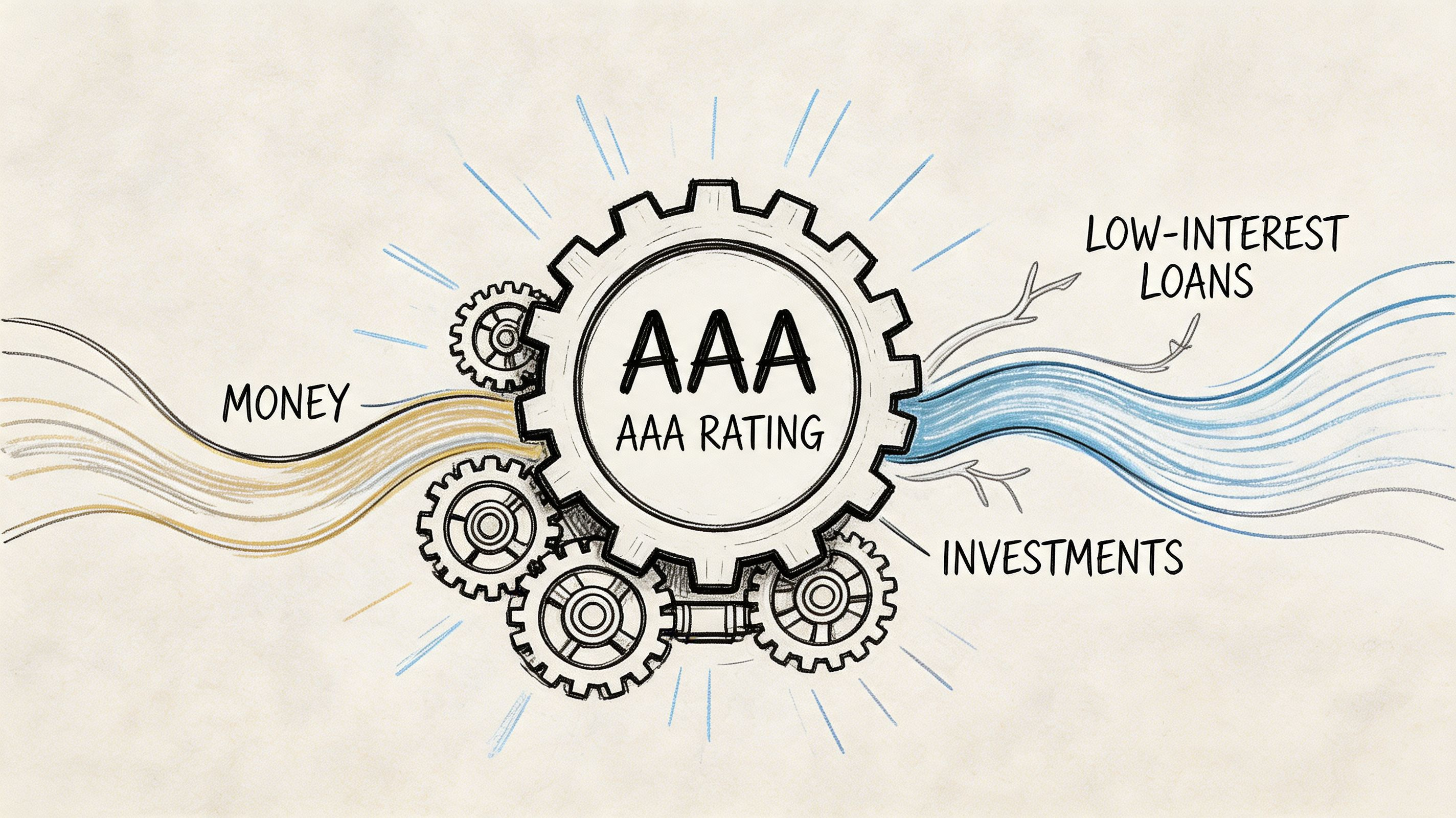
The basic funding model
That model sounds simple. In practice, it creates a demanding job.
Cheap funding is only useful if the bank can place it into projects that meet policy objectives, survive credit scrutiny, and stand up to internal review. That is why EIB work sits at the intersection of treasury, risk, sector expertise, legal structuring, and public policy. The institution is not paid to take reckless risk. It is paid to price, structure, and justify risk better than a purely commercial lender would in policy-relevant areas.
Here is the operating toolkit in practical terms:
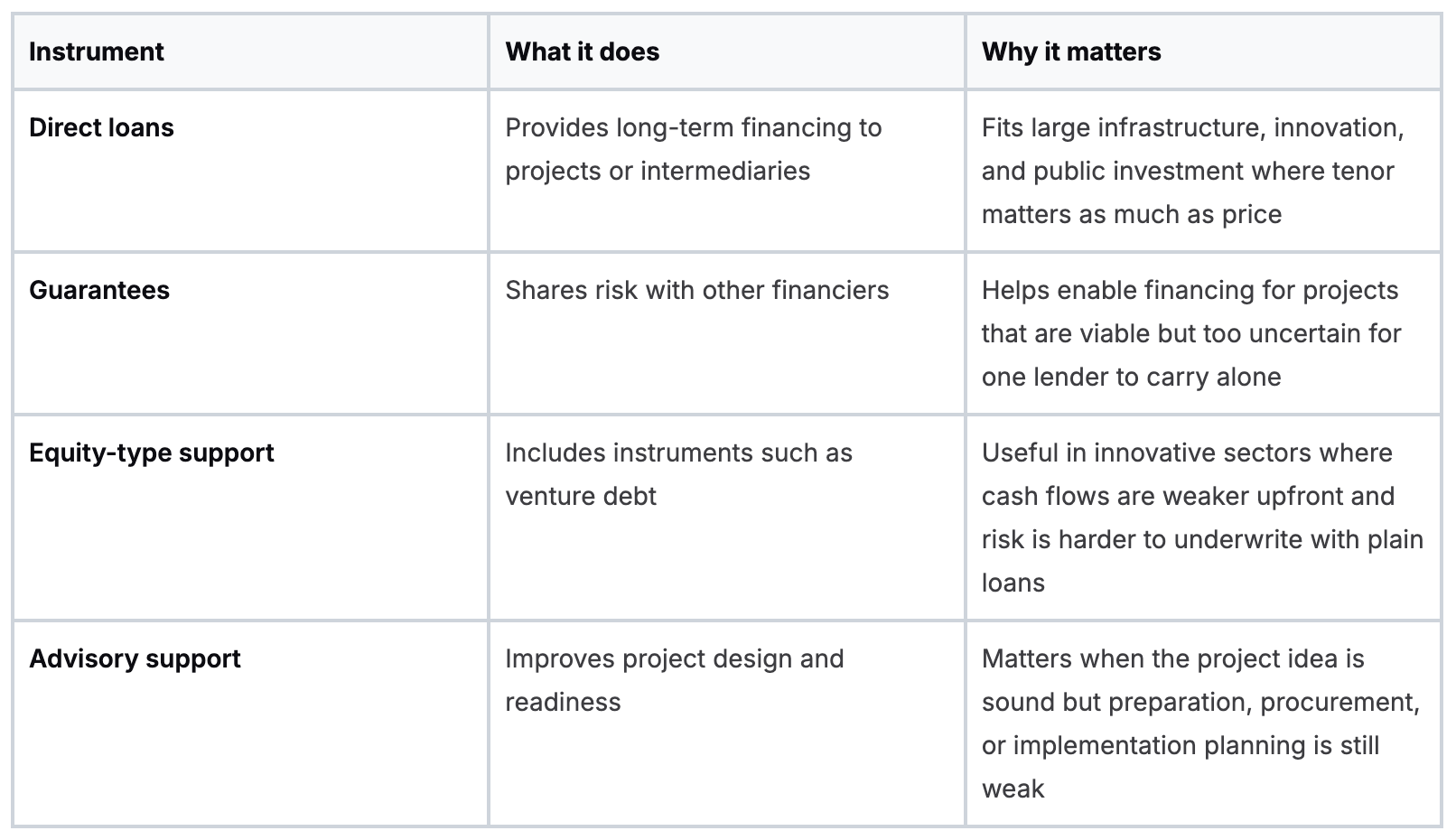
For applicants, many answers often become too generic. “The EIB finances good projects” is not enough. Strong candidates show they understand the mechanics. Funding cost, risk allocation, project readiness, and policy fit all have to line up.
What blending operations mean
Blending operations matter because many EIB priority projects are bankable only after the capital structure is adjusted. The bank can combine its own financing with grants or other public support so the project carries a risk-return profile that additional investors can accept.
This is common in areas where the public case is strong but the commercial case is not yet strong enough on its own. Early-stage clean technology, municipal infrastructure, energy efficiency, and cross-border projects often fall into that category. A grant may absorb part of the upfront cost. An EIB loan may provide long tenor. A guarantee may reduce downside risk for other lenders. Together, those elements can mobilize capital that would otherwise stay out.
If you want a useful parallel, this is closely related to the logic behind results-based management in development finance. Money is not just allocated. It is structured around delivery, risk, and measurable outcomes.
Good EIB professionals separate attractive policy narratives from executable financing. The institution earns its reputation by funding projects that are both aligned and ready.
What works and what does not
What works is disciplined de-risking. The EIB performs well when it uses its balance sheet to improve a project’s financing structure without pretending weak fundamentals are strong ones.
The trade-off is important. If the bank is too conservative, it misses projects where public finance can make a real difference. If it stretches too far, it weakens credit quality and damages credibility with investors, counterparts, and EU stakeholders. The best teams know how to handle that tension. They do not confuse policy relevance with bankability, and they do not confuse financial creativity with avoiding hard project problems.
That matters in interviews. Candidates who can explain how bond funding, pricing advantage, guarantees, and appraisal discipline work together sound ready for the institution. Candidates who speak only in broad “impact” language usually sound like they understand the mission but not the machine.
Key Priorities and Landmark Projects
You are reviewing an EIB vacancy in energy or transport. The job description talks about climate, security of supply, innovation, and project appraisal. Those are not abstract themes. They are the bank’s operating priorities, and they shape what gets financed, which teams grow, and what skills hiring managers screen for.
The practical way to read the EIB is by sector concentration. Follow the money, then ask what kind of execution that sector demands.
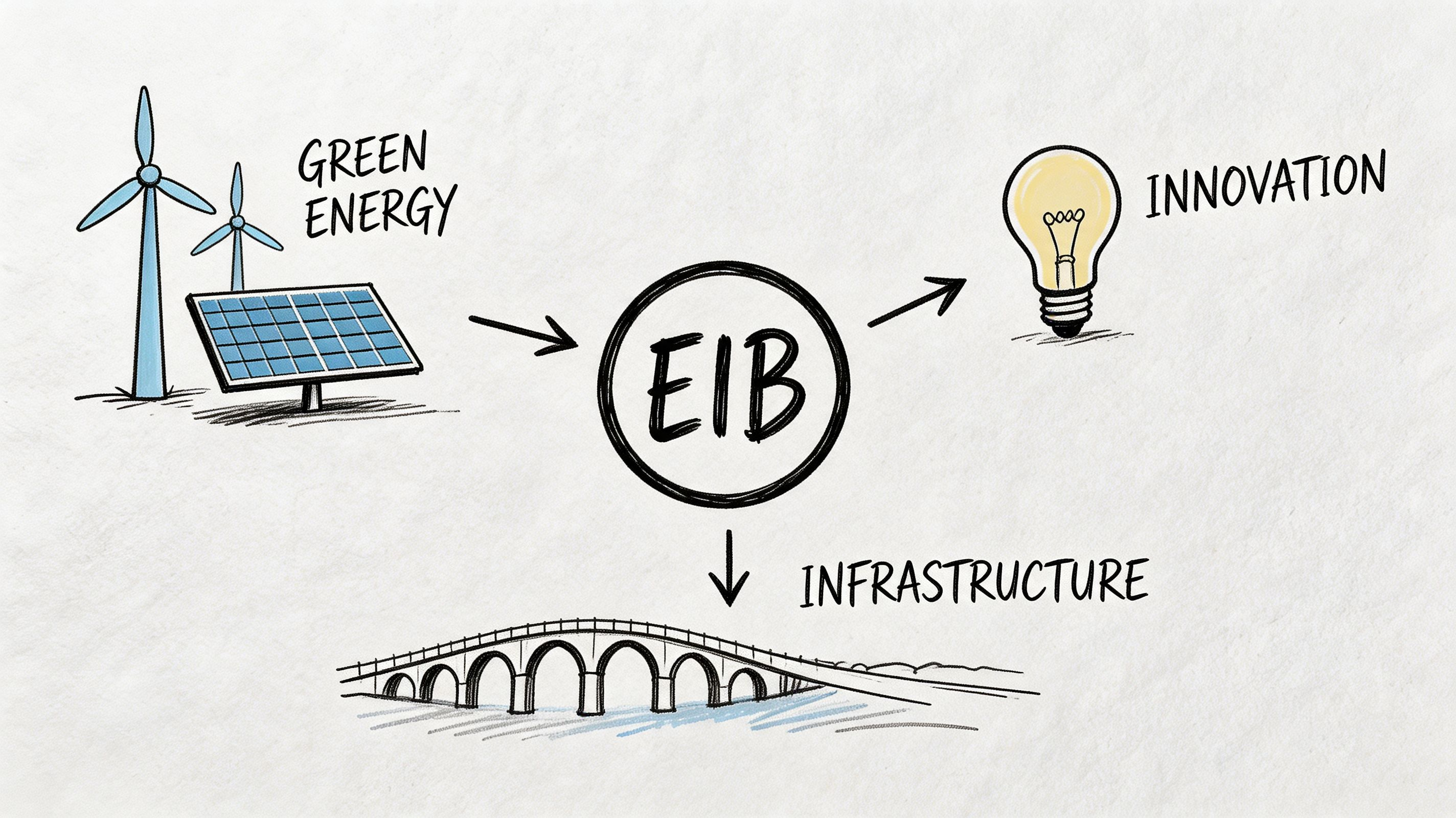
The current priority map
Four areas matter most.
Climate and energy transition: The EIB has built a large share of its identity around climate finance. In practice, that means renewables, grids, storage, building efficiency, clean transport, industrial decarbonization, and adaptation.
Energy security: Since Europe’s energy shock, the bank’s climate work has become more tightly connected to resilience and strategic autonomy. Transmission, interconnection, flexibility, and import substitution now matter as much as headline emissions targets.
Innovation and competitiveness: The EIB backs research, scale-up, advanced manufacturing, digital infrastructure, and technologies that are still commercially promising but not always easy for private lenders to price.
Social and territorial cohesion: Hospitals, schools, affordable housing, water, urban services, and regional investment still sit firmly inside the mandate, especially where weaker regions risk falling behind.
Those priorities are broad by design. The core work is deciding which projects are mature enough, useful enough, and financially sound enough to justify support.
What landmark projects actually show
Applicants often treat flagship projects as branding. They are better read as signals about institutional appetite and internal capability.
If the EIB finances a major offshore wind program, a rail corridor, a grid upgrade, or a clean-tech manufacturing facility, the lesson is not just that the bank likes green projects. The lesson is that the bank is willing to spend time on permitting risk, procurement structure, revenue assumptions, state aid questions, environmental standards, and implementation capacity. Landmark transactions show where the institution is prepared to do hard appraisal work at scale.
That matters for your application. A strong candidate can move from priority area to project type to risk question in a few sentences.
Why priorities shape careers
The bank does not hire for strategy language alone. It hires for the work created by strategy.
Climate hiring rewards people who can assess power markets, electricity networks, storage economics, heat decarbonization, industrial transition plans, and counterparty quality. Innovation hiring rewards people who are comfortable with uncertainty, technology risk, portfolio effects, and business models that do not fit classic infrastructure templates. Social infrastructure work calls for people who understand public-sector procurement, fiscal constraints, and service delivery, not just construction.
A results mindset helps here. Candidates who can connect financing to implementation milestones, monitoring, and measurable outputs usually perform better in interviews. This primer on results-based management in development finance is a useful refresher if you need to sharpen that part of your story.
Strong applicants translate EIB priorities into bankable project categories, execution risks, and appraisal questions. Weak applicants stop at policy slogans.
The trade-off behind the headlines
Priority sectors attract political support, but they also bring harder cases. Clean energy can face permitting delays and supply-chain constraints. Innovation deals can carry technology and market-adoption risk. Social projects can be politically popular while remaining weak on implementation readiness.
The EIB earns its position by handling that tension well. It needs to support sectors the EU cares about without lowering appraisal standards to chase policy momentum.
That is also why career fit matters. If your experience is in project finance, engineering, sovereign or sub-sovereign lending, climate economics, procurement, environmental assessment, or regulated infrastructure, the bank’s current priorities create obvious entry points. If your background is more generalist, the gap to close is not enthusiasm. It is sector judgment.
The EIB Group and Its Global Peers
You spot two vacancies that both carry the EIB name. One sits in infrastructure lending. The other focuses on guarantees and venture capital funds. If you treat them as interchangeable, you will misread the job.
The EIB Group has two main institutions: the European Investment Bank and the European Investment Fund (EIF). The EIF was created in 1994 and concentrates on smaller businesses, financial intermediaries, guarantees, private equity, and venture capital. That difference matters in practice because the technical language, counterparties, and risk questions are not the same.
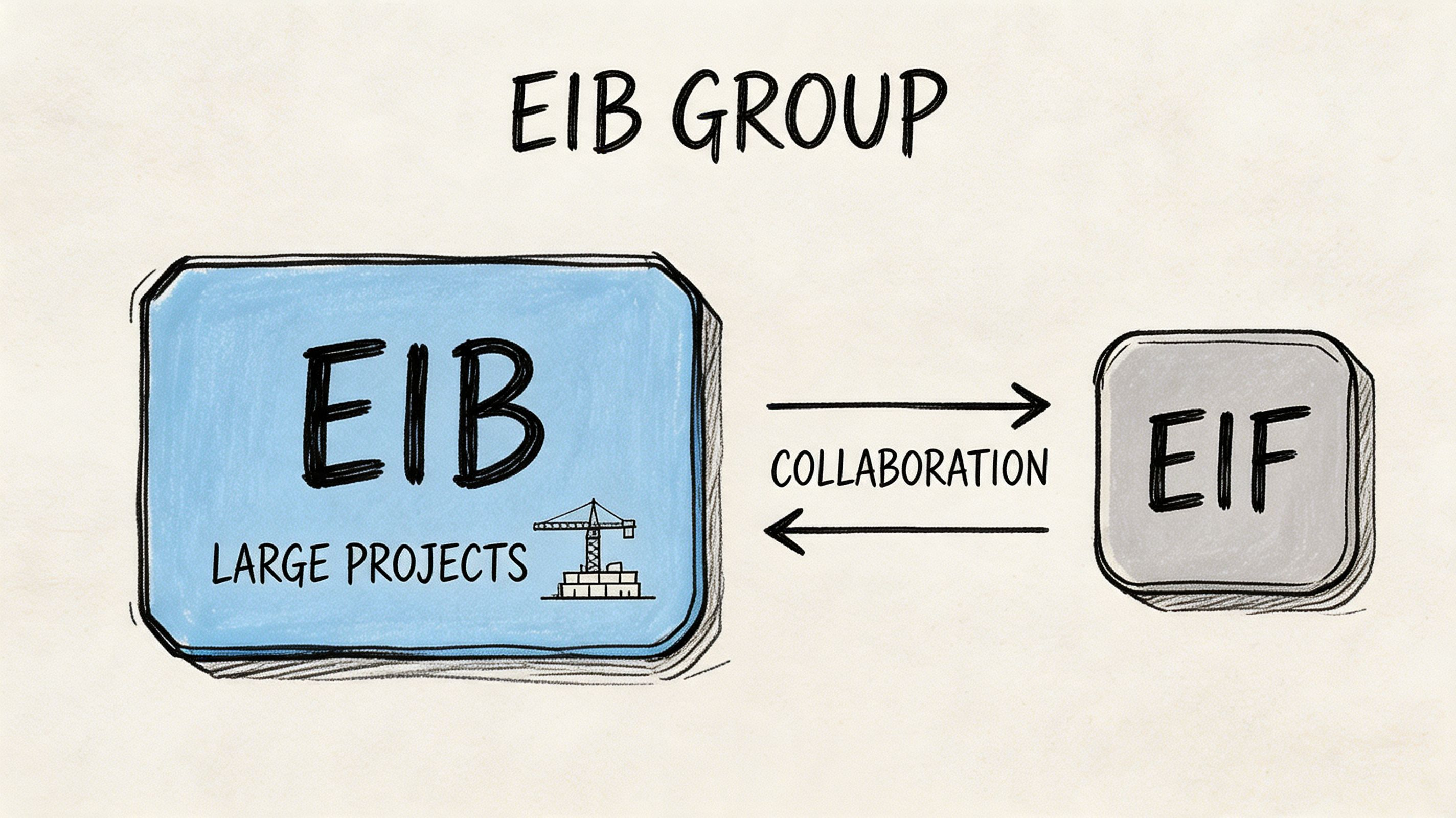
EIB versus EIF
For applicants, the cleanest way to separate them is by deal type.
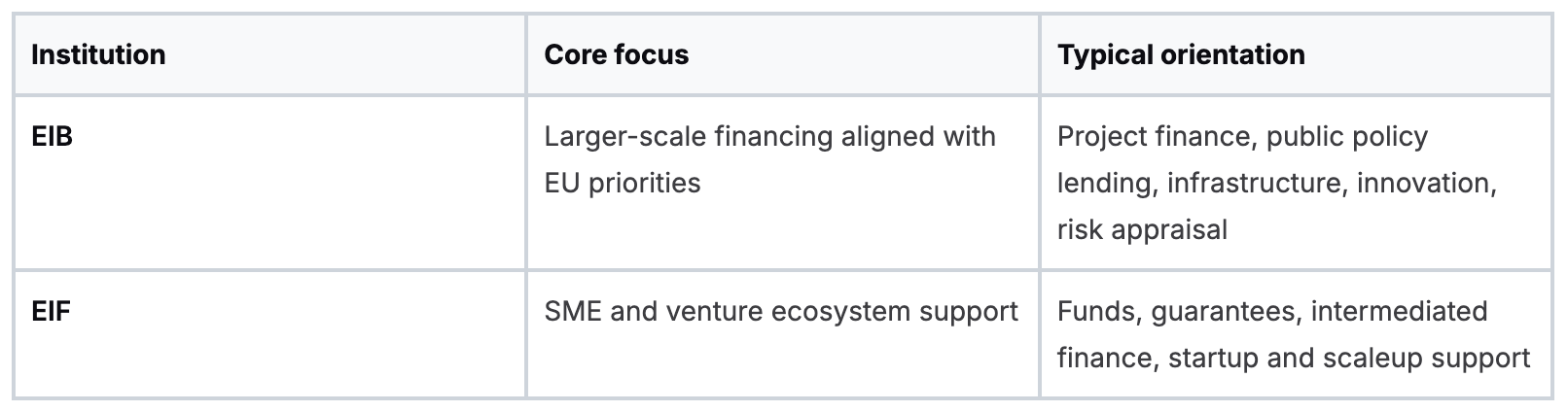
That table looks simple. The day-to-day work is not.
At the EIB, teams often assess large projects, public entities, regulated sectors, and long investment cycles. At the EIF, work is closer to fund managers, portfolio construction, guarantee products, and the mechanics of getting capital to smaller firms through intermediaries. If your background is in transport, energy, water, municipalities, sovereign or sub-sovereign lending, or technical project appraisal, the EIB is usually the better match. If you come from fund investing, startup finance, SME lending, or guarantee structures, the EIF may fit your profile better.
How it compares with other MDBs
The EIB sits in the multilateral development finance world, but it does not operate like a generic MDB. Its shareholders are EU member states, and its mandate is tied closely to EU policy goals. That gives it a narrower political center of gravity than institutions with broader geographic mandates.
For candidates, that has practical consequences. The World Bank, ADB, AfDB, and EBRD can offer more country-facing roles, different regional exposure, or heavier field-office models depending on the team. The EIB usually offers something else: financing work anchored in European policy, strong technical review, and institutional processes shaped by EU law and governance. If you are comparing employers across the sector, this guide to regional multilateral development banks gives useful context.
What this means for institutional fit
The EIB suits people who are comfortable with structure, documentation, and careful appraisal. It rewards sector depth and patience with process. It is a weaker fit for applicants who want a loose mandate, highly commercial incentives, or a career built mainly around emergency or humanitarian operations.
That is the comparison to make. Do not ask only whether the EIB is prestigious. Ask whether you want to spend your time on the kinds of transactions, committees, counterparties, and policy constraints that define the bank’s work.
Landing a Job at the European Investment Bank
Usually, candidates need the blunt version.
The EIB is prestigious, selective, and process-heavy. A good profile helps. A generic profile doesn’t. You need to show that you understand the institution and that your background maps clearly to the work.
Start with eligibility
For many roles, nationality is a practical gatekeeper. The bank is an EU institution owned by member states, so citizenship requirements matter. You need to check each vacancy carefully and follow the stated eligibility terms precisely.
Language also matters. Strong professional English is expected. French can be a real advantage because it remains important in the bank’s working environment.
If your CV reads like it was written for a commercial bank, a consulting firm, and an MDB all at once, you’ve already made the reviewer’s job harder.
The profiles the EIB values
The EIB hires across functions, but the strongest recurring profiles tend to cluster around technical and financial credibility.
Common backgrounds include:
Economists: Especially those who can connect investment decisions to productivity, competitiveness, cohesion, or market gaps.
Engineers and sector specialists: Critical for energy, transport, water, digital, and industrial project appraisal.
Financial analysts and bankers: Useful in lending, structuring, treasury, guarantees, and portfolio work.
Risk professionals: Essential in credit, financial risk, compliance, and control functions.
Policy and advisory specialists: Valuable when paired with implementation discipline and sector depth.
The mistake many applicants make is assuming a prestigious degree is enough. It isn’t. The bank wants people who can evaluate projects, challenge assumptions, and work inside a formal decision chain.
Where early-career and experienced applicants differ
Early-career candidates need to prove raw analytical quality, strong drafting, language ability, and a believable motivation for this specific institution. Experienced hires need to prove judgment.
That distinction matters in interviews. Early-career applicants are often assessed on how quickly they can learn and how clearly they think. Experienced applicants are judged on whether they’ve already made difficult calls, structured complex work, or managed counterparties under pressure.
How to approach the process
Treat the process like a professional transaction, not a hopeful submission.
Read the vacancy like a term sheet
Pull out the core requirements, sector themes, language demands, and signs of what the hiring team needs right now.Rebuild your CV around relevance
Lead with transactions, analytical work, sector expertise, and implementation experience. Put prestige signals second.Prepare for technical screening
Expect questions on project logic, financing structure, institutional fit, and your ability to work across teams.Show institutional maturity
The EIB is not impressed by vague enthusiasm for Europe. It values candidates who understand process, governance, and decision quality.
If you want a role-specific breakdown of hiring paths, vacancy types, and how candidates typically position themselves, this guide to European Investment Bank careers is a strong next step.
What works in practice
The strongest applications usually do three things well:
They make the candidate’s sector expertise obvious within seconds.
They show comfort with both public-policy objectives and financial discipline.
They avoid inflated language and stick to evidence from actual work.
What doesn’t work is broad “international development” branding with no financing depth, or pure private-sector branding with no sign you understand public mandate institutions.
Insider Tips for Your EIB Application
Most rejected applicants are qualified on paper. They lose on positioning.
Speak the institution’s language
Tailor your CV and cover letter to the EIB’s operating reality. That means writing about project appraisal, lending, risk, implementation, sector analysis, policy alignment, and investment impact in concrete terms. If you worked on energy, transport, digital, SME finance, or climate-related transactions, make that visible immediately.
Don’t bury the relevant experience under generic leadership phrases. The reviewer needs to see fit fast.
Show judgment, not just motivation
Hiring teams hear a lot of polished interest in Europe, sustainability, and development. That does not separate you.
What separates you is evidence that you can make sound decisions in ambiguous situations. Use examples that show how you assessed risk, challenged assumptions, improved a financing structure, or handled messy implementation realities.
“I care about development” is a starting point. “I know how to structure and appraise investments that survive scrutiny” is a stronger message.
Clean up the common weak spots
Before you apply, check these carefully:
Language quality: Your written English needs to be precise and controlled.
Role fit: Apply for jobs that clearly match your experience level and technical base.
Institutional understanding: Know how the EIB differs from a commercial bank, a ministry, and another MDB.
Evidence: Replace broad claims with specific responsibilities and outputs from your actual work.
The last thing to remember is simple. The EIB hires adults. That means it values seriousness, clarity, and judgment over performance.
If you want a smarter way to track openings across the EIB and other major institutions, Multilateral Development Bank Jobs is worth subscribing to. It curates full-time MDB roles, consulting opportunities, and practical career guides for candidates targeting institutions like the EIB, World Bank, ADB, AfDB, IMF, and AIIB.