

Thinking about a career at the European Investment Bank? Good. You’re looking beyond a typical banking job and toward something with real-world impact. Landing a role at the EIB, the financial engine of the European Union, demands a specific, well-informed strategy.
This is a mission-driven career, and you need to approach it that way.
Your Career Path at the European Investment Bank
First, get one thing straight: the EIB is not a commercial bank. It’s the lending arm of the EU, tasked with funding massive projects that align with the Union’s policy goals. This includes everything from continent-spanning infrastructure and climate action to bolstering the small businesses that form the backbone of Europe’s economy.
Working here means your analysis of a project’s viability or your legal work on a loan agreement has a direct line to tangible outcomes. The bank’s scale is immense. For perspective, investments signed by the EIB Group in 2025 are on track to mobilize €302 billion in total investment and help create around 1,500,000 jobs across the EU by 2029. You can dig into the EIB’s economic and job creation impact on their site. Understanding this is critical; it’s the “why” behind every role at the bank.
This guide is your map. We’ll break down who the EIB hires, the different ways to get your foot in the door, and how to build an application that gets noticed.
What Kinds of Professionals Does the EIB Hire?
Forget the stereotype of a bank staffed only by economists and financiers. The EIB’s project-based model requires a spectrum of expertise to see an initiative through from concept to completion.
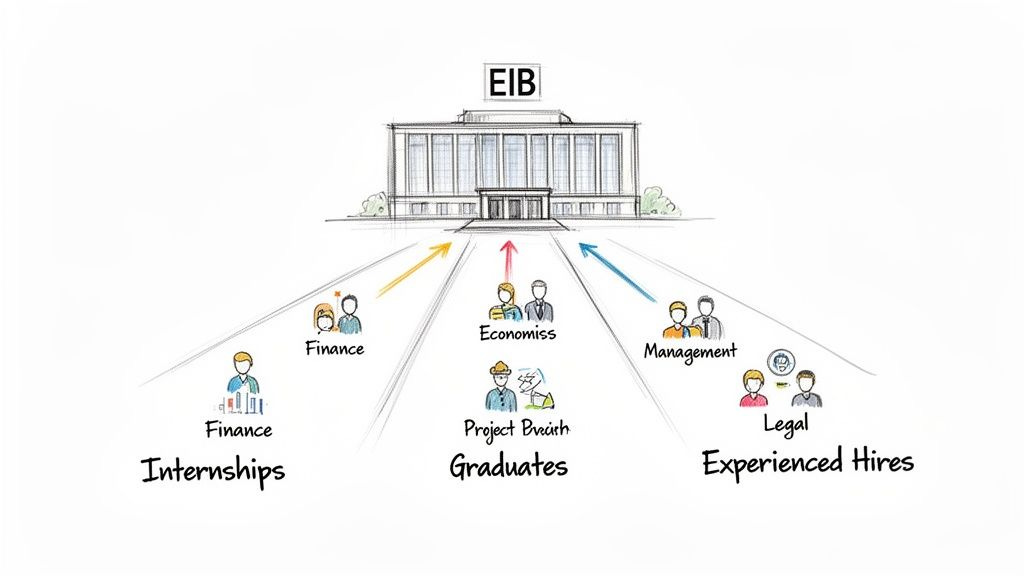
They need a diverse team to make these huge, complex projects happen. The bank consistently looks for talent in several key areas:
Finance & Economics: This is the core. Think loan officers, financial analysts, and economists who spend their days assessing project risk and financial viability.
Engineering & Technical Experts: The EIB needs specialists who can get into the weeds on the technical feasibility of infrastructure, energy, and climate projects. Can that bridge actually be built? Is this renewable energy plan sound?
Legal Services: Every major financing deal needs airtight legal backing. EIB lawyers structure complex agreements and ensure everything is compliant with a web of regulations.
Project & Policy Experts: These people manage the entire lifecycle of a project or help shape the bank’s strategic direction on everything from urban development to digital innovation.
This guide walks you through all entry points, from internships and graduate programs to senior-level roles, giving you a clear, actionable plan to get started.
Understanding EIB Job Families and Who They Hire
To have a chance at a European Investment Bank career, you first have to figure out where you fit. The EIB is a collection of highly specialized teams, each looking for very specific skills.
Sending a generic CV to the EIB is like sending a cardiologist’s resume to a hospital’s orthopedics department. It doesn’t matter how good you are if you’re applying to the wrong place. Nailing this first step is everything.
The Bank organizes its talent into job families. These are the core pillars that do the actual work: lending, advising, and keeping the lights on. Getting to know them is your first assignment.
The Core EIB Job Families
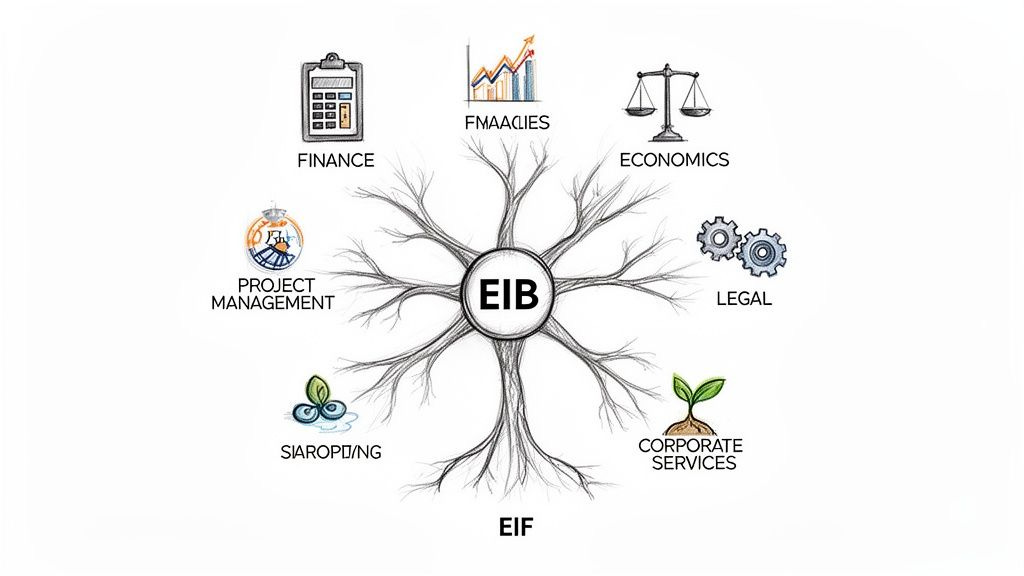
Most professional roles at the Bank slot into one of five main categories. Each plays a distinct role in getting a project from an idea on paper to a fully-funded, legally-sound operation on the ground.
Finance: This is the engine room. These people figure out if a project makes financial sense, structure the loans, and manage the Bank’s own massive treasury and capital market activities. You’ll find Loan Officers, Financial Monitoring Officers, and Treasury Specialists here.
Economics: The economists at the EIB are the big-picture thinkers. They dig into the wider economic, social, and environmental ripple effects of an investment, making sure it aligns with EU policy and delivers real value.
Project Management & Engineering: This is where the technical experts live. This group is filled with engineers, environmental scientists, and sector specialists who kick the tires on a project’s feasibility. They ask the hard questions: Can this wind farm actually be built on time? Is the infrastructure design sound?
Legal Services: Every single loan, bond, and agreement is a maze of legal complexities. EIB lawyers draft and negotiate these deals, navigating the laws of multiple countries to make sure every ‘i’ is dotted and the Bank’s interests are protected.
Corporate Services: This is the backbone that supports the entire institution. It’s a broad category covering everything from HR and IT to communications, internal audit, and compliance. These are the professionals who keep the Bank running day-to-day.
Your background is your entry point. A civil engineer should be looking at Project Management roles. A corporate lawyer should laser-focus on Legal Services. Matching your experience to the right job family is the most critical part of your application strategy.
Don’t Forget the European Investment Fund (EIF)
You can’t have a complete conversation about EIB Group careers without mentioning its sister institution, the European Investment Fund (EIF). Although it’s part of the same family, the EIF has its own distinct mission: supporting Europe’s small and medium-sized enterprises (SMEs), often through venture capital and private equity.
The EIF is a serious employer in its own right, with a team of over 700 staff members. Its work is managed through five key offices, including a dedicated Risk Office and People Office.
If you’re interested in the high-growth, high-risk world of venture capital and SME financing, the EIF is where you want to look. It actively recruits for roles in fund management, risk analysis, and SME finance. You can dive deeper into careers and the work culture at the EIF to see if it’s the right fit for you.
Who Actually Gets Hired?
So what’s the common denominator among people who land jobs at the EIB? It’s a blend of deep, verifiable technical skill and a genuine grasp of the Bank’s public service mission. A star banker from the private sector won’t get very far if they can’t clearly connect their skills to the EIB’s policy goals.
Hiring managers are hunting for a specific combination of traits:
Technical Excellence: You have to be a master of your craft. Whether it’s project finance, environmental science, or international law, you need to be at the top of your game.
A Public-Sector Mindset: You must understand the “why” behind the EIB’s work. This means showing a real interest in EU policy, economic development, and sustainability.
International Experience: The EIB is a global player. Having experience working across different cultures, time zones, and legal systems is a huge plus.
Language Skills: English is the main working language, but don’t underestimate the power of French. Fluency is a massive advantage, and proficiency in any other EU language will always help your case.
At the end of the day, the EIB hires practitioners. They want people who have built things, structured deals, and managed messy, complex projects. Your CV needs to scream “real-world accomplishments,” not just “academic credentials.”
Key Entry Routes Into the EIB
Thinking there’s a single “front door” to the European Investment Bank is a mistake. The bank uses several distinct channels to bring people in, and your success depends on picking the right one for your career stage.
The EIB needs everyone from fresh graduates to seasoned directors. Your job is to understand these pathways and build a targeted application that actually gets read.
The Graduate and Early Career Routes
For anyone just starting out, the EIB runs structured programs to build its next generation of talent. They’re incredibly competitive, and they are a serious launchpad into the world of multilateral finance.
There are two main programs you need to have on your radar:
The EIB Internship Programme: This is the main way for current students or very recent graduates to get a feel for the Bank from the inside. These are paid, full-time positions that last 3 to 12 months. The goal is to give you real project work. To be eligible, you have to be a current student or have graduated less than one year ago.
The EIB Graduates Programme: This is the Bank’s premier early-career program. It’s a two-year commitment where you rotate through different departments, getting a 360-degree view of how the EIB actually works. The bar for entry is higher, usually requiring a Master’s degree and some initial work experience (internships often count). Think of it as a fast-track for high-potential candidates.
Getting into these programs takes more than just good grades. Hiring managers are looking for a genuine, demonstrated interest in the EIB’s mission. You need to show it through your coursework, side projects, or past internships in relevant fields like development finance or public policy.
Experienced Professionals and Consultants
If you’re already a few years into your career, your path in is more direct. You are applying for a specific, open role where your skills are needed right now.
These jobs fall into two main buckets:
Experienced Hires (Staff Positions): These are your standard permanent or fixed-term contracts for specific roles, from Loan Officer to Legal Counsel. You’ll find these advertised on the EIB’s careers portal. Your application has to be a direct answer to that job description, proving exactly how your past work makes you the perfect person for the job.
Consultants (External Experts): The EIB frequently brings in outside experts for projects with a clear start and end date. These gigs are usually for highly specialized pros who have niche expertise the Bank doesn’t have in-house. Finding these roles can be tricky, as they’re often advertised through procurement notices and on specialized job boards.
For a broader look at this type of work, you might be interested in our guide on landing entry-level consultant roles, as many of the same principles apply across all the big MDBs.
Crucial Eligibility and Nationality Rules
This is a big one, and it’s a hard-and-fast rule you cannot get around. To be eligible for almost any staff position at the European Investment Bank, you must be a national of an EU Member State.
There are almost no exceptions. While a few niche consultant roles might have different rules, if you want a permanent staff career, EU nationality is non-negotiable.
It’s the very first filter your application will go through. Before you invest a single second in an application, make sure you are eligible. This is standard for all EU institutions and reflects the bank’s core identity as a body of the European Union. Always double-check the specific job post, but just assume this is a deal-breaker.
Mastering the EIB Application and Interview Process
Getting your application right gets you in the door. Nailing the interviews lands you the job. The EIB’s recruitment process is a multi-stage gauntlet designed to test everything from your technical skills to your cultural fit and your grace under pressure. You need a clear strategy for each step to make it through.
Let’s break down exactly what they’re looking for and how you can deliver it.
Crafting a CV and Cover Letter That Gets Noticed
Your CV and cover letter are your first, and often only, chance to make an impression. Generic documents that could be sent to any bank are weeded out almost immediately. You absolutely have to tailor your application to speak directly to the EIB and its public mission.
Your CV should be a highlight reel of your accomplishments. Quantify everything you can. Instead of saying you “managed project finances,” you need to say you “managed a €15 million project budget, delivering the project 5% under forecast.” The first is passive; the second shows impact.
Your cover letter is where you bridge the gap between those achievements and the EIB’s purpose. This is a career choice driven by a public mandate. Show them you get that. If you need a solid framework, our guide on how to write a compelling statement of interest offers actionable advice that’s directly applicable here.
The path you’re applying for also shapes the expectations for your application, as you can see below.
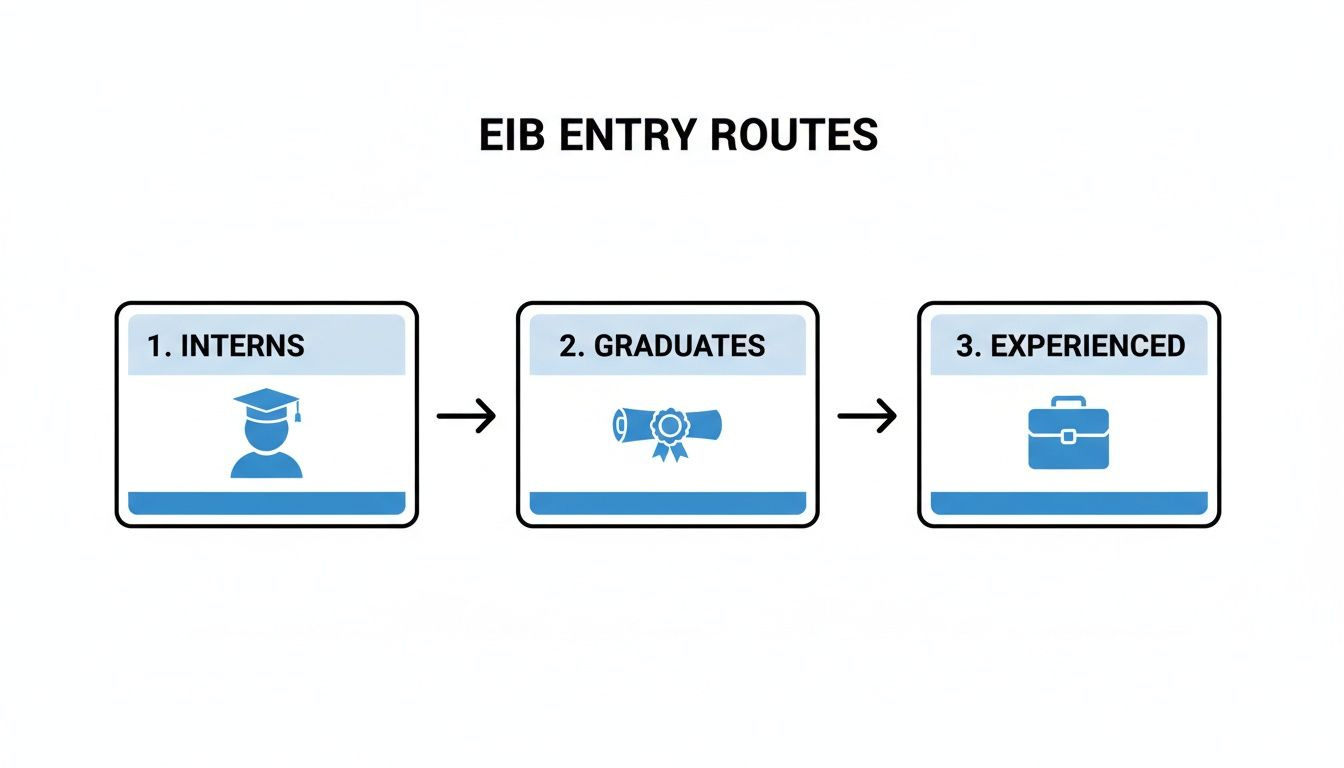
Whether you’re coming in as an intern, a graduate, or an experienced hire, your story needs to align perfectly with the pathway you’ve chosen.
Decoding the Assessment Stages
If your application makes the cut, you’ll move into the assessment phase. This is where the real tests begin. The exact sequence can change depending on the role and seniority, but you should prepare for a few common hurdles.
Psychometric Tests: These are often the first gate you’ll have to pass. Expect tests measuring your numerical, verbal, and logical reasoning skills. You’re being benchmarked against every other candidate. The only way to get good at these is to practice them until the format and timing feel second nature.
Case Studies: For most analytical and project-related roles, the case study is a make-or-break moment. You’ll get a business scenario, often mirroring a real EIB project, and be asked to analyze it and present your findings. They’re testing your analytical horsepower, your business sense, and how you structure an argument.
Panel Interviews: You will almost certainly face a panel interview. This typically includes the hiring manager, someone from HR, and a technical expert from a related team. The idea is to get a 360-degree view of your expertise, your personality, and how you’d fit into the bank’s collaborative culture.
The case study is your chance to show them how you think. There isn’t always a single right answer. The panel is far more interested in your thought process, how you structure your analysis, and how you defend your conclusions under pressure.
Excelling in the Competency-Based Interview
Like most major international institutions, the EIB leans heavily on competency-based interviews. They are going to ask you to prove your skills using concrete examples from your past.
Get ready for direct prompts that sound like this:
“Tell me about a time you had to manage a conflict within a project team.”
“Describe a situation where you had to adapt your approach due to unforeseen circumstances.”
“Give an example of a complex problem you analyzed and the outcome of your recommendation.”
The only way to answer these questions effectively is by using the STAR method:
Situation: Set the scene. What was the context?
Task: What was your specific responsibility or goal?
Action: Detail the steps you personally took. This is the core of your answer.
Result: What was the outcome? Quantify it with numbers or concrete results whenever possible.
Before you even think about the interview, you need to prepare at least five to seven solid STAR examples from your career. Map them to key EIB competencies like teamwork, problem-solving, results orientation, and communication. This preparation is what separates a candidate who sounds credible and confident from one who fumbles for answers. It shows you’re a serious contender who came ready to play.
EIB Salary and Benefits Explained
Let’s talk money. Compensation is a massive factor in any career move, and the package is a major draw at the European Investment Bank. To really understand what’s on the table, you need to look past the base salary and see how the EIB actually builds its offers.
The EIB uses a transparent grade structure where your pay is directly tied to the seniority and responsibility of your role. This system keeps things fair and lays out a clear financial path as you climb the ladder at the bank.
Understanding EIB Salary Bands
As the EU’s financing arm, the EIB pays competitively. The bank has nine salary grades, and each one has a defined minimum and maximum gross annual salary. This range allows for real salary growth within your role, based on your performance and time on the job.
So, what are we talking about in real numbers? For entry-level roles at Grade 1, the gross annual salary starts at €45,339.96 and can go up to €72,543.94. A mid-career professional at Grade 5 is looking at a band from €79,452.39 up to €127,123.84. At the very top, like a Grade 9 Head of Division, the compensation is substantial, with salaries falling between €255,530.00 and €313,605.00.
You can dig into the full details on the EIB’s complete benefits and salary structure over on their official site.
The key takeaway is the transparency. The published bands give you a very clear picture of your earning potential from day one and what you can aspire to as you move up.
To make this more concrete, here’s a quick look at what those salary bands mean for different types of roles.
EIB Sample Annual Salary Bands (2026)
This table gives a snapshot of the gross annual salary ranges for a few key grade levels at the EIB.
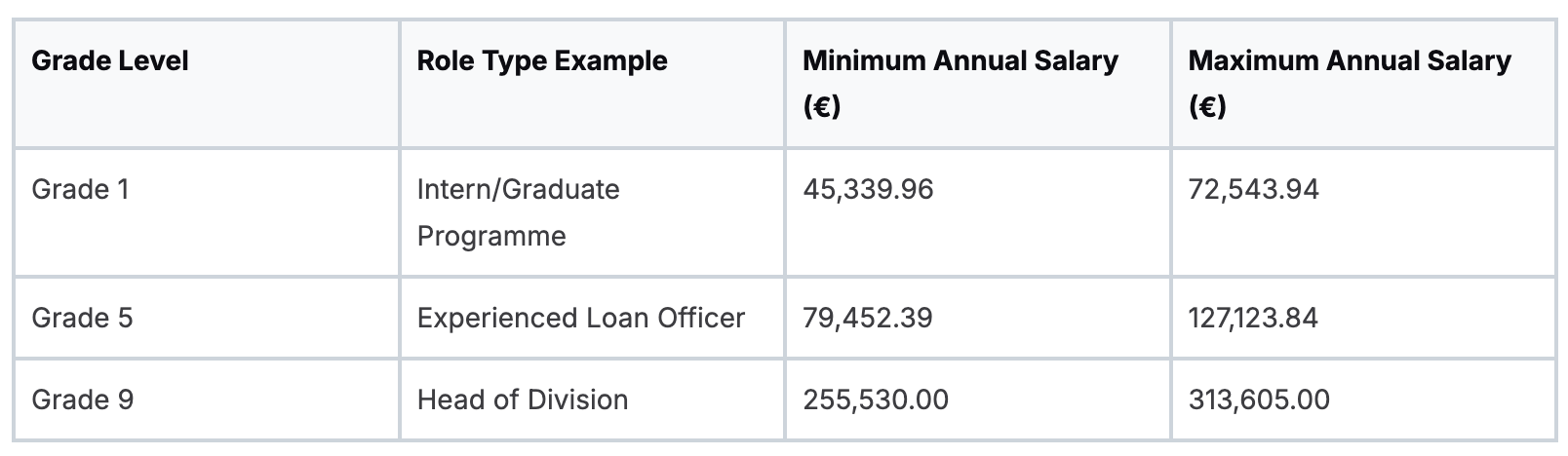
These numbers give you a solid baseline, but remember, the total value of an EIB offer goes far beyond just the gross salary.
More Than Just a Paycheck
The base salary is just the starting point. The full package is where the EIB really stands out compared to a typical private sector job. The bank provides a whole suite of benefits designed to support you and your family.
Here are some of the big ones:
Health and Wellness: A solid health insurance scheme covers you and your family, alongside accident insurance. The bank prioritizes employee wellbeing.
Family Support: The EIB offers generous allowances for dependents, including household, child, and education allowances that ease the financial side of family life, especially for expats.
Retirement Planning: A robust pension scheme helps secure your financial future long after your career at the bank. This is a massive long-term financial perk that’s often overlooked.
Work-Life Integration: Staff get generous annual leave, great parental leave policies, and access to flexible working arrangements. It’s all geared toward helping you build a sustainable career.
This complete package makes a huge difference. For a deeper dive on how these benefits and salaries really stack up against other MDBs, check out our breakdown on the numbers you want to know about MDB salaries. It’s all about evaluating the total value, not just the number on your payslip.
Your EIB Questions, Answered
Even with the best-laid plans, you’re going to have questions. When it comes to a place like the European Investment Bank, a few key details can make or break your application.
Let’s cut through the noise and get straight to the answers you need.
What Are the Nationality Requirements for EIB Jobs?
Let’s start with the most important, non-negotiable rule. To have any shot at a staff position at the EIB, you must be a national of an EU Member State.
This is the very first hurdle. If you don’t meet this criterion, your application won’t even get a second look. It’s a hard-and-fast requirement for EU institutions, reflecting the bank’s fundamental role as a body of the European Union.
While you might occasionally see a very specific, short-term consultancy gig with different rules, don’t count on it. For a long-term career, EU nationality is the price of admission.
How Long Does the EIB Recruitment Process Take?
Deep breaths. The EIB hiring process is thorough, methodical, and definitely not fast. From the day you hit “submit” to a potential offer, you should expect a timeline of three to six months. For senior roles, it can easily stretch longer.
This isn’t a sign of disinterest. It’s just how a massive, bureaucratic institution operates. The process typically unfolds in stages:
Initial Screening: Your CV and cover letter are checked against the absolute essentials.
Assessments: This is where you might face psychometric tests or technical assignments to prove your skills.
Interviews: Expect at least one panel interview, and often several rounds.
Final Deliberation: The hiring committee debates and makes its final call.
Each step takes time, and you might experience long periods of silence. It’s part of the game, so don’t get discouraged.
Do I Need to Speak Multiple Languages?
Yes, and it’s a bigger deal than you might think. The EIB’s two official working languages are English and French. While nearly all business is conducted in English, fluency in French is the secret weapon that makes your profile incredibly compelling.
Proficiency in a second EU language is a mandatory requirement for all staff members at the EIB. While you may be hired with proficiency in only one, you will be required to demonstrate competence in a second language to be confirmed in your post at the end of your probationary period.
Think of it this way: strong English gets your foot in the door. But a good command of French or another EU language shows you’re serious about a long-term career and understand the bank’s pan-European identity.
What Is the Work-Life Balance Like at the EIB?
Compared to the brutal hours of private-sector finance, the EIB is known for offering a much more sustainable work-life balance. This isn’t a “face time” culture where your commitment is measured by how late you stay at your desk. It’s all about results.
Generous annual leave, solid parental leave policies, and flexible working arrangements are all part of the package. The bank knows that burned-out employees don’t produce good work, and it invests in long-term wellbeing to keep its people effective and engaged.
Navigating the world of multilateral development banks is complex. At Multilateral Development Bank Jobs, we simplify it for you. Our Substack newsletter delivers curated job listings, consultant opportunities, and deep-dive career guides directly to your inbox three times a week. Subscribe to Multilateral Development Bank Jobs and get the insider edge you need.