

People mix them up all the time, but if you’re serious about a career in global development, you need to know the difference between the International Monetary Fund (IMF) and the World Bank. They might share a block in Washington D.C. and a birth year, but their jobs couldn’t be more distinct.
Getting this wrong isn’t a trivial mistake. It signals to recruiters that you haven’t done your homework.
IMF vs World Bank: An Overview
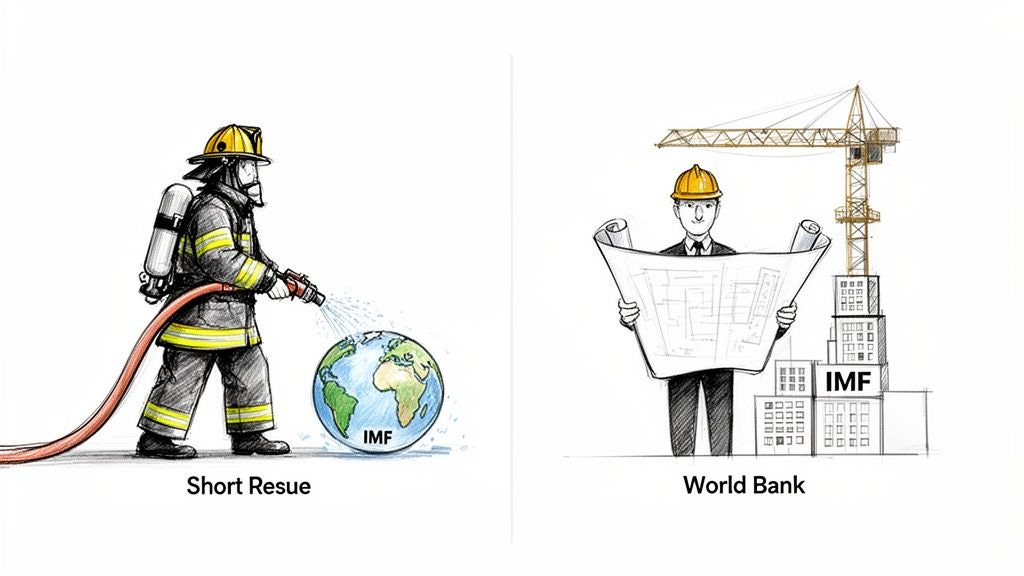
Think of it this way: the IMF is the global economy’s firefighter. When a country faces a currency collapse or a balance of payments crisis, the IMF steps in with short-term loans to put out the fire. Its goal is financial stability.
The World Bank is the long-term construction crew. It finances specific projects like building schools, power grids, or sanitation systems to reduce poverty and foster sustainable development.
Both institutions were born out of the 1944 Bretton Woods Conference, designed to rebuild the international economic system after World War II. Their mandates were deliberately split.
The IMF’s role is to prevent and manage macroeconomic meltdowns. A classic example is the 1997 Asian financial crisis, where it mobilized $118 billion in emergency packages for Thailand, Indonesia, and South Korea. Its focus is always on the big picture: exchange rates, government deficits, and monetary policy.
The World Bank’s mission is about poverty reduction through long-term investment. This distinction shapes everything from their funding models to the kinds of jobs they offer.
Key Institutional Differences
At its core, the IMF functions like a credit union for its 190 member countries. Members contribute to a pool of funds based on quotas, which they can draw from when facing financial distress. Its lending is designed to be rapid and short-term, stabilizing entire economies.
The World Bank operates more like a development investment bank. It raises most of its funds by selling bonds on global capital markets and then lends that money to developing nations for specific, long-haul projects.
For a closer look at how the World Bank operates from the inside, check out our practical guide to the World Bank.
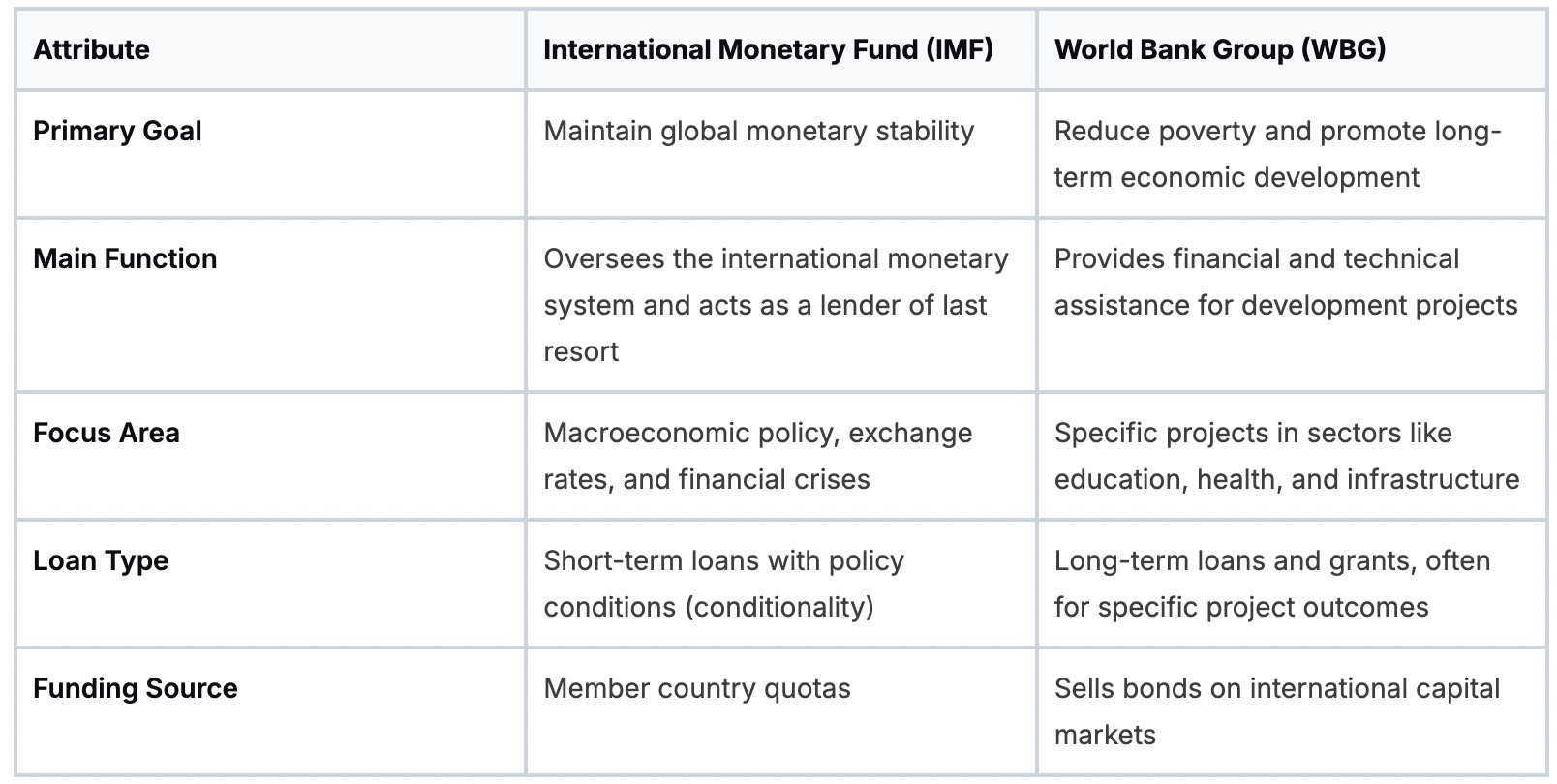
To make it even clearer, here’s a direct comparison of their core functions.
IMF vs World Bank At a Glance
This table breaks down the fundamental distinctions that every aspiring development professional should know cold.
Understanding these differences is the first step. For job seekers, it’s about aligning your skills and career goals with the right institution. An economist focused on monetary policy belongs at the Fund. An education specialist will find their home at the Bank.
Their Core Missions And Historical Evolution
To really get the difference between the IMF and the World Bank, you have to go back to their shared origin at the 1944 Bretton Woods Conference. They were born at the same time, but they were never twins. History forced them down even more separate paths.
Their missions weren’t an accident. They were designed to solve two different problems plaguing the post-war global economy.
The IMF Becomes a Financial Firefighter
The IMF’s original job was to be the guardian of a stable international monetary system. Its purpose was to prevent a repeat of the competitive currency devaluations that crippled global trade in the 1930s. It did this by overseeing a system of fixed exchange rates pegged to the U.S. dollar, which was in turn pegged to gold.
When that system fell apart in the early 1970s, the IMF had to find a new reason to exist. It went from being a system manager to a crisis manager.
The oil shocks of the 1970s and the Latin American debt crisis of the 1980s cemented this new role. The IMF became the world’s lender of last resort for countries facing a balance-of-payments crisis. In simple terms, this happens when they can’t afford to pay for essential imports or service their foreign debt.
This is the IMF we know today. It’s the institution that swoops in with emergency loans when a country’s economy is teetering on the brink. These loans come with strict conditions meant to force rapid macroeconomic adjustments, like slashing government spending or jacking up interest rates to stabilize the economy fast.
The core mission remains focused on macroeconomic stability. The IMF isn’t building roads or schools; it’s ensuring a country’s financial system doesn’t implode and drag its neighbors down with it.
This crisis-response function is its defining feature. It explains its lean structure, its staff of macroeconomists, and its very short-term operational timeline. The Fund’s playbook is about immediate stabilization, not long-term development.
The World Bank Shifts to Poverty Reduction
The World Bank’s story followed a different arc. It was initially called the International Bank for Reconstruction and Development (IBRD), and its first task was exactly what the name implies: financing the reconstruction of a war-torn Europe.
Its very first loan, for $250 million in 1947, went to France.
Once Europe was back on its feet, the Bank’s focus pivoted dramatically. Starting in the 1960s under its president, Robert McNamara, its mission became the fight against global poverty. It began lending to developing countries for specific projects that would spark long-term economic growth and raise living standards.
This was a fundamental shift. The Bank moved from rebuilding nations to building up their foundational capacity. It went from broad economic reconstruction to targeted investments in things like:
Infrastructure: Funding for the roads, ports, and power plants needed to connect markets and power economies.
Human Capital: Investments in education and healthcare systems to build a healthy, productive workforce.
Agriculture: Projects designed to boost crop yields and food security, especially for rural populations.
This historical pivot is why the World Bank is a project-focused institution. Its mission demands deep, sector-specific expertise from engineers, health specialists, and agricultural experts who can design and oversee complex, multi-decade initiatives. Unlike the IMF’s rapid-response model, the Bank’s approach is methodical and long-term. It’s trying to build the pillars of a prosperous society from the ground up.
How Their Funding and Lending Models Differ
To really get the difference between the IMF and the World Bank, you have to follow the money. Their entire financial machinery is a direct product of their missions. One operates like a global credit union for emergencies, the other like a massive investment bank for long-term development.
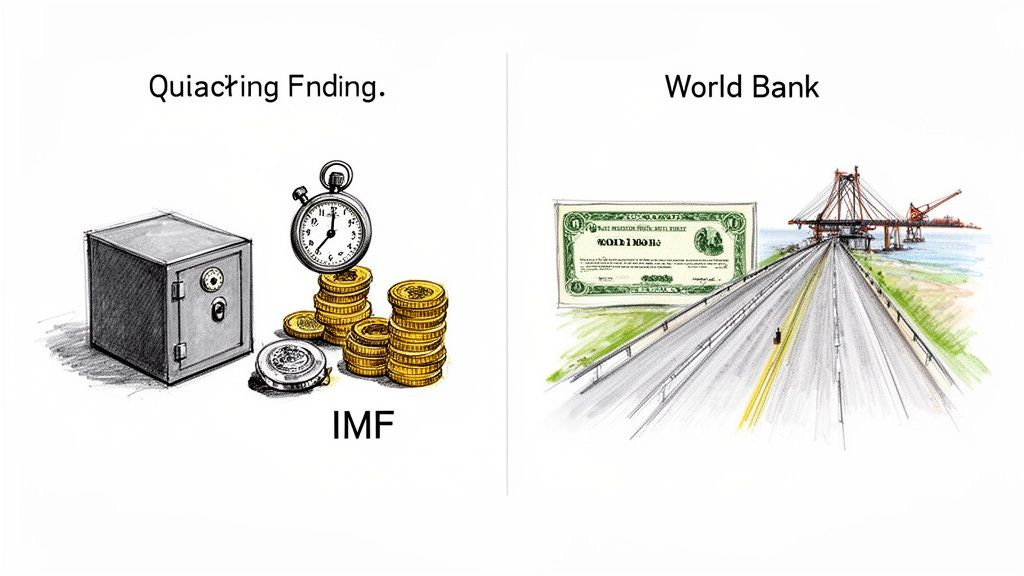
This split in financial strategy dictates who they help, how they help, and what they expect in return. Getting this clear is non-negotiable for anyone looking to work in this space.
The IMF’s Quota-Based Funding System
The IMF’s funding is unique and central to its role as a global financial firefighter. It doesn’t borrow on the open market. Its money comes almost entirely from quotas paid by its 190 member countries.
Think of quotas like membership fees for a very exclusive club. A country’s quota is based on its weight in the world economy. A huge economy like the United States has a much larger quota and more voting power than a smaller one.
This is the pool of money the IMF taps to make emergency loans to countries staring down a balance-of-payments crisis. It’s a structure built for speed, allowing the Fund to deploy billions without needing to go hat-in-hand to investors.
The IMF operates like a credit union. Members contribute to a shared pool of resources, and in a time of crisis, a member can draw from that pool far more than their individual contribution. This is its core financial principle.
When a country needs a lifeline, the IMF has a few tools. The most common are Stand-By Arrangements (SBAs). These are short-term loans, typically lasting 12–24 months, that come with strict policy conditions attached. They have one purpose: rapid economic stabilization.
The World Bank’s Market-Based Investment Model
The World Bank’s financial engine runs on a different fuel. It gets contributions from member countries, especially for its arm that helps the poorest nations, but its main financing body, the International Bank for Reconstruction and Development (IBRD), raises most of its cash on global capital markets.
The IBRD acts a lot like a traditional investment bank. It issues highly-rated World Bank bonds to pension funds, insurance companies, and other huge investors. Because the Bank has a top-tier AAA credit rating, it can borrow money at incredibly low interest rates.
It then lends this money to middle-income countries for specific, long-term development projects like roads, power plants, and schools. It charges a small premium to cover its own costs. This model lets it mobilize hundreds of billions for projects that can take decades to bear fruit.
The sheer scale of their operations tells the story. In fiscal year 2024, the World Bank’s total commitments hit $128.1 billion, including $31.9 billion in IBRD loans. Meanwhile, the IMF had $153 billion in outstanding credit, most of it concentrated in massive crisis packages like Argentina’s $44 billion program. The Bank’s IDA affiliate, which provides grants and zero-interest loans to the world’s poorest countries, committed $29.2 billion in fiscal year 2025. You can dig into the specifics in this IMF-World Bank factsheet.
3. Operational and Structural Differences
To really get the difference between the IMF and the World Bank, you have to look at how they’re built. Their internal structures, staffing, and even their governance models are a direct reflection of their missions. One is a lean team of economic surgeons; the other is a sprawling army of project builders.
The most obvious difference is sheer scale. The IMF is a relatively small, centralized organization with about 2,700 staff. The vast majority are economists based in its Washington D.C. headquarters, focused squarely on macroeconomic surveillance and policy advice.
The World Bank is a massive global institution. It employs over 13,000 people spread across more than 140 country offices. This huge footprint is necessary because its work is on the ground, managing a huge portfolio of development projects.
How Governance Shapes Everything
Technically, both the IMF and the World Bank are owned by their member countries. This is not a one-country, one-vote system. Far from it. Decision-making power is tied directly to a country’s economic size and financial contributions, a system based on quotas.
This governance structure has real-world consequences. It means that developed nations, particularly the G7 countries, hold significant sway over policy and lending decisions. The United States, for instance, holds the largest single voting share in both institutions, giving it a unique level of influence.
This quota-based system is a critical, and often criticized, aspect of their governance. It means that the institutions’ priorities are inevitably shaped by the political and economic interests of their most powerful shareholders.
This political reality is something any aspiring MDB professional needs to grasp. The policy advice from the IMF or the project focus of the World Bank doesn’t happen in a vacuum; it’s heavily influenced by this shareholder structure.
Staffing and Expertise: Who They Hire and Why
The difference in mission directly dictates the kinds of experts each institution hires. Think of it as specialized teams for highly specialized jobs.
The IMF’s signature activity is its annual Article IV consultation. This is a deep-dive economic health check-up for each member country, and this work requires a very specific skillset.
Who they hire: Primarily PhD-level macroeconomists, financial sector experts, and fiscal policy specialists.
What they do: Analyze national budgets, monetary policy, and financial system stability.
Where they work: Mostly from D.C., with teams flying out for short, intense country missions.
The World Bank’s operational model is completely different. Its day-to-day work involves designing, financing, and overseeing tangible projects, which demands a much broader range of expertise. You can get a much better sense of this by exploring what a typical World Bank project cycle looks like.
Who they hire: A huge variety of professionals, including engineers, public health specialists, urban planners, environmental scientists, and education experts.
What they do: Manage long-term projects like building dams, reforming healthcare systems, or digitizing government services.
Where they work: Many are based in country offices, working directly with government officials and local partners on the ground.
This table gives a clear, side-by-side look at the operational DNA of the IMF and World Bank.
Operational and Structural Comparison
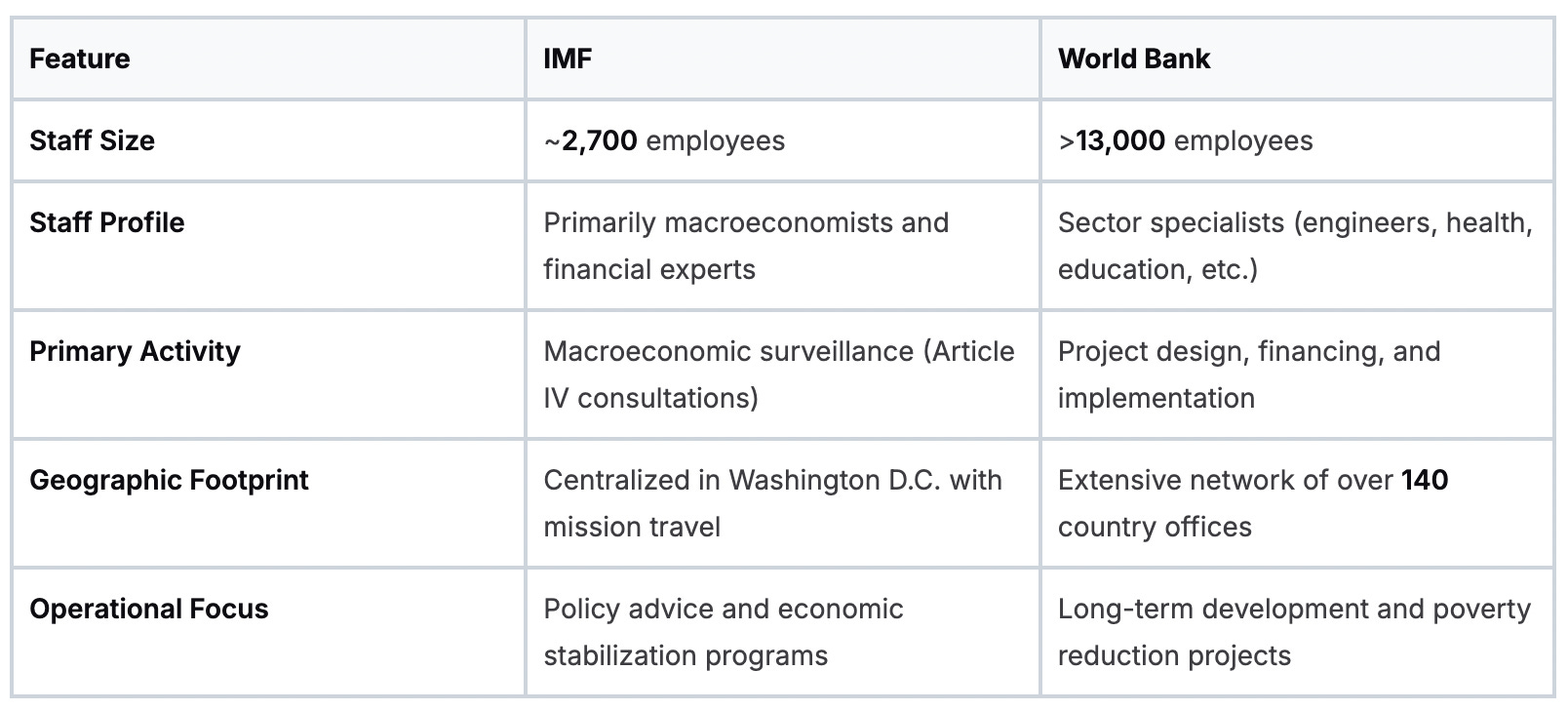
For anyone considering a career at these institutions, this structural difference is probably the most important factor. Your professional background and expertise will almost certainly align much more closely with one than the other.
An economist focused on exchange rate policy fits the IMF. An engineer specializing in water infrastructure belongs at the Bank.
How The IMF And World Bank Actually Work Together
Many people assume the IMF and World Bank are rivals operating in separate orbits. The reality is they’re two sides of the same coin, with a long, structured history of collaboration. They are partners with carefully defined roles, especially when a country is in crisis.
This is a formal arrangement. Their partnership was laid out in the 1989 ‘concordat,’ a pact that delegates specific responsibilities. This framework puts the IMF in the driver’s seat for macroeconomic policy, while the World Bank leads on the structural and sectoral stuff.
A Formal Division Of Labor
This division of labor is incredibly practical. The IMF tackles the big-picture economic health of a country, like fiscal deficits, monetary policy, and exchange rates. The World Bank gets its hands dirty with the nitty-gritty of a country’s development problems, working on projects in education, health, energy, and infrastructure.
It’s like building a house. The IMF is the architect who ensures the foundation is solid and the budget is sound. The Bank then comes in as the contractor to build the rooms, install the plumbing, and wire the electricity. You need both for a functional home, but they require different toolkits and expertise.
A classic scenario is a country getting an IMF loan to stabilize its currency and rein in its budget. At the same time, it might be using a World Bank loan to overhaul its failing energy grid or modernize its port facilities. That’s their complementary roles in action.
Their teamwork really kicked into high gear after the debt crises of the 1980s. Joint efforts like the Heavily Indebted Poor Countries (HIPC) Initiative (launched in 1996) and the Multilateral Debt Relief Initiative (MDRI) (2005) are prime examples. Through these programs, the institutions jointly wiped out over $130 billion in debt for more than 36 countries. This helped slash their average debt-to-GDP ratios from a staggering 150% down to below 40% by 2020.
More recently, during the COVID-19 pandemic, the IMF worked to deploy $1 trillion in liquidity while the World Bank approved $160 billion in financial support by mid-2022. You can get a deeper look at how their different economic models play out in these joint efforts by reading these analyses on country economics.
Why Their Forecasts Sometimes Differ
Despite this close partnership, you’ll often see the IMF and World Bank release slightly different economic forecasts for the same country. This isn’t a sign they disagree. It’s the natural result of them using different analytical tools to answer different questions.
The IMF’s Focus: Their models are built for speed and precision on short-term macroeconomic factors like inflation, exchange rates, and fiscal balances. Their main job is to check for immediate financial stability.
The World Bank’s Focus: The Bank takes a much longer-term, structural view. Its analysis pulls in microeconomic data, sectoral trends, and the expected impact of specific development projects into its growth forecasts.
So, when the numbers don’t match perfectly, it’s because they’re looking at the same economy through different lenses. The IMF is asking, “Is this economy stable right now?” The Bank is asking, “What’s this economy’s growth potential in five or ten years, once these new highways are built?” Their data simply reflects their core institutional mandates.
How To Land A Job At The IMF Or World Bank
Let’s get practical. Knowing the difference between the IMF and the World Bank is one thing. Turning that knowledge into an actual job offer is something else entirely.
It all boils down to aligning your specific profile with the right institution. They are looking for fundamentally different people, and getting this right is the single most critical part of your job search strategy.
The IMF Hires Macroeconomists. Period.
At its core, the IMF is an institution of economists. Its entire mandate revolves around macroeconomic surveillance, financial stability, and crisis management, so it hires an incredibly specific type of professional. The heart and soul of the Fund’s staff are PhD-level macroeconomists, financial sector experts, and public finance specialists.
If you want to work at the Fund, your CV needs to scream high-level economic expertise. Your career path almost certainly involves:
A doctorate in economics, with a sharp focus on monetary policy, fiscal affairs, or international finance.
Serious quantitative and analytical firepower, especially in econometric modeling.
Experience at a central bank, ministry of finance, or a top-tier academic institution.
The IMF’s flagship entry point is the Economist Program (EP), which is their version of a Young Professionals Program. It’s brutally competitive and designed almost exclusively for recent PhDs in economics. Mid-career roles are no different. They demand deep, technical expertise in the Fund’s core business lines. If you aren’t a macroeconomist, your options here are slim to none.
The World Bank Needs Everyone Else
The World Bank is a completely different universe. Because it’s a project-based development bank, it needs a much, much wider array of talent. Yes, it hires plenty of economists, but they are just one piece of a massive operational puzzle. The Bank’s mission to fund development projects demands deep, on-the-ground expertise across dozens of sectors.
This means the Bank recruits from a huge range of professions. You’ll find thousands of roles for:
Engineers (civil, energy, water)
Public health specialists
Education professionals
Environmental scientists
Urban planners
Agriculture experts
Digital development specialists
The World Bank’s Young Professionals Program (YPP) reflects this incredible diversity, actively seeking candidates from all these fields. Unlike the IMF’s EP, a PhD is often a plus but not a hard requirement, especially if you have a relevant master’s degree and significant field experience.
For the Bank, practical field experience is gold. Having worked on a development project in a low- or middle-income country gives you a massive advantage. It proves you understand the real-world complexities that don’t show up in a spreadsheet.
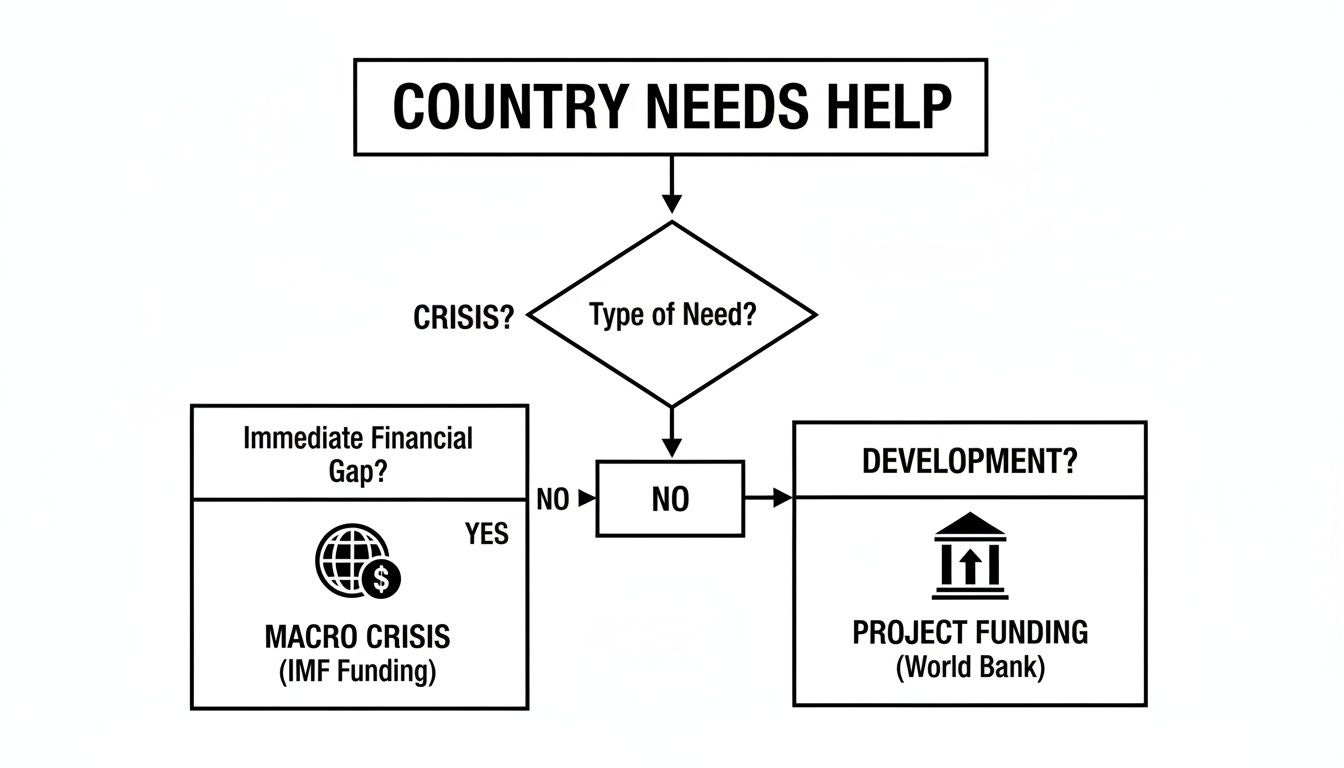
This visual shows the basic decision-making process for financial aid, which directly influences who each institution needs to hire. The chart illustrates that a country’s core problem—a balance of payments crisis versus a long-term development need—determines whether the IMF or the World Bank steps in. This choice dictates the exact professional expertise required for the job.
You Need Two Different Resumes
You cannot use the same resume for both institutions. It’s an immediate red flag. Your application has to be surgically tailored to the hiring institution’s DNA.
For an IMF Application:
Lead with Your Analytical Prowess: The top of your resume should showcase your quantitative skills, modeling experience, and any publications in top economic journals.
Emphasize Policy Work: Highlight any experience with fiscal, monetary, or financial sector policy analysis, even if it’s academic.
Think Macro: Frame everything through a macroeconomic lens. They want to see you can operate at the 30,000-foot level of a national economy.
For a World Bank Application:
Showcase Sectoral Expertise: Your specific technical skills—be it in public health program design, transport engineering, or climate finance—should be front and center.
Flaunt Your Field Experience: Dedicate real estate on your resume to any hands-on work in developing countries. Name the projects, locations, and your specific results.
Prove You Can Manage a Project: The Bank runs on projects. Highlight your ability to handle budgets, timelines, and stakeholder relationships.
Finally, networking and understanding the specific needs of individual departments is huge. For a deep dive into the practical steps for landing a role at the Fund, our guide offers specific strategies on how to find and win IMF job vacancies.
Your background almost certainly makes you a better fit for one of these institutions over the other. Your first task is to be honest with yourself about which one it is, and then apply accordingly.
Frequently Asked Questions
Let’s clear up some of the most common questions that come up when people try to untangle the IMF and the World Bank.
Can Any Country Join The IMF And World Bank?
Think of it like a two-step process. Joining the IMF is the first, mandatory step. A country has to apply and get the green light from a majority of the existing members.
Once you’re in the Fund, you can then apply to join the World Bank. This means all 190 member countries of the IMF are also members of the World Bank. You simply can’t be in the Bank without first being a member of the Fund.
Who Runs The IMF And The World Bank?
There’s an unwritten rule, a “gentlemen’s agreement” that’s been in place since the Bretton Woods conference. A European always leads the IMF, and an American citizen always heads the World Bank. This reflects the power dynamics of the post-World War II era, and it’s a tradition that has held for decades.
The IMF is led by a Managing Director, while the World Bank is run by a President. Both are appointed for a five-year renewable term, with nominations typically coming from their respective traditional regions and then approved by the institutions’ executive boards.
Does The IMF Or World Bank Give Grants?
The World Bank absolutely gives grants. This happens primarily through its International Development Association (IDA), which is the arm of the Bank dedicated to the world’s poorest countries. These grants fund crucial development projects like health, education, and infrastructure and don’t need to be paid back.
The IMF is not in the business of giving grants. Its whole model is built on lending. The closest it comes is offering debt relief through joint programs like the Heavily Indebted Poor Countries (HIPC) Initiative. This can function like a grant by essentially canceling debt, but it’s not the same as handing over cash for a new project.
While both provide financial assistance, only the World Bank has a dedicated mechanism for giving grants for development projects. The IMF’s financial support is almost exclusively in the form of loans tied to economic policy adjustments.
Which Is Better, The IMF Or The World Bank?
This is like asking whether a firefighter is better than a construction engineer. Neither is “better” because they are designed to solve completely different problems. The right institution depends entirely on the crisis at hand.
If a country is battling a currency crisis and needs an emergency injection of cash to prevent a full-blown economic collapse, the IMF is the right institution to call. They are the global economy’s emergency responders.
But if a country needs to finance a new power grid, overhaul its education system, or secure clean water for its citizens over the next two decades, the World Bank is the right institution. They focus on long-term development and poverty reduction. They are complementary, not competitors, and countries in serious trouble often end up working with both at the same time.
At Multilateral Development Bank Jobs, we demystify these complex institutions to help you build a career in global development. We send out full-time staff listings, consultant opportunities, and deep-dive career guides every week. Subscribe at
https://mdbjobs.com to get started