

Getting a job at the World Bank isn’t about finding a single, hidden door. It’s a complex ecosystem with multiple entry points, each designed for a different kind of professional.
The Bank’s hiring process is fundamentally different from a typical company’s. It uses specific pipelines to fill everything from permanent staff roles to short-term project consultancies. The system is built to attract a diverse, global workforce with deep technical expertise.
4 Main Ways to Join The World Bank
The Bank segments its hiring to meet its wide-ranging operational needs. You must understand these different pathways. Each one has its own rules, timelines, and target audience.
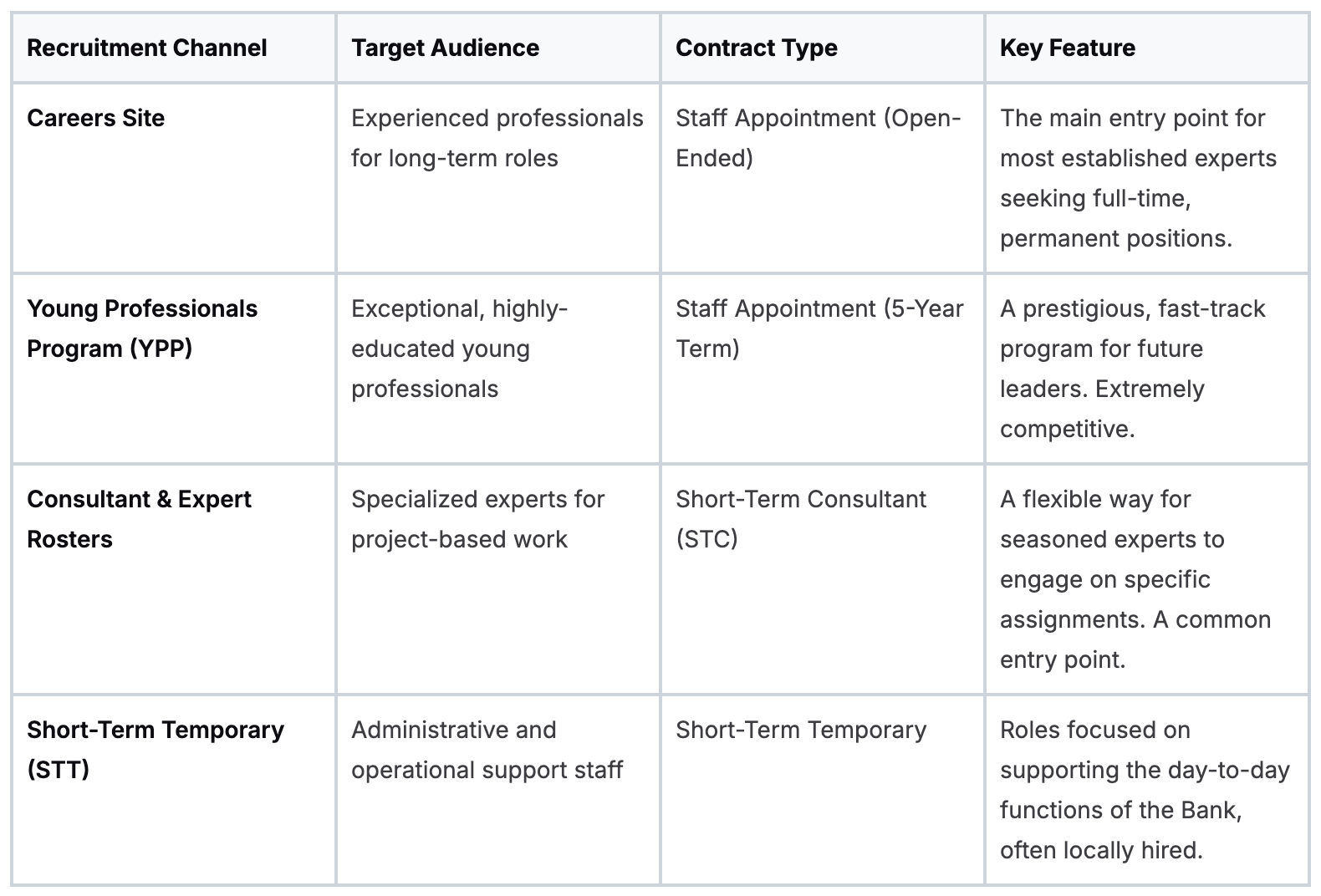
Here’s a direct overview of the main channels.
World Bank Recruitment Channels at a Glance
This table breaks down the primary ways to get a job at the World Bank. Understanding which channel fits your profile is the first and most important step.
Let’s dig into what each of these means for an applicant.
The Primary Recruitment Channels
Permanent Staff Roles via the Careers Site: This is the most straightforward channel. These are long-term positions with full benefits, typically for experienced professionals, and they’re all posted on the main careers website. Think of this as the front door for most mid-career and senior hires.
The Young Professionals Program (YPP): The YPP is the Bank’s flagship program for grooming future leaders. It’s an incredibly competitive entry point designed for exceptional young talent with advanced degrees and a few years of relevant experience. If you’re aiming for a long-term career track from an early stage, this is the program to target.
Consultant and Expert Rosters: This is a huge part of how the Bank gets things done. Rosters are databases of pre-vetted specialists who can be quickly contracted for short-term assignments. It’s a very common path for seasoned experts to first work with the Bank, and many successful staff members started this way.
The screenshot below from the official careers page gives you a sense of how the Bank organizes these opportunities for potential candidates.
This page is the central hub, directing you to the right program or job listing based on your career stage and expertise.
Getting this first step right is crucial. Each pathway has its own eligibility rules, application process, and selection timeline. Picking the wrong one is a fast track to a rejected application. A huge number of people who eventually land permanent staff positions first got their foot in the door through a consultant contract.
Recognizing which door fits your profile is the key to building a winning strategy. To get more context on how the institution works, you can check out The Complete Guide to the World Bank. This foundational knowledge is essential for aligning your application with what the Bank is actually looking for.
You’ve essentially got four main ways in: the official Careers Site for staff jobs, the prestigious Young Professionals Program (YPP), expert rosters for consultants, and short-term contracts. Let’s break down what each one is for and who they’re really looking for.
This diagram gives you a quick visual of the main pathways you’ll be navigating.
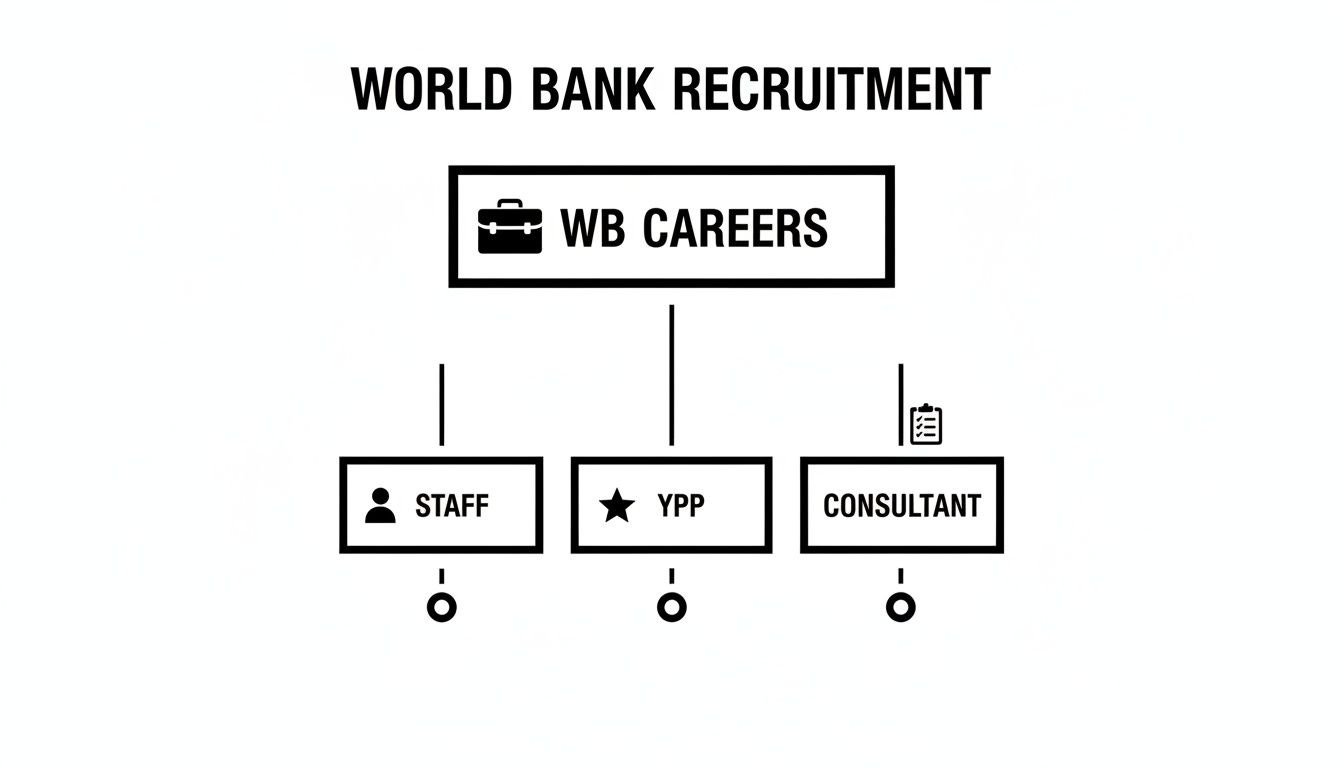
As you can see, things branch out quickly. While the careers portal is the central hub, your path will diverge into staff, YPP, or consultant tracks, and they are not interchangeable.
The Official Careers Site for Staff Positions
This is the main entryway for most mid-career and senior professionals. The World Bank Careers Site is where you’ll find all the open-ended and term staff appointments. These are the permanent, pensionable jobs with full benefits, and they almost always require serious, specialized experience in a field like economics, public health, or infrastructure finance.
When you see job grades like GF, GG, or GH, you’re looking at a staff role. Each letter corresponds to a specific level of education and professional experience, climbing up in seniority. These roles are the absolute backbone of the institution, filled by the core experts who drive the Bank’s projects and shape its policies.
A key thing to remember is that these are not entry-level jobs. The Bank hires for expertise. They expect you to arrive with a deep skill set, ready to contribute from day one.
The Young Professionals Program (YPP)
The YPP is the Bank’s crown jewel for recruiting its next generation of leaders. It’s an intensely competitive, five-year rotational program designed to build a pipeline of future senior staff. It’s the ultimate fast track, but the barrier to entry is exceptionally high.
Candidates typically need:
A Master’s or doctoral degree.
Several years of relevant, high-impact work experience.
Deep expertise in a field directly related to the Bank’s work.
A clear, demonstrated passion for international development.
Make no mistake, the YPP is a high-stakes game. The selection process is grueling because they’re not hiring for a job; they’re looking for people with the potential to one day lead massive, complex development projects. It’s a huge investment by the Bank in its future talent.
Expert Rosters and Consultant Assignments
This is one of the most common, and frankly, most effective, ways to get your foot in the door. The Bank maintains extensive rosters of pre-vetted experts who can be called upon for specific, short-term assignments. These are professionals with deep, niche expertise in everything from public financial management to climate adaptation strategies.
Getting onto a roster usually involves submitting your CV to a specific unit or responding to a general call for expressions of interest. Once you’re approved, you become part of a talent pool that hiring managers can tap into quickly when a project need arises. A huge number of long-term staff members started their Bank careers this way, building a network and proving their value through a series of consultant contracts.
Short-Term Contracts (STT and STC)
Short-Term Temporary (STT) and Short-Term Consultant (STC) roles are the most flexible entry points available. These are contracts for very specific tasks, usually lasting up to 150 days per fiscal year.
STC (Short-Term Consultant): These roles are for technical experts brought in to provide specialized advice, analysis, or a specific deliverable for a project.
STT (Short-Term Temporary): These positions are more about providing administrative, operational, or other crucial support to a team.
These contracts are an incredibly practical way to get direct, hands-on experience inside the Bank. They let you learn the culture, understand the internal systems, and see how the work actually gets done without the long-term commitment of a staff role. For many, a successful STC or STT gig is the critical first step that leads to a staff position.
This focus on bringing in diverse talent through different channels is directly tied to the Bank’s core mission. The World Bank has made job creation a cornerstone of its global strategy. This is a response to the massive global employment challenge, with an estimated 1.2 billion young people expected to enter the workforce in developing countries over the next decade. You can learn more about the Bank’s vision for job creation and see how it shapes their hiring.
Each of these four doors offers a different way in. Your strategy should be based on a very realistic assessment of your experience, your qualifications, and where you want to go in your career. For more practical advice from someone who’s been there, you can read our guide on breaking into the World Bank.
The Non-Negotiable Eligibility Rules
Before you even think about hitting ‘apply,’ you need to do an honest gut-check against the World Bank’s eligibility rules. These aren’t suggestions. They’re hard lines that automatically filter out a massive chunk of applicants. If you get this part wrong, your application is dead on arrival.
The Bank’s recruitment process is built on specific mandates. Understanding them is your first real test. Let’s look at what it takes to even get in the door.
The Nationality Rule
This is the first and biggest hurdle for many. For almost every staff position, you must be a citizen of one of the World Bank’s member countries. Exceptions are incredibly rare. It’s a foundational requirement tied directly to the Bank’s identity as a multinational institution owned by its member governments.
If your country isn’t on that list, your options shrink dramatically, usually to specific consultant gigs that sometimes play by different rules. So, this is the very first box you have to tick.
For those who do get appointed to a staff job at the Washington, D.C. headquarters, the Bank sponsors the G-4 visa. This is a special visa for employees of international organizations and their immediate families. Crucially, it’s tied to your employment. If you leave the Bank, your visa status is gone.
Matching Your Experience to the Right Job Grade
The World Bank isn’t a place where you just apply for a “job.” Roles are structured into a formal grading system, and you have to target the right level. If your resume doesn’t line up with the grade’s minimums, you simply won’t be considered.
Grade GF: This is the entry point for seasoned professionals. These are technical and professional roles that typically demand a Master’s degree plus at least five years of relevant professional experience.
Grade GG: This is the senior professional tier. You’ll usually need a Master’s or PhD and a solid eight years of highly specialized, relevant experience. At this level, you’re expected to be leading significant pieces of work.
Grade GH: Now we’re talking about lead or managerial roles. An advanced degree is a given, and you’ll need 12 or more years of experience, including a proven history of managing teams, navigating complex projects, and handling client relationships.
The Bank is surgical about what “relevant experience” means. It’s about how many of your working years are directly applicable to the role’s responsibilities. Mismatched applications are the first to get tossed out by the screening software.
Language Skills and International Exposure
Fluency in English is the absolute baseline. The World Bank runs on English, so your ability to write, speak, and collaborate effectively is non-negotiable.
For many operational roles, speaking another language is a massive advantage and sometimes a hard requirement. The big ones are:
French
Spanish
Arabic
Portuguese
Russian
Chinese
Beyond language, a demonstrated track record of international experience is critical. The Bank’s work is global. They need people who have actually lived or worked in different cultural contexts, especially in developing countries. This proves you can adapt, pick up on local nuances, and work effectively with clients.
A CV without a single stamp in the passport is a huge red flag for most operational jobs. The Bank is hiring someone who can deploy their expertise in messy, complex, cross-cultural situations. Before you apply, be brutally honest: does your profile actually meet these fundamental criteria?
The Recruitment Timeline from Application to Offer
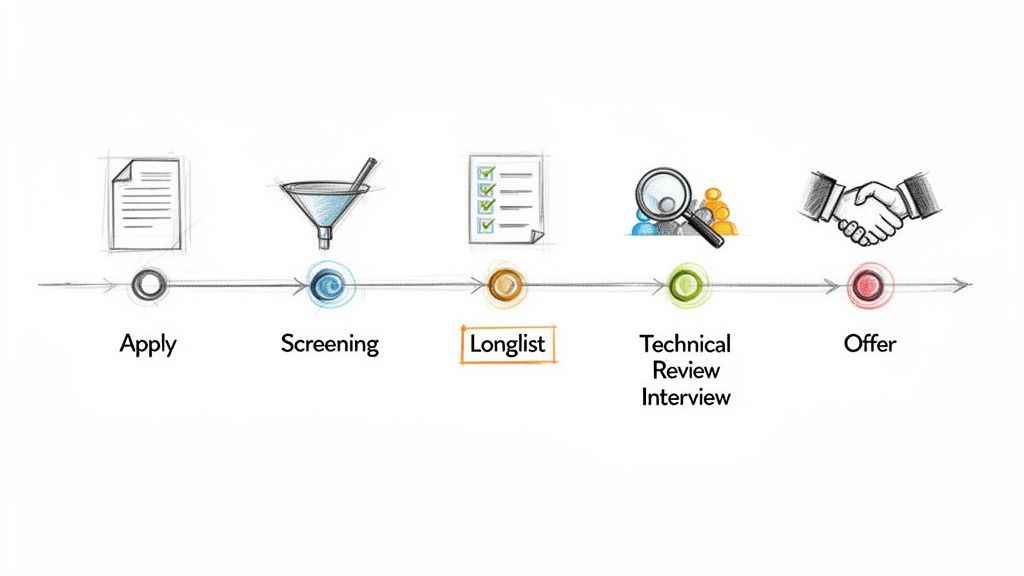
If there’s one virtue you need when applying to the World Bank, it’s patience. The journey from hitting ‘submit’ to getting an offer is almost always long and often feels like a black box. Understanding the typical stages helps you manage your expectations.
The entire process can take anywhere from three to six months, and sometimes longer. A long stretch of radio silence is completely normal, so don’t assume your application is out of the running. The system moves at an institutional pace, not a corporate one.
From Application to Longlist
Once a job posting closes, the real work starts inside the Bank. This first phase filters a massive pool of candidates down to a manageable number.
First, your application hits an automated screening. The Bank’s software scans your resume and cover letter for keywords and qualifications that match the job description. If you don’t pass this check, a human will probably never see your application.
Next, a recruiter in Human Resources goes through the applications that made it past the bots. They’ll build a “longlist” of the 10 to 20 most promising candidates. This list then gets passed over to the hiring manager. Expect this phase alone to take a solid four to eight weeks.
The Technical Review and Shortlist
Now the hiring manager and their team, the actual subject-matter experts, take over. They get the longlist from HR and scrutinize each application from a technical perspective. They’re hunting for genuine expertise and a deep, practical understanding of the field.
This is where your directly relevant experience and quantified achievements become absolutely critical. The team will debate the merits of each candidate, eventually whittling the longlist down to a “shortlist” of the top three to six people they want to interview. This stage can easily add another two to four weeks to the clock.
The core of the World Bank’s mission is creating tangible human impact, and your application needs to reflect that. For instance, the Bank’s recent work supported 244 million people with social safety nets and helped 325 million students access education. These aren’t just numbers; they’re direct translations of projects into human development.
Panel Interviews and Final Selection
The interview stage is the most intense part of the process. You will face a panel interview, which usually includes the hiring manager, a few team members, and someone from HR.
These interviews are competency-based. They use behavioral questions to probe your past performance, problem-solving skills, and how you might fit into the Bank’s culture. You’ll need to come prepared with specific examples of your work, structured clearly using something like the STAR method.
After the interviews, the panel gets together to make its final call. They’ll pick their top candidate and often a runner-up. The interview and deliberation process can tack on another four to six weeks.
Finally, the process moves to reference checks. HR will contact the people you’ve listed to verify your experience and character. Assuming everything checks out, a formal offer is extended. To really get a handle on how these timelines play out, check out our World Bank Hiring Playbook for a more detailed breakdown.
How to Craft an Application That Actually Gets You Shortlisted
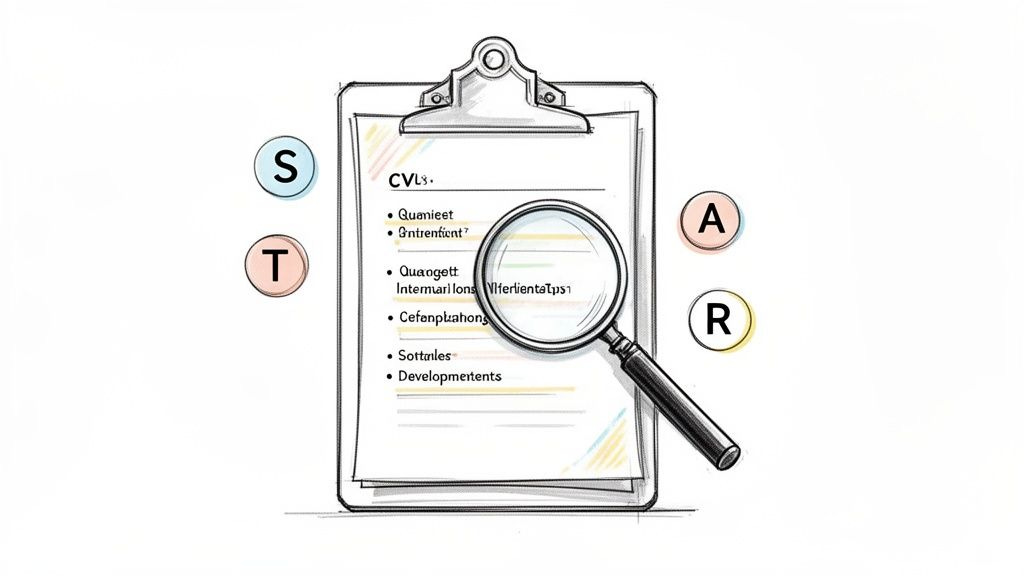
Let’s be blunt: your application is the single most important document you will produce in this process. Most applications are dead on arrival, screened out by software or a quick human scan because they fail to speak the Bank’s language.
Forget the generic advice. We’re going to focus on what actually gets your CV past the initial filters and onto a hiring manager’s desk.
The first rule? Make the recruiter’s job easy. They are drowning in hundreds, sometimes thousands, of applications. Your CV and cover letter need to immediately signal, “I am a serious, qualified candidate who understands this role.” This means you must tailor every single document you submit.
Mirror the Job Description
The job description is your cheat sheet. It’s a detailed list of exactly what the hiring manager needs. Your job is to show them, point-by-point, how your experience solves their problem.
Here’s a practical exercise: print out the job description. Take a highlighter and mark up the key responsibilities, qualifications, and selection criteria. Now, open your CV and edit it to reflect that exact terminology.
If the posting asks for experience in “public financial management,” your resume had better say “public financial management,” not “government budget oversight.” This is critical for passing the initial automated screening systems that look for keyword matches.
Quantify Everything with the STAR Method
Vague statements like “managed a team” or “worked on project implementation” are useless to a World Bank recruiter. They mean nothing. You need to show concrete results and give them a sense of the scale and impact of your work.
The STAR method is the best way to frame every single bullet point on your CV.
Situation: Briefly set the scene. Where were you, and what was the challenge?
Task: What was your specific responsibility? What were you asked to achieve?
Action: What specific steps did you take? Use strong, active verbs.
Result: What happened? Use numbers, percentages, and dollar amounts to prove your impact.
For example, instead of “Led a research project,” a STAR-based bullet point looks like this:
“Led a $50,000 research project (Situation) to assess the impact of microfinance on female entrepreneurs in rural Kenya (Task). Designed and deployed surveys to 500+ participants and analyzed data using Stata (Action), delivering a final report that informed a $5M program expansion (Result).”
This level of detail accomplishes two critical things. First, it proves you have the required technical skills. Second, it demonstrates that you think in terms of impact, which is the absolute core currency of the World Bank.
Navigating the Online Application Portal
The Bank’s online portal is where many otherwise strong applications go to die. It’s a rigid, structured system, and you have to play by its rules. Do not just upload your beautifully formatted CV and call it a day.
Take the time to fill out every single section completely. Pay close attention to any screening questions, which are often simple yes/no queries tied directly to the mandatory qualifications. If you answer “no” to a required skill or provide an answer that contradicts your CV, you’re giving the system an easy reason to screen you out immediately.
Your goal here is simple: present your qualifications so clearly and directly that the recruiter has no choice but to put you on the shortlist. Your application must be a direct, evidence-based argument for why you are the answer to the hiring manager’s problem.
Common Mistakes That Will Sink Your Application
Every year, thousands of highly qualified people get rejected by the World Bank. Their rejections are often not because of their résumés, but because of simple, avoidable stumbles. The recruitment process is a gauntlet, and understanding where others trip up gives you a massive advantage.
The number one killer of applications? Being generic. Recruiters can spot a one-size-fits-all CV and cover letter from a mile away. If your application reads like it could have been sent to any international organization, it’s going straight to the ‘no’ pile. You have to surgically tailor every single application to the specific job you’re targeting.
Another classic mistake is wildly misinterpreting what the role actually requires. The Bank is incredibly precise with its job descriptions. If a position demands five years of experience in urban water management, your decade in rural sanitation, while impressive, isn’t a match. You must address every single listed qualification, point by point.
Ignoring the Competency Framework
This one is fatal. The entire World Bank interview process is built on its competency framework. If you don’t prepare for this, you’re toast. They need to understand how you did your work, not just what you did.
Interviewers will hammer you with behavioral questions designed to see if you have the right stuff. They’re screening for specific traits, including:
Client Orientation: How do you actually build and maintain relationships with stakeholders on the ground?
Teamwork and Collaboration: Can you prove you can work effectively in diverse, multinational teams when things get tough?
Knowledge, Learning, and Communication: How do you share what you know and help others get smarter?
Business Judgment and Analytical Decision Making: What’s your process for making a solid call when faced with a mountain of complex information?
If you can’t give them clear, structured examples that showcase these competencies, you will not get the job. It’s that simple.
The Bank is a mission-driven institution. Demonstrating a collaborative, problem-solving mindset is just as important as your technical skills. They are screening for colleagues, not just employees. An arrogant or individualistic attitude during the interview is a massive red flag.
Misunderstanding the Culture
Finally, many applicants don’t get the unique culture of the World Bank. This isn’t a tech startup or an investment bank. It’s a huge, consensus-driven international bureaucracy.
This means showing patience, diplomacy, and an ability to navigate incredibly complex political and stakeholder environments is non-negotiable. Your demeanor in the interview matters immensely. You need to come across as a collaborative problem-solver who understands that development work is a team sport.
The people who get hired are the ones who prove they have both the technical chops and the right temperament to thrive in this very specific world. Sidestep these common blunders, and you’ll put yourself miles ahead of the competition.
Your Top Questions Answered
Let’s tackle some of the most common questions that pop up when you’re trying to get a job at the World Bank. Getting straight answers can help you manage your expectations and keep your application strategy on track.
How Long Does The Recruitment Process Usually Take?
Be prepared to play the long game. From the day you hit “submit” to getting a final decision, the process can easily take anywhere from three to six months. This is an institutional timeline, not a corporate one, so patience is key.
Just the initial screening and shortlisting can take up to 4 to 8 weeks. After that, you’re looking at another 4 to 6 weeks for interviews, followed by reference checks. A long stretch of silence is completely normal and doesn’t mean you’re out of the running.
Can I Apply for Multiple Positions at Once?
You can, but you have to be smart about it. Firing off the same generic application to a dozen different openings is one of the quickest ways to get all of them rejected. Recruiters can spot a copy-paste job from a mile away.
Focus on quality, not quantity. Only apply for roles where your experience is a clear and compelling match for what they’re asking for. Every single application, including your CV and your cover letter, needs to be carefully tailored to that specific job description.
The real game is showing the hiring manager that you are the solution to their specific problem. A scattergun approach proves you haven’t done your homework and aren’t serious about any particular role.
What Is The Difference Between a Staff Position and a Consultant Role?
These are two entirely different worlds inside the Bank. A staff position is a permanent or long-term appointment. It comes with a full benefits package, a pension plan, and a defined career path within the institution. These are the most competitive jobs to get.
A consultant role, often called an STC or STT, is a short-term contract tied to a specific project. These gigs typically last for up to 150 days per fiscal year. Consultants are essentially treated as vendors; you’re paid a daily rate and don’t get benefits. It’s an incredibly common way for professionals to get a foot in the door, build a network, and prove their worth for a future staff role.
Does The World Bank Sponsor Work Visas?
Yes, but only for staff positions. If you land a staff role in the U.S. and aren’t a citizen or permanent resident, the World Bank will sponsor a G-4 visa for you and your immediate family. This visa is specifically for employees of international organizations.
Consultant contracts almost never come with visa sponsorship. You’re expected to have the right to work in the country where the job is based.
Navigating the MDB hiring landscape requires insider knowledge and timely information. At Multilateral Development Bank Jobs, we deliver curated job lists and practical career guides directly to your inbox, giving you the edge you need to land your next role. Subscribe to get started.