


You’ve probably seen the phrase young professional used in three completely different ways.
A recruiter uses it for a networking event. A university uses it for recent alumni. An MDB uses it in a capitalized program title that can shape an entire career. Those are not the same thing, and treating them as interchangeable leads people into bad decisions.
If your goal is a serious international career, the only definition that matters is the one tied to eligibility, hiring standards, and role design. That’s where most generic career content falls apart. It tells you what the label sounds like. It doesn’t tell you who qualifies.
The Two Meanings of Young Professional
A candidate sees “Young Professional Programme” on an MDB careers page and assumes it means “entry level for people in their twenties.” That mistake costs people time every year.
There are two valid meanings of young professional, and only one helps you assess whether you have a real shot at an MDB track.
The everyday meaning is broad. It usually refers to someone in the early part of a professional career, often degree-qualified, employed, and building toward more specialized work. It works well enough in networking, alumni relations, and general career advice because nobody is applying hard filters.
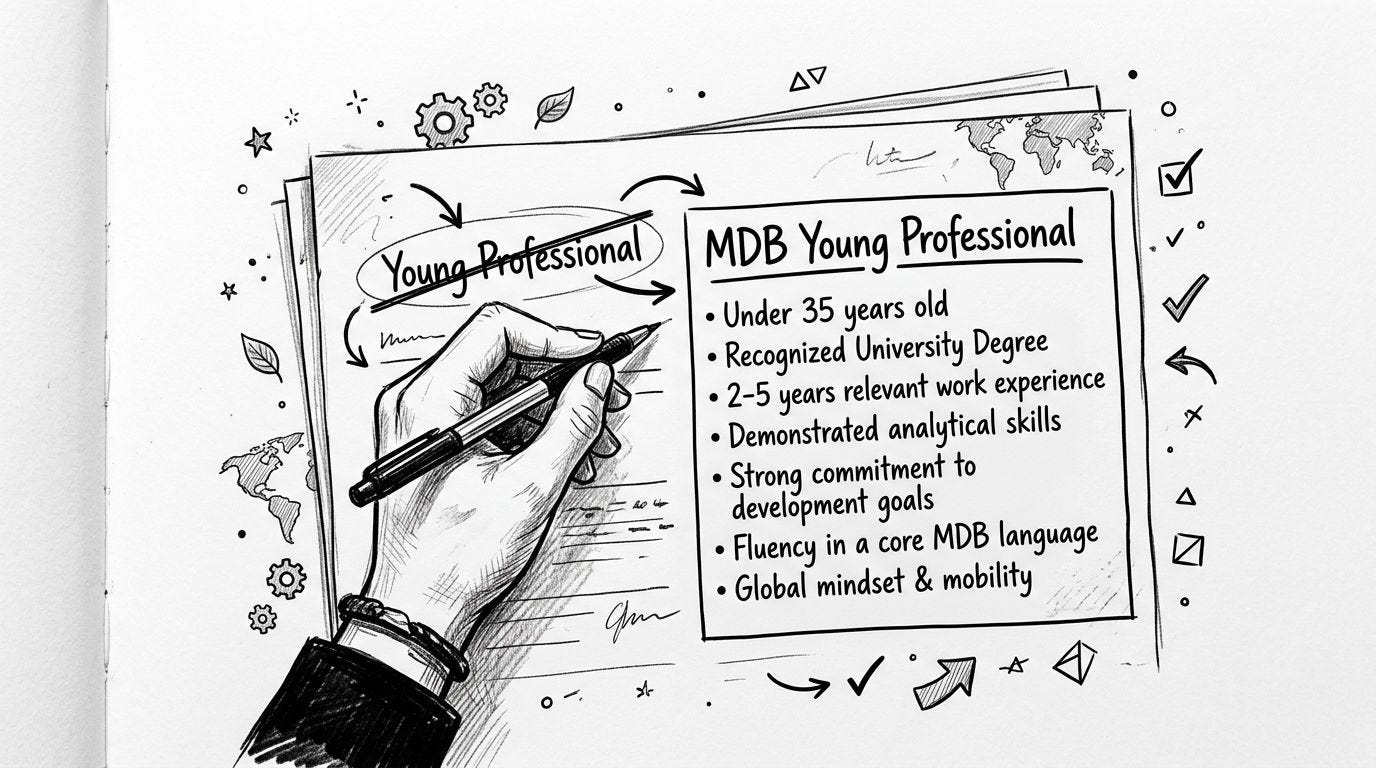
MDBs use the term differently. In that setting, Young Professional is often a formal hiring category with defined selection criteria. The label can carry age limits, graduate degree requirements, relevant work experience thresholds, citizenship or nationality conditions, language expectations, and a competitive assessment process.
That difference matters because candidates often prepare for the social label and ignore the institutional one.
The casual label
In general use, “young professional” describes a career stage. It is not a protected title, and it does not point to one agreed standard. Someone a few years out of university may use it. So might a professional in their early thirties changing sectors or stepping into management.
That flexibility is fine in ordinary conversation. It is useless for screening yourself against a selective program.
The phrase works as a social shorthand. It breaks down once an institution attaches formal eligibility rules to it.
The institutional title
Inside MDB hiring, Young Professional functions more like a program designation than a generic description. It signals a structured entry route for people the institution sees as long-term professional talent, not candidates who happen to be early in their careers.
That is the operative definition in this context. If your target is an MDB YP program, treat the term as a recruitment category with specific gates, not as a vague description of age or ambition.
The General Definition a Demographer Would Use
A candidate can be 29, hold a solid white-collar job, and still be nowhere near competitive for an MDB Young Professional program. That disconnect starts with the ordinary meaning of the phrase.
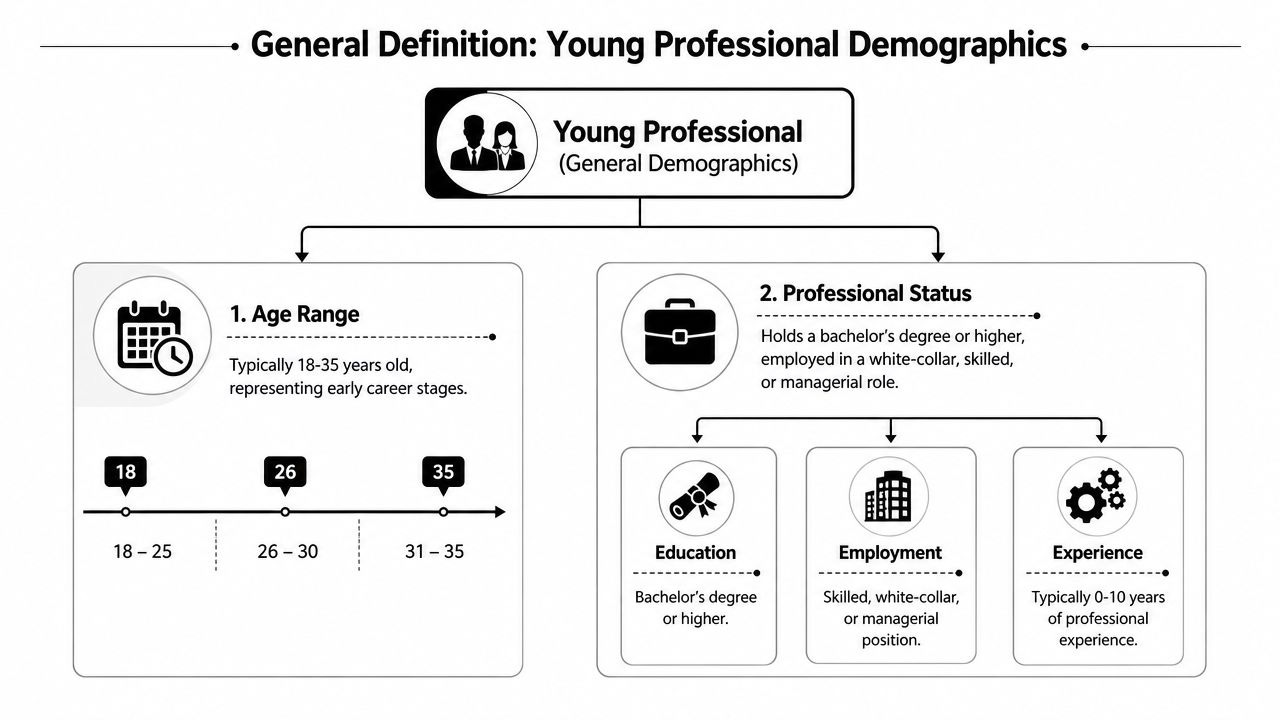
Outside MDB recruiting, the cleanest definition comes from labor-market research. The U.S. Department of Professional Employees describes young professionals as people aged 20 to 34 working in a professional or technical occupation, according to the DPEA factsheet on the young professional workforce.
That definition helps because it gives the term boundaries. It ties “young professional” to age and occupation instead of status signaling, networking culture, or personal branding.
The broad labor-market picture
Demographers often use the 25 to 34 age band as a practical proxy. In the United States, the National Center for Education Statistics reported that in 2023 about 80% of 25- to 34-year-olds were employed, up from 75% in 2013 and 79% in 2019, based on NCES data on educational attainment and employment.
The same NCES source also shows why education matters in this age range. Among 25- to 34-year-olds whose highest attainment was high school completion, the employment rate was 74% in 2019, fell to 68% in 2021, and returned to 74% in 2023. In plain terms, “young professional” usually implies stronger attachment to skilled work than the much wider category of “young adults.”
That is useful context. It is weak screening logic.
A demographer is trying to describe a population. An MDB recruiter is trying to cut that population down to a very small shortlist. Those are different jobs, and they produce different definitions.
Why this definition is too broad for MDB candidates
For someone targeting the World Bank, ADB, AfDB, IMF, or AIIB, the general definition does very little work. It tells you that you may fit a common labor-market category. It does not tell you whether you fit a specific intake with degree rules, language expectations, nationality constraints, or experience thresholds.
This is the mistake I see often. Candidates use the social meaning of “young professional” as a proxy for competitiveness, then wonder why they are screened out.
Use the term in three layers:
Demographic definition: a young adult in a professional or technical occupation
Program definition: an applicant who clears a bank’s formal eligibility filters
Competitive definition: an applicant whose profile stands up against the current pool
The third layer is the one that decides outcomes.
If you are benchmarking yourself against a bank such as ADB, start with the published program criteria and role profile, not the casual label. Our guide to the ADB Young Professional Program is a better model for self-screening than any broad workforce definition.
The right question is not “Am I a young professional?” It is “Do I meet this program’s exact eligibility rules, and do I look strong against its applicant pool?”
How MDBs Actually Define a Young Professional
In the MDB world, Young Professional is a formal recruitment track. It’s not a flattering term for promising applicants. It’s an institutional category with screening logic behind it.
Banks use YP programs to bring in people who can grow fast, move across functions, and eventually handle complex operational or policy work. That’s why the bar is higher than many candidates expect.
What the title usually signals
When an MDB advertises a YP route, it usually means the institution wants an applicant who already looks credible in a professional environment. You’re expected to arrive with academic depth, relevant work, and enough maturity to handle cross-border teams, policy pressure, and operational ambiguity.
A useful benchmark comes from outside the MDB system but within the same class of elite international employers. NATO’s Young Professionals Programme requires candidates to be 21 to 32 years old, hold a master’s degree or equivalent, have at least one year of professional experience including internships or temporary assignments, and demonstrate proficiency in English or French, according to NATO’s Young Professionals Programme requirements.
That tells you something important. Institutions use young professional to describe an early-career expert, not a blank-slate graduate.
What usually matters in practice
Across major MDB programs, the details vary. The core logic does not.
Here’s what selection teams usually care about most:
Advanced education: A master’s degree is commonly the floor. In some tracks, a PhD or a highly technical profile helps.
Relevant experience: Generic work experience won’t carry much weight. The experience needs to connect to operations, policy, finance, economics, infrastructure, governance, climate, social development, or another bank-relevant field.
Clear international fit: Language ability, cross-cultural exposure, and evidence that you can work across institutions matter.
Program-specific constraints: Age limits, nationality requirements, and field preferences can eliminate you before anyone reads your motivation statement closely.
What candidates get wrong
The biggest mistake is treating YP as an entry-level synonym.
It isn’t.
Internships are entry-level. Some assistant or analyst roles are entry-level. A YP seat is usually a fast-track professional role. You are being assessed for long-term institutional potential, not for basic readiness to join an office.
Practical rule: Read the eligibility page first, then assess your profile honestly. Aspirational reading wastes time. Criteria-driven reading saves it.
If you’re targeting ADB specifically, this guide to the ADB Young Professional Program is the kind of program-specific material worth studying. That’s the right approach. Move from the generic label to the actual recruitment architecture.
YP vs Intern vs JPO What’s the Difference
A candidate finishes a master’s, picks up a year or two of relevant work, and starts applying everywhere with “young professional” in the title. That usually leads to a muddled search. In MDB hiring, these tracks sit at different points in the pipeline, and the selection logic behind each one is different.
The cleanest way to separate them is to ask a blunt question: is the institution testing potential, offering exposure, or funding early-career development?
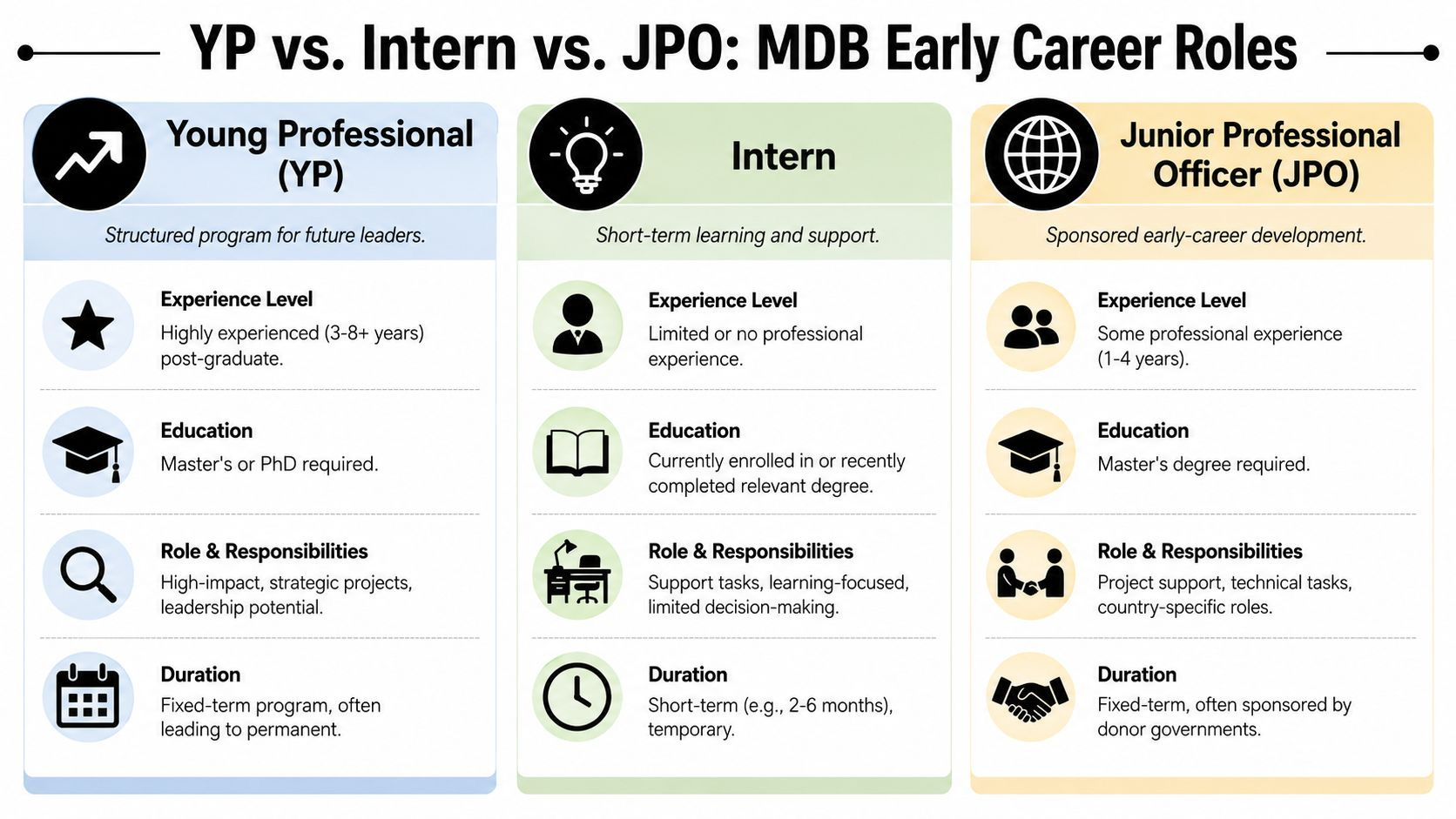
The quick comparison
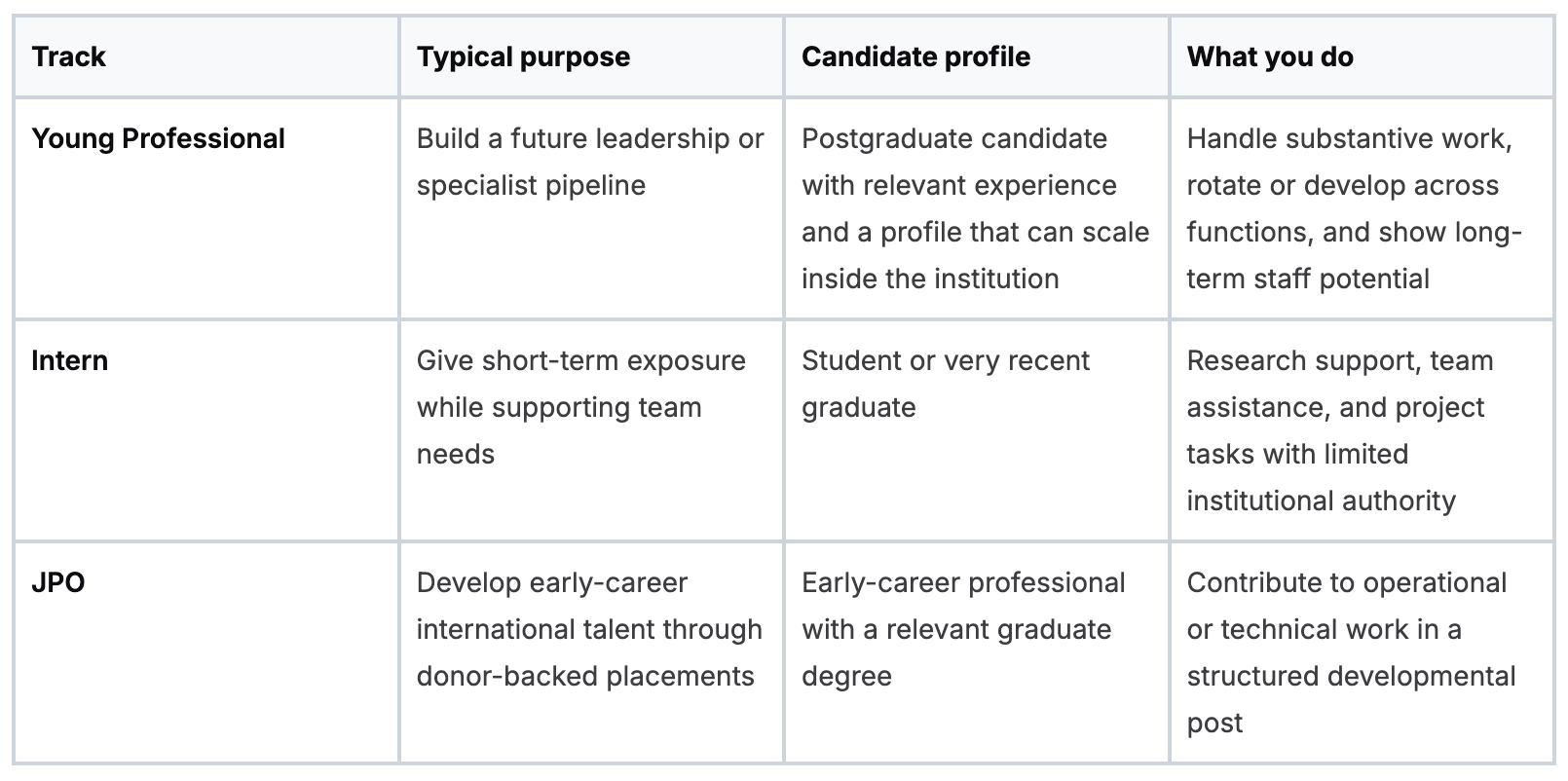
YP is the highest-trust entry point of the three
This is the distinction that matters.
A YP seat is usually built for people the bank may want to retain and grow. The bar is higher because the role carries more trust earlier. You are not being brought in mainly to observe how the institution works. You are being assessed for whether you can operate inside it, represent it well, and grow into harder assignments.
That is why candidates who are still at the exploration stage often do better looking at World Bank jobs for fresh graduates and similar early-career routes instead of forcing a YP application too early.
Internships are for access and signal building
Internships matter, especially if you need proof of institutional fit, exposure to MDB workflows, or recognizable names on your CV. I would still treat them for what they are: a learning and screening mechanism.
The trade-off is straightforward. Internships can strengthen your profile, but they rarely place you in the same decision space as a YP hire. The work can be useful and visible within a team, yet the role itself is not designed as a fast-track professional intake.
JPO is a separate route, not a weaker YP
Candidates often misread JPOs as a backup plan for people who missed YP. That is too simplistic.
A JPO post usually exists because a donor government is funding a structured early-career placement. The host institution benefits, the donor develops talent, and the candidate gets a serious professional role with clearer scaffolding than most internships provide. Depending on the sponsor, nationality rules and eligibility conditions can matter as much as your technical fit.
A simple decision rule works:
Choose an internship if you need exposure, proof of fit, or recognizable MDB experience.
Choose a JPO if you meet sponsor rules and want structured early-career development with real professional content.
Choose a YP track if you already have the academics, experience, and maturity for a higher-trust intake.
If your profile could fit more than one route, choose based on function and entry level, not prestige. Title confusion wastes time. Program design tells you where you belong.
A Look Inside Major MDB Professional Programs
The phrase Young Professional looks uniform from the outside. The programs do not feel uniform once you study them closely.
Each institution uses the model to solve its own talent problem. That means the right fit depends on your discipline, geography, and preferred style of work.
World Bank Group
The World Bank track is the one most candidates picture first. It attracts people who want broad development exposure, institutional mobility, and high-visibility work. The profile that does well here usually combines strong academics with policy fluency, operational credibility, and the ability to speak clearly across sectors.
People who are earlier in the pipeline sometimes confuse this with lighter-entry routes. It helps to separate them mentally from roles such as the World Bank Junior Professional Associate pathway, which serves a different purpose and targets a different stage.
Asian Development Bank
ADB tends to reward candidates who can connect technical skill to the practicalities of the Asia-Pacific region. Sector relevance matters. Regional familiarity matters. The ability to work in a highly international environment while staying grounded in development execution is also highly valued.
The strongest ADB candidates usually look specific, not generic. They can explain why their experience fits the bank’s portfolio and member-country context.
African Development Bank
AfDB often attracts applicants with deep interest in regional development, infrastructure, private sector growth, public systems, and delivery challenges on the continent. The strongest candidates usually combine serious technical preparation with a practical understanding of implementation conditions.
That distinction matters. Many applicants can talk strategy. Fewer can talk strategy and execution in the same breath.
IMF and AIIB
The IMF sits in a more specialized lane. Many roles lean harder toward macroeconomics, financial systems, surveillance, and policy analysis. Candidates need to understand the institution they are applying to, not just admire the brand.
AIIB has a different feel again. It draws applicants interested in infrastructure, investment, project finance, and institution-building in a newer multilateral setting. The pace, portfolio, and internal culture can differ from older banks.
Good candidates don’t apply to “MDBs” in the abstract. They apply to a specific institution for reasons they can defend.
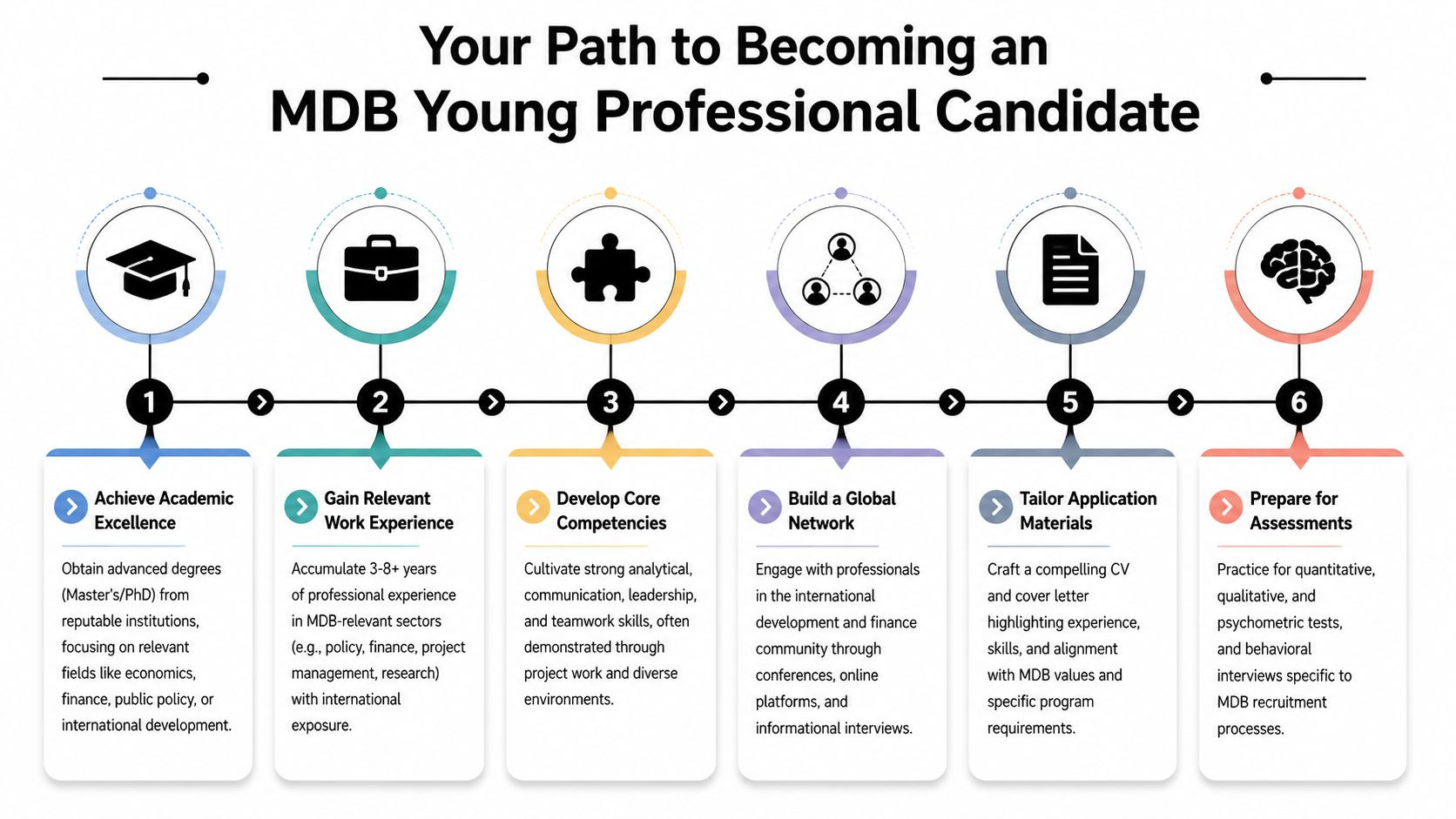
Your Path to Becoming a Candidate
A common mistake happens early. A candidate sees the phrase “young professional,” assumes it means generally early-career, and starts collecting credentials at random. MDB selection does not work that way. Once you are targeting a formal Young Professional program, the question is not whether you seem promising for your age. The question is whether your profile already matches a narrow institutional screen.
That is why strong applicants prepare backward from the program, not forward from a vague career label.
Build the three assets that matter
Selection panels tend to reward the same three things, even when the formal criteria differ by institution.
Academic credibility
You need advanced training that fits the work the bank hires for. That may be economics, public policy, finance, engineering, law, development studies, climate, health, governance, infrastructure, or a quantitative social science field.
The degree is a screening tool first. It signals that you can handle technical material, write clearly, and operate at the level expected in a policy and operations environment.
Professional evidence
Many applications often weaken. Committees want proof that you have already worked on problems close to the ones the institution handles.
Useful experience usually has at least two of these features:
Substance: You owned analysis, implementation, operations, investment work, policy design, or technical delivery.
Relevance: The work connects clearly to development finance, public systems, regulation, infrastructure, social sectors, or institutional reform.
Progression: Your CV shows growing responsibility, not a series of disconnected brand names.
A candidate with three solid years in a ministry, DFI, regulator, project unit, or serious consulting team often looks stronger than someone with a shinier but thinner profile.
Narrative discipline
Good candidates still lose here.
Your application has to answer four questions with precision:
Why this institution
Why this practice area or function
Why this stage of your career
Why your background is competitive against other high-performing applicants
If those answers are vague, the rest of the file starts to look accidental.
What tends to help
Focused accumulation helps. Pick a domain and build depth. Add cross-border or field exposure if you can. Build language capability where it is valued. Learn to describe your work in plain English, especially the problem, your role, and the result.
There is a trade-off here. Breadth can make you adaptable, but too much breadth makes you look unfocused. Early in the process, candidates often overvalue optional extras and undervalue core evidence. A short certificate is fine. It does not substitute for credible work with policy, financing, implementation, or operational complexity.
A practical routine helps:
Track openings consistently: One option is the Multilateral Development Bank Jobs newsletter, which publishes MDB staff roles, consultant listings, and long-form guides.
Study real job descriptions: They show recurring degree requirements, sector preferences, language expectations, and experience thresholds.
Audit your gaps candidly: If the same requirements keep appearing across programs, treat them as a hiring signal, not a suggestion.
The strongest non-linear candidates do one thing very well. They make every turn in their background look purposeful.
Clearing Up Common YPP Myths
A candidate sees “young professional” in a job forum, checks their age, and assumes they are eligible for an MDB YPP. That is where a lot of bad applications start. In MDB hiring, the casual label means almost nothing. The program criteria decide everything.
“You have to be under 30”
Age myths waste time because they confuse a social label with a recruitment scheme. Some programs set an age limit. Some do not. Some change the rule by intake. The only version that matters is the one in the vacancy notice for that institution and cycle.
“Only economists can apply”
Economists are one part of the pool, not the whole pool. MDBs recruit for operations, infrastructure, finance, governance, law, climate, social development, digital, risk, and other specialist tracks. The real question is not whether your field sounds prestigious. It is whether your background matches a live hiring need and whether you can show applied results.
“You need a PhD from an elite school”
Programs screen for academic strength, but pedigree alone does not carry an application. In many files, a strong master’s degree plus relevant execution experience is more convincing than a highly academic profile with little evidence of delivery. I have seen candidates overestimate the signaling value of a famous university and underestimate the value of solid work in policy, lending, implementation, or advisory settings.
“An internship is the only route in”
Internships help, especially if they give you exposure to operations or internal writing standards. They are still only one route. Candidates also come in from consulting, government, central banks, project finance, technical sector work, JPO roles, and nationally anchored positions that build directly relevant experience.
“A career change disqualifies you”
Career changes are common. Unexplained career changes are the problem. A switch can strengthen your case if it gives the bank a clearer reason to hire you. It weakens your case if the story reads like drift, with no credible connection between your past work and the function you now want.
“If I fit the age band, I count as a young professional candidate”
That assumption fails in screening. MDB recruiters are not asking whether you fit a broad demographic label. They are asking whether you meet the stated criteria for that specific Young Professional program, at that specific institution, in that specific year.
This is the practical test. Can you show the degree they ask for, the experience level they expect, the language profile they prefer, and a coherent reason for your fit?
Candidates who handle this well stop arguing with the label. They read the program notice closely, map their evidence against it, and make a hard call. Apply now, build for the next cycle, or use a different entry route first.
If you want a clearer view of the MDB hiring market, Multilateral Development Bank Jobs tracks roles across major institutions and publishes practical guides on YPPs, consultant pathways, and bank-specific hiring rules. It is a useful way to monitor openings and compare what different MDBs ask for.