

The Asian Development Bank (ADB) Young Professional Program is a prestigious leadership accelerator. It’s built to find and cultivate the bank’s future senior managers and directors. You get a three-year fixed-term contract where you’ll work on real-world development projects across Asia and the Pacific. This program is your most direct shot at a long-term, high-impact career inside the ADB.
What Is the ADB Young Professional Program
The ADB Young Professional Program (YPP) is a talent pipeline. Its purpose is to recruit and develop the future leaders of the Asian Development Bank. This is not just another entry-level job. It’s a structured, long-term investment in a small group of high-potential people who show a deep commitment to the region’s development.
When you’re accepted, you join the bank on a three-year, fixed-term appointment at the YP1 grade level. That contract comes with a 12-month probationary period. Think of this first year as your proving ground. You have to demonstrate your technical skills, your adaptability, and how well you align with the ADB’s mission.
The Strategic Importance of the Program
Here’s what makes the YPP different. The ADB does not see Young Professionals as a way to fill immediate operational gaps. Hiring departments are specifically told to view YPs as long-term assets for the bank’s future. The program’s design reflects this strategic commitment to growing leadership from within.
This focus on future leadership separates the ADB YPP from many other early-career roles in international development. The bank invests heavily in your growth through a mix of challenging assignments and structured learning.
The entire program is a breeding ground for the next generation of ADB directors and senior staff. Your performance is evaluated on your immediate tasks and on your potential to lead complex development initiatives in the future.
Your Path as a Young Professional
After you successfully clear the 12-month probation, you are confirmed in your role and get a promotion to the YP2 grade. This is a big milestone. It solidifies your position within the bank and opens you up to more complex responsibilities. Over your three-year term, you’ll typically complete two rotational assignments.
These rotations are designed to give you broad exposure to how the bank works. For example, you might spend your first assignment working on a transport infrastructure project from the Manila headquarters, then move to a country office in Southeast Asia to support its implementation on the ground.
This structure ensures you get both headquarters and field experience, which is critical for a well-rounded career in a multilateral development bank. It’s helpful to understand the bigger picture of where this can lead. Check out our guide on Asian Development Bank jobs to see the full career landscape.
At the end of your three-year term, strong performance leads to regularization. This means your fixed-term contract converts to a regular staff position, putting you squarely on a path for a long and impactful career at the Asian Development Bank.
Meeting the Eligibility Requirements
Before you spend a single second polishing your CV, you need to be certain you qualify for the ADB Young Professional Program. The bank has a set of non-negotiable criteria, and they are ruthless about enforcing them. If you miss even one, your application is automatically discarded. No questions asked.
Think of these requirements as the first and most brutal filter. ADB uses them to cut a massive applicant pool down to a manageable number of genuinely qualified candidates. It’s a blunt instrument, but it’s effective, so you have to get this part right.
The Core Eligibility Checklist
Let’s get straight to it. These are the four pillars of eligibility you must meet. There is zero flexibility on these points.
Age Limit: You must be born on or after a specific date. For the 2024 program, this was January 1, 1992. This means you have to be 32 years of age or younger when you apply. You’ll need to prove it with a passport or birth certificate.
Nationality: You must be a citizen of an ADB member country. The ADB has 68 member countries, and if yours isn’t on the list, you simply cannot apply. This is a hard-and-fast rule.
Academic Qualification: You need at least a Master’s degree or an equivalent qualification. The degree has to be in a field that ADB cares about for the YPP role you’re targeting: think economics, finance, public policy, or an engineering discipline relevant to their operations.
Professional Experience: You must have a minimum of two years of relevant, full-time professional experience. Crucially, this experience has to be after you finished your Master’s degree and must directly relate to the job you want at ADB.
These criteria are designed to find exceptional young talent who are ready to hit the ground running. You’ll also need excellent oral and written English, as it’s the working language of the bank’s multinational environment.
Understanding the Nuances
Ticking the boxes is not enough. You have to understand what the ADB is really looking for. For instance, while two years of experience is the stated minimum, the reality is that many successful YPs have closer to three to five years of highly relevant work under their belt.
The key word here is “relevant.” Your experience must sync up with ADB’s operational priorities. This could be work in sectors like energy, urban development, climate change, or public health. If you’ve worked at another multilateral development bank (MDB), a government agency, or a major international NGO, that’s a huge plus. It shows you already get the ecosystem.
The ADB is looking for a specific cocktail of academic training and practical experience that screams “future leader.” Your entire profile has to tell a clear story of commitment, capability, and alignment with their mission.
This is why you have to be brutally honest with yourself about your qualifications. If you’re not sure whether your nationality qualifies you for roles at the ADB or other MDBs, you can use our tool to check your eligibility across different MDBs. It’s a quick way to confirm where you stand before you pour hours into an application.
Building Your Application Strategy and Timeline
The application window for the ADB Young Professional Program is brutally short and intensely competitive. Success is about executing a perfect application strategy. Procrastination will kill your chances, so you need a battle plan to manage the whole process.
The official roles typically get announced in late summer, usually around August, with a deadline just a few weeks later in September. This tight turnaround leaves zero room for error. You must have your documents ready and waiting well before the job descriptions go live.
Your Pre-Application Game Plan
The candidates who succeed don’t start prepping when the announcement drops. They start months earlier. Your mission is to have 90% of your application package complete before the YPP vacancies are posted. This means your CV, academic transcripts, and a solid cover letter template are ready to be fine-tuned.
The short application window is for making final, targeted tweaks, not starting from a blank page. When the specific job descriptions are released, you’ll be focused on perfectly aligning your materials with the roles you’re targeting, not scrambling to find your diploma.
Here’s the bare-minimum checklist of documents you’ll need to have ready to go:
Updated Curriculum Vitae (CV): Your CV needs to be specifically tailored to reflect ADB’s operational priorities.
Cover Letter: This isn’t a formality. It has to make a powerful case for why you want to work at the ADB and not somewhere else.
Academic Transcripts and Diplomas: Get digitized copies of your Master’s degree and any other relevant qualifications. Don’t wait.
Proof of Nationality: A clean, clear copy of your passport is a must.
Hunting down these documents, especially official transcripts, can take weeks. Start this process early to avoid a last-minute panic.
The Application Timeline Breakdown
To stay on top of everything, you need a timeline. The ADB YPP process is fairly predictable, which is a huge advantage for those who plan ahead. A disciplined, methodical approach is your best weapon.
A solid plan is vital if you’re trying to juggle a demanding job while you prepare. If you need more advice on how to schedule your job search, our guide on how to set time targets for landing an MDB job offers a practical framework.
The application window is a sprint, but the preparation is a marathon. How methodically you prepare each piece of your application will directly determine whether you get noticed by the recruiters.
To help you get organized, I’ve put together a typical timeline and checklist. Use this to map out your own project milestones and hold yourself accountable.
ADB YPP Application Timeline and Checklist
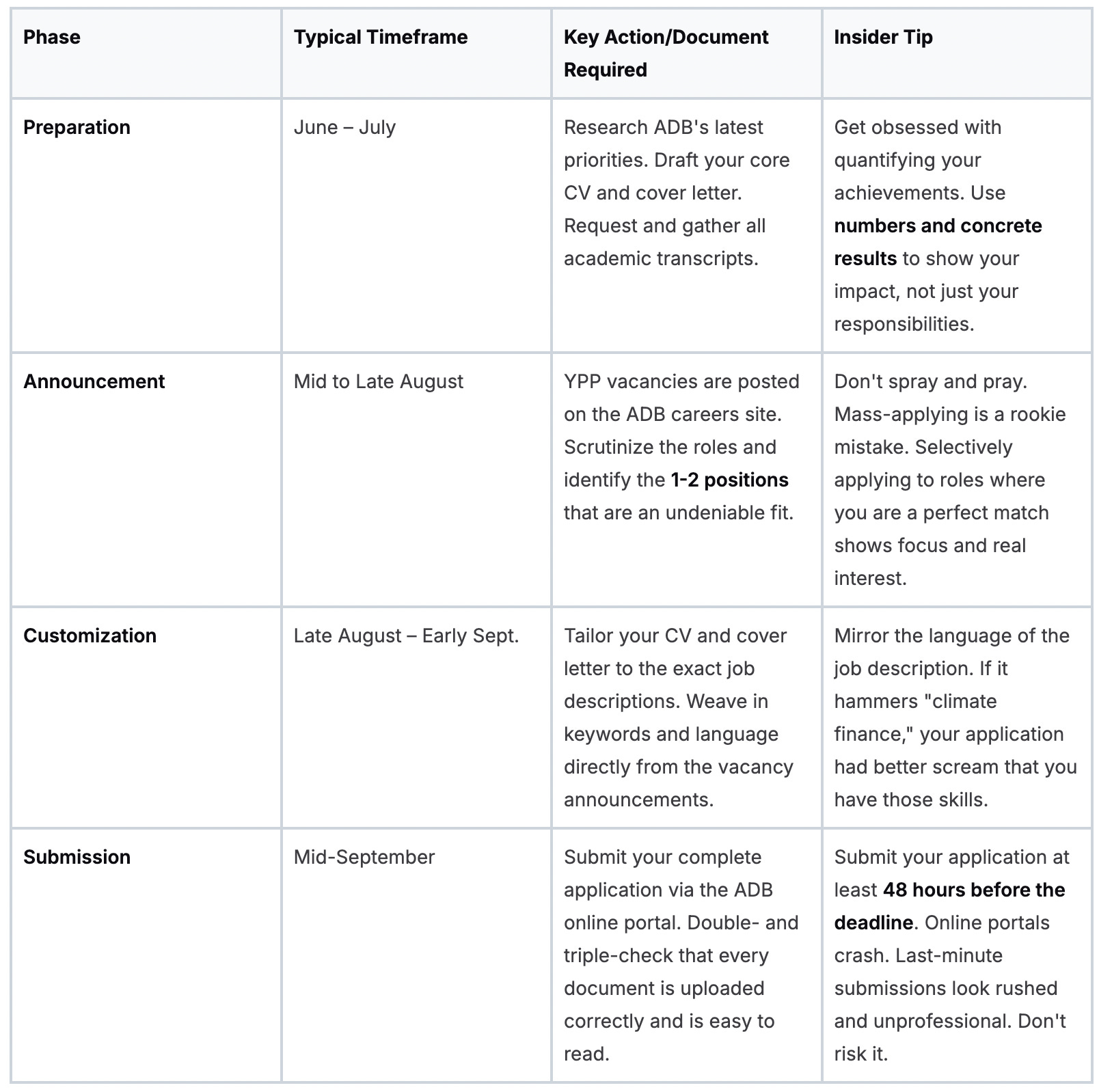
Stick to this timeline, and you’ll move from a state of reactive stress to one of proactive confidence. When that application window opens, you’ll be ready to strike.
The Selection Gauntlet: What to Expect After You Apply
Hitting “submit” on your application is just the starting gun for a long and grueling race. The ADB Young Professional Program selection process is a multi-stage gauntlet designed to methodically whittle down thousands of hopefuls to a handful of new hires. Knowing what’s coming is your best defense.
First, your application lands in front of the ADB’s HR team for an initial screening. This is a simple, brutal check: do you meet every non-negotiable eligibility rule? If you don’t, you’re out. No exceptions. If you do, your file moves on to be reviewed against the specific needs of the hiring departments. This is where tailoring your CV and cover letter pays off.
If you make it through this initial cull, you’ll be placed on the longlist. Congratulations, you’ve beaten out a huge chunk of the competition. But this is where the real tests begin, as the process shifts from checking credentials to seeing how you perform under fire.
Before we dive into the stages, this diagram neatly sums up the foundational work you need to do just to get to this point.
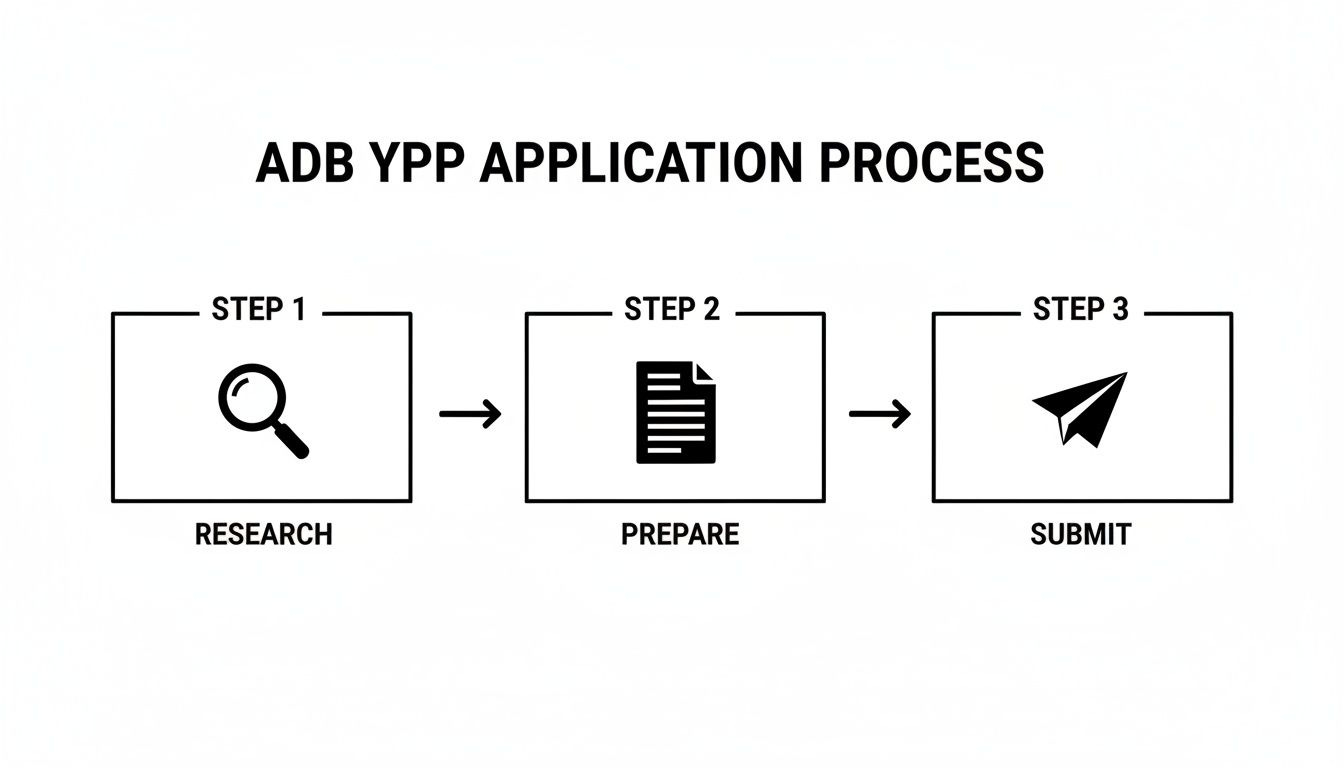
As you can see, the effort you put in long before the selection process starts is what will carry you through the challenges ahead.
Stage 1: The Online Tests
Once you’re on the longlist, you’ll get an invitation to complete a series of online tests. These are not a formality. They are a critical elimination stage designed to test your cognitive horsepower and your technical chops.
The tests usually fall into two categories:
Psychometric Tests: Think of these as a mental workout. They’ll measure your verbal, numerical, and logical reasoning skills under tight time constraints. The goal is to see if you have the raw analytical ability to think on your feet.
Technical Tests: This is where your specialized expertise is put under the microscope. The questions will be directly tied to the role you applied for. If you’re gunning for an Economist position, expect tough macroeconomics questions. If you applied as a Transport Specialist, get ready for project finance or engineering scenarios.
The only way to get through this is to practice. You can find tons of free resources online to drill for standard psychometric tests. For the technical part, dust off your Master’s degree notes and make sure you’re up-to-date on the major projects and policy debates happening in your field right now.
Stage 2: The One-Way Video Interview
If you clear the testing hurdle, you’ll move on to a pre-recorded video interview. This is exactly what it sounds like: a one-way street where you record your answers to questions that pop up on your screen. You won’t be talking to a live person, which can feel awkward.
This stage is about your communication style and composure as much as what you actually say. ADB wants to see if you can explain complex ideas clearly and concisely, even when you’re just talking to your webcam.
The STAR method is your best friend here. It’s a classic for a reason:
Situation: Set the scene. What was the project or challenge you faced?
Task: What was your specific job? What goal did you need to accomplish?
Action: What, exactly, did you do? Focus on your personal contributions, not the team’s.
Result: What happened in the end? Use numbers and hard data to quantify your impact whenever you can.
Do a few practice runs by recording yourself on your phone or laptop. Watch the playback. Are you looking at the camera? Is your background clean and professional? These details matter more than you think.
Stage 3: The Assessment Center and Final Interview
The final, and most intense, stage is the assessment center, which all leads up to a final panel interview. This is a high-stakes, multi-day affair where you and the other finalists are put through a series of exercises that simulate the real work of a Young Professional.
You can expect a mix of challenges, including:
Case Study Analysis: You’ll get a complex problem, often based on a real ADB project, and a limited time to analyze it, develop recommendations, and prepare a presentation.
Group Exercises: This is all about teamwork. They want to see how you collaborate, influence others, and work toward a shared goal. These skills are essential in a massive multilateral organization like ADB.
Final Panel Interview: This is the main event. You’ll sit across from a panel of senior ADB staff, including managers from the department that wants to hire you. They will grill you on your experience, your motivations, and your understanding of the development challenges facing Asia and the Pacific.
Your performance across all these exercises determines whether you walk away with an offer. It’s a grueling finale, but making it this far proves you’re a top contender.
Crafting a Winning CV and Cover Letter
Your CV and cover letter are your opening sales pitch for the Asian Development Bank Young Professional Program. A generic, one-size-fits-all application is a guaranteed way to get your file tossed in the reject pile. You need to craft these documents with surgical precision, showing you have the skills and you get ADB’s mission and culture.
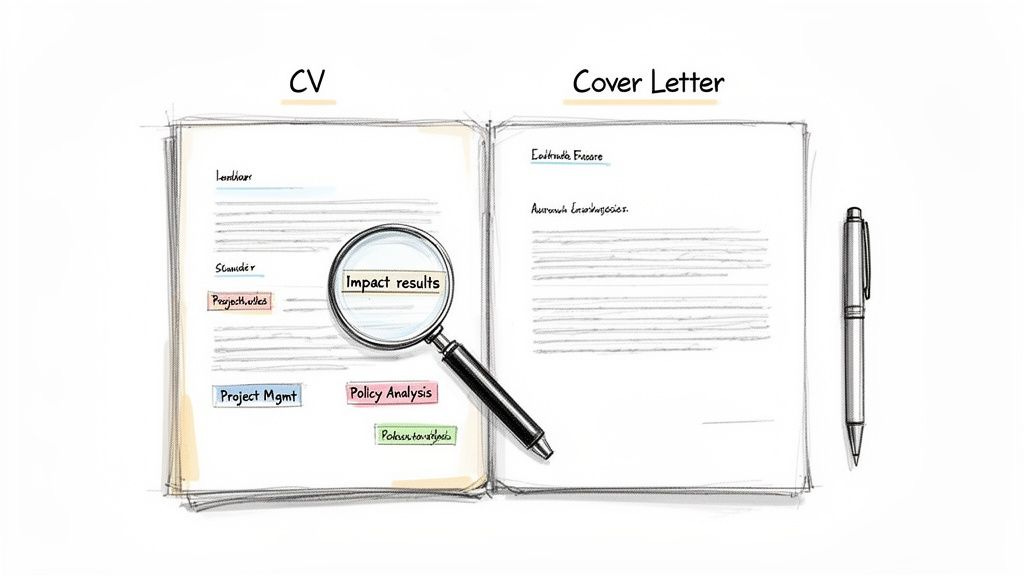
Think of the ADB reviewer as your audience. They might spend only a few seconds scanning each CV. Your job is to make those seconds count by giving them exactly what they’re trained to look for: measurable impact, relevant expertise, and a clear line connecting you to development in Asia and the Pacific.
Architecting Your Impact-Driven CV
Your CV needs to be less about listing job duties and more about showcasing your results. The ADB isn’t hiring you to perform tasks; they’re hiring you to deliver outcomes. You have to reframe every bullet point to answer the question, “So what?”
For instance, instead of saying you “managed a project,” you need to quantify it. Did you manage a $2 million grant? Did you lead a team of five people to complete a feasibility study three weeks ahead of schedule? That’s the language of impact, and it’s what gets noticed.
Project Management Skills: Detail your role in the project lifecycle. Mention specific methodologies you used, budgets you oversaw, and the stakeholders you coordinated.
Policy Analysis: Don’t just say you analyzed policy. Explain what the policy was about, the analytical tools you used (like cost-benefit analysis), and how your work directly informed a specific decision or recommendation.
Financial Modeling: If this is your skill, be explicit. State the type of models you built (e.g., DCF, project finance models) and what purpose they served, such as securing funding or evaluating an investment’s viability.
Your CV should tell a story of progressively increasing responsibility and concrete achievements. Every line must position you as a capable, results-oriented professional who can handle the complexities of development work.
Connecting Your Story in the Cover Letter
The cover letter is where you connect the dots. It’s your chance to bridge the hard data in your CV with your personal commitment to the ADB’s mission. This is where you articulate your “why.” Why the ADB? Why this specific program? Why now? A generic letter that could be sent to any development bank is a waste of an opportunity.
You need to show you’ve done your homework. Reference a specific ADB project, a recent strategy document like Strategy 2030, or a blog post from an ADB expert that resonated with you. For example, you could link your experience in gender-focused initiatives to the ADB’s work on helping women rejoin the workforce post-pandemic.
Your cover letter has to make a compelling case that you’re a long-term investment. It’s the human element that breathes life into the data on your CV.
Structure your letter to tell a clear, concise narrative:
The Hook: Start with a powerful opening. State the exact role you’re applying for and immediately connect your core expertise to a known ADB priority.
The Proof: Dedicate a paragraph or two to specific examples from your career that demonstrate the key skills they’re looking for. Link these directly to the kind of work you’d be doing as a Young Professional.
The “Why”: Explain your motivation. Connect your personal story or professional goals to the development challenges in Asia and the Pacific. Show them this is more than just a job for you.
Your cover letter should be concise, passionate, and deeply personal. It’s your single best chance to speak directly to the hiring manager and convince them you are the perfect fit for the ADB Young Professional Program.
Your Career Path After the YPP
You’ve made it through the three-year gauntlet of the YPP. Congratulations. Finishing the program isn’t the end; it’s the start of your long-term career at the Asian Development Bank. The YPP is a pipeline, designed to turn you from a fixed-term Young Professional into a full-fledged international staff member.
After your 3-year term, assuming you’ve performed well, regularization is practically a given. It’s rare for a YP who completes the program not to be offered a permanent position. This means your contract flips to a regular staff appointment, and you’re officially on the path toward leadership.
Navigating Your Post-YPP Career
The YPP gives you a serious advantage. The blend of headquarters experience in Manila and a field-based rotation makes you incredibly versatile. You’ll have built a network across different departments and, more importantly, you’ll have a ground-level understanding of how ADB projects get designed and delivered.
This foundation sets you up for a few common career tracks:
Become a Sector Guru: You can choose to go deep, becoming a go-to expert in a specific area like energy, transport, or urban development. This path usually means working on bigger, more complex projects and policy work from the Manila headquarters.
Go to the Field: If you prefer being closer to the action, you can pursue a role in one of ADB’s Resident Missions. This is where you’ll have direct, day-to-day contact with government officials, project teams, and the communities ADB serves.
Climb the Ranks at HQ: You might also opt to move up the ladder in Manila, taking on roles with more strategic and management responsibility. This could look like leading project teams, managing a departmental budget, or helping shape the bank’s big-picture strategy.
The YPP is explicitly designed to find and groom the next generation of ADB leaders. The broad exposure and tough training are meant to prepare you for senior roles down the line, whether that’s a Country Director, a sector chief, or a senior manager running a major department.
The Tangible Impact of an ADB Career
Your work at ADB contributes to real, measurable outcomes. For instance, between 2010 and 2013, projects funded by the Asian Development Fund led to new or upgraded schools for over 17 million students.
In that same period, ADB also trained more than 700,000 teachers and improved quality assurance systems impacting over 20 million students. You can explore more about these transformative projects and see the kind of far-reaching impact your career could have.
The goal of the ADB Young Professional Program is to identify and mold individuals who can one day steer the bank’s mission. Your career after the program is about delivering on that initial investment, making a tangible difference in the lives of millions across Asia and the Pacific.
Frequently Asked Questions About the Program
Let’s clear up some of the most common questions that pop up about the ADB Young Professional Program. Getting these details right from the start can make or break your application.
Can I Apply with More Than Two Years of Experience?
Yes, absolutely. Think of the two-year requirement as the starting line, not the finish line. In fact, many successful candidates come in with three to six years of high-quality, relevant experience.
The real test is whether your experience is a perfect fit for the role you’re targeting. The YPP is built for early-career professionals who have clear leadership potential, not for seasoned experts. If you’re clocking in at ten years of experience, you’re almost certainly too senior for this program.
What Kind of Professional Experience Is Relevant?
The right experience connects directly to what the Asian Development Bank does day-in and day-out. Your professional background needs to be in a field where the ADB is actively investing and making an impact.
Sector Experience: This means you’ve worked in areas like energy, transport, water, urban development, climate change, public finance, or digital development.
Functional Skills: Your resume should scream competence in project management, policy formulation, economic analysis, or financial modeling.
Institutional Background: Having prior experience at another multilateral development bank, a key government agency, a top-tier consulting firm, or a major international NGO is a huge plus. It shows you already speak the language and understand the ecosystem.
Is a PhD Required for the ADB YPP?
No, a PhD is not a hard requirement. The minimum ticket to entry is a Master’s degree or an equivalent postgraduate qualification.
A PhD can definitely give you an edge, but usually only for highly specialized roles, like an Economist position in the research department or a Climate Scientist. At the end of the day, the selection committee looks at the whole package: the powerful combination of your academic credentials and your real-world professional wins. The right experience often speaks louder than a higher degree.
At Multilateral Development Bank Jobs, we track opportunities and share insider advice to help you build a career with impact. Subscribe for weekly job listings and deep-dive guides to land your role at the ADB, World Bank, and more.