

A Terms of Reference, or TOR, is the single most important document you’ll see in MDB consulting. Think of it as the project’s DNA. It’s the official blueprint that tells you exactly what the client wants, why they want it, and how they expect you to deliver.
Getting this document right is the first and most critical step to winning high-value contracts.
The TOR is Your Project’s Constitution
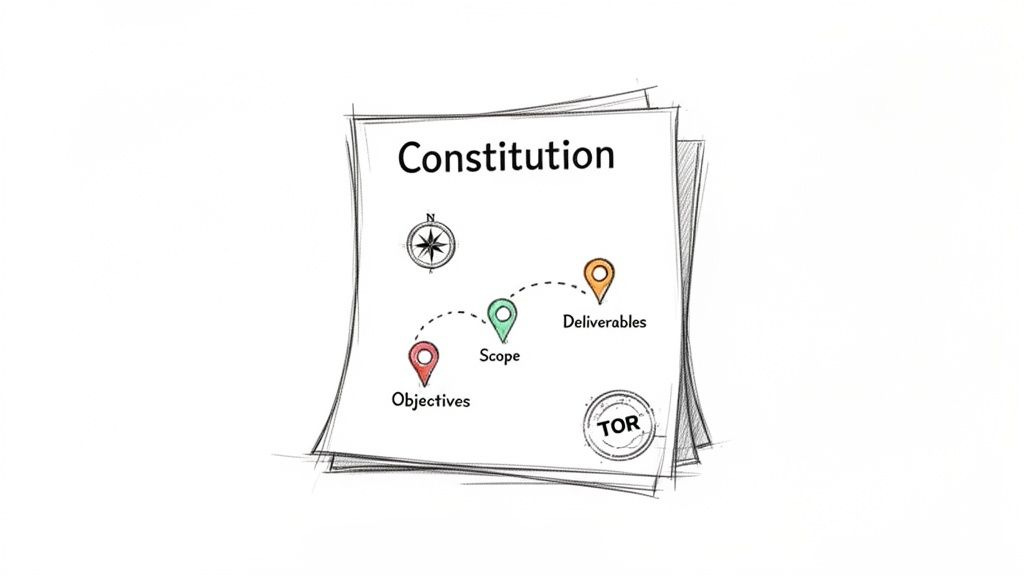
I call a TOR the project’s constitution. It lays out the rules of engagement, draws clear boundaries, and sets the goals everyone must work toward. It’s much more than a job description. It’s a detailed, often legally binding guide that dictates everything from your initial proposal to your final payment.
This is the foundational agreement between you and the client. It gets everyone on the same page before any money is spent or work begins, which kills misunderstandings and scope creep before they start.
Why MDBs Live and Die by the TOR
For Multilateral Development Banks, the TOR is a non-negotiable governance tool. These institutions manage enormous, complex projects funded by public and private money, so precision is everything. This reliance has intensified as MDBs’ share of total Official Development Finance shot up from 45% to 61% between 2012 and 2022.
When MDBs committed $60.7 billion to climate finance in 2022, you can bet the TOR for every single project specified exactly how those funds would be used for mitigation and adaptation, down to the last detail. If you want to dive into these numbers, the OECD’s report on multilateral development finance is a great resource.
So, what does a TOR actually do for an MDB?
It Defines Success: The TOR gives you measurable objectives and specific, tangible deliverables. There’s no guesswork about what a “win” looks like.
It Sets the Boundaries: It clearly outlines the scope of work: what’s in, and just as critically, what’s out. This is your shield against scope creep.
It Ensures Accountability: By establishing reporting requirements, timelines, and evaluation criteria, the TOR creates a clear framework to measure your performance.
Mastering how to read and respond to a TOR separates amateur applicants from seasoned MDB consultants. It’s how you prove you understand their world and can deliver work that meets their high standards.
Terms of Reference vs. Job Description At a Glance
It’s easy to mistake a TOR for a fancy job description, but they are fundamentally different. A job description outlines a role; a TOR defines a mission. This table breaks down the key distinctions.
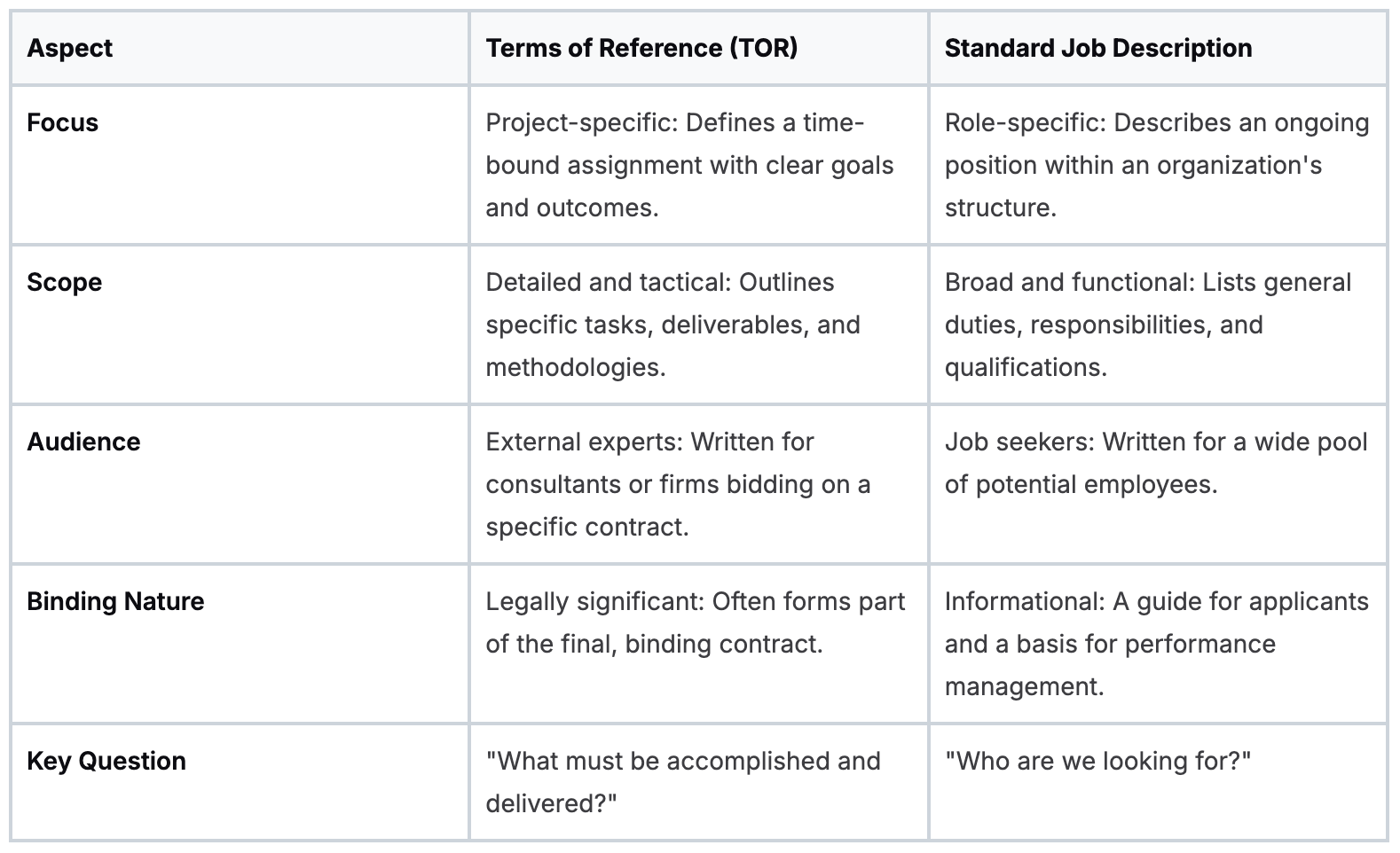
Understanding this difference is crucial. When you respond to a TOR, you’re not just applying for a job. You’re submitting a strategic plan to solve a specific problem. That requires a completely different mindset.
Decoding the Core Components of a TOR
Every TOR follows a predictable script. Once you learn the pattern, you gain a massive advantage. You can instantly zero in on the information that actually matters.
It’s like reading a blueprint. You don’t have to be an architect to understand the big picture once you know where to find the foundation, the electrical plan, and the plumbing layout. It’s the same with a TOR.
Let’s pull apart a typical TOR, piece by piece. This is a practical walkthrough of the sections that will make or break your proposal.
The Groundwork: Background and Objectives
The first part of any TOR sets the stage. The background section is the “why.” It explains the client’s problem, the history leading up to this project, and maybe what they’ve tried before that didn’t work. Read this part like a detective. It’s packed with clues about the client’s real pain points.
Right after that, you get the objectives. This is the heart of the document. Objectives are the high-level goals, the “what” the client wants to achieve. Everything else in the TOR is just detail on how to get there.
A well-written TOR has SMART objectives: Specific, Measurable, Achievable, Relevant, and Time-bound. If the objectives feel fuzzy or vague, that’s a huge red flag. It means the client hasn’t thought through what they actually want, which can spell trouble down the line.
The Nitty-Gritty: Scope, Deliverables, and Timeline
This is where the rubber meets the road. These sections get hyper-specific about what you’re being paid to do and produce.
Scope of Work: This defines the sandbox you’ll be playing in. It lists the specific activities and tasks you need to perform. It also tells you what is out of scope. This is your best defense against scope creep.
Deliverables: These are the tangible things you have to hand over, like reports, datasets, presentations, or software. A good TOR will define each one so there’s no debate about what “done” looks like.
Timeline: This is your project calendar, laying out key milestones and final deadlines. A realistic timeline is a great sign of a well-planned project. An absurdly tight one is another red flag. For many consultants, the timeline is a make-or-break factor when considering short-term consultancy positions.
The People and Process: Qualifications and Reporting
Finally, the TOR gets into who they’re looking for and how you’ll communicate once you’re on board.
The required qualifications section is your checklist. It lists the non-negotiable skills, years of experience, and educational background they need. You have to prove you tick these boxes to get your foot in the door. These are gatekeepers. If you don’t meet them, your application is dead on arrival, especially with MDBs.
The reporting structure tells you who your boss is, how often you need to check in, and what those check-ins look like. This section gives you a surprisingly clear window into the client’s management style and how much oversight you can expect.
By breaking a TOR into these parts, you shift from feeling overwhelmed to being in control. You’ll know exactly what the client wants, how they want it, and whether you’re the right person for the job.
How MDBs Use TORs to Steer Billions in Funding
When you look at a Terms of Reference from a Multilateral Development Bank, you’re not just reading a job description. You’re looking at a piece of a massive, multi-billion-dollar strategic puzzle. A TOR is a critical governance tool that institutions like the World Bank and the African Development Bank use to steer huge initiatives with absolute precision.
The TOR is where strategy becomes action. It’s the mechanism that translates a huge, abstract goal like “improving climate resilience” into a concrete, measurable, and auditable project with a defined budget and a hard deadline. For any consultant trying to win a bid, understanding this context is everything.
The TOR creates a clear line of sight from the high-level project goal down to the specific tasks you’ll be paid to do.
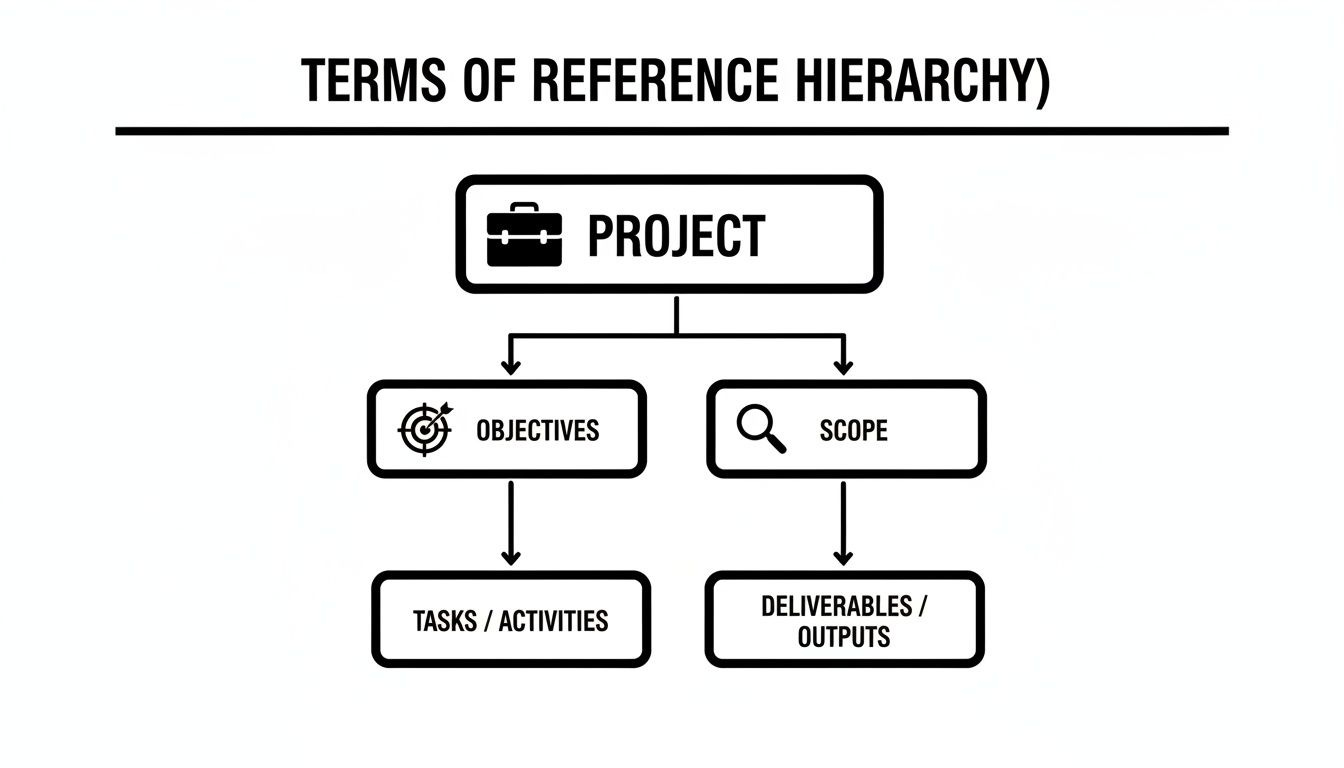
This structure ensures that every single deliverable directly serves the bank’s mission, leaving zero room for misinterpretation.
The TOR as a Financial and Risk Management Blueprint
A TOR dictates much more than your daily to-do list. It’s a core part of how MDBs manage their financial health and institutional risk. Every clause, from the budget ceiling to the reporting schedule, is there to enforce accountability and maintain control.
In MDB governance, a TOR defines the exact guardrails for lending, equity, and risk. For example, the European Investment Bank (EIB) has to maintain a strict gearing ratio, currently at 87% against a 92% threshold. This rule is enforced through statutes directly referenced in project TORs.
This meticulous control, embedded in every TOR, allowed MDBs to collectively hit a record $137 billion in climate finance. If you’re targeting competitive roles like Young Professional Programs, you have to get this. For a deeper dive, you can see how these financial structures operate across different banks.
Why This Inside View Matters to You
So, what does all this high-level talk mean for your application? It means you’re bidding to become a temporary, but vital, cog in a rigorously managed machine.
When an MDB hires you, they entrust you with a piece of their reputation and a slice of their meticulously managed funds. Your ability to deliver is a direct reflection of their ability to achieve their global mission.
This perspective should change how you write your proposal. You need to speak their language: a language built on accountability, risk mitigation, and measurable impact.
Showing you understand this bigger picture, that you see the TOR as a contract of trust and strategic alignment, will instantly set you apart from the crowd. It proves you’re a partner, not just another contractor.
How to Read a TOR Like a Pro: Your Actionable Checklist
You’ve got a new Terms of Reference in your inbox. This is the moment of truth. Don’t just skim it. It’s time to dissect this thing. A thorough, critical analysis is what separates consultants who win great projects from those who waste weeks chasing dead ends.
Your mission is to hunt for red flags, get clarity on fuzzy details, and make a smart call: is this project a good fit for me? This is about interrogating the document. A well-written TOR is a roadmap to success. A messy one is the first sign of a disorganized client and a project destined for trouble.
Let’s break down how to do it right.
The First Pass: Make-or-Break Questions
Before you even think about writing a proposal, run the TOR through this quick filter. These are big-picture questions. A hard “no” on any of them means you should seriously consider walking away. This gut check can save you a world of pain.
Are the objectives clear and measurable? Look for concrete goals like “increase farmer crop yields by 20% in the target region.” Vague ambitions like “enhance agricultural productivity” are a warning sign.
Is the timeline realistic? If a client asks for a complex, multi-country study that should take six months and they want it in six weeks, they’re setting you up to fail.
Are the deliverables specific? “Final report” is a guess. “A 40-page report with a literature review, stakeholder interview analysis, and a cost-benefit model” is a deliverable. You need to know exactly what you’re on the hook for.
Do my skills truly match the qualifications? Be brutally honest. If the TOR demands 10 years of experience in public financial management and you have three, this isn’t the one.
The Deeper Dive: Spotting the Hidden Dangers
Okay, the TOR passed the first test. Now it’s time to read between the lines. This is where you uncover hidden assumptions, unstated expectations, and the danger of scope creep. Seasoned consultants know that what a TOR doesn’t say can be just as important as what it does.
Pay close attention to the language. Phrases like “including, but not limited to...” or “assist with other duties as assigned” are classic scope creep traps. They are the client’s backdoor to pile on extra work you never agreed to or budgeted for.
Look for a fundamental mismatch between the budget (if they’ve shared it), the timeline, and the list of deliverables. A client who wants the moon delivered in two weeks on a shoestring budget isn’t just optimistic. They’re clueless. It signals that they don’t understand the value of your work.
A professional client provides a TOR where resources, timeline, and expectations are in harmony. Anything less means you should proceed with caution.
The TOR Red Flag Detector
Think of this table as your early-warning system. These are common signs of a poorly planned project or a difficult client relationship waiting to happen.
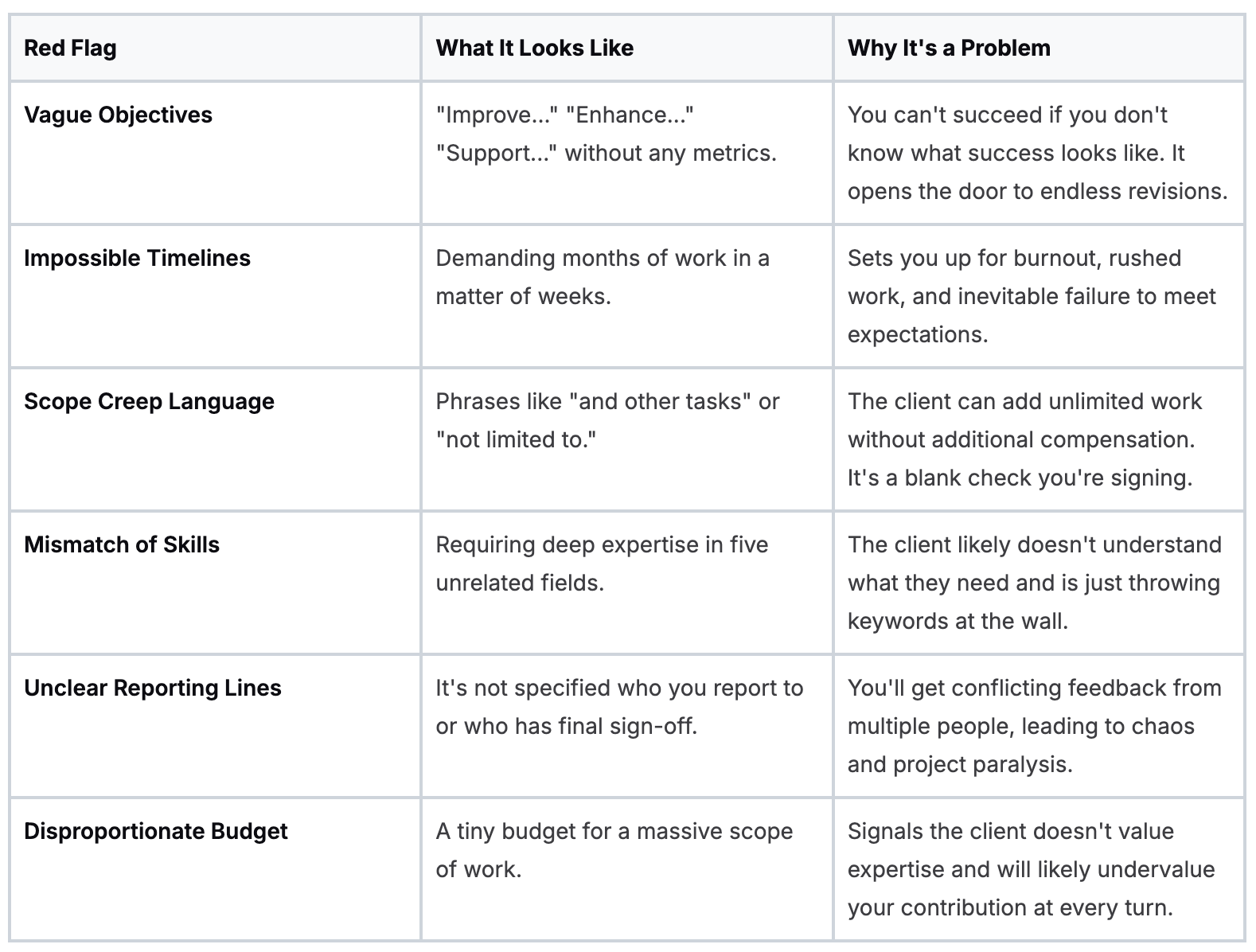
If you spot one or two of these, ask clarifying questions. If you see three or more, it’s probably time to politely decline and move on. Your time is too valuable to spend on projects that are broken from the start.
Tailoring Your Application to Win the Contract
Let’s be blunt: a generic, copy-paste application is a losing application. This is especially true in MDB consulting, where the client is procuring a specific solution to a complex problem. The TOR is your cheat sheet, giving you the keywords, priorities, and language you need to make your proposal the obvious choice.
Your job is to show the client you’ve read and understood the TOR. This means mirroring its language and structure in your CV and proposal without sounding like a parrot. You must create a direct, undeniable link between their problem and your experience.
Frame Your Experience as the Solution
Start by deconstructing the “Required Qualifications” and “Scope of Work” sections. Treat them like a checklist. For every requirement they list, provide a direct, tangible example from your own history.
This isn’t about listing past jobs. It’s about reframing your accomplishments to speak directly to the client’s needs.
If the TOR asks for: “Experience in post-conflict infrastructure needs assessments...”
Your CV should state: “Post-Conflict Infrastructure Specialist: Conducted a comprehensive needs assessment in Country X, identifying critical infrastructure gaps and securing $1.5M in follow-on funding.”
See the difference? The second example uses the TOR’s keywords but frames the experience as an achievement with a measurable outcome. This proactive approach shows you don’t just have the experience; you know how to use it to get results. If you’re thinking about a career with MDBs like the African Development Bank, this is the level of detail they expect. You can learn more in our guide to AfDB careers.
Connect Your Work to Broader MDB Goals
Demonstrating that you understand the TOR’s role within the larger MDB framework is a powerful move. These documents don’t exist in a vacuum. They often tie into critical global areas like climate finance and social infrastructure, specifying allocations and impacts.
For instance, TORs guided the $60.7 billion committed in the 2022 Joint MDB Climate Finance Report, with specific TORs differentiating projects for mitigation (63%) from those for adaptation. Showing you grasp this context proves your value goes beyond technical skills. You can read the full 2022 Joint MDB Climate Finance Report to see these priorities in detail.
Your proposal should implicitly answer the question: “How will my work help this MDB achieve its strategic objectives?” When you connect your deliverables to their larger mission, you’re no longer just a consultant. You’re a strategic partner.
This targeted approach transforms your application from a hopeful resume into a compelling business case. It proves you’ve done your homework and are ready to deliver precisely what the client needs, making you the clear and logical choice.
A Real-World TOR Breakdown
Let’s stop talking theory and get our hands dirty.
A good TOR isn’t about fancy jargon. It’s about clarity. When you strip it all down, every decent TOR, whether from the World Bank or a boutique consulting firm, has the same core skeleton.
Think of the following as your mental checklist every time you open a new job posting.
The Basic TOR Structure
Project Title: What’s this gig called?
Background: Why does this project even exist? What’s the problem they’re trying to solve?
Objectives: The big-picture goals. If you nail this, what does success look like?
Scope of Work: The nitty-gritty. What are the specific tasks you’ll be doing day-to-day?
Key Deliverables: The tangible things you have to create. Reports, presentations, datasets. What are they paying you to produce?
Timeline & Milestones: When is everything due?
Consultant Qualifications: The skills and experience they think are non-negotiable.
Reporting Structure: Who’s your boss?
Budget: How much money is on the table for this work?
Annotated TOR Excerpt: Reading Between the Lines
Now, let’s see how this plays out in the real world. Here’s a snippet from a TOR, followed by what a seasoned consultant is actually thinking. This is the internal monologue that helps you decide if a project is right for you and how to frame your application.
Project: Climate Resilience Strategy for the Port of Mombassa
4. Scope of Work: The consultant will conduct a vulnerability assessment of port infrastructure. This includes analyzing sea-level rise projections, storm surge modeling, and identifying critical asset failure points.
(My note: Okay, this is a highly technical assessment. They need a specialist, not a generalist. I need to push my climate modeling and infrastructure analysis experience to the very top of my proposal. They’re looking for hard skills here.)
Answering Your Burning TOR Questions
Alright, let’s get into the nitty-gritty. These are the practical, in-the-weeds questions that pop into your head when you’re staring down a Terms of Reference. Here are the straight-up answers you need.
What’s the First Thing I Should Look At in a TOR?
Go straight to the objectives and deliverables. No exceptions. This is the heart of the contract. It tells you exactly what the client wants to achieve and what you have to hand over when you’re done.
If these two sections are crystal clear, it’s a great sign that the rest of the document will be solid. If they’re vague, confusing, or contradictory, that’s a massive red flag. The client hasn’t fully thought through their own project, and that’s a headache you don’t want.
Can I Negotiate the Terms in a TOR?
Yes, but you have to be smart about it. You can’t just mark up the whole document with red ink. You can and should ask clarifying questions before you submit a proposal. If a timeline seems impossible or a deliverable is poorly defined, raise the issue upfront.
A professional client will appreciate thoughtful questions that head off problems down the road. It shows you’re a serious expert who understands project management, not just a contractor willing to agree to anything.
This is your chance to gently push back on unrealistic expectations. Frame your questions around ensuring a successful outcome for them, and you’ll find it leads to a much more productive conversation. For a deeper dive into the application process, check out our guide on how to apply for World Bank jobs.
How Long Should a Good TOR Be?
There’s no magic number. A TOR for a simple, two-week research assignment might only be a few pages. A TOR for a complex, multi-year infrastructure program could easily run 50 pages or more.
Length is far less important than clarity and detail. A short, precise TOR is always better than a long, rambling one that leaves you with more questions than answers. The document just needs to be long enough to clearly define the project without burying you in unnecessary fluff.
What if I Don’t Meet All the Qualifications?
Be brutally honest with yourself here. MDBs often use the “required qualifications” section as a hard filter. If a TOR demands 10 years of experience and you have five, your application will almost certainly be screened out by an algorithm before a human ever sees it.
However, if you meet all the core requirements but are missing one or two minor “preferred” qualifications, it can still be worth applying. The trick is to directly address it and emphasize how your other strengths more than compensate for that small gap. Don’t just hope they won’t notice.
At Multilateral Development Bank Jobs, we don’t just find you listings. We give you the insider knowledge to win them. Our weekly newsletter delivers curated full-time staff and consultant roles from over 30 MDBs, plus deep-dive guides to help you navigate the entire process. Subscribe to MDB Jobs and start turning applications into contracts.