

Thinking about volunteering overseas? Let’s get one thing straight: this is a strategic career move, not a gap year activity. The right placement is a launchpad into international development.
You’ll find a spectrum of opportunities, from fully-funded professional gigs with organizations like VSO and UN Volunteers to grassroots projects where you might fund your stay. The real challenge is cutting through the noise to find a role that builds your CV and makes an impact, instead of being expensive tourism.
The Modern Volunteer Landscape: Professionalized and Growing
Forget the stereotype of paying a fortune to paint a school for a week. Today’s voluntary service overseas jobs demand real skills and offer tangible, career-defining experience in return.
This shift is why the market is exploding. The global volunteer sector is projected to jump from USD 8.5 billion in 2025 to a staggering USD 22.4 billion by 2033. You can see the numbers in the full market research.
More growth means more options, and you need a solid framework to tell the good from the bad.
“Volunteering” Is Not a Monolith
The word “volunteer” covers a massive range of roles. You have high-skill, stipended positions that are essentially entry-level professional jobs. You also have short-term, fee-based placements focused on cultural immersion.
Neither is inherently better, but they serve different purposes. Understanding the basic models is the first step to finding your fit.
I’ve broken down the most common program types you’ll find. This is your roadmap for figuring out where you belong.
Comparing Overseas Voluntary Service Models
This table lays out the common program models to help you identify the best fit for your career goals and financial situation.
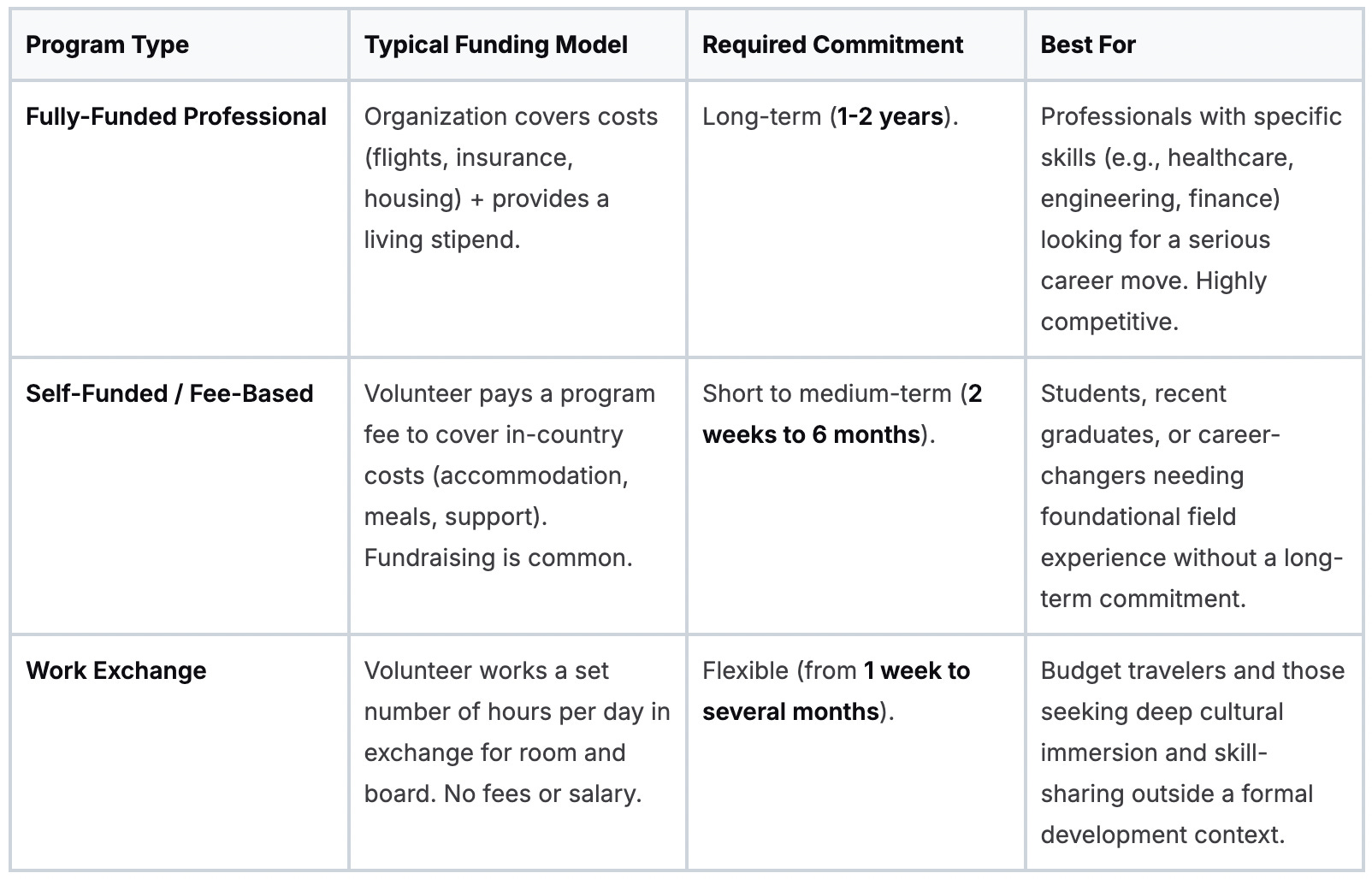
These models offer distinct pathways. The fully-funded roles are your direct route into the professional development sector. Fee-based and work-exchange programs are excellent for building foundational skills and cultural literacy. Choose the one that aligns with your immediate goals.
Here’s the bottom line: ask yourself one critical question. Are you paying for an experience, or are you being compensated for your skills? Answering that honestly will filter your options and point you in the right direction.
How to Vet Programs and Find Reputable Organizations
The voluntary service overseas market is crowded. Your first task is to separate high-impact, legitimate organizations from glorified tour operators selling program fees.
Getting this wrong means wasting thousands of dollars and months of your time on an experience that doesn’t help the local community or your career. A slick website and glossy photos mean nothing. You have to dig deeper.
This decision tree gives you a quick visual on how to start narrowing things down based on your goals, your budget, and your time commitment.
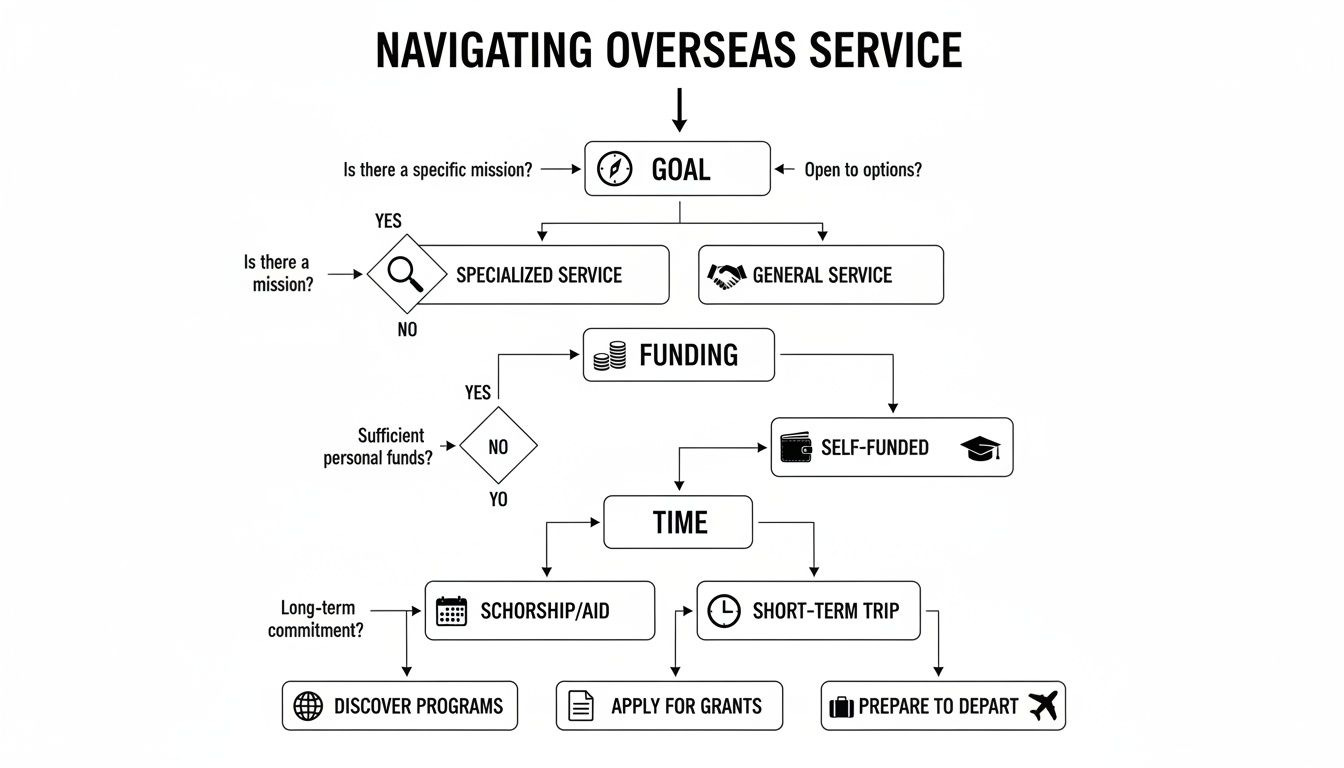
As the flowchart shows, everything starts with what you want. Are you looking for serious professional development, or is cultural immersion your priority? Be honest. That answer filters everything else.
Key Indicators of a Quality Program
You need hard evidence that a program is effective and ethical. Vague promises about “making a difference” are a red flag. Real organizations are transparent and operate professionally.
Here’s a checklist of what to look for:
Clear Project Descriptions: They should tell you exactly what you’ll be doing. What are your specific roles and responsibilities? What are the expected outcomes? If it’s fuzzy, they don’t have a clear plan.
Evidence of Community Partnership: The best programs are locally driven, not imposed by outsiders. Look for mentions of local partners: community leaders, local NGOs, government bodies. This is a huge sign of legitimacy.
Financial Transparency: Where does your money go? Reputable non-profits often have annual reports or financial statements available. If you can’t find a clear breakdown of program fees, be skeptical.
Detailed In-Country Support: The website should spell out the entire support structure. This includes airport pickup, a real orientation process, housing details, and clear emergency protocols.
Digging Deeper for Honest Feedback
Online reviews are a starting point, but you have to read between the lines. A dozen five-star reviews saying “It was amazing!” are less useful than one detailed, balanced three-star review that lays out the pros and cons.
The most valuable intelligence comes from speaking directly with past volunteers. If an organization hesitates or refuses to connect you with their alumni, walk away. That’s a massive red flag. Former volunteers are your single best source for the unvarnished truth.
When you talk to them, ask direct questions. How was the training? Did you feel your work had a real impact? What was the in-country support actually like? This is where you’ll find out what life on the ground is really like.
Go-To Organizations for Professional Placements
Some organizations have a long-standing reputation for professional, high-impact programs. These are often government-backed or large international non-profits that offer structured roles with a stipend or living allowance. They are professional entry points into the sector.
VSO (Voluntary Service Overseas): Specializes in placing skilled professionals in long-term roles to fill specific development gaps identified by local partners.
UN Volunteers: A direct pipeline into the United Nations system. It offers a huge range of assignments supporting UN agencies across the globe, from fieldwork to policy analysis.
Peace Corps: This is a major commitment: a two-year U.S. government program focused on grassroots community development. It’s tough but highly respected.
These placements are competitive and the application process is rigorous because they’re treated like real jobs. The skills you build are directly transferable to careers in international development, including opportunities in our guide on short-term consultancy positions. Think of them as a direct on-ramp to a career in the development sector.
Building a CV That Gets You Noticed Internationally
Your standard corporate resume will fall flat for voluntary service overseas jobs. Recruiters for these roles scan for a different set of skills: resilience, cross-cultural competence, and resourcefulness, not just a list of professional certifications.
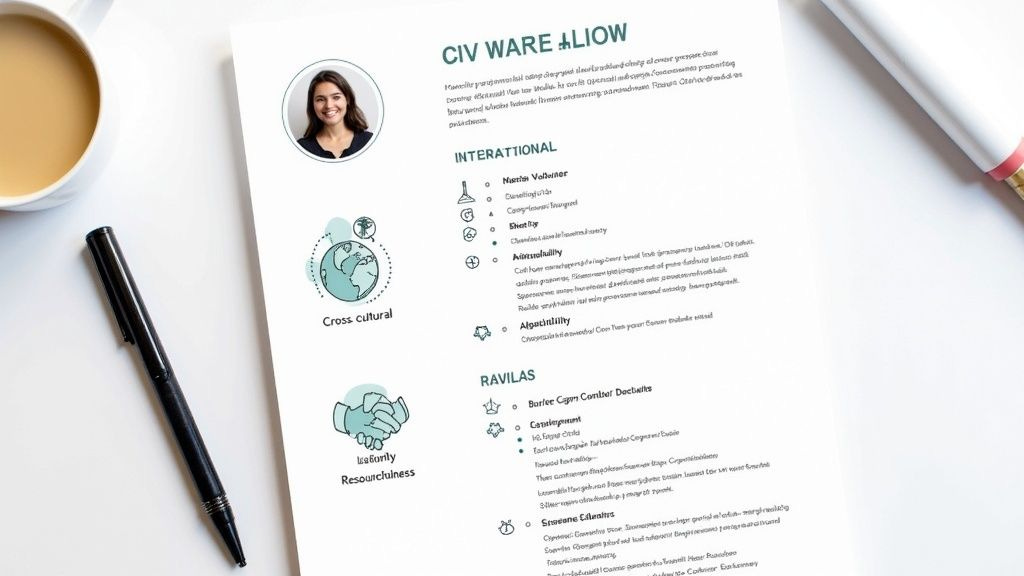
You have to reframe your professional history through the lens of international development. Even if your background is in marketing or IT, you must pull out the skills that prove you can handle ambiguity and thrive in challenging environments. This shows you’re a problem-solver, not just a specialist who needs perfect conditions.
You need to stand out. Each year, over 10 million international travelers, mostly from North America and Europe, take on some form of volunteer work abroad. The field is crowded, especially with applicants in the 18-35 age range. A generic CV gets you nowhere. You can get a better sense of the competition by looking into the specifics of volunteer tourism demographics.
Frame Your Experience for Impact
Every bullet point on your CV needs to signal “fieldwork-ready.” Stop thinking about corporate metrics and start thinking about adaptability and human interaction. Translate your past wins into the language of the development sector.
Here’s a simple example:
Instead of: “Managed a team of five direct reports to increase quarterly sales by 15%.”
Try: “Led a cross-functional team of five to achieve project goals under tight deadlines, successfully navigating diverse working styles and communication barriers.”
The second version shows you get it. Results in this field are about collaboration and navigating complexity, not just hitting a number. Your goal is to prove you can function effectively when resources are tight and the plan changes.
Your personal statement or cover letter connects the dots. It must show a genuine, believable motivation for the work. If it reads like you’re just looking for an exotic travel experience, your application is going straight to the bin.
Highlighting Essential Soft Skills
Recruiters for overseas roles obsess over soft skills. They are the best predictor of whether someone will succeed or burn out in the field. Your technical ability means nothing if you can’t adapt to a new culture or work with a local counterpart.
Structure your CV to make these competencies impossible to miss:
Cross-Cultural Communication: Detail any experience working with people from different backgrounds. Did you manage language barriers? Did you adapt your communication style for different audiences? Put it in.
Problem-Solving and Resourcefulness: Give concrete examples of when you solved a problem with limited resources or information. This proves you can think on your feet.
Resilience and Adaptability: Mention any experience living or working abroad, dealing with unstructured environments, or managing unexpected project changes. This is gold.
These skills are the bedrock of effective fieldwork. For a deeper dive into presenting your qualifications for high-level development roles, check out our guide: Your Practical Guide to Landing Jobs.
Preparing for the Interview
The interview for a voluntary service placement is less about what you know and more about who you are. They’re testing your character and trying to see how you react under pressure. Get ready for scenario-based questions.
They’ll ask things like:
“Describe a time you had a significant disagreement with a colleague from a different cultural background. How did you resolve it?”
“Tell us about a situation where you had to complete a task with unclear instructions and minimal support. What was your process?”
Your answers must be grounded in specific examples. Use the STAR method (Situation, Task, Action, Result) to keep your stories clear and impactful. The point is to prove you are a low-maintenance, high-impact candidate who can handle the messy reality of a challenging new environment.
The Practicalities: Budgeting, Visas, and Logistics
You landed the gig. The acceptance letter is in your inbox. Then comes the admin.
The practical side of moving abroad can feel like a full-time job. Tackle it one piece at a time and it’s manageable. Think of it as your first project.

Breaking this down into clear, actionable chunks from the start will save you massive headaches later.
Demystifying the Financials
The funding model dictates everything. It’s the first thing to get your head around.
Fully-funded professional placements from VSO or UN Volunteers are the gold standard. They cover all major expenses and provide a modest living stipend. This is not a salary for saving; it’s calculated to let you live a comfortable, local life.
For self-funded programs, you’re on the hook for a program fee and all associated costs. This is where fundraising becomes a critical skill. Don’t just ask for money. Create a compelling campaign that explains the project’s impact and your specific role. I’ve seen many volunteers successfully use platforms like GoFundMe to cover their flights and program fees.
No matter the model, you need a spreadsheet. List every anticipated cost before you think about packing.
Program Fees: The upfront number you pay the organization.
Flights: Book these as early as possible for better prices.
Visas and Permits: These can be costly, ranging from $50 to over $500 depending on the country and length of stay.
Vaccinations and Medical: This can easily run several hundred dollars, especially if you need a series of shots.
Travel Insurance: This is non-negotiable. Look for a policy that includes medical evacuation coverage. You hope you never need it, but if you do, it’s priceless.
In-Country Living: Your daily budget for food, local transport, phone credit, and occasional weekend trips.
My best advice? Build a realistic budget, then add a 15-20% contingency fund. Unexpected expenses are a guarantee, not a possibility. That buffer prevents a minor hiccup from becoming a major crisis.
Tackling Visas and Paperwork
The visa process is almost always the biggest administrative hurdle. It will take longer than you think. Do not underestimate it.
Your placement organization should provide guidance, but the responsibility for getting the application submitted correctly and on time is yours.
Start the process the moment you are formally accepted. Some volunteer visas can take three to six months to process, especially for placements lasting a year or more.
You will need an official letter of invitation from the host organization, proof of financial support (even for funded gigs), and a valid passport with at least six months’ validity beyond your planned return date. That last one trips people up constantly.
Always check the specific requirements on the official website of the embassy or consulate for your destination country. That is the only source of truth. Getting this right is the critical first step to a successful placement.
Turning Your Volunteer Experience into a Career
Your time in the field is a strategic career move. Treat it as a launchpad for roles in international development and you’ll leave with a serious competitive edge. It all comes down to how you frame and leverage the experience.
This is about systematically documenting your achievements to build a portfolio of results. The skills you gain on the ground, project management under pressure, stakeholder engagement with local leaders, and resilience when things go wrong, are exactly what top employers want.
Document Everything From Day One
Don’t wait until your placement is over to find CV content. Start building your evidence base from the first week. Keep a detailed log of your responsibilities, the challenges you faced, and the specific outcomes you helped deliver.
Forget vague descriptions. Focus on quantifiable results.
Did you help organize a community health workshop? Note how many people attended and what key health messages were delivered.
Did you assist with a grant report? Jot down the funding amount and the project activities it supported.
Were you involved in training local staff? Track how many people you trained and on what specific skills.
This habit transforms abstract experiences into concrete career assets. It’s the difference between saying “I helped with a project” and “I co-facilitated a training program for 25 community health workers, resulting in a 15% increase in clinic attendance.”
Build Your Network in the Field
The connections you make during your voluntary service are invaluable. These aren’t just colleagues; they are your future professional network within international development. Be intentional about building these relationships.
Get to know the local staff, managers at partner NGOs, and any visiting consultants from multilateral organizations. These people have deep institutional knowledge and connections that can open doors for you years later. Keep their contact information and stay in touch after your service ends.
The scale of these networks can be massive. An organization like VSO International has placed over 100,000 volunteers in more than 90 countries since 1958. This represents a huge alumni and professional network you can tap into. You can discover more insights about the state of volunteering on Signup Genius.
Translate Your Skills for Recruiters
When you update your CV, your job is to translate your field experience into the language that recruiters at INGOs, development banks, and consulting firms understand. They aren’t looking for a travel diary. They’re screening for core competencies.
Here’s how to reframe common volunteer activities into professional skills.
Translating Volunteer Skills to Professional Competencies
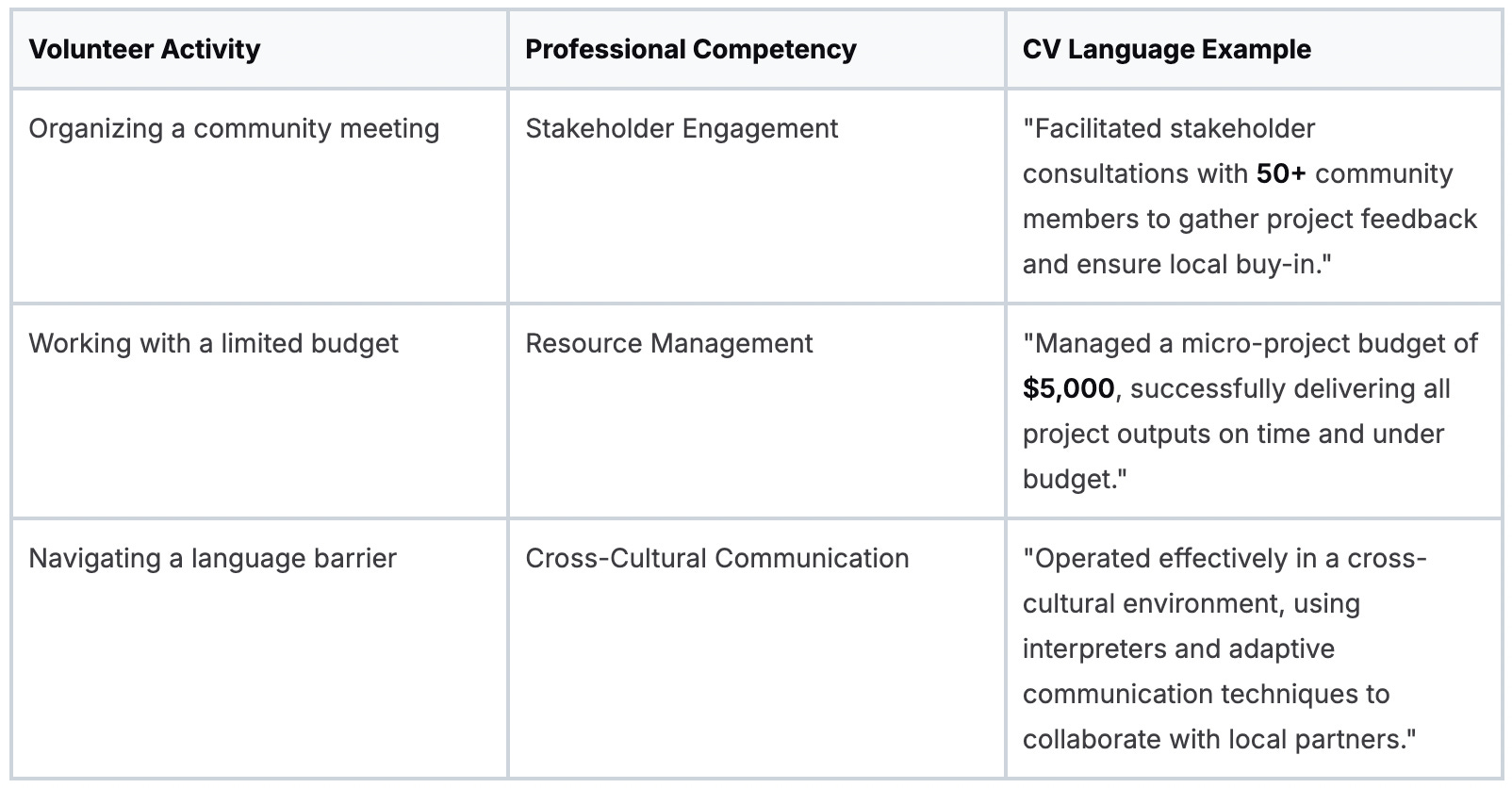
Your ability to reframe your experience this way is critical. The goal is to show that your volunteer placement was a professional assignment that gave you the exact skills they need.
For those aiming for high-level roles, our guide on repositioning yourself from an NGO to a Multilateral Development Bank offers more advanced strategies. Prove your volunteer work was a professional assignment that equipped you with the precise skills they’re hiring for.
Your Top Questions About Voluntary Service Overseas, Answered
Let’s get straight to the questions I hear most often. These are the practical, nuts-and-bolts concerns that always come up.
Here are the direct answers.
Can I Actually Get Paid to Volunteer Abroad?
Yes, but we need to be specific about the word “paid.” In this context, “paid” rarely means a competitive salary.
What you’ll find usually falls into one of these buckets:
Fully Funded Placements: This is the gold standard for skilled professionals. Think organizations like VSO or the Peace Corps. They cover your big-ticket items: flights, insurance, housing, and then give you a monthly living allowance. It’s calculated to let you live a comfortable local lifestyle.
Stipended Roles: Many programs, like those with UN Volunteers, offer a Volunteer Living Allowance (VLA). The goal is to ensure you’re not out of pocket while serving. It’s designed to cover basic living expenses.
Work Exchange: This is the most direct trade: your labor in exchange for a bed and food. It’s the model for platforms like Workaway or WWOOF. No cash changes hands, but your essential costs are covered.
Genuine salaried roles are incredibly rare and are basically contract positions disguised as volunteer gigs. For most opportunities, “compensation” is about cost-coverage, not income.
What Are the Age Requirements?
Most reputable programs have no upper age limit. It’s quite the opposite.
Organizations like Projects Abroad and GVI actively recruit older volunteers and professionals on career breaks. They value the deep life and work experience you bring.
The key is your ability to do the work and the skills you have. While the demographic for many programs leans toward the 18-35 range, mature applicants possess a level of expertise that is in high demand.
The bottom line is this: if you have the skills and can handle the physical demands, organizations want you. Your decades of professional experience are a massive asset, not a liability.
Do I Need a Specific Degree?
It completely depends on the role.
For general community development projects or teaching English, a degree is often a plus but not always a deal-breaker if you have strong, relevant life experience.
For specialized voluntary service jobs, your qualifications are everything. Roles in healthcare, engineering, finance, or agricultural development absolutely require a formal degree and often several years of professional experience. These are not training grounds; they are professional assignments where you’re expected to contribute your expertise from day one.