

Young Professional Programs are often approached as prestige applications. That’s the wrong frame. These programs exist because the leadership pipeline is thin, and the gap starts early. The 2023 CELO report estimates that fewer than 16% of youth in the United States access leadership development experiences with demonstrable impact by age 25 (CELO youth leadership report). Institutions that care about long-run talent have responded by building structured development tracks, not casual networking clubs.
That matters for MDB candidates. A top Young Professional Program is a talent investment decision made by people who are trying to identify future operators, policy shapers, and managers. If you treat the process like a polished graduate job application, you’ll miss what they’re screening for.
Your Path to a Global Development Career
A serious MDB Young Professional Program can change the trajectory of your career faster than almost any standard recruitment channel. It gives you institutional access, internal credibility, and exposure to work that usually takes years to reach through normal hiring routes. That’s why people fixate on these programs.
They should. It’s critically important.
The problem is that most advice on young professional leadership programs is generic. It tells you to be passionate, polished, and mission-driven. None of that is wrong. None of it is enough either. Selection committees are trying to answer a harder question: can this person handle complexity inside a political, technical, multicultural institution where results move slowly and scrutiny never stops?
What candidates usually miss
Candidates often focus on brand names and overlook role design. They assume “young professional” means fresh graduate. In MDB recruiting, it usually means something else entirely. It means early-career, already tested, and still moldable.
If you’re still exploring options before you qualify for a formal YPP, start with entry routes that build the right profile. This guide to World Bank jobs for fresh graduates is useful for mapping the earlier stages.
MDBs don’t hire YPs to admire their potential. They hire them to absorb pressure quickly and become useful fast.
The game you’re actually playing
You need to show four things at once:
Technical depth: You can own a real subject area.
Operational judgment: You understand how policy, financing, and implementation collide.
Institutional fit: You can work inside a large bureaucracy without becoming passive.
Leadership trajectory: You’re headed toward bigger responsibility, not just a specialist cul-de-sac.
That combination is rare. It’s why these programs carry so much weight, and it’s why weakly framed applications die early.
What These Programs Really Are

Young professional leadership programs at MDBs are institutional talent accelerators. They are built to identify people with enough track record to be credible now and enough upside to matter later.
The clearest example is the World Bank Group model. Its Young Professionals Program requires at least 2 years of post-undergraduate work experience and a relevant master’s-level degree completed before the start date, uses a two-year program structure, and then places successful participants into a role for an additional 5 years based on performance (World Bank Group Young Professionals Program). That design tells you exactly how the institution thinks. It screens for proven capability, accelerates development, and keeps people long enough to see whether they can deliver.
This is a pipeline, not a trial run
That throughput model matters. The bank isn’t looking for someone who might become good with enough support. It’s looking for someone who has already produced credible work and can scale under supervision.
In practical terms, that means:
A YPP is not an internship: You’re expected to arrive with substance.
A YPP is not a classroom: Training exists, but performance pressure starts immediately.
A YPP is not generic leadership development: The institution is shaping you for its own operating model.
Why the label confuses people
The phrase “young professional” causes a lot of bad decisions. Candidates hear “young” and think age. Recruiters hear “professional” and think evidence. The second interpretation wins every time.
A strong YPP candidate usually has three layers already in place:
A field of competence that maps to the institution’s business.
Work that shows judgment under constraints.
Enough maturity to represent the organization with clients, governments, or internal stakeholders.
Practical rule: If your profile still reads like academic promise rather than professional output, you’re probably too early for the top tier.
That doesn’t mean you shouldn’t apply in the future. It means you need to build the right evidence first. The best candidates understand the assignment. They don’t pitch themselves as high achievers looking for a break. They present themselves as developing professionals ready for a structured acceleration track.
The Hard Rules of Eligibility And Nationality
Before you draft essays or chase referrals, clear the hard filters. These are administrative, unforgiving, and often misunderstood. Strong candidates get rejected every cycle because they treat eligibility rules like guidance instead of gatekeeping.
Eligibility comes before merit
Most MDB programs use a basic screen that includes age, education, and relevant professional experience. The exact thresholds differ by institution, and they can change, so you need to read each vacancy notice line by line. Don’t rely on memory, forums, or recycled social posts.
The practical checks are simple:
Age: Many programs use a firm upper limit. If the cutoff is tied to the closing date, that date controls.
Education: A relevant master’s degree or doctorate is usually expected. Relevance matters as much as prestige.
Experience: Full-time, substantive work counts. Peripheral exposure usually doesn’t.
Your degree has to connect to the bank’s mandate. Economics, finance, public policy, engineering, climate, transport, agriculture, governance, health, education, and data-heavy operational fields tend to map well when the work history supports them.
Relevant experience means applied work
Candidates overstate relevance all the time. A short consulting project, student competition, or volunteer initiative can help your story, but it won’t replace actual professional responsibility.
Selection teams usually respond well when your experience shows one or more of these patterns:
Project execution: You helped move something from design into delivery.
Policy or analytical rigor: You worked on issues tied to public systems, finance, or regulation.
Cross-border or cross-stakeholder work: You can operate across institutions, not just inside one team.
Evidence of judgment: Someone trusted you with ambiguity, deadlines, and trade-offs.
Nationality is not a side note
Nationality is one of the least understood parts of MDB hiring. Membership matters because these are shareholder institutions. If you are not a national of an eligible member country, the rest of the file may never matter.
The second layer is more subtle. Geographic distribution influences hiring logic inside international institutions. Some candidate pools are crowded. Others are thinner. You won’t usually see the full internal staffing picture, but you should assume that institutional diversity goals shape outcomes.
Your nationality won’t carry a weak application. It can shape how your application is read once you’re already competitive.
What to do before you invest serious time
Run a pre-application audit:
Read the current official notice: Don’t use an old PDF or blog post as your source of truth.
Verify your passport status: Dual nationality can matter. So can pending citizenship.
Match your degree to the vacancy language: If the fit is indirect, explain it clearly.
Stress-test your work history: Ask whether an external reviewer would call it MDB-relevant.
This step feels boring. It saves enormous time.
Comparing The Major MDB Programs
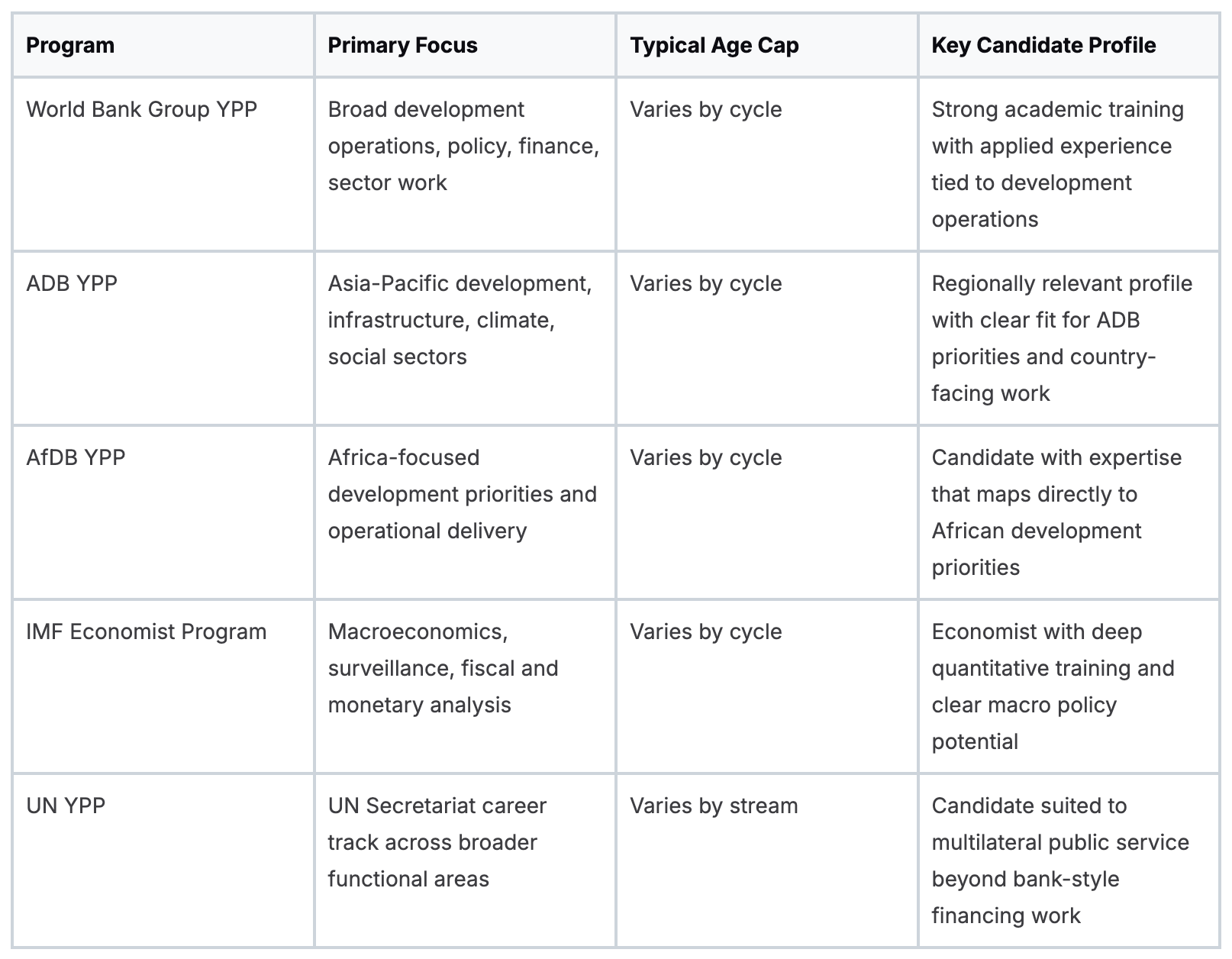
The biggest mistake I see is the “one essay, five institutions” strategy. It almost never works. The major MDB programs may look similar from the outside, but they reward different kinds of candidates.
Key Differences in Major MDB Young Professional Programs
World Bank Group
The World Bank tends to attract broad-profile candidates who combine technical training with exposure to policy, lending, advisory work, or implementation. It rewards people who can bridge analysis and operations. A pure research profile can work if it clearly connects to institutional use.
The hidden test is range. Can you think beyond your niche without becoming shallow? The Bank likes specialists who can still operate in large, matrixed environments.
Asian Development Bank
ADB is often underestimated by candidates who apply to it as a regional version of the World Bank. That’s a mistake. ADB has its own style, priorities, and organizational culture. Your Asia-Pacific relevance needs to be sharp, not decorative.
If ADB is on your list, read a more targeted breakdown like this guide to the ADB Young Professional Program. It helps you avoid broad-brush positioning.
Strong ADB candidates usually show:
Regional credibility: Language, geography, policy exposure, or sustained work linked to the region.
Operational practicality: Comfort with infrastructure, climate finance, public systems, or implementation-heavy sectors.
Institutional realism: You understand that development banking involves transaction discipline, not just ideas.
African Development Bank
AfDB candidates need a much more grounded Africa story than many applicants provide. Generic statements about commitment to the continent won’t carry weight. The file has to show specific sector expertise, country knowledge, or direct relevance to African development priorities.
The strongest applications usually combine technical fit with contextual understanding. AfDB values candidates who can work in real institutional conditions, not just discuss strategy at a high level.
IMF Economist Program
The IMF sits apart from the classic YPP model in one important way. It is far narrower in intellectual style and recruitment logic. If your economics training is not central to your profile, this isn’t your lane.
The IMF rewards analytical precision, macroeconomic fluency, and the ability to defend a position under pressure. Candidates who thrive there tend to enjoy highly structured argument, quantitative work, and policy rigor.
UN YPP
The UN YPP belongs in the same family of international early-career programs, but it is not an MDB path in the operational banking sense. The competencies, workflows, and downstream roles are different.
Apply to the UN if your long-term fit is broader multilateral public service. Apply to MDBs if you want to work where finance, policy, projects, and institutional reform meet.
The right target program is the one that matches your actual professional shape. Prestige-chasing creates weak applications.
Building Your Application The Strategic Way
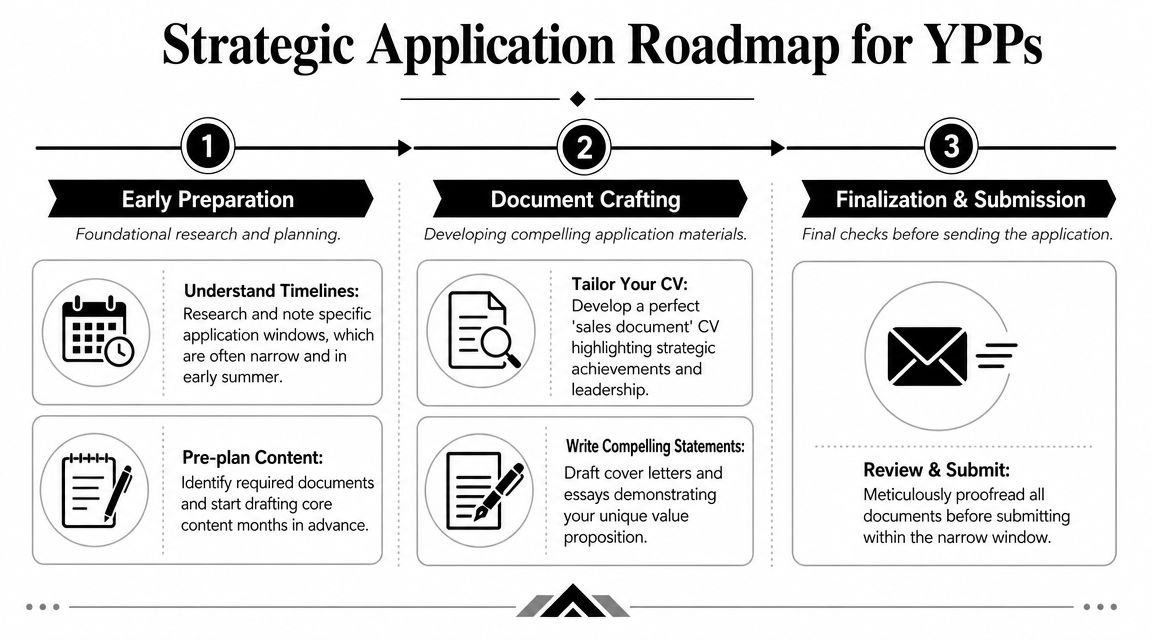
A strong application is built months before the portal opens. By the time the form goes live, most of the work should already be done.
Start with timing and inputs
Young professional leadership programs often have narrow application windows. That means your preparation cycle has to start early. Waiting for the announcement before you begin is how people end up submitting recycled material.
Build your file in this order:
Target list first
Pick the institutions that fit your profile. Don’t build generic materials and hope to adapt them later.Evidence inventory second
List your strongest projects, outputs, publications, missions, presentations, stakeholder engagements, and leadership examples.Narrative architecture third
Decide the through-line. Why this institution, why now, and why you in this specific lane?
Rebuild your CV from an MDB perspective
Your corporate resume is usually too inward-looking for an MDB application. It often describes tasks, teams, and promotions without showing development relevance.
A YPP CV should make three things easy to see:
Substance: What issue did you work on?
Responsibility: What did you personally own?
Institutional relevance: Why would an MDB care?
Weak bullet:
Supported project implementation across multiple stakeholders.
Better bullet:
Coordinated analysis, reporting, and stakeholder inputs for a public-sector project affecting service delivery, with direct responsibility for drafting decision materials and managing cross-team follow-up.
That version still avoids invented metrics, but it gives shape to the work.
Essays need a sharp operating story
Most personal statements fail because they are moral essays instead of selection documents. Passion matters. It just has to be translated into institutional language.
Your statement should answer these questions cleanly:
Why this institution rather than another one?
What problem set are you equipped to work on?
How has your prior experience prepared you for the bank’s operating environment?
What kind of internal trajectory are you plausibly building?
Use specific references to the institution’s mandate, sector priorities, and regional logic. Avoid generic “I have always wanted to make a difference” language. Everyone writes that. It tells the reader nothing.
Use tools that keep you organized
You need a simple system to manage drafts, vacancy criteria, and examples. Candidates often use spreadsheets, Notion, or basic document trackers for version control. For monitoring openings and program-specific guidance, Multilateral Development Bank Jobs publishes MDB listings and application-focused articles that can help you track timing and compare routes.
Application rule: Every sentence in your file should either prove fit, prove competence, or reduce doubt.
Surviving The Assessment And Interview Gauntlet
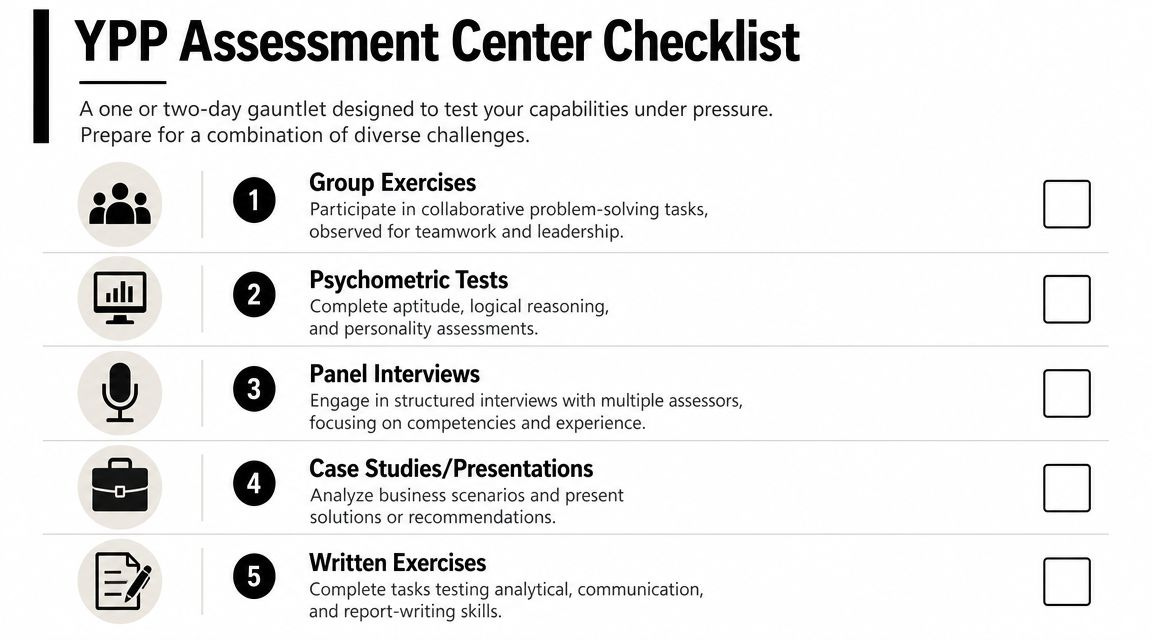
If you reach the interview stage, the institution is no longer asking whether you are interesting. It is asking whether you are safe to invest in. That’s a different standard.
Most final rounds test how you think, how you communicate, and how you behave with other people when the clock is running. You may face technical interviews, panel interviews, case exercises, written tasks, and group discussions. Sometimes the format is spread out. Sometimes it feels compressed and relentless.
What assessors are actually measuring
A lot of candidates prepare for questions and ignore competencies. That’s backwards. Questions change. Competencies stay fairly stable.
Assessors usually look for evidence of:
Analytical clarity: You can structure a messy issue fast.
Communication discipline: You answer the question asked.
Collaboration: You improve the room instead of competing for airtime.
Judgment: You can weigh trade-offs without posturing.
Composure: Pressure doesn’t make you ramble or freeze.
The group exercise is where many strong candidates self-sabotage. They confuse visibility with leadership. Real leadership in that setting often looks like summarizing options, drawing in quieter members, and moving the discussion toward a usable recommendation.
Prepare like the format matters
The best preparation model is repeated, interactive practice. That’s not just common sense. It mirrors how leadership development works in serious programs. NSPE’s Emerging Leaders Program uses a seven-month intensive cycle for professionals with 5–8 years of experience, combining monthly 90-minute live leadership training, asynchronous learning discussions, a cumulative small-group project, and mentoring (NSPE Emerging Leaders Program overview). Those elements matter because ownership, communication, feedback, and team development improve through practice and external critique.
That same logic applies to YPP interview prep.
A practical prep stack
Technical defense practice
Be ready to explain your thesis, core sector expertise, and past projects with precision. If you can’t explain your own work clearly, the panel will notice fast.Competency drills
Build STAR stories, but don’t recite them mechanically. Prepare examples on conflict, failure, influence, ambiguity, teamwork, and judgment.Live mock sessions
Practice with people who will interrupt, push back, and force clarity. Friendly mocks don’t prepare you for real panels.Case rehearsal
Work through short policy or operational cases in your field. Focus on structure, prioritization, and recommendation quality.
If you need help framing competency examples well, this guide on how to pass a competency-based interview is a solid practical reference.
In assessment centers, the candidate who helps the group think clearly often outperforms the candidate who tries hardest to sound impressive.
The interview tone that works
Speak like a future colleague, not a student seeking approval. That means concise answers, direct reasoning, and enough humility to acknowledge uncertainty without collapsing into vagueness.
Panels respond well to candidates who can say, in effect: here is the problem, here are the constraints, here is how I’d approach it, and here is what I’d need to validate next. That is operational thinking. It travels well across MDBs.
Common Pitfalls And Final Advice
The first fatal mistake is the generic file. If your essay can be sent to the World Bank, ADB, AfDB, and the IMF with a few search-and-replace edits, it’s dead on arrival. Top young professional leadership programs are specific institutional pipelines. Your application has to feel built for that institution.
The second mistake is misunderstanding what kind of program you are applying to. Some offerings marketed to young professionals are leadership accelerators. Others are membership funnels, donor communities, or prestige networks with age-bounded access rules. That distinction matters. For example, NAACP NEXTGEN is for ages 21–40 and requires commitment to join the organization, while some United Way leadership-giving models use age caps and contribution thresholds (NAACP NEXTGEN leadership program details). If you don’t read the structure behind the branding, you can waste time pursuing the wrong kind of opportunity.
The mindset traps that sink strong candidates
Some candidates over-academize everything. They answer practical questions with theory and never reach a decision. Others go too far the other way and present themselves like consultants chasing deliverables with no real development commitment.
Neither profile works especially well.
Watch for these traps:
Overclaiming leadership: Titles matter less than behavior and judgment.
Mistaking motivation for fit: Caring about development doesn’t prove you can work inside an MDB.
Submitting polished vagueness: Elegant writing with no evidence still reads weak.
Ignoring institutional culture: Every bank has its own preferences, internal language, and tolerance for abstraction.
Final advice that holds up
Treat the process as a long campaign, not a one-off application. Build a profile before you need it. Choose target institutions judiciously. Write with specificity. Prepare for interviews out loud, not in your head.
The strongest candidates are rarely the most theatrical. They are the people who know what they’ve done, know why it matters, and know where they fit.
If you want a practical way to stay close to this market, Multilateral Development Bank Jobs tracks roles across major MDBs and publishes application-focused guidance on YPPs, nationality rules, and related entry routes.